XLF Financials: $3.2M Diagonal Roll Signals Institutional Repositioning Ahead of Bank Earnings!
** January 13, 2026 | Unusual Activity Detected**
The Quick Take
Someone just executed a $3.2 MILLION diagonal roll on XLF puts during the heart of bank earnings season! This institutional trader is closing out a June 2026 position while simultaneously opening a new March 2026 position - a textbook time spread adjustment that suggests they're managing exposure around the Q4 2025 earnings deluge. With JPMorgan already reporting this morning and Bank of America, Wells Fargo, and Citigroup on deck tomorrow, this is smart money actively repositioning.
About XLF
Financial Select Sector SPDR Fund (XLF) is one of the largest financial sector ETFs with $51.87B in assets under management. The fund tracks major U.S. financial institutions including:
| Top Holdings | Weight | 2025 Performance |
|---|---|---|
| Berkshire Hathaway (BRK.B) | 11.45% | +17.3% |
| JPMorgan Chase (JPM) | 11.22% | +35% |
| Visa (V) | 7.43% | +3.84% |
| Mastercard (MA) | 5.94% | +7.6% |
| Bank of America (BAC) | 4.72% | Part of 40% bank avg |
Current Stats:
- Price: $54.37
- YTD Return: +2.48%
- 52-Week Range: $42.21 - $56.52
- P/E Ratio: 19.29
- Expense Ratio: 0.08%
The Option Flow Breakdown
What Just Happened
| Date | Time | Direction | Type | Expiration | Strike | Volume | OI | Premium | Spot | Signal | Option |
|---|---|---|---|---|---|---|---|---|---|---|---|
| 2026-01-13 | 10:35:43 | SELL | Put | 2026-06-18 | $50 | 20,000 | 108,000 | $2.0M | $54.54 | CLOSE | XLF20260618P50 |
| 2026-01-13 | 10:35:43 | SELL | Put | 2026-03-20 | $52 | 21,000 | 27,000 | $1.2M | $54.54 | OPEN | XLF20260320P52 |
Total Flow: $3.2M | Strategy: Diagonal Roll | Confidence: HIGH
What This Actually Means
This is a Diagonal Roll - a sophisticated institutional strategy where a trader:
- Closes an existing position (the June $50 put they previously sold)
- Opens a new position at a different strike AND expiration (March $52 put)
Translation for us regular folks: This trader had sold puts at $50 expiring in June (betting XLF stays above $50). Now they're buying those back and selling new puts at $52 for March instead.
Why do this?
- Collect premium NOW - They're getting paid $1.2M to take on new risk
- Shorter duration - March expiration means less time at risk
- Tighter strike - $52 vs $50 means they're more confident in near-term stability
- Timing - March 20 is right after Q1 2026 begins but avoids Q4 earnings chaos
Unusualness Score
Based on the Z-score analysis:
- June $50 Put closing: Z-Score 2.66 (HIGHLY UNUSUAL)
- March $52 Put opening: Z-Score 9.04 (EXTREMELY UNUSUAL - this happens maybe a few times per year!)
Unusualness: [======] 8.5/10
The March leg is in the 99th+ percentile of XLF option activity. This is definitely NOT your neighbor trading on Robinhood - this is institutional capital making a calculated move.
Technical Setup
YTD Chart
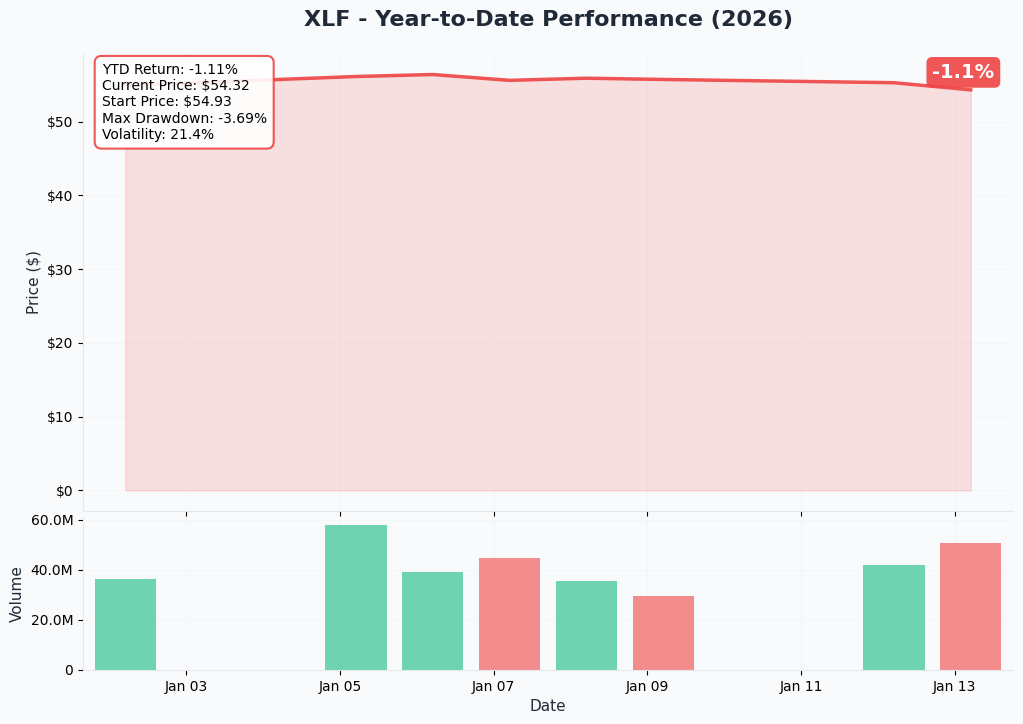
XLF is trading near 52-week highs at $54.37, just below the all-time high of $56.52. The financial sector has been on a tear with the KBW Bank Index up 34% over the past year. Today's pullback following JPMorgan's expense guidance shock ($105B vs $96B in 2025) has created some near-term uncertainty.
Gamma-Based Support & Resistance
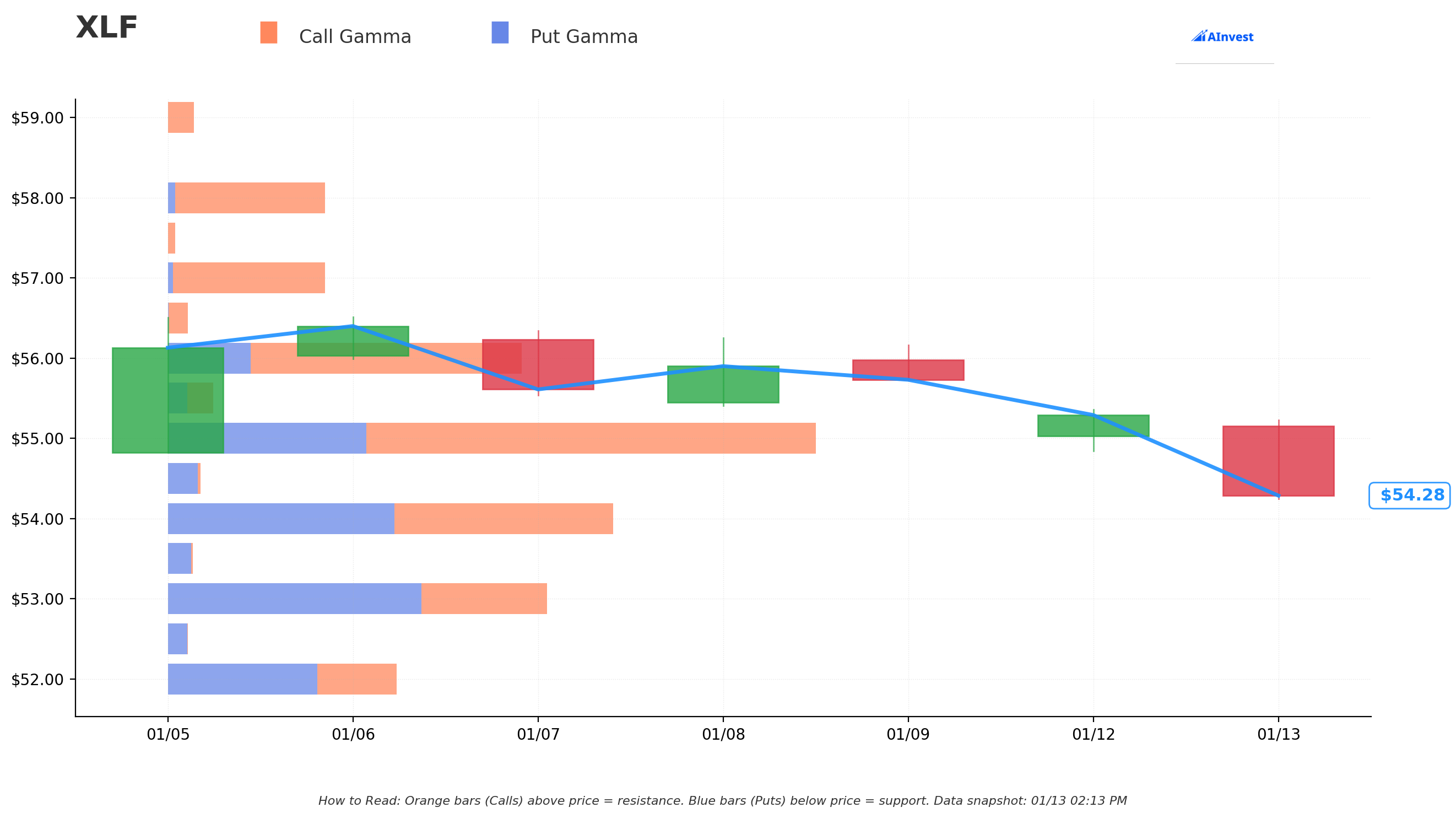
Key Gamma Levels:
| Level | Type | Strike | Net GEX | Distance from Price |
|---|---|---|---|---|
| Strong Support | Put Gamma | $54 | -2.56 | 0.6% below |
| Medium Support | Put Gamma | $53 | -49.33 | 2.4% below |
| Trade Strike | Put Gamma | $52 | -27.39 | 4.2% below |
| Trade Strike | Put Gamma | $50 | -60.78 | 7.9% below |
| Key Resistance | Call Gamma | $55 | +99.17 | 1.3% above |
| Resistance | Call Gamma | $56 | +74.02 | 3.1% above |
Gamma Summary:
- Total Call GEX: 708.1 (Bullish pressure above)
- Total Put GEX: 613.5 (Support cushion below)
- Net Bias: BULLISH - Price tends to gravitate toward $55
The $55 strike is a massive call gamma wall. Market makers are heavily exposed here, meaning price tends to get "magnetized" toward this level. The $50 and $52 strikes (where our trader placed their bets) show significant put gamma - these are natural support floors.
Implied Move Analysis
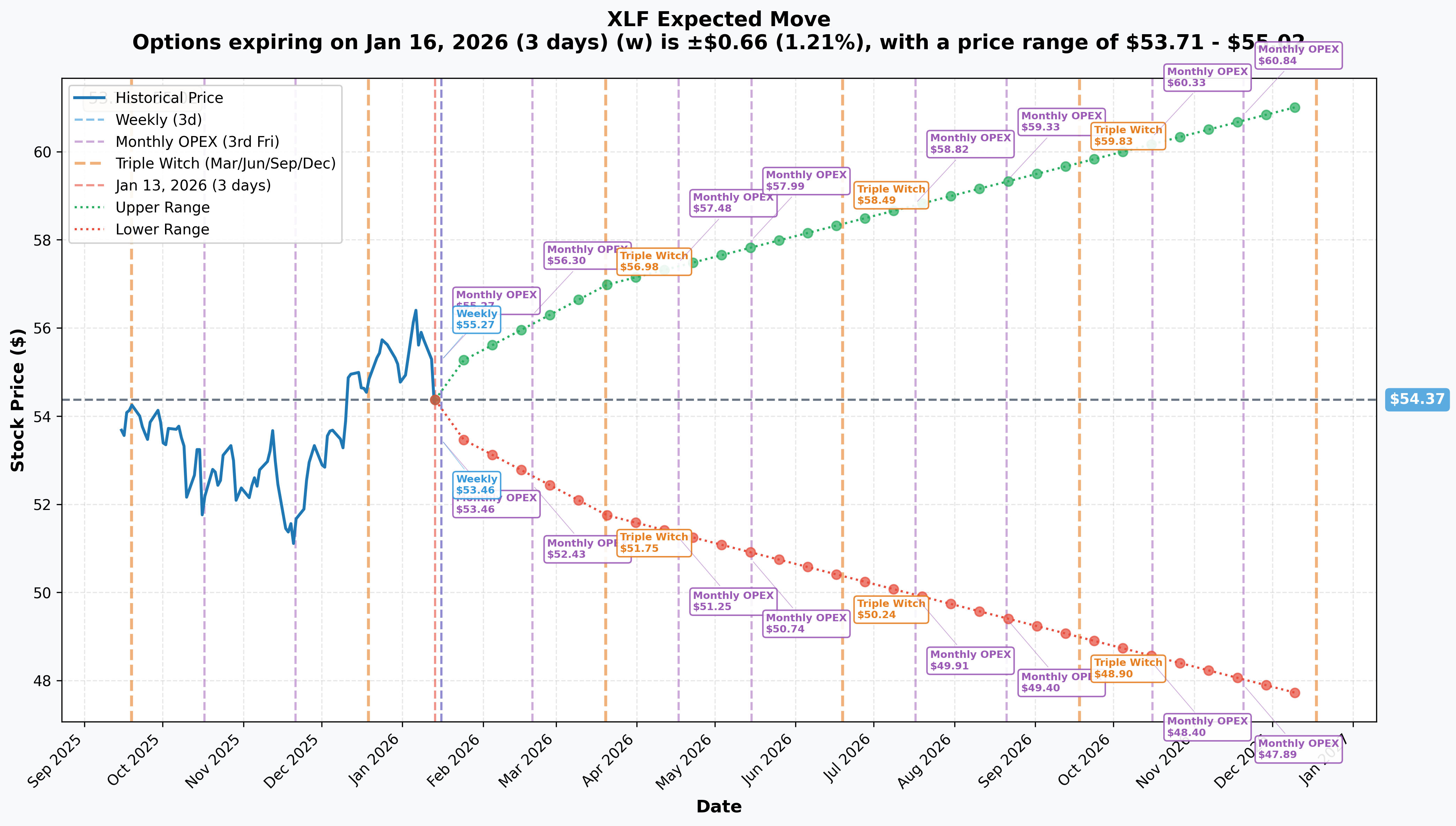
What the options market is pricing in:
| Timeframe | Expiration | Implied Move | Range |
|---|---|---|---|
| Weekly | Jan 16 | +/-1.21% | $53.71 - $55.02 |
| March (Trade Exp) | Mar 20 | +/-4.82% | $51.75 - $56.98 |
| June (Closed Exp) | Jun 18 | +/-6.65% | $50.24 - $58.49 |
| LEAPS | Dec 18 | +/-12.45% | $47.59 - $61.14 |
What this tells us: The March $52 put strike is RIGHT AT the lower bound of the implied move range ($51.75). This trader is essentially betting that XLF stays within the expected range - a high-probability trade.
Catalysts
Upcoming Events
| Date | Event | Impact |
|---|---|---|
| Jan 14, 2026 | Bank of America, Wells Fargo, Citigroup Q4 | HIGH |
| Jan 15, 2026 | Goldman Sachs, Morgan Stanley Q4 | HIGH |
| Jan 20, 2026 | Credit Card Rate Cap Decision | RISK |
| Jan 28-29, 2026 | FOMC Meeting | MEDIUM |
| Mar 17-18, 2026 | FOMC Meeting (before March expiry) | MEDIUM |
Recent Events (Already Happened)
| Date | Event | Result |
|---|---|---|
| Jan 13, 2026 | JPMorgan Q4 Earnings | Beat on EPS ($5.23 vs $5.00), but $105B expense guidance spooked market |
| Dec 2025 | Fed Rate Cut | Rate to 3.50-3.75% (third consecutive cut) |
| 2025 | Bank M&A Surge | 181 deals worth $47B (+45% vs 2024) |
| May 2025 | Capital One-Discover Merger | $35.3B deal completed |
Price Targets & Probabilities
Based on gamma levels, implied moves, and current catalyst landscape:
Bear Case: $50-52 (15% probability)
What needs to happen:
- Bank earnings disappoint on NII guidance
- Credit card rate cap (10%) gets implemented Jan 20
- Credit quality concerns resurface
- Fed signals fewer rate cuts in 2026
Why the trader is comfortable here: The $52 strike is their sold put level, meaning they're willing to own XLF at $52 if it crashes. That's 4.2% below current price and matches the lower implied move bound.
Base Case: $54-55 (60% probability)
What needs to happen:
- Bank earnings meet expectations with manageable expense guidance
- Regulatory environment stays favorable
- Rate cap proposal fails or gets diluted
Gamma magnet effect: Price naturally gravitates toward the $55 gamma wall. The net bullish GEX bias supports this.
Bull Case: $56-58 (25% probability)
What needs to happen:
- Blockbuster earnings from remaining banks
- M&A activity accelerates under favorable regulation
- Fed signals more cuts than currently priced
- Investment banking fees continue record run
Trading Ideas
Conservative: "The Income Collector"
Strategy: Cash-Secured Put at $52 (mimic the institutional trade)
| Detail | Value |
|---|---|
| Contract | Sell XLF Mar 20, 2026 $52 Put |
| Premium | ~$0.60-0.70/contract |
| Max Gain | $60-70 per contract |
| Break-even | $51.35 |
| Max Risk | Assignment at $52 (4.3% below current) |
Why this works: You're copying the institutional playbook. If XLF stays above $52 (high probability based on gamma support), you pocket the premium. If assigned, you own XLF at an effective cost of ~$51.35 - a 5.5% discount to current price.
Track this trade: XLF 2026-03-20 P52
Balanced: "The Bull Put Spread"
Strategy: Bull Put Spread $52/$50
| Detail | Value |
|---|---|
| Sell | XLF Mar 20, 2026 $52 Put |
| Buy | XLF Mar 20, 2026 $50 Put |
| Net Credit | ~$0.35-0.40/spread |
| Max Gain | $35-40 per spread |
| Max Risk | $165-160 per spread |
| Break-even | $51.62 |
Why this works: Limited risk version of the conservative trade. You profit if XLF stays above $52, but your max loss is capped at $1.60-1.65 per spread even if XLF crashes.
Aggressive: "The Financial Surge"
Strategy: Call Spread targeting $56
| Detail | Value |
|---|---|
| Buy | XLF Mar 20, 2026 $55 Call |
| Sell | XLF Mar 20, 2026 $57 Call |
| Net Debit | ~$0.50-0.60/spread |
| Max Gain | $150-140 per spread (3:1 reward/risk) |
| Break-even | $55.55 |
Why this works: The gamma wall at $55 is your friend here. If bank earnings drive XLF higher and the bullish GEX bias plays out, you could see XLF push toward $56-57. March expiration gives you time for the catalyst to play out.
Track this trade: XLF 2026-03-20 C55
Risk Factors
What Could Go Wrong:
Expense Shock Contagion - JPMorgan's $105B expense guidance is $5B above Street estimates. If Bank of America and others report similar guidance tomorrow, the sector could sell off hard.
Credit Card Rate Cap - A proposed 10% rate cap effective January 20 would severely impact consumer-heavy banks like BAC and C.
Credit Quality Deterioration - Card delinquencies near 2008 levels and CRE office delinquencies at 18% could trigger provision increases.
NII Headwinds - If banks signal weaker net interest income due to Fed cuts, the sector rally could "stall midway".
Fed Chair Transition - Powell's term expires in 2026, creating policy uncertainty.
The Bottom Line
Real talk: This $3.2M diagonal roll tells us an institution is actively managing their XLF exposure through earnings season. They're not abandoning the financial sector - they're just tightening up their timeline and strikes. The move from June $50 to March $52 suggests they want:
- Shorter duration exposure (less uncertainty)
- Higher strike (more confident in near-term support)
- Premium collection (getting paid while they wait)
What to do:
If you're bullish on financials: The Conservative or Balanced put-selling strategies align with institutional flow. The $52 level has strong gamma support and is at the lower bound of implied moves.
If you're watching from the sidelines: Wait for the rest of bank earnings this week. BAC, WFC, C, GS, and MS report over the next 2 days. By Friday you'll have a much clearer picture of expense trends and NII outlooks.
If you're bearish: The JPM expense shock could be the start of something bigger. Consider put spreads below $52 or simply stay away until the dust settles.
Mark your calendar: The big test is tomorrow (Jan 14) with BAC, WFC, and C earnings. This will either confirm the bullish thesis or accelerate the selling.
** Resources:**
- XLF ETF Details
- TipRanks XLF Forecast - Consensus price target: $60.35 (+15% upside)
- SSGA XLF Official Page
- Disclaimer: This analysis is for educational purposes only. Options trading involves significant risk of loss. The unusual options activity described does not guarantee future price movement. Always do your own research and consider your risk tolerance before trading. Past performance does not guarantee future results.*
Analysis Date: January 13, 2026