🌾 MOS: Someone Just Dropped $3.4M Betting Mosaic Rallies 23% — While the World Burns!
📅 March 5, 2026 | 🔥 Unusual Activity Detected
🎯 The Quick Take
Someone loaded up on $3.4M worth of MOS January 2027 $30 calls — nearly 10,000 contracts — while the stock sits at just $27.20. That's a big, patient bet that Mosaic climbs at least 23% over the next 10 months. With a z-score of 19.57 (extremely unusual, as in we basically never see this), the Strait of Hormuz crisis disrupting global fertilizer supply, and the stock near 52-week lows, this LEAP buyer is making a bold statement: the chaos benefits Mosaic.
🏢 Company Overview
The Mosaic Company (NYSE: MOS) is one of the largest phosphate and potash producers in the world, headquartered in Tampa, FL. The company mines phosphate rock in the U.S. and potash in Canada, and runs a major fertilizer distribution operation in Brazil.
📊 Key Stats:
- 💰 Market Cap: ~$8.3B
- 🏭 Industry: Agricultural Chemicals (SIC 2870)
- 👥 Employees: ~13,765
- 📈 52-Week Range: $22.36 - $38.23
- 💵 Dividend Yield: ~3.16% ($0.88/year)
- 🏦 Institutional Ownership: ~89%
Real talk: Mosaic and Nutrien basically control over 70% of U.S. fertilizer production. That dominance is exactly why the DOJ is now poking around — more on that below.
💰 The Option Flow Breakdown
📊 The Tape
| Time | Symbol | Side | Buy/Sell | C/P | Strike | Volume | OI | Expiration | Size | Premium | Spot | Price |
|---|---|---|---|---|---|---|---|---|---|---|---|---|
| 10:01:07 | MOS | MID | BUY | CALL | $30 | 10K | 5.2K | 2027-01-15 | 9,997 | $3.4M | $27.20 | $3.45 |
🤓 What This Actually Means
Let's break this down in plain English:
🐋 Whale alert! At 10:01 AM, a buyer scooped up nearly 10,000 call contracts on MOS with a January 2027 expiration (that's a LEAP — about 10 months out). Here's why this is wild:
-
📊 Volume vs. Open Interest: 10,000 contracts traded against only 5,200 existing open interest — a 1.92x Vol/OI ratio. That tells us this is almost entirely new positioning, not someone adjusting an old trade.
-
🎯 Z-Score of 19.57 — classified as EXTREMELY UNUSUAL. To put that in perspective, a z-score above 3 is already rare. A 19.57 means this trade is roughly 19 standard deviations above average activity for this contract. You might see a flow this unusual a few times a year at most.
-
💸 $3.4M premium for a single LEAP position is a serious institutional allocation. This is not your neighbor's Robinhood account — this is a fund making a calculated macro bet.
-
⏳ Breakeven at $33.45 (strike $30 + $3.45 premium) — that's about 23% above the current stock price. The buyer needs MOS to move significantly, but they have 10 months to get there.
-
🤝 Executed at MID — the trade filled at the midpoint of the bid-ask spread, which screams institutional execution. Retail traders hit the ask; big players negotiate the mid.
📈 Technical Setup / Chart Check-Up
YTD Chart
MOS has been in a grinding downtrend since peaking near $38 last summer. The stock is currently trading around $26.78, well below both its 50-day moving average (orange line) and 200-day moving average (red line around $30-31). Volume has spiked recently — a sign that big players are making moves.
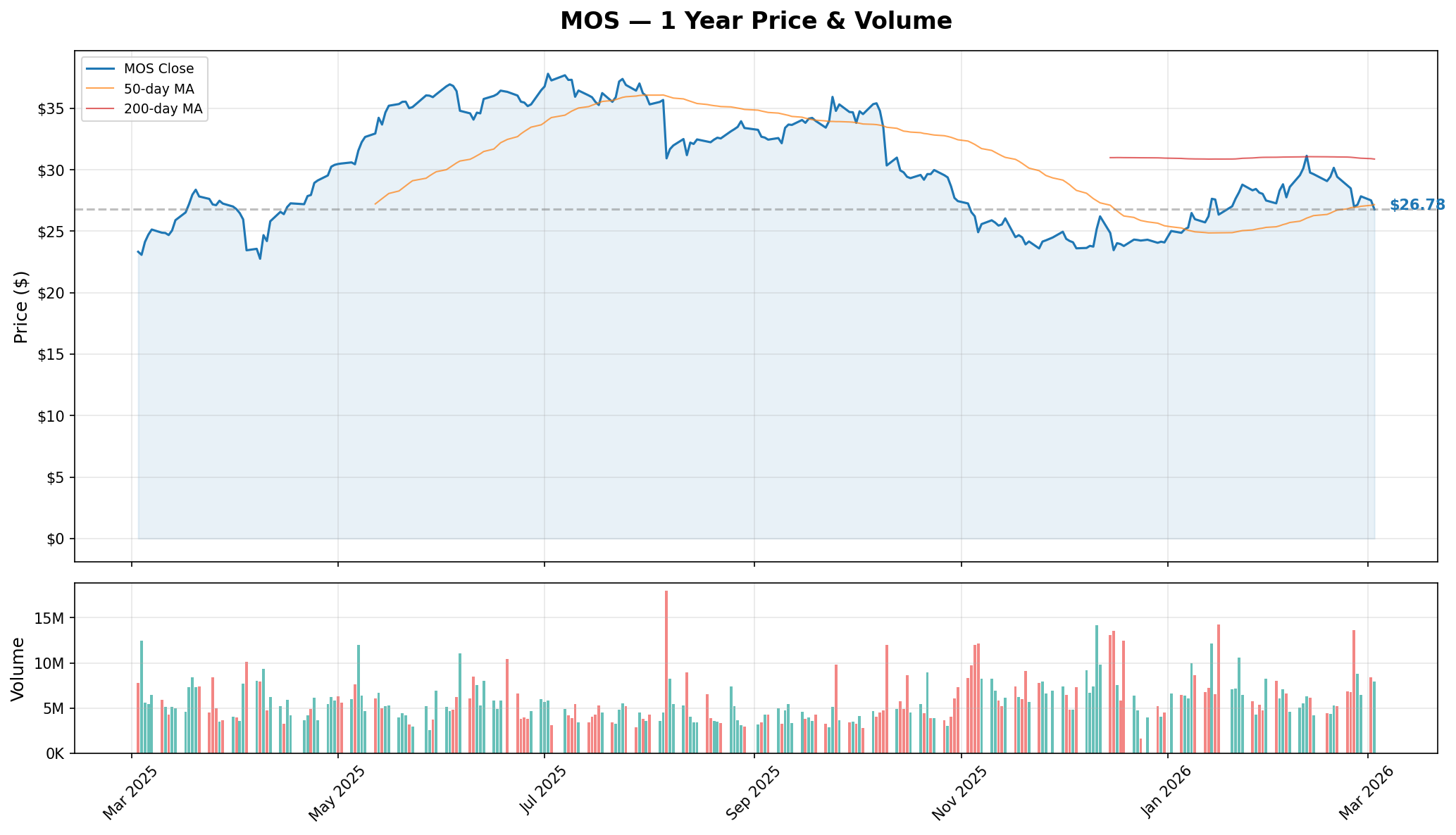
The good news? MOS has bounced off the $23-24 area multiple times, forming a decent floor. The bad news? Every rally attempt keeps getting rejected at $28-29. The buyer of today's LEAP is betting that this pattern breaks to the upside over the next 10 months.
🔵🟠 Gamma-Based Support & Resistance Analysis
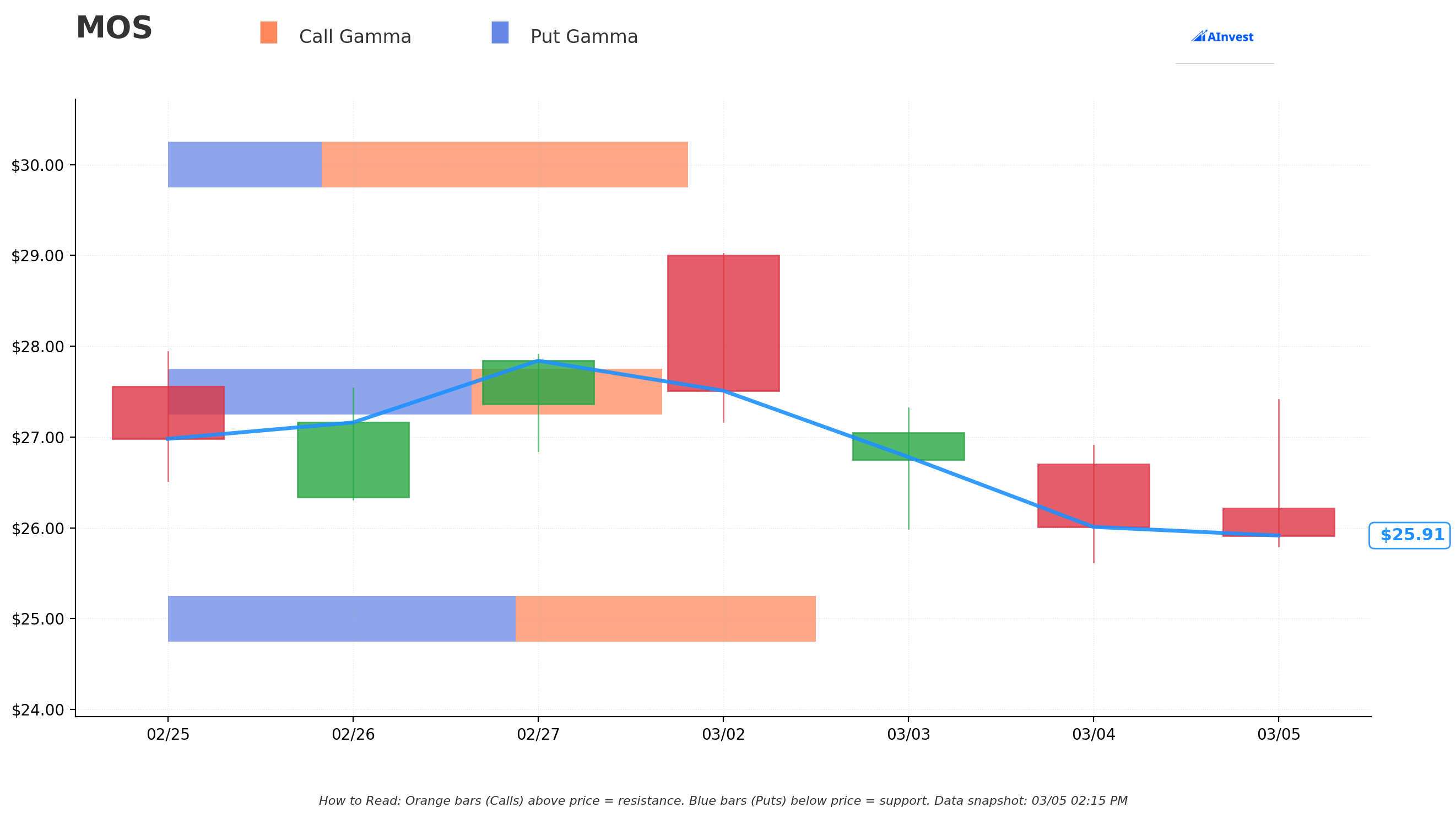
Here's how to read this chart:
- 🟠 Orange bars (Call Gamma) above the current price = resistance levels where options activity creates selling pressure
- 🔵 Blue bars (Put Gamma) below the current price = support levels where options activity creates buying pressure
Key Gamma Levels:
- 🔵 $25 Put Gamma Wall — this has been the strongest support zone over the past two weeks, with heavy put open interest creating a floor. If MOS dips toward $25, market makers hedging these puts will buy shares, supporting the price.
- 🟠 $27-$28 Call Gamma Zone — this range is acting as overhead resistance. Notice the call gamma bars consistently building here through late February and early March. Breaking above $28 would be technically significant.
- 🟠 $29-$30 Call Gamma Cluster — the next major resistance above. This aligns perfectly with the $30 strike targeted by today's whale trade. The $30 level also matches the average analyst price target of $30.94.
Keep in mind: gamma levels shift throughout the day as options are bought and sold. These are a snapshot as of 2:15 PM on March 5.
📐 Implied Move Analysis
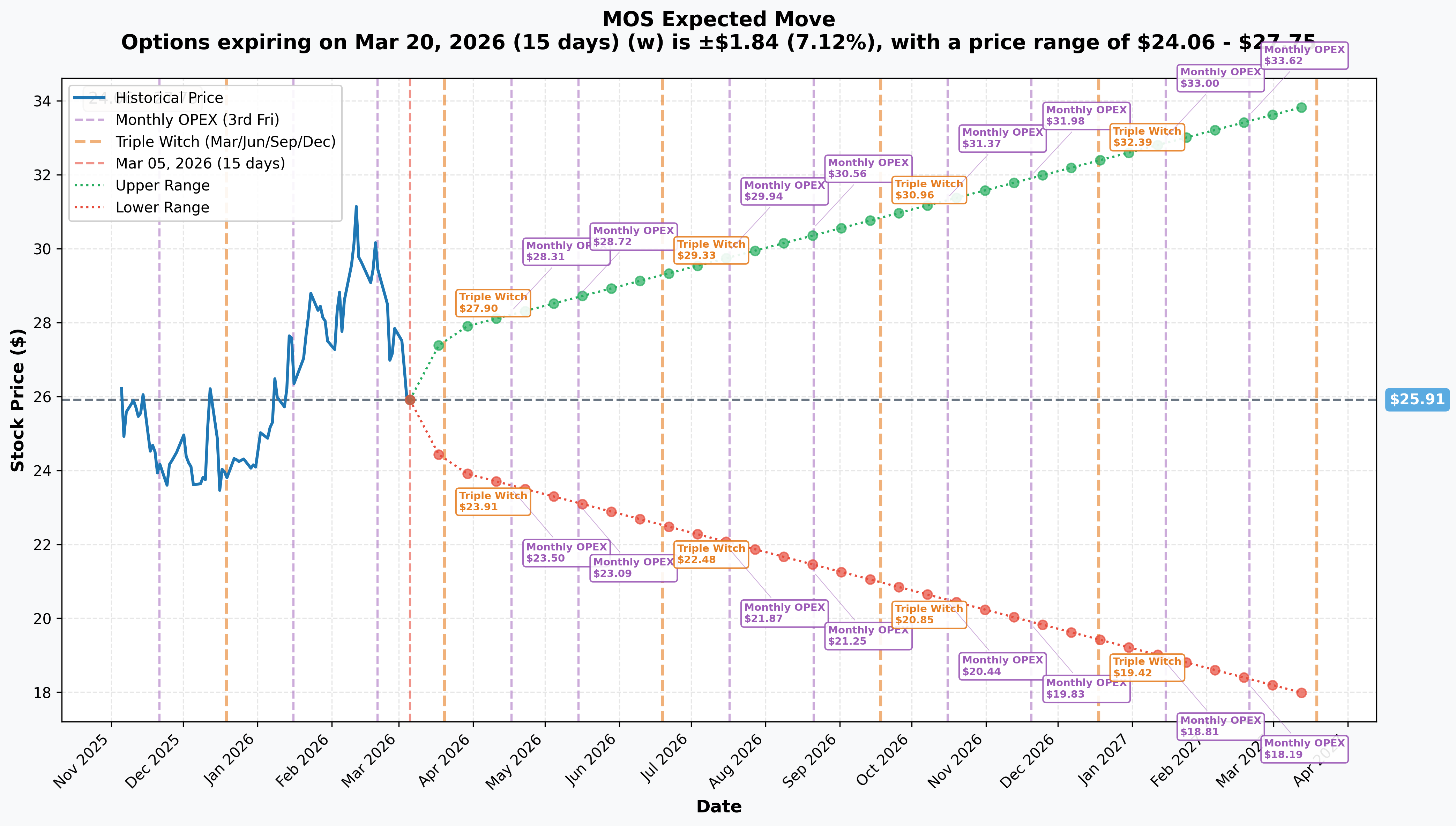
The options market is pricing in some wide expected ranges for MOS. Here's the breakdown by timeframe:
Near-Term (March 20, 2026 — Triple Witch, 15 days):
- 📊 Implied Move: +/- 7.1% ($1.84)
- 📈 Upper Range: $27.75
- 📉 Lower Range: $24.06
By Earnings (~May 15, 2026 OPEX):
- 📈 Upper Range: $28.72
- 📉 Lower Range: $23.09
LEAP Target (January 15, 2027 — where today's trade expires):
- 📈 Upper Range: $33.00
- 📉 Lower Range: $18.81
- 📊 Implied Move: ~31% ($8.03)
This is key: the options market itself is saying MOS could land anywhere from ~$19 to ~$33 by January 2027. Today's buyer clearly believes the upper end of that range is more likely. Their breakeven of $33.45 is slightly above the implied upper range of $33.00, meaning they need MOS to outperform even the market's bullish expectations to profit.
🎪 Catalysts
✅ Already Happened (Baked Into Price)
-
📉 Q4 2025 Earnings Miss (February 24): Mosaic missed on both revenue ($2.97B vs. $3.21B consensus) and EPS ($0.22 vs. $0.48). Stock dropped 3.65% pre-market. Phosphate margins got crushed by sulfur costs, while potash sales rose 23.2% YoY.
-
📉 Analyst Downgrades (Late Feb - Early Mar): JPMorgan cut MOS to Underweight ($24 PT). Barclays downgraded to Equal Weight ($31 PT). Morgan Stanley cut its target from $35 to $28.
-
💥 Operation Epic Fury / Strait of Hormuz Crisis (February 28): U.S. strikes on Iranian nuclear sites triggered Iran to effectively close the Strait of Hormuz. Fertilizer prices surged 6.5% in the first week — about a third of globally traded fertilizer transits the Strait.
-
⚖️ DOJ Antitrust Probe (Reported March 4): Bloomberg reported the DOJ opened an antitrust investigation into Mosaic, Nutrien, CF Industries, Koch, and Yara for alleged price collusion. This followed USDA Deputy Secretary Vaden publicly accusing Nutrien and Mosaic of colluding back in January.
📅 Coming Up (Potential Price Movers)
| Date | Event | Why It Matters |
|---|---|---|
| March 20 | Triple Witch OPEX | Heavy options expiration could increase volatility |
| March 31 | USDA Prospective Plantings | Sets the tone for spring fertilizer demand — USDA projects 94M corn acres (down 4.8M YoY) |
| April 1 | ITC Tariff Review Deadline | Responses due on Morocco/Russia phosphate import duties. Removal = more competition for MOS |
| ~May 5 | Q1 2026 Earnings | Consensus: EPS ~$0.28-$0.46. Management guided to a $250M EBITDA headwind vs. prior-year Q1 |
| May 8 | ITC Tariff Adequacy Comments | Second deadline in the tariff review process |
| Ongoing | Strait of Hormuz Status | If closure persists through spring, fertilizer prices could spike dramatically |
| Ongoing | DOJ Probe Developments | Subpoenas and testimony requests could create headline risk anytime |
🎲 Price Targets & Probabilities
Combining our gamma levels, implied move data, and catalyst timeline:
🐻 Bear Case: $22-$24 (20% probability)
If the DOJ probe escalates into a formal price-fixing case, the ITC removes phosphate tariffs, and the Hormuz crisis resolves quickly (removing the supply shock premium), MOS could retest its 52-week low of $22.36. JPMorgan's $24 price target reflects this downside scenario. The implied move lower range of $23.09 by May OPEX supports this floor.
⚖️ Base Case: $28-$31 (50% probability)
This is the "things slowly improve" path. Spring planting demand provides seasonal lift, potash prices climb moderately (capacity utilization above 90% through 2028 per Morgan Stanley), the DOJ probe stays early-stage, and Hormuz tensions keep fertilizer prices slightly elevated. The $28-$29 zone aligns with multiple analyst targets (RBC $28, Morgan Stanley $28) and the 200-day moving average region. The $30-$31 range matches Barclays' $31 target and the average analyst PT of $30.94.
🚀 Bull Case: $33-$36 (30% probability)
Here's where today's LEAP buyer lives. If the Strait of Hormuz closure persists through spring planting (crushing global fertilizer supply), MOS benefits massively as a domestic producer. Add in the $300M-$500M working capital release management described as "highly possible," another $100M in cost savings, and structurally tight potash markets — MOS could reclaim $33-$35. Scotiabank's $35 target is the most bullish active price target on the street. The implied move upper range for January 2027 OPEX is $33.00 — right at the LEAP's breakeven.
💡 Trading Ideas
🛡️ Conservative: "The Patient Farmer" — Bull Call Spread
The Trade:
- BUY MOS January 2027 $27.50 Call
- SELL MOS January 2027 $32.50 Call
- Estimated Net Debit: ~$2.20 per spread
- Max Profit: $2.80 per spread (127% return on risk)
- Breakeven: ~$29.70
Why this works: You reduce your cost basis significantly compared to the outright LEAP by selling the $32.50 call against it. Your breakeven drops to $29.70 (only ~9% above current price), which is right at the 200-day moving average zone and where several analysts have their targets. You cap your upside at $32.50, but you also cap your risk. If the Hormuz crisis gives MOS a sustained tailwind and spring planting demand materializes, this spread does well.
⚖️ Balanced: "Follow the Whale" — Long LEAP Call
The Trade:
- BUY MOS January 2027 $30 Call (same as the whale)
- Cost: ~$3.45 per contract ($345 per option)
- Breakeven: $33.45 (~23% upside needed)
- Max Loss: Premium paid
Why this works: You're piggybacking on a $3.4M institutional bet with 10 months of runway. The $30 strike is right at the average analyst price target ($30.94), so even a move back to consensus gets you close to breakeven. The LEAP structure means you ride through multiple catalysts — USDA Plantings (March 31), earnings (~May 5), and the full spring/summer fertilizer season. The 3.16% dividend yield at current levels provides some underlying support, and the structurally tight potash market through 2028 is a long-term tailwind.
Position sizing tip: Given the 23% breakeven hurdle, keep this position small — no more than 2-3% of your portfolio.
🚀 Aggressive: "Hormuz Heater" — Near-Term Call Spread into USDA Report
The Trade:
- BUY MOS April 17, 2026 $27 Call
- SELL MOS April 17, 2026 $30 Call
- Estimated Net Debit: ~$1.10 per spread
- Max Profit: $1.90 per spread (173% return on risk)
- Breakeven: ~$28.10
Why this works: This targets the USDA Prospective Plantings report on March 31 — the single biggest near-term catalyst. If spring planting demand surprises to the upside or the Hormuz crisis continues disrupting supply chains, MOS could pop toward the $28-$30 resistance zone quickly. Your breakeven is only ~3.3% above current price. The April expiration gives you time to capture both the USDA report and the ITC tariff review deadline (April 1). Just be aware — this is a compressed timeframe and the DOJ headlines could create sudden downdrafts.
⚠️ Risk Factors
Honesty time — here's what could go wrong:
❗ DOJ Antitrust Probe Escalation: The DOJ investigation into fertilizer price-fixing is early-stage, but if subpoenas land or the probe turns criminal, MOS could see a sharp selloff. This is an unpredictable legal overhang.
❗ ITC Tariff Removal: If the ITC five-year review removes the 16%+ duties on Moroccan and Russian phosphate imports, Mosaic loses a key competitive moat. Nutrien is actually lobbying to remove them.
❗ Hormuz Resolution = Reversal: A big chunk of the bull case rests on the Strait of Hormuz staying disrupted. If diplomacy resolves the crisis quickly, the fertilizer price spike unwinds and MOS gives back its geopolitical premium.
❗ Sulfur & Ammonia Cost Squeeze: The Hormuz disruption is a double-edged sword. While it raises fertilizer prices, it also spikes MOS's own input costs — sulfur and ammonia. Management already flagged a $250M EBITDA headwind from sulfur prices in Q1 2026.
❗ Farm Demand Destruction: DAP-to-corn price ratios are at record highs — meaning fertilizer is extremely expensive relative to crop revenue. Farmers may simply apply less, which crushes volume even if prices stay elevated.
❗ Cash Flow Pressure: MOS ran a $815M free cash flow deficit after dividends in 2025 while planning $1.5B in CapEx for 2026. The balance sheet isn't in great shape.
🎯 The Bottom Line
Real talk: A $3.4M LEAP bet on MOS at a z-score of 19.57 is the kind of flow that grabs your attention. This buyer is betting that the chaos — Hormuz, supply disruptions, tight potash markets — ultimately benefits North America's largest fertilizer producer. And they're giving themselves 10 months to be right.
Here's your action plan:
✅ If you're bullish: The "Patient Farmer" bull call spread gives you a realistic shot with a $29.70 breakeven — right in the analyst consensus zone. You don't need MOS to go to the moon, just back to its moving averages.
👀 If you're watching: Mark your calendar for March 31 (USDA Prospective Plantings) and April 1 (ITC tariff deadline). These two back-to-back events could set the direction for MOS through spring. Wait for those catalysts to confirm before committing capital.
🐻 If you're bearish: The DOJ probe, tariff risk, and balance sheet pressure are all legitimate reasons to stay away. JPMorgan's $24 target means there's still meaningful downside if the headwinds stack up.
📅 Key dates to watch: March 20 (Triple Witch), March 31 (USDA), April 1 (ITC), ~May 5 (Q1 Earnings).
The fertilizer market is sitting on a powder keg of catalysts right now. This LEAP buyer is making a calculated bet that when the dust settles, MOS is standing taller. Whether you follow the whale or not, keep this ticker on your radar — the next 90 days are going to be eventful.
Disclaimer: This analysis is for informational purposes only and does not constitute financial advice. Options trading involves significant risk of loss and is not appropriate for all investors. Always do your own research and consider your risk tolerance before making any trading decisions.
Data sourced from Ainvest Labs options flow analytics, March 5, 2026.