🔵 SMH — Whale Sells $12M Put at 20% Below Spot. Translation: Maximum AI Chip Conviction!
📅 March 13, 2026 | 🔥 Unusual Activity Detected
🎯 The Quick Take
Someone just collected $12 MILLION selling puts on the semiconductor ETF SMH this morning — and they placed their protection floor a full 20% below the current price. This isn't a nervous retail bet: selling a $310 put when SMH is trading at $388 means the seller is basically saying "I'll buy this ETF at a 20% discount if the AI chip boom collapses." With NVIDIA's GTC conference starting in just 3 days (March 16–19), that is one seriously confident call.
📊 ETF Overview
SMH (VanEck Semiconductor ETF) is the institutional benchmark for U.S.-listed semiconductor stocks. It tracks the MVIS US Listed Semiconductor 25 Index — the 25 largest semiconductor companies including ADRs — and is the purest single-instrument play on the AI chip infrastructure buildout.
- Market Cap Proxy: ~$25B+ in AUM — the most liquid semiconductor ETF
- Industry: Exchange-Traded Fund — Semiconductors & Related Devices
- Current Price (Mar 13, 2026): $388.02 (down ~3.25% on the day)
- 52-Week Range: $170.11 – $427.94
- Expense Ratio: 0.35%
Top Holdings (March 2026):
| Rank | Company | Weight |
|---|---|---|
| 1 | NVIDIA Corporation | 18.84% |
| 2 | Taiwan Semiconductor (TSMC ADR) | 10.97% |
| 3 | Broadcom (AVGO) | 7.69% |
| 4 | Micron Technology (MU) | 6.47% |
| 5 | ASML Holding (ADR) | 5.81% |
The top 10 names account for 74.71% of the entire fund. Real talk: SMH is effectively a leveraged NVIDIA proxy with a semiconductor basket attached. When NVDA sneezes, SMH catches a cold. More importantly: when NVDA crushes it, SMH rockets. [VanEck SMH Fund Page] [StockAnalysis SMH Holdings]
💰 The Option Flow Breakdown
📊 The Tape — March 13, 2026 at 11:56:24
| Time | Symbol | Side | Buy/Sell | Type | Expiration | Premium | Strike | Volume | Size | Spot | Option Price |
|---|---|---|---|---|---|---|---|---|---|---|---|
| 11:56:24 | SMH | MID | SELL | PUT $310 | 2026-05-15 | $12M | $310 | 20K | 20,000 | $388 | $5.82 |
🤓 What This Actually Means
This is a Short Put (Sell to Open) — a classic premium collection strategy. Here's what went down:
- 💸 Premium collected: $12M ($5.82 per contract × 20,000 contracts × 100 shares)
- 🛡️ Strike cushion: $310 is 20.1% below the $388 spot price — that's a massive buffer
- 📏 Distance: For this put to go in-the-money, SMH would need to DROP $78 from $388 to below $310
- ⏰ Timeframe: ~63 days to May 15, 2026 expiration
- 📊 Position size: 20,000 contracts = 2,000,000 shares of SMH exposure
- 🏦 Effective buy price if assigned: ~$304.18 ($310 strike minus $5.82 premium received)
What's really happening here:
This trader is making a high-conviction bullish-to-neutral bet on semiconductors. Selling a put this far out-of-the-money means they are comfortable with two outcomes: (1) SMH stays above $310 and they pocket the $12M free and clear, or (2) they get "forced" to buy 2 million shares of the best semiconductor ETF on the planet at a 21.6% discount to current price. Either way, they win in their view. Definitely not your neighbor Bob's Robinhood account — this is institutional money running a textbook premium collection strategy right before a major catalyst. 👀
The $310 level requires a near-crash scenario. SMH's largest single drawdowns during the AI bull market have been in the 15–20% range on extreme negative news. The seller is essentially writing earthquake insurance: they collect premium every month knowing the "big one" is unlikely, but they've structured their position so even in a severe selloff they're buying at an attractive price. This trade expresses maximum sector confidence with a built-in cushion larger than most corrections.
Unusual Score: 🔥 HIGH — 20,000 contracts in a single print, transacted at the mid on a day SMH is already down 3.25%. The timing on a down day amplifies the signal: when the sector is selling off and someone is aggressively selling puts, they're betting the selloff is overdone.
📈 Technical Setup / Chart Check-Up
YTD Performance Chart
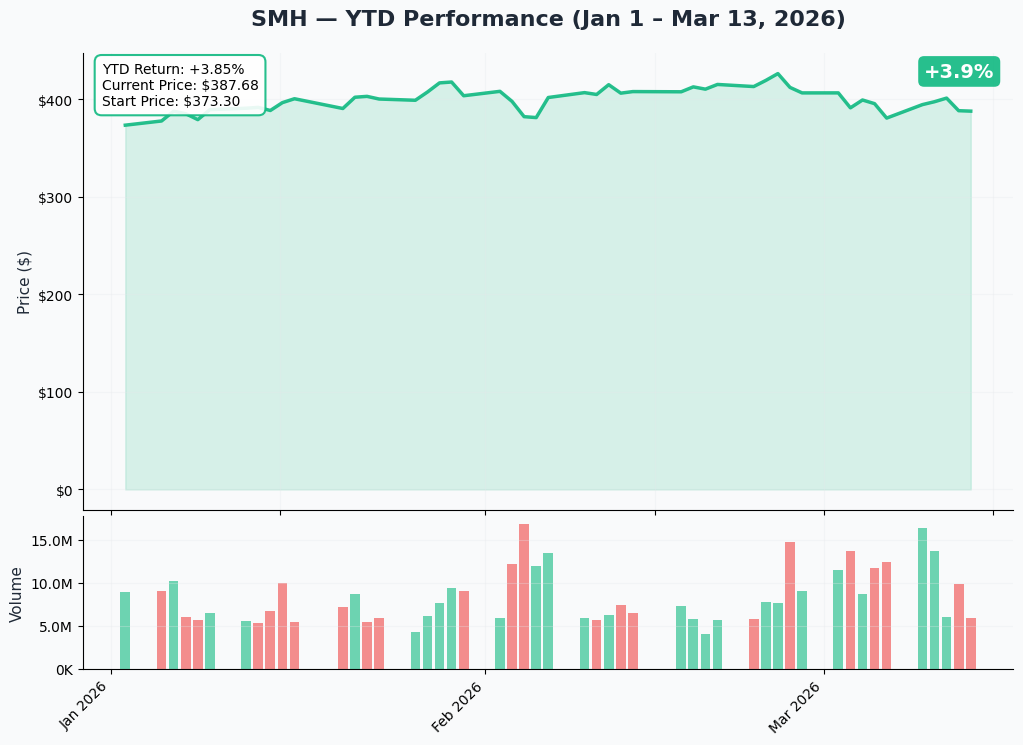
SMH has been on an extraordinary run — from its 52-week low of $170.11 all the way to a peak of $427.94, that's a +151.5% gain from trough to peak. The AI infrastructure buildout narrative has been the rocket fuel. Today's ~3.25% pullback (trading at $388, down from the $396 open) is being attributed to U.S. Commerce Department semiconductor tariff headlines — but the broader uptrend remains intact. SMH remains up massively from its yearly lows and this dip, while notable intraday, does not change the structural picture.
Key observations from the YTD chart:
- 🚀 Massive AI-driven rally: The fund doubled from its lows as NVIDIA's Blackwell revenue ramp validated the AI infrastructure thesis
- 📉 Today's dip is a speed bump: A 3.25% pullback on tariff news in the context of a 150%+ move from lows is entirely normal
- 📊 Volume on down days: The selling pressure today was enough to prompt one institution to sell $12M worth of downside protection — that's a contrarian signal
- ⚠️ Volatility is elevated: The 52-week range of $170–$428 tells you this ETF moves hard in both directions
Gamma-Based Support & Resistance Analysis
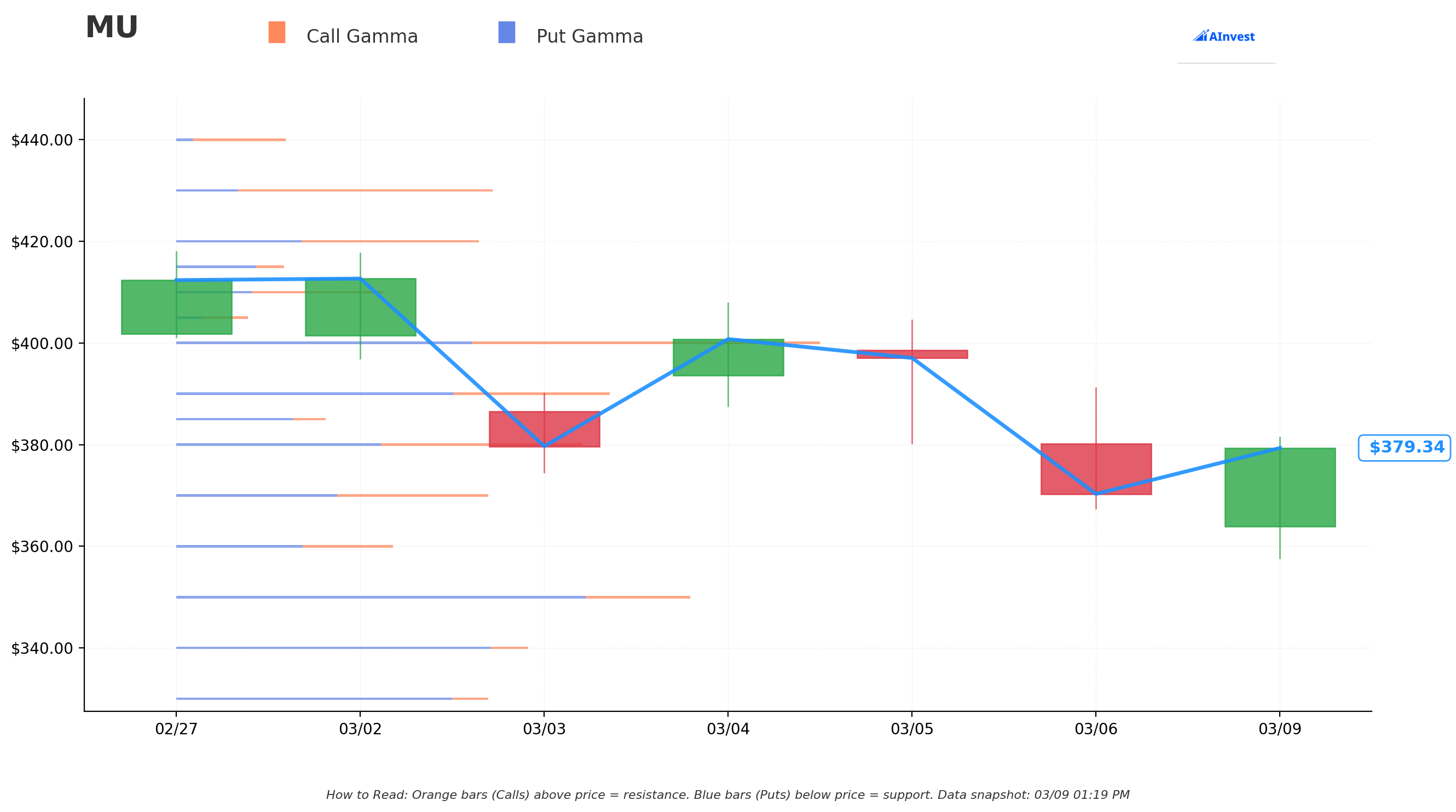
Current Price: $387.98
The gamma exposure map shows where options market makers are concentrated — these levels act as price magnets and barriers that govern near-term price action:
🔵 Support Levels (Put Gamma Below Price):
| Strike | Total GEX | Distance | Significance |
|---|---|---|---|
| $387.50 | 15.3B | 0.1% | Immediate floor — strongest nearby support |
| $385.00 | 36.0B | 0.8% | MAJOR SUPPORT — massive 34.0B put gamma wall |
| $380.00 | 11.6B | 2.1% | Secondary floor |
| $375.00 | 8.1B | 3.3% | Third tier support |
| $370.00 | 14.4B | 4.6% | Extended support with decent gamma |
| $367.50 | 12.8B | 5.3% | Strong put concentration here |
| $360.00 | 8.4B | 7.2% | Deeper support zone |
| $350.00 | 8.5B | 9.8% | Disaster floor |
🟠 Resistance Levels (Call Gamma Above Price):
| Strike | Total GEX | Distance | Significance |
|---|---|---|---|
| $390.00 | 26.6B | 0.5% | IMMEDIATE CEILING — strongest single resistance level |
| $400.00 | 19.4B | 3.1% | Secondary resistance — psychological $400 barrier |
What this means for traders:
SMH is pinned in an incredibly tight band right now. With the current price at $388, there is massive put gamma at $385 (36.0B — the single largest level in the entire chart) acting as a gravitational floor just 0.8% below. This means market makers are sitting on enormous hedging obligations at $385 that will create aggressive buying pressure on any further dip toward that level.
The $390 resistance (26.6B call gamma, just 0.5% above current price) creates a ceiling that market makers will sell into. This is a classic gamma compression setup: SMH is sandwiched between $385 support and $390 resistance in the very short term, with the resolution likely coming from the NVDA GTC event starting March 16.
Net GEX Bias: Bearish (total call GEX 82.8B vs total put GEX 176.6B) — but this bearish gamma bias is actually supportive for price. Heavy put concentration below means dealers have to BUY shares to hedge as price falls, which cushions downside moves. Think of it as a shock absorber under the ETF.
Notice something critical: The $310 put seller placed their strike well below every meaningful gamma support level. There's no significant put gamma protecting the $310 area in the current data — the seller is operating in "open air" territory where SMH would need an extraordinary, sustained selloff to reach. That's by design.
Implied Move Analysis
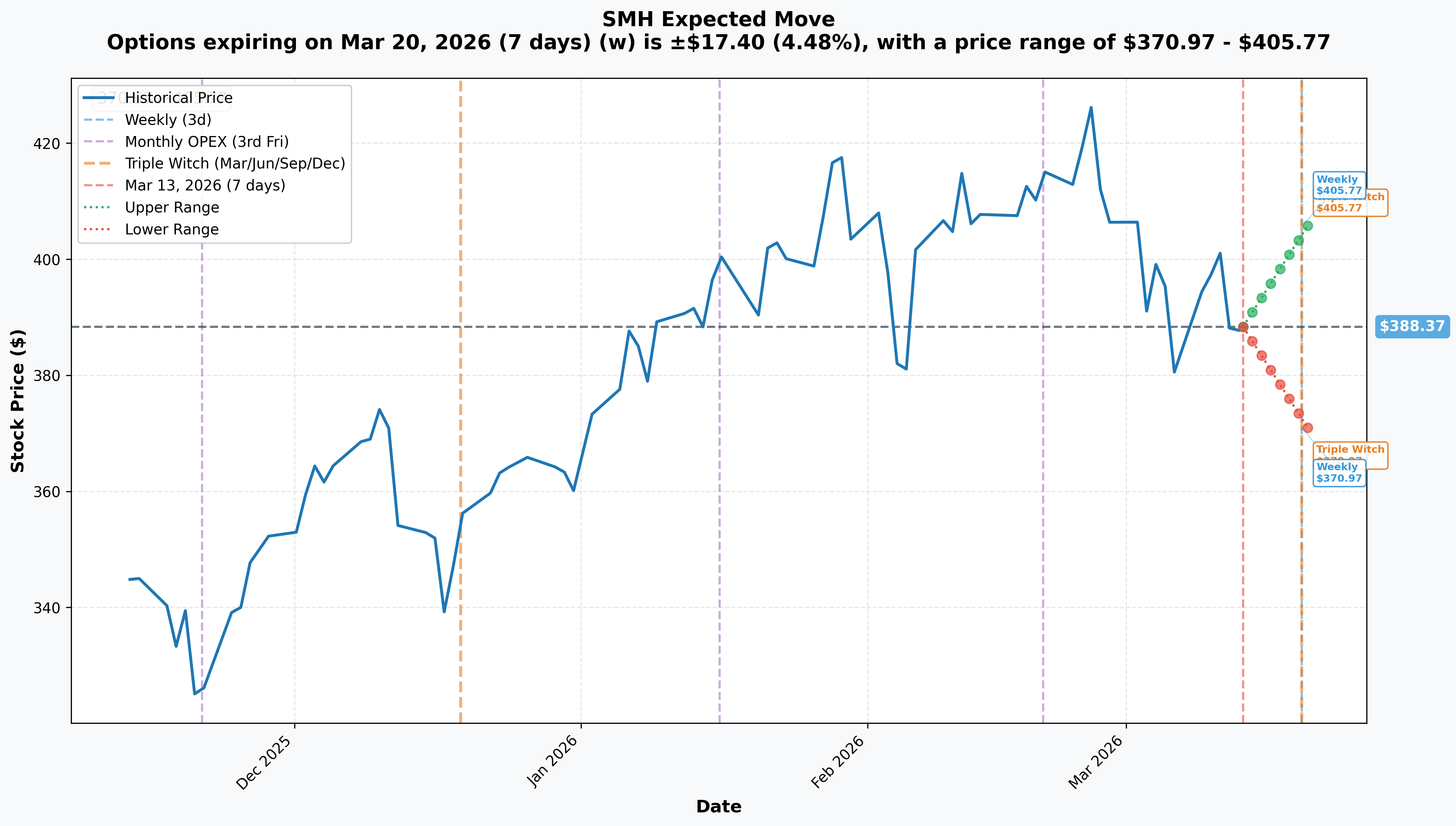
Options market pricing for upcoming expirations (as of March 13, 2026):
| Timeframe | Expiry | Days | Implied Move | Range |
|---|---|---|---|---|
| 📅 Weekly / Monthly OPEX | March 20 | 7 days | ±$17.40 (±4.48%) | $370.97 – $405.77 |
| 📅 Quarterly Triple Witch | March 20 | 7 days | ±$17.40 (±4.48%) | $370.97 – $405.77 |
Translation for regular folks:
The options market is pricing in a ±4.48% move ($17.40) by this Friday's OPEX (March 20). The lower bound of $370.97 is well above the $310 put strike — the market is not pricing in anywhere near the kind of move needed to threaten this position in the near term.
Note that the next major expiry with distinct pricing is the May 15, 2026 expiration where this trade lives. At 63 days out, the broader implied move would be substantially larger. But the market structure currently shows that even a full sigma move to the downside over the next week lands at $371 — still 19.7% above the $310 strike. The seller is operating with extraordinary cushion relative to the market's own volatility estimates.
Key insight: The March 20 OPEX aligns with the end of NVDA's GTC conference (March 16-19). The options market is already pricing in meaningful volatility around that event — and yet someone just sold puts well below even the most bearish implied move scenario. That's a statement of maximum conviction.
🎪 Catalysts
🔥 Upcoming Catalysts (Next 3 Months)
NVIDIA GTC 2026 — March 16-19, 2026 (3 DAYS AWAY!) 🤖
NVIDIA's GPU Technology Conference is the single most important near-term catalyst for SMH. With NVDA representing 18.84% of the fund, GTC announcements can move SMH 5-10% in a session. Key watch items:
- 🚀 Blackwell Ultra (B300) production ramp updates — any acceleration in supply would be massive
- 🏭 GB300 NVLink infrastructure scalability — the architecture that's pulling all hyperscaler capex
- 🤖 New CUDA/AI framework announcements — software moat deepening
- 💰 Revenue guidance signals from CEO Jensen Huang's keynote
- ⚡ Customer announcements (Microsoft, Google, Amazon, Meta deployment scale)
This is THE catalyst the $12M put seller is positioned around. They sold puts just 3 days before GTC — betting that NVDA delivers, SMH pops, and those $310 puts expire worthless.
NVIDIA Q1 FY2027 Earnings — Late May 2026 📊
NVIDIA reports Q1 FY2027 earnings in late May 2026 — right as this May 15 put expires. This is the most dangerous catalyst for the trade. Street expects continued strong Blackwell GPU demand. Any guidance miss would land while the put is still open. Key metrics:
- 📊 Data center revenue trajectory (was $35B+ in Q4 FY2026)
- 💡 Blackwell GB300 supply vs. demand commentary
- 📈 Gross margin recovery toward 70%+ on Blackwell mix
TSMC 2nm Node Ramp — H1 2026 🏭
TSMC (10.97% of SMH) is entering high-volume manufacturing on its N2 (2nm) process in H1 2026. Yield news and production ramp speed directly impacts TSMC's revenue and, by extension, SMH pricing. Positive yield progress would validate the long-term SMH bull case.
Broadcom AI ASIC Cycle — Q2 2026 Earnings 💻
Broadcom (7.69% of SMH) is a critical AI ASIC supplier to Google, Meta, and ByteDance. Its February 2026 earnings showed AI revenue at ~$4.5B/quarter. The next update — arriving before this put expires — will confirm or deny acceleration in the custom chip segment.
U.S. CHIPS Act Phase 2 — Advanced Packaging 🇺🇸
Additional CHIPS Act disbursements in 2026 covering advanced packaging (CoWoS, SoIC) and domestic HBM production would directly benefit Micron, Intel, and equipment makers inside SMH. This is a slow-burning positive catalyst with real dollars attached.
⚠️ Risk Catalysts (Already Happened / Ongoing)
Semiconductor Tariff Headlines — March 13, 2026 (TODAY)
The U.S. Commerce Department announced a 25% national security tariff on certain high-end semiconductors. This is cited as the primary driver of SMH's 3.25% decline today. While framed as protective of U.S. manufacturing, it creates uncertainty for TSMC's ADR and other non-U.S. fab names in the fund. "Phase one" language implies follow-on actions are possible.
China Rare Earth Export Controls — Active Since March 3, 2026 🇨🇳
Beijing tightened rare earth export controls effective March 3, 2026 — critical materials used in semiconductor manufacturing equipment. This directly impacts ASML (5.81% of SMH), Lam Research, and Applied Materials. Escalation of this restriction is the primary tail risk for the $310 put seller.
TSMC Capex Confidence (Positive)
Despite geopolitical noise, TSMC announced a $38–40B capex plan for 2026 — one of the largest semiconductor capex commitments in history. This validates the structural AI infrastructure spending thesis that underpins the entire SMH bull case.
ASML Record Bookings (Positive)
ASML's €13.2B Q4 2025 order backlog — a 144% sequential increase — signals that equipment spending (and therefore capacity additions) will stay elevated well into 2027-2028. This is deeply bullish for the long-term SMH thesis.
🎲 Price Targets & Probabilities
Using gamma levels, implied move data, and the upcoming NVDA GTC catalyst, here are the scenarios through May 15, 2026:
📈 Bull Case (40% probability)
Target: $405–$430
How we get there:
- 🚀 NVDA GTC keynote delivers major Blackwell Ultra announcements with hyperscaler commitments and strong Q1 revenue signals
- 💥 Semiconductor tariff concerns fade as Commerce Dept clarifies scope is narrower than feared
- 📊 TSMC 2nm ramp news positive — yields on track, supply ramping smoothly
- 🤖 Broadcom Q2 AI ASIC revenue guidance surprises to the upside
- 🔵 Break above $390 gamma resistance triggers technical rally — next stop $400 (second resistance), then $405+
- 💰 $310 put seller's premium evaporates in value — maximum profit scenario
Key triggers: NVDA GTC keynote tone, hyperscaler capex comments, any positive China trade rhetoric
🎯 Base Case (45% probability)
Target: $375–$405 (Gamma-Pinned Consolidation)
Most likely scenario:
- ✅ NVDA GTC delivers solid product updates but markets were expecting fireworks — "sell the news" chop
- ⚖️ Tariff headlines create ongoing uncertainty but no escalation
- 📊 SMH bounces between $385 gamma support (36.0B put gamma — massive floor) and $390 resistance (26.6B call gamma)
- 🔄 Consolidation until NVDA May earnings provide the next big directional catalyst
- 💤 Implied volatility compresses as GTC passes without major surprises
Put seller's outcome in base case: $310 puts expire worthless, full $12M premium kept. The 20% buffer is plenty of cushion even in a choppy sideways-to-slightly-down market.
📉 Bear Case (15% probability)
Target: $330–$370 (Test of Deeper Supports)
What could go wrong:
- 😰 NVDA GTC disappoints — Jensen Huang signals demand softness or supply chain delays
- 🚨 U.S. semiconductor tariffs escalate to include TSMC-manufactured chips, directly impacting top holdings
- 🇨🇳 China rare earth restrictions tighten further, threatening ASML and equipment names
- 📊 Macro tech selloff accelerates — yields spike, risk-off hits high-multiple semis hardest
- 🔨 Break below $385 gamma support ($36.0B — the major floor) triggers dealers to reduce hedges, accelerating move to $375, $370, $367
Critical support levels in bear scenario:
- 🛡️ $385: STRONGEST floor (36.0B put gamma) — MUST HOLD for bull thesis
- 🛡️ $370: Secondary support (14.4B gamma)
- 🛡️ $367.50: Extended floor (12.8B gamma)
- 🛡️ $350: Disaster floor (8.5B gamma)
Does $310 get hit? Even in this bear case, $310 remains well below every gamma support level and would require a sequential breakdown through $385, $375, $367, $360, and $350 — each of which has meaningful dealer buying support. A move to $310 from $388 would be a ~20% drop, landing squarely in "multiple black swan" territory.
Put seller's outcome in bear case: If SMH drops to $350, the $310 puts still expire worthless. A move to $310 requires near-catastrophic sector failure — the seller is comfortable underwriting that scenario.
💡 Trading Ideas
🛡️ Conservative: The "Fade the Fear" Stock Accumulator
Play: Buy SMH shares on this dip into the $385-$390 gamma support zone
Why this works:
- 🔵 The most powerful gamma support in the entire chart sits at $385 (36.0B put gamma) — dealers will buy aggressively here
- 💰 An institution just sold $12M in puts, effectively committing to buy SMH at $304 — copying their directional bias at better cost
- 🚀 NVDA GTC (March 16-19) is a known positive catalyst just 3 days away
- 📊 SMH is down 3.25% today on tariff noise — that's an opportunity, not a warning sign for the long-term thesis
- ⏰ If GTC delivers, $390 gamma resistance breaks and $400 becomes the next target (3% upside)
Action plan:
- 🎯 Entry: $385-$390 (right at major gamma support)
- 🛡️ Stop: $377 (below $380 secondary support — would signal real structural breakdown)
- 📈 Target 1: $400 (psychological level + second resistance)
- 📈 Target 2: $415 (post-GTC momentum if NVDA crushes it)
- 💡 Risk/Reward: ~2.5:1 with defined stop
Risk level: Moderate (directional equity) | Skill level: Beginner-friendly
⚖️ Balanced: The "GTC Call Spread" — Copy the Conviction, Define Your Risk
Play: Buy a call spread targeting post-GTC momentum through March OPEX
Structure: Buy March 20 $390 calls, Sell March 20 $405 calls (or April $400/$415 spread for more time)
Why this works:
- 🎢 The $390 gamma resistance is the exact line in the sand — if NVDA keynote delivers, this wall breaks
- 💸 Defined risk spread caps your loss at the net debit paid (~$4-6)
- 🚀 Maximum profit $9-11 if SMH above $405 by March 20 — a realistic target given NVDA GTC
- ⏰ GTC runs March 16-19, expiration March 20 — the timing is almost perfect
- 📊 $15 wide spread at $4-6 cost = 2.5:1 to 3.75:1 reward-to-risk
Estimated P&L:
- 💰 Cost: ~$4-6 net debit per spread (adjust based on post-open IV)
- 📈 Max profit: ~$9-11 if SMH above $405 on March 20
- 📉 Max loss: $4-6 (100% of premium — fully defined)
- 🎯 Breakeven: ~$394-396
Risk level: Moderate (defined-risk directional) | Skill level: Intermediate
🚀 Aggressive: Mirror the Whale — Sell a Smaller Put for Premium (The "Mini Whale" Play)
Play: Sell a deep OTM put on SMH, collecting premium while defining a low-probability assignment risk
Structure: Sell May 15 $340 puts (or $330 puts for even more buffer) — collect premium on AI sector conviction
Why this works:
- 🐋 You're copying the institutional trade logic at a strike that's even more OTM (12-15% buffer vs 20%)
- 💰 Collect $1.50-3.00 per contract in premium — annualized yield of 12-20%+ on margin held
- 🎯 $340 strike requires a 12.4% crash in 63 days to go ITM — plausible only with catastrophic multi-factor failure
- 🔵 Every gamma support level from $385 down to $350 stands between current price and this strike
- ⏰ Sell vol ahead of GTC when IV is elevated — let IV compression work for you after the event
The math on a 10-contract position:
- 💸 Collect ~$150-300 per contract × 10 = $1,500-3,000 premium
- 🎯 Max profit: Keep full premium if SMH above $340 on May 15
- ⚠️ Max risk: Get assigned 1,000 shares at $340 — a $340,000 stock obligation (requires margin/cash secured)
- 📉 Break even on assignment: $340 minus premium received — effective cost ~$337-338
IMPORTANT WARNING: Selling naked puts requires significant capital reserves and margin. If assigned, you must be prepared to own 1,000 shares of SMH at $340. Only attempt if:
- ✅ You have $340,000+ in available cash/margin per 10 contracts
- ✅ You would genuinely be happy owning SMH at $337-338
- ✅ You understand you can lose far more than the premium collected if assigned
- ✅ You have traded short options before and understand the mechanics
Risk level: HIGH (undefined risk on downside) | Skill level: Advanced only
⚠️ Risk Factors
Real talk — here's what could blow up this thesis:
-
🎤 NVDA GTC disappoints in 3 days (BIGGEST SHORT-TERM RISK): NVIDIA represents 18.84% of SMH. If Jensen Huang's keynote signals any demand softness, supply chain issues, or competitive concerns from AMD/Google TPUs, SMH could gap down 5-8% immediately. The market expects fireworks — anything "merely good" could be sold. GTC is the event that will define SMH's trajectory through April.
-
🚨 Semiconductor tariff escalation: Today's 3.25% decline was driven by U.S. Commerce Dept tariff announcements. The "phase one" framing implies more could follow. TSMC (10.97% of SMH), ASML (5.81%), and other non-U.S. manufacturers could face additional restrictions that structurally impair their revenue — directly threatening the $310 put seller's cushion.
-
🇨🇳 China rare earth restriction escalation: Beijing's rare earth export controls effective March 3, 2026 target materials critical to semiconductor equipment manufacturing. ASML has already flagged China weakness. A significant escalation could simultaneously hurt ASML, Lam Research, and Applied Materials — three meaningful SMH holdings — in a way that creates a sustained drawdown rather than a brief dip.
-
📊 NVIDIA Q1 FY2027 earnings (May 2026) — the timing trap: The May 15 expiration sits right BEFORE NVDA's late-May earnings. If NVDA pre-announces a miss or issues a profit warning, the $12M put position could be severely tested in the final days. The seller's biggest vulnerability is a late-April/early-May NVDA guidance cut, as there is almost no time left on the put to recover.
-
💸 Valuation risk at peak AI enthusiasm: SMH has surged from $170 to $388 — a 128% gain from the 52-week low. At these levels, a lot of good news is already priced in. If the AI capex cycle shows any signs of peaking — Microsoft slows Azure buildout, Amazon trims AWS capex — the repricing could be swift and brutal. High-valuation ETFs have zero margin of safety when sentiment shifts.
-
🎢 Gamma structure turns bearish below $385: The current put gamma concentration at $385 is a shield — but if that level breaks convincingly, the gamma support structure unwinds. Dealers reduce their SMH hedges below $385, removing the natural buying support. This "gamma air pocket" from $380 to $370 means a break of $385 could cascade faster than the current chart suggests.
-
🌐 Macro tech selloff / yield spike: Semiconductor stocks are long-duration assets priced on future earnings. Any spike in interest rates, credit stress, or macro recession signals could trigger risk-off selling that treats SMH as "the most expensive thing to sell first." Historical drawdowns during macro panics have been 20-30% in the SMH.
🎯 The Bottom Line
Here's the deal: An institution just sold $12 MILLION in downside protection on SMH, collecting premium while betting that the semiconductor sector won't fall more than 20% in the next 9 weeks. This is one of the most bullish signals you can send in the options market — not because they're buying calls and chasing, but because they're confidently underwriting catastrophic risk and getting PAID for it.
What this trade tells us:
- 🎯 The seller has deep conviction that SMH stays above $310 through May 15 — a level that would require the AI chip boom to essentially stall completely
- 💰 They structured at $310 ($78 below spot) because at NVDA GTC in 3 days, they see a POSITIVE catalyst — they sold puts into a 3.25% down day to maximize the premium they collect
- ⚖️ The timing is calculated: 63 days out captures GTC (March 16-19) and misses NVDA earnings (late May) — they're selling the volatility window, not riding into the biggest binary event
- 🐋 $12M in premium collected — if correct, that's pure profit. If wrong (SMH below $310), they're buying the world's premier semiconductor ETF at a 21.6% discount
If you're bullish on SMH:
- ✅ The $385 gamma support level (36.0B put gamma — strongest in the chart) is your line in the sand. Bounce entries here are well-supported.
- 📊 NVDA GTC (March 16-19) is the catalyst to watch. NVDA keynote tone + announcements = the directional driver for SMH through March OPEX
- 🎯 $390 gamma resistance needs to break for the bull trade to really sing. A close above $392 would signal the tariff fear is fading
- 🚀 Bull targets: $400 (next resistance), $415 (April recovery), $430 (retest of highs)
If you're watching from sidelines:
- ⏰ March 16 (Monday) is when GTC begins — watch the NVDA premarket reaction for the tone
- 🎯 A dip to $385-$387 with the $385 gamma floor holding would be an attractive risk/reward entry
- 📈 Looking for: NVDA keynote catalysts, tariff narrative stabilizing, TSMC 2nm ramp confirmation
- ⚠️ Don't chase above $392 pre-GTC — that's paying up ahead of the binary event
If you're bearish:
- 🎯 Watch the $385 gamma floor closely. A daily close below $385 (with volume) would signal the support is failing
- 📉 First real technical target on a break: $375 → $370 → $367.50 (the waterfall of smaller support levels)
- ⚠️ But shorting SMH into NVDA GTC with the sector already down 3.25% today is fighting the tide — wait for GTC to pass before initiating new bearish positions
Mark your calendar — Key dates:
- 📅 March 16-19, 2026 — NVIDIA GTC Conference (CRITICAL for near-term direction)
- 📅 March 20, 2026 — Weekly OPEX / Triple Witch (±$17.40 implied move; $370.97–$405.77 range)
- 📅 Late April 2026 — Watch NVDA supply chain commentary from hyperscaler earnings (MSFT, AMZN, GOOGL)
- 📅 May 15, 2026 — This $12M short put EXPIRES (maximum vulnerability window: late April to May 15)
- 📅 Late May 2026 — NVIDIA Q1 FY2027 earnings (after put expiry, but sets up next trade)
- 📅 Q2 2026 — Broadcom AI ASIC revenue update — confirmation or denial of AI ASIC cycle
Final verdict: This $12M short put on SMH is one of the cleanest expressions of institutional AI chip conviction we've seen recently. Selling a $310 put from $388 with NVDA GTC in 3 days is almost poetic — maximum premium, maximum buffer, maximum catalyst alignment. The seller isn't reckless; they've done the math. Even in a significant tariff-driven selloff, the gamma support structure between $385 and $350 creates multiple layers of natural buying. The only scenario that threatens this trade is a multi-factor catastrophic failure — NVDA GTC miss + tariff escalation + China restrictions tightening simultaneously. Possible? Yes. Probable? That's why they're getting paid $12M to underwrite it.
Real talk: Don't just copy the trade — understand the conviction behind it. This institution is saying the AI chip story isn't over, and March is a buy-the-dip moment. The $310 floor is their vote of confidence. The chart, gamma structure, and GTC timing all support that view.
⚠️ Disclaimer: Options trading involves substantial risk of loss and is not suitable for all investors. This analysis is for educational purposes only and does not constitute financial advice or a solicitation to buy or sell any security. Selling put options carries significant risk including the obligation to purchase the underlying ETF at the strike price if assigned, which could represent a significant capital commitment. The premium received does not fully offset potential losses on the underlying position. SMH holds concentrated semiconductor exposure; sector-specific risks including geopolitical events, tariff actions, and technology disruption can cause rapid, significant drawdowns. Past performance does not guarantee future results. The unusual options activity described may reflect hedging activity, portfolio rebalancing, or complex institutional strategies not appropriate for individual retail investors. Always conduct your own due diligence and consider consulting a licensed financial advisor before trading options.
About SMH (VanEck Semiconductor ETF): The VanEck Semiconductor ETF tracks the 25 largest U.S.-listed semiconductor companies, with top holdings in NVIDIA (18.84%), TSMC (10.97%), Broadcom (7.69%), Micron (6.47%), and ASML (5.81%). The fund is the benchmark instrument for institutional semiconductor exposure, with over $25B in AUM and a direct correlation to the AI infrastructure buildout thesis driving technology markets in 2025-2026.