🐋 ABVX — ≈$3.3M Bullish Call Sweep Into a Clinical Binary
Published: 2026-06-17 | Last updated: 2026-06-18
✅ Updated 2026-06-18 — OPEN CONFIRMED: Next-day OPRA OI resolves the provisional flag as a clean fresh open. The Jul-17 $110C rose 2,483 → 5,125 (Δ +2,642), matching the ≈2,600-lot sweep — a brand-new long-call position (BTO), not a close. The bullish read stands. See the ✅ RESOLVED box below.
Quick Take
Someone put ≈$3.3M into short-dated, out-of-the-money calls on Abivax (ABVX) this morning via a lit sweep — real urgency, took the displayed market. The strike is ≈13% above the current price, expiring July 17. The position is timed directly around a late-June safety data readout that is the single most important near-term catalyst for the stock. This is a high-conviction binary bet: it pays off handsomely if the safety overhang from the June 1 Phase 3 readout eases; it expires worthless if it does not.
Company Overview
Abivax (ABVX) is a clinical-stage French biotechnology company listed on Nasdaq. Its entire near-term enterprise value rests on a single asset: obefazimod, a first-in-class once-daily oral miR-124 enhancer being developed for moderately-to-severely active ulcerative colitis (UC). The company has no approved product revenue to speak of (≈$4.57M). What it does have is a strong balance sheet (≈€491.6M cash, runway into Q4 2027) and Phase 3 data in UC that the Street has described as Rinvoq-comparable in efficacy — alongside a cancer/malignancy safety signal that has divided analysts and rattled the stock.
ABVX is a pure clinical binary. There is no revenue cushion, no diversified pipeline to fall back on near term, and no floor beyond cash.
The Trade
Trade Details
| Field | Value |
|---|---|
| Date | 2026-06-17 |
| Time | 10:14 ET |
| Direction | BUY |
| Type | CALL |
| Expiration | Jul 17, 2026 |
| Strike | $110 |
| Spot at Print | ≈$97.50 |
| Strike vs Spot | ≈13% OTM |
| Option Price | ≈$12.70 |
| Volume | ≈2,600 contracts |
| Prior OI | ≈2,500 contracts |
| Total Premium | ≈$3.3M |
| Execution | ⚡ Lit Sweep (took the displayed market) |
| Order Type | BTO — ✅ confirmed open (next-day OI +2,642) |
Flow tag: ⚡ LIT SWEEP — this was genuine market-taking aggression. The buyer consumed displayed offer-side liquidity, signaling urgency to get filled now rather than working the order passively.
✅ RESOLVED — Next-Day OI Confirms a Clean Open (2026-06-18)
The provisional flag is resolved. Next-morning OPRA open interest rose right in line with the ≈2,600-lot sweep, confirming a brand-new opening long-call position (BTO) — not a close.
| Leg | Pre-print baseline (EOD 2026-06-16) | Resolving (EOD 2026-06-17) | Δ | Verdict |
|---|---|---|---|---|
| Jul-17 $110C | 2,483 | 5,125 | +2,642 | ✅ OPEN confirmed |
The +2,642 increase matches the trade size almost exactly (and lands inside the "≈2,500 to ≈5,000+" range the original analysis predicted for an open). With a clean fresh open confirmed, the bullish, urgency-driven lit-sweep read holds in full: a buyer opened ≈$3.3M of short-dated upside into the late-June safety binary.
🤓 What This Actually Means — Plain English
What did someone just buy?
A "buy-to-open Jul $110 call" means the buyer paid ≈$12.70 per share (×100 shares per contract × ≈2,600 contracts = ≈$3.3M total) for the right — but not the obligation — to buy ABVX stock at $110 per share, any time before July 17, 2026.
Today, the stock is at ≈$97.50. So the strike is ≈$12.50 above the current price. For this call to pay off at expiry, ABVX needs to be above $122.70 (strike + premium paid = $110 + $12.70). That is a ≈26% move from today's ≈$97.50 in 30 days.
Why would anyone do this?
Because ABVX has a known, specific, short-dated catalyst that falls inside the July 17 expiry window: late-June "Part 2" safety data from the Phase 3 program. The buyer is not betting on the company in the abstract — they are betting on a specific data readout resolving the cancer/malignancy signal favorably (or M&A arriving) before the option expires worthless.
What is the risk/reward?
- Maximum loss: 100% of premium paid — ≈$3.3M, if the stock is below $110 at July 17 expiry. That is the full downside.
- Maximum gain: theoretically uncapped. At $140 the position is worth ≈$7.8M (profit of ≈$4.5M, a ≈136% return on premium). At $160 it is worth ≈$13M.
- Breakeven at expiry: ≈$122.70.
This is a high-implied-volatility, short-dated, out-of-the-money call on a clinical-stage biotech. The option pricing already reflects elevated uncertainty — the market is charging a lot for this lottery ticket because everyone knows a binary event is imminent. The buyer is accepting that price anyway.
What does the lit-sweep execution tell us?
A lit sweep means the buyer took available offer-side contracts at the displayed market price rather than working a limit order patiently. That is an urgency signal. Someone wanted these contracts today, at market, without waiting to see if they could get a better fill. That is consistent with conviction around a near-term catalyst — not a position built casually over weeks.
Technical Setup
ABVX Year-to-Date Chart
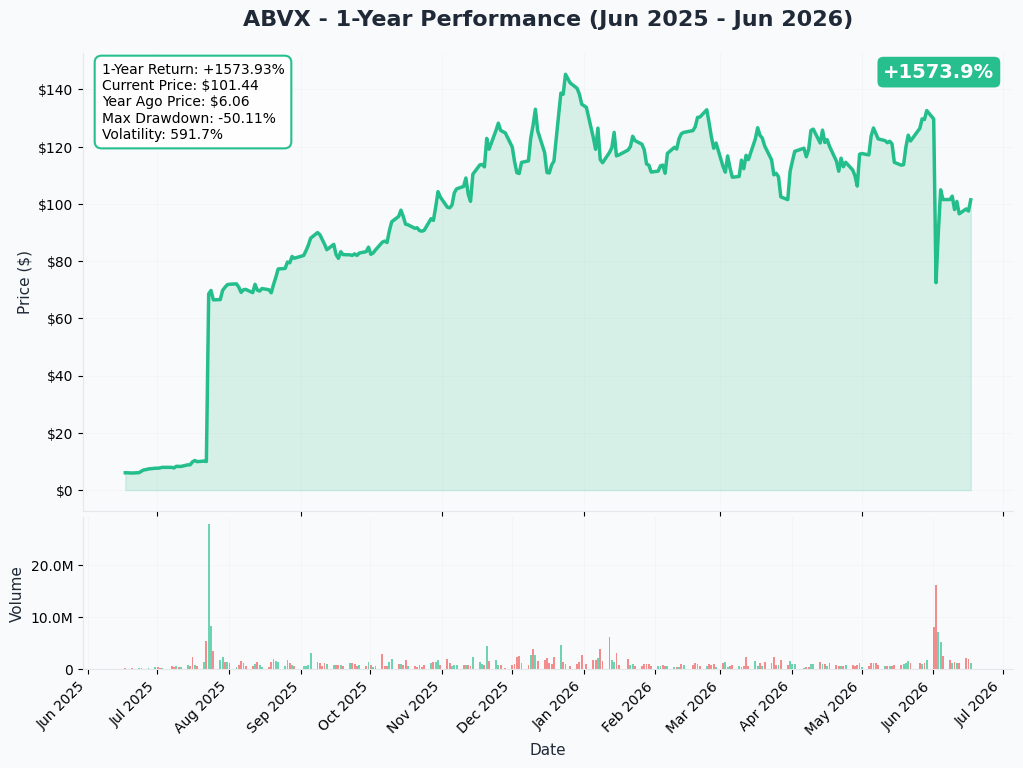
The stock's dominant YTD story is the ≈44% one-day collapse from ≈$129.69 (June 1) to ≈$72.50 (June 2) on the Phase 3 maintenance readout, followed by a partial recovery to the mid-to-high $90s / low $100s. The call buyer is effectively betting on a continuation of that recovery leg — not just back to pre-crash levels, but through the $110 strike and above.
Gamma S/R Levels
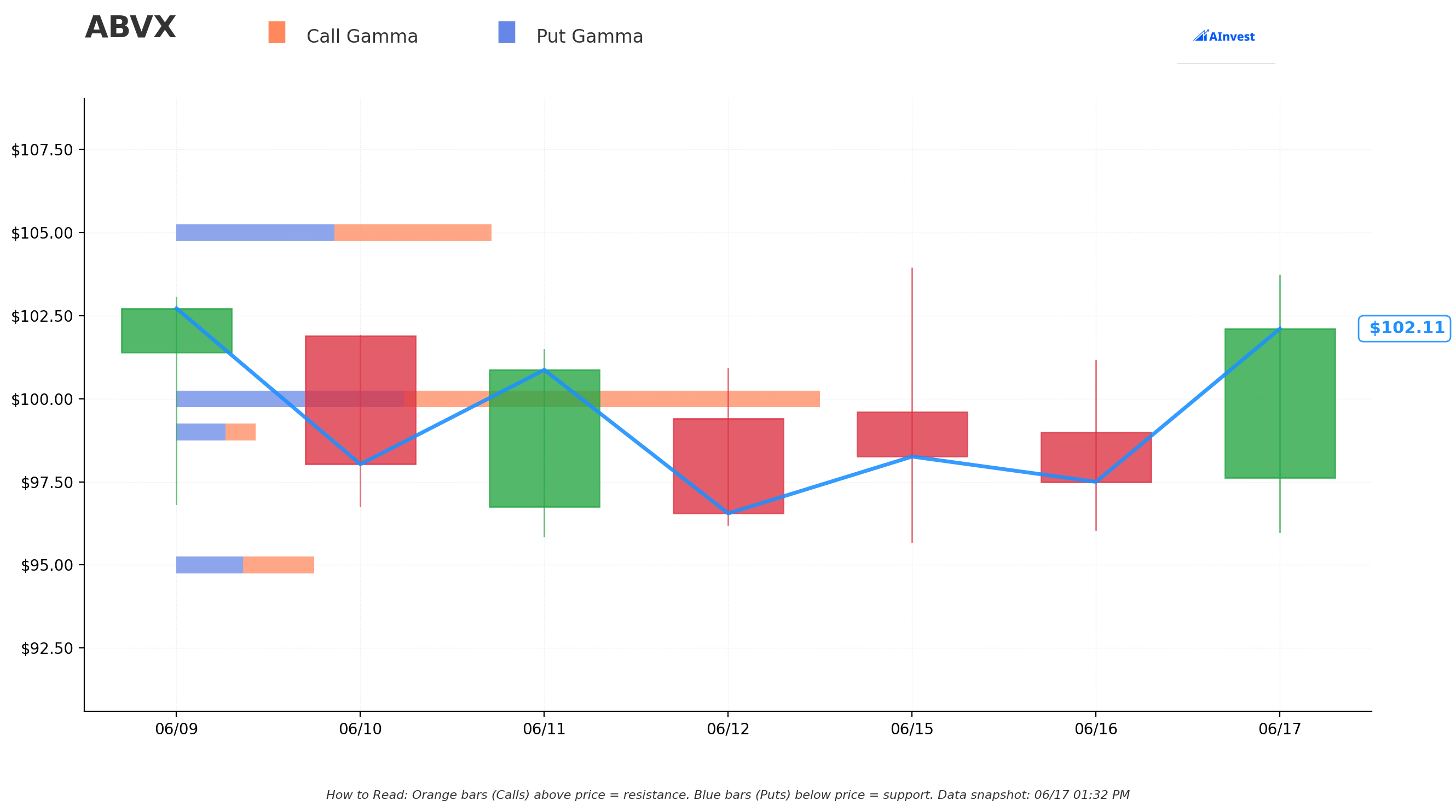
Based on current open interest and dealer gamma positioning:
- $100 — Moderate Support (≈2.0% below current price): The largest gamma concentration in the chain sits at the $100 strike (total GEX ≈3.2 units, net positive). Dealers are net long gamma here and will mechanically buy dips / sell rips around this level, acting as a gravitational anchor. This is the key support level to watch — a sustained break below $100 would remove that support cushion.
- $105 — Secondary level (≈2.9% above): Meaningful two-sided GEX (call ≈0.78 / put ≈0.79, nearly balanced, total ≈1.6). Likely to act as a friction zone on the way up.
- $110 — The call buyer's strike (≈7.8% above): Also carries notable call-side GEX (≈0.81). Getting through $110 with conviction likely requires a genuine catalyst — gamma dynamics alone will not drive the stock there.
- Downside levels: $90 carries the largest put GEX below spot (net negative ≈-0.15), which would provide limited cushioning on a significant selloff; $85 and $75 are deeper put-weighted levels.
The gamma structure suggests the stock has near-term pinning forces around $100–$105. A clean break above $105 with catalyst would be needed for the $110 call to come into play.
Implied Move Cone
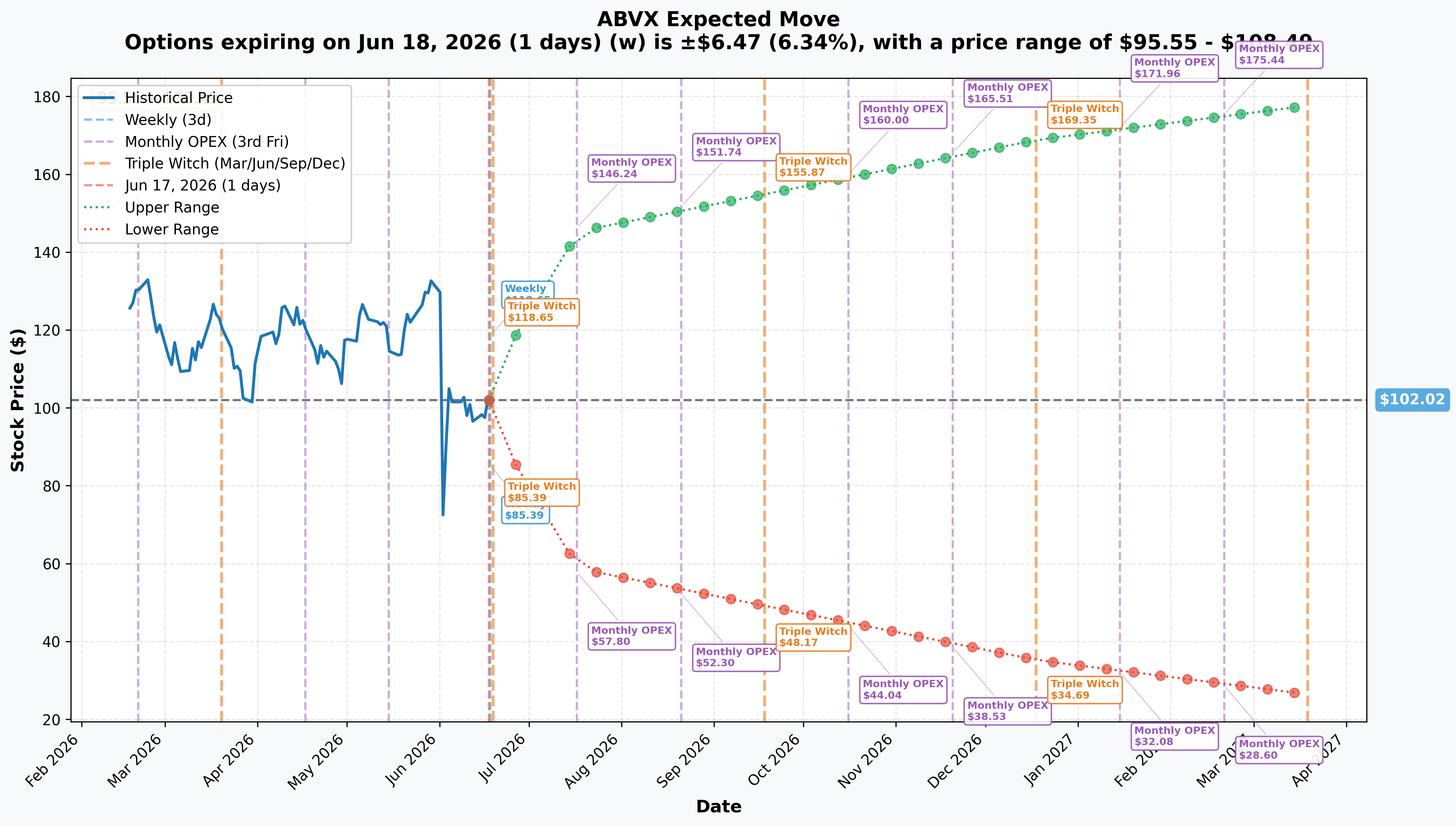
The options market is pricing an extremely wide range of outcomes:
| Horizon | Implied Move | Upper Range | Lower Range |
|---|---|---|---|
| Weekly (Jun 18) | ±6.3% / ±$6.47 | $108.49 | $95.55 |
| Monthly OPEX (Jul 17) | ±42.4% / ±$43.30 | $145.32 | $58.72 |
| Quarterly (Dec 18) | ±65.5% / ±$66.85 | $168.87 | $35.17 |
The July implied move (±42%) is enormous and reflects the market pricing in the late-June safety readout as a literal binary event. The $110 strike sits within the implied move upper range for July ($145 upper). That means the options market considers a move to $110+ achievable — it is not considered a tail scenario. However, it is also pricing in a scenario where the stock drops to ≈$59, which is roughly the June 2 crash low.
High implied volatility also means IV crush risk: even if the stock moves up modestly after the safety data, if implied vol contracts sharply, option prices can fall even on an up move. The call buyer needs both direction and magnitude.
Catalysts
The dominant near-term catalyst — directly inside the July 17 expiry window:
-
Late June 2026 — "Part 2" safety data from the ABTECT Phase 3 program. This is the most immediate and most important event. Wolfe Research specifically flagged that the cancer/malignancy safety debate could be clarified by Part 2 data due late June 2026. The June 1 Phase 3 maintenance readout delivered best-in-class efficacy (≈51% Week-44 remission vs 10.4% placebo, per Abivax) but was marred by a malignancy signal concentrated at the 50 mg dose. The 25 mg dose appears to carry the efficacy with a cleaner safety read — Part 2 data will either confirm that thesis or deepen concerns. This readout is the binary the call buyer is betting on.
-
Ongoing 2H 2026 — M&A and partnership speculation. Multiple analysts — including Truist — have flagged Abivax as a credible strategic takeout candidate: a best-in-class oral UC mechanism, Phase 3-complete data package, and ≈€491.6M in cash with runway into Q4 2027, per StocksToTrade. Any credible bid announcement would blow through the $110 strike.
-
Late Q4 2026 — U.S. NDA filing to the FDA for obefazimod in ulcerative colitis, per Abivax. Outside the July expiry window, but a confirmed filing on schedule would support the stock's recovery thesis.
-
2H 2026 — EMA MAA (European regulatory) submission for obefazimod, per Seeking Alpha. Also outside the July window but adds to the regulatory de-risking narrative.
Analyst target spread (post-June 1 readout):
| Firm | Rating | Target |
|---|---|---|
| Citizens | Outperform | $187 |
| Guggenheim | Buy | $175 |
| BTIG | Buy | $150 |
| Wolfe Research | Outperform | $136 |
| Truist | Buy | $135 |
| Morgan Stanley | Overweight | $132 |
| Jefferies | Hold (downgrade) | $90 |
| Wedbush | Neutral (upgrade) | $90 |
The range — $90 to $187 — captures the debate perfectly. Bulls see the 25 mg dose as best-in-class with a clean safety profile; bears see the 50 mg signal as a regulatory overhang that caps the upside. The call buyer is firmly in the bull camp and paying up for the right to participate if safety concerns ease.
4-Reader Interpretation
If you are a speculative trader (YOLO): This is the highest-risk/highest-reward read. The call buyer paid ≈$12.70 for something that expires worthless unless the stock is above $122.70 in 30 days. The late-June data is the bet. If Part 2 safety data is clean — or if M&A headlines hit — this position can double or more rapidly. If the data is neutral or bad, you lose the full premium. Do not size this as anything other than a speculation allocation you are prepared to lose entirely.
If you are a swing trader: The more actionable level is whether the stock can get back above $105 on positive catalyst. Buying shares or longer-dated calls gives you more time and breathing room than this specific position. The July $110 call is very short-dated for what is genuinely a multi-month thesis (NDA filing, EMA submission). Note the gamma support at $100 — that is the natural stop-think level on the downside.
If you are a premium seller: Implied volatility at these levels is pricing a ±42% monthly move. If you believe the binary resolves with less drama than the market fears, selling premium — puts, calls, or strangles — with appropriate risk management can make sense. Be aware that the June 2 crash proved the stock can move ≈44% in a single session; selling naked premium here requires very careful position sizing and defined-risk structures.
If you are a beginner: This trade is showing you what "buying optionality into a binary catalyst" looks like. Someone put ≈$3.3M into a bet that pays off only if a very specific event (safety data) goes the right way in the next 30 days. The option expires worthless if the stock does not move far enough, fast enough. This is not a stock purchase or a long-term investment — it is closer to an event-driven speculation with a hard expiration date. The lesson is that options have time limits, and those limits matter enormously in clinical-stage biotech.
Honest Risk Assessment
Binary clinical risk: The June 2 crash (≈44% in one session) happened on data the company described as "favorable." The next readout — late-June Part 2 safety data — could move the stock violently in either direction. If the malignancy signal worsens or extends to the 25 mg dose, a further leg down is entirely plausible. The $110 call can go to zero quickly.
IV crush: The options market is pricing extreme uncertainty (±42% monthly implied move). If the late-June data is mixed or ambiguous rather than clearly bullish, implied volatility may collapse even as the stock rises modestly, resulting in option losses on a "win" in the underlying.
Time decay (theta): With 30 days to expiry and ≈13% OTM, time works against this position every day. Even in a no-news environment, the option loses value daily.
Single-asset concentration: Obefazimod is essentially all of Abivax's value. A negative regulatory signal, a filing delay, or a new safety finding could be permanently impairment-level negative, not just a temporary dip.
Open/close ambiguity — RESOLVED: The original "size ≈ prior OI" doubt is now settled. Next-day OPRA OI rose 2,483 → 5,125 (Δ +2,642 ≈ the trade size), confirming a fresh opening long-call position (BTO), not a close. The bullish read stands. See the ✅ RESOLVED box above.
What the tape cannot tell us: We do not know the buyer's identity, their broader portfolio hedge, whether they own stock offsetting this call position, or their ultimate exit price target. The lit sweep tells us urgency; it does not tell us conviction about the outcome.
Article generated: 2026-06-17. ✅ Last updated: 2026-06-18 — next-day OPRA OI confirmed a clean fresh open (2,483 → 5,125, Δ +2,642).
Options trading involves substantial risk, including the potential loss of the entire premium paid. This analysis is for informational purposes only and does not constitute a recommendation to buy or sell any security. Clinical-stage biotechnology investments carry additional risks specific to regulatory, clinical, and binary-event outcomes. Always consult a financial advisor before making investment decisions.