🧬 ABVX: That $3.16M "Call Buy" Was Only Half the Trade — a Ratio Spread That Wants $200, Not Beyond
📅 2026-08-11 | 🤝 Block Cross | Net Debit ≈$2.16M
🔄 Updated 2026-08-12 pre-market — the next-day OPRA open interest confirmed both legs, essentially to the contract. The December $140 calls opened 200 → 2,210 (+2,010 against a 2,000-lot buy); the December $200 calls opened 236 → 4,247 (+4,011 against a 4,000-lot sale). Both landed within ≈11 contracts of the published predictions of ≈2,200 and ≈4,236. The 1x2 ratio spread is a fully confirmed, fully new position at full size. See the ✅ RESOLVED box.
🎯 The Quick Take
The flow screen flagged a $3.16M purchase of 2,000 December $140 calls on ABVX and left it there — a clean, bullish-looking call buy. Scanning the full ABVX chain found what the screen missed: 4,000 December $200 calls sold at the exact same millisecond, printed at the bid for ≈$1.00M. The real position is a 1×2 call ratio spread — long one $140 call against two short $200 calls — for a net debit of ≈$2.16M, not a directional long-call bet. This trade makes its full money if ABVX is sitting at $200 on December 18. It does not want ABVX to keep climbing past that — beyond ≈$249.20 the desk is effectively net short a call, and the loss is open-ended.
🏢 Company Overview
ABVX is the Nasdaq-listed American Depositary Share of ABIVAX Société Anonyme, a French clinical-stage biotech (ordinary shares also trade on Euronext Paris). Its lead asset is obefazimod (ABX464), an oral, once-daily miR-124 enhancer in Phase 3 (ABTECT) for moderately-to-severely active ulcerative colitis, with a Phase 2b Crohn's program (ENHANCE-CD) behind it. Market cap is ≈$11.0B, sector Healthcare / Biotechnology, on ≈79.3M shares outstanding. The company just closed a $920M public offering (net ≈$874.1M, priced at $125.00/ADS) that it says extends its cash runway into Q4 2029, and it is hiring a U.S. commercial team to launch obefazimod without a Big Pharma partner. Because it is dual-listed, French-time press releases and occasional Euronext trading halts can move the ADS while Paris is closed — a structural source of overnight gap risk that matters for a December-expiry option.
💰 What Actually Printed — The Missing Leg
The flow screen surfaced one line. The tape shows two, executed together as a negotiated 🤝 block cross (a broker matched both sides off the open book — there is a known counterparty, this is not aggressive sweeping):
| Time | Buy/Sell | Call/Put | Expiration | Premium | Strike | Volume | Prior OI | Size | Spot | Option Price | Symbol | Order Type | Strategy |
|---|---|---|---|---|---|---|---|---|---|---|---|---|---|
| 13:09:42 | BUY | CALL | 2026-12-18 | $3.16M | $140 | 2,015 | 200 | 2,000 | $126.19 | $15.80 | ABVX20261218C140 | BTO | 1×2 Call Ratio Spread (long 140 / short 2× 200) |
| 13:09:42 | SELL | CALL | 2026-12-18 | $1.00M | $200 | 4,131 | 236 | 4,000 | $126.19 | $2.50 | ABVX20261218C200 | STO | 1×2 Call Ratio Spread (long 140 / short 2× 200) |
Net premium: ≈$2.16M debit ($3.16M paid − $1.00M collected). Gross dollars crossing the tape were $4.16M, but that double-counts the spread — the $2.16M debit is the actual capital at risk. Both legs were 🤝 block-crossed, negotiated off the lit book with a known counterparty on the other side — no urgency, no aggressive sweeping, just a worked package.
✅ RESOLVED — Both Legs Opened, Within ≈11 Contracts of the Published Prediction
Updated 2026-08-12 pre-market. Resolving OPRA snapshot timestamped August 12 (reflects the August 11 close, after this print); baseline is the August 11 snapshot (reflects the August 10 close, before this print).
| Leg | Baseline (Aug-11) | Resolving (Aug-12) | Δ | Print size | What we published | Verdict |
|---|---|---|---|---|---|---|
| Dec-18 $140 call (bought) | 200 | 2,210 | +2,010 | 2,000 | "toward ≈2,200" | ✅ OPEN (BTO) — exact |
| Dec-18 $200 call (sold) | 236 | 4,247 | +4,011 | 4,000 | "toward ≈4,236" | ✅ OPEN (STO) — exact |
Both strikes gained slightly more open interest than the blocks themselves, meaning essentially none of this size was existing holders trading against each other — it is close to 100% net-new contracts, plus a little extra flow that followed the block in. The ratio-spread read below stands at full size: 2,000 long $140 calls against 4,000 short $200 calls, a genuine new 1x2 structure rather than a repackaging of something that already existed.
Nothing in the analysis below needs revision.
🤓 What This Actually Means — Plain English
A 1×2 call ratio spread means: buy one call at a lower strike, sell two calls at a higher strike, same expiration. Here that's long the $140 call, short two $200 calls, financed by the $1.00M credit from the short calls against the $3.16M spent on the long call. Per 1×2 unit (one long, two short), the math is:
- Pay $15.80, collect $5.00 (2 × $2.50) → net debit $10.80/share (≈$1,080 per contract).
- Lower breakeven ≈$150.80. That's where the long $140 call's intrinsic value ($10.80) exactly covers the net debit. Because the short calls kicked in a credit, this breakeven sits ≈$5 cheaper than a plain long $140 call bought outright (which would break even at ≈$155.80) — the trade-off for that discount is the cap that follows.
- Maximum profit sits exactly at $200 at expiration: ≈$49.20/share (≈$4,920 per unit, ≈$9.84M across the full 2,000-unit package) — the long call is worth $60 and both short calls just expire worthless.
- Above $200, every extra dollar the stock gains costs the position, not helps it. With two short calls against one long call, the package becomes net short one call past the $200 strike. Profit erodes dollar-for-dollar with the stock above $200, crosses back to zero at ≈$249.20, and every dollar past that is an open-ended loss — there is no short-side hedge left to cap it.
The plain-English bottom line: this position wants ABVX to rise to $200 by December 18 and stop there. It is a bet on a specific price target, not on unlimited upside — which is unusual framing for a $126 stock with an active takeover speculation history and a binary regulatory filing on the calendar. Anyone reading the $3.16M headline alone would have missed that the same desk simultaneously capped its own gains and took on uncapped risk above $249.20.
📈 Technical Setup
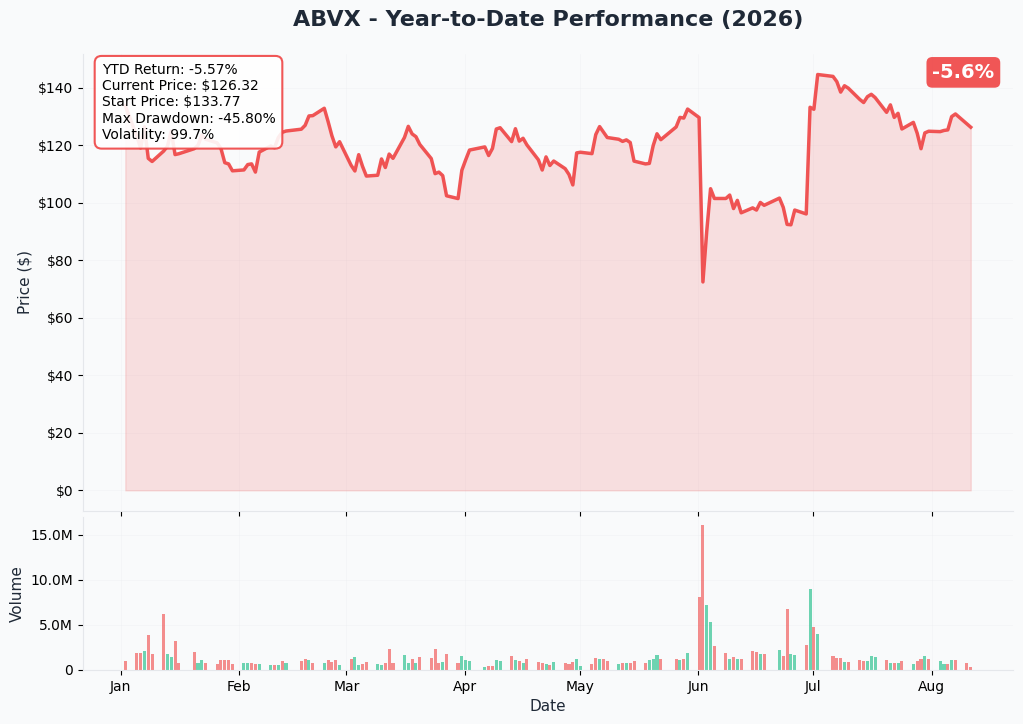
ABVX's year has been a round trip, not a breakout: the stock cratered −44% on June 2 on a malignancy safety signal in Phase 3 data, then recovered almost the entire drawdown on June 29–30 when follow-up safety data eased the cancer concern. At ≈$126.19, the stock sits ≈1% above the $125.00 price of its own July secondary offering and roughly midway between its 52-week low ($67.15) and high ($148.83).
Gamma-based support & resistance
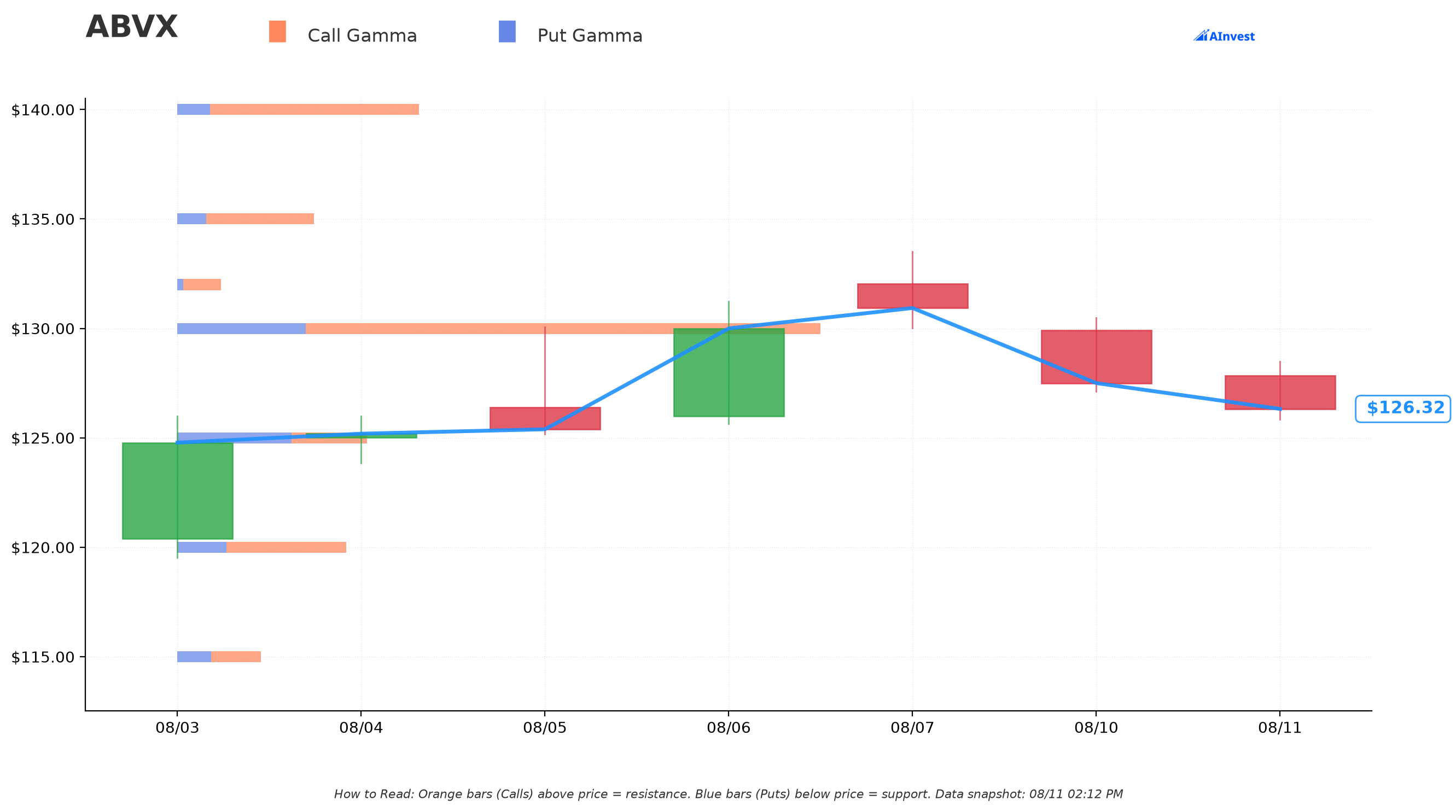
Per gex.json, dealer positioning is thin and concentrated close to spot. The only level flagged with real strength is $130 (moderate resistance, ≈2.9% above spot, net GEX ≈2.10) — call gamma there (2.79) heavily outweighs put gamma (0.69), consistent with dealers needing to sell into a rally toward $130. Further out, the $140 strike (the long leg of today's spread) shows a secondary net-gamma bump (total GEX ≈1.31, net ≈0.95, ≈10.8% above spot) — some of that is likely today's own new open interest. The $200 strike (the short leg) barely registers (total GEX ≈0.36, ≈58% above spot) — dealer hedging flows there are negligible, which is exactly what you'd expect from a strike this far out of the money and this early before expiration.
Implied move
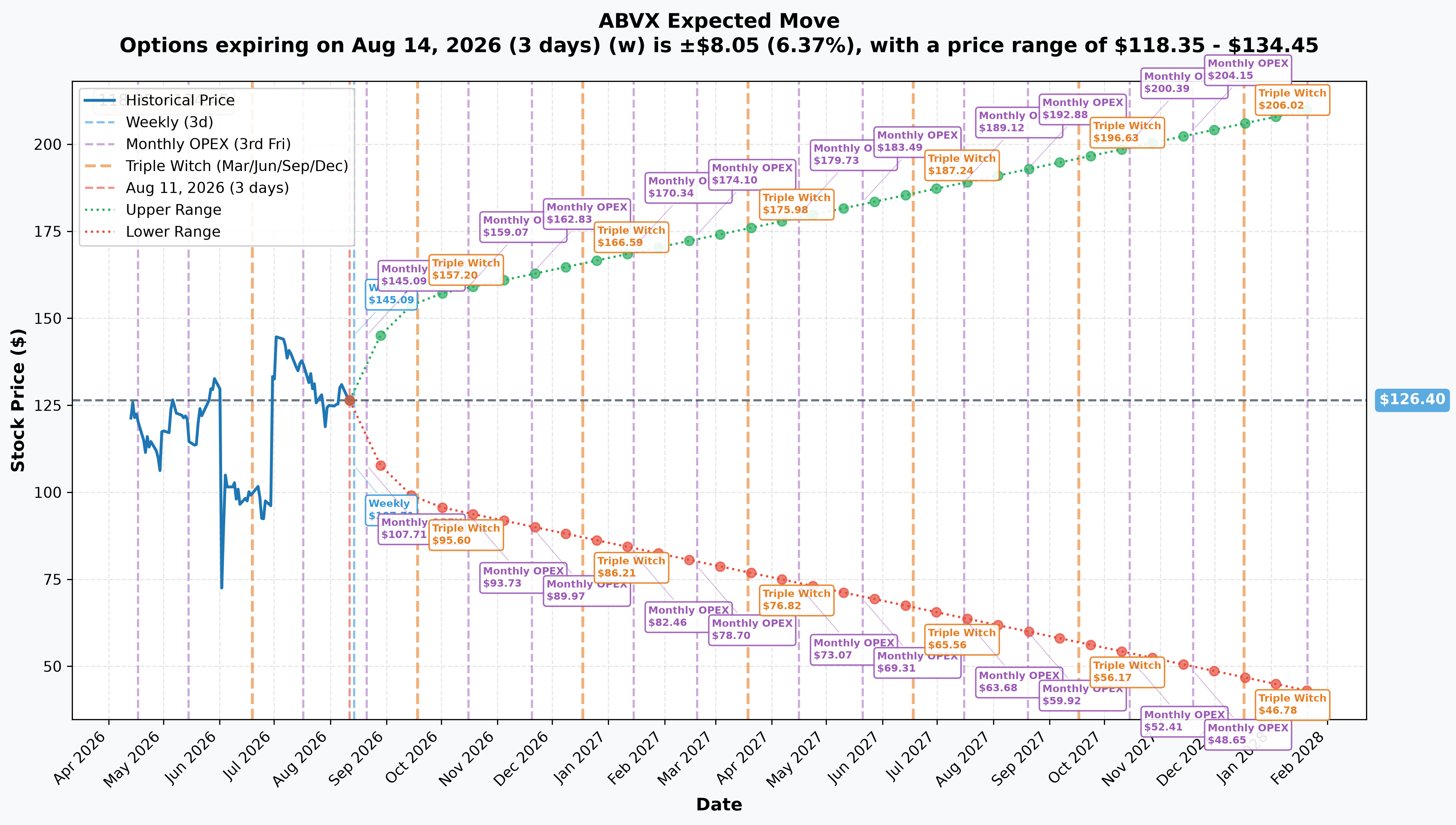
implied_move.json prices the December 18 expiration itself as a Triple Witch OPEX date, with an implied range of $86.21 – $166.59 — a ≈32% move in either direction from spot. That is the important context for this spread: the $140 long strike (≈11% OTM) sits comfortably inside the market's own implied range, but the $200 short strike sits above the entire implied move ($166.59 upper bound), which is why the desk could sell it for only $2.50 — the market is pricing $200 as a genuinely low-probability outcome. Nearer-term, the market prices a ±11.97% move into the August 21 monthly OPEX ($111.27–$141.53) and a ±23.23% move into the September 18 Triple Witch ($97.04–$155.76).
🎪 Catalysts — Separating What's Confirmed From What's Estimated
The single most important fact for this trade: there is no confirmed clinical data readout or regulatory decision inside the December 18 window. What can fall inside it is a company-guided filing, not a coin-flip data event.
Already occurred (context, not upcoming)
- 2026-06-02: stock −44.10% on a malignancy safety signal in Phase 3 maintenance data.
- 2026-06-29: ABTECT Maintenance Part 2 results — malignancy rates framed as within published UC background ranges, which reversed most of the June 2 crash (Abivax).
- 2026-07-06: $920M ADS offering closed, net ≈$874.1M, priced at $125.00 (Abivax).
- 2026-07-30: positive pre-NDA interaction with the FDA; company reaffirmed submission "by end of 2026" (Abivax).
Inside the December 18 option window
| Event | Date | Confirmation |
|---|---|---|
| Half-year 2026 financial results | 2026-09-21 | Company-confirmed date — first clean post-raise cash figure |
| NDA submission to FDA (obefazimod, UC) | Q4 2026 (Oct 1 – Dec 31) | Company-guided quarter, no specific date. ≈85% of the quarter (78 of 92 days) falls before Dec 18; the remaining 13 days after expiry are a real tail risk if the filing slips to year-end |
| Q3 2026 update | ≈November 2026 | ⚠️ Unconfirmed — no sourceable date |
| Renewed M&A approach (Eli Lilly reportedly circled a ≈$15B bid in January 2026; company pushed back in March) | Unscheduled | Speculative — plausible but unpredictable |
Outside the window — the real binary events sit past expiry
| Event | Date | Note |
|---|---|---|
| FDA filing acceptance + PDUFA date assignment | ≈Q1 2027, estimated | No PDUFA date exists yet by definition — it can't be set until the NDA is filed and accepted |
| Phase 2b ENHANCE-CD Crohn's topline | Mid-2027, company-guided (Abivax) | The next genuine data readout — ≈6 months after this option expires |
Eleven analysts average a $165.91 price target (range $142–$187) (stockanalysis.com/forecast) — notably, Wedbush's Hold-rated target sits at exactly $140, the long strike of this spread, while the average target sits well short of the $200 short strike. This is a filing-confirmation and multiple-drift setup, not a scheduled data catalyst.
👥 Four Ways to Read This
🎰 YOLO Trader
Do not copy this as a simple bullish call buy — that is precisely the mistake the flow screen invites. If you want raw upside exposure into the NDA-filing window, buying the $140 call outright (without the short calls) costs more ($15.80 vs $10.80 net) but keeps unlimited upside. Replicating the actual package caps your gain at $200 and adds an open-ended loss above ≈$249.20 — a real risk in a name with live takeover speculation, where a surprise bid could gap the stock straight through your short strikes with no time to adjust.
📈 Swing Trader
The structure argues for watching the $130 gamma-resistance level first (per the gamma chart) and the $140 strike as the trade's own breakeven zone (≈$150.80 for the package to show a profit). If ABVX grinds toward $140–$160 into the September 21 earnings date and the Q4 filing news, the long leg gains steadily; the short calls stay a background drag only once price nears $200. This is a name to size cautiously — it already made a −44% one-day move once in 2026.
💰 Premium Collector
You didn't sell this — someone else did, collecting $2.50 per contract (≈$1.00M) on 4,000 December $200 calls that sit above the market's own ±32% implied move for that expiration. That is a defined, modest credit for taking on real tail risk if ABVX re-rates sharply (M&A, an accelerated filing, or a positive surprise). If you're inclined to sell premium on ABVX yourself, note the short strike here is already priced at the edge of "low probability" — selling closer to spot would need to weigh the binary-event risk this stock has already demonstrated it can deliver.
🔰 Beginner
This is a case study in why the headline number can mislead. "$3.16M call purchase" sounds like someone is betting ABVX goes up a lot. The full picture — a ratio spread — is a bet that ABVX goes up to a specific level and stays roughly there, with real financial risk if the stock keeps climbing past $249.20. Ratio spreads are a defined-risk-on-one-side, undefined-risk-on-the-other structure; they are not a beginner strategy, and this article is meant to help you read them correctly when you see them in flow, not to suggest replicating one.
⚠️ Honest Limits — What the Tape Cannot Prove
- The OPRA tape proves the two legs printed together as a cross and confirms price, size, and prior open interest. It cannot prove the trader's motive, whether this is a new position or an adjustment to an existing book, or whether the desk holds offsetting stock, other options, or a hedge elsewhere.
- Both legs look like proven opens on today's size-versus-OI margin, but a cross can still partially offset existing positions on either side — the next-session OI print is the only real confirmation, and this article will need revisiting if the actual OI move falls well short of the ≈2,200 / ≈4,236 projections above.
- Dealer gamma levels from
gex.jsonare inferred from open interest and a sign convention, not observed market-maker positioning — treat $130 and $140 as probabilistic pressure zones, not hard walls. - The NDA-submission timing is company-guided to a quarter, not a date; nothing here should be read as predicting an exact filing day.
- This is not a recommendation to open, close, or replicate this position. Options trading carries substantial risk of loss, ratio spreads carry open-ended risk on the short side, and clinical-stage biotech names can gap far beyond any strike on a single headline — size and risk-manage accordingly.
Last updated: 2026-08-12 (pre-market) — the next-day OPRA open-interest snapshot confirmed both legs. Dec-18 $140C 200 → 2,210 (+2,010 against a 2,000-lot buy): OPEN (BTO). Dec-18 $200C 236 → 4,247 (+4,011 against a 4,000-lot sale): OPEN (STO). Both inside the published prediction, so no thesis, title or tone changes were required; the ⏳ callout was replaced with the ✅ RESOLVED box.