🔄 AMD — CORRECTED: The $54.4M 2028 Call Buy Created No New Exposure. Open Interest FELL on Both Strikes.
🔄 INVERSION — updated 2026-08-07 pre-market. This was not $54M of new bullish exposure. We flagged both legs ⏳ provisional because each traded below its existing open interest, and set the test: up ≈2,000 if opened, down ≈2,000 if closed. Open interest went down on both. The December-2028 $760 call fell 2,351 → 1,498 (−853) and the $860 call fell 2,744 → 2,526 (−218), on day volume of 2,001 and 2,018 — essentially just this package. Not one new contract was created. A buy that reduces open interest is a buy to close: at minimum 1,071 contracts of pre-existing position were retired across the two strikes, and the rest changed hands between existing holders. Nobody added a long 2028 AMD call position on August 6. See the ✅ RESOLVED box below.
Advanced Micro Devices designs CPUs, GPUs and data-centre accelerators. Sector: Technology / Semiconductors. Market cap $805.63B, stock at $493.50, up 2.38% (StockAnalysis). Follow it on the AMD ticker page.
The Trade in Plain English
In the first ten seconds of the session — 09:30:09 — one order bought two different long-dated calls at once, both expiring December 15, 2028, both 2,000 contracts:
Buy 2,000 $760 calls at $143, and buy 2,000 $860 calls at $129.
Note what this is not. When two same-right strikes trade together, the usual shape is a vertical spread — one bought, one sold. Here both legs were bought. The arithmetic confirms it: the price difference is $143 − $129 = $14 against a $100 strike width, nowhere near the width you would see on a financing spread, and both strikes sit far above the stock. These are two outright long call positions, purchased as one package.
| Time | Buy/Sell | C/P | Expiration | Strike | Size | Volume | OI (prior) | Option Price | Premium | Spot | Option Symbol |
|---|---|---|---|---|---|---|---|---|---|---|---|
| 09:30:09 | BUY | CALL | 2028-12-15 | $760 | 2,000 | 2,000 | 2,351 | $143.00 | $28,600,000 | $472.56 | AMD20281215C760 |
| 09:30:09 | BUY | CALL | 2028-12-15 | $860 | 2,000 | 2,000 | 2,744 | $129.00 | $25,800,000 | $471.38 | AMD20281215C860 |
Net: a $54,400,000 DEBIT. We originally reported a package delta of +223,720 shares as though that exposure had been added to the market. It was not — see below. The strikes sit roughly 61% and 82% above the current price, with almost two and a half years to run.
✅ RESOLVED — Open Interest FELL. Nothing Opened.
Updated 2026-08-07 pre-market. The ≈06:30 ET OPRA snapshot (which reflects the August 6 close) has published, and it landed on the closing branch of the test we published.
| Leg | Baseline OI (Aug-6 snap) | If opened | If closed | Actual (Aug-7 snap) | Δ | Print size | Day vol | Verdict |
|---|---|---|---|---|---|---|---|---|
| Dec-15-2028 $760 C (bought 2,000) | 2,351 | ≈4,350 | ≈350 | 1,498 | −853 | 2,000 | 2,001 | 🔄 NOT AN OPEN — net closing |
| Dec-15-2028 $860 C (bought 2,000) | 2,744 | ≈4,750 | ≈750 | 2,526 | −218 | 2,000 | 2,018 | 🔄 NOT AN OPEN — net closing |
Day volume at each strike was 2,001 and 2,018 — this package and almost nothing else. So every contract of the open-interest change belongs to it, with no ambiguity about attribution.
The mechanics, stated precisely. Open interest rises only when a buyer opening meets a seller opening; it stays flat when one side opens and the other closes; it falls only when both sides close. It fell on both strikes. That means:
- At least 853 contracts at the $760 strike, and 218 at the $860 strike, were bought to close — the buyer was retiring a short call position they already had, against a seller who was also closing.
- The remaining contracts, at most ≈1,147 and ≈1,782, were at best transfers between existing holders — one account's long moving to another account's book, creating nothing new.
- In no scenario consistent with this data did new long call exposure enter the market. The net 2028 AMD call position at these two strikes is smaller after August 6 than before it.
That is the opposite of how the headline print reads on a scanner. A $54.4M buy in the first ten seconds of the session, on two far out-of-the-money LEAP strikes, looks like a conviction bet being established. The open-interest record says a position was being unwound or reshuffled, not built.
What this does not mean. It does not mean anyone turned bearish. Closing a short call is, if anything, the removal of a bearish obligation. And a transfer says nothing about either party's view — a book can change hands for reasons that have nothing to do with AMD.
What is still unknowable. Which portion was a genuine close versus a transfer; who held the pre-existing position; and whether any stock, futures or other options offset sits behind it. Open interest gives us the net, not the participants.
🤓 What This Actually Means — Plain English
Buying a call normally gives you the right to buy the stock at the strike price, and buying one 61% above the current price expiring in 2028 would be a long, slow-burning claim on a much larger AMD.
But that is only true if the buy opens a position. The same buy order can also close one: if you already sold that call to somebody else, buying it back cancels the obligation and takes you flat. On the tape the two look identical — same direction, same size, same premium. What separates them is the next morning's open-interest count, and here it fell.
So the plain-English version of what happened is: somebody paid $54.4M to get out of, or hand off, an existing 2028 AMD call position — not to get into a new one. The money moved; the market's net exposure at those strikes did not grow. It shrank.
The one thing worth carrying forward is the arithmetic in the section above: two strikes bought together, at a $14 price difference against a $100 strike width, genuinely is not a vertical spread. That part of the original read holds. What does not hold is the assumption that the package was new.
📊 The Charts
One-Year Price Action
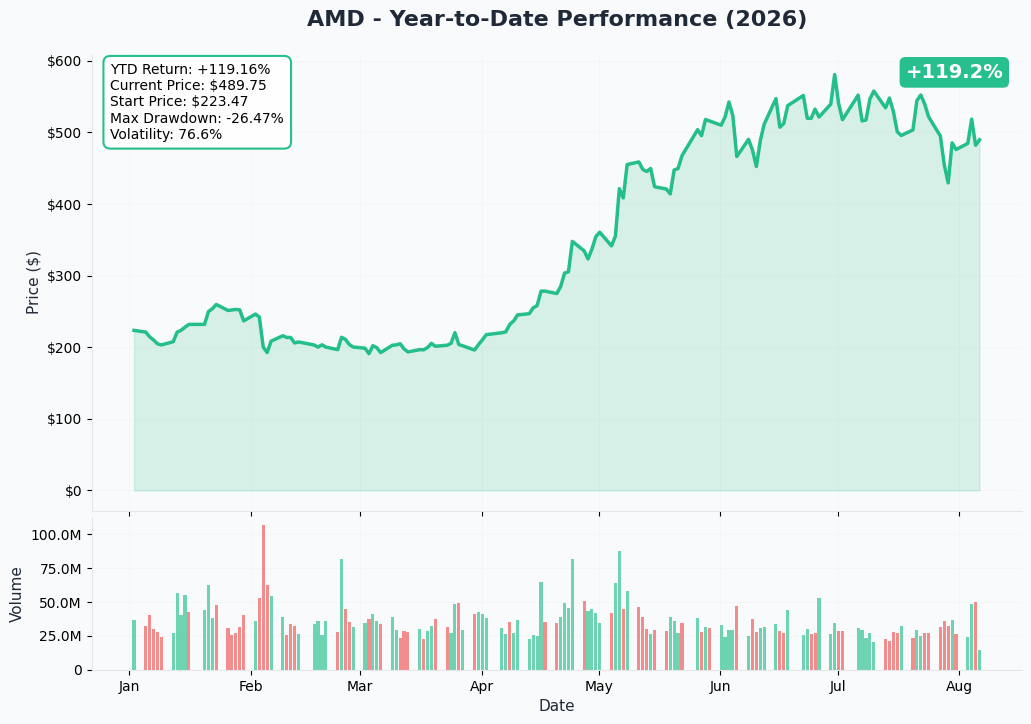
AMD is up ≈119.2% over the past year. With the close confirmed, the relevant reading is the reverse of what we originally wrote: rather than somebody establishing a 2028 bet after a 119% run, this looks like existing 2028 exposure being taken off or handed on after that run.
Gamma Support and Resistance
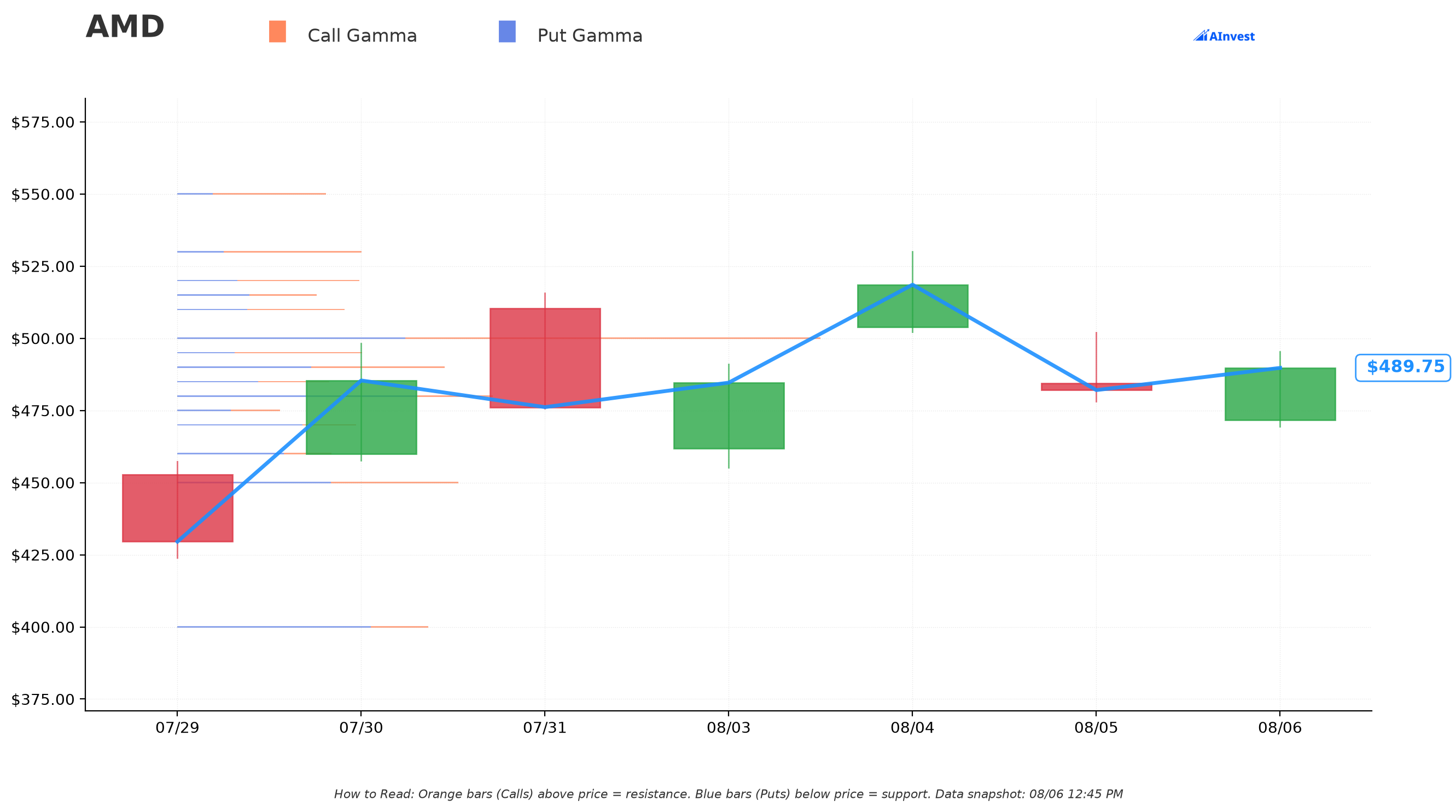
Dealer gamma clusters tightly around the current price — support at $490, $480 and $470, resistance at $495, $500 and $520, all rated Strong or Very Strong. That is a dense, well-defined zone. It tells you where the stock is likely to churn in the near term; it says nothing at all about $760, which is far outside any level the options market is currently hedging.
Implied Move
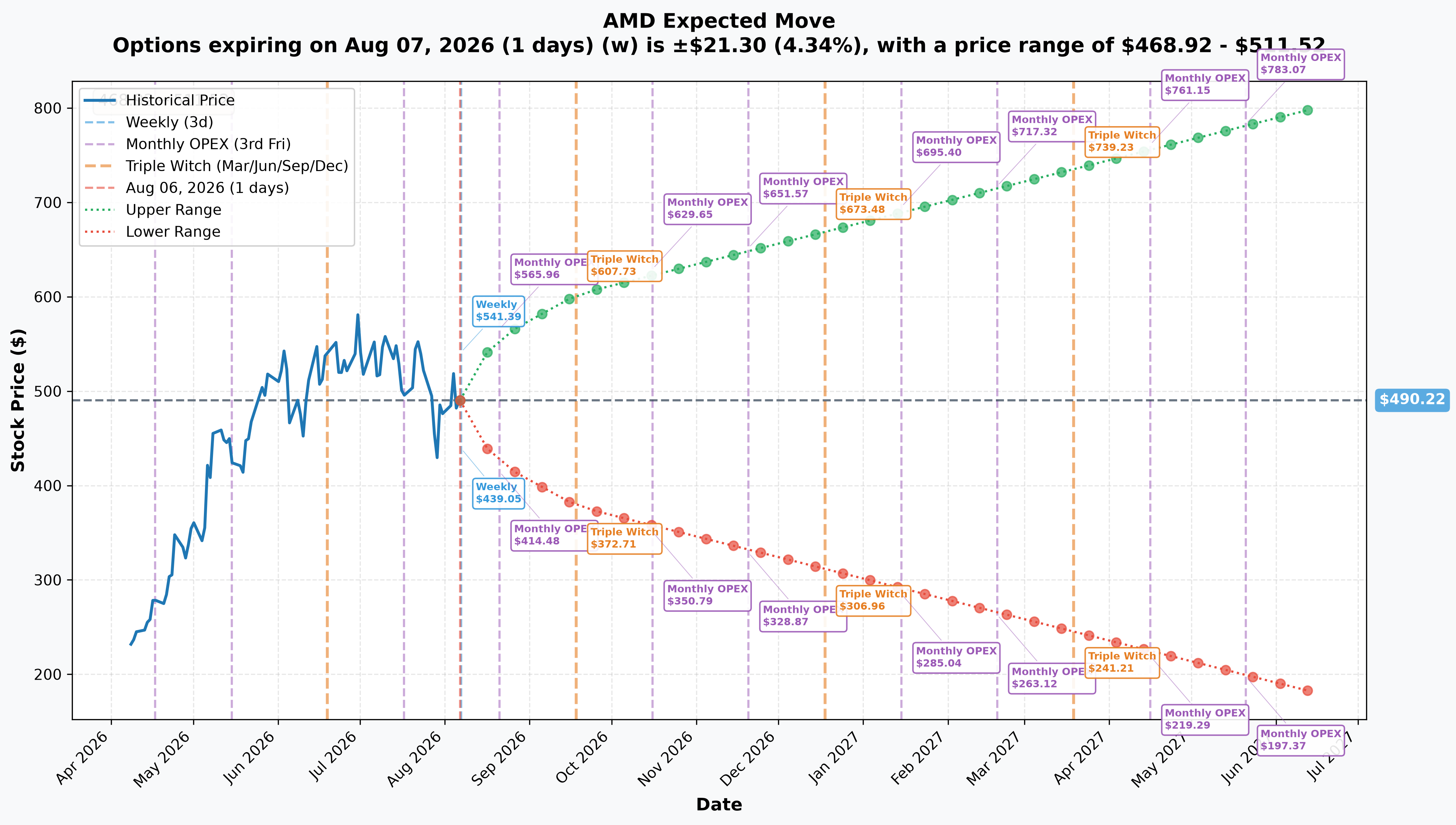
The chain prices ±4.34% by tomorrow ($468.92–$511.52), ±13.82% by August 21 ($422.45–$557.99), and ±63.46% out to June 2027 ($179.11–$801.33).
That last range is the useful one. Even looking almost a year ahead, the market's expected band tops out around $801 — and the $860 strike sits outside it. Somebody was paying $129 a contract for an outcome the chain treats as beyond the likely range; with the close confirmed, the more interesting question is why the other side was willing to let go of it at that price.
📅 Catalysts
- Earnings have already happened. AMD reported Q2 2026 on August 4, delivering "record quarterly revenue and profitability driven by strong data center and AI product adoption" (StockAnalysis). No forward earnings date has been published, so we will not guess one — but a December-2028 contract will span roughly ten more prints regardless.
- Data-centre and AI adoption is the stated engine behind that record quarter and the main thing that has to keep working.
- The street is still above the stock: consensus is Strong Buy with an average target of $606.42, about 22.88% above spot (StockAnalysis). Worth noting that even the analyst average sits far below the $760 strike.
- Spot is roughly 15.6% below the 52-week high of $584.73.
👥 Four Ways to Read This
🎲 The YOLO trader — the thing to take from this is not the trade, it is the correction. A $54.4M call buy printing in the first ten seconds of the session is exactly the kind of headline that gets chased. It created zero new exposure. Size on a scanner is not conviction.
📈 The swing trader — there is no near-term signal here, and now there is no directional signal at all. A 2028 expiry says nothing about the next three months, and the gamma cluster at $470–$520 is a far better guide to that.
💰 The premium collector — the original framing had you as the natural counterparty to a big new long. Scratch that: the seller here was closing, not opening. If you want the lesson that survives, it is that a large buy hitting a strike where open interest then falls is somebody paying to get out of an obligation — which is what a short call looks like when it is being retired, and the price they pay is the cost of that mistake or that risk decision.
🌱 The beginner — two lessons now. First, the net-versus-width check: two strikes trading together usually means a spread, and here the $14 difference against a $100 width proves it is not one. Second, and more important: "BUY" on a flow scanner does not mean "opened." Buy-to-open and buy-to-close print identically. The only way to tell is whether open interest goes up or down the next morning, which is why this article now says the opposite of what it said yesterday.
⚠️ Honest Risk and Limits — What the Tape Cannot Prove
- The opening read was wrong and has been corrected. Open interest fell on both strikes. No new long 2028 call exposure was created; at minimum 1,071 contracts of pre-existing position were retired.
- We cannot split the close from the transfer. Open interest gives the net change, not the identity or intent of either side.
- We cannot see any stock, futures or other options positions this may hedge or offset.
- Deep out-of-the-money LEAP calls lose money slowly and then all at once. The strikes are 61% and 82% away, and even the chain's own year-ahead range does not reach the higher one — relevant to whoever still holds the ≈1,498 and ≈2,526 contracts that remain outstanding.
- A close is not a bearish signal. Buying back a short call removes a bearish obligation; a transfer says nothing at all about either party's view.
Nothing here is investment advice.
Last updated: 2026-08-07 — 🔄 INVERSION. Next-day OPRA open interest resolved both provisional legs against the opening read: the December-2028 $760 call fell 2,351 → 1,498 (−853) and the $860 call fell 2,744 → 2,526 (−218), on day volume of 2,001 and 2,018. No new exposure was created — the package was net-closing plus transfer. Title, lead, delta framing, plain-English, chart, reader and risk sections were rewritten.