🔬 ASML $4.4M December-2027 LEAP Call Bought as a Floor Block — 100 Contracts, Zero Intrinsic, All Bet on the High-NA Ramp
2026-08-11 | 🤝 Floor Block Detected
🔄 Updated 2026-08-12 pre-market — the next-day OPRA open interest confirmed the open to the contract. Open interest on the December-2027 $1,900 call went 6 → 106 (+100) against a 100-lot buy — precisely the ≈106 we published. Every contract is net-new; none of it was existing holders trading against each other. See the ✅ RESOLVED box.
🏢 Who Is ASML?
ASML Holding N.V. sits at the single narrowest point of the entire semiconductor supply chain. It is the only producer of extreme-ultraviolet (EUV) lithography systems on earth, and the only producer of the next-generation High-NA EUV platform — the machines that print the smallest transistor features in every leading-edge chip made anywhere.
Three businesses feed the model:
- 🔵 EUV systems — the low-NA workhorse (NXE platform) and the new High-NA TWINSCAN EXE:5000/5200B tools.
- 🔵 DUV systems — deep-ultraviolet immersion and dry scanners, the volume business for mature and mid-node chips.
- 💰 Installed Base Management (IBM) — service, upgrades, and field options on the fleet already out there. This is the annuity, and it's the fastest-growing line: €2.762 billion in Q2 2026, up from €2.488 billion in Q1.
One thing worth knowing before you look at the options: the US line isn't an ADR. ASML states plainly that its ordinary shares are dual-listed — the exact same shares trade on Nasdaq (USD) and Euronext Amsterdam (EUR), with no ratio and no ADR fee. That's clean for the option deliverable, but it also means a US-listed ASML option carries an unhedged euro/dollar exposure sitting on top of the stock move — the Amsterdam market sets the price, translated at the intraday FX rate.
Company snapshot: market cap ≈$687B (384.10M shares × the ≈$1,789 live quote — sources disagree between ≈$671.6B and $703.8B on share-count convention), sector Information Technology, industry Semiconductors & Semiconductor Equipment.
💰 The Trade: A $4.4M Bet That Looks Small But Isn't
At 12:10:07 ET, someone bought 100 December-17-2027 $1,900 calls for $441.50 each — ≈$4.42M total. It printed as a 🤝 floor block — a negotiated trade with a known counterparty, executed manually rather than swept off the lit book. No urgency, no aggression — this was arranged, not chased.
The first thing to notice: 100 contracts is a tiny number, and $4.42M is not. That's the ASML tax — the stock trades near $1,795, so a single option here costs roughly a quarter of a full share of stock. A "100-lot" on ASML moves more real dollars than a 5,000-lot on a $30 stock. Don't read the low contract count as low conviction.
📋 Full Trade Details
| Field | Value |
|---|---|
| Time | 12:10:07 ET |
| Buy/Sell | BUY |
| Call/Put | CALL |
| Expiration | 2027-12-17 |
| Strike | $1,900 |
| Premium (total) | $4,415,000 |
| Option Price | $441.50 |
| Volume | 100 |
| Prior Open Interest | 6 |
| Size | 100 |
| Spot (at print) | $1,795.46 |
| Order Type | BTO (proven — see callout below) |
| Strategy | Long OTM LEAP Call (Dec-2027) |
| Option Symbol | ASML20271217C1900 |
| Mechanism | 🤝 Floor block (negotiated, known counterparty) |
✅ RESOLVED — Exactly 106, Exactly as Published
Updated 2026-08-12 pre-market. Resolving OPRA snapshot timestamped August 12 (reflects the August 11 close, after this print); baseline is the August 11 snapshot (reflects the August 10 close, before this print).
| Leg | Baseline (Aug-11) | Resolving (Aug-12) | Δ | Print size | What we published | Verdict |
|---|---|---|---|---|---|---|
| Dec-17-2027 $1,900 call (bought) | 6 | 106 | +100 | 100 | "should print at ≈106" | ✅ OPEN (BTO) — exact to the contract |
This is the cleanest resolution on the August 11 board. The strike had been frozen at 6 contracts for weeks; it is now 106. The delta equals the print size exactly, which means zero of this size crossed against another existing holder — all 100 contracts are net-new long LEAP exposure, and someone genuinely owns them into December 2027.
Nothing in the analysis below needs revision.
🤓 What This Actually Means — Plain English
This is where the real story is, and it's in the option math, not the ticker tape.
The option is 100% time value. The strike is $1,900. The stock was at $1,795.46 when this traded — so the call had zero intrinsic value. Every single dollar of that $441.50 price is pure extrinsic value: a wager that ASML moves, and moves before time eats the premium. Compare that to a deep-in-the-money call, where most of the price is just "stock in disguise." This has none of that cushion. If ASML sits still for 16 months, this option is worth zero at expiration — full stop, regardless of how good the company's fundamentals turn out to be.
Breakeven is $2,341.50 — about +30% from here. That's not a typo. To simply break even (ignoring the time value of money), ASML has to trade above $2,341.50 on December 17, 2027. In market-cap terms: ASML is worth ≈$687B today; breakeven requires ≈$899B — the position needs the company to add roughly $212 billion of market value in 16 months, on top of the $4.42M already paid.
Here's the part that makes a 5.8%-out-of-the-money strike deceptive: it's basically at-the-money once you account for time and interest rates. A $1,900 strike sounds comfortably above the $1,795 spot. But options don't price off today's spot — they price off the forward price, which for a 16-month horizon and a positive interest rate sits meaningfully above spot. Run the math backward from the $441.50 price (using T ≈1.35 years and a ≈3–4% rate) and the implied forward lands around ≈$1,870–1,895 — almost exactly on the $1,900 strike. That's why the option isn't priced like a moonshot lottery ticket; solving for the price also implies volatility around ≈50–55% and a delta near ≈0.60–0.62.
What a 0.6 delta means in plain terms: for every $1 ASML moves, this option's value moves roughly $0.60 — right now. That's much closer to owning stock than to owning a cheap, far-out-of-the-money gamble. At that delta, 100 contracts control roughly 6,000–6,200 share-equivalents, or ≈$10.8–11.1M of notional exposure, for $4.42M of premium — call it ≈2.5× leverage on the stock, a leverage ratio that shrinks toward 1× if the stock rallies (option goes deep ITM) and toward zero if it doesn't. This reads less like "loading up on a lottery ticket" and more like a considered, capital-efficient way to run a long-term bullish view with a hard, known-in-advance maximum loss.
(Flagged: the ≈50–55% IV and ≈0.60–0.62 delta above are computed from price/strike/spot/tenor, not pulled from a live quote feed — treat them as estimates, not sourced greeks.)
📈 Chart Check
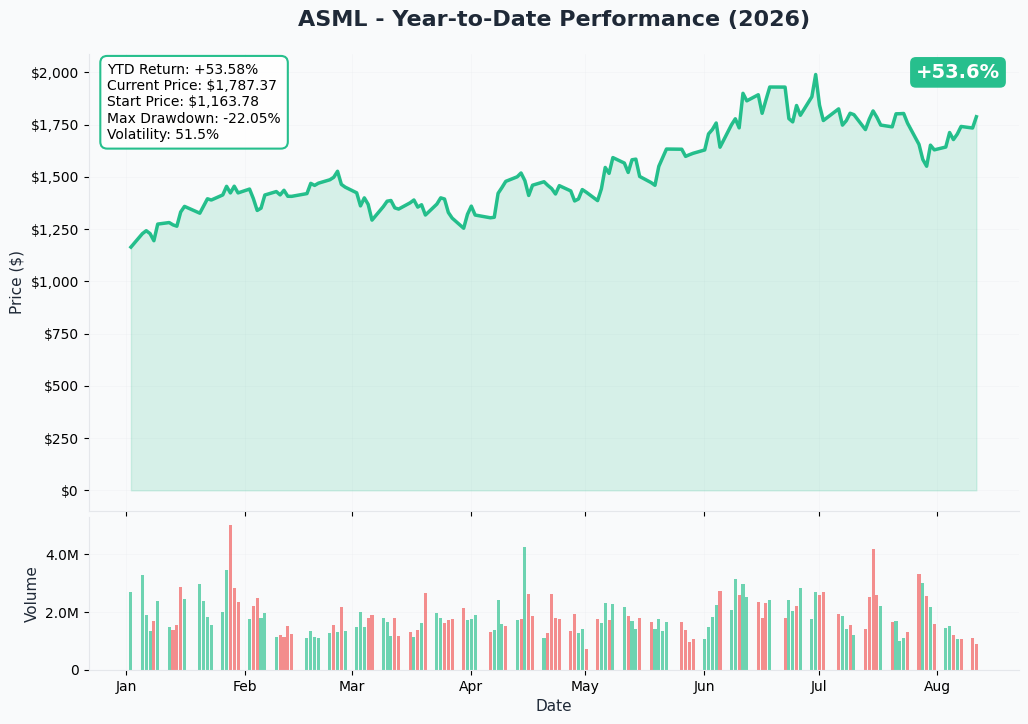
ASML's last year has been violent in both directions: 2026 year-to-date is +62%, the stock touched an all-time closing high of $1,989 on June 30, and then it fell ≈18% in July — despite the company raising full-year guidance during that same month. Currently trading ≈$1,787–1,795, ≈1.3% above its 50-day moving average ($1,766.69) and ≈26% above its 200-day ($1,416.49), with an RSI near 55.7 — neither stretched nor washed out.
🎯 Gamma Support & Resistance
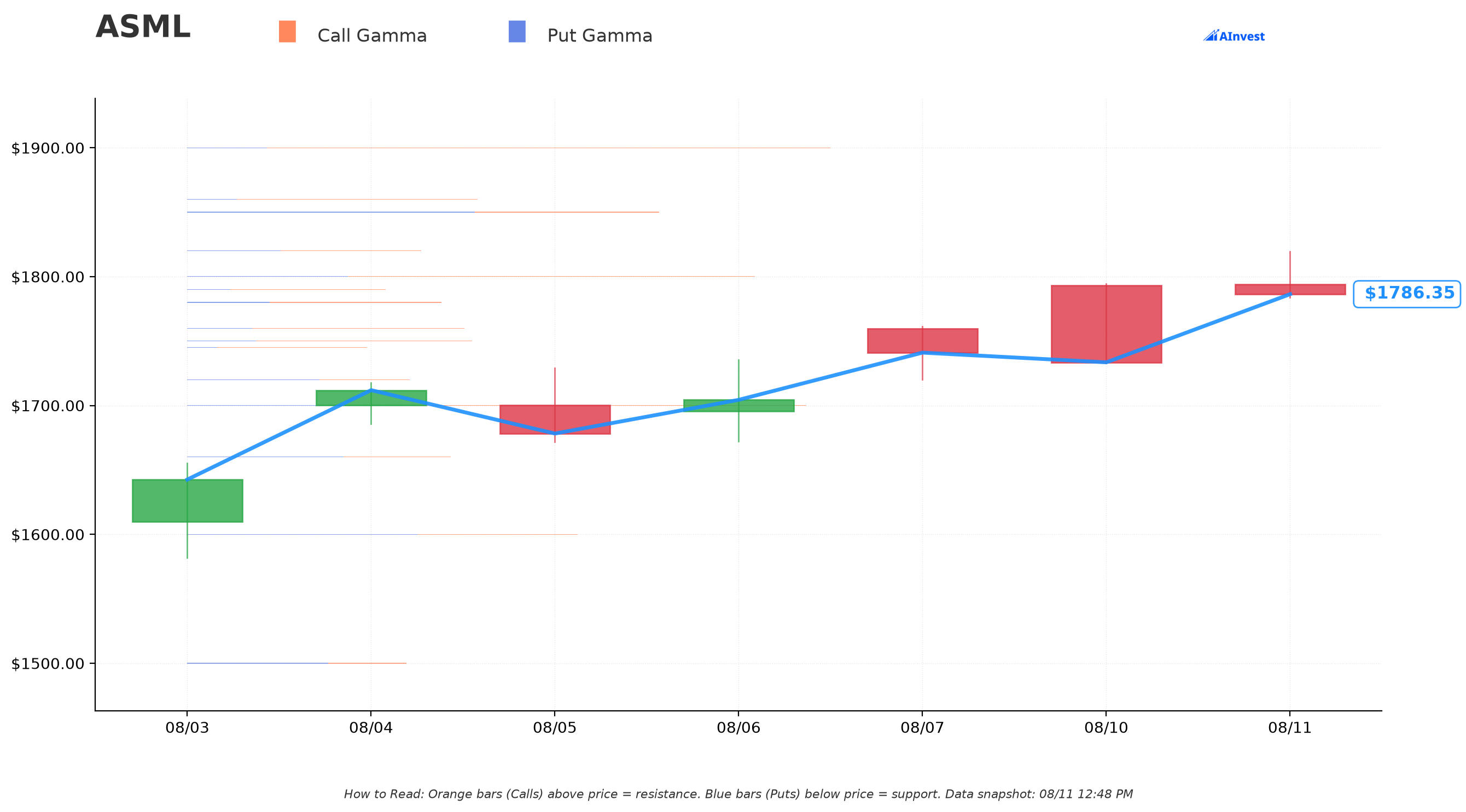
Reading gex.json at a reference spot of $1,786.85: the largest single positive net-gamma strike on the board is $1,900 — the exact strike this trade bought (net gamma +0.77, total gamma exposure 1.03, the single biggest total-GEX strike in the whole chain). $2,000 (net gamma +0.55) is the next major magnet above that. Below spot, $1,850 shows the largest net-negative gamma pocket (−0.16), with smaller resistance-turned-support clusters at $1,780 and $1,800 right around the current price. In plain terms: dealers already have real hedging exposure concentrated at $1,900 and $2,000 — those levels tend to act as price magnets/pivot zones as expiration approaches, which is notable given this LEAP's strike sits directly on top of the nearest one. These gamma levels are dynamic and will shift daily as new options trade — they're a same-day/near-term read, not a 16-month forecast.
📐 Implied Move
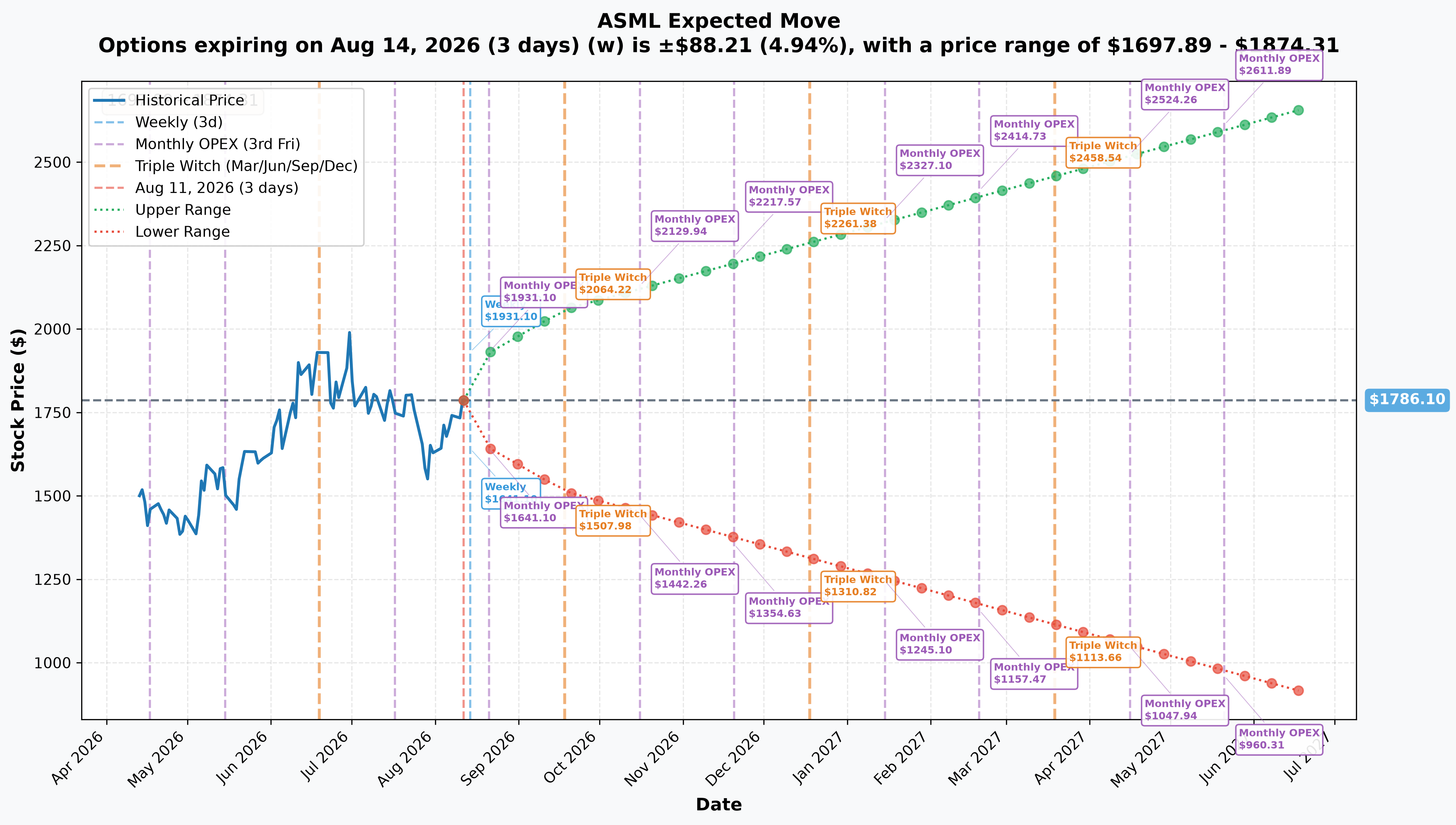
Per ASML_implied_move.json (spot $1,786.10): the market prices a weekly (2026-08-14, 3 days) implied move of ≈4.94% ($88.21), range $1,697.89–$1,874.31; a monthly OPEX (2026-08-21, 10 days) move of ≈8.12% ($145.00), range $1,641.10–$1,931.10; and a quarterly triple-witch (2026-09-18, 38 days) move of ≈15.33% ($273.74), range $1,512.36–$2,059.84. Zooming out to the longest available reference — the yearly LEAPS bucket (2027-06-17, 310 days, which pre-dates this trade's December 2027 expiration) — the market prices an implied move of ≈48.69% ($869.60), a range of $916.50–$2,655.70. That range brackets the trade's $1,900 strike and its $2,341.50 breakeven comfortably, which is consistent with the ≈50–55% IV estimated above — this is a genuinely two-sided, high-uncertainty instrument, not a coin flip disguised as a sure thing.
🎪 Catalysts
What already happened (last three months)
- Q2 2026 results, July 15: €9.326B in sales, 54.0% gross margin, beat guidance on both, driven by Installed Base Management strength. Full-year 2026 guidance was raised to €43–45B from €36–40B just one quarter earlier — an ≈€8B lift in six months.
- High-NA EUV reaches high-volume manufacturing, also July 15: Intel Foundry shipped its first high-volume logic product — the Core Ultra Series 3 ("Panther Lake") on Intel 18A — built with High-NA tools at yields matched to the existing NXE platform. This is the first real production proof that the technology this LEAP is betting on actually works commercially, not just in the lab.
- The stock de-rated into the good news. From the June 30 all-time closing high of $1,989, ASML fell ≈18% in July — a −7.4% drop on July 1 on reports Anthropic was working on its own AI chip (a customer-concentration scare), a modest +2.2% pop on the July 15 beat-and-raise, and a −5.8% drop on July 27 on reports that a Chinese government-backed firm in Shanghai has begun building its own DUV lithography systems.
- China's share of ASML's business keeps shrinking — by design. System sales to China fell from 41% in 2024 to ≈16% of total revenue in H1 2026, with ≈20% expected for full-year 2026. The bull case: ASML raised FY2026 guidance while China fell — the rest of the business is doing all the work.
- A quiet but real disclosure gap: the quarterly net bookings figure — historically the single number that moved this stock most — is absent from both the Q1 and Q2 2026 press releases. ASML hasn't announced a policy change; the number is just not there, replaced by qualitative language about "extremely strong" order intake and by capacity guidance instead: +30% low-NA EUV capacity and +30% DUV immersion capacity planned for 2027.
What's ahead (through the option's life)
- ≈October 14, 2026 — Q3 2026 results (date estimated, not yet confirmed by ASML). Guided to €11.0–12.0B at 55–57% gross margin. This is the near-term credibility test for the €43–45B full-year number — H1 already delivered €18.1B, implying a steep €25–27B second half.
- ≈Late January 2027 — Q4/FY2026 results plus first formal FY2027 guidance. Street currently models $54.33B revenue and $51.42 EPS for 2027. This is arguably the single biggest re-rating event inside the option's window.
- Mid-April 2027, mid-July 2027, mid-October 2027 — Q1, Q2, and Q3 2027 results. All five of ASML's next scheduled quarterly reports fall inside this option's life.
- A possible Investor Day / 2030 target reset — speculative, no date announced. Worth flagging: ASML's 2030 target of €44–60B revenue was set in November 2024; the FY2026 guide of €43–45B already sits at the bottom of that range, four years early.
Structurally important: this option expires December 17, 2027 — roughly six weeks before ASML's FY2027 annual report (≈late January 2028), which is expected but not yet scheduled. The holder is long the entire 2027 High-NA production ramp and rides through five straight quarterly reports, but the contract settles on the market's expectation of how 2027 finished and what 2028 looks like — not on the printed full-year result. The last hard catalyst inside the window is the ≈October 2027 Q3 print; the final ≈two months of the option's life carry no scheduled company event.
👥 Four Ways to Read This
🚀 YOLO Trader
You're not going to buy this exact contract — $441.50 a share is a real check, not a lotto ticket. If you want the same directional bet with less capital at risk, look further out-of-the-money (higher strike, same expiration) for a cheaper, higher-leverage, lower-delta version. Understand you're giving up the ≈0.6 delta stock-substitute quality for pure gamma — and pure gamma on a 16-month clock bleeds theta every single day nothing happens.
📊 Swing Trader
This contract's multi-month horizon doesn't suit a swing timeframe, but the print is a useful signal: someone with real capital is positioning for ASML to clear its all-time high and keep going, timed onto the High-NA ramp. If you're trading the next few weeks, the more relevant read is the implied-move data above — a ≈4.94% weekly move and ≈8.12% monthly move bracket the near-term range, not this LEAP's math.
🛡️ Premium Collector
Selling premium against a name with ≈50–55% estimated IV can look attractive on a vol-percentile basis, but ASML is a single, binary-report name with a genuine bull/bear analyst split (three Sell ratings against a $2,874 high target) — a name that fell 18% in a month after a beat-and-raise. If you sell premium here, size it assuming the stock can gap double digits on a headline, and prefer defined-risk structures (spreads) over naked short premium.
🌱 Beginner
The single most important lesson in this whole trade: an option that is 100% time value can go to zero even if you're eventually right about the company. If ASML grinds sideways near $1,800 for a year and then finally breaks out in month 17, this specific contract has already expired worthless. Time is not free, and on a $4.42M position, someone is paying real money every day just for the right to be right on time. Before buying any LEAP, ask: what does the stock need to do, and by when, for this to pay off — not just "do I like the company."
⚠️ Honest Limits — What We Cannot Prove From the Tape
- We can confirm this was a genuine opening trade (prior OI of 6 flat for weeks makes that clean), but the tape cannot tell us why. We don't know if the buyer is hedged elsewhere — in Amsterdam-listed options, in shares, or not hedged at all.
- We don't know the counterparty, the broker, or whether this is a single trader's conviction bet or an institutional structural position (e.g., part of a larger book).
- The ≈50–55% implied volatility and ≈0.60–0.62 delta cited above are calculated from the trade's own price, strike, spot, and time to expiration — not pulled from a live options-pricing feed — so treat them as informed estimates, not exact greeks.
- ASML's own bookings disclosure gap means neither we nor the market currently has the forward-order signal this stock has historically traded on; capacity guidance (+30% EUV, +30% DUV for 2027) is the best available substitute, but it is not the same data.
- A negotiated floor block has a known counterparty and was arranged off the lit order book — that tells us the trade was deliberate, but it does not tell us anything about aggressor side or urgency the way a lit sweep would.
This is options-flow analysis, not investment advice. Options trading involves substantial risk, including total loss of premium, and is not suitable for all investors. Do your own research and size positions according to your own risk tolerance.
Last updated: 2026-08-12 (pre-market) — the next-day OPRA open-interest snapshot confirmed the open. Dec-17-2027 $1,900C 6 → 106 (+100 against a 100-lot buy): OPEN (BTO), exact to the contract and exactly the figure published. No thesis, title or tone changes were required; the ⏳ callout was replaced with the ✅ RESOLVED box.