😬📞 AZN: $7.1M in Calls Bought at the Offer While Shares Crater −7% on a $400B Megadeal Report
📅 August 3, 2026 | 🔥 Unusual Activity Detected
✅ UPDATE — August 4, 2026 pre-market: confirmed a clean, fully fresh open. Open interest on the Oct-16 $170 call went 270 → 16,015 (+15,745) against a 15,500-lot print — ≈102% of the block, so every contract was new money and then some. See the ✅ RESOLVED box.
🎯 The Quick Take
AstraZeneca shares got hammered today — down roughly −7.1%, from Friday's $169.64 close to $157.63, on ≈11.5 million shares versus a normal ≈1.7 million. The trigger: a Financial Times report that AstraZeneca is in early talks on a ≈$400 billion combination with Bristol Myers Squibb, and investors hate the math of the acquirer paying up in its own stock. Into that exact decline, at 14:09:36 ET, someone paid $7.13 million to buy 15,500 October 16 $170 calls at $4.60 — printed 100% at the offer. Prior open interest on that strike was just 270 contracts, so this is essentially a brand-new, proven-opening position, not an add to something old. It is a contrarian bet that today's drop is headline noise, not a fundamental break — but the strike still needs ≈8.3% of recovery just to be worth anything at expiration.
📊 Company Overview
AstraZeneca PLC (AZN) is a UK-headquartered global biopharmaceutical major that U.S. investors access through an American Depositary Receipt. Its business spans oncology (Tagrisso, Imfinzi, Enhertu, Datroway), cardiovascular, renal & metabolic disease (Farxiga), and respiratory & immunology, plus rare disease through its Alexion unit.
- Market cap: ≈$245–265 billion (sources disagree slightly on share-count basis — MarketBeat shows $244.5B, StockAnalysis shows $263.7B)
- Sector: Healthcare / Biopharmaceuticals
- P/E: ≈23.5–25.3x
- Dividend yield: ≈2.75%
- YTD performance (before today): only ≈−7.7%; today's single session roughly doubled AZN's full-year loss, taking YTD to ≈−14.3%
💰 The Option Flow Breakdown
📊 What Just Happened — The Tape
| Time | Symbol | Buy/Sell | Type | Expiration | Premium | Strike | Volume | OI | Size | Spot | Option Price | Option Symbol |
|---|---|---|---|---|---|---|---|---|---|---|---|---|
| 14:09:36 | AZN | BUY | CALL $170 | 2026-10-16 | $7,130,000 | $170 | 15,628 | 270 | 15,500 | $156.91 | $4.60 | AZN20261016C170 |
🤝 BLOCK CROSS — this printed as a single-leg negotiated block, not a lit sweep. A broker matched a known buyer and seller off the open book. That means the size alone carries less directional certainty than a lit tape print would — but it still printed 100% at the offer ($4.60), which is a meaningful, non-trivial detail even on a cross: nobody negotiates a price at the full ask by accident.
✅ RESOLVED — Next-Day OI Is In (August 4, 2026 pre-market)
The OPRA open-interest snapshot timestamped August 4, 2026 ≈06:30 ET reflects the close of business August 3 — the definitive open-vs-close test we flagged when this published. Here is what it says.
| Leg | Baseline OI (Aug-3 snap) | Resolving OI (Aug-4 snap) | Δ | Print size | Δ as % of print | Verdict |
|---|---|---|---|---|---|---|
| Oct-16-2026 $170 call (bought) | 270 | 16,015 | +15,745 | 15,500 | ≈101.6% | ✅ OPEN (BTO) |
Verdict: a fully fresh long call position — no closing, no transfer. Open interest rose by slightly more than the block itself, which means additional buyers opened at the same strike on top of the flagged trade. The strike went from a near-empty 270 contracts to over 16,000 in one session. The BTO label published August 3 is confirmed at HIGH confidence: someone genuinely opened ≈$7.1M of upside exposure into a −7% day, and did not close anything in the process.
🤓 What This Actually Means — Plain English
Let's decode this one piece at a time:
- Order type: BTO (Buy-to-Open). Paid premium, opened a brand-new long call position. This is a directional bull bet, not a hedge and not income collection — full stop, no ambiguity here given the 57.9x OI multiple.
- Breakeven at expiration: $174.60 ($170 strike + $4.60 paid). From today's $157.63 close, AZN needs to climb ≈10.8% in ≈10.5 weeks just to get this trade back to even. Just to reach the strike itself (at-the-money, ignoring the premium paid) requires ≈8.3% of recovery.
- Delta exposure: ≈+442,835 shares, against 15,500 contracts (1,550,000 shares of notional). That works out to an option delta of roughly 0.29 — this is a real out-of-the-money call, not a stock surrogate.
- The context is the whole story. Buying calls at the full offer on the day a stock drops 7% is buying a falling knife with a deadline attached. Whoever did this is not reacting to AstraZeneca's own numbers — the company's actual news flow into today was uniformly positive (see catalysts below). They are making a specific bet: that the market is overreacting to deal speculation that AstraZeneca itself has not confirmed, and that if the Bristol Myers talks cool off or get denied, AZN snaps back toward — or through — $170 well before October 16.
- Why a cross and not a lit sweep matters here: because it's a negotiated block, we can't read "urgency" into it the way we would a lit tape aggressor lifting the offer in real time. But someone still agreed to pay full ask for 15,500 contracts on the single worst trading day of AZN's year — that's a strong opinion, expressed through a quieter mechanism.
- Motive, graded: PROVEN — bought, at the offer, opening. INFERRED — this is a contrarian bet that the M&A headline is the whole story and will fade; we cannot see whether the same desk also holds AZN stock, sold puts elsewhere, or is running a broader book. The tape cannot tell us who they are or what else they own.
📈 Technical Setup / Chart Check-Up
YTD Performance Chart
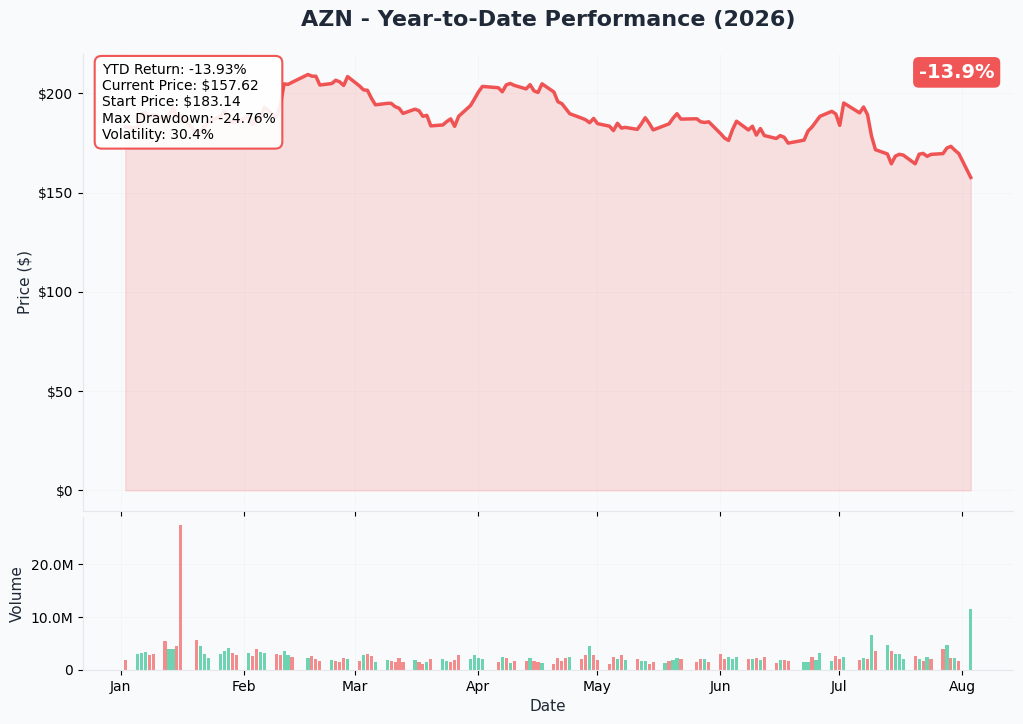
AZN spent most of 2026 grinding lower before today's gap. The stock was down only ≈−7.7% YTD through Friday's $169.64 close — a mild, orderly decline. Today's single session took the year-to-date loss to ≈−14.3%, effectively doubling it in one afternoon. That's the visual: a slow bleed, then a cliff.
Gamma-Based Support & Resistance Analysis
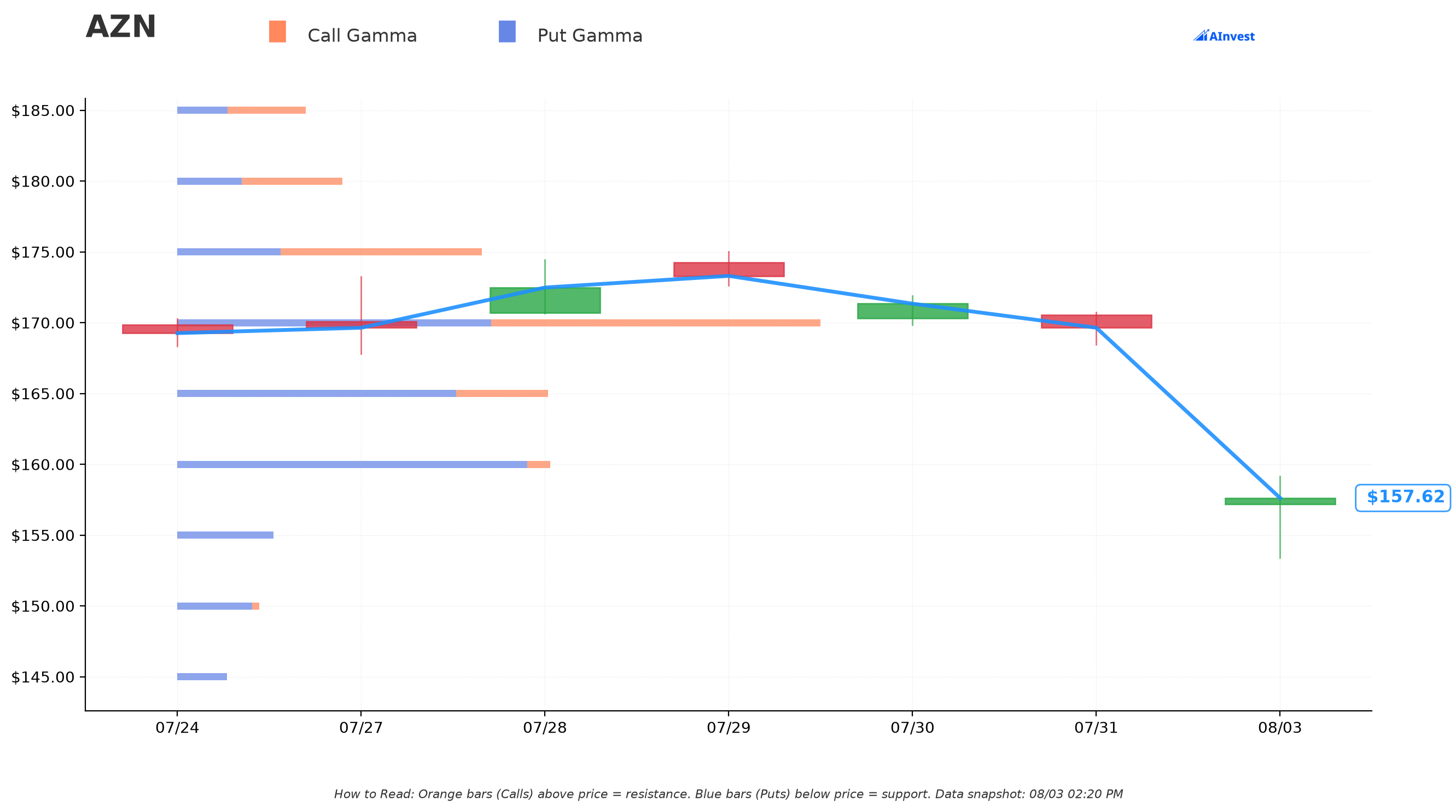
Current price: ≈$157.69
- 🔵 Put Wall (support): $155 — the largest put-gamma concentration at or below spot, sitting just ≈1.7% below current price. This is the nearest floor dealers are likely to defend.
- 🟠 Call Wall (resistance): $170 — the largest call-gamma concentration at or above spot, ≈7.8% above spot — and notice: this is the exact strike the $7.13M call buyer chose. Whoever put this trade on picked the single biggest resistance level in the chain, not a random number.
- ⚙️ Zero-gamma flip (Hedge Wall): ≈$168–170 — net gamma is negative from $155 through $165 (dealers short gamma, amplifying moves) and flips slightly positive right around $170. That means $170 is both the Call Wall and roughly where dealer hedging flips from destabilizing to stabilizing — a genuinely load-bearing level, not just a round number.
- A secondary cluster sits at $160 (≈1.5% above spot), which carries the single largest total gamma in the chain (calls + puts combined) — a magnet zone right around the money that price will likely fight through before it can even approach $170.
What this means for traders: the $170 call buyer picked a strike that sits exactly on top of the level where dealer gamma flips sign. If AZN can clear $160 and then $165, dealer hedging around $168-170 could help accelerate a move into the strike — but that same wall has repelled rallies before and could just as easily cap it.
Implied Move Analysis
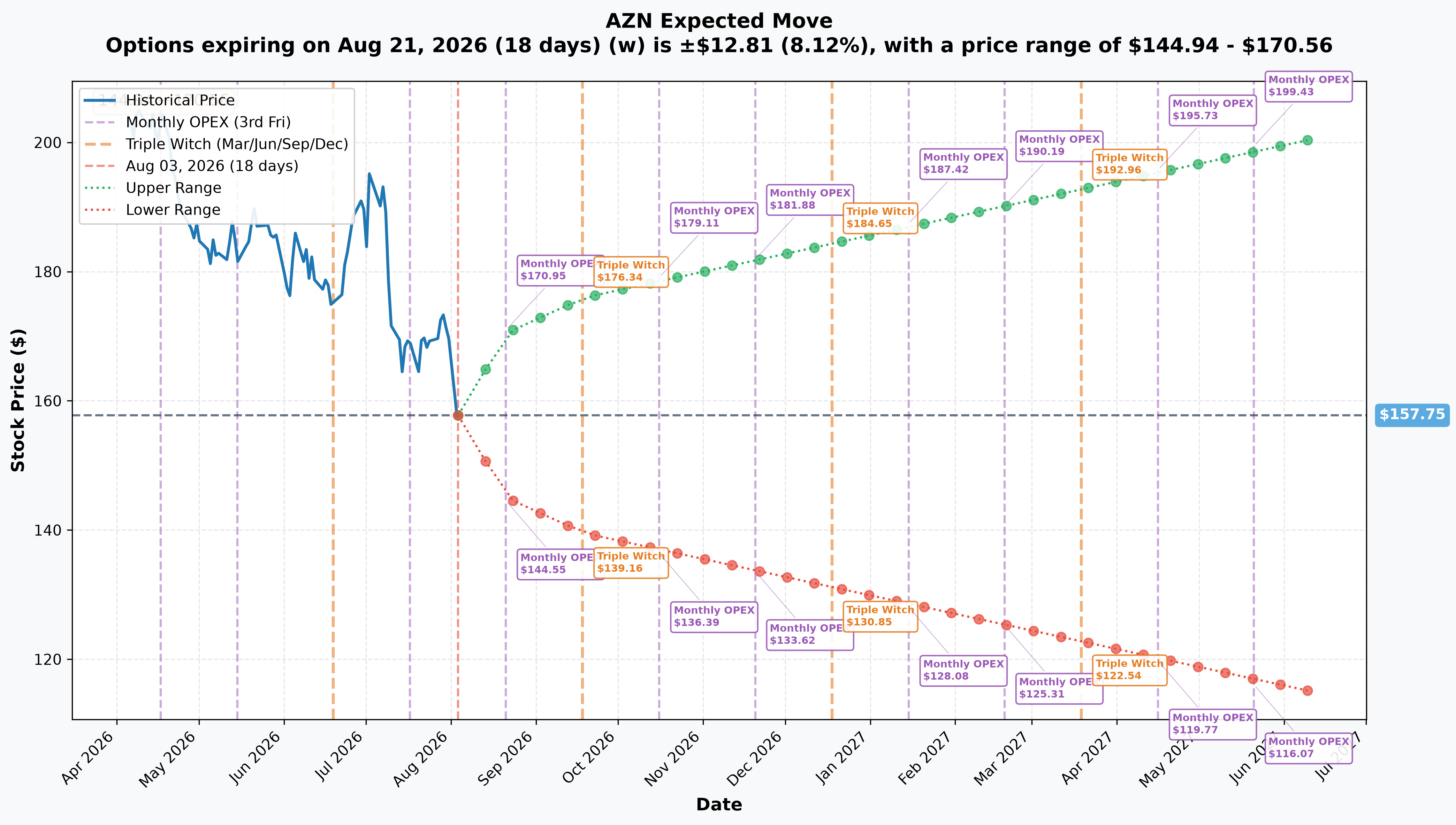
- 📅 Monthly OPEX (Aug 21, 18 days): ±8.12% → range $144.94 – $170.56. Notice the upper bound is already essentially at the $170 strike — the market is pricing a scenario where AZN could tag this call's strike within three weeks, if it moves like a "normal" volatile month.
- 📅 Quarterly Triple Witch (Sep 18, 46 days): ±11.55% → range $139.53 – $175.97.
- 📅 Monthly OPEX — same date as this trade's expiration (Oct 16, ≈10.5 weeks): upper range $179.11, lower range $136.39.
- 📅 LEAPS (Jun 17, 2027, 318 days): ±27.47% → range $114.41 – $201.09.
Does the cone reach $170 by October? Yes — comfortably. The options market's own pricing for the Oct-16 expiration puts the upper edge of the "normal" range at $179.11, roughly $9 above the strike this trade bought. That doesn't mean it's likely — implied move ranges are roughly one standard deviation, so this is "plausible," not "expected" — but it confirms the $170 strike is well within the boundaries of what the market itself considers a realistic outcome over this window, not a moonshot number.
🎪 Catalysts
🚨 Why AZN Actually Fell −7.1% Today (the whole story)
This was not a trial failure, not a regulatory rejection, and not a guidance cut. It was a Financial Times report that AstraZeneca is in early talks on a combination with Bristol Myers Squibb valued around $400 billion — and the market punished the acquirer, exactly as it usually does in these situations. Per StockAnalysis's AZN coverage, "the proposed combination could be valued around $400 billion and would create one of the world's largest pharmaceutical companies. While Bristol Myers Squibb stock surged on the news, AstraZeneca shares fell as analysts questioned the strategic rationale."
The strongest evidence this is a deal story and not a fundamentals story: the target went up while the acquirer went down. Bristol Myers Squibb initially jumped ≈8% to $70.47 on the report before fading back to $65.05, roughly flat (−0.40%) on the day. A pipeline disaster at AstraZeneca does not send Bristol Myers up 8% intraday, even if the pop faded — this is a cross-asset tell that decisively points to deal speculation, not a company-specific AZN problem. Citi called the report "surprising, given AstraZeneca's best-in-sector pipeline," and MarketBeat's headline feed carries the line "AstraZeneca investors balk at prospect of $400 billion Bristol Myers pharma deal" — this is a capital-allocation objection, not a "the drugs don't work" objection.
Ruling out the alternatives: AZN's own newsflow into the drop was uniformly positive — Datroway's EU approval for metastatic triple-negative breast cancer (July 31), a positive overall-survival readout for sonesitatug vedotin in gastric cancer (July 27), and a CHMP positive opinion for Enhertu + pertuzumab in HER2+ metastatic breast cancer (July 24). H1 2026 earnings, reported July 27, showed revenue of $30.7B (+9%) with guidance reconfirmed, and Q2 EPS of $2.63 beat the $2.50 consensus (StockTitan, MarketBeat). None of that broke down today — it was overwhelmed by the merger headline.
Critically: AstraZeneca has not confirmed anything. Every source describes "early discussions," and one analyst view characterizes a purchase as "unlikely for now". This is a binary, headline-risk situation: if AZN walks away or the report gets downgraded, much of the −7.1% arguably has no fundamental basis to persist. If the company confirms large-scale equity issuance to fund it, the de-rating likely extends.
🗓️ Mapping the calendar to this trade's October 16 expiry
- The single biggest near-term catalyst is an AstraZeneca statement on the BMY talks — this could land any day in August, well before this trade expires, and is the event most likely to move the stock ≥5% in either direction.
- EC final approval of Enhertu + pertuzumab is expected in the August–October 2026 window, following the confirmed CHMP positive opinion — this sits comfortably inside the Oct-16 window and is a genuine, positive, company-specific catalyst independent of the merger noise.
- Sonesitatug vedotin regulatory filings on the confirmed gastric-cancer OS win are expected in H2 2026 — also inside this window.
- Next earnings (Q3 2026) — estimated, not confirmed, for early-to-mid November 2026 based on AstraZeneca's standard reporting cadence; StockAnalysis's own "next earnings date" field hadn't rolled forward off the just-reported H1 date at the time of writing. Either way, no scheduled earnings print sits inside this trade's Oct-16 window — that date lands after expiration, so this position will not see the next quarterly report. Management's first public Q&A addressing the BMY report, however, could come far earlier and well within the window.
- Analyst consensus (pre-selloff, likely stale) sits at Moderate Buy, average target $211 (MarketBeat) — implying ≈34% upside from spot, though these targets almost certainly have not yet been revised for the merger headline.
🎲 Price Targets & Probabilities
📈 Bull Case (the trade's thesis) — Target: $170–$180
AstraZeneca denies or walks away from the BMY talks in the coming days/weeks, the deal-overhang discount unwinds, and the stock recovers most of today's −7.1% drop plus continues on its underlying pipeline strength (Enhertu EU approval, sonesitatug filings). AZN reclaims the $160 magnet zone, then the $170 Call Wall/gamma-flip level — which is also where dealer hedging could help accelerate the move. This is what the $170 call needs.
🎯 Base Case — Target: $150–$165 (chop while the headline resolves)
AZN trades a wide, choppy range while the market waits for an official company statement. Some of the drop holds as a permanent "trust discount" even if the deal doesn't happen, because the market has now priced in the possibility that management would consider something shareholders dislike. The $155 Put Wall and $160 gamma cluster define this zone.
📉 Bear Case — Target: below $145
AstraZeneca confirms the talks and terms involve meaningful AZN equity issuance and/or leverage, validating the de-rating fear. The stock continues lower toward the lower edge of the implied-move range (≈$136–145 by October).
💡 Trading Ideas — Four Reader Types
🎰 YOLO Trader
Mirroring this exact trade means paying $4.60 for the Oct-16 $170 call, needing an ≈10.8% rally to breakeven in ≈10.5 weeks, with 100% of the premium at risk if AZN just sits here or grinds lower. This is a headline-binary bet layered on top of normal equity risk — size it as a lottery ticket, not a core position. If you want smaller, cheaper exposure to the same "deal talk fades" thesis, consider a further-dated or slightly lower strike to reduce the breakeven hurdle.
🌊 Swing Trader
Don't chase the exact strike blind. Wait for the next concrete data point — an AstraZeneca statement on the BMY talks, or a clean reclaim of the $160 gamma cluster — before committing. A pullback that holds the $155 Put Wall on lighter volume would be a more constructive entry than buying into today's panic candle. Consider a call spread (long $160/$165, or similar) to lower cost basis versus an outright $170 call.
💰 Premium Collector
Today's drop almost certainly juiced implied volatility across the chain. That's a two-way opportunity: selling cash-secured puts near the $155 Put Wall (or lower, near $150) captures elevated premium while defining an entry price roughly in line with dealer support — appropriate only if you're comfortable owning AZN if the merger overhang gets worse. Alternatively, if you already hold shares, this is a reasonable window to sell covered calls at or above the $170 Call Wall given the richer premium, effectively renting out the same resistance level this $7.13M buyer is betting gets broken.
🔰 Beginner
This is not a beginner trade. A negotiated block cross, a binary M&A headline with no company confirmation, and a strike that needs double-digit percentage recovery to pay off are three separate sources of risk stacked on top of each other. If you're new to options, the better move is to simply watch: track whether AstraZeneca comments on the BMY report, and use this as a real-world lesson in how a single unconfirmed headline can double a stock's year-to-date loss in one session.
⚠️ Risk Factors — What Could Go Wrong (Read This Before You Trade)
- Full premium at risk. If AZN sits below $170 through October 16, the entire $7.13M — and every dollar an individual trader puts into mirroring this — is gone. Options expire worthless routinely; this is not a hypothetical.
- The catalyst is binary and outside anyone's control. Nobody in this trade — including whoever bought these calls — can influence whether AstraZeneca confirms, denies, or drags out the Bristol Myers talks. Headline risk cuts both ways, fast, and often overnight.
- A negotiated cross tells us less than a lit trade would. Because this printed as a block cross, we cannot read real-time urgency or aggression into it the way a lit sweep would show. We know it printed at the full offer; we do not know why the seller agreed to that price, or whether they were hedging something else entirely.
- Open-interest confirmation is not the same as being right. Tomorrow's OI print will almost certainly confirm this opened — but "proven open" only tells us a position exists, not that it will be profitable or even held. The buyer could exit at any time; we have no visibility into that.
- Deal overhangs can leave permanent scars. Even if the BMY talks evaporate entirely, some investors may now discount AstraZeneca's management for having entertained the idea — meaning the stock might not fully retrace to pre-headline levels even in the "good" outcome.
- We cannot see the buyer's full book. The tape cannot prove whether this call is a standalone speculative bet, a partial hedge against a short position elsewhere, or one leg of a larger strategy we simply can't see. Treat the read as informed but incomplete.
- AZN is already down double digits YTD. A −14.3% year-to-date stock catching a falling knife on a fresh −7.1% day is a "buying the dip" trade in the truest, riskiest sense — it can always go lower before (if ever) it goes higher.
🎯 The Bottom Line
Real talk: someone paid $7.13 million, at the full offer, for October $170 calls on the single worst trading day of AstraZeneca's year — a day driven entirely by an unconfirmed Financial Times report about a $400 billion Bristol Myers Squibb combination, not by anything wrong with AstraZeneca's own drugs or numbers. Prior open interest of just 270 contracts against a 15,500-lot buy means this is essentially a fresh position, not an add — tomorrow's OI print should confirm it jumped to roughly 15,770.
This is a contrarian, headline-fade bet with a deadline: AZN needs to climb ≈10.8% by October 16 just to break even, and the strike sits right on top of the chain's Call Wall and gamma-flip zone at $170 — a real resistance level, not an arbitrary number. If AstraZeneca denies or walks away from the BMY talks, this trade has a real path to work. If management confirms a dilutive, equity-funded megadeal, the de-rating likely gets worse, not better.
Mark your calendar:
- Any day now — potential AstraZeneca statement on the Bristol Myers talks (the single biggest catalyst for this trade)
- ≈06:30 ET tomorrow — next-day OPRA open interest confirms the open (expect ≈270 → ≈15,770)
- August–October 2026 — expected EC final approval of Enhertu + pertuzumab
- October 16, 2026 — this trade expires
Disclaimer: Options trading involves substantial risk of loss and is not suitable for all investors. This analysis is for educational and informational purposes only and is not financial advice. Past performance does not guarantee future results. The trade discussed here was identified as unusual based on size relative to prior open interest — this does not imply it will be profitable or that readers should replicate it. This is a negotiated block-cross print with a known counterparty; the tape cannot prove the buyer's full portfolio, intent, or whether they will hold the position to expiration. AstraZeneca's merger talks with Bristol Myers Squibb are, as of this writing, reported but not confirmed by the company — treat all deal-related analysis as provisional pending an official statement. Always do your own research and consider consulting a licensed financial advisor before trading options.
Last updated: August 4, 2026 — next-day OPRA open-interest resolution added (✅ RESOLVED box above). Original analysis published August 3, 2026.