🩴 BIRK: The $14.6M "Put Ladder" Was Mostly a Re-Strike — Only the $40 Leg Opened, and Net Put Open Interest Actually Fell
2026-08-11 | 🤝 Floor Block | ✅ Resolved 2026-08-12: $40 Put OPENED, $47.50 & $37.50 Puts CLOSED
🔄 Updated 2026-08-12 pre-market — the next-day OPRA open interest resolved all three legs, and two of the three inverted. The $40 put opened as predicted (203 → 9,045, +8,842 against 9,000 bought). The $47.50 and $37.50 puts did not: open interest fell 9,002 → 3,020 (−5,982) and 9,209 → 3,102 (−6,107) respectively, where opening would have pushed both toward ≈18,000. We flagged the near 1:1 size-to-OI match as a closing signature — it was. Netting all three strikes, put open interest across this ladder fell by 3,247 contracts. This was not 27,000 contracts of fresh downside; it was a re-strike into the $40 line that left BIRK with less open put interest than it had the day before. See the ✅ RESOLVED box.
🎯 The Quick Take
A desk bought 27,000 August 21 puts across three strikes on Birkenstock (NYSE: BIRK) for ≈$14.62 million in two floor-negotiated clips late in the session, against a stock that had just fallen −5.45% on the day to ≈$37.75. The reason this trade makes sense: Birkenstock reports fiscal third-quarter results pre-market on Thursday, August 13 — two days after this print and eight days before these options expire. These are, in substance, earnings contracts, and the desk paid ≈$3.9 million of pure time value for the privilege of being positioned across that print. The package carries ≈1.9 million shares of short delta — ≈3.6% of Birkenstock's entire 53.75-million-share float — in a stock where roughly a fifth of that float is already sold short. That combination cuts both ways, and this article tries to explain both sides honestly rather than pick a winner.
🏢 Company Overview
Birkenstock Holding plc makes footbed-based sandals, closed-toe shoes, sleep systems and skincare, tracing its roots to 1774 and marketing itself as "the inventor of the footbed" (company profile). It sells through owned e-commerce and retail stores as well as B2B wholesale — in the wholesale-heavy pre-season quarter (fiscal Q2 2026), B2B ran 76% of revenue versus 24% DTC, though DTC is the faster-growing channel, up 11% to €795 million and ≈38% of full-year FY2025 revenue (company release).
Market cap ≈$6.91 billion on 183.91 million shares outstanding, GICS Consumer Discretionary sector, Footwear & Accessories industry (the strict GICS sub-industry maps to Footwear, though we could not independently confirm that code against a primary index-provider page) (StockAnalysis, company profile).
Three structural facts matter more than usual for reading this trade:
- Fiscal year end is September 30, so "Q3 FY2026" covers the April–June 2026 calendar quarter, reporting August 13, 2026.
- Birkenstock is a foreign private issuer, filing an annual Form 20-F (in euro, under IFRS) plus interim Form 6-K disclosures — no quarterly 10-Q, no Regulation FD obligation, no Section 16 insider filings (FPI sourcing). That means routine disclosure is thinner than a domestic issuer, which matters for anticipating a large shareholder's next move.
- L Catterton, the LVMH/Groupe-Arnault-backed private-equity firm, remains the controlling shareholder at an approximate 60–65% stake through its vehicle BK LC Lux MidCo S.à r.l. (ownership sourcing). That leaves a free float of only ≈53.75 million shares — ≈29% of shares outstanding — with ≈21% of that float already sold short (statistics). A small float with heavy short interest means the same dollar of options delta moves this stock further than its $6.9 billion headline market cap would suggest — in either direction.
💰 The Trade, Plain English
Two clips, four minutes apart, buying the exact same three put strikes each time — a ladder, not a spread. Both printed as 🤝 floor blocks: negotiated on the exchange floor between a broker and a known counterparty, not orders slamming into the lit book. No urgency language belongs here — this was arranged, not chased.
| Time (ET) | Buy/Sell | Call/Put | Expiration | Strike | Size | Prior OI | Spot | Option Price | Premium | Option Symbol |
|---|---|---|---|---|---|---|---|---|---|---|
| 15:31:00 | BUY | PUT | 2026-08-21 | $47.50 | 4,000 | 9,002 | $37.72 | $10.25 | $4,100,000 | BIRK20260821P47.5 |
| 15:31:00 | BUY | PUT | 2026-08-21 | $40.00 | 4,000 | 203 | $37.72 | $3.80 | $1,520,000 | BIRK20260821P40 |
| 15:31:00 | BUY | PUT | 2026-08-21 | $37.50 | 4,000 | 9,209 | $37.72 | $2.20 | $880,000 | BIRK20260821P37.5 |
| 15:35:38 | BUY | PUT | 2026-08-21 | $47.50 | 5,000 | 9,002 | $37.78 | $10.25 | $5,125,000 | BIRK20260821P47.5 |
| 15:35:38 | BUY | PUT | 2026-08-21 | $40.00 | 5,000 | 203 | $37.78 | $3.80 | $1,900,000 | BIRK20260821P40 |
| 15:35:38 | BUY | PUT | 2026-08-21 | $37.50 | 5,000 | 9,209 | $37.78 | $2.20 | $1,100,000 | BIRK20260821P37.5 |
| Total | 3 strikes | 27,000 | ≈$14,625,000 |
Strategy (as resolved 2026-08-12): Put re-strike into Aug-21 $40 — 9,000 contracts printed at each of three strikes, but only the $40 leg created new open interest; the $47.50 and $37.50 legs retired ≈6,000 contracts each. On the tape's face all six clips print as BUY, all same expiration, all printed within a five-minute window. Against a $37.72–$37.78 spot at print time, the $47.50 put is ≈26% in the money, the $40 put is slightly in the money, and the $37.50 put is essentially at the money.
✅ RESOLVED — One Leg Opened, Two Closed, and Net Put Interest Went Down
Updated 2026-08-12 pre-market. Resolving OPRA snapshot timestamped August 12 (reflects the August 11 close, after this print); baseline is the August 11 snapshot (reflects the August 10 close, before this print).
| Leg | Baseline (Aug-11) | Resolving (Aug-12) | Δ | Print size | What we published | Verdict |
|---|---|---|---|---|---|---|
| Aug-21 $40 put (bought) | 203 | 9,045 | +8,842 | 9,000 | "close to ≈9,203" | ✅ OPEN (BTO) — 98% of size |
| Aug-21 $47.50 put (bought) | 9,002 | 3,020 | −5,982 | 9,000 | "near 18,002 if opening; a sharp decline means the existing position was largely closed" | 🔄 CLOSE — was BTO ⏳ |
| Aug-21 $37.50 put (bought) | 9,209 | 3,102 | −6,107 | 9,000 | "near 18,209 if opening; a sharp decline means closed" | 🔄 CLOSE — was BTO ⏳ |
| Net across all three strikes | 18,414 | 15,167 | −3,247 | 27,000 | — | ⚠️ Net put interest FELL |
We called the signature and it held. The article below flagged that the near 1:1 match between print size and prior open interest at $47.50 and $37.50 "is exactly the kind of signature that shows up when an existing block gets closed rather than a new one opened." Both strikes lost roughly two-thirds of their open interest overnight.
The $40 leg is the only genuinely new position. 8,842 net-new contracts against 9,000 bought — a clean open, 98% of the print, and the one place where fresh downside exposure was actually created.
Why this materially changes the read. The analysis below describes a 27,000-contract, three-strike bearish ladder placed two days before earnings. What the open-interest print actually shows is ≈9,000 new puts at $40 paid for by retiring ≈12,000 puts at $47.50 and $37.50 — a consolidation of existing downside exposure onto a single strike, not an addition to it. Net put open interest across the three strikes fell 3,247 contracts. The bearish-conviction reading — "someone is loading up on downside into the print" — does not survive this. The defensible reading is that a holder who already owned deep-in-the-money and at-the-money August puts re-struck that exposure to $40, giving up the deep-ITM $47.50 line (which was almost pure intrinsic, a stock substitute) for a cheaper, higher-leverage strike closer to spot.
Control check. The neighbouring August-21 $45 put was untouched over the same window (25 → 25), so these moves are attributable to this package rather than a market-wide event in BIRK options.
The honest caveat. Open interest is a market-wide total, not this desk's book. We can prove the $47.50 and $37.50 lines shrank while the $40 line was created; we cannot prove one desk did all three.
🤓 What This Actually Means — Plain English
The structure is a ladder, not a spread. All three legs are BUY-to-open puts (one confirmed, two provisional) at the same expiration, no legs sold. That's different from a vertical spread, where you'd sell one strike to help pay for another — here the desk paid full premium at all three strikes, buying downside exposure at three different levels of "in the moneyness" rather than financing the trade by giving any of it back.
The time-value math is the sharpest part of this trade. Total premium was ≈$14.62 million on 27,000 contracts — ≈$5.41 a share on average. Using the $37.78 print, intrinsic value alone was $9.72 on the $47.50 strike, $2.22 on the $40 strike, and $0.00 on the $37.50 strike (it's out of the money) — ≈$3.98 a share averaged across the ladder, or ≈$10.75 million in aggregate. Subtract that from the premium paid and ≈$3.9 million was pure extrinsic (time) value — money with no payoff unless the stock actually moves, paid for ten calendar days that contain exactly one scheduled event: the August 13 earnings print. That's not a cheap, casual hedge; it's a real bet on volatility landing inside a specific ten-day window.
The short-delta number is the other half of the story. Using approximate deltas at these moneyness levels (≈−0.95 on the deep-ITM $47.50, ≈−0.70 on the modestly-ITM $40, ≈−0.50 on the at-the-money $37.50), the package works out to roughly 855,000 + 630,000 + 450,000 ≈ 1.9 million shares of short delta. Against a float of 53.75 million shares, that's ≈3.6% of every tradable Birkenstock share expressed through this one position. In a stock where ≈21% of the float is already sold short, adding another 3.6% of float-equivalent short exposure through options — on top of the existing short base — is not a rounding error.
What we cannot tell you: whether this is a directional bet or a hedge. The deep-ITM $47.50 leg trades almost like short stock, carrying very little time value of its own — that's the classic building block of both a stock-replacement short and protective insurance over an existing long position or pending share block. The tape proves the position existed and roughly what it cost. It does not prove intent.
📈 Technical Setup
YTD Chart
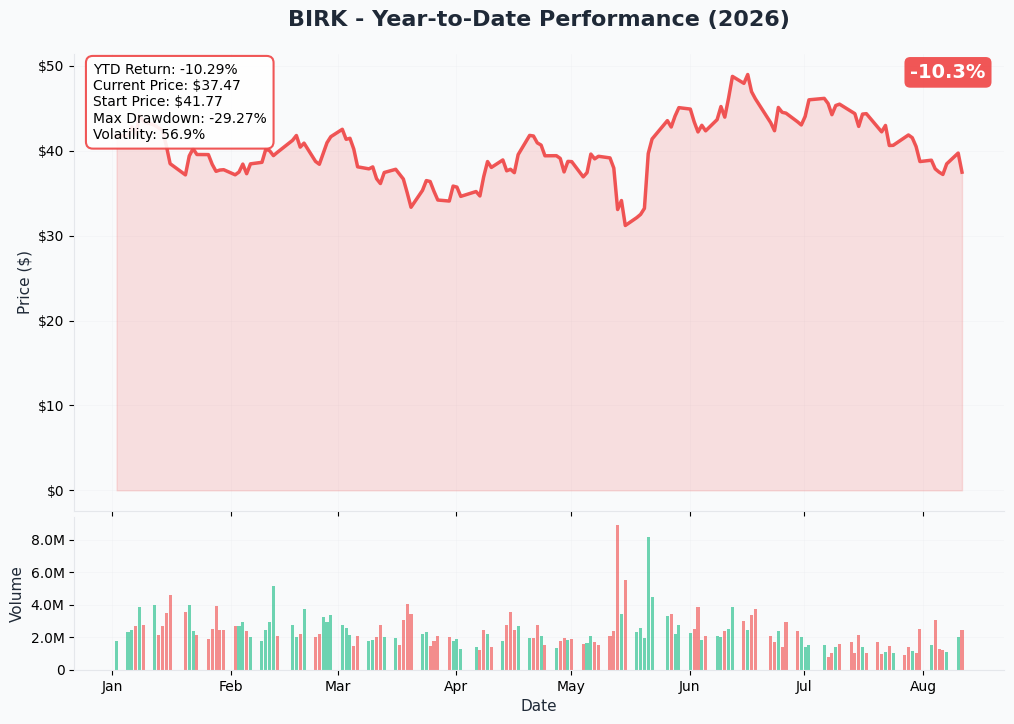
The past year traces a violent round trip: a slide to the 52-week low of $31.12, a snap back to the 52-week high of $53.53, and now a stock sitting at ≈$37.47–$37.78, roughly midway between those extremes but ≈29% below the high and ≈22% lower over 52 weeks (statistics).
Gamma-Based Support & Resistance
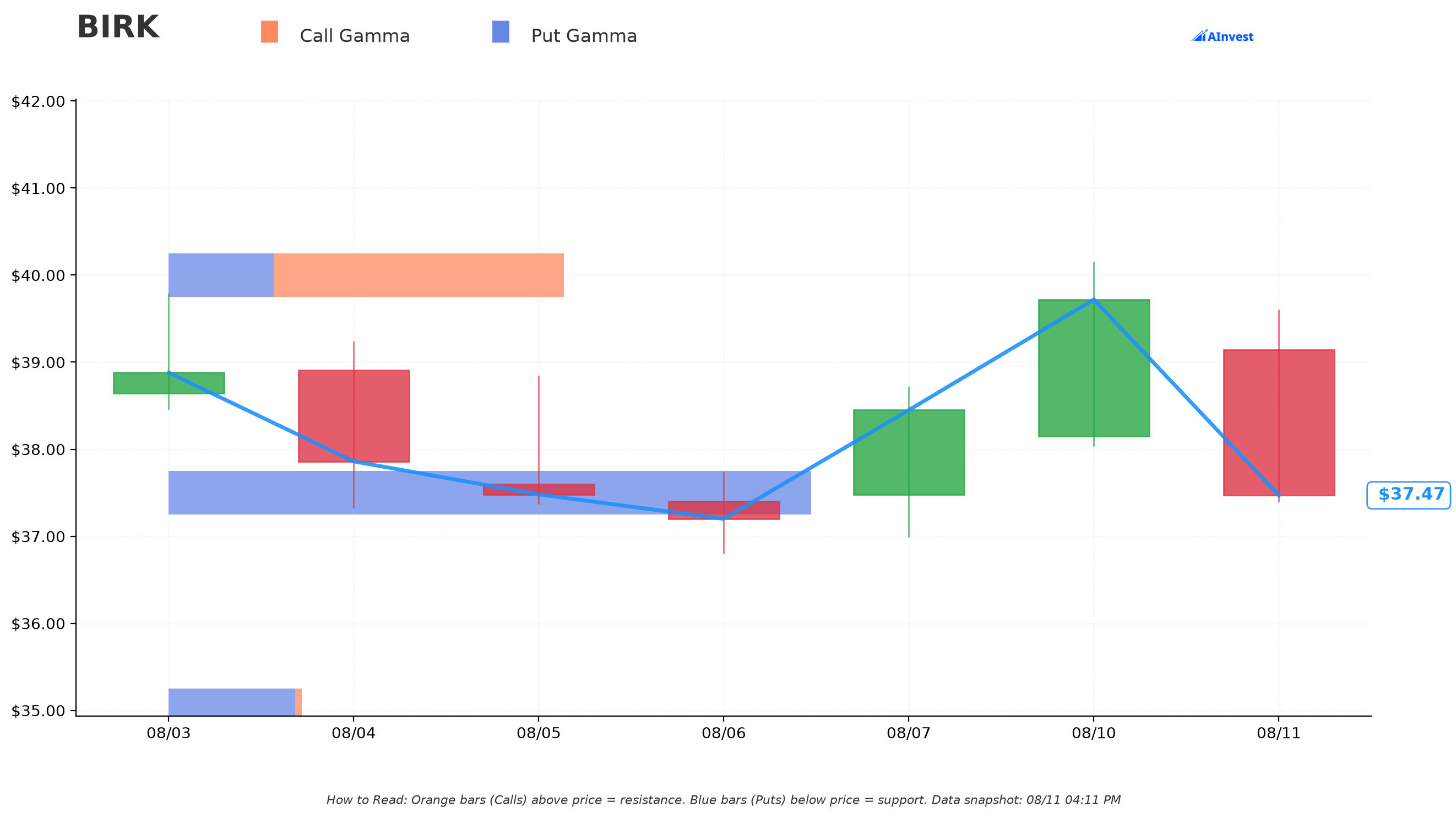
Honest read: BIRK's option chain did not return material gamma support or resistance levels today. With spot at $37.47, the chain is thin enough that the gamma-exposure model could not identify walls with the confidence it uses elsewhere — the underlying strikes carry gamma exposure (the $37.50 strike shows the largest total gamma on the board, mostly put-side, sitting right at spot), but nothing rises to a clean, labeled support or resistance level. That thinness is itself informative: a name where someone just transacted 27,000 option contracts in five minutes has a chain too shallow to produce clean dealer-hedging levels, which tells you the options market here is being moved by a handful of large prints, not deep two-sided liquidity.
Implied Move
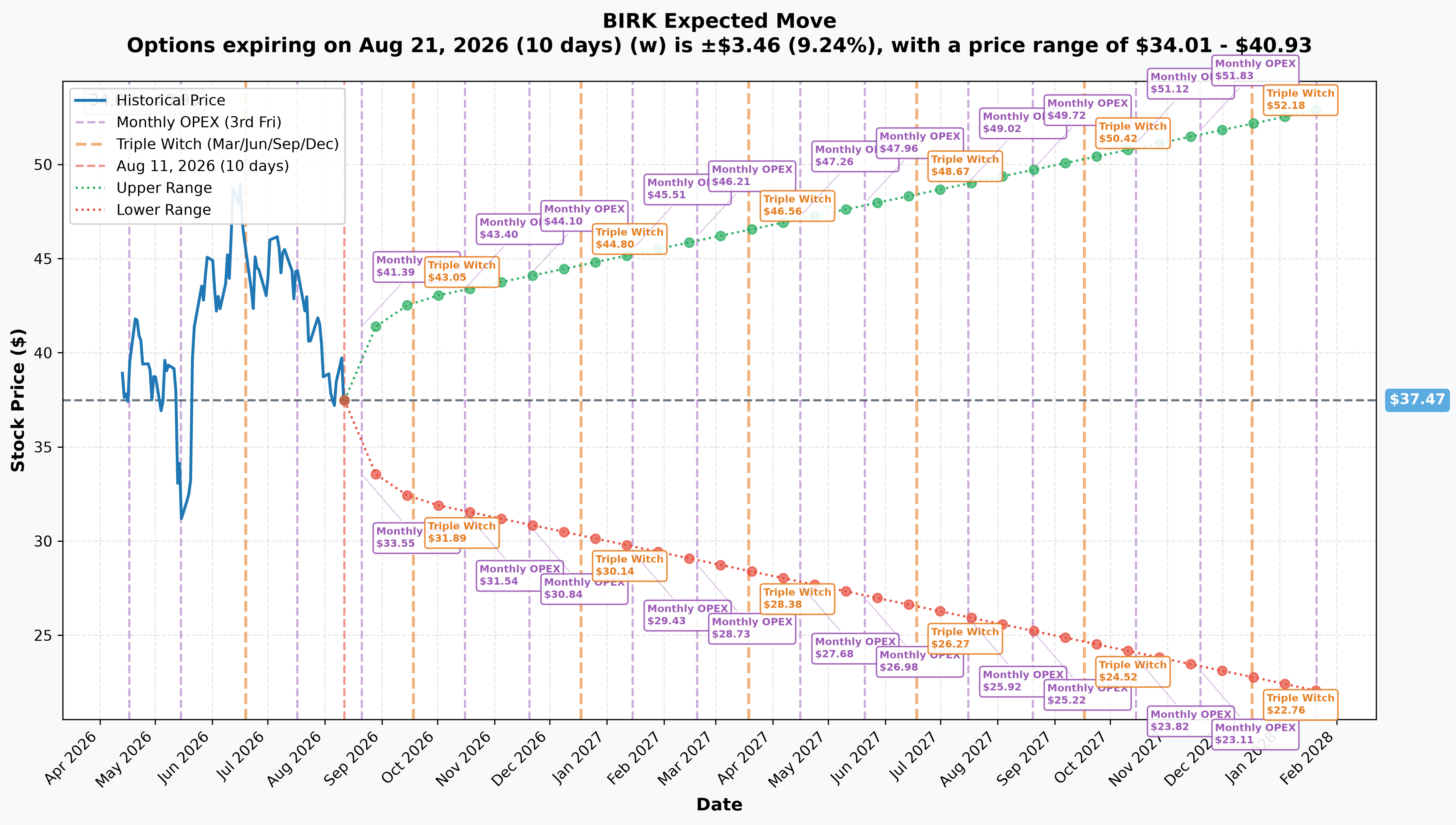
Straight from the options market's own pricing:
| Window | Expiry | Implied move | Range |
|---|---|---|---|
| Monthly OPEX (this trade's window) | 2026-08-21 | ±9.24% | $34.01 – $40.93 |
| Quarterly / triple witch | 2026-09-18 | ±14.18% | $32.16 – $42.78 |
Here's the reader's real takeaway: the market is currently pricing a ±9.24% move to August 21. But look at what actually happened last time Birkenstock reported — the May 13 fiscal Q2 miss sent the stock crashing well outside that kind of range, down to ≈$31 from the high $30s/low $40s. If Q3 reproduces anything close to that magnitude of reaction, it would blow through the current implied-move band on either side. That's the case for this trade, stated honestly: the options market may be under-pricing the tail here relative to Birkenstock's own recent history. But one prior earnings reaction is not a distribution — it does not guarantee the next one repeats that size, and a correct bearish view that moves the stock by only 5–6% could still leave this ladder underwater on the extrinsic value paid.
🎪 Catalysts
Inside the August 21 expiration window
- Wednesday, August 12, 2026 (≈23:00 CEST) — MSCI's August 2026 Index Review results are published. We found no evidence Birkenstock is a candidate for addition, deletion, or size-segment migration in this review — flag it as an unknown scheduled date, not a forecast (MSCI review schedule). Critically, even if BIRK were affected, the index changes don't take effect until August 31 — ten days after these options expire.
- Thursday, August 13, 2026, pre-market (call at 8:00 a.m. ET) — Birkenstock reports fiscal Q3 2026 results (quarter ended June 30, 2026), the dominant catalyst inside this window. The company announced this date on July 15, 2026 (company news & events). Consensus sits at ≈$816 million revenue (+9% year over year) and ≈$0.87 EPS, against a brutal year-ago comparison: Q3 FY2025 delivered a 60.5% gross margin — the highest of the last six quarters — which Q3 FY2026 must lap while absorbing management's own guided ≈100 basis points of tariff drag for this exact quarter (Q2 FY2026 transcript). The full-year guide also requires H2 revenue growth to accelerate to ≈11–14.5% reported (versus +9% in H1) while holding H2 gross margin near 59–60% — there is no slack in that math (company release).
Note the sequencing: the August 21 expiration itself is not an event — it is just the settlement date. The two dates that matter are August 12 and 13, both inside the ten-day window; the MSCI effective date of August 31 falls outside it.
Recent context that built to this print
- May 13, 2026 — Q2 FY2026 badly missed: EPS of $0.579 versus ≈$0.70 consensus, net profit −22%, and gross margin down 380 basis points to 53.9%, driven by FX (−230 bp), tariffs (−90 bp) and channel mix (−30 bp) (company release). The stock crashed toward ≈$31.
- May 21, 2026 — Management responded with a $250 million accelerated share repurchase at a $33.21 base price, and the stock popped ≈17% on the announcement, with CEO Oliver Reichert citing "a strong disconnect between our share price and the strength of our underlying fundamentals" (ASR release).
- June 12, 2026 — the stock rallied to $48.75, a local high.
- Mid-June through August 11 — the shares bled ≈23% back down into this print, against markdown chatter (retailers reportedly running 25% discounts), and three analyst downgrades: William Blair (May), Seaport Global (July 20, Buy → Neutral), and Zacks Research (August 5, to Strong Sell) (analyst summary).
- August 6, 2026 — Alexandre Arnault resigned from the board, effective immediately, five business days before earnings. The company said Financière Agache will "remain one of our closest strategic investors" (company release).
The hedge reading — presented fairly, unproven either way
There is no lock-up expiration and no announced secondary offering pending. L Catterton's last marketed sale was May 30, 2025 at $52.50 — more than 14 months ago (offering detail). But on June 15, 2026, the company authorized up to $500 million of further buybacks, explicitly noting purchases could come via open market, negotiated trades, or "potentially including purchases from BK LC Lux MidCo S.à r.l." — the controlling holder's own vehicle (buyback detail). That is a pre-wired, undated mechanism for a negotiated block from the controlling shareholder — and because Birkenstock is a foreign private issuer with no 10-Q and no Section 16 filings, such a block could arrive with effectively no warning. That is the strongest sourced argument for reading a large protective position here as a hedge rather than pure conviction.
The counterweight is real, too: L Catterton's last two marketed sales cleared at $52.50 and $54.00 — ≈28–30% above today's ≈$37.75 spot. A seller choosing to transact at current levels would be accepting a materially worse price than its recent history. We are not declaring which reading is correct — the tape proves the position exists; it cannot prove the motive behind it.
👥 How Different Readers Should Think About This
🎲 The YOLO trader
You'd be buying the same three strikes retail traders can also access — but understand the economics first. This ladder paid ≈$5.41 a share on average against ≈$3.98 of intrinsic, meaning roughly a quarter of every dollar spent was pure time value that needs the stock to actually move to pay off. If you're chasing directional conviction into the August 13 print, the implied move of ±9.24% is your reference: a move smaller than that, even in the right direction, can still lose money on premium decay after the print. Size this like the binary, leveraged bet it is — a wrong-sized move (not just a wrong-direction move) can wipe out the position.
📈 The swing trader
The interesting read here is the calendar alignment, not the price level. This ladder is built entirely around a ten-day window that contains one confirmed earnings print and nothing else that clearly matters — the MSCI announcement is a scheduled date with unknown relevance, and the mechanism that would actually move real shares (the MSCI effective date, and any negotiated block from the controlling holder) sits outside this expiration. If you're tracking this stock post-earnings, the September 18 expiration (±14.18%, $32.16–$42.78) is the next window that captures any drift or re-rating that doesn't fully resolve by August 21.
💰 The premium collector
This is the opposite trade of what's on the tape today. Selling premium into a confirmed earnings print two days out, on a stock with only a 53.75-million-share float and ≈21% of that float already short, is a specific and serious risk: if the print is in-line or better, a heavily shorted, thin-float stock can squeeze violently, and short options positions on the wrong side of that gap have no natural ceiling on the loss. If you're inclined to collect premium here, understand you're taking the other side of a desk that just paid ≈$3.9 million for ten days of time value spanning exactly this event — they're not obviously wrong to want that protection.
🌱 The beginner
Think of this as three separate insurance policies stacked on the same house, each triggering at a different damage threshold. The $47.50 put already has real value baked in even before anything happens (it's "in the money"), the $40 put has a little, and the $37.50 put has none — it only starts paying if the stock actually falls below $37.50 by August 21. All three expire worthless if Birkenstock is trading anywhere at or above their respective strikes on that date, and the buyer loses whatever premium they paid for that leg. This trade is not a prediction that Birkenstock definitely falls — it's a large, leveraged position that only pays off within a specific ten-day window, and a stock that simply drifts sideways after earnings would leave most of this premium worthless regardless of the eventual direction.
⚠️ Honest Limits — What the Tape Cannot Prove
- We cannot see who placed this trade, their broker, or their existing position. Floor blocks are negotiated privately; the tape shows the print, not the identity or motive behind it.
- We cannot prove open versus close on two of the three legs. The $47.50 and $37.50 puts both sit almost exactly on top of prior open interest (9,002 and 9,209 contracts respectively, against 9,000 bought at each) — tomorrow's ≈06:30 ET OPRA open-interest snapshot is the definitive test, not today's tape.
- We cannot determine whether this is a directional bearish bet or a hedge over an existing long position or pending share block. Both readings are structurally plausible, as laid out above, and nothing in the trade tape itself resolves that question — it would require seeing a paired stock position, which is outside what OPRA discloses.
- We cannot confirm any relationship to L Catterton, BK LC Lux MidCo S.à r.l., or the company's own buyback program. The $500 million buyback authorization naming the controlling holder's vehicle is real and sourced, but there is no evidence connecting it to this specific options trade.
- We cannot verify BIRK's relevance to the August 12 MSCI review, or whether that announcement will move the stock at all before earnings the next morning.
- Options trading involves substantial risk of loss and may not be suitable for all investors. This analysis is not investment advice. A leveraged, binary bet on a confirmed earnings event can lose money even with a correct directional view if the actual move is smaller than the premium paid — verify all figures independently and size any position to what you can afford to lose.
Last updated: 2026-08-12 (pre-market) — the next-day OPRA open-interest snapshot resolved all three legs. Aug-21 $40P 203 → 9,045 (+8,842): OPEN (BTO), 98% of the print. Aug-21 $47.50P 9,002 → 3,020 (−5,982) and Aug-21 $37.50P 9,209 → 3,102 (−6,107): CLOSE on both — the provisional BTO labels are retired. Net put open interest across the three strikes fell 3,247 contracts, so the "27,000-contract fresh bearish ladder" framing has been withdrawn and restated as a re-strike into the $40 line. The title, subtitle, strategy line and bearish-conviction framing were updated; the ⏳ callout was replaced with the ✅ RESOLVED box.