🤝💵 CLX $31.96M Deep-ITM Call Sale — the Dividend-Capture Call Was Right: Clorox's Entire In-the-Money Call Book Vanished Overnight
📅 2026-08-11 | 🔥 Unusual Activity Detected
🔄 Updated 2026-08-12 pre-market — the dividend-capture thesis is confirmed, and it happened faster than we predicted. We wrote that if this was a dividend-capture operation, "expect the August 12–13 OI print at the $95 strike to collapse as the newly opened contracts get exercised and assigned overnight." It collapsed in the very first snapshot: August $95 open interest went 3,369 → 27 (−99.2%). And it was not just this strike — every Clorox call with negligible time value collapsed across both expirations (August $90 946 → 9, August $100 2,656 → 11, September $95 1,273 → 18, September $70 2 → 0), while out-of-the-money calls and all puts were untouched. Clorox went ex-dividend on August 12 at $1.25/share (Clorox IR). That is a textbook dividend-driven early-exercise wave. One consequence: because the wave hit every in-the-money strike, the strike-level numbers can no longer isolate this desk's own open-versus-close. See the ✅ RESOLVED box.
🎯 The Quick Take
Between 2:57 PM and 3:55 PM ET, four blocks of deep in-the-money calls sold across The Clorox Company (CLX) for a combined ≈$31.96M collected, led by 20,400 August 21 $95 calls that printed not as one trade but as twenty identical 1,020-lot clips over fourteen minutes. Every leg priced at or within pennies of pure intrinsic value — essentially zero time premium. That detail matters because Clorox goes ex-dividend tomorrow, August 12, at $1.25 a share, and today, August 11, is the last session on which a deep-ITM call holder can exercise and still collect it. This is not a bullish or bearish trade. It's a trade about who owns the stock the moment the dividend record book closes.
🏢 What Clorox Actually Is
Clorox manufactures and markets consumer and professional cleaning, household, and personal-care products worldwide, headquartered in Oakland, California, founded in 1913, with ≈7,600 employees (company profile).
| Segment | What it sells | Anchor brands |
|---|---|---|
| Health and Wellness | Cleaning, disinfecting, laundry; professional/away-from-home | Clorox, Clorox2, Pine-Sol, Tilex, and — since April 2026 — Purell |
| Household | Cat litter, bags and wraps, grilling | Fresh Step, Scoop Away, Glad, Kingsford |
| Lifestyle | Food, water filtration, natural personal care | Hidden Valley, Brita, Burt's Bees, Natural Vitality, RenewLife, Rainbow Light |
| International | The above portfolio sold outside the U.S. | — |
Snapshot (August 11, 2026):
| Metric | Value |
|---|---|
| Sector / Industry | Consumer Staples / Household & Personal Products |
| Market cap | ≈$13.09–$13.10 billion |
| Price (close) | $108.12 |
| 52-week range | $84.70 – $128.90 |
| Dividend / yield | $5.00/yr annualized (≈4.62%) |
| Payout ratio | 103.95% of earnings |
| Beta (5Y) | 0.54 |
| Short interest | ≈9.65–9.71% of shares, ≈4.79 days to cover |
Source: stockanalysis.com statistics, MarketBeat.
⚠️ The fiscal calendar is not the calendar calendar. Clorox's fiscal year ends June 30 (company profile), so "FY2027" runs July 2026 through June 2027. Fiscal Q4/FY2026 (the April–June quarter) reported on August 3, 2026 — just eight days before this flow — which is exactly why nothing earnings-related sits inside either expiration used in this trade.
💰 The Trade, in Plain English
Four separate blocks of deep in-the-money calls sold this afternoon, all printed as 🤝 negotiated floor blocks — worked manually rather than hit against the lit order book:
- 20,400 August 21 $95 calls sold ≈$12.74–$12.80, in twenty identical 1,020-lot clips between 14:57 and 15:11 ET — one worked order broken into uniform pieces, not one print. ≈$25.99M collected.
- 675 September 18 $95 calls sold at $12.60 at 15:30:48 — this print never appeared in the captured flow; the raw tape found it. ≈$0.85M.
- 1,000 September 18 $95 calls sold at $13.09 at 15:55:26. ≈$1.31M.
- 1,000 September 18 $70 calls sold at $38.10 at 15:55:26. ≈$3.81M.
Total ≈$31.96M collected across all four legs.
⚠️ A note on direction before the table. All four legs printed at or essentially at intrinsic value as negotiated floor blocks. A block priced at parity has no aggressor — the usual "did it lift the offer or hit the bid" test is meaningless here. The BUY/SELL labeling below comes from the captured flow record, not from tape geometry. Treat the side as reported, and the mechanism, price-versus-intrinsic, size, and timing as the things that are actually proven.
📊 Full Trade Details
| Time | Buy/Sell | Call/Put | Expiration | Premium | Strike | Volume | OI (prior) | Size | Spot | Option Price | Option Symbol |
|---|---|---|---|---|---|---|---|---|---|---|---|
| 14:57–15:11 ET (20 clips) | SELL | CALL | 2026-08-21 | $25.99M | $95 | 20,414 | 3,369 | 20,400 | $107.60 | $12.74 | CLX20260821C95 |
| 15:30:48 | SELL | CALL | 2026-09-18 | $0.85M | $95 | 1,703 | 1,273 | 675 | $107.71 | $12.60 | CLX20260918C95 |
| 15:55:26 | SELL | CALL | 2026-09-18 | $1.31M | $95 | 1,703 | 1,273 | 1,000 | $108.13 | $13.09 | CLX20260918C95 |
| 15:55:26 | SELL | CALL | 2026-09-18 | $3.81M | $70 | 1,005 | 2 | 1,000 | $108.13 | $38.10 | CLX20260918C70 |
Mechanism: 🤝 FLOOR BLOCK on every leg — negotiated, manually worked, off the lit book.
✅ RESOLVED — The Dividend-Exercise Wave Landed, Exactly Where We Said to Look
Updated 2026-08-12 pre-market. Resolving OPRA snapshot timestamped August 12 (reflects the August 11 close, after this print); baseline is the August 11 snapshot (reflects the August 10 close, before this print).
| Leg | Baseline (Aug-11) | Resolving (Aug-12) | Δ | Print size | What we published | Verdict |
|---|---|---|---|---|---|---|
| Aug-21 $95 call (sold) | 3,369 | 27 | −3,342 (−99.2%) | 20,400 | "expect the $95 strike OI to collapse … exercised and assigned overnight" | ✅ Dividend-capture CONFIRMED — no open interest survived |
| Sep-18 $95 call (sold) | 1,273 | 18 | −1,255 (−98.6%) | 1,675 | "a rise supports opening; a fall toward ≈600–1,300 supports closing" | ⛔ Confounded — consumed by the same exercise wave |
| Sep-18 $70 call (sold) | 2 | 0 | −2 | 1,000 | "should simply rise toward ≈1,002 and hold" | ⛔ Prediction missed — exercised instead |
The central call was right, and it is the whole story. We named the August $95 open interest print as "the single most important number to check tomorrow morning … what actually separates 'this was a dividend-capture trade' from 'this was an ordinary covered-call write.'" It came in at 27 contracts. Twenty thousand four hundred calls were sold into that strike on the last cum-dividend afternoon and, one session later, essentially nothing is left outstanding. This was a dividend-capture operation.
It was market-wide, not just this strike. Every Clorox call whose time value sat below the $1.25 dividend was exercised, across both expirations:
| Strike / expiry | Aug-11 | Aug-12 | Change |
|---|---|---|---|
| Aug-21 $90 call | 946 | 9 | −99.0% |
| Aug-21 $95 call | 3,369 | 27 | −99.2% |
| Aug-21 $100 call | 2,656 | 11 | −99.6% |
| Aug-21 $105 call | 9,237 | 8,202 | −11.2% |
| Aug-21 $110 call | 1,484 | 1,556 | +4.9% |
| Sep-18 $70 call | 2 | 0 | −100% |
| Sep-18 $80 call | 163 | 23 | −85.9% |
| Sep-18 $95 call | 1,273 | 18 | −98.6% |
| Sep-18 $100 call | 1,440 | 1,438 | −0.1% |
| Sep-18 $110 call | 5,167 | 5,177 | +0.2% |
| Aug-21 $100 put (control) | 2,407 | 2,412 | +0.2% |
The cutoff is exactly where option theory says it should be: calls with extrinsic value below the $1.25 dividend were exercised, calls with extrinsic value above it were not, and puts — which have no dividend-capture motive — did not move at all. The September $100 call surviving while the August $100 call was wiped is the same effect seen through time value: the September contract still carried enough extrinsic to make exercising it irrational.
What this resolution can and cannot prove.
- ✅ Proven: the deep-in-the-money Clorox call book was extinguished by early exercise into the August 12 ex-dividend date. The trade's timing, mechanism and economic purpose are exactly as described below.
- ⛔ Now unprovable: the open-versus-close question on the two ⏳ September $95 prints. We published a decision rule ("a fall toward ≈600–1,300 supports closing"), but the strike fell to 18 because of the market-wide exercise wave, not because of anything this desk did. Strike-level open interest can no longer separate the two branches, and we are not going to pretend otherwise — those legs are retired as unresolvable, not resolved as closes.
- ⛔ Prediction that missed: we expected the September $70 call to "simply rise toward ≈1,002 and hold" on the reasoning that no ex-dividend sits inside the September window. That was wrong. The ex-date on August 12 pulls exercise forward for any call carrying less extrinsic value than the dividend, regardless of how far out the expiration is — and at $38.10 of premium on $38.13 of intrinsic, the September $70 call had essentially none. It went to zero. The lesson is that an ex-dividend date prices early exercise across the whole chain, not just the front expiration.
🤓 What This Actually Means — Plain English
The structure, mechanically: every leg here is a short call sale (STO) — someone collected premium and took on the obligation to deliver stock at the strike if the buyer exercises. On the August $95 and September $70 strikes, the tape proves these are freshly opened positions (size far exceeds prior open interest). On the two September $95 prints, we can't yet prove open vs. close — the size on each print is smaller than the strike's existing open interest.
The extrinsic-value test is what makes this trade interesting. A call's price is intrinsic value (how far in the money it is) plus extrinsic value (time value + a little bit for volatility). Strip that out for each leg:
| Leg | Spot at print | Strike | Intrinsic | Traded price | Extrinsic remaining |
|---|---|---|---|---|---|
| Aug $95C | ≈$107.60–$107.71 | $95 | ≈$12.60–$12.71 | ≈$12.74–$12.80 | ≈$0.20 |
| Sep $70C | $108.13 | $70 | $38.13 | $38.10 | ≈−$0.03 (at or a hair below intrinsic) |
| Sep $95C (both) | $107.71 / $108.13 | $95 | $12.71 / $13.13 | $12.60 / $13.09 | ≈−$0.11 / −$0.04 (also at or below intrinsic) |
A call trading with essentially no time value isn't expressing a view on the stock — it's a share substitute. All four legs clear that bar, which is why none of this should be read as a bet on where CLX trades next.
Now the reason, and it's the whole story: Clorox goes ex-dividend tomorrow, August 12, 2026, at $1.25 a share — record date August 12, payable August 28, declared July 31 (company announcement). Under T+1 settlement the ex-date equals the record date, so today, August 11, is the last cum-dividend session — and these clips printed in its final hour, 14:57 to 15:11 ET.
Here's the mechanic: a holder of a deep in-the-money call who does not exercise before the ex-date simply misses the dividend — the stock goes ex-dividend, the option doesn't. Early exercise of an American-style call becomes the rational move once the dividend being forfeited is bigger than the extrinsic value being given up by exercising early. On the August $95 call, that math isn't close: ≈$0.20 of extrinsic against a $1.25 dividend is a ≈6.3× ratio. That's about as clean an early-exercise signal as options markets produce. The base case is assignment overnight — in which case the August 21 expiration date never actually arrives for this contract. Whoever is short these calls should be prepared to deliver stock at $95 tomorrow morning and to not receive tomorrow's dividend on those shares.
Be honest about the competing readings, because the tape can prove mechanism but not motive:
- Dividend play (the primary hypothesis). Twenty identical 1,020-lot clips inside a fourteen-minute window, on the last cum-dividend afternoon, in a strike carrying almost no time value, is the textbook signature of a dividend-capture operation — someone building or facilitating a large deep-ITM position specifically so the long side can exercise and pull the dividend out of the exchange's random assignment pool.
- Covered-call writing / income overwrite. This is the label the strategy classifier defaults to, and it's worth taking seriously — but it sits awkwardly with the facts. ≈$0.20 of premium on a $107+ stock isn't meaningful income, and it's an odd coincidence for an overwriter to schedule a write for the one afternoon that all but guarantees losing the dividend to assignment. A patient overwriter who wanted to keep the shares through August 21 would normally pick a strike with real time value to collect, not one already priced at parity.
- The arbiter is tomorrow's open interest print at the $95 strike, as described in the callout above. If it collapses, the dividend mechanic ran through it. If it doesn't, the covered-call reading gets stronger.
Grade this honestly: the mechanism (floor block), the pricing versus intrinsic, the size, and the timing against the ex-dividend date are all proven from the tape and the company's own dividend filing. The motive — dividend capture versus income overwrite versus something else — is inferred, not proven.
📈 Chart Check-Up
YTD Price Action
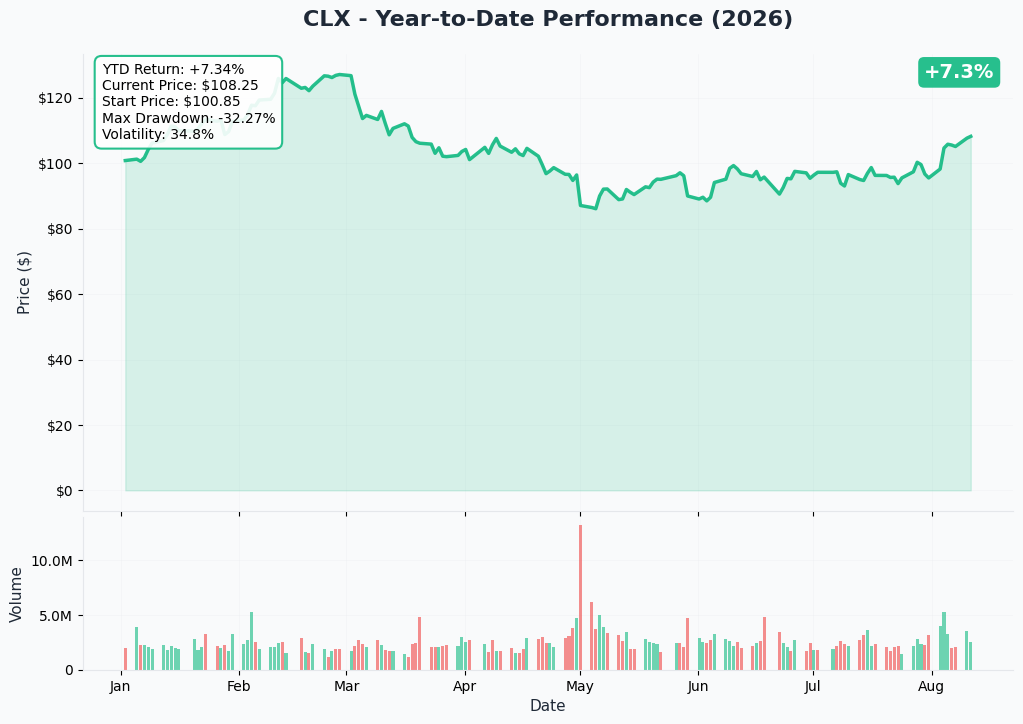
CLX bottomed at $95.53 on July 31, 2026 — the same day the token one-cent dividend raise was declared — then ran +13.2% in eight sessions to $108.12, including a +6.52% single-day move on August 4 following the Q4/FY26 print. The stock now sits well above both its 50-day ($96.86) and 200-day ($103.76) moving averages, on volume that was actually lightest of the entire run on August 11 (1.61M shares, ≈31% of the August 4 peak of 5.21M) — a pattern more consistent with a fading impulse than fresh accumulation.
Gamma Support & Resistance
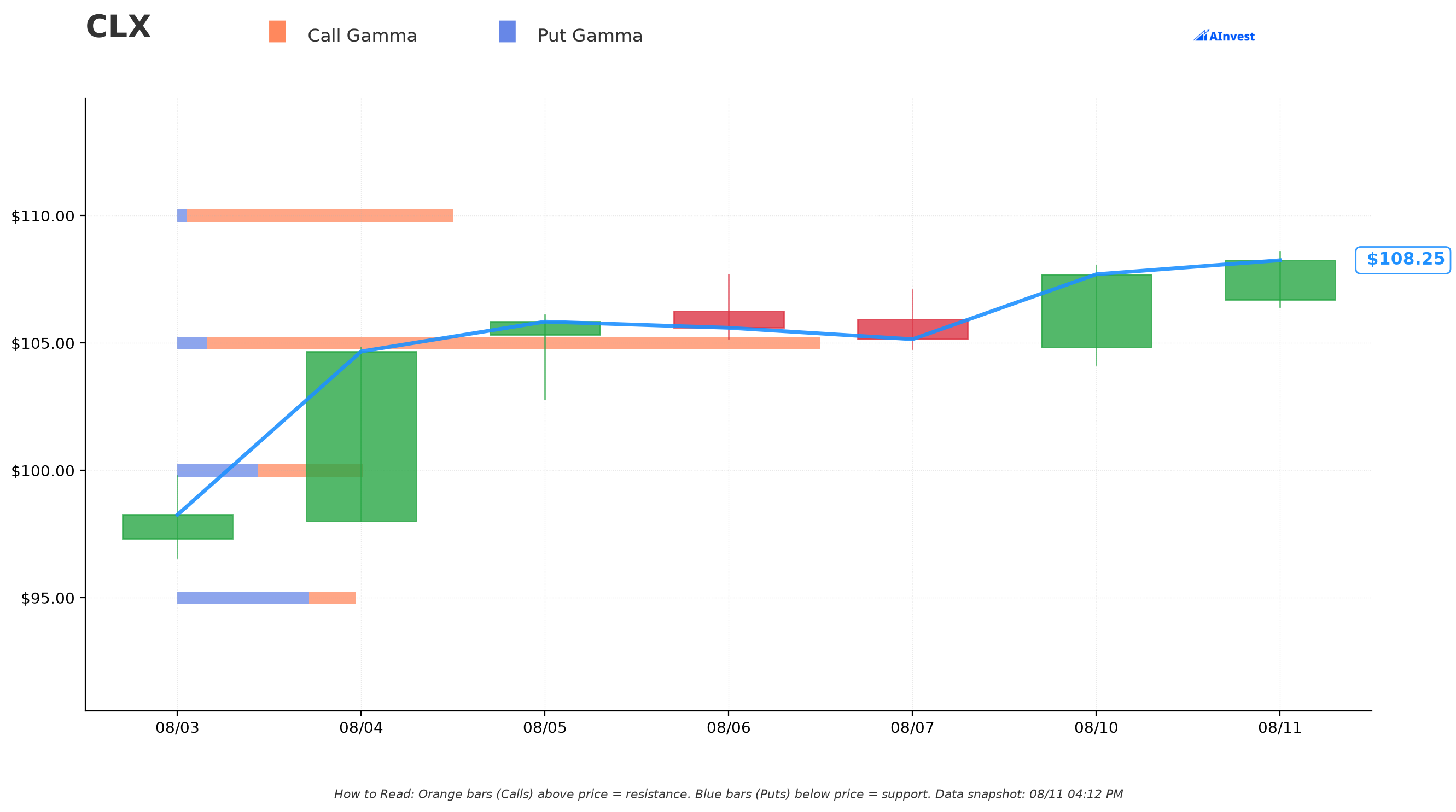
Against a gamma-model reference spot of $108.54, the board shows a Very Strong support wall at $105 (net gamma 9.09, ≈3.3% below spot) and a Moderate resistance wall at $110 (net gamma 4.00, ≈1.3% above spot). In plain terms: dealer positioning currently boxes CLX into a tight $105–$110 corridor, with the floor materially stronger than the ceiling. Note the $95 strike — where all of today's largest flow sits — shows negative net gamma (−1.33) on the board, well below current spot and outside the active support/resistance zone; it's a live options strike but not a dealer-hedging level right now.
Implied Move
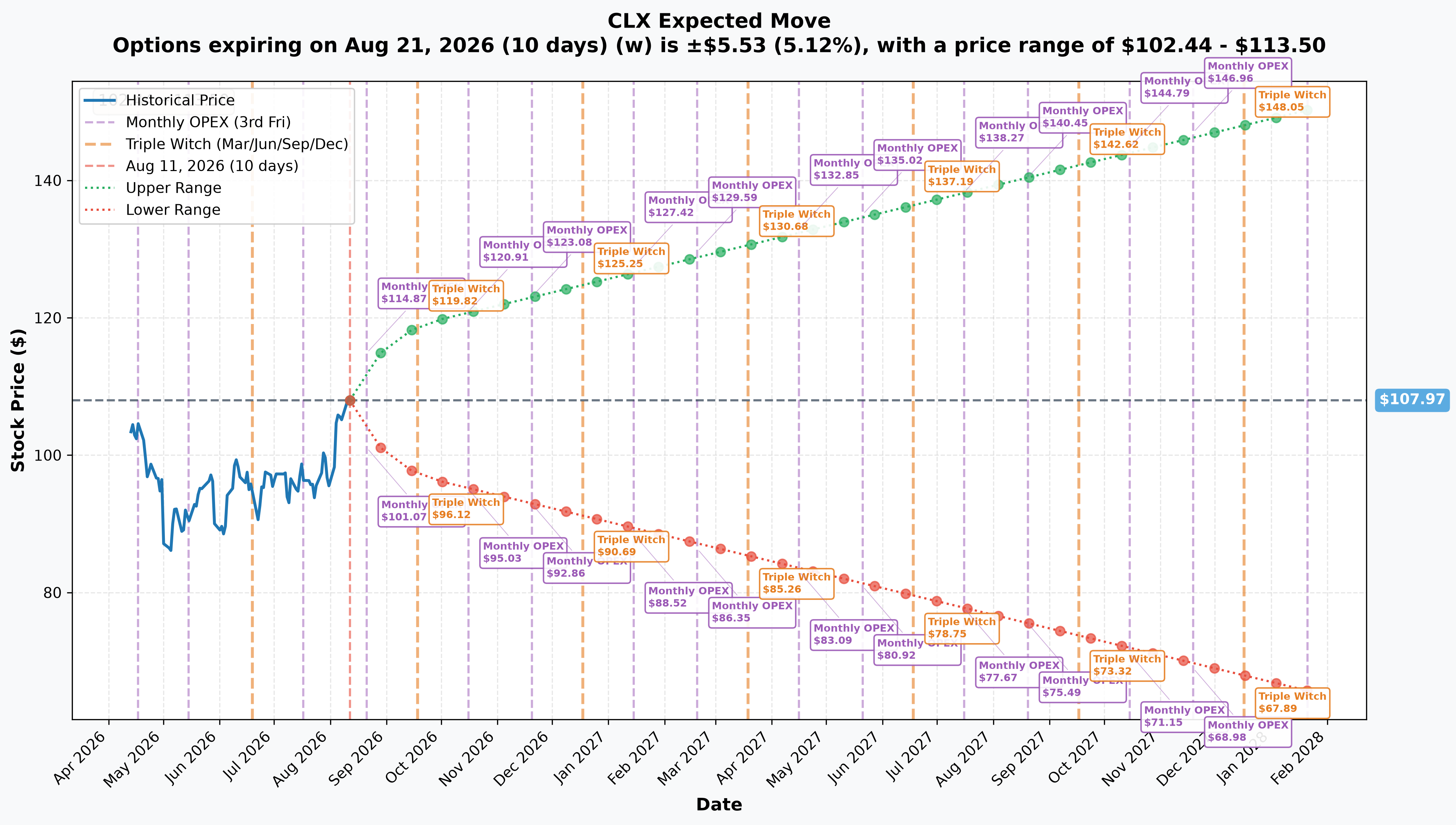
The options market is pricing ±5.12% (±$5.53) through the August 21 expiration — a range of $102.44 to $113.50 — and ±10.20% (±$11.02) through September 18 — $96.95 to $118.99. Both of today's key strikes sit inside those ranges: $95 is below the low end of even the wider September window, while $70 (the deep-ITM leg) is far outside any plausible move in either window — consistent with that contract being a pure stock substitute rather than a directional position.
🎪 Catalysts
The headline finding: the flow's calendar and the dividend calendar are the same event
Inside the August 21 expiration, there is exactly one confirmed company catalyst: tomorrow's ex-dividend. Clorox already reported fiscal Q4/FY2026 on August 3, 2026 (results release), eight days before this flow, and the next report — fiscal Q1 2027 — isn't expected until ≈November 4, 2026, which is a third-party estimate, not company-confirmed (Investing.com earnings calendar; MarketBeat shows no confirmed date). The September 18 expiration contains no confirmed company catalyst of any kind — no earnings, and the next ex-dividend date after tomorrow is expected only around ≈October 21–22, 2026, estimated from the historical pattern (dividend history) — well outside the September window.
What already happened (past)
- July 31, 2026 — dividend raised $1.24 → $1.25, a one-cent, ≈0.81% increase; stock closed at its cycle low of $95.53 the same day (declaration).
- August 3, 2026 — Q4/FY26 results: adjusted EPS $1.66 beat the $1.64 consensus; revenue $1.95B beat $1.91B — but organic sales fell −13%, of which roughly 13.5 points is an ERP-transition lapping artifact rather than genuine demand collapse (results release). FY27 adjusted EPS guidance of $5.70–$6.00 came in below the $6.23 consensus (MarketBeat).
- August 4, 2026 — stock +6.52% to $104.67 on 5.21M shares, alongside seven analyst target revisions, none of them to Buy (price history).
- May 28, 2026 — CEO Linda Rendle announced she is stepping down for health reasons; the board began a search with no disclosed timeline (release).
Confirmed inside the option windows
- August 12, 2026 — ex-dividend and record date, $1.25/share, company-confirmed (declaration; corroborated by dividend page and MarketBeat).
- August 28, 2026 — dividend payable, $1.25/share (after the August 21 expiration).
What's still ahead (outside both windows)
- ≈October 21–22, 2026 — next ex-dividend date, estimated from pattern (dividend history).
- ≈November 4, 2026 — Q1 FY2027 earnings, consensus EPS $1.28, estimated, not company-confirmed (Investing.com).
- Unscheduled — a new CEO could be named at any time, with no timeline disclosed (release).
The fundamentals behind the dividend that's driving this trade
The dividend itself is worth scrutinizing given it's the whole thesis here. FY26 free cash flow was $405 million against an annualized dividend obligation of ≈$605 million (120.93M shares × $5.00) — a payout ratio of 103.95% of earnings (statistics, dividend page). The one-cent July raise reads as streak preservation, not confidence. Separately, the Street is unusually one-sided: zero Buy ratings across 17–19 covering analysts, with the stock trading ≈6% above the $101.71–$102.40 consensus target (MarketBeat, StockAnalysis). The most parsimonious explanation offered for the +13.2% eight-session run on a guide-down is short covering — short interest sits at ≈9.7% with 4.79 days to cover on a 0.54-beta staple, which is heavy for this kind of name (statistics) — though that causal link is inference, not proof.
🎭 How Different Traders Should Read This
🎲 The YOLO trader
There's no directional lottery ticket here. All four legs are priced at or near pure intrinsic value — buying or selling stock exposure through these strikes accomplishes almost nothing that buying or shorting the shares directly wouldn't, except you'd also be taking on assignment/exercise risk around a known dividend event. If you want a real CLX bet, this flow tells you nothing about direction; it tells you where a dividend-driven mechanical trade is happening.
📈 The swing trader
The useful information here is the gamma corridor, not the flow itself: $105 support (Very Strong) and $110 resistance (Moderate) box the stock tightly in the near term, and the implied move confirms it — ±5.12% ($102.44–$113.50) through August 21. CLX has already run 13.2% in eight sessions on thinning volume; a name that stretched can chop or reverse inside that range just as easily as it can continue. With the calendar empty of confirmed catalysts after tomorrow's dividend until ≈November, this reads as a range-bound stretch, not a trend continuation.
💰 The premium collector
This is the group that most needs to internalize the mechanic in this article: writing a covered call the day before an ex-dividend, at a strike with almost no time value, is usually a mistake. If you already own CLX and want to keep both the shares and tomorrow's $1.25 dividend, selling a call with ≈$0.20 of extrinsic left is close to giving the stock away for free — you collect almost nothing extra, and the buyer has every incentive to exercise tonight, forfeiting your dividend along with your shares. If income is the goal, a strike with real time value premium — one where the dividend doesn't dwarf what you're being paid — protects you from exactly this outcome. The fact that this flow printed on the single worst possible afternoon to write that trade is itself the tell that it likely wasn't an ordinary income overwrite.
🌱 The beginner
A short call means promising to deliver stock at the strike if the buyer exercises. A deep in-the-money short call with almost no time value left is especially exercise-prone — and dividends make it more so: if a stock is about to pay a dividend that's bigger than what's left in the option's price, the buyer usually benefits from exercising early to grab that dividend, and whoever's short the call gets "called away" and doesn't receive it. This trade is a clean, real-world example of that mechanic, timed to the day before it matters. If you're new to options, the lesson to take away isn't about CLX specifically — it's that deep ITM calls near a dividend behave differently than calls anywhere else on the chain, and that difference can determine whether a short-call writer keeps their shares or not.
⚠️ Honest Limits — What the Tape Can't Prove
- Motive is inferred, not proven. The tape proves the mechanism (floor block), the price-versus-intrinsic gap, the size, and the timing against the ex-dividend date. It cannot prove whether this was a deliberate dividend-capture operation, an ordinary (if badly timed) covered-call write, or something else entirely.
- Open vs. close on the September $95 calls is unresolved. Both prints (675 and 1,000 contracts) sit below the strike's prior open interest of 1,273 — today's tape alone cannot tell us whether these opened new short positions or closed existing long calls.
- Direction is reported, not proven. All four legs printed at or near intrinsic as negotiated floor blocks — a block at parity has no lit-market aggressor, so the BUY/SELL labels come from the captured flow record, not from tape geometry.
- Covered vs. naked is invisible. OPRA shows the option print, not the seller's stock position or any paired hedge. We cannot confirm whether the short calls are backed by existing shares.
- Counterparty is unknown. A floor block means a broker matched a known buyer and seller manually, off the open book — we cannot see who either side is.
- Q1 FY2027 earnings date is a calendar estimate, not company-confirmed (Investing.com); the actual date could shift.
- The October ex-dividend date is estimated from the historical pattern, not yet declared by the company (dividend history).
Options trading involves substantial risk, including the potential loss of more than the amount invested. Early exercise, assignment, and dividend-related mechanics add complexity that this article explains generally but cannot predict for any individual account. This is not a recommendation to buy or sell any security — do your own diligence and size positions according to your own risk tolerance.
Last updated: 2026-08-12 (pre-market) — the next-day OPRA open-interest snapshot confirmed the dividend-capture thesis. Aug-21 $95C 3,369 → 27 (−99.2%) against a 20,400-lot sale, with every in-the-money Clorox call collapsing across both expirations while out-of-the-money calls and all puts were untouched; Clorox's $1.25 ex-dividend date was 2026-08-12. The two ⏳ Sep-18 $95 prints are retired as unresolvable — the market-wide exercise wave, not this desk's trading, drove that strike to 18, so open-versus-close can no longer be separated. The published expectation that the Sep-18 $70 call would rise toward ≈1,002 and hold was wrong (2 → 0); that miss is documented in the ✅ RESOLVED box. The title and the open/close verdicts were updated; the ⏳ callout was replaced with the ✅ RESOLVED box.