🧴 CLX: $1.22M of September Puts Bought Into a Calendar With Nothing Scheduled
📅 2026-08-13 | 🤝 Floor Block Detected
🎯 The Quick Take
At 10:41:42 ET a desk bought 7,625 September $100 puts at ≈$1.60 in Clorox — ≈$1.22 million of downside, five weeks out, against prior open interest of just 998. That makes it a provably new position.
What makes it interesting is the calendar. Clorox's two scheduled events both happened before this trade — earnings on August 3 and the ex-dividend on August 12. The next earnings and the next ex-dividend both fall outside September 18. So this buyer is not positioning for anything on the schedule.
Which raises the obvious question: what could take Clorox down the ≈6.6% this needs? The research turned up a live precedent — and it is larger than the move required.
🏢 Company Overview
Clorox makes cleaning, household and personal-care brands. It runs a June 30 fiscal year end, so its June quarter reports in August.
| Attribute | Value |
|---|---|
| Price | $105.34 (at the print) |
| Sector / industry | Consumer Staples / Household Products |
| Dividend yield | ≈4.7% |
| Beta | 0.54 |
| Short interest | ≈9.7–11.3% of float, 4.64 days to cover |
At a 4.7% yield and 0.54 beta, Clorox trades substantially as a bond proxy — which matters for what falls inside this option's window.
💰 The Trade, in Plain English
| Time | Buy/Sell | Call/Put | Expiration | Premium | Strike | Volume | OI | Size | Spot | Option Price | Option Symbol |
|---|---|---|---|---|---|---|---|---|---|---|---|
| 10:41:42 ET | BUY | PUT | 2026-09-18 | ≈$1,220,000 | $100 | 7,600 | 998 | 7,625 | $105.34 | $1.60 | CLX20260918P100 |
The $100 strike is ≈5.1% out of the money, so the option is 100% time value — there is no intrinsic value in it at all. Breakeven is ≈$98.40, a ≈6.6% fall from spot.
Printed as a negotiated floor block. It took no liquidity, so the BUY label is reported rather than tape-proven — though with prior open interest of 998 against 7,625 traded, the opening is not in doubt regardless of the label.
✅ RESOLVED — Opened, With ≈7% Matching Against Existing Holders
Updated 2026-08-14 pre-market. Resolving OPRA snapshot timestamped August 14 (reflects the August 13 close, after this print); baseline is the August 13 snapshot (reflects the August 12 close, before this print).
| Leg | Baseline (Aug-13) | Resolving (Aug-14) | Δ | Print size | Capture | Verdict |
|---|---|---|---|---|---|---|
| Sep-18 $100 put | 998 | 8,118 | +7,120 | 7,625 | 93% | ✅ OPEN (BTO) |
The opening is confirmed, but not every contract was new. We predicted ≈8,623 and the line came in at 8,118 — 505 contracts short. That gap is the honest part of this resolution: roughly 7% of the block matched against holders who were closing rather than creating exposure. The remaining 93% is genuinely new.
This does not change the read, which rested on the September calendar being empty rather than on the exact contract count. It does mean the position built is ≈7,120 puts, not ≈7,625.
🤓 What This Actually Means — Plain English
Buying a put is buying the right to sell. Here: the right to sell Clorox at $100 any time before September 18, for which the buyer paid $1.60 a share.
Because the stock is $105.34, that right is worth nothing today — you would not sell at $100 what you can sell at $105.34. The entire $1.60 is a payment for the possibility that Clorox falls below $100 in the next five weeks. If it does not, the whole ≈$1.22M is lost.
The breakeven is what to focus on. The buyer needs Clorox below $98.40 to make money — a 6.6% decline. Below that, the put's value rises roughly dollar-for-dollar with the fall.
Two readings, and we cannot distinguish them:
- Insurance — someone owns Clorox shares and is paying ≈1.5% of the share price to protect against a drop over the next five weeks.
- A bet — someone with no position thinks the stock falls.
The tape cannot tell them apart. What it can tell us is that the position is new, and that no scheduled company event sits inside its life.
📈 Technical Setup
One-Year Performance
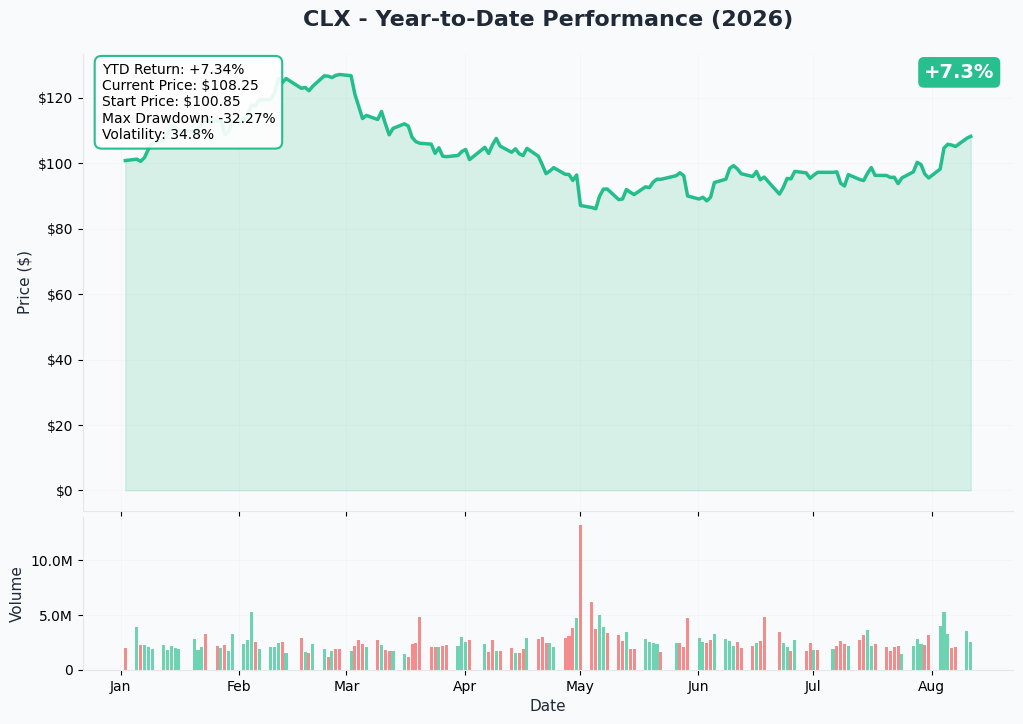
The relevant recent path: Clorox ran +13.3% in eight sessions, from $95.53 on July 31 to $108.25 on August 11, before easing to ≈$105. That run is the context for someone buying downside now — the put was bought after a sharp rally, not into a decline.
🔵🟠 Gamma-Based Support & Resistance
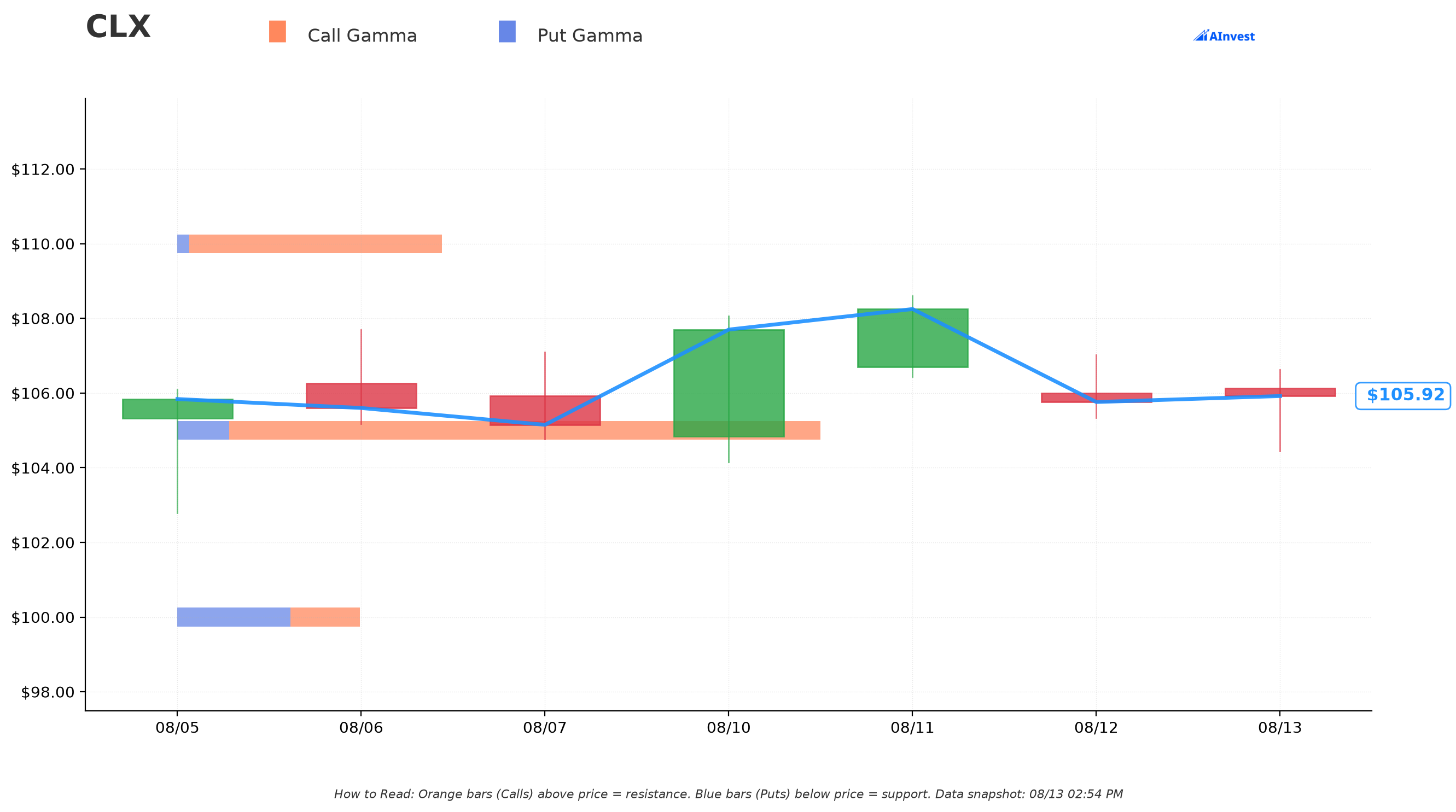
| Level | Strike | Strength |
|---|---|---|
| Resistance | $110 | Moderate |
| Spot | $105.92 | — |
| Support | $105 | Strong |
Support at $105 sits above the $100 strike — so the stock would need to break through a strong gamma level before this put starts working.
🎯 Implied Move
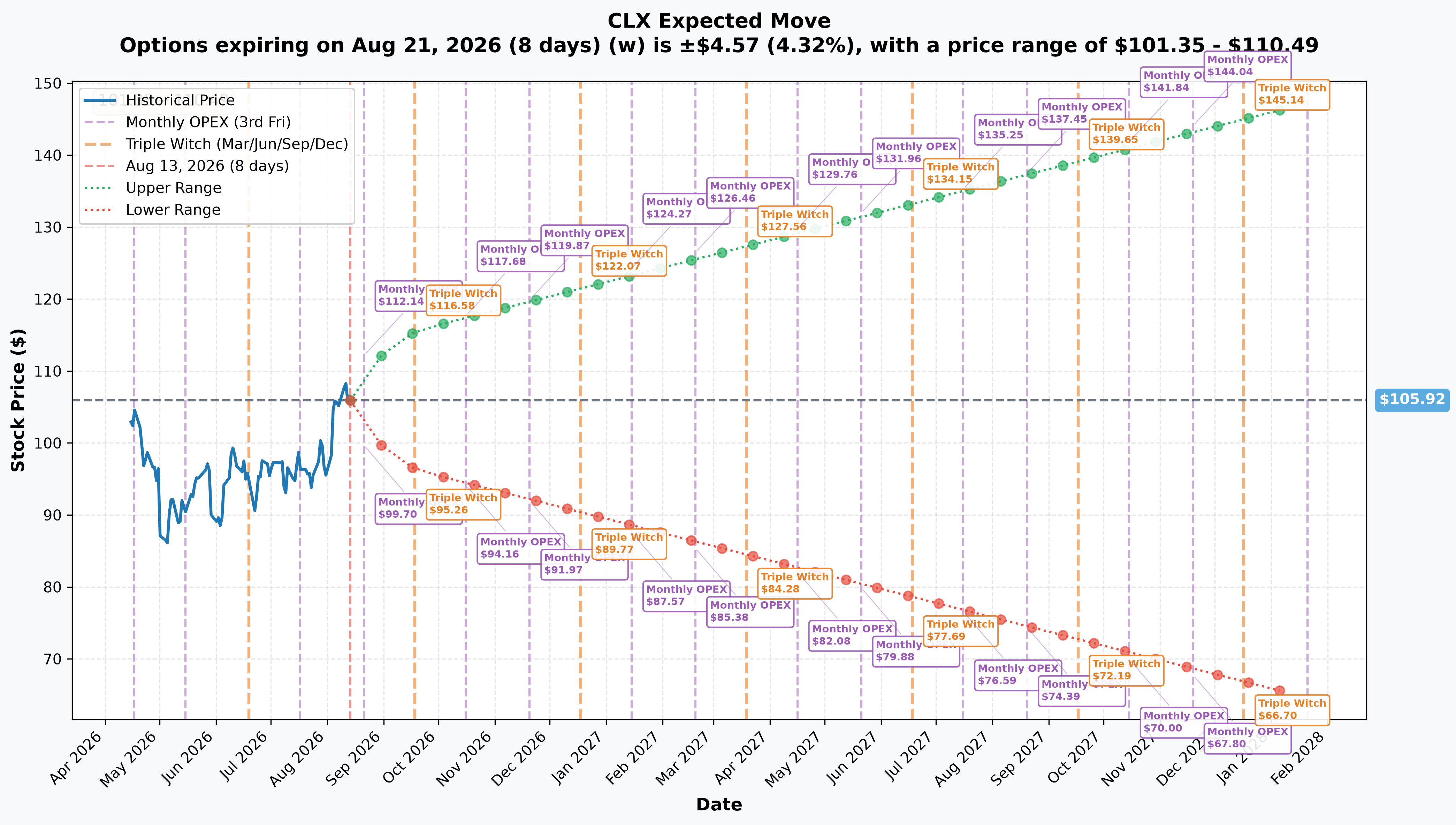
| Horizon | Implied move |
|---|---|
| Aug 21 | ±4.32% |
| Sep 18 (this expiry) | ±9.15% |
| Jan 2028 | ±39.04% |
The ±9.15% expected range to September 18 comfortably covers the 6.6% needed for breakeven — so the market does price this as a realistic outcome, not a tail. That is consistent with the option costing only $1.60.
🎪 Catalysts — The Window Is Empty, and That's the Point
Both of Clorox's scheduled events fell BEFORE this trade:
- August 3 — fiscal Q4/FY26 results: adjusted EPS $1.66 vs $1.64 consensus, revenue ≈$1.95B, but organic sales −13% (of which ≈13.5 points is an ERP-transition lapping artifact), and FY27 guidance of $5.70–$6.00 against ≈$6.23 consensus.
- August 12 — the $1.25 ex-dividend, which we covered yesterday in a separate trade.
Inside the September 18 window:
| Date | Event | Status |
|---|---|---|
| Sep 15-16 | FOMC with Summary of Economic Projections | Confirmed — the only scheduled event inside |
| ≈late Oct/early Nov | Fiscal Q1 FY27 earnings | Estimated, NOT company-confirmed — outside |
| ≈late October | Next ex-dividend | Estimated — outside |
For a 4.7%-yielding, 0.54-beta staple, the September FOMC is genuinely material — bond proxies re-rate on the long end.
So what could deliver a 6.6% fall? There is a precedent, and it is recent. On May 28, 2026 Clorox's board began a CEO search after Linda Rendle decided to step down for health reasons — and the stock fell 6.42% the next session. That is an unscheduled move larger than what this put needs, inside the last three months, with no announced successor timeline. A CEO appointment (or a further delay) can land any day.
The strike sits on the sell side's own fair value. Post-earnings targets cluster at $84 / $95 / $95 / $98 / $99 / $100 / $102 / $105 — a median of ≈$98.50, essentially identical to the put's ≈$98.40 breakeven. Consensus averages ($101.71 and $102.40) sit below the current price, with zero buy ratings and four to five sells. Jefferies cut to Hold with a $125 → $98 target on July 28.
The hard bearish number: FY26 free cash flow of $405M against $602M of dividends paid — 0.67× coverage — plus $256M of buybacks, with long-term debt rising to $3.98B from $2.48B. July's dividend raise was a token $0.01.
The counter-case: short interest of ≈9.7–11.3% with 4.64 days to cover is squeeze fuel that likely drove the +13.3% run, and the ERP lapping artifact mathematically reverses in FY27.
👥 Four Ways to Read This Trade
🎲 The YOLO trader
A 5%-out-of-the-money put on a 0.54-beta staple is a poor lottery ticket — low-beta names rarely deliver the sharp moves that make out-of-the-money options pay. The one thing that could is an unscheduled headline like the CEO news in May. If that is your thesis, know you are betting on an announcement with no date attached.
📈 The swing trader
The levels are unusually well-defined. $105 is strong gamma support, $98.40 is the put's breakeven, and the sell side's median target is $98.50 — the last two are essentially the same number. The stock just ran 13% in eight sessions into a guide-down, on heavy short interest. Whether that was a squeeze or a re-rating is the trade.
💰 The premium collector
You would be on the other side, selling this put and taking ≈$1.60 to promise to buy Clorox at $100 — an effective basis of $98.40, right at the analyst median. That is not a bad entry on a staple with a 4.7% yield. But note the dividend coverage: $405M of free cash flow against $602M paid out. Selling puts on a name whose distribution isn't covered by cash generation deserves a smaller size than the yield might tempt you into.
🌱 The beginner
Learn to check the calendar before you read intent. This buyer paid $1.22M for five weeks of downside — and there is not a single scheduled company event in that window. Earnings already happened. The dividend already happened. That tells you they are either insuring an existing holding or betting on something unscheduled. Neither is "they know earnings will be bad," because there are no earnings to be bad.
⚠️ Honest Limits
- We cannot distinguish a hedge from a bet. A put bought against shares you own is insurance; the same put bought alone is a directional position. The tape shows no equity leg attached, but that does not rule out shares held elsewhere.
- Direction is reported, not tape-proven — the print took no liquidity. The opening is proven by size versus open interest regardless.
- The next earnings date and next ex-dividend date are estimates, not company confirmations. Clorox has announced neither.
- Research gaps, disclosed: the search budget was exhausted, so all sourcing was by direct retrieval. The GOJO acquisition price could not be verified and no figure is stated. Two source conflicts are presented as ranges rather than resolved: short float (9.68% vs 11.25%) and the dividend-increase streak (47 vs 49 years).
- Unknowable: who holds this, and whether it hedges a larger book.
Last updated: 2026-08-14 — next-day OPRA open interest resolved the put as an open, with ≈7% matching against existing holders — 998 → 8,118 (see the ✅ RESOLVED section).
This is market analysis and education, not investment advice. Options carry substantial risk of loss.