🐻 CRWV $4.8M Year-Out Bearish Put on the Most Leveraged Name in AI
📅 June 15, 2026 | 🔥 Unusual Activity Detected
✅ Updated 2026-06-16: Next-day OPRA OI confirms the open — the Jun-2027 $105 put rose 95 → 2,200 (Δ +2,105, even more than the 1,500 traded). Fresh long LEAP put confirmed.
🎯 The Quick Take
Someone just dropped $4.8M on a year-long bearish bet against CoreWeave (CRWV) — the AI GPU cloud company that IPO'd in 2025, tripled in price, and is now the poster child for the AI-infrastructure leverage debate. They bought 1,500 June 2027 $105 put contracts as a block cross right near the current stock price, putting downside insurance on a company carrying ≈$22.6B of long-term debt and spending $2.60 for every $1 of new revenue it brings in. With DA Davidson cutting the stock from $175 to $100 just weeks ago, and founders having dumped >$2.3B in stock since the IPO lockup expired, this is the kind of trade that says: "the story could crack, and I want 12 months of protection."
📊 Company Overview
CoreWeave (CRWV) is an AI hyperscaler and GPU cloud provider — the pure-play, publicly traded bet on AI infrastructure demand:
- Market Cap: ≈$54.9B
- Sector / Industry: Information Technology — AI Cloud / GPU Infrastructure (Hyperscaler)
- What they do: CoreWeave rents out massive clusters of Nvidia H100/H200 GPUs to AI companies that need computing power to train and run their models. Think of it as AWS, but built almost entirely for AI workloads. Their customers include Microsoft, Meta, OpenAI, and Anthropic. The business model: borrow billions, build data centers, fill them with Nvidia GPUs, and lease that compute on long-term contracts.
- Recent performance: Up ≈200% since its March 2025 IPO. Currently trading ≈$107.84. Q1 2026 revenue hit $2.1B (+112% YoY), backlog ballooned to $99.4B, but the net loss widened to $740M for the quarter. The company guides to spending $30–35B on capex in 2026 alone. It just earned its Nasdaq-100 spot (joining June 22, 2026) — a real stamp of arrival. But it also carries ≈$22.6B of long-term debt with bonds trading at yields of ≈11.5%, which is how credit markets price significant credit risk. Two stories, same stock.
💰 The Option Flow Breakdown
The Tape — June 15, 2026 @ 13:21:48: 🤝 single-leg block cross
| Time | Buy/Sell | Call/Put | Expiration | Premium | Strike | Volume | OI | Size | Spot | Option Price | Option Symbol |
|---|---|---|---|---|---|---|---|---|---|---|---|
| 13:21:48 | BUY | PUT | 2027-06-17 | $4.8M | $105 | 1,500 | 95 | 1,500 | $107.84 | $32.15 | CRWV20270617P105 |
Flow type: 🤝 Single-Leg Block Cross — this was a negotiated block trade with a known counterparty on the other side. Not a panicked sweep through the open book. A desk crossed this print deliberately — buyer and seller agreed on price before the trade ever hit the tape. For a position this size on a volatile name, that's actually the smart way to do it (no market impact, no slippage).
✅ RESOLVED — Next-Day OI Confirms the Open (2026-06-16)
| Leg | Pre-print baseline (EOD 2026-06-12) | Resolving (EOD 2026-06-15) | Δ | Verdict |
|---|---|---|---|---|
| Jun-2027 $105P | 95 | 2,200 | +2,105 | OPEN — fresh long LEAP put confirmed |
The next-morning OPRA snapshot confirms a clean open: open interest rose from 95 to 2,200, a +2,105 gain that actually exceeds the 1,500 contracts in this block — meaning other participants added to the same strike alongside it. This is a genuine new long LEAP put, a year-out bearish/hedge bet on the most leveraged name in AI-cloud.
🤓 What This Actually Means — Plain English
Let's break down exactly what this trade does.
A long put is downside insurance. The buyer paid $32.15 per share (≈$4.8M total across 1,500 contracts × 100 shares) for the right to sell CRWV shares at $105 anytime up to June 17, 2027. With CRWV at ≈$107.84 today, this is an almost-at-the-money put — the stock only needs to drop a couple of dollars before it's in-the-money.
The breakeven math: The buyer paid $32.15 per share for a $105 right. So they need CRWV to trade below $72.85 ($105 − $32.15) at expiration to profit. That's a ≈32% decline from the current price of $107.84.
Why is the option so expensive? That $32.15 price tag looks massive — it's ≈30% of the stock price. But CRWV is an extremely volatile stock. The implied volatility (what the market thinks CRWV could swing) is enormous, reflecting the genuine binary quality of the business: either AI capex demand runs hot for years and CRWV is the crown jewel of the cycle, or credit markets tighten and a debt-laden business spending $30–35B on capex hits a wall. The options market is pricing that uncertainty directly into the premium.
Three scenarios:
-
It's a standalone bearish bet. The buyer thinks CRWV's leverage/concentration risk could force a major re-rating over the next 12 months. With DA Davidson slashing their target from $175 to $100, and the company's 2031 bonds yielding ≈11.5% (a red flag for credit markets), the worry is that a financing squeeze, anchor-customer wobble, or AI-capex air pocket cracks the stock well below $105.
-
It's portfolio insurance (a hedge). A fund that owns CRWV stock — or owns other AI infrastructure names — may have bought this put to cap their downside. If you're running a $50M AI-exposure portfolio, spending $4.8M on a year of downside protection at the current price isn't crazy. It's like buying homeowner's insurance on a house built in a flood zone.
-
It could be both. A holder of CRWV stock who has become more cautious about the leverage thesis — say, after founders dumped $2.3B+ of shares and after the DA Davidson downgrade — might buy ATM puts as a collar: keep the stock for the upside, cap the downside with puts.
The order type is BTO — Buy to Open. This is a fresh position, not a closing trade. The 1,500-versus-95-OI math makes that essentially certain.
Confidence: HIGH — size (1,500) is 15.8x prior OI (95), making this a clear opening. Next-day OI will formalize it, but this is about as close to confirmed-open as you get from same-day tape alone.
📈 Technical Setup / Chart Check-Up
YTD Performance
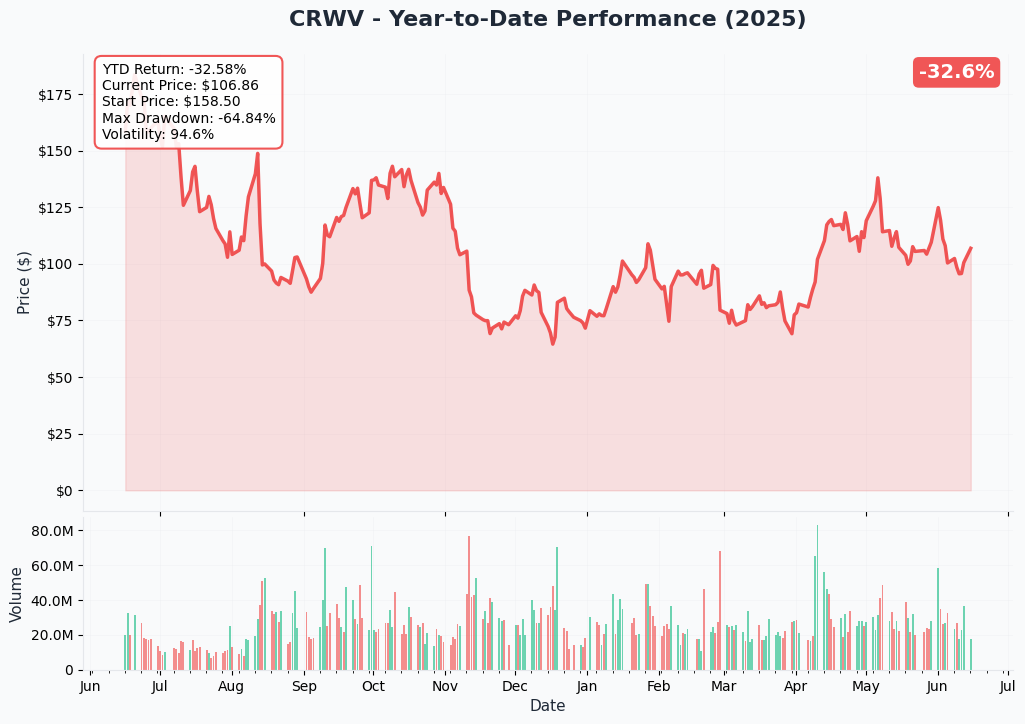
CRWV has been a wild ride since its March 2025 IPO — up roughly 200% in about 15 months, but with gut-wrenching swings along the way. The stock reflects every headline in the AI infrastructure debate: surges on monster contract wins (Meta $14.2B, OpenAI $6.5B), dips when leverage concerns resurface or insiders sell. There is no boring day with CRWV.
Key observations:
- 📈 Up ≈200% from IPO as the AI data-center demand thesis proved real and the backlog exploded to $99.4B
- 📅 Joined the Nasdaq-100 effective June 22, 2026 — just 15 months after IPO, a legitimacy stamp that also drives passive index buying
- 📉 Heavy insider selling ($2.3B+ from founders) and the DA Davidson downgrade have created headwinds — the stock has been choppy even during AI rallies
- 🎯 Current price ≈$107.84 sits near the ATM strike of the put — that's not coincidence; someone is putting on protection right here, right now
Gamma-Based Support & Resistance
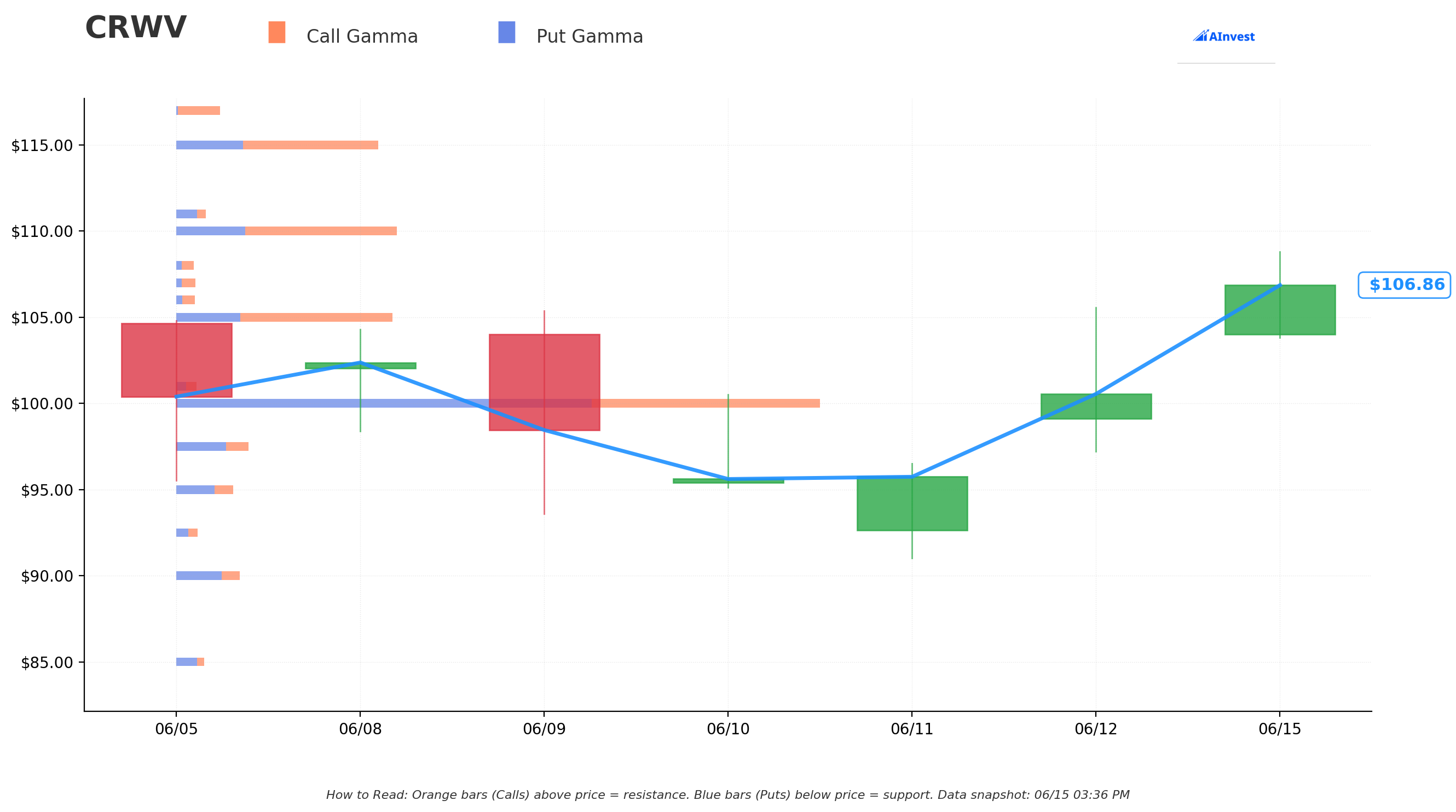
Current Price: ≈$107.84
The gamma map around CRWV shows relatively clean structure given the stock's short IPO history:
🔵 Support Levels (Put Gamma Below Price):
- $105.00 — Key Support / ATM Strike. This is both the most relevant gamma floor AND the put strike the desk just bought. Market makers who sold these puts are now delta-hedging, which creates mechanical buying pressure near $105. The put itself creates a gravitational pull toward this level.
- $100.00 — Next Major Support. This aligns with the DA Davidson downgrade target of $100 and represents a significant round-number psychological level. A break below $105 would put $100 directly in focus — it's the bear case target from the most recent analyst downgrade.
🟠 Resistance Levels (Call Gamma Above Price):
- $110.00 — Near-Term Resistance. Call positioning at $110 creates overhead friction. The stock needs to clear this level convincingly to push toward higher targets.
- $115.00 — Secondary Resistance. A level where call gamma builds further; would require sustained buying momentum to break through.
Translation for traders: CRWV is currently perched right at the $105 gamma support zone — exactly where the put buyer positioned their strike. The Nasdaq-100 inclusion (June 22) is the near-term bull catalyst that could push the stock toward $110–$115. The bear case — and what this put profits from — is a break below $105, then $100.
Implied Move Analysis
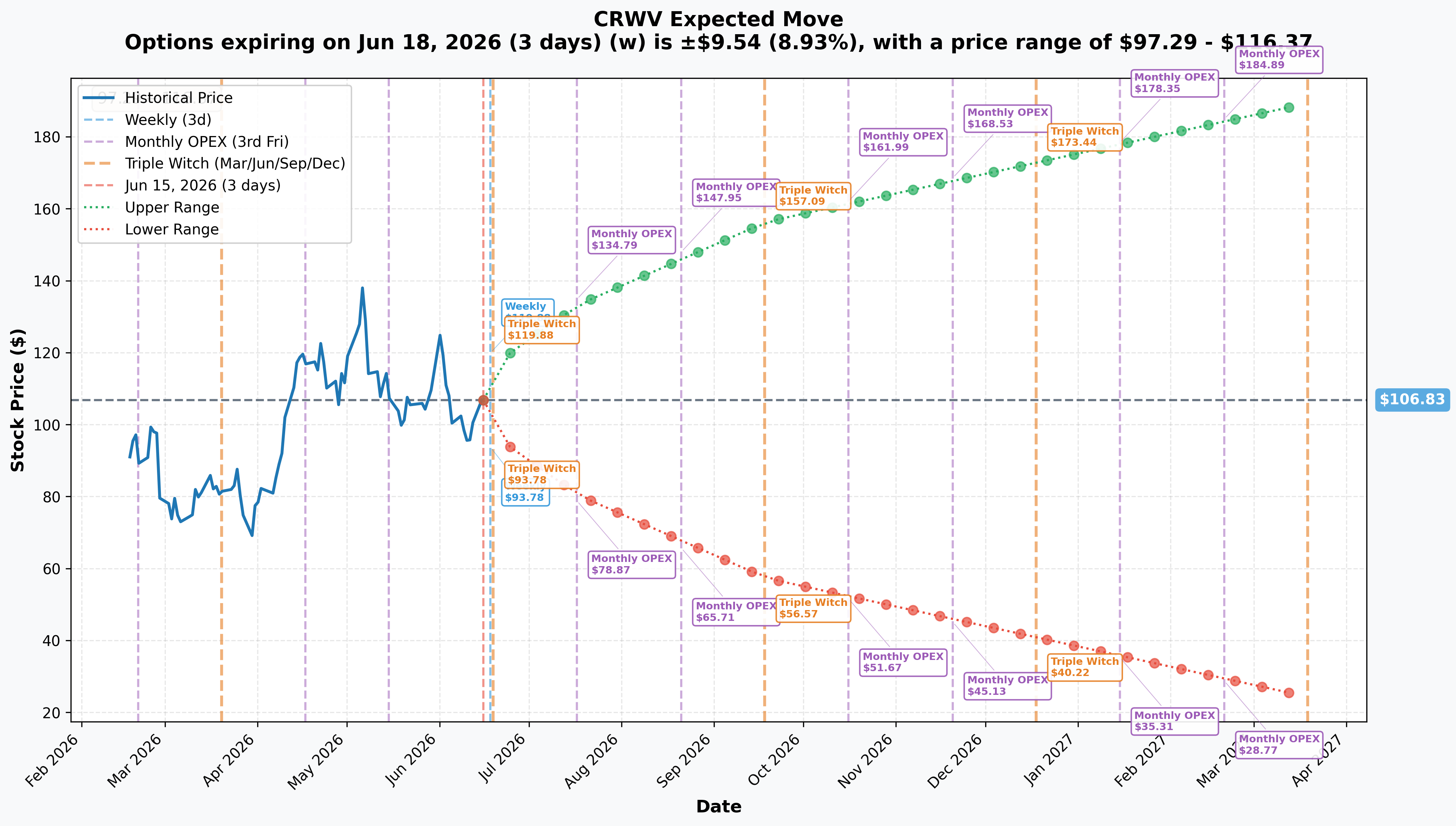
The options market is pricing enormous uncertainty into CRWV across every time horizon. This is one of the widest implied-move cones you'll see on any large-cap name:
- 📅 Monthly (exp 2026-07-17): ±24.81% → Range $80.33 – $133.33
- 📅 Quarterly (exp 2026-09-18): ±46.37% → Range $57.30 – $156.36
- 📅 LEAP (exp 2027-03-19): ±77.32% → Range $24.23 – $189.43
Real talk: a monthly implied move of ±25% means the options market thinks CRWV could be at $80 or $133 within the next 30 days. That's not a small-cap biotech — this is a ≈$55B company. That extreme cone is why the $32.15 option price doesn't look crazy in context: it reflects a market that genuinely cannot price the outcomes tightly.
The put buyer's breakeven of $72.85 sits inside the one-year LEAP implied range (the LEAP floor is $24.23). The trade isn't pricing in a moonshot collapse — it's pricing in a scenario the options market itself considers within the normal distribution for this stock over 12 months.
🎪 Catalysts
Already Happened (Background to the Bearish Thesis)
Q1 2026 Earnings — May 7, 2026 (Revenue Beat, Bottom Line Miss) CoreWeave reported Q1 revenue of $2.1B, up 112% YoY and above the ≈$1.97B consensus — the growth story is intact. But adjusted EPS came in at −$1.12 vs −$0.90 expected, and net loss widened to $740M. The backlog hit $99.4B — impressive — but management acknowledged ≈$2.60 in capex for every $1 of new revenue and raised the full-year capex guide to $30–35B. This is the heart of the bear thesis.
DA Davidson Downgrade — May 18, 2026 (The Catalyst That Puts the Trade in Context) DA Davidson cut CoreWeave from Buy to Neutral, slashing the price target from $175 to $100 — a $75 cut in a single note. They cited valuation, execution risk, and profitability headwinds despite the backlog. The analyst community's average target remains ≈$132–$140, but the downgrade shows how violently targets can compress when the leverage narrative shifts.
Massive Insider Selling Post-Lockup CoreWeave co-founders sold >$2.3B in stock after the IPO lockup expired (≈August 2025). A CSO sold another $7.45M as the Nasdaq-100 inclusion approached. Backer Magnetar Financial reduced its stake by >$5.5B. When founders dump at this scale, it's information worth noting.
Core Scientific Acquisition Failed — Twice Core Scientific shareholders voted against CoreWeave's ≈$9B all-stock acquisition bid in October 2025; the merger was terminated. This was CoreWeave's second failed attempt to secure owned data-center capacity — leaving the company more reliant on leased space and continuous external financing.
Raised >$20B in Capital in 2026 YTD CoreWeave has raised more than $20 billion in capital in 2026 alone — a rate of financing that is the business model's spine and its greatest risk. $8.5B of that is recent debt; a $4.2B maturity is due in 2026 and will need refinancing.
The Nvidia-CoreWeave-OpenAI Circular Financing Loop Nvidia holds equity in CoreWeave and acts as a backstop buyer of unsold GPU capacity through 2032. OpenAI is a major customer and has committed ≈$6.5B through May 2031. Meta committed ≈$14.2B through December 2031. Critics call this a circular-financing structure: Nvidia sells GPUs to CoreWeave on credit, CoreWeave rents those GPUs to AI labs that buy chips from Nvidia. When someone asks who ultimately pays, the answer is: the capital markets. Sam Altman himself said "someone is going to lose a phenomenal amount of money" in this AI infrastructure cycle.
Upcoming Catalysts (What Moves This Put)
Nasdaq-100 Inclusion — June 22, 2026 📅 (Bull catalyst — short-term) CoreWeave joins the Nasdaq-100 just 15 months after its IPO, effective before market open June 22. This drives mandatory passive index buying from QQQ and related funds — a mechanical short-term positive for the stock. A put buyer here accepts that this near-term bull catalyst may push the stock higher before their thesis plays out over 12 months.
Q2 2026 Earnings — ≈August 18, 2026 📅 (Binary) The next big catalyst. Company guide: $2.45–2.6B revenue. Key watch items: Microsoft customer concentration trajectory (expected to fall below 50% as OpenAI/Meta ramp), capex and cash burn pace, net interest expense (already ≈$536M in Q1), any new debt financing, backlog conversion rate. A bottom-line miss or financing-market concerns will be heavily scrutinized.
$4.2B Debt Maturity in 2026 📅 (Bear catalyst risk) CoreWeave has a $4.2B debt maturity due in 2026 that needs refinancing. If credit markets tighten or the company's bond yields rise materially from the already-elevated ≈11.5%, refinancing cost could spike — directly squeezing the model that runs on continuous borrowing.
Q3 2026 Earnings — ≈November 2026 📅 A second data point on the capex-to-revenue math and customer concentration trends. The LEAP put has time to capture both Q2 and Q3 before expiring in June 2027.
Ongoing AI Capex Environment 📅 (Macro risk) A credit-tightening or AI-capex air pocket scenario is the macro tail risk the put hedges. If the AI spending cycle peaks or credit costs rise materially, a company running ≈$22.6B in long-term debt at ≈11.5% bond yields faces immediate financial pressure.
🎲 4-Reader Interpretation
🚀 YOLO Trader
This is the trade you dream about in a name this volatile. The buyer put $4.8M on a year-out bearish bet with a 15.8x OI print — that's not a retail trade. If you want to ride alongside, the same strike (CRWV Jun-2027 $105P) gives you defined risk (the premium you pay) and explosive upside if CoreWeave's leverage story cracks. But that $32.15 price tag is steep — ≈30% of the stock price. You could also go further OTM (say the $80 or $75 puts) for much less cost per contract, accepting that the stock needs to fall more before you profit. The leverage cuts both ways: if CRWV rallies toward $130+ after the Nasdaq-100 inclusion, these puts bleed fast. Size accordingly.
📊 Swing Trader
Watch the $105 gamma support level closely. That's the zone where the put buyer is positioned AND where market-maker delta-hedging kicks in. If CRWV breaks and holds below $105 on elevated volume — especially after the Nasdaq-100 inclusion pop dissipates — that's your technical signal that the bears are taking control. Near-term swing setup: watch for a close below $105 post-June 22 and play momentum toward the $100 gamma support (also the DA Davidson target). Alternatively, if the stock rallies to $115, that's the call-gamma resistance level where a covered short entry against a long position makes sense. The ±25% monthly implied move means there's plenty of range either way — pick your spots and use tight risk management.
🛡️ Premium Collector
With implied volatility this elevated (≈30% of spot in the option price), CRWV is a premium seller's dream in theory — but the stock is also genuinely capable of moving 30%+ in a month, making naked short premium on this name genuinely dangerous. A safer approach: credit spreads. Selling a put spread (e.g., sell the $100P / buy the $85P in a near-term expiry) collects income while defining your maximum loss. You're collecting premium in a high-IV environment while limiting exposure if the leverage thesis actually cracks. Avoid uncapped short puts on a name with ≈$22.6B in long-term debt and an 11.5% bond yield — the tail risk is real.
🌱 Entry-Level / Beginner
Here's what happened in plain terms: someone paid $4.8M for the right to sell [CoreWeave stock at $105 anytime before June 2027. CoreWeave is an AI company that rents out massive computer clusters to companies like Microsoft, Meta, and OpenAI — but to do it, they've borrowed over $22 billion. The worry is: what happens if AI spending slows down, or if it gets more expensive for CoreWeave to borrow money? The stock might fall a lot. The put buyer is essentially saying: "I think that risk is real over the next 12 months, and I'll pay $4.8M to profit if it happens." The stock needs to fall to ≈$72.85 for the option buyer to break even. This is called a long put — a bearish bet with defined risk (they can only lose the $4.8M they paid) but substantial profit potential if the stock drops significantly. It's the options equivalent of buying insurance on a house before a potential hurricane season.
⚠️ Risk Factors
Options trading involves substantial risk. Here are the honest risks for this trade and the CRWV thesis:
The Bull Case Is Not Dead CoreWeave has a $99.4B contracted backlog anchored by Meta ($14.2B), OpenAI ($6.5B), Anthropic, and Jane Street. Revenue is growing at 112% YoY. Nasdaq-100 index inclusion on June 22 drives mechanical buying. The consensus analyst target remains ≈$132–$140 — well above current price. If AI infrastructure demand stays strong and credit markets stay open, the put expires worthless and the buyer loses the full $4.8M.
The Breakeven Requires a ≈32% Decline The $105 put cost $32.15, so CRWV must trade below $72.85 at expiration to profit. That's a big move, even for a volatile name. The stock has been up ≈200% from its IPO — buyers of this put need the story to genuinely break, not just wobble.
Near-Term Catalyst Headwind (Nasdaq-100 June 22) The Nasdaq-100 inclusion forces index funds to buy CRWV shares mechanically, regardless of fundamentals. This creates near-term upward price pressure that works directly against a short-dated put position. The June 2027 expiry gives the buyer time to ride out this near-term bull catalyst — but it's still a headwind for the first few weeks.
Customer Concentration Is Declining (the Right Direction) Management expects Microsoft to fall below 50% of revenue as OpenAI and Meta ramp. If concentration risk is actively diversifying, one of the key bear arguments weakens. Q2 earnings will be the first real read on this trajectory.
AI Capex Continues to Accelerate Across the Industry If hyperscalers (Microsoft Azure, AWS, Google) continue expanding their own AI infrastructure and signing long-term contracts with GPU cloud providers, CoreWeave's backlog could keep growing and its financing costs could fall as its credit profile improves. A virtuous cycle benefits the stock and kills the put.
What the OPRA Tape CANNOT Tell Us We know the mechanism (single-leg block cross), size (1,500 contracts), strike ($105), expiration (June 2027), price ($32.15), and direction (BUY PUT). We do not know the buyer's identity, whether this is a standalone position or a hedge against a larger CRWV long, what their stop-loss level is, or their precise conviction on timing. We read the tape; we don't read minds.
🎯 The Bottom Line
Here's the deal: a desk just paid $4.8M for 12 months of downside protection on CoreWeave — the single most leveraged bet in the public AI-infrastructure space. The trade says: "The story of $30–35B in annual capex funded by ≈$22.6B in debt with 11.5% bond yields and ≈65% customer concentration could crack over the next year. And when it does, I want to be positioned."
This isn't the kind of trade you make to pick up a few percent. The breakeven is a ≈32% decline. The put buyer either has deep conviction on the leverage thesis, or is hedging a large existing long position, or both. The enormous implied volatility (≈30% of spot in the option price) tells you the options market itself is not comfortable putting tight probability bounds on where CRWV trades in June 2027.
The two-path summary:
- 📈 If the bull case holds: $99.4B backlog converts smoothly, Microsoft concentration falls below 50%, credit markets stay open, Nasdaq-100 passive buying lifts the stock. The put expires worthless. Buyer loses $4.8M.
- 📉 If the bear case materializes: A financing scare, an anchor-customer wobble, a credit-market tightening, or an AI-capex air pocket forces a multiple compression. The stock breaks $105, moves toward $100, and then $72.85 puts the put buyer at breakeven — each dollar below that is pure profit.
What to watch:
- 📅 June 22, 2026: Nasdaq-100 inclusion takes effect — near-term stock price support from forced index buying
- 📅 ≈August 18, 2026: Q2 2026 earnings — watch capex/cash burn pace, Microsoft concentration trajectory, and any new financing details
- 📅 2026 ongoing: $4.2B debt maturity refinancing — the terms will signal credit market confidence in CoreWeave's model
- 📅 ≈November 2026: Q3 2026 earnings — second data point on whether the backlog is actually converting and leverage is under control
- 📅 June 17, 2027: CRWV Jun-2027 $105P expiration
- 📅 Tomorrow ≈06:30 ET: OPRA OI snapshot — expected to show $105P OI rising from 95 to ≈1,595, confirming a fresh opening position
If you own CRWV stock: the $105/$100 gamma support zone is your key technical floor to watch. If the Nasdaq-100 inclusion catalyst fades and the stock breaks below $105 on volume, the technical picture deteriorates. The DA Davidson $100 target becomes the next magnet.
If you're bearish on the AI-leverage narrative: this $105 put is the textbook instrument — defined risk (the premium), year-long runway, positioned right at the current price. Size it based on how much you'd be comfortable losing entirely.
If you're bullish: the near-term setup (index inclusion, $99.4B backlog, analyst consensus at $132+) still favors the upside. But respect what this trade is saying — someone with real resources just paid $4.8M for 12 months of protection on this name.
A $4.8M long-dated put on the most leveraged name in AI — calculated, patient, and positioned exactly at the level where the leverage thesis meets the chart.
Disclaimer: Options trading involves substantial risk of loss and is not suitable for all investors. This analysis is for educational and informational purposes only and does not constitute financial advice. Past unusual options activity does not guarantee future returns. The CRWV June 2027 $105 put requires the stock to decline significantly from current levels (breakeven ≈$72.85 at expiration, approximately a 32% decline from ≈$107.84) for the buyer to profit at expiration; the option can expire worthless, resulting in 100% loss of the $4.8M premium. The implied move ranges shown are market-derived estimates, not guarantees. Leverage and debt levels cited are from company filings; credit and financing risk can evolve rapidly. Always conduct your own due diligence and consider consulting a licensed financial advisor before making any trading decisions. Open/close classification is based on size (1,500) vs prior OI (95) — a 15.8x ratio that points to a clear new opening position, to be confirmed by next-day OPRA open interest data (≈06:30 ET).
Last updated: 2026-06-16 — next-day OPRA OI confirmed the open (+2,105).