🤝 CRWV: ≈$27M of Far-OTM Calls Sold in Three Auctions — Someone's Harvesting CoreWeave's Rich Vol
📅 2026-08-03 | 🔥 Unusual Activity Detected
✅ UPDATE — August 4, 2026 pre-market: both call sales confirmed as genuine OPENING shorts. The $110 strike went 8,011 → 59,713 (+51,702) and the $115 strike 8,143 → 38,555 (+30,412). This was new short inventory created, not an existing position being bought back. See the ✅ RESOLVED box.
🎯 The Quick Take
Between 10:00 AM and 10:30 AM ET, a trader (or traders) sold ≈$27.08 million of far-out-of-the-money CoreWeave September calls — strikes sitting 38–45% above the ≈$80 spot at print time, with roughly six weeks to run. Both strikes are proven fresh opens (size far exceeds prior open interest). There is no equity hedge anywhere on the tape, which means this is either large-scale covered call writing against stock we simply can't see, or naked upside-call selling with open-ended risk on one of the market's most volatile AI names. We cannot tell which from today's data alone, and we say so plainly below.
Two things happened after this trade printed that make it materially riskier than it looked at 10:30 AM. First, CoreWeave's Q2 2026 earnings are now company-confirmed for Tuesday, August 11, 2026 — landing squarely inside this trade's 46-day life, 38 days before the September 18 expiration. Second, CRWV itself is up ≈17.25% today to ≈$84.15, on top of +24% and +21.9% single sessions just last week — this is a stock that can eat a chunk of a "far" OTM strike in two or three trading days. Both points are covered in full below.
📊 Company Overview
CoreWeave, Inc. (CRWV) trades on the NASDAQ and is classified under SIC code 7372 ("Services-Prepackaged Software"), though in practice it operates as a specialized AI cloud infrastructure provider:
- What they do: CoreWeave rents out Nvidia GPUs and other AI hardware, optimized for the largest AI training and inference workloads — think of it as a specialized, hyperscale-adjacent cloud built specifically for AI compute rather than general-purpose web hosting.
- Market cap: ≈$45 billion as of today's move (roughly $37-46B depending on the data source and share-class treatment used)
- Exchange / listing: NASDAQ, IPO'd March 28, 2025
- Employees: ≈2,189
- Customers: Multi-year contracts with large AI/hyperscaler customers including Microsoft, OpenAI, Meta, and Anthropic — we could not independently verify specific contract values or revenue-concentration percentages for this piece, so we're not citing exact numbers here.
- 52-week range: $60.55 (late July 2026 low) to $153.20 (prior high) — CRWV has traded within both extremes in just the last twelve months
On the "up nicely this year" question — be careful. We cannot verify a precise 2026 year-to-date return; one data source describes 2026 YTD as "roughly flat." What is verified: CRWV is down ≈19.84% on a trailing 52-week basis, and sits ≈45% below its 52-week high — this is not the story of a stock quietly compounding gains all year. It's a story of a huge round trip, which the YTD chart below makes visually obvious.
💰 The Option Flow Breakdown
📊 What Just Happened — The Tape
Three separate price-improvement auctions printed on CRWV's September 18, 2026 calls this morning — each one filled at or below the bid, which is the tape's way of telling us these were sold, not bought.
| Time | Buy/Sell | Call/Put | Expiration | Premium | Strike | Volume | Prior OI | Size | Spot | Option Price | Option Symbol |
|---|---|---|---|---|---|---|---|---|---|---|---|
| 10:00:40 | SELL | CALL | 2026-09-18 | $9.17M | $110 | 56,785 | 8,011 | 22,335 | $80.68 | $4.105 | CRWV20260918C110 |
| 10:17:27 | SELL | CALL | 2026-09-18 | $8.47M | $110 | 56,785 | 8,011 | 22,242 | $79.25 | $3.81 | CRWV20260918C110 |
| 10:30:11 | SELL | CALL | 2026-09-18 | $9.44M | $115 | 31,096 | 8,143 | 30,444 | $79.59 | $3.10 | CRWV20260918C115 |
🤝 Mechanism: Negotiated / Price-Improvement Auction. Each block was exposed on the exchange for price improvement and matched there — this is not a lit sweep (no aggression, no urgency implied) and not a pre-arranged block cross with a single known counterparty either. It's a worked order that found a fill through the exchange's auction mechanism. No raw exchange condition codes matter to you as a reader — just know these were negotiated, orderly fills, not panic selling or aggressive buying.
The totals:
- $110 calls: 44,577 contracts sold combined (22,335 + 22,242), collecting $17.64M
- $115 calls: 30,444 contracts sold, collecting $9.44M
- Grand total: ≈$27.08 million collected in premium
- Prior open interest: 8,011 ($110C) and 8,143 ($115C) — today's combined sizes of 44,577 and 30,444 blow past both, so both strikes are PROVEN fresh opens, not someone unwinding an old position.
- Package delta: −1,934,734 shares (≈$155M notional at the ≈$80 trade-time spot) — no offsetting equity hedge found anywhere on the day's tape.
✅ RESOLVED — Next-Day OI Is In (August 4, 2026 pre-market)
The OPRA open-interest snapshot timestamped August 4, 2026 ≈06:30 ET reflects the close of business August 3 — the definitive open-vs-close test we flagged when this published. Here is what it says.
| Leg | Baseline OI (Aug-3 snap) | Resolving OI (Aug-4 snap) | Δ | Print size | Δ as % of print | Verdict |
|---|---|---|---|---|---|---|
| Sep-18-2026 $110 call (sold) | 8,011 | 59,713 | +51,702 | 44,577 | ≈116.0% | ✅ OPEN (STO) |
| Sep-18-2026 $115 call (sold) | 8,143 | 38,555 | +30,412 | 30,444 | ≈99.9% | ✅ OPEN (STO) |
Verdict: confirmed premium-selling, opened fresh. Both strikes added open interest of roughly the size sold (and more at the $110 line, where other participants opened alongside). That settles the one thing the tape could not: this was STO — sold to open — not someone buying back a short or unwinding an old overwrite. The vol-harvesting read published August 3 holds. The seller is now carrying that short call exposure into September expiry, which is exactly the risk the article described.
🚨 CONFIRMED: Earnings Land Inside This Trade's Life — 38 Days Before Expiration
This is not a scheduling estimate. CoreWeave issued a press release confirming Q2 2026 financial results and conference call for Tuesday, August 11, 2026 at 5:00 PM ET — company-announced, not a calendar guess.
- August 11 is 38 calendar days before the September 18 expiration, leaving ≈27 trading sessions afterward for any post-earnings move to keep running before these calls expire.
- That matters enormously for a short-call seller: they are short gamma and short vega straight through a confirmed binary event, on a stock that has produced repeated double-digit single-session moves this year. Unlike a trade where earnings falls just outside the option's life, there's no way to sidestep this one by simply waiting it out — the position is live on both sides of the print.
- Consensus heading into the print: the company's own guidance is $2.5B-$2.6B in Q2 revenue versus a Street consensus nearer $2.7B — a "beat the guide, miss the Street" setup that has produced violent, direction-ambiguous moves before. CoreWeave has missed EPS consensus in 4 of its last 5 quarters as a public company.
- The stock's own recent behavior previews the risk: CRWV is up ≈17.25% today alone (to ≈$84.15), and posted +24% and +21.9% single-session moves in the prior week. Daily swings of ±10-25% have been routine in this name for weeks. A confirmed earnings event, on top of that realized volatility, is the single biggest thing standing between this trade and a clean expiration.
🤓 What This Actually Means — Plain English
In English: someone got paid $27 million today to promise to sell CoreWeave shares at $110 or $115 if the stock gets there by September 18.
Here's the decode:
- Order type: STO (Sell To Open). Both strikes show fresh open interest being created — this wasn't closing out an old position, it's a brand-new short call position. When you sell a call to open, you collect the premium upfront as cash, and in exchange you take on the obligation to deliver 100 shares at the strike price if the buyer exercises.
- "38–45% out of the money" — what that means for the odds, and why that number is already shrinking. At the ≈$80 print-time spot, these strikes were 38-45% away. But CRWV is up ≈17.25% today alone to ≈$84.15 — at today's price the gap is already down to roughly 31-37%, and the stock has posted +24% and +21.9% single-session moves within the past week. Using the combined position's own delta (≈0.26 per contract, or roughly a 1-in-4 rough probability of finishing in the money — delta is an approximation of this, not an exact probability, but it's the standard retail shorthand), the market was pricing these as longshots at the time of the sale — but "far OTM" is a moving target on a stock that can close a third of that gap in a single session.
- Covered vs. naked — THE central unanswered question. There are two very different stories that fit the same tape:
- Covered / overwriting: the seller already owns a large block of CRWV stock (or economically equivalent exposure held elsewhere, off-tape) and is renting out the upside for income — a classic "collect the premium, cap my gains" trade. Risk here is capped at opportunity cost (missing out on gains above the strike).
- Naked short calls: the seller has no offsetting long position at all. If CRWV squeezes past $110–115, the losses are open-ended — there is no ceiling on how high a stock can go, and this is exactly the kind of high-beta AI name that has produced 10-20%+ single-session moves before (see the July 2026 credit-driven selloff below, or the flip side — today's snap-back).
- We looked for an equity hedge on the full day's tape and found none. That does not prove it's naked — a pre-existing stock position from a prior day, a hedge routed through a different venue, or a portfolio-level offset elsewhere would not show up in today's tape. We're marking this INFERRED, not proven, and saying honestly: we cannot tell you which story is true.
- One more wrinkle worth naming: CoreWeave's credit market has been pricing real distress. Credit-default-swap pricing reportedly implied ≈50% default odds on CoreWeave debt as of July 30, 2026. If a seller believes credit stress structurally caps how far the equity can run (any good news accrues to creditors first), that's a coherent reason to sell calls even naked. It's also exactly the kind of thesis that can be violently wrong if a financing event or credit-spread tightening flips sentiment — which is part of why we won't guess at motive here.
- The premium itself is a signal. Collecting $3.10–$4.11 per contract on an ≈$80 stock for strikes 38-45% away, with only 46 days to expiration, is rich. A "normal" stock this far out of the money with this little time would trade for pennies. Getting several dollars tells you CoreWeave's implied volatility is priced extremely high right now — this trade is as much a bet on selling expensive volatility as it is a directional view that CRWV stays under $110.
- Scale of the risk if naked: every $1 CRWV trades above the combined breakeven (roughly $114–118, blending both strikes) costs the seller ≈$7.5 million per $1 across the full 75,021-contract position. That is the number that should focus anyone's attention on whether this is covered.
📈 Technical Setup / Chart Check-Up
YTD Performance
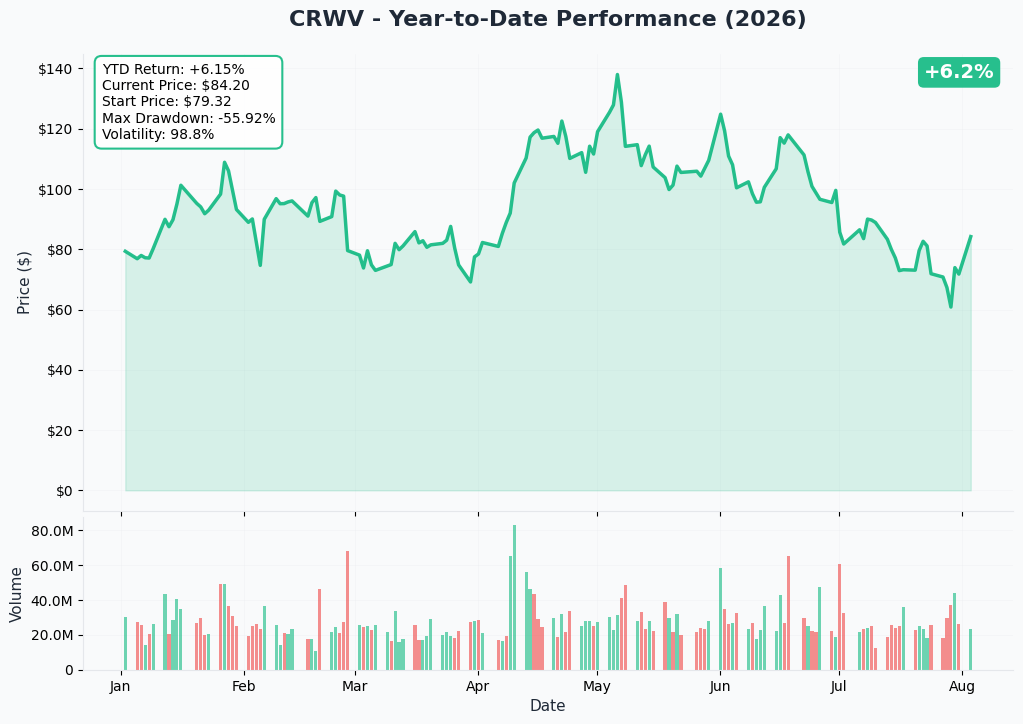
We can't pin down an exact 2026 year-to-date return with confidence — one data source describes it as "roughly flat." What we can verify is a trailing 52-week decline of ≈19.84%, a 52-week range of $60.55 to $153.20, and a stock currently sitting ≈45% below that high. The chart tells the real story regardless of the exact YTD number: a violent round trip. CRWV spiked toward the $110s-$150s earlier in the year, then cratered ≈26.5% from ≈$111.29 (June 22) to ≈$81.75 (early July) after a Bloomberg/Reuters report that anchor customer Meta might build its own competing cloud business — and kept falling into a new 52-week low of $60.55 in late July, driven largely by a credit-market scare (more below), before today's sharp +17.25% snap-back to ≈$84.15. Today's short calls were sold roughly into the early stage of that snap-back, not at a fresh high — but the round trip shows how quickly this stock's range can shift.
Gamma-Based Support & Resistance
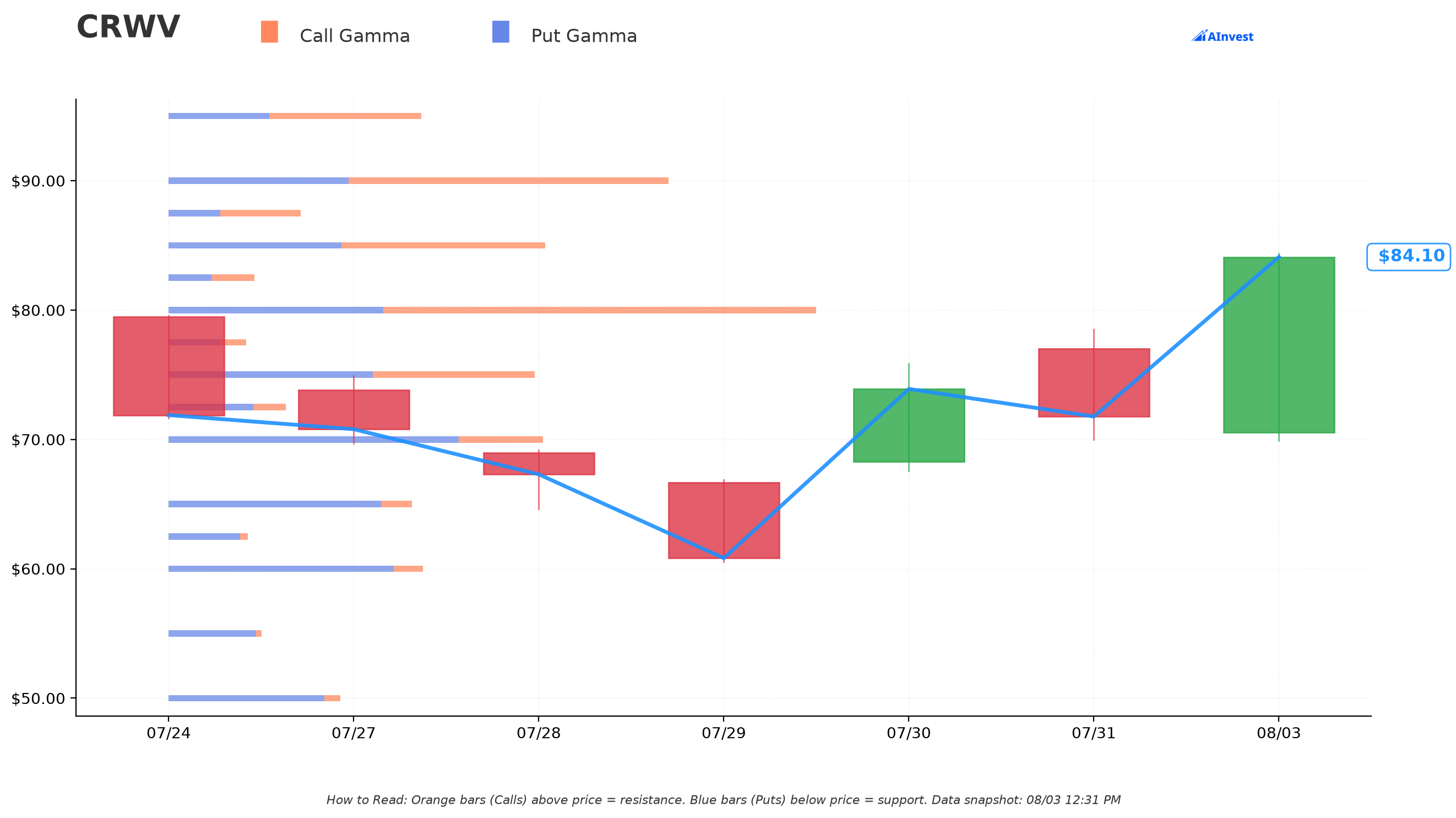
Current price: ≈$83.83 (per the gamma snapshot; CRWV continued running intraday to ≈$84.15, +17.25% on the day)
- 🔵 Support: $80 is the nearest major support wall (8.27B total gamma, "Strong" — ≈4.6% below spot). This is where dealer hedging flows should cushion any pullback.
- 🟠 Resistance: $85 (4.81B, "Moderate," ≈1.4% above spot) is the first ceiling, then $90 (6.39B, "Strong," ≈7.4% above), and the single biggest gamma wall on the board sits at $100 (14.30B total gamma, ≈19.3% above spot) — the real line dealers will defend hardest on the way up.
- What about the sold strikes? At $110, total gamma is only 3.64B; at $115, just 2.55B — both far thinner than the $100 wall. That's consistent with these strikes carrying very little prior open interest before today (8,011 and 8,143) — there simply wasn't much positioning out there until this morning's sale. The dominant gamma structure between here and the sold strikes is the $100 wall; CRWV would need to punch through that first before the $110/$115 strikes become the market's next concern.
Implied Move Analysis
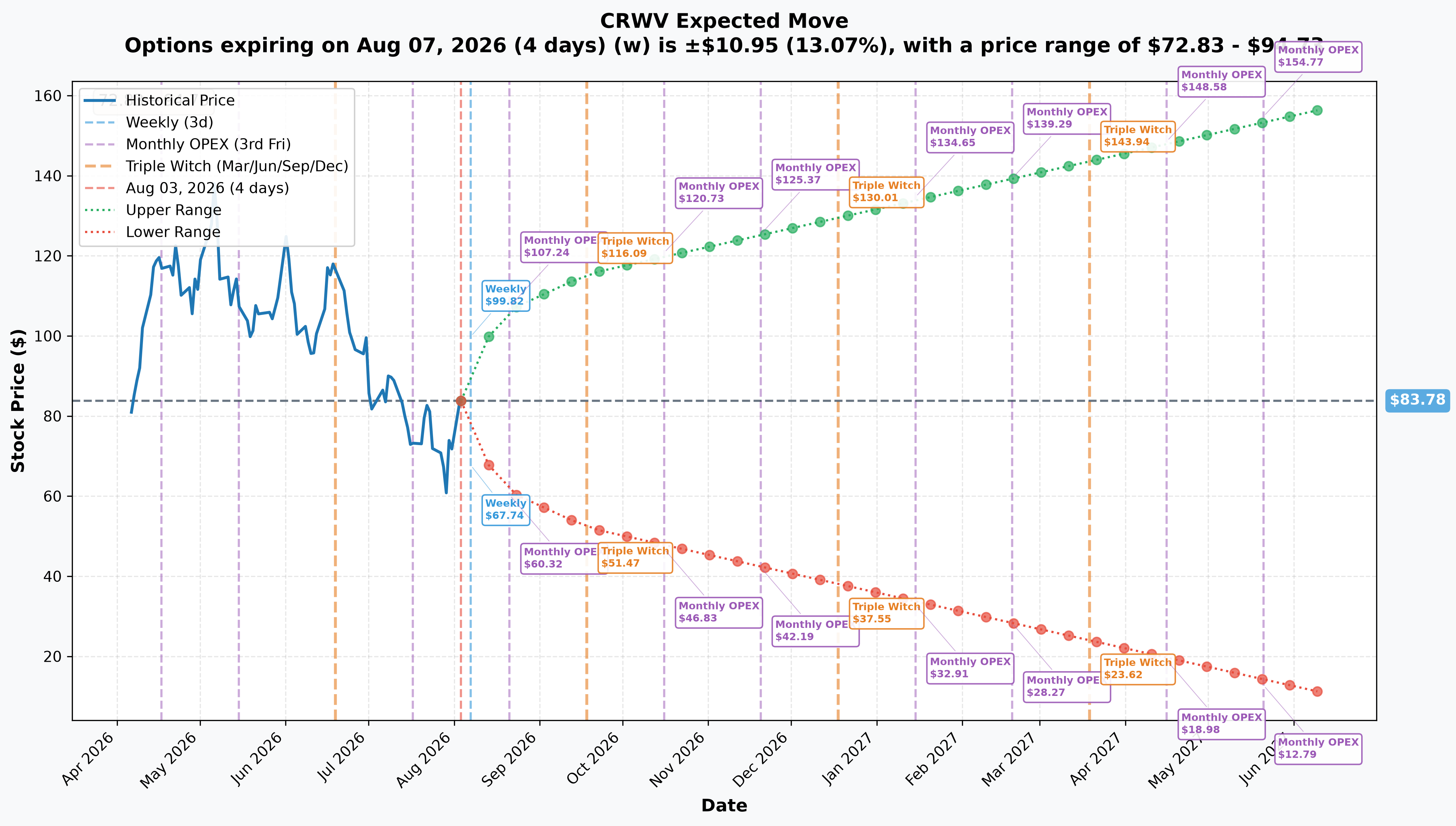
The options market is pricing serious movement into every horizon:
- Weekly (Aug 7, 4 days): ±13.1% → range $72.83 – $94.73
- Monthly OPEX (Aug 21, 18 days): ±27.3% → range $60.95 – $106.61
- Quarterly / Triple Witch — the trade's own expiration (Sep 18, 46 days): ±37.8% (±$31.69) → range $52.09 – $115.47
This is the single most important number in this whole analysis: the market's own implied-move upper bound for September 18 is $115.47 — almost exactly at the $115 strike these sellers just sold. In other words, they aren't selling something wildly outside the market's own expected range — they're selling right at the statistical edge of it. That's a meaningfully more aggressive bet than it first appears: it's not "impossible," it's "roughly the market's own definition of an outlier move." The $110 strike sits comfortably inside that range, which is consistent with it carrying more delta (the position's blended delta of ≈0.26 leans harder on the $110 leg).
🎪 Catalysts — Mapped to the September 18 Expiration
🚨 The big one: Q2 2026 earnings are CONFIRMED for August 11, 2026 — 38 days inside this window
CoreWeave issued a press release confirming Q2 2026 financial results and conference call for Tuesday, August 11, 2026, 5:00 PM ET — this is company-confirmed, not an estimate. That lands 38 calendar days before the September 18 expiration, leaving ≈27 trading sessions afterward for any post-print trend to keep running. Company guidance calls for Q2 revenue of $2.5B–$2.6B, versus a Street consensus nearer $2.7B — a "beat the guide, miss the Street" setup — and CoreWeave has missed EPS consensus in 4 of its last 5 quarters as a public company. A big beat could send CRWV straight toward — or through — these strikes; a miss in line with recent history could reinforce the seller's thesis. Either way, this is the dominant, non-avoidable event risk in the trade's life.
💳 The July collapse was a CREDIT story, not a demand story — and it's still live
This is arguably the most important reframe for this trade: CoreWeave's July selloff to a new 52-week low of $60.55 was driven by the bond market, not by weak AI demand.
- Credit-default-swap pricing reportedly implied ≈50% default odds on CoreWeave debt as of July 30, 2026 — an extreme reading for a ≈$45B equity.
- Total debt grew ≈+195% year-over-year, from ≈$11.9B to ≈$35.1B, against just ≈$2.24B of cash.
- Current ratio ≈0.31 — short-term obligations dwarf liquid assets — and one data provider computes an Altman Z-Score of 0.36, in the conventional distress zone (below 1.8), explicitly flagged as "elevated bankruptcy risk."
- Trailing-twelve-month free cash flow is ≈−$10.62 billion.
- Margins are moving the wrong way over five quarters: gross margin fell from ≈75.6% to ≈65.5%, and operating margin flipped from ≈+15.1% to ≈−6.9%.
- Why this matters for a call seller: if credit stress structurally caps how far the equity can run — because any good news accrues to creditors before shareholders — that's a real reason far-OTM calls can be safe to sell. But it's also a thesis that can reverse hard and fast: a large financing done on good terms, or a CDS-spread tightening, could flip sentiment violently, since the July decline was priced off credit fear rather than a fundamentals miss.
- The Meta-competition overhang is still part of the picture too: the July selloff was compounded by reports that anchor customer Meta may be building its own competing cloud business — a direct threat to CoreWeave's customer base. We could not independently verify the specific dollar value or revenue-concentration percentage of CoreWeave's contracts with Meta, Microsoft, OpenAI, or Anthropic for this piece, so we're not citing exact figures here — but the competitive question itself is real and unresolved.
⚖️ The squeeze debate — genuinely two-sided, and worth reading both halves
Arguments this short-call position is reasonably safe:
- Despite ≈19% of float sold short, days-to-cover is only ≈2.45 — far short of the multi-week readings that typically fuel a forced-buying squeeze. Two sessions of average volume would clear the entire short position.
- Shorts already cut their position ≈20.5% into mid-July — some of the squeeze fuel has already been spent.
- The street-low analyst targets sit below today's spot — not every analyst thinks this stock has more room to run.
Arguments this short-call position is genuinely dangerous:
- CRWV traded as high as $153.20 within the last 52 weeks — well above both sold strikes — so "far OTM" strikes sit comfortably inside the stock's own recent trading range, not in some historically unprecedented zone.
- Consensus analyst targets run ≈$136–$138, with a street-high target as high as $250-$303 — a re-rating narrative is readily available to buyers if sentiment turns.
- The confirmed August 11 earnings event, discussed above, sits squarely inside this trade's life.
- The stock has already shown it can move +24% and +21.9% in single sessions within the past two weeks, plus +17.25% today — two or three sessions like that compound quickly past a strike that looked untouchable at the time of the sale.
📊 Analyst activity — a busy, split July, and a wide-open target range
The week of July 21-22, 2026 saw an unusually large cluster of analyst moves, cutting both ways: downgrades to Hold from Citigroup, Jefferies, and Raymond James, alongside new bullish coverage from Bernstein, BTIG, TD Cowen, Cantor Fitzgerald, and an upgrade from Truist. Consensus sits at Moderate Buy / Buy (37 analysts, roughly 1 Strong Buy / 21 Buy / 14 Hold / 1 Sell on one count), with an average target near $136-$138 — but the full range spans as wide as $36 to $303, an >8x spread that reflects two genuinely incompatible theses (some analysts model an equity worth multiples of today's price, others model something worth far less). That dispersion means consensus targets shouldn't be treated as a reliable anchor for a 6-week options strike either way.
🧑💼 Insider selling — a continuous, price-insensitive overhang
CoreWeave insiders have sold ≈$1.76 billion of stock in the trailing three months and ≈$8.61 billion over the trailing twelve months, across 11 sellers and zero buyers. This is one of the more extreme insider-selling profiles in large-cap tech, and it has continued through the stock's decline from the $120s into the $70s — meaning insiders have been selling into weakness, not just strength. It's a structural headwind against any sustained squeeze: there is persistent share supply hitting the market regardless of price.
🔮 Forward catalysts inside and beyond the window
- New/expanded contracts with major AI/hyperscaler customers would be a positive catalyst source, though we can't cite specific contract values or concentration percentages with confidence here.
- Capex/financing cadence: FY2026 capex guidance runs well above current revenue — expect further large debt or equity raises, each one a dilution/leverage headline that can move the stock either way, especially given the current credit backdrop.
- Capacity/power buildout milestones (CoreWeave has previously cited roughly 3.5 GW of contracted power against a smaller active base) convert backlog into recognized revenue over time and are a recurring positive catalyst source — though we did not independently reconfirm the exact backlog dollar figure for this piece.
- Q3 2026 earnings are expected around November 2026 — after this trade's expiration, but relevant if the position gets rolled.
💡 Trading Ideas — Four Ways to Read This
🎰 YOLO Trader
If you think CoreWeave's credit-distress and Meta-competition fears are overblown and the confirmed August 11 earnings print comes in strong, buying the same $110 or $115 September calls this desk just sold is the mirror trade — you'd be betting the sellers are wrong about a 38-45%+ move being unlikely. At $3.10-$4.11 per contract, this is a real lottery ticket: cheap in dollar terms, but you need a genuinely large move to profit, and time decay works against you every day it doesn't happen. Given the stock's own recent ±20%+ single-session moves, this is less absurd than it would be on a calmer name — but size this as pure speculation, money you can lose entirely.
🎢 Swing Trader
Watch the $80 gamma support and $100 gamma wall as your reaction zones, and mark August 11 on your calendar as the single most important date between now and expiration. A clean hold above $85-90 into a strong Q2 print could see CRWV grind toward the $100 wall — that's a tradeable swing long with defined risk using a call spread (e.g., buying $90 calls against selling $105 calls) rather than outright stock, given how volatile this name is. A credit-related headline (financing stress, CDS spread moves) is just as likely a trigger as the earnings print itself. A break back below $80 support reopens the July lows near $60-75.
💰 Premium Collector — the natural audience, with a hard warning
This trade is exactly the kind of income strategy premium collectors gravitate toward — sell rich, far-OTM volatility, collect cash upfront, let time decay work for you. But retail accounts should not mirror this trade naked. A $27 million institutional short-call position can absorb a multi-million-dollar adverse move; a retail account selling naked calls on a name that can gap 10-20%+ overnight faces genuinely unlimited risk with no such cushion. If you want the same economic idea, do it with a defined-risk call credit spread instead — for example, selling the $110 call and buying the $120 or $125 call against it caps your maximum loss at the strike width, at the cost of some of the premium collected. That is the responsible way for an individual account to express "I don't think CRWV rallies 40%+ in six weeks" without risking the farm if you're wrong.
🌱 Beginner / Entry-Level
This is an advanced, professional-grade trade — not a template to copy. The lesson here is conceptual: selling options for income only works if you can survive being wrong, and on a stock this volatile, "being wrong" can mean losses many multiples of the premium collected. If you're new to options, this is a good trade to study, not to replicate. Paper-trade a covered call on a smaller, calmer stock first, and only consider selling calls against shares you already own (a true covered call) before ever considering a naked short call.
⚠️ Risk Factors — What the Tape CANNOT Prove
- A confirmed earnings event sits inside this trade's life, and it's not a minor one. August 11, 2026 is company-confirmed, 38 days before expiration, leaving ≈27 trading sessions afterward for a post-print trend to run. CoreWeave has missed EPS in 4 of its last 5 quarters — but a beat, especially one paired with credit-relief news, could move the stock hard through both strikes.
- CRWV is not calm right now — it is up ≈17.25% today alone, on top of +24% and +21.9% single sessions last week. Two or three more days like that compound past a "far" strike quickly. Spot ran from ≈$79-81 at the time of the sales to ≈$84.15 as of this writing — a real-time reminder that these short calls are live, mark-to-market positions from minute one, not static bets.
- The balance sheet is at or near conventional distress levels. Total debt is up ≈195% year-over-year to ≈$35.1B against ≈$2.24B cash, current ratio ≈0.31, one provider's Altman Z-Score of 0.36 ("elevated bankruptcy risk"), and trailing free cash flow of ≈−$10.62B. Credit-default-swap pricing reportedly implied ≈50% default odds in late July. This cuts both ways: it may cap the equity's upside (good for the seller), but a credit-relief surprise could also reverse it violently (bad for the seller).
- Insider selling is continuous and price-insensitive. ≈$1.76B sold in three months, ≈$8.61B over twelve months, 11 sellers and zero buyers — a structural supply headwind, but not a guarantee against a sharp squeeze move given the stock's realized volatility.
- Covered vs. naked is unresolved. We searched the full day's option and equity tape and found no offsetting stock hedge. That is evidence, not proof — a pre-existing position, an off-day hedge, or a portfolio-level offset elsewhere would not appear here.
- We cannot identify the counterparty. Broker/MMID, customer identity, and order ID are all invisible to us. We don't know if this is one desk or several accounts matched at the same auction.
- Open interest resolves "held vs. bought back," not identity. Tomorrow's OI snapshot tells us whether the position survived the day — it will not tell us who holds it or why.
- The squeeze picture is genuinely mixed, not a one-way risk. ≈19% of float is short, but days-to-cover is only ≈2.45 and shorts already cut ≈20.5% into mid-July — there's no obvious multi-week forced-buying engine. At the same time, CRWV traded as high as $153.20 in the past year and carries analyst targets as high as $250-$303, so a re-rating narrative is readily available if sentiment turns.
- The Meta-competition overhang is unresolved, and we could not verify specific contract dollar figures or concentration percentages. Any headline confirming or denying a competing in-house cloud push could move CRWV sharply in either direction before September 18.
- Several figures we'd want for a complete picture simply weren't verifiable this session: the exact current revenue backlog/RPO, specific Microsoft/OpenAI/NVIDIA contract values and concentration percentages, and any lockup expiry or new securities offering. Treat any confident-sounding claim about those specific numbers elsewhere with appropriate skepticism.
Disclaimer: Options trading involves substantial risk of loss and is not suitable for all investors. This analysis is for educational purposes only and is not financial advice. We cannot verify whether this position is hedged, who is behind it, or what happens to it after today — treat every open/close and covered/naked read here as our best honest interpretation of incomplete data, not certainty. Always do your own research and consider consulting a licensed financial advisor before trading, especially with undefined-risk strategies like naked call selling.
About CoreWeave, Inc.: CoreWeave is a modern cloud infrastructure company offering Nvidia GPUs and other AI hardware optimized for the largest AI training and inference workloads, supporting foundational large language model development for AI-industry customers including Microsoft, OpenAI, Meta, and Anthropic. Market cap ≈$45 billion as of today's move, listed on NASDAQ since its March 28, 2025 IPO.
Last updated: August 4, 2026 — next-day OPRA open-interest resolution added (✅ RESOLVED box above). Original analysis published August 3, 2026.