🤝 CRWV $10.07M December $110 Call Cross — Why This Is a Volatility Trade, Not a Bullish Bet
📅 2026-08-12 | 🤝 Stock+Options Cross Detected — Not a Directional Signal
✅ Updated 2026-08-13 pre-market — the next-day OPRA open interest confirmed the full 5,000 as a new position, not a partial transfer. Open interest rose 2,330 → 7,342 (+5,012) against a 5,000-lot print — we predicted ≈7,330. The article only claimed ≈2,670 contracts were provably new; the snapshot proves all 5,000 were, plus 12 more. The BTO label is upgraded from provisional to confirmed. See the ✅ RESOLVED box.
🎯 The Quick Take
A desk bought 5,000 CoreWeave December 18 $110 calls for ≈$10.07M — but the print carries a paired equity leg, meaning shares traded alongside the calls in the same negotiated package. That makes this a delta-hedged cross, not a clean directional bet, and the option alone tells us almost nothing about where the desk thinks CRWV is headed. What it does tell us is that someone paid an extraordinary price for volatility — ≈18.9% of the share price in pure time value — one day after CoreWeave's stock jumped +17.9% on its Q2 earnings beat.
🏢 Company Overview
CoreWeave is a specialised GPU cloud ("neocloud") — it buys Nvidia accelerators at scale, houses them in leased/contracted data-centre capacity, and rents that compute out under multi-year contracts rather than hourly pricing. It brands itself "The Essential Cloud for AI." Sector/industry is commonly bucketed as Technology / Software – Infrastructure, though the exact GICS sub-industry code could not be confirmed from a primary filing this session.
The core economic engine is a spread trade: borrow at a credit spread, buy GPUs, lock in a multi-year contract that amortizes the hardware, and pocket the difference. That structure makes CoreWeave far more sensitive to its own cost of capital than to raw AI demand — and that's exactly what drove the stock's rollercoaster over the last three months.
Key numbers:
- Market cap: ≈$58.1B, enterprise value ≈$104.3B
- Shares outstanding: 545.57M (public float 310.84M; insiders hold 24.2%)
- Beta: 7.43 — extreme sensitivity to broad market moves
- 52-week range: $60.55–$153.20 (a 2.5x span)
Customer concentration is the single biggest structural risk. Microsoft accounted for ≈two-thirds of fiscal 2025 revenue. Nvidia is simultaneously CoreWeave's supplier, a ≈$2B equity investor (January 2026 at $87.20/share), and counterparty to a ≈$6.3B backstop/order agreement — the "circular financing" setup bears point to. 2026 has brought real diversification — Meta, Anthropic, Jane Street and Leidos among the named additions — but the Microsoft dependency remains the dominant single-name risk.
The debt and lease load — read this before anything else. As of June 30, 2026: $35.1B of total borrowings, $51.6B including $16.5B of lease liabilities, ≈$46.1B of net debt, and $640M of net interest expense in a single quarter. Free cash flow was −$5.7B for the quarter. Debt-to-equity sits at 3.68x. $7.5B of debt is classified current against just $5.5B of cash — the current portion of debt exceeds the entire cash balance. This is the mechanical reason financing headlines have moved this stock 10%+ in a single session.
IPO history: CoreWeave IPO'd March 28, 2025 at $40.00, raising ≈$1.5B. The IPO lock-up expired ≈August 14–15, 2025 — there is no remaining lock-up overhang; the ongoing supply pressure now comes from routine 10b5-1 insider selling ($8.66B sold over the trailing 12 months, zero purchases), not a scheduled unlock cliff.
💰 The Trade, In Plain English
At 11:32:42 ET, a desk bought 5,000 December 18, 2026 $110 calls at $20.15, for ≈$10.07M in premium, with CRWV trading at $106.50 (spot at the time of the print; the broader tape shows spot near $107.31 shortly after). The strike sits ≈3.3% above the money.
Here's the part that changes everything: this printed as a stock-and-options cross — the shares traded alongside the calls in the same negotiated package, off the open book, with a known counterparty on the other side. 🤝
What that means in plain terms: when a desk buys calls and simultaneously trades the offsetting stock, the combined position is delta-hedged at inception. The stock leg cancels out (or substantially offsets) the directional exposure the calls would otherwise carry. The trade is expressing a view on volatility, financing, or is facilitating a client's book — not a bet that CRWV goes up. Calling this "a $10M bullish bet" misreads the mechanics.
| Field | Detail |
|---|---|
| Time | 11:32:42 ET |
| Buy/Sell | BUY (reported, see caveat below) |
| Call/Put | CALL |
| Expiration | 2026-12-18 |
| Premium | ≈$10,075,000 |
| Strike | $110 |
| Volume | 5,200 |
| Prior OI | 2,330 |
| Size | 5,000 |
| Spot | $106.50 |
| Option Price | $20.15 |
| Option Symbol | CRWV20261218C110 |
| Mechanism | 🤝 Stock+Options Cross |
Direction caveat: this printed as a negotiated cross that took no liquidity — it did not sweep a lit order book. The BUY label is the reported side, not tape-proven the way a lit aggressor read would be. And critically, the paired share leg means the option's direction is not the position's direction. Treat this as a volatility/facilitation footprint, not a signal about where CRWV is headed.
✅ RESOLVED — The Full 5,000 Opened, Not Just the Provable 2,670
Updated 2026-08-13 pre-market. Resolving OPRA snapshot timestamped August 13 (reflects the August 12 close, after this print); baseline is the August 12 snapshot (reflects the August 11 close, before this print).
| Leg | Baseline (Aug-12) | Resolving (Aug-13) | Δ | Print size | What we published | Verdict |
|---|---|---|---|---|---|---|
| Dec-18 $110 call (bought) | 2,330 | 7,342 | +5,012 | 5,000 | "climb from 2,330 toward roughly ≈7,330" | ✅ OPEN (BTO) — 100.2% of size |
The provisional half of this read is now settled. Yesterday we could only prove 2,670 contracts were new (size minus prior open interest) and explicitly warned that the balance could have been a transfer — citing the AMAT 2026-06-09 case where only 876 of 3,150 contracts became new open interest. That did not happen here: +5,012 against a 5,000 print is 100.2% capture, with a dozen contracts of extra buying on top.
The falling-OI branch — which would have flipped the entire read to a close — did not occur. Open interest rose, decisively.
What is still unproven: this printed as a negotiated cross alongside stock, so the volatility-trade framing rests on the structure and the paired share leg, not on an aggressor read. Open interest confirms the option position is new; it does not convert this into a directional signal.
🤓 What This Actually Means — Plain English
Let's slow down on two ideas, because they're the whole story here.
First: what is a "delta-hedged" options position, really? Imagine you buy a call option that pays off if the stock goes up. On its own, that's a directional bet — you win if the stock rises, you lose (or your option decays to zero) if it doesn't. Now imagine that in the same trade, you also sell (or otherwise trade) the underlying shares in a size calibrated to offset the option's sensitivity to the stock price. Now your combined position barely cares whether the stock goes up or down in the short run — you've stripped out the direction and kept only the exposure to how much the stock moves, i.e., volatility. That's what a paired stock+options cross does. It's why we can't read "BUY 5,000 calls" here as bullish conviction — the shares that traded alongside it neutralize that read.
Second: what does paying 18.9% of the share price in pure time value tell us? The $110 strike is above today's $106.50 spot, so the entire $20.15 the buyer paid is time value — there's zero intrinsic value baked in. Spending nearly a fifth of the stock's price just to hold the right to buy it later, with nothing "real" backing that premium yet, only makes sense if you expect enormous movement between now and December 18. Working backward from that price (our own Black-Scholes back-solve, not a quoted figure), the option is priced for roughly ≈80% implied volatility — an extraordinary level. If the stock does absolutely nothing between now and expiration — just sits at $106.50 — that $20.15 decays straight to zero. Time value is a wasting asset, and 100%-time-value options are the fastest-wasting kind.
Why would anyone pay that much for volatility? Because CRWV genuinely moves like almost nothing else on the board. Beta is 7.43. Average true range is ≈7.9% of spot on a normal day. The stock lost 39.8% in July and gained back 47.7% in the first eight sessions of August. Options priced ≈15.5% single-day swings into the August 7 pre-earnings setup and ≈17–19% into the May print. Roughly 18–21% of the float is sold short with only ≈2.3 days to cover, which can violently amplify moves in either direction. And underneath all of it: CoreWeave carries ≈$46B of net debt against ≈$58B of equity market cap — in a highly levered company, the stock behaves like a call option on the whole enterprise. When credit gets priced for distress (CDS implied ≈50% default odds on July 30), equity volatility mechanically explodes right along with it. An ≈80% implied vol price is not an outlier here — it's what the math says this specific stock, at this specific moment, should cost.
📈 Chart Check-Up
1-Year Performance
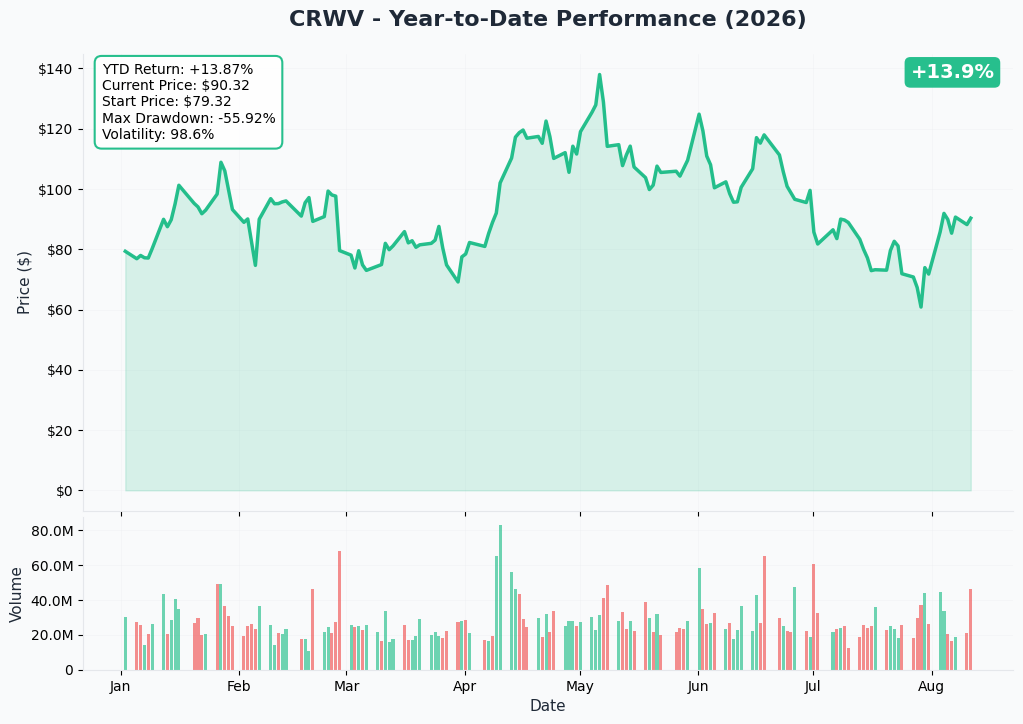
CRWV's past year is the ATR and beta numbers made visible: a steep climb, a brutal July drawdown, and a sharp August recovery — all inside twelve months.
Gamma Support & Resistance
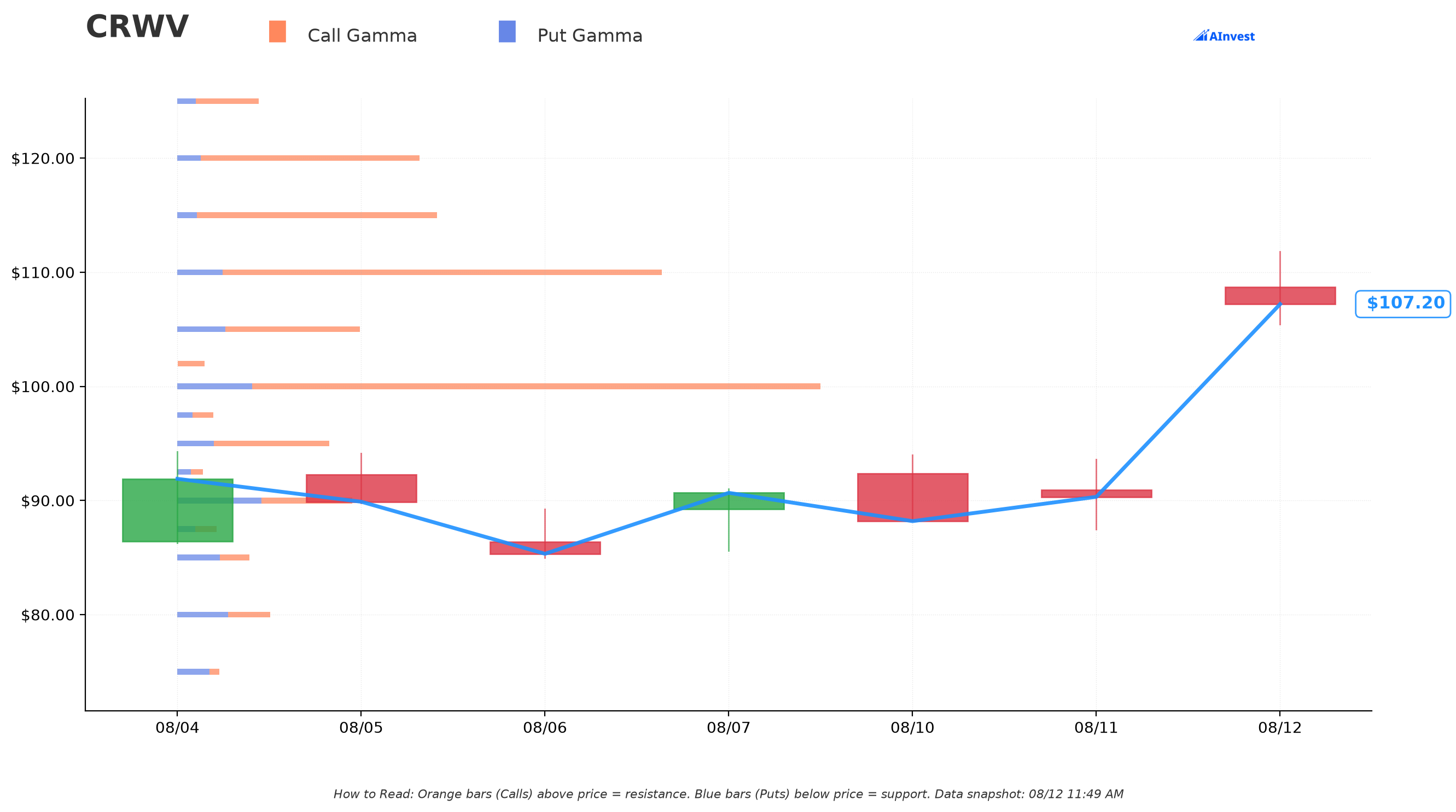
With spot at $107.31, the options market is drawing a tight box around price:
- Resistance at $110 — Very Strong. This is the largest single gamma concentration on the board, and it's exactly the strike the $10.07M call trade bought. A cluster of dealer hedging activity sits right where this position is targeted, which can act as a magnet or a ceiling depending on how dealers are positioned.
- Support at $105 — Strong, just below spot.
- Beyond that immediate range, $100 support and $115/$120 resistance are both "Very Strong," meaning the gamma structure widens out fast in both directions — consistent with a stock that genuinely trades in big steps, not small ones.
Implied Move
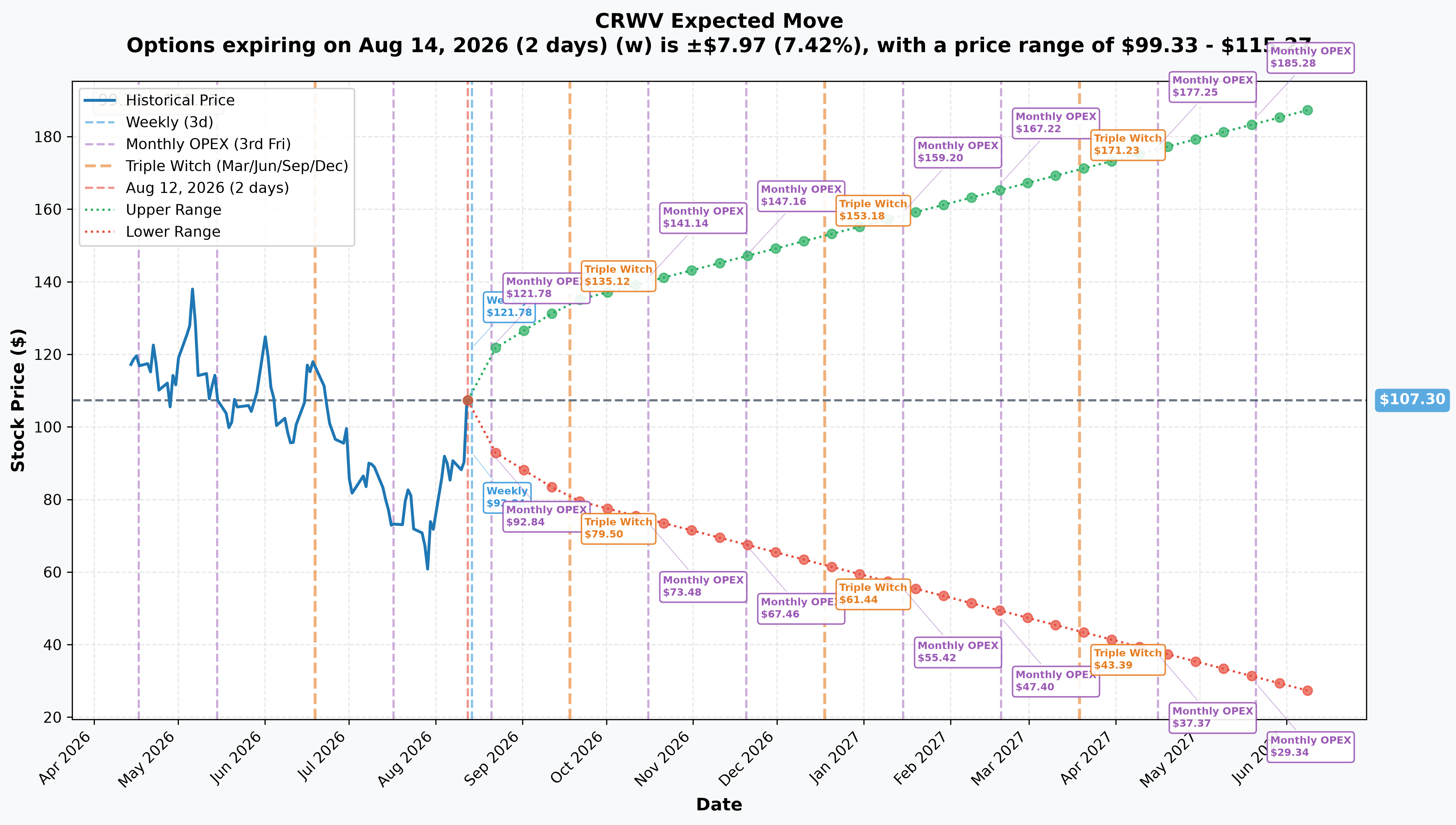
The options market's own math on how far CRWV could travel:
| Horizon | Expiry | Implied Move | Range |
|---|---|---|---|
| Weekly | 2026-08-14 | ±7.42% | $99.33 – $115.27 |
| Monthly OPEX | 2026-08-21 | ±13.04% | $93.31 – $121.31 |
| Quarterly (Triple Witch) | 2026-09-18 | ±25.36% | $80.10 – $134.52 |
A ±25.4% range over just five weeks is among the widest implied moves you'll find on any actively traded name — this is what an ≈80% implied-volatility stock looks like when you let the math run forward. It also frames the $110 strike concretely: it sits well inside even the weekly implied range, meaning the market doesn't consider $110 a stretch target at all in the near term — the real uncertainty is about how far past it CRWV could travel by autumn.
🎪 Catalysts
Keep two dates straight throughout this section: the option expires 2026-12-18. The catalysts that matter for it are dated separately, and they don't line up perfectly with that expiration.
Already happened (last 3 months)
- Q2 2026 earnings, reported August 11, 2026 (after close): revenue $2.575B, +112% year-over-year; EPS −$1.14 against a −$1.52 consensus (a beat); backlog $104B, up ≈246% year-over-year, plus ≈$25B of additional commitments signed in early Q3 (which reconciles the $104B and $129B figures circulating). FY2026 revenue guidance was raised to $12.4B–$13.2B. The stock rose +17.9% to $106.46, ending a five-quarter streak of negative post-earnings reactions, per the company's release and stockanalysis.com.
- But the prior three months were dominated by credit, not demand. Q1 2026 (May 7) sent the stock down ≈10–12% on weak guidance and a bigger spending forecast. A $3.1B delayed-draw term loan closed May 18. A $3.55B global note offering ($1.25B USD + €2.0B EUR, due 2032) priced in June. Nasdaq-100 inclusion took effect June 22, 2026 — already complete, not an upcoming event, and the stock actually fell ≈5% on the effective date.
- Then July collapsed: the stock fell to $71.77, a −39.8% monthly decline, as credit default swaps reportedly implied ≈50% odds of default and loan spreads blew out ≈125bp, forcing sweetened terms on a pending credit facility.
- The turn: a $2.6B loan facility closed oversubscribed on August 10, 2026, priced at SOFR+550, rated Ba2 (Moody's) / BB+ (Fitch), arranged by JPMorgan and MUFG — per the company's closing release. That closing removed the acute left-tail credit risk one day before the earnings beat. This CDS-blowout-to-oversubscribed-financing sequence explains the stock's 80% implied vol better than the earnings print alone does.
Upcoming — inside the December 18 expiration
- Exactly ONE quarterly report falls inside the option's life: Q3 2026, estimated ≈November 10, 2026 — and this date is NOT yet company-confirmed. For context, Q2's date was only announced 15 days ahead of the actual report, so a formal Q3 date announcement isn't expected until late October.
- The Nasdaq-100 annual reconstitution announcement (≈mid-December, unconfirmed) likely falls just inside the window — but its effective date (≈December 21) lands one trading day after the option expires.
- Additional debt financing is a high-probability event inside this window, even though it's unscheduled. CoreWeave has closed a new facility or note offering in nearly every month of 2026 to date, against ≈$37B of planned 2026 capex and only $5.5B of cash on hand.
Upcoming — outside the December 18 expiration
- Q4/FY2026 results and the first FY2027 guidance, estimated ≈late February 2027, fall entirely outside this option's life. This is arguably the single biggest information event of the next six months, and the December $110 calls do not capture it.
- The Nasdaq-100 reconstitution's effective date, as noted, is one trading day too late to be captured.
Bottom line on timing: this December structure buys exposure to one unconfirmed Q3 earnings event roughly three months out, plus roughly five weeks of decay afterward into expiration — but it misses the bigger FY2027 guidance event entirely.
👥 Four Ways to Read This
🎲 The YOLO trader
You want a piece of the $110 strike for December. Fine — but understand you'd be buying into ≈80% implied volatility on a stock that just moved 48% in eight trading days. The premium you'd pay is comparable in spirit to what a real desk paid here, and their position is hedged; yours would not be. If you buy naked calls at this vol level, you need CRWV to keep moving fast just to avoid decay eating you alive. Size this like the lottery ticket it is — a small fraction of a small position, never rent money.
📈 The swing trader
The gamma map gives you real, near-term levels: $105 support, $110 resistance (the strongest wall on the board, and where this trade is targeting), then $115/$120 further out. The implied-move data says the market expects CRWV could realistically test either the $93–$121 range by August 21 or the $80–$135 range by September 18. If you're playing a bounce or a fade off those gamma levels with a defined-risk spread rather than a naked long call, you're paying far less for the extraordinary vol premium than an outright buyer does.
💰 The premium collector
An ≈80% implied volatility name is exactly the environment premium sellers dream about — and exactly the environment where a single bad print can wipe out months of collected premium in an afternoon. If you're considering a covered call or a credit spread here, the $110 strike is a genuine magnet (heaviest gamma resistance on the chain) and could be a reasonable short-call level against existing shares. But respect the tail: this stock gapped ±18% and ±48% inside the last two months. Size credit positions assuming a double-digit gap is not a black-swan scenario here — it's a recent, repeated occurrence.
🌱 The beginner
This is a genuinely difficult trade to learn from precisely because the headline ("someone bought $10M of calls!") is misleading on its own. The paired stock leg means this wasn't a simple directional bet — it's a lesson in why you always ask "what else traded alongside this?" before assuming conviction. If you're new to options, CRWV at ≈80% implied volatility with $46B of net debt is not a name to learn on. Consider watching this one from the sidelines, or start with much smaller, much less volatile underlyings until you're comfortable reading a full trade, not just one leg of it.
⚠️ Honest Limits — What We Cannot Prove
- The tape cannot identify the counterparty, the broker, or the customer's true intent. We know a paired stock leg exists; we do not know the exact ratio, whether it fully or partially offsets the option's delta, or whether this is a market-maker facilitation, a financing/borrow trade, or something else entirely.
- Open versus close is not fully resolved. At least 2,670 of the 5,000 contracts must be new, but the full-size open is not provable from a single session on a negotiated cross. The next-day OPRA open interest snapshot is the definitive test — see the ⏳ callout above.
- Filings hosts returned errors for the entire research session — no 10-Q or 10-K was read directly. That means there is no verified maturity-by-maturity debt schedule, and the sector/industry classification above is a data-provider label, not a confirmed GICS sub-industry code.
- No earnings-call transcript was available. The Q3 guidance figures ($3.5B–$3.6B) and the FY2026 capex range (reported anywhere from $30–35B to $35–39B depending on the outlet) come from secondary reporting and are not primary-sourced. Treat the capex figure as directionally right but not precise.
- Contracted power capacity is disputed across sources: CoreWeave's own release states ≈3.7 GW; one outlet reported 4.2 GW. This was not reconciled.
- Several claims throughout this piece rest on aggregated news-headline indexes rather than full original articles, because major outlets (Reuters, CNBC, the Financial Times, and others) blocked direct retrieval this session. Those claims establish that something was reported and roughly when, not full original-article detail.
This analysis is for informational purposes only and is not investment advice. Options trading involves substantial risk of loss and is not suitable for all investors. CRWV carries elevated volatility, significant leverage, and concentrated customer risk — position sizing should reflect that reality, not the size of the headline premium number.
Last updated: 2026-08-13 (pre-market) — the next-day OPRA open-interest snapshot confirmed the full size. Dec-18 $110C 2,330 → 7,342 (+5,012 against 5,000, 100.2% of size): OPEN (BTO), upgraded from the partially-provable ≈2,670. The ⏳ callout was replaced with the ✅ RESOLVED box; no thesis or title change was required.