⏰ CSCO: A Desk Sold $15.12M of Downside Insurance Five Hours Before Tonight's Earnings
📅 2026-08-12 | 🤝 Block Cross Detected
✅ Updated 2026-08-13 pre-market — the next-day OPRA open interest confirmed a genuinely new short put, landing 43 contracts above our published number. Open interest rose 73 → 5,116 (+5,043) against 5,000 sold; we predicted ≈5,073. The STO label stands: this was fresh downside insurance written into the earnings print, not a transfer between existing holders. See the ✅ RESOLVED box.
🎯 The Quick Take
At 11:21:01 AM ET, a desk sold 5,000 Cisco Systems January-2028 $140 puts at $30.25, collecting ≈$15.12M in premium, roughly five hours before Cisco reports fiscal Q4 2026 after the close tonight. The print crossed as a negotiated 🤝 block cross — a known counterparty, no urgency, no lit-market chase. Selling a put obligates the seller to buy the stock, so despite the "SOLD PUTS" headline, this reads as a bullish, financing-style structure — but it commits to a purchase price above where the average Wall Street analyst thinks Cisco belongs. We'll walk through why the timing matters, why the structure is not what it looks like at first glance, and what tonight's print could do to it.
🏢 What Cisco Actually Is
Cisco Systems, Inc. (NASDAQ: CSCO) designs and sells networking, security, collaboration and observability technology — data-center switching and routing, network security, threat intelligence, and the Webex collaboration suite. It sits in the Technology sector, Communication Equipment industry, employs ≈86,200 people, and has been publicly traded since its February 16, 1990 IPO, per stockanalysis.com's CSCO profile.
Cisco is also a Dow Jones Industrial Average component (as well as S&P 500 and Nasdaq-100), and 2026 has been its best year in the index: shares are +74.4% over the trailing 52 weeks and ≈+61% year to date — the top-performing Dow stock of 2026 (stockanalysis.com).
Snapshot (2026-08-12):
| Metric | Value |
|---|---|
| Sector / Industry | Technology / Communication Equipment |
| Market cap | $484.64B |
| Shares outstanding | 3.94B |
| Price | $123.09 (at print) |
| 52-week range | $65.75 – $130.37 |
| Trailing P/E | 40.14 |
| Forward P/E | 25.66 |
| Dividend | $1.68/yr (1.37% yield), 56% payout ratio |
| Fiscal year end | Late July (52/53-week fiscal calendar) |
Source: stockanalysis.com · stockanalysis.com statistics.
One thing to know before anything else: Cisco's fiscal year ends in late July, not December. stockanalysis.com states plainly that Cisco's "Fiscal year is Aug - Jul." That means tonight's report isn't just another quarter — it closes the entire fiscal year and carries the first FY2027 guidance, the highest-information event inside this trade's entire life. More on that below.
The Splunk acquisition. Cisco completed its acquisition of Splunk on March 18, 2024 for $157/share in cash, ≈$28 billion in equity value — the largest deal in company history, positioned to make Cisco a bigger security and observability player (Cisco press release). Two-plus years in, the promised non-GAAP EPS accretion is showing up at the total-company level, but the underlying Security segment has been flat, which matters directly to this trade — see Section 3.
The dividend. Cisco pays $0.42/share quarterly ($1.68 annualized), a 1.37% yield with a 56% payout ratio and 14 consecutive years of increases (stockanalysis.com dividend). At a ≈2.67% five-year average growth rate, it's a slow, reliable raiser — and, as covered below, dividends work differently for a short put than most readers assume.
💰 The Trade, in Plain English
A desk sold 5,000 January 21, 2028 $140 puts for $30.25 each, with Cisco trading at $123.09 — a strike sitting ≈14% above spot, meaning the put is in the money. Selling an in-the-money put means agreeing to buy 500,000 Cisco shares at $140 apiece if the buyer exercises, and getting paid ≈$15.12M today for taking on that obligation. It printed as a negotiated block cross — one broker matched a known buyer and known seller off the open book, so there was no urgency, no chasing a lit market.
📊 Full Trade Details
| Field | Value |
|---|---|
| Time | 11:21:01 ET |
| Buy/Sell | SELL (reported — see direction caveat below) |
| Call/Put | PUT |
| Expiration | 2028-01-21 |
| Premium | ≈$15.12M (net credit) |
| Strike | $140 |
| Volume | 5,000 |
| OI (prior) | 73 |
| Size | 5,000 |
| Spot | $123.09 |
| Option Price | $30.25 |
| Option Symbol | CSCO20280121P140 |
| Order Type | STO — Short ITM LEAP put (financing structure) |
| Mechanism | 🤝 BLOCK CROSS (negotiated, off-book) |
✅ RESOLVED — A Genuinely New Short Put, Written Hours Before Earnings
Updated 2026-08-13 pre-market. Resolving OPRA snapshot timestamped August 13 (reflects the August 12 close, after this print); baseline is the August 12 snapshot (reflects the August 11 close, before this print).
| Leg | Baseline (Aug-12) | Resolving (Aug-13) | Δ | Print size | What we published | Verdict |
|---|---|---|---|---|---|---|
| Jan-21-2028 $140 put (sold) | 73 | 5,116 | +5,043 | 5,000 | "rise from 73 toward ≈5,073" | ✅ OPEN (STO) — 100.9% of size |
Confirmed open, and slightly larger than the block itself. The +5,043 against a 5,000 print means the entire size became new open interest with ≈43 contracts of additional selling behind it. A week of flat prior open interest (68 → 73) made this the cleanest possible baseline, and the resolution matched.
The timing point in the article is now on firmer ground. Someone opened — not rolled, not transferred — a new 5,000-lot short put position hours before Cisco reported. The premium was collected against genuinely new risk.
Direction remains reported, not tape-proven. This crossed at mid and took no liquidity, so the aggressor and IV-change checks do not apply. Open interest proves the contracts are new; it does not prove which side initiated.
🤓 What This Actually Means — Plain English
Selling a put is the mirror image of buying a call: the seller collects cash today in exchange for agreeing to buy stock later if the buyer wants to sell it to them. Here, the seller is on the hook to buy 500,000 Cisco shares at $140 apiece — a total obligation, or notional, of $70.0M — any time before January 21, 2028, if the put holder exercises.
But they were paid $30.25 per share, ≈$15.12M total, to take that obligation. Netting the strike against the premium collected gives an effective purchase price near $109.75 — about 10.8% below today's $123.09 spot. That's the real trade: not "I think Cisco is going to crash," but "I'm willing to own Cisco at $109.75, and I'll get paid while I wait to find out if I have to."
Why this is bullish, not bearish, even though the label says "SOLD PUTS": a put seller wants the stock to stay flat or rise. Maximum profit — keeping the full $30.25 — is realized if Cisco closes at or above $140 on expiration, a required gain of ≈13.7% over ≈17 months. The position only starts losing money below the ≈$109.75 breakeven. A reader who sees "SOLD PUTS" and assumes a bearish or panicked trade has it backwards — this is closer to a disciplined way to get long Cisco at a discount, with insurance-style income collected along the way.
Breaking down the $30.25 price: with Cisco at $123.09 and the strike at $140, $16.91 of that price is intrinsic value — money the put is worth just from being in the money — and ≈$13.34 is time value, the part the seller is actually being paid for taking on ≈17 months of risk. On an effective ≈$109.75 of committed capital, that ≈$13.34 works out to roughly 8.4% annualized — a real yield, but one that requires being right about Cisco holding above $140 to capture in full, and requires nothing more than staying above $109.75 to avoid a loss.
The catch: the average sell-side price target — $132.59 across 26 analysts (stockanalysis.com forecast) — sits $7.41 below the $140 strike. Only two of the covering firms, Bank of America and Argus, both at $150, put Cisco above the strike within a 12-month window (MarketBeat price-target log). This desk is committing to a purchase price that most of Wall Street doesn't think Cisco earns to on a normal timeframe — the ≈17-month runway and the ≈$15M in collected premium are the arguments for why that's still a reasonable bet, not a free one.
📈 Chart Check-Up
YTD Price Action
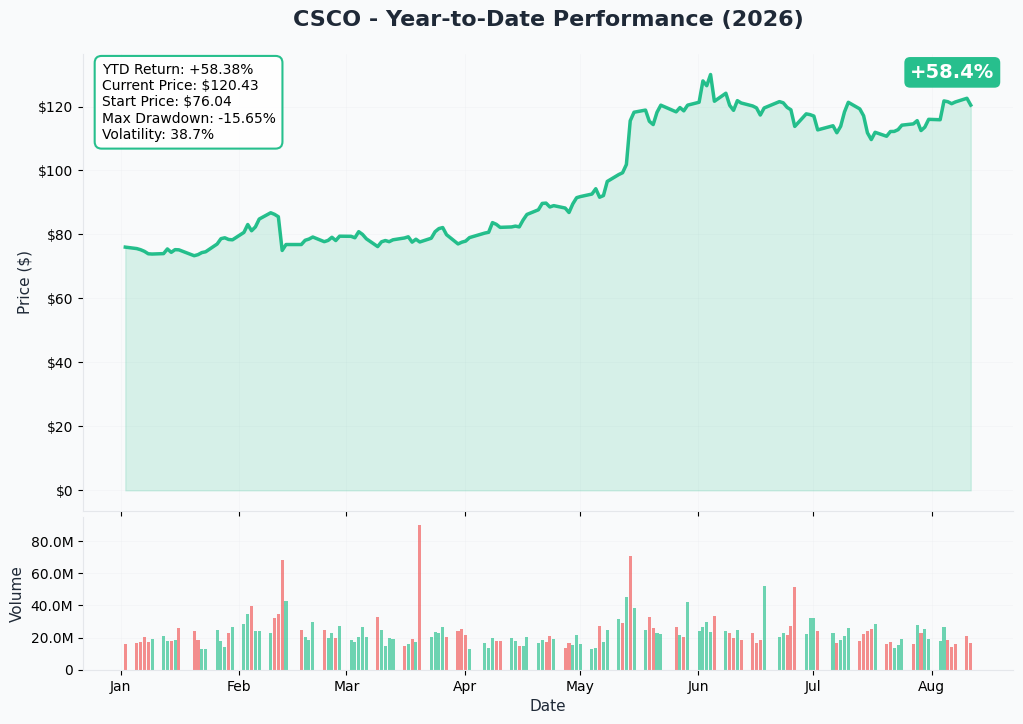
Cisco's trailing year captures the whole re-rating story: a 52-week range of $65.75 to $130.37, a +74.4% 12-month move, and a stock that spent the back half of 2025 grinding out of the high-$70s before accelerating hard on the May 13 Q3 FY2026 beat and raise. At $123.09, the stock sits ≈5.7% below its 52-week high and roughly ≈87% above its 52-week low — nowhere near a level that screams "cheap protection," which is exactly why a deep-in-the-money put paid $30.25 rather than a few dollars.
Gamma Support & Resistance
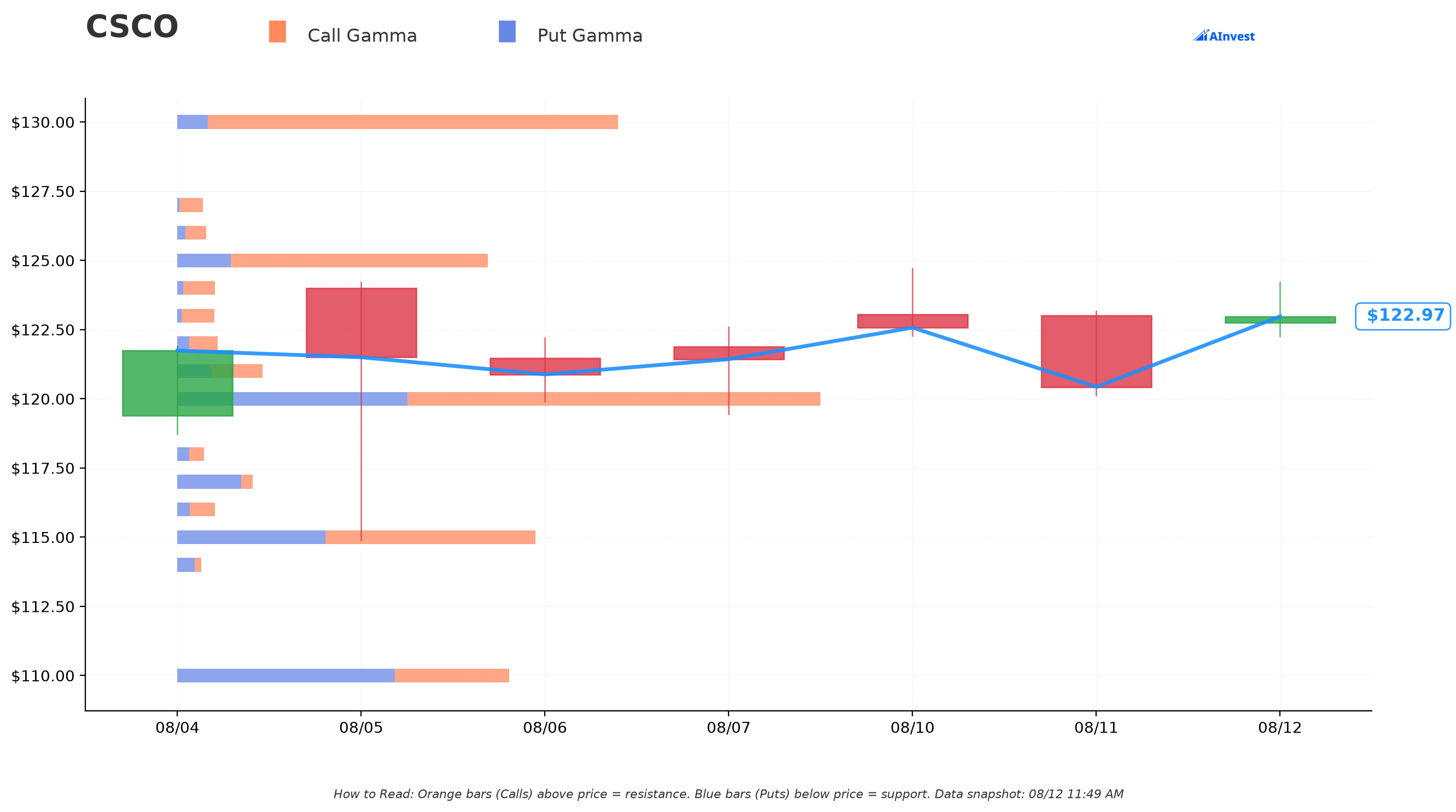
The gamma model, referenced to a $123.03 spot, flags $125 as Strong resistance (call gamma dominant, ≈1.6% above spot) and $120 as Very Strong support (the single largest gamma concentration on the board, ≈2.5% below spot). In plain terms: dealer hedging flows currently cluster tightly around today's price, with $120 acting as the more powerful magnet of the two. Further out, $130 and $135 show up as secondary resistance walls, and $110 and $115 as secondary support — but none of that structure means much until tonight's number resets the whole chain. Gamma levels like these are a same-day positioning map, not a multi-quarter forecast; treat them as noise the moment the print hits the tape.
Implied Move
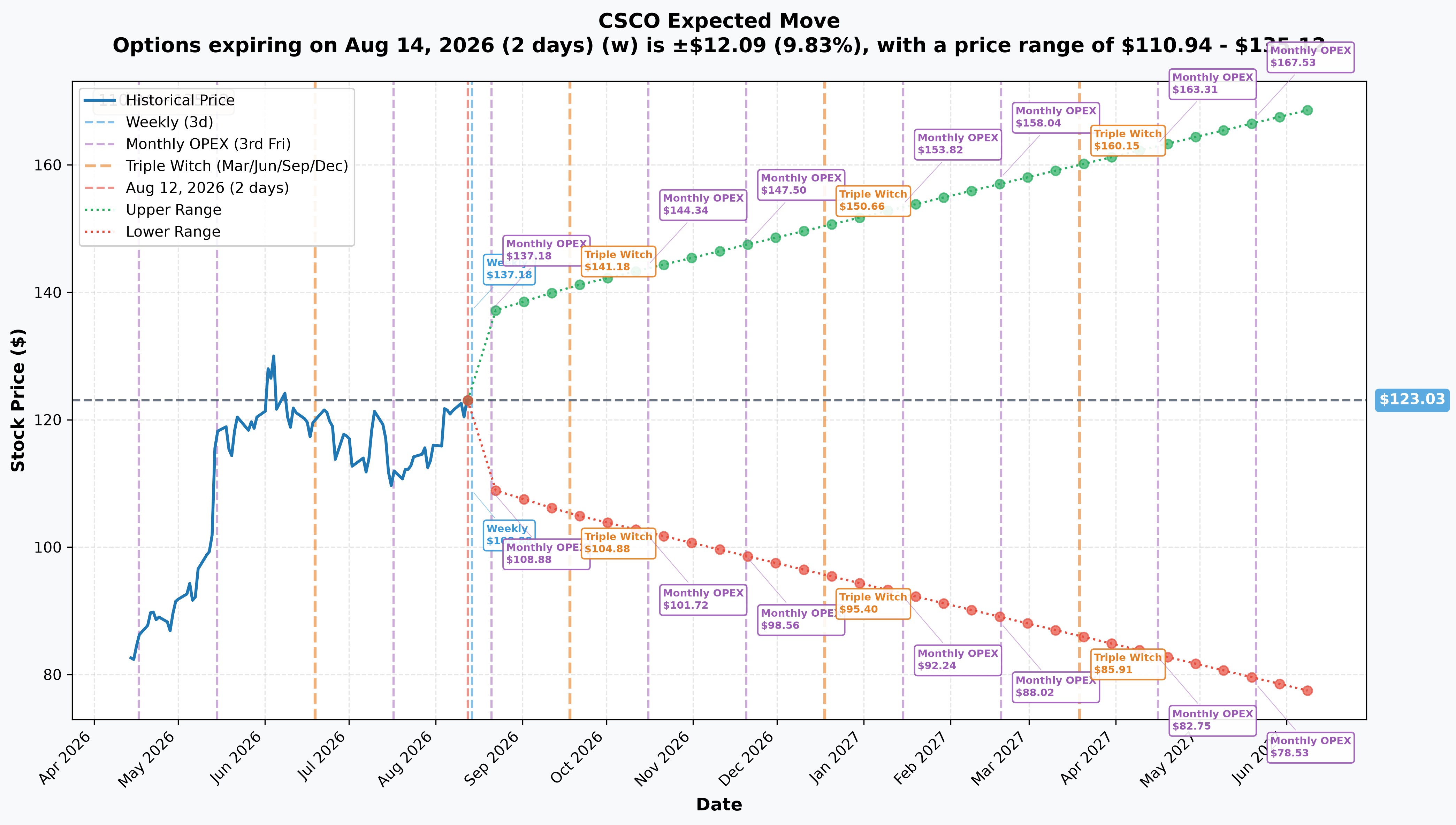
This is the clearest tell on the board. The options market is pricing:
- ±9.83% to August 14 ($110.94 – $135.12) — the two-day window that includes tonight's earnings print
- ±11.39% to August 21 ($109.02 – $137.04) — the following weekly
- ±14.49% to September 18 ($105.20 – $140.86) — the next monthly/triple-witch expiration, roughly five weeks out
Look at the shape of that: the two-day range (±9.83%) is nearly as wide as the full five-week range (±14.49%). Almost the entire month's worth of expected movement is compressed into the next 48 hours. That is exactly what an options market looks like when it's pricing a binary, headline-driving event — which tonight is. It also means the $140 strike, sitting ≈14% above spot today, could be meaningfully closer or farther away within 24 hours purely on the earnings reaction, long before anything about the underlying 17-month thesis has actually changed.
🎪 Catalysts
Keep these separate: the catalysts below happen on their own dates; the traded option doesn't expire until 2028-01-21.
What's happening tonight (the nearest catalyst)
Cisco is scheduled to report fiscal Q4 2026 after market close today, 2026-08-12, at 4:30 PM ET, per both MarketBeat's earnings calendar and stockanalysis.com's statistics page. This date is widely reported by independent data providers and same-day press coverage, but Cisco's own scheduling press release and investor-relations events page could not be retrieved for direct confirmation — treat it as very high confidence, not company-verified in this piece.
Because Cisco's fiscal year ends in late July, tonight's release covers a quarter that ended ≈2.5 weeks ago and closes the full fiscal year — which means it comes bundled with the first FY2027 guidance, the dividend declaration, and (per the options market) an ≈8% implied earnings swing that our own implied-move data corroborates almost exactly (±9.83% to the Friday expiration). Consensus is non-GAAP EPS $1.17 against Cisco's own $1.16–$1.18 guidance, with FY2026 guided to $62.8B–$63.0B revenue and $4.27–$4.29 EPS — consensus sits essentially at the midpoint of guidance, meaning there's little room for a clean "beat" to move the needle the way May's raise did (MarketBeat earnings, stockanalysis.com forecast).
What already happened (the re-rating)
The May 13, 2026 fiscal Q3 print is why Cisco is at $123 instead of $80. Revenue came in at $15.84B (+12% YoY), beating $15.56B; non-GAAP EPS hit $1.06, beating $1.03. The real driver was AI infrastructure: Cisco raised its FY2026 AI orders guide from $5B to $9B (with $5.3B already booked year-to-date) and its AI revenue guide from $3B to $4B (Q3 FY2026 release).
The qualifications matter, though, and they're directly relevant to tonight: product revenue grew 17% while services fell 1%; networking grew 25% while Security sat flat at $2.0B — the key caveat on the ≈$28B Splunk thesis; total product orders were up 35%, but only +19% excluding hyperscalers, meaning roughly half the order acceleration traces to a handful of concentrated AI capex buyers; and remaining performance obligations (RPO) grew just 4%, well behind the 35% order growth, suggesting short-cycle conversion rather than durable multi-year backlog (Q3 FY2026 release).
Analyst reaction has been broadly positive but not unanimous: Citi, KeyCorp, Morgan Stanley, and Bank of America all raised targets through June and early August, while Goldman Sachs raised its target to $125 but kept a Neutral rating, and Zacks downgraded to Hold on August 4 (via stockanalysis.com).
Expiration-aligned view (17-month LEAP — catalyst dates, kept separate from the January 2028 expiration)
Six quarterly reports land inside the life of this option, plus tonight's:
| # | Report | Est. date | Confirmation |
|---|---|---|---|
| 1 | Q4 FY2026 + FY2027 initial guide | 2026-08-12 (today) | Provider-confirmed (MarketBeat) |
| 2 | Q1 FY2027 | ≈2026-11-11 | Pattern-estimated, not company-confirmed |
| 3 | Q2 FY2027 (historically the dividend-raise quarter) | ≈2027-02-10 | Pattern-estimated |
| 4 | Q3 FY2027 | ≈2027-05-12 | Pattern-estimated |
| 5 | Q4 FY2027 + FY2028 initial guide | ≈2027-08-11 | Pattern-estimated |
| 6 | Q1 FY2028 | ≈2027-11-10 | Pattern-estimated |
Q2 FY2028 would land ≈2028-02-09 — after the 2028-01-21 expiration. So there is no earnings event inside the final ≈10 weeks of this position's life; the last fundamental input is the ≈November 2027 print.
Six ex-dividend dates also fall inside the window — ≈2026-10-02, ≈2027-01-05, ≈2027-04-05, ≈2027-07-06, ≈2027-10-04, and ≈2028-01-04, just 17 days before expiration — cumulatively ≈$2.56/share, or ≈$1.28M against a position this size (pattern per stockanalysis.com dividend).
On the dividend mechanics, precision matters here: rising ex-dividend dates drive early exercise of in-the-money calls, not puts — a call holder exercises early to capture the dividend. For this deep-in-the-money short put, the relevant early-assignment driver is interest carry, not dividends, and rising dividends actually make early assignment less likely (the holder would forfeit the dividend by exercising early rather than staying long stock through the ex-date). The real trigger to watch is the option's time value collapsing toward zero — today it's ≈$13.34, which makes early assignment economically irrational for the holder right now. That calculus only changes if Cisco falls hard or expiration gets close.
🎭 How Different Traders Should Read This
🎲 The YOLO trader
There's no lottery ticket here. A 17-month, deep-in-the-money short put crossed as a block is a financing structure, not a directional flyer — there's no leverage-to-the-upside payoff to chase. If you want a pure earnings bet on tonight's print, this isn't it; the position barely moves on a one-day surprise relative to its ≈17-month horizon. Betting on tonight's ≈9.83% implied swing directly (short-dated options, not this LEAP) is the actual YOLO trade, and it's a completely different risk profile with completely different math.
📈 The swing trader
The useful information here is the levels, not the trade. Gamma flags $120 as Very Strong support and $125 as Strong resistance around today's spot — watch how price behaves at those marks through tonight's reaction. The implied-move cone (±9.83% to Friday, $110.94–$135.12) is your realistic trading range for the next 48 hours; a gap outside it in either direction is the market being surprised. This LEAP put itself isn't a swing-trade instrument — its time decay is too slow and its size too large for anyone but an institutional desk — but the strike ($140) and the breakeven (≈$109.75) are useful reference points for reading where big money has staked out its comfort zone.
💰 The premium collector
This is the natural audience for this structure, and it's worth being honest about both sides of it. Collecting ≈$13.34 of time value (≈8.4% annualized on ≈$109.75 of committed capital) to agree to buy a Dow-component compounder ≈10.8% below its current price is a defensible income strategy — Cisco has a 14-year dividend-growth streak, an ongoing buyback, and five straight earnings beats behind it. But selling puts into an earnings print is exactly how you get assigned at a bad price: if tonight goes poorly and Cisco gaps down toward the low end of its implied range (≈$111, or worse in a real miss), this position is instantly deep in the money with ≈17 months left to run before it resolves. A 17-month obligation is a long time to be wrong, and the consensus price target sitting $7.41 below the strike is a real headwind, not a technicality. If you're running something similar, size it as if you might actually own 500,000 shares of Cisco at $140 — because that's the real commitment being made here, not the $15.12M headline.
🌱 The beginner
Selling a put means promising to buy stock at a set price if the buyer wants to sell it to you — the opposite of selling a call, where you'd be promising to sell stock you may or may not own. Here, the seller is promising to buy 500,000 Cisco shares at $140 each — a $70.0M commitment — in exchange for ≈$15.12M paid today. If Cisco stays above $140, the seller just keeps the cash and nothing happens. If Cisco falls below $140, the seller can be forced to buy stock at a price higher than what it's trading for, with a loss that grows the further the stock falls. Before ever selling a put, you need to be honestly certain you have the capital and the willingness to actually own that stock at that price if things go wrong — this is not free money, it's compensation for taking on a real obligation.
⚠️ Honest Limits — What the Tape Can't Prove
- The SELL label is reported, not tape-proven. This printed as a negotiated block cross at the middle of the market and took no liquidity — the standard percentage-across-the-spread aggressor read doesn't apply to a negotiated block the way it would to a lit trade.
- Counterparty and motive are invisible. OPRA shows the print, not who was on either side of the cross, whether the seller holds other Cisco positions, or whether this is part of a larger book (e.g., covered by short stock, or one leg of a broader financing structure).
- Tonight's earnings date is provider-confirmed, not company-confirmed. Two independent data providers and same-day financial press agree on 2026-08-12 after the close, but Cisco's own scheduling press release and investor-relations events page could not be retrieved to verify it directly.
- No standalone Splunk revenue, ARR, or subscription figure is available. Cisco has not disclosed a clean Splunk-specific contribution in the retrievable Q3 FY2026 release text — the flat Security segment number ($2.0B) is the best proxy available, not a direct Splunk metric.
- FY2027 and FY2028 consensus figures are not publicly available — the ≈$4.79 FY2027 EPS estimate referenced in research on this trade is derived arithmetically from the published forward P/E, not a quoted Street consensus.
- All earnings and ex-dividend dates after tonight are pattern-based projections, built from Cisco's historical reporting cadence, not confirmed company dates.
- Cisco's annual shareholder meeting date could not be verified for this window.
Options trading involves substantial risk, including the potential loss of more than the amount invested. Selling deep-in-the-money puts carries the obligation to buy stock at the strike regardless of where the market has moved, and this is not a recommendation to buy or sell any security — size any position according to your own risk tolerance and do your own diligence, especially around tonight's earnings print.
Last updated: 2026-08-13 (pre-market) — the next-day OPRA open-interest snapshot confirmed the open. Jan-2028 $140P 73 → 5,116 (+5,043 against 5,000, 100.9% of size): OPEN (STO). The ⏳ callout was replaced with the ✅ RESOLVED box; no thesis or title change was required.