🛡️ CXW: A Desk Sold ≈$8.63M of Puts and Calls Betting CoreCivic Goes Nowhere for 19 Months
📅 August 10, 2026 | 🔥 Unusual Activity Detected
🎯 The Quick Take
A desk sold the same three-leg package twice today on CoreCivic (CXW): short the $28 put, short the $32 put, and short the $35 call, all expiring March 19, 2027. First clip at 13:59:11, second at 14:02:10, spot ticking from $33.35 to $33.55 in between. Total premium collected: ≈$8.63 million, all credit. Unlike almost everything else on today's board, these are certain opens — prior open interest on all three strikes was 0, 0 and 1. This isn't a directional bet on CoreCivic; it's a bet the stock stays roughly where it is through next March, collected while the stock sits up ≈76% year to date and options are unusually expensive.
📊 Company Overview
CoreCivic, Inc. (NYSE: CXW) owns and operates correctional, detention and residential reentry facilities under government contract, along with rehabilitation, education, healthcare and food services for the people housed in them. Founded in 1983, headquartered in Brentwood, Tennessee, with ≈13,651 employees and CEO Patrick Swindle.
- 🏢 Sector / industry: Industrials — Security & Protection Services
- 💰 Market cap: ≈$3.32 billion
- 📉 Corporate structure — a correction worth repeating: CoreCivic is a former REIT and today is a taxable C corporation, not a REIT. It pays no dividend. The 2026 asset-sale economics prove the point: CoreCivic expects to book ≈$400 million of federal and state taxes on the July sale alone — a REIT distributing its taxable income wouldn't pay entity-level tax at that scale. It still reports legacy metrics like FFO and Normalized FFO per share, which is likely why the REIT association lingers.
- 📈 The stock is up ≈76% year to date (from a $19.13 open on January 2, 2026 to ≈$33.5 today) — that run is exactly why the premiums in this trade are fat enough to be worth selling. More on that below.
💰 The Trades — Same Three Legs, Printed Twice
Six rows on the tape, but really it's one short-premium package sold in two clips, ≈3 minutes apart. Each clip sells the same three strikes in the same size: 4,785 $28 puts, 4,350 $32 puts, 3,045 $35 calls, all expiring March 19, 2027 (≈19 months out, ≈221 days from today). What proves these are two genuine, separate prints — not a duplicated screen entry — is that the cumulative day Volume column roughly doubles between the two timestamps (5,000 → 10,000 on the $28 put; 4,500 → 9,500 on the $32 put; 3,200 → 6,700 on the $35 call) while the Size of each individual print stays identical, and the spot ticks from $33.35 to $33.55 between clips. Mechanism: this printed as a 🤝 floor block with a paired stock leg — a negotiated trade with a known counterparty, and shares came with the package, so it's delta-hedged rather than a naked directional wager.
| Time | Buy/Sell | Call/Put | Expiration | Premium | Strike | Volume | Prior OI | Size | Spot | Option Price | Option Symbol | Order Type | Strategy |
|---|---|---|---|---|---|---|---|---|---|---|---|---|---|
| 13:59:11 | SELL | PUT | 2027-03-19 | $1.10M | $28 | 5,000 | 0 | 4,785 | $33.35 | $2.30 | CXW20270319P28 | STO | Short Premium Package + Stock (delta-hedged) |
| 14:02:10 | SELL | PUT | 2027-03-19 | $1.10M | $28 | 10,000 | 0 | 4,785 | $33.55 | $2.30 | CXW20270319P28 | STO | Short Premium Package + Stock (delta-hedged) |
| 13:59:11 | SELL | PUT | 2027-03-19 | $1.67M | $32 | 4,500 | 0 | 4,350 | $33.35 | $3.85 | CXW20270319P32 | STO | Short Premium Package + Stock (delta-hedged) |
| 14:02:10 | SELL | PUT | 2027-03-19 | $1.67M | $32 | 9,500 | 0 | 4,350 | $33.55 | $3.85 | CXW20270319P32 | STO | Short Premium Package + Stock (delta-hedged) |
| 13:59:11 | SELL | CALL | 2027-03-19 | $1.54M | $35 | 3,200 | 1 | 3,045 | $33.35 | $5.05 | CXW20270319C35 | STO | Short Premium Package + Stock (delta-hedged) |
| 14:02:10 | SELL | CALL | 2027-03-19 | $1.54M | $35 | 6,700 | 1 | 3,045 | $33.55 | $5.05 | CXW20270319C35 | STO | Short Premium Package + Stock (delta-hedged) |
Total across both clips: ≈$8.63 million of premium collected, entirely credit. Note the spot genuinely differs between the two prints ($33.35 vs $33.55) — this wasn't a static screen redraw, the market moved between clips.
✅ RESOLVED — Every Strike Opened Past Its Predicted Number
Updated 2026-08-11 pre-market. Resolving OPRA snapshot timestamped August 11 (reflects the August 10 close); baseline is the August 10 snapshot (reflects August 7 — before these prints).
| Leg | Baseline (Aug-10) | Resolving (Aug-11) | Δ | Print size | Δ as % | Day vol | Our published prediction | Verdict |
|---|---|---|---|---|---|---|---|---|
| Mar-19-2027 $28 put (sold) | 0 | 11,281 | +11,281 | 9,570 | +117.9% | 11,436 | ≈9,570 | ✅ OPEN (STO) |
| Mar-19-2027 $32 put (sold) | 0 | 10,000 | +10,000 | 8,700 | +114.9% | 10,000 | ≈8,700 | ✅ OPEN (STO) |
| Mar-19-2027 $35 call (sold) | 1 | 7,001 | +7,000 | 6,090 | +114.9% | 7,000 | ≈6,091 | ✅ OPEN (STO) |
As predicted, there was nothing to resolve — only to confirm, and the confirmation is emphatic. All three strikes went from essentially zero to a full book of open interest. We flagged that open interest landing short of the predicted numbers would mean some contracts crossed against existing inventory; the opposite happened. Every strike printed above its prediction, by 1,300–1,700 contracts, because additional participants traded these newly-created lines during the session on top of the package itself.
The $32 put and $35 call are exact to the contract on the day's volume (10,000 traded, 10,000 open; 7,000 traded, +7,000 open) — every single contract that changed hands created a new open position. Nothing was closed, nothing was transferred. This is the cleanest open on the board.
🤓 What This Actually Means — Plain English
This is a short strangle with an extra downside wing, all sold, all at once, twice.
- Selling a put means collecting cash today in exchange for an obligation: if CXW is below that strike at expiration, you (the seller here) can be forced to buy the stock at that strike — no matter what the news says between now and March 2027.
- Selling a call means collecting cash for the opposite obligation: if CXW is above that strike at expiration, you can be forced to deliver stock at that strike — capping the upside on however much of the position is hedged with shares.
- The $32 put and $35 call are the "core" of the trade — they bracket the ≈$33.45 spot almost symmetrically, ≈4.3% below and ≈4.6% above. That's the seller saying "I don't think this stock moves much more than that in 19 months," and pocketing $3.85 and $5.05 per share for saying so.
- The $28 put is a different animal — a far downside wing, ≈16.3% below spot. It's cheaper ($2.30) precisely because it's less likely to matter, but it still obligates the seller to buy CXW at $28 if the bottom falls out. Selling it collects extra premium for taking on tail risk on the down side specifically.
- The motive is the fat premium itself, and the numbers back it up. CXW is up ≈76% YTD, and that run is exactly what makes these options rich. At 30 days, implied volatility runs 43.63% against 28.54% realized — a ≈1.53x ratio. At 120 days it's 50.78% implied against 38.78% realized — ≈1.31x (AlphaQuery 30-day, AlphaQuery 120-day). Calls are priced ≈8 points richer than puts (47.72% vs 39.54% at 30 days) — so the $35 call sold here is coming off the single richest part of the whole volatility surface. Selling premium into that gap is the strategy: time decay and a range-bound stock are supposed to earn back more than any single move costs.
- The honest counterweight: the same research shows 30-day intraday-range (Parkinson) volatility at 47.54%, well above the 28.54% close-to-close figure — meaning CXW swings hard within a session and mean-reverts by the close. That gap makes the "1.53x free premium" framing look better than it is; a seller of these options can still get whipped around badly intraday even if the close-to-close read stays calm.
- Why sell puts on THIS name, at THIS moment — the balance-sheet answer. CoreCivic isn't just cash-rich, it just told the market it's buying back stock. Today's release layers on top of two facility sales: DHS bought four CoreCivic facilities for ≈$2.2 billion gross across July 2 and August 5, cutting expected total debt from ≈$1.347 billion to ≈$739.1 million. Today, CoreCivic announced a $500 million accelerated share repurchase — ≈12.4 million shares, ≈12.5% of shares outstanding — settling through Q2 2027, essentially the entire life of this option. A company mechanically buying back an eighth of itself is a real, structural bid under the stock for the same window these puts are short. That's arguably the single best reason to sell the $32 and $28 puts here rather than on a name without that buyback running underneath it — though it's a support argument, not a guarantee; no calendared item stops the company from pausing the ASR if conditions change.
- This is not a naked bet. Because the tape shows a paired stock leg came with the package, part (or all) of the delta is hedged with shares — the option legs alone don't tell us the seller's net directional exposure. That's an honest limit, not a footnote (see below).
📈 Technical Setup / Chart Check-Up
YTD Chart
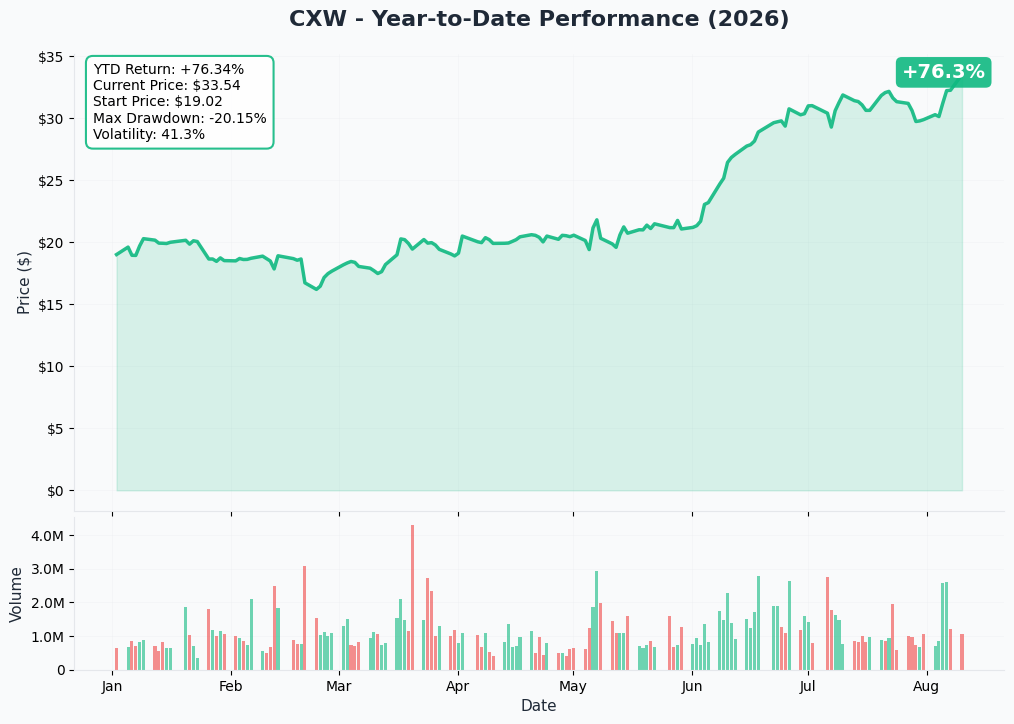
CoreCivic's ≈76% YTD run has been driven almost entirely by policy and balance-sheet catalysts rather than a smooth grind — a 44% single month in June with no company press release at all, a July $1.5 billion facility sale to DHS, an August 5 second sale plus Q2 earnings, and an August 10 $500 million buyback announcement. The stock is trading within ≈4% of its 52-week high of $34.86.
Gamma-Based Support & Resistance Analysis
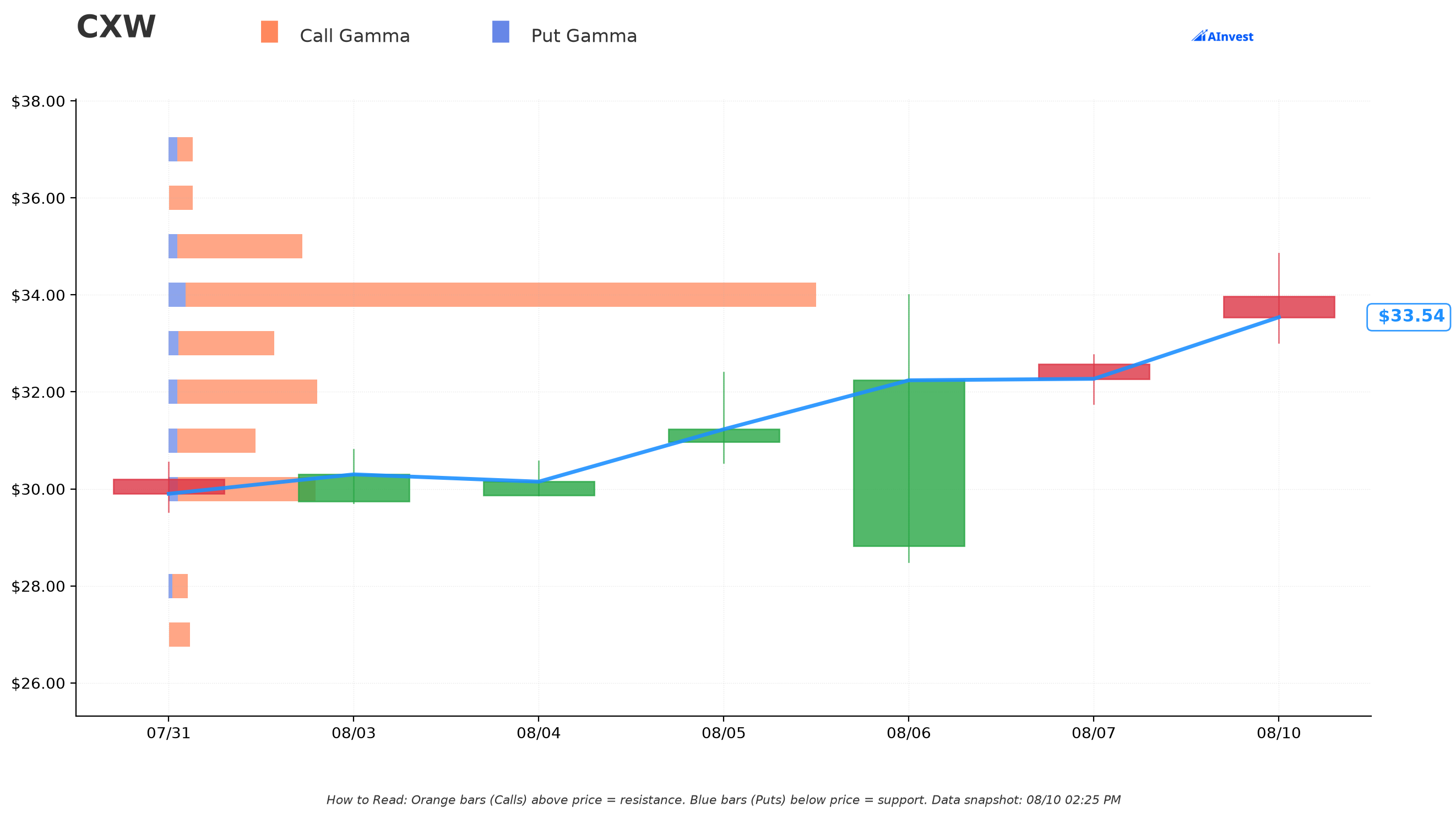
Current price: $33.54. Be honest about the data here: only ≈13 strikes carry any meaningful gamma exposure on this chain, and this map only produced one real level — there's no gamma support level at all below spot, only a single resistance wall.
- 🟠 $34 — the one real wall, "Strong": total gamma exposure ≈9.04, almost entirely call gamma (≈8.80 call vs ≈0.24 put), just ≈1.4% above spot. That's the nearest overhead level dealers are likely to defend.
- Everything else on the chain is thin: $32 (this trade's near put strike) carries only ≈2.07 total gamma (≈1.95 call / ≈0.12 put); $35 (this trade's call strike) carries ≈1.86 total gamma (≈1.74 call / ≈0.12 put); $28 (the downside wing) carries just ≈0.27 total gamma (≈0.21 call / ≈0.05 put).
- No blue support bars appear at all in this data — the gamma map simply doesn't have enough put open interest built up below spot yet to produce a support level. Don't read anything bearish into that; it's a data-thinness problem, not a signal.
What this means for traders: the $34 wall sitting right above spot is the most concrete near-term level on the board, and it's worth watching, but it says nothing about a March 2027 expiration 19 months out — gamma maps are a today snapshot, not a forecast for next spring.
Implied Move Analysis
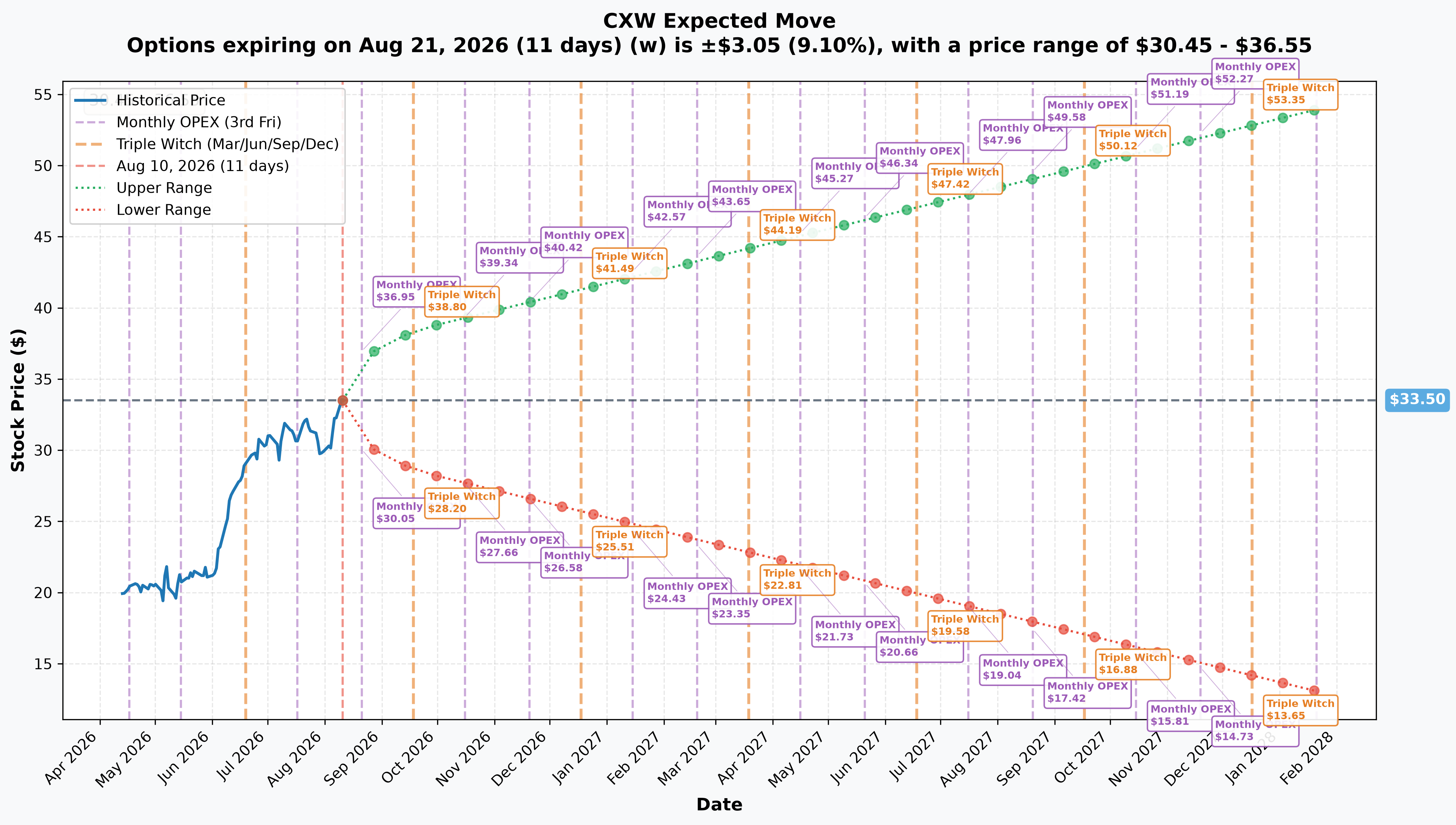
The pricing engine's three standard windows don't line up with this trade's own expiration, so here are both: the standard windows, and the one number that actually matches March 19, 2027.
- Monthly OPEX (Aug 21, 2026 — 11 days): ±9.1% → range $30.45 – $36.55
- Quarterly Triple Witch (Sep 18, 2026 — 39 days): ±14.7% → range $28.58 – $38.42
- LEAPS reference (Jan 21, 2028 — 529 days, longer than this trade): ±61.0% → range $13.05 – $53.95
- The actual match — March 19, 2027 (this trade's expiration, 221 days out): implied one-standard-deviation range $22.81 – $44.19
That $22.81–$44.19 band is the honest yardstick for this trade. The $32 put and $35 call sit well inside it — only ≈4-5% from spot versus a ≈32% band edge — which is the mechanical reason they carry rich premium: the market assigns real, non-trivial odds of touching either strike sometime before March. The $28 wing sits between spot and the band's lower edge, closer to spot than to $22.81 — a real tail, priced accordingly, but not the market's worst-case scenario.
🎪 Catalysts Through March 19, 2027
Dates below are catalyst dates — the option itself expires March 19, 2027, a separate date from any of these.
Confirmed, inside the window
- August 11, 2026 — Prairie Correctional Facility's new five-year ICE contract commences (1,600 beds, ≈$75M/year at full ramp) (CoreCivic, Aug 4, 2026).
- August 12, 2026 — Redemption of $238.468M of 4.750% senior notes, cash-funded (CoreCivic, Jul 13, 2026).
- August 2026 – Q2 2027 — $500M accelerated share repurchase execution, ≈12.4 million shares (≈12.5% of shares outstanding) expected, a mechanical bid running through most of this option's life (CoreCivic, Aug 10, 2026).
- ≈Early November 2026 — Q3 2026 earnings (date not yet announced; inferred from CoreCivic's own pattern of announcing ≈4-5 weeks ahead). The first quarter reflecting post-asset-sale operating economics.
- November 3, 2026 — U.S. midterm elections. Control of both the House and Senate is contested, and CoreCivic's revenue is ≈53% federal (ICE and U.S. Marshals) (The Hill headline index). The single largest policy-risk date inside this trade's life.
- December 11, 2026 — Federal funding deadline under the continuing resolution the Senate passed 90-6; House passage and final enactment are not yet confirmed in public sources (NACo / Tech Times headline index, Aug 2026). A shutdown or DHS-specific funding fight touches ICE detention money directly.
- ≈February 2027 — Q4/FY2026 earnings plus initial FY2027 guidance (date not yet announced; inferred from the February 11, 2026 precedent) — the last scheduled earnings print before the March 19, 2027 expiration.
- Ongoing, undated — "preliminary stage" discussions with ICE about CoreCivic selling additional facilities. Management disclosed this in the Q2 2026 release with no timing guidance (Q2 2026 results) — an undated, high-magnitude event that can land any day inside the window.
Confirmed, but landing OUTSIDE the window (do not confuse with the March 2027 expiration)
- August 2027 — California City Detention Facility's ICE contract expires — ≈5 months after this option expires.
- September 2027 — Midwest Regional Reception Center's ICE contract expires — ≈6 months after expiration.
- Q2 2027 — Prairie reaches full operation and the ASR's final settlement occurs — both fall shortly after expiration.
The important caveat: although no scheduled contract-expiration decision falls inside the window, CoreCivic disclosed that ICE retains termination rights on the sold facilities and that management agreements "may be modified to reflect the change in ownership" — a termination or renegotiation is not calendared and could occur at any point inside this trade's life (August 5, 2026 release).
🎲 Four-Reader Interpretation
🎰 YOLO Trader
This trade isn't built for you to copy directly — it's a short-premium package, and copying it naked means unlimited-ish downside risk on the put side and capped-but-real upside risk on the call side, for ≈$2-4 per contract of premium. If you want the same market view with defined risk, look at buying the wings the desk sold (a long strangle) rather than selling them — you'd be betting the OPPOSITE way, that CXW breaks out of the $28-$35 range hard, funded by the same 19-month window and binary catalysts (midterms, funding deadline, potential ICE facility purchase). That's a real trade idea, but it is not this trade.
📊 Swing Trader
The single concrete near-term level here is the $34 gamma wall, ≈1.4% above spot with the largest gamma concentration on a thin chain. That's a level worth watching for the next few weeks around the August 21 monthly OPEX (implied range $30.45–$36.55) and the September 18 triple witch (implied range $28.58–$38.42) — this desk's 19-month package tells you nothing about next week's price action.
💰 Premium Collector — this trade's natural home, with a blunt warning
This is the playbook you'd study. Selling the $32 put and $35 call around a ≈$33.45 spot, then adding the deep $28 put for extra credit, is a textbook range bet funded by rich implied volatility (≈1.3-1.5x realized) on a name whose options are expensive because of real policy binary risk. But be blunt with yourself about what you're agreeing to: selling that $32 put means you can be forced to buy CXW at $32 no matter what the November 3 election or the December 11 funding fight does to ICE's budget. Selling the $35 call on a stock already up ≈76% YTD is a real obligation to sell shares into a policy-driven rally, not free income — if this name gaps up on an ICE facility-purchase headline, that call is not a paper loss you can ignore. Size any strangle you sell on this name smaller than you would on a stock without a binary federal-funding calendar sitting inside your holding period.
🌱 Beginner
Skip this one. Selling naked puts and calls means taking on obligations — to buy stock you might not want, or sell stock you might wish you'd kept — and it requires margin most beginner accounts either don't have or shouldn't use. If you're curious about CoreCivic, start by reading about the company (a former REIT now a taxable C corporation, revenue ≈53% dependent on ICE and the U.S. Marshals) and, if you want options exposure at all, look at buying a single call or put with a small, defined dollar amount you're fully prepared to lose — never selling uncovered options as your first trade.
⚠️ Honest Limits — What the Tape Cannot Prove
- We cannot see the size or direction of the paired stock leg. The tape confirms shares came with this package (hence "delta-hedged"), but not how many shares, on which side, or what net directional exposure the desk is left holding after the hedge. Calling this "market-neutral" would be an assumption we can't verify from OPRA alone.
- We cannot see the counterparty, the broker, or whether this is one desk's position or two separate desks trading against each other. "Known counterparty" from the floor-block mechanism just means it wasn't matched on the open book — not who's on the other side.
- No disclosed CoreCivic contract expiration falls inside this window — the nearest, California City, is August 2027, ≈5 months past this option's expiration. But that's a fact about the calendar, not about risk: ICE retains termination rights on the facilities it just bought, and CoreCivic has disclosed the management agreements "may be modified to reflect the change in ownership" with no assurance it keeps managing them. That risk is uncalendared — it can hit on any day inside the window — and it sits directly under a seller who is short puts betting on a quiet 19 months.
- We cannot see whether this position gets adjusted, rolled, or unwound before March 2027. Nineteen months is a long time, and nothing in today's tape tells us the seller's plan for the midterm election, the funding deadline, or a possible ICE facility-purchase headline.
- The March 19, 2027 implied-volatility figure quoted above is extrapolated, not a directly observed quote at that specific tenor — the longest sourced IV observation runs to 120 days, well short of this trade's 221-day life.
- The gamma map here is thin (only ≈13 strikes carry measurable exposure) and reflects today's open interest, not a forecast of what the chain will look like as this position — now the largest single source of open interest at these three strikes — continues to season over the coming months.
Disclaimer: Options trading, and especially selling uncovered puts and calls, involves substantial risk of loss and is not suitable for all investors. This analysis is for educational purposes only and is not financial advice. Past performance doesn't guarantee future results. Always size positions you can afford to lose and consider consulting a licensed financial advisor before trading.
Last updated: 2026-08-11 (pre-market) — the next-day OPRA open-interest snapshot resolved this session's provisional flags. All three legs OPEN, each above its predicted number: $28P 0 → 11,281, $32P 0 → 10,000, $35C 1 → 7,001. The ⏳ callout was replaced with the ✅ RESOLVED box.