🔁 DASH $16.70M Roll — Desk Sells Deep-ITM September Calls, Buys November Calls Up & Out
📅 August 10, 2026 | 🤝 Block Cross Detected
🎯 The Quick Take
At 11:08:42 this morning, a desk crossed two 10,000-lot DoorDash call blocks in the same second: it sold the Sep-18 $145 calls (≈$67.21M collected) and bought the Nov-20 $170 calls (≈$50.51M paid), netting a ≈$16.70M credit. This is a roll up and out — closing (probably) a deep-in-the-money September position and rolling the exposure further out in time and higher in strike, not a fresh bearish bet and not a credit spread. It printed as a negotiated block cross, meaning a broker matched a known buyer and seller off the lit book — there's no urgency here, just two counterparties agreeing on price.
📊 Company Overview
DoorDash, Inc. (DASH) operates a global local-commerce platform — its core Marketplace connects consumers with restaurants, grocers, and retailers through an independent-contractor courier network, alongside a subscription business (DashPass/Wolt+), a fast-growing advertising platform, merchant software, and international operations through Wolt and Deliveroo.
- Market cap: ≈$90.9 billion (≈433.3 million shares outstanding)
- Sector / industry: Consumer Discretionary (S&P GICS); Internet Retail (data-provider classification)
- Spot price today: $211.88
- Valuation: ≈113.6x trailing P/E, ≈33.7x forward P/E, TTM revenue ≈$15.89B
- 52-week range: $143.30 – $285.50
DoorDash reported Q2 2026 results on August 5 — revenue of $4.454B beat consensus (+36% YoY), but GAAP net income fell 30% YoY to $200M on a $98M legal/regulatory charge and a ≈52% jump in R&D spend tied to robotics and drone delivery. The stock sold off despite the top-line beat.
💰 The Trade in Plain English
Someone rolled a big, deep-in-the-money DoorDash call position out to a later expiration and up to a higher strike. In one second, the same desk:
- Sold 10,000 September $145 calls for ≈$67.21 each (≈$67.21M collected)
- Bought 10,000 November $170 calls for ≈$50.51 each (≈$50.51M paid)
Net: ≈$16.70M credit. But don't let the size of the individual legs fool you — the September $145 call is priced at $67.21 against $66.88 of pure intrinsic value (spot $211.88 minus $145 strike). That leaves just ≈$0.33 of time value on a $67 option. In other words, that leg is barely different from owning the stock outright — most of the $67.21M "premium" is really just the stock's own value changing hands between two counterparties, not a directional wager on where DASH goes next. The real "new" risk being taken on is the $50.51M paid for the November $170 calls.
Full Trade Details
| Time | Buy/Sell | Call/Put | Expiration | Premium | Strike | Volume | OI | Size | Spot | Option Price | Option Symbol | Order Type | Strategy |
|---|---|---|---|---|---|---|---|---|---|---|---|---|---|
| 11:08:42 | SELL | CALL | 2026-09-18 | $67.21M | $145 | 10,000 | 10,175 | 10,000 | $211.88 | $67.21 | DASH20260918C145 | ✅ STC (resolved; ≈86% transfer) | Long Call Roll |
| 11:08:42 | BUY | CALL | 2026-11-20 | $50.51M | $170 | 10,000 | 6,800 | 10,000 | $211.88 | $50.51 | DASH20261120C170 | BTO | Long Call Roll |
Mechanism: 🤝 BLOCK CROSS — both legs printed as a negotiated cross, meaning a broker matched a known buyer and seller off the open book. No urgency, no sweep — this was arranged, not chased.
✅ RESOLVED — The New Leg Opened Exactly; the Old Leg Barely Retired
Updated 2026-08-11 pre-market. Resolving OPRA snapshot timestamped August 11 (reflects the August 10 close); baseline is the August 10 snapshot (reflects August 7 — before these prints).
| Leg | Baseline (Aug-10) | Resolving (Aug-11) | Δ | Print size | Δ as % | Day vol | Our published prediction | Verdict |
|---|---|---|---|---|---|---|---|---|
| Nov-20 $170 call (bought) | 6,754 | 16,762 | +10,008 | 10,000 | +100.1% | 10,011 | proven open, ≥3,200 new | ✅ OPEN (BTO) — exact |
| Sep-18 $145 call (sold) | 10,175 | 8,804 | −1,371 | 10,000 | −13.7% | 10,001 | falls toward ≈175 if STC | ⚠️ CLOSE direction, ≈86% TRANSFER |
The November leg is exact — 10,008 new contracts against a 10,000-lot print. That is the cleanest possible confirmation that the new, higher, further-dated long call position is real and freshly opened.
The September leg is the one that needs an honest caveat. We predicted that a genuine close would take open interest down toward ≈175. It fell to 8,804 — a decline of only 1,371, or 13.7% of the 10,000 contracts sold. The direction matches the closing read (open interest fell, it did not rise, so the "not simply closing an existing long" branch is ruled out), and the multi-week unwind pattern we cited (20,780 → 14,080 → 12,080 → 10,175 → 8,804) continued. But roughly 86% of the print did not retire open interest — it transferred, meaning opening buyers absorbed most of the sale.
What that changes. The roll framing stands: this desk sold September and bought November, and the November side is proven new. But the September position at that strike did not disappear — 8,804 contracts remain outstanding, now held by whoever bought them. A reader tracking "how much of the old position came off" should use 1,371, not 10,000. This is the same lesson that recurs across these checks: a size-matched sale into an existing position tells you a seller acted; only the open-interest delta tells you whether the position was actually retired.
🤓 What This Actually Means — Plain English
This reads as a long call roll — up and out, not a new bearish or bullish bet, and definitely not a credit spread. Here's the decode:
- STC (sell to close) on the $145 call, if the OI history is right: the trader is very likely taking a long call position they've owned for weeks (maybe longer) and cashing it in. Since that leg is nearly all intrinsic value, this is functionally similar to "selling stock you've held" — they're booking the gain on a position that's been deep in the money for a while.
- BTO (buy to open) on the $170 call: simultaneously, they're re-establishing bullish exposure further out in time (Nov-20 instead of Sep-18) and at a higher strike ($170 instead of $145) — i.e., staying long DASH, just with a fresh strike/expiration and less capital tied up in pure intrinsic value.
- The ≈$16.70M net credit is NOT new income. It's recycled profit from the winning $145 position — the trader collected more on the sale than they paid for the new position, but that's a byproduct of rolling a deep-ITM winner into a cheaper, further-OTM position. It is not premium collected for taking on new risk (the way a covered call or cash-secured put would be).
- Why roll instead of just holding the $145 call? Rolling frees up the ≈$66.88 of intrinsic value that was sitting dormant in the old contract, redeploys a smaller amount of capital into the new position, and pushes the expiration out ≈63 days — past the September 18 date and into a window that actually captures the next round of catalysts (more on that below).
- Bottom line on intent: this looks like a bullish investor managing a winning position, not someone turning cautious or bearish. The dollar figures are eye-catching, but the September leg's economics tell you most of that $67.21M was never "at risk" on DASH going up or down — it was just moving a large, already-realized gain into a new vehicle.
📈 Technical Setup / Chart Check-Up
YTD Chart
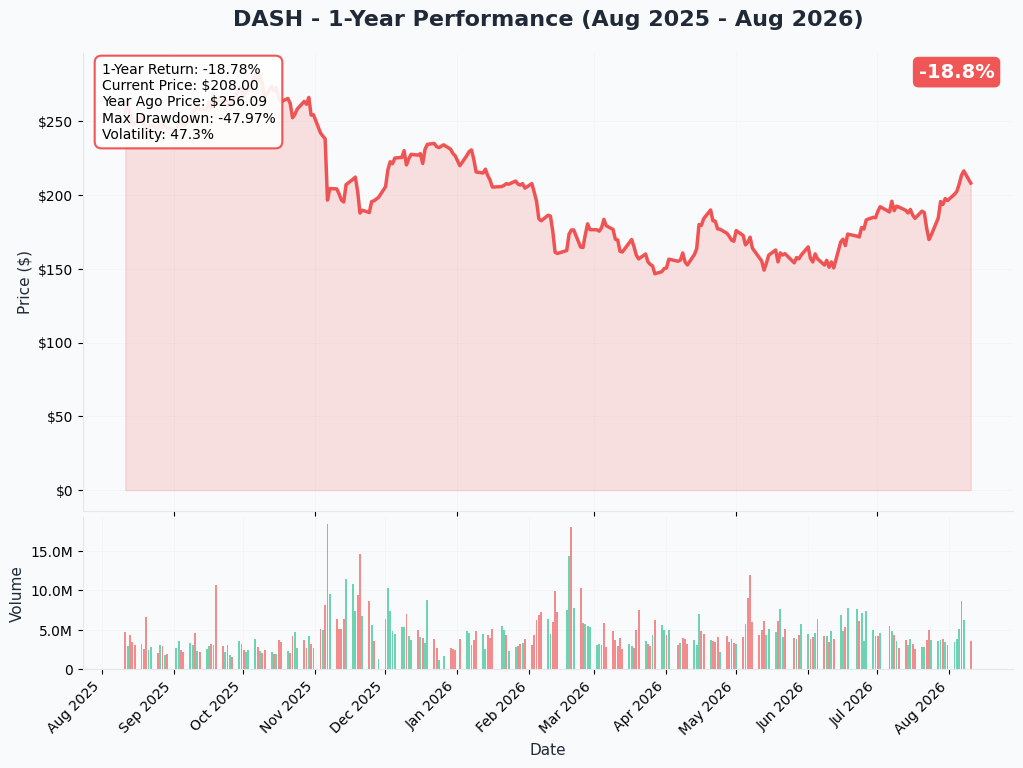
DASH has traded in a wide band this year, recovering from a June low near $184.53 back up to $216.26 by August 7 before settling at today's $211.88 — still well below the 52-week high of $285.50.
Gamma-Based Support & Resistance Analysis
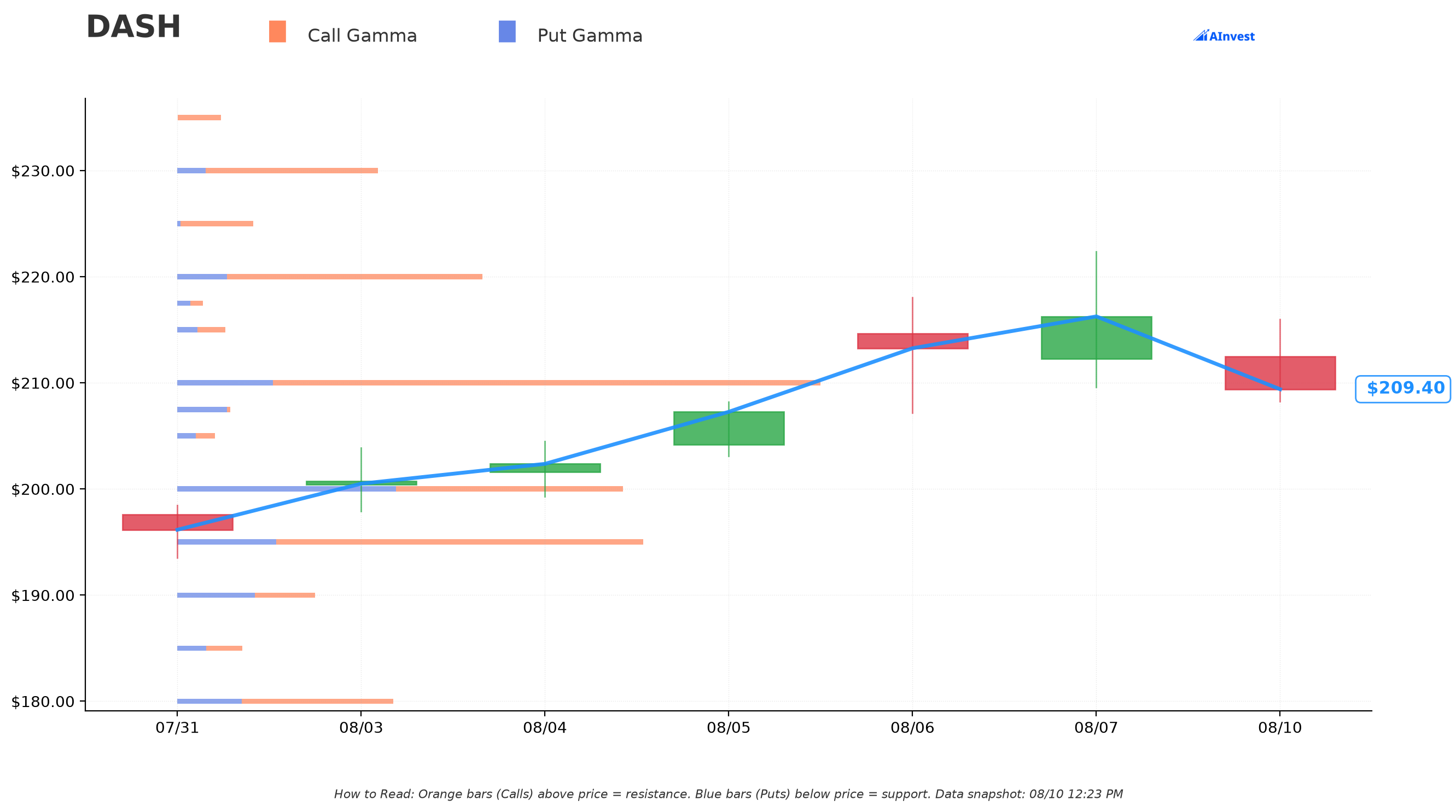
Current price: $209.23 (gamma-snapshot spot)
Reading the actual gex.json levels:
- 🟠 $210 — moderate resistance, immediately overhead. Total gamma exposure of 3.45 (call gamma 2.94 dominates put gamma 0.51), just 0.37% above spot. This is the single largest gamma concentration on the board and sits basically right at today's price — expect chop right here as dealers hedge into it.
- 🟠 $220 — the next real ceiling. Net gamma 1.11, call-heavy (1.38 call vs 0.27 put gex), about 5.1% above spot.
- 🟠 $200 — the closest meaningful support zone below spot, with balanced call/put gamma (1.22/1.18) about 4.4% below spot — this is the level dealers will lean on if the stock pulls back.
- 🟠 $195 — deeper support/resistance mix, total gex 2.51, roughly 6.8% below spot.
- Where the roll's strikes sit relative to gamma: the September $145 strike being sold has very little remaining gamma (total gex 0.53) — it's so deep in the money that dealers barely need to hedge it anymore, another sign it behaves like stock, not like an option. The new November $170 strike also carries modest gamma (total gex 1.07) — both are well below the live gamma action clustered at $195–$220, underscoring that neither leg is a near-term directional lever on price; they're longer-dated positioning.
What this means for traders: the fight for control of DASH right now is happening in the $195–$220 band, not down at $145 or $170. Those strikes are where this roll's economics live, but they aren't where the stock's day-to-day price action is being fought over.
Implied Move Analysis
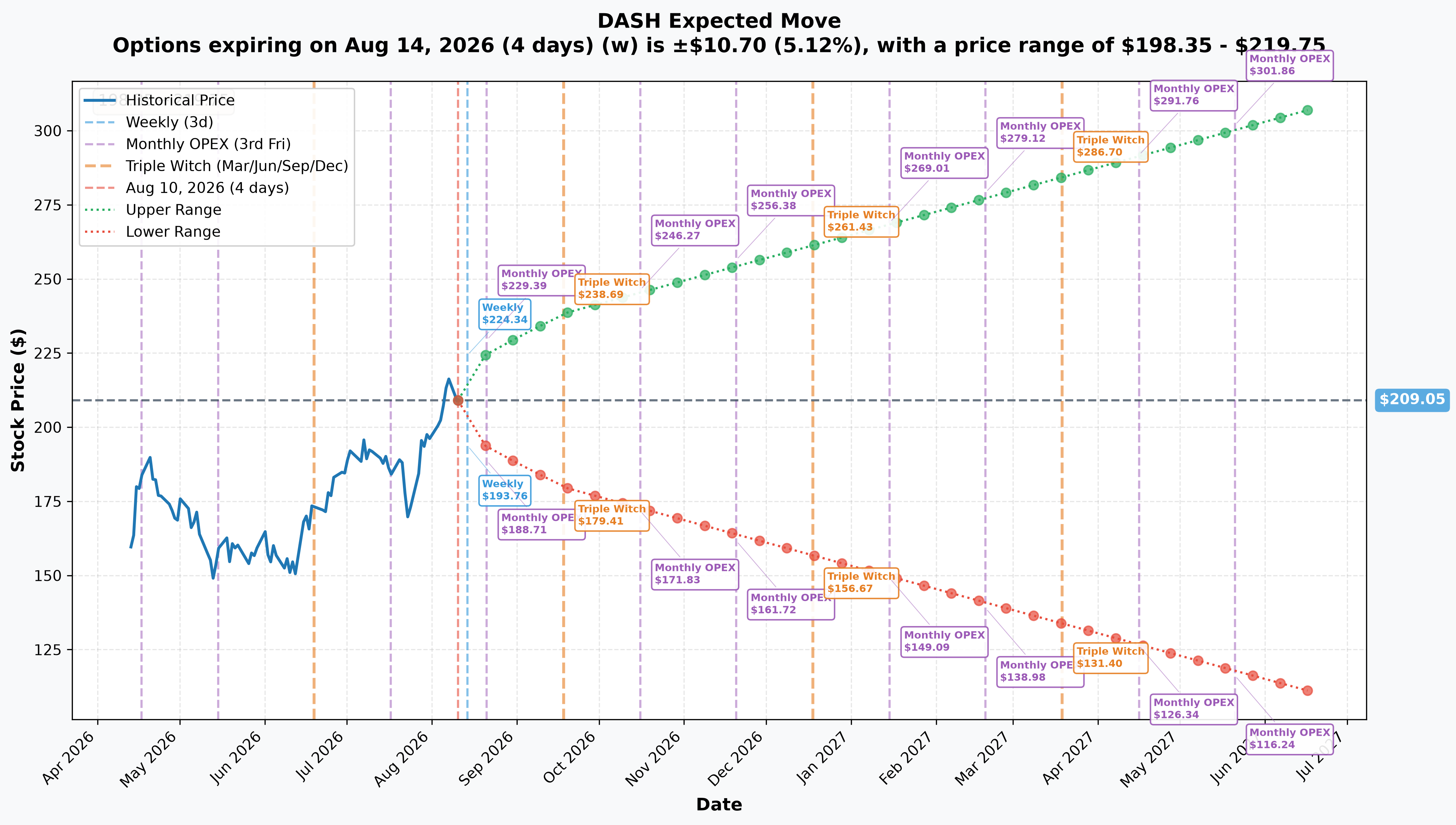
Options are currently pricing (spot $209.05 basis):
- Weekly (Aug 14, 4 DTE): ±5.12% (±$10.70) → range $198.35 – $219.75
- Monthly OPEX (Aug 21, 11 DTE): ±7.68% (±$16.06) → range $192.99 – $225.11
- Sep 18 (quarterly triple witch, 39 DTE — the strike being SOLD today): ±14.06% (±$29.39) → range $179.66 – $238.44
- Yearly LEAPS reference (Jun 2027, 311 DTE): ±46.94% (±$98.12) → range $110.93 – $307.17
The Nov 20 expiration itself isn't a labeled timeframe in this snapshot, but the opex-label table pins it directly: upper $256.38 / lower $161.72 by November 20 — a far wider cone than the September 18 range, reflecting both the extra ≈45 days of time and the extra event risk packed into that window (see catalysts below). Notice both the $145 strike being sold and the $170 strike being bought sit well below even the lower bound of the September implied-move range ($179.66) — both legs remain solidly in the money across nearly every plausible near-term scenario, reinforcing that this trade is about capital efficiency and time horizon, not a directional lottery ticket.
🎪 Catalysts
The calendar split between these two expirations is the whole story here — read this carefully, because the two option expiration dates below are NOT catalyst dates, they're deadlines.
Sep-18, 2026 expiration (the leg being closed) — essentially event-free
There is no scheduled DoorDash earnings report and no dated regulatory decision between today and September 18, 2026. The Q2 2026 earnings already happened on August 5 — well before this expiration — and Q3 earnings aren't expected until after this contract dies. Ongoing items in this window (Dot robot/DoorDash Air scaling, Flavor Fest marketing) are all non-material, no-fixed-date items. A September 18 position expresses a view on price drift and volatility only — not a known event.
Nov-20, 2026 expiration (the leg being opened) — event-dense
This contract captures two hard dated items:
- October 1, 2026 — New Jersey's ABC-test worker-classification regulations take effect. Adopted May 5, 2026; DoorDash formally opposed the rulemaking (Jersey Vindicator). This is the first hard-dated adverse classification rule of the cycle, though no source has quantified its potential cost to DoorDash.
- ≈November 4, 2026 — Q3 2026 earnings, expected after the close. This date is a third-party estimate, not yet confirmed by DoorDash (TipRanks earnings calendar; Zacks earnings calendar). DoorDash has guided to Q3 Marketplace GOV of $33.0–$34.0B and adjusted EBITDA of $950M–$1.1B (Q2 2026 release). If the company schedules the report later than usual — past November 20 — this expiration would miss its single biggest catalyst, so this date should be re-checked once DoorDash issues its official announcement.
Note what's excluded even from the November contract: the EU Platform Work Directive transposition deadline (December 2, 2026) — arguably the largest structural regulatory event for Wolt/Deliveroo — falls 12 days after the November 20 expiration and is captured by neither leg.
Recent analyst activity (post Q2 print)
Sell-side reaction to the August 5 print has been broadly constructive on price targets even as the stock initially sold off: Cantor Fitzgerald raised its target to $260 (Overweight, Aug 7), Barclays raised to $230 (Equal Weight, Aug 9), and Needham reiterated Buy (Aug 7). Consensus across 44 analysts sits at Buy, average target $251.26 (stockanalysis.com forecast) — roughly 20% above today's spot.
🎲 Price Targets & Scenarios
Using the gamma levels and implied-move ranges above, framed by the calendar split:
- Base case, through September 18: the stock chops inside the $180–$238 implied-move cone with no scheduled catalyst to break it decisively. Gamma at $210 (moderate resistance) and $200 (support) likely define the near-term trading band.
- Bull case, through November 20: an in-line-or-better ≈November 4 print plus limited fallout from the October 1 New Jersey rule keeps DASH grinding toward the $230–$260 consensus-target zone, and the $170 calls gain real intrinsic value on top of what's already there.
- Bear case, through November 20: a Q3 miss or guidance cut (management has already flagged Q4 margin contraction from seasonal Dasher costs and autonomy investment) combined with negative NJ-related headlines pressures the stock back toward the $180s — testing but likely not breaching the $170 strike itself, which still carries a wide cushion from today's $211.88 spot.
💡 What Different Traders Should Take From This
🚀 YOLO Trader
There's no fresh, uncapped bullish signal to chase here — the $145 leg is a closing/profit-taking transaction, not new buying pressure, and the $170 leg is deep in the money with modest extrinsic value, not a lottery-ticket strike. If you want to express a similar view, look at genuinely OTM November calls above the $220–$230 gamma resistance zone rather than trying to front-run this specific roll — and size it as a small speculative slice, not a core position.
⚖️ Swing Trader
The roll's structure (closing deep ITM, reopening further out and higher) is a textbook "let the winner ride but reduce dollars at risk" move. A swing trader agreeing with that thesis could look at call spreads bracketing the $195–$220 gamma zone into the November 20 expiration, sized to survive both the October 1 NJ headline risk and the ≈November 4 earnings estimate — treating both as real event risk, not background noise.
🛡️ Premium Collector
Neither leg here was sold to collect income against a static position — the STC leg is realizing gains on a long, not writing a covered call. A premium collector wanting to replicate the spirit of "getting paid to reduce risk" should look at their own covered-call or cash-secured-put candidates around the $200–$210 gamma zone, understanding DASH's implied volatility is elevated into the October/November event window and premiums will reflect that.
🌱 Beginner
The single most useful lesson from this trade: a huge headline dollar figure doesn't always mean a huge directional bet. The $67.21M "sold" leg here was priced at $67.21 with only $0.33 of actual time value — almost all of that number was the stock's existing value, not fresh conviction about where DASH is headed. Before reacting to any big options headline, ask whether the strike is deep in the money (mostly intrinsic, low-conviction) or genuinely out of the money (mostly time value, real directional bet).
⚠️ Honest Limits — What the Tape Cannot Prove
- We cannot prove today whether the $145 call leg opened or closed. Size (10,000) sits essentially at prior OI (10,175) — this is the textbook ambiguous case. The multi-week OI decline (20,780 → 10,175) makes a close the more probable read, but "probable" is not "proven." Tomorrow's OI snapshot is the actual test.
- OPRA cannot tell us who the counterparty was, their account type, or their broker. A block cross means a buyer and seller were matched off-book — we know the trade happened, not who was on either side or why beyond what the structure and OI history imply.
- We cannot see any offsetting stock or other options position. If this trader also holds DASH shares, other option strikes, or a hedge elsewhere, none of that is visible in this print.
- The November 4 earnings date used throughout this piece is a third-party estimate, not company-confirmed — treat the November 20 expiration's catalyst calendar as provisional until DoorDash issues its own announcement.
- This is one trade on one day. It says something about one desk's positioning, not about DoorDash's fundamentals or where the stock is headed.
Options trading involves substantial risk of loss and may not be suitable for all investors. This analysis is for educational purposes only and is not financial advice. Always size positions responsibly and confirm today's provisional flags against tomorrow's open-interest data before acting.
Last updated: 2026-08-11 (pre-market) — the next-day OPRA open-interest snapshot resolved this session's provisional flags. Nov-20 $170C 6,754 → 16,762 (+10,008 on a 10,000-lot print): OPEN (BTO), exact. Sep-18 $145C 10,175 → 8,804 (−1,371): closing direction confirmed, but only ≈14% of the print retired open interest — the remaining ≈86% transferred to opening buyers, so 8,804 contracts remain outstanding at that strike. The roll framing stands; the size of the exit was overstated. The order-type cell and the ⏳ callout were updated.