💰 DXYZ $1.2M Credit Collected — A Desk Writes Puts on the Pre-IPO Portfolio, Targeting Income Near NAV
Destiny Tech100 (DXYZ) | Jun 16, 2026 · Last updated: 2026-06-17
✅ Updated 2026-06-17: Next-day OPRA OI confirms a clean fresh open — the Jul-17 $25 put rose 1,540 → 6,590 (Δ +5,050 ≈ the 4,999 traded). The short put (STO) is confirmed as a brand-new premium-collection position, exactly as predicted.
Quick Take
A single-leg price-improvement auction in Destiny Tech100 (DXYZ) options landed on the tape this morning: 4,999 Jul-17 $25 puts sold, collecting ≈$1.2M in premium credit (not paid — received). This is a put-write (short put), a textbook income and "willing-to-own-lower" structure. With spot at ≈$26.59 and the fund's last reported NAV at $24.56 per share, the $25 strike sits almost exactly at NAV — meaning an assigned writer would effectively purchase the private-tech portfolio (SpaceX, OpenAI, xAI, Databricks...) at close to asset value, with a tape breakeven of ≈$22.69 that is comfortably below NAV. The order was filled as a facilitated, methodical auction — not an urgent lit sweep — consistent with a desk systematically establishing a premium-harvesting position in one of the richest-implied-vol names in the listed options market.
🚀 Special edition — SpaceX options are live today. June 16, 2026 is the first day of listed options trading on SpaceX (SPCX) — DXYZ's single largest holding (≈16% of the portfolio). We broke down the biggest day-one trades (risk reversals, put-writes, and upside lottery tickets, with open interest starting from zero) in a dedicated piece: SpaceX options went live today — see our day-one flow breakdown →. Because SPCX now re-marks DXYZ's biggest position at a public price, that tape is the most direct read on what's driving DXYZ day-to-day.
Company Overview
Destiny Tech100 (DXYZ) is an exchange-listed closed-end fund that offers retail investors access to up to 100 venture-backed, pre-IPO private technology companies — the kind of names that ordinarily require accreditation and a large minimum check: SpaceX (≈16.2% of portfolio), xAI (≈3.5%), OpenAI (≈2.1%), Anthropic, and Databricks (≈4.0%), among others.
Three structural features define DXYZ for any options analysis:
-
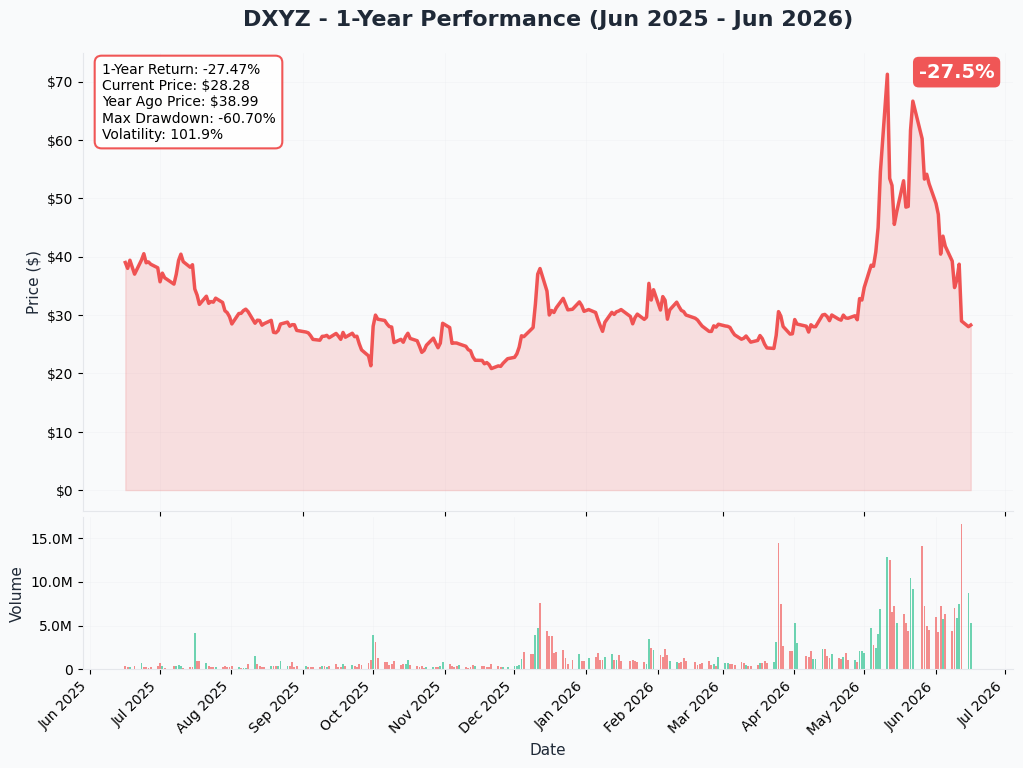
Premium-to-NAV dynamics. The share price is driven primarily by the expansion and contraction of the market premium above NAV, not by changes in portfolio value. The last reported NAV was $24.56 as of March 31, 2026. At a ≈$28 share price, DXYZ currently trades at roughly a 15% premium — but it has historically traded at far wider premiums (the stock hit $72.87 at its 52-week high) and has also crashed 63% in a single move when that premium compressed. NAV reprices only quarterly off private valuations, so the daily share price absorbs all the day-to-day speculation.
-
Extreme realized volatility. DXYZ carries a beta of ≈5.11 and a 52-week range of $19.71–$72.87. It behaves like a leveraged sentiment vehicle, not a diversified fund. This makes its option premiums among the richest in the listed market.
-
$1.0B ATM dilution overhang. Destiny registered a $1.0 billion at-the-market common-stock program (sales agent Jefferies). Each tranche of new share sales at a premium is dilutive and acts as a persistent cap on the share price. The fund sold 8.49M shares in Q1 2026 at ≈$28.76 for ≈$244M net proceeds.
Market cap: ≈$863.7M | YTD: up >61% | 52-wk range: $19.71–$72.87
The Trade
| Field | Detail |
|---|---|
| Date / Time | Jun 16, 2026 / 10:04:23 ET |
| Buy / Sell | Sell |
| Call / Put | Put |
| Expiration | Jul 17, 2026 |
| Strike | $25.00 |
| Volume | 4,999 contracts |
| Prior Open Interest | ≈1,500 contracts |
| Option Price | ≈$2.31 per contract |
| Premium (CREDIT collected) | ≈$1.2M received |
| Spot at print | ≈$26.59 |
| Tape breakeven | ≈$22.69 ($25.00 − $2.31) |
| Flow type | Price-improvement auction (facilitated) |
| Order type | STO — Sell to Open (new short put) |
| Option leg | DXYZ Jul-17-2026 $25P |
The fill arrived via a single-leg price-improvement auction — a facilitated, methodical execution mechanism that is distinct from an urgent aggressive lit sweep. This is the hallmark of a desk that is working an order, not panicking into puts.
✅ RESOLVED — Next-Day OI Confirms a Clean Open (2026-06-17)
| Leg | Pre-print baseline (EOD 2026-06-15) | Resolving (EOD 2026-06-16) | Δ | Verdict |
|---|---|---|---|---|
| Jul-17 $25P | 1,540 | 6,590 | +5,050 | OPEN — fresh short put (STO) confirmed |
The next-morning OPRA snapshot confirms the open: open interest stepped up from 1,540 to 6,590, a +5,050 rise that matches the 4,999 puts sold. This is a brand-new put-write — fresh short contracts, not a close or transfer. The desk is genuinely opening a premium-collection position, exactly as the tape size suggested.
🤓 What This Actually Means — Plain English
This is a put-write (short put) — income first, ownership second.
When you sell a put, you collect premium upfront and take on the obligation to buy 100 shares per contract if the stock falls below the strike at expiration. The seller is not making a bullish directional bet per se; they are making an income and "willing-to-own-lower" bet:
- If DXYZ closes above $25 on July 17, the puts expire worthless. The desk keeps the entire ≈$1.2M credit and walks away. Full profit.
- If DXYZ closes between $22.69 and $25 on July 17, the desk is assigned 499,900 shares at $25, but the ≈$2.31 credit reduces the effective cost basis to ≈$22.69 — still below the fund's last reported NAV of $24.56. The desk has essentially purchased the private-tech portfolio at a discount to asset value.
- If DXYZ closes below $22.69 on July 17, the desk loses money on the position, with maximum risk equal to the full assignment at $25 minus the credit (loss accelerates below $22.69, maximum theoretical loss at $0).
Why is this trade coherent here?
First, DXYZ's implied volatility is exceptionally rich relative to most names — a beta ≈5 fund with a 52-week range of $19.71–$72.87 commands very elevated option premiums. A put-writer is harvesting that elevated IV, not expressing a high-conviction directional view.
Second, the $25 strike is essentially at the last reported NAV ($24.56 as of 3/31/2026). If assigned, the writer acquires the private-tech portfolio (SpaceX, OpenAI, Anthropic, xAI...) at approximately net asset value — paying little-to-no premium for that exposure, versus the ≈15% premium current shareholders pay in the open market.
Third, the $25 strike is ≈6% below spot, providing cushion. The breakeven of ≈$22.69 is ≈15% below the last reported NAV — a meaningful margin of safety against even a partial premium-to-NAV compression.
STO (Sell to Open) = the desk is opening a new short position and collecting premium. This is the opposite of a buyer paying premium. The ≈$1.2M is a credit received, not capital deployed.
Technical Setup
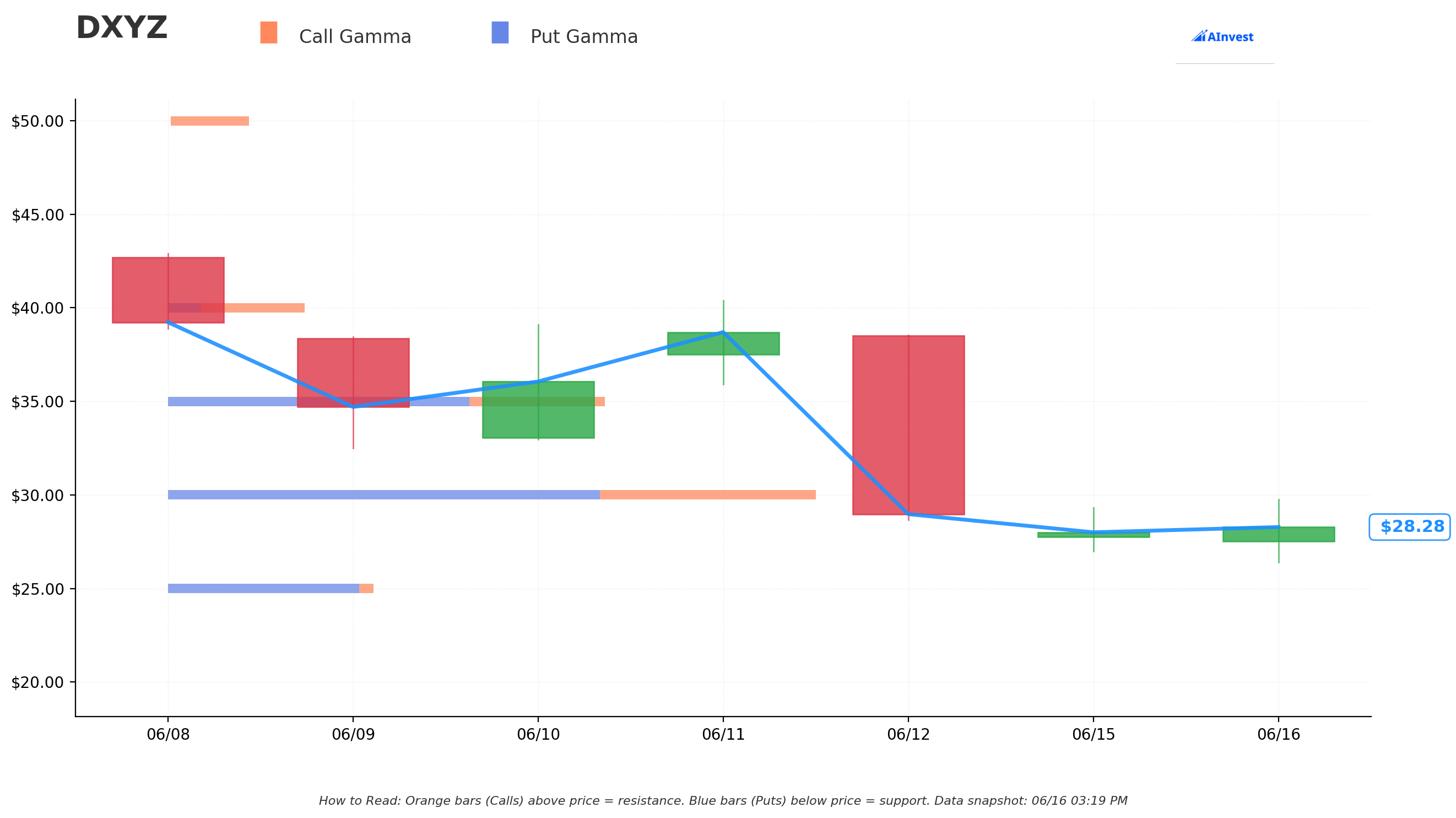
Gamma levels (from the options chain as of Jun 16):
The heaviest put gamma concentration sits at the $25 strike — exactly where the put-write is anchored. This strike carries a net GEX of roughly −$0.25 (put-dominated), meaning market makers who are long those puts are carrying negative gamma there: as DXYZ approaches $25, they would be sellers of the underlying to hedge, which can create a gravity-like pull toward (and potential acceleration through) $25 on a downturn. The put-writer is aware of this dynamic and is being compensated for providing that liquidity.
The $30 strike carries the largest total gamma concentration on the board (total GEX ≈0.90), acting as the primary near-term resistance. A sustained move above $30 would reduce the gamma pressure from market makers and could allow a freer run higher — but also signals that the ≈6% cushion on the $25 put is widening.
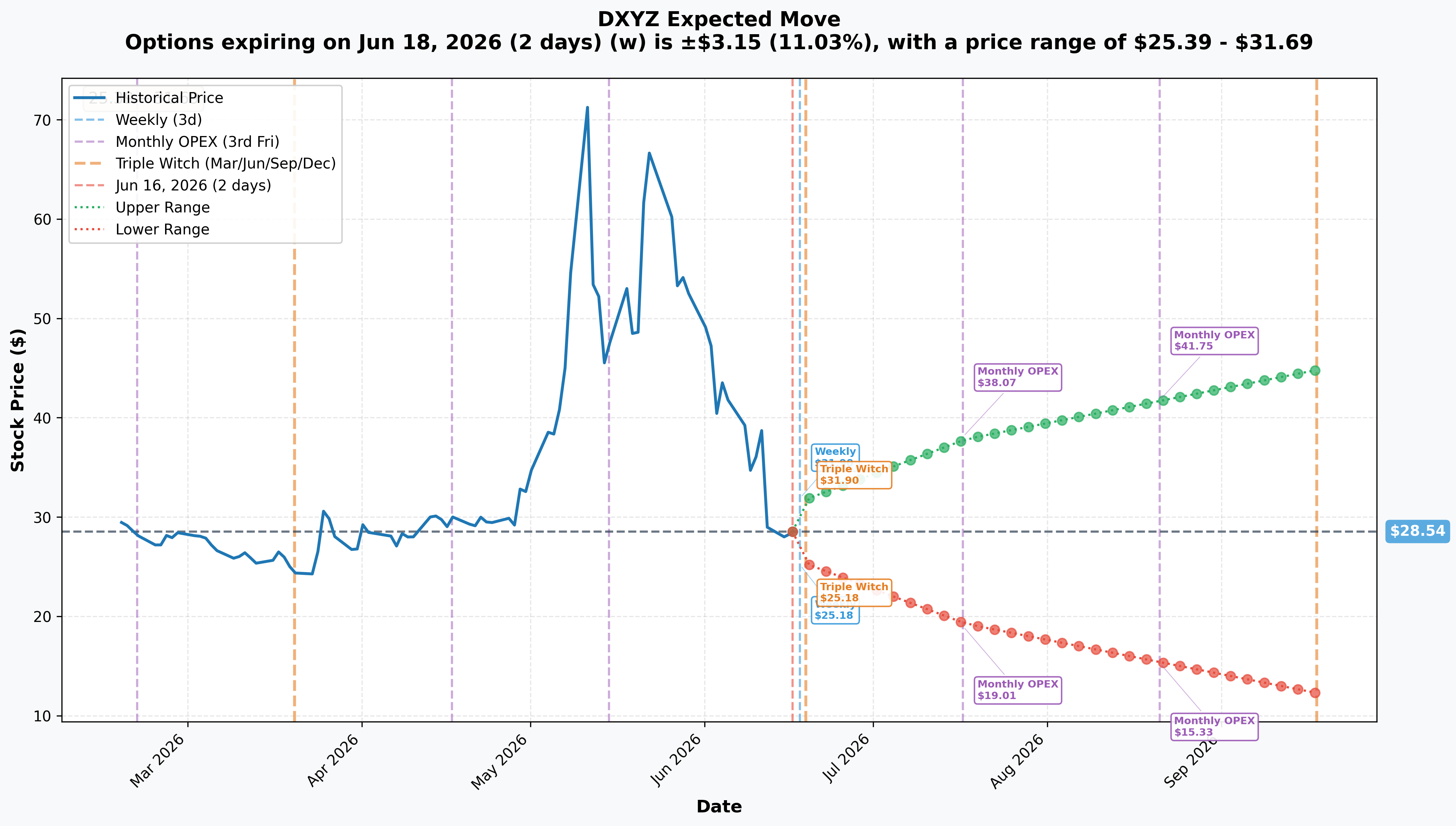
Implied move (options-derived price ranges):
| Timeframe | Expiry | Implied Move | Upper Range | Lower Range |
|---|---|---|---|---|
| Weekly | Jun 18 (2 DTE) | ±11.0% / ±$3.15 | $31.69 | $25.39 |
| Monthly OPEX | Jul 17 (31 DTE) | ±32.6% / ±$9.31 | $37.85 | $19.23 |
| Quarterly | Sep 18 (94 DTE) | ±57.2% / ±$16.33 | $44.87 | $12.21 |
The market is pricing in a ±32.6% move by the Jul 17 expiry — an implied range of roughly $19.23 to $37.85. The lower bound of that range ($19.23) sits well below the $22.69 breakeven, confirming that the market assigns meaningful probability to moves through that level. This is a high-risk/high-reward income structure, not a "safe" premium collection. The put-writer is essentially saying: the premium is rich enough to compensate for the tail risk.
The weekly range ($25.39–$31.69) is notable: the lower boundary of the two-day implied move almost exactly touches the $25 strike. DXYZ is priced for near-term turbulence.
Catalysts
Already fired:
-
🚀 SpaceX (SPCX) IPO — the defining event. SpaceX priced its IPO on June 11, 2026, and began trading on Nasdaq under SPCX on June 12, 2026, at a valuation above $1.75T — the largest IPO in market history. SpaceX is DXYZ's largest holding at 16.2%. The IPO re-marks DXYZ's biggest position at a public-market price, and post-IPO SPCX trading range is now the dominant day-to-day driver of DXYZ sentiment. With the catalyst fired, the risk of a "sell the news" premium compression is real — which makes the put-write's near-NAV strike logically positioned. See our SpaceX day-one options flow breakdown → for the biggest trades on SPCX's first session.
-
💰 OpenAI $122B mega-round closed. OpenAI closed a record $122B funding round at an $852B post-money valuation on March 31, 2026, co-led by SoftBank with Nvidia and Amazon participation. OpenAI (≈2.1% of DXYZ) has also filed confidentially for a public listing targeting 2H 2026.
-
📋 Q1 2026 NAV at $24.56. NAV rose 23% quarter-over-quarter to $24.56 as of March 31, 2026, reflecting private-portfolio appreciation. This is the baseline for the "near-NAV" assignment framing.
-
🏛️ New portfolio additions: Anthropic, CHAOS Industries, Hermeus. Destiny closed ≈$127M in new exposure including $100M in Anthropic via an SPV in February 2026, broadening the AI coverage beyond SpaceX.
Upcoming:
-
📊 Q2 2026 NAV report (late June–mid July). The next hard fundamental event: DXYZ reports NAV quarterly and the Q2 mark (period ending June 30) will incorporate a fresh SpaceX markup to the SPCX IPO price plus any OpenAI/Anthropic adjustments. A large NAV step-up could meaningfully compress the premium-to-NAV and affect the $25 strike's positioning. This report is expected before the Jul 17 expiry — making it a binary catalyst for the put-write.
-
📈 OpenAI potential public listing, 2H 2026. OpenAI is targeting a listing in the second half of 2026; any concrete S-1 or pricing news is a secondary DXYZ catalyst given the halo effect and direct NAV impact.
-
📉 $1.0B ATM program — ongoing dilution. Each tranche of share sales under the active $1.0B ATM is dilutive and has historically pressured the share price by capping premium expansion. This overhang works in the put-writer's favor only if DXYZ declines toward $25 more slowly than the premium erodes.
-
📅 Jul 17, 2026 — expiry. The put-write lands at monthly OPEX. The fund will have reported Q2 NAV and the full post-SpaceX-IPO sentiment shift will have played out before this date.
Four-Reader Breakdown
YOLO Trader This is not your trade — you are on the opposite side of the desk. A 4,999-lot put-write means a desk sold ≈$1.2M of credit and is now short massive delta if DXYZ falls to $25. If you think DXYZ is heading lower (SpaceX "sell the news," ATM dilution, NAV premium compression), these are the exact puts someone sold you the opportunity to buy. But the premium is rich for a reason — you'd be buying expensive volatility on a name that can move 30% in a month.
Swing Trader The $25 strike represents a meaningful technical and fundamental level — it's both at the ATM implied-move lower bound for the weekly (≈$25.39) and at the last reported NAV ($24.56). A drop to and through $25 would signal premium-to-NAV compression is accelerating and could mark a decisive technical break. Watch how DXYZ handles $25–$26 as a support zone.
Premium Collector This is your archetypal trade — high-IV name, OTM put-write, near-NAV assignment level. The logic is clean: collect the elevated premium on a beta-5 fund where assignment still lands near fundamental value. The risk is the same risk all short-put writers face in high-volatility names: a sharp gap move can turn a clean income setup into a large loss before you can adjust. Sizing is critical.
Beginner A desk just sold 4,999 put contracts. That means they collected ≈$1.2M in cash upfront. In exchange, they agreed to buy ≈499,900 shares of DXYZ at $25 if the stock is below $25 on July 17. They want DXYZ to stay above $25 so the puts expire worthless and they keep all the cash. They chose $25 because it's close to the fund's asset value — so even in the worst case (assigned), they feel they're buying something at a fair price. The risk is if DXYZ falls well below $25, which the market says is possible (implied range goes as low as $19.23).
Risks
The tape can confirm the mechanism and the size; it cannot prove intent, broker identity, or whether this is a standalone position or part of a larger hedged portfolio. Key risks to the put-write thesis:
-
Premium-to-NAV collapse. DXYZ has crashed 63% in prior episodes. The fund traded at $72.87 at its 52-week high and $19.71 at its low — a range that makes the $22.69 breakeven look vulnerable if sentiment shifts violently. The premium can compress sharply, independently of any change in portfolio value.
-
ATM dilution accelerating. The $1.0B ATM program creates a structural ceiling. If Destiny accelerates share sales, the resulting dilution and negative sentiment could push the price through $25 before July 17.
-
SpaceX "sell the news." The IPO catalyst has fired. If SPCX trades below its IPO range in the coming weeks, DXYZ sentiment follows nearly one-to-one — exactly the kind of sharp move that would pressure the $25 strike.
-
Q2 NAV surprise to the downside. If private marks come in below expectations — a down-round at one of the smaller names, or a stale SpaceX mark before the Q2 filing — NAV could disappoint. A lower NAV shrinks the "below-NAV assignment" cushion.
-
Stale private marks / cash drag. A significant portion of the portfolio sits in Treasury and money-market sleeves (≈31% in one filing), not in operating-company equity. The "buying SpaceX/OpenAI at NAV" narrative overstates the purity of the exposure.
-
Open/close — RESOLVED as a clean open. Next-day OPRA OI rose 1,540 → 6,590 (Δ +5,050 ≈ the 4,999 traded), confirming a fresh short-put open (STO). No longer provisional.
-
Options trading involves substantial risk. Short puts carry maximum loss equal to the full strike value per share minus the credit received (maximum loss ≈$22.69 × 499,900 shares = ≈$11.35M in an extreme scenario). This strategy is not appropriate for all investors. Consult a licensed financial professional before implementing.
Bottom Line
A desk collected ≈$1.2M in premium by selling 4,999 Jul-17 $25 puts on Destiny Tech100 (DXYZ) via a facilitated price-improvement auction — methodical, not urgent. The structure is a textbook premium-harvesting put-write in one of the highest-implied-vol names in the listed market (beta ≈5, 52-week range $19.71–$72.87), anchored at the $25 strike which sits almost exactly at the fund's last reported NAV of $24.56. The breakeven of ≈$22.69 is comfortably below NAV, providing a margin of safety against partial premium compression.
The timing is deliberate: SpaceX's IPO (DXYZ's largest holding at 16.2%) just priced and began trading, the Q2 NAV report is expected before July 17, and the $1.0B ATM program provides a known dilution ceiling. The put-writer is being paid richly — ≈9% of the strike in 31 days — to provide downside liquidity at a level that, if assigned, delivers the private-tech portfolio at close to fundamental value.
The risk is real: the market's own implied range for Jul 17 reaches as low as $19.23, well below the breakeven. This is not a "safe" income trade — it is a high-premium, high-conviction income structure in an exceptionally volatile closed-end fund, where the put-writer's edge is the elevated IV and the near-NAV strike geometry, not a low-probability-of-loss payoff.
✅ RESOLVED (2026-06-17): the open is confirmed. Next-day OPRA OI rose 1,540 → 6,590 (Δ +5,050 ≈ the 4,999 traded) — a fresh short-put (STO) premium-collection position, exactly as predicted.
Last updated: 2026-06-17 — next-day OPRA OI confirmed a clean short-put open (+5,050).
Options trading involves substantial risk of loss and is not appropriate for all investors. This analysis is informational only and does not constitute investment advice. Past performance of similar trades does not guarantee future results.