🐻 EQT — $3M Bearish Put Bet: A Desk Positioned for Gas Prices to Slide Into Summer
✅ RESOLVED — Next-Day OI Update (2026-06-11): $50P OI 2,096 → 39,077 (Δ +36,981 ≈ size). The aggressive bearish nat-gas puts opened as read.
Last updated: 2026-06-11
📅 June 10, 2026 | 🔥 Unusual Activity Detected
🎯 The Quick Take
A desk paid roughly ≈$3M to open 37,413 EQT July $50 puts this morning, bought aggressively at the ask via a multi-leg auction. With EQT trading near $53, this position profits if the stock slides toward or through $50 by July 17 — a pure bet on soft summer natural-gas prices, not earnings. The opening size (37,413 contracts) dwarfed prior open interest of just 2,100, making this a clearly deliberate new position, not a routine hedge roll.
📊 Company Overview
EQT Corporation (EQT) is the largest natural gas producer in the United States, operating across the Appalachian Basin (Marcellus and Utica shales):
- Market Cap: ≈$32.9 billion
- Sector: Energy — Natural Gas E&P
- Current Price: ≈$52.57 (as of June 9, 2026); 52-week range $48.47–$68.24
- Business: Vertically integrated — exploration, production, gathering, and transmission, with roughly 19.8 trillion cubic feet equivalent of proved reserves across ≈1.8 million gross acres (EQT Investor Relations)
- Key fact: Management keeps the majority of 2026 production unhedged (only ≈20% hedged beyond Q1) — so EQT's equity is highly geared to the Henry Hub strip, in either direction
Because EQT is nearly a pure-play, largely unhedged gas producer, a view on natural gas expresses cleanly through the stock. That is exactly what this trade is doing.
💰 The Option Flow Breakdown
What Just Happened
At 09:55 ET, a desk executed two prints on the same EQT July $50 put in a multi-leg auction — a facilitated complex-order mechanism where the exchange runs a price-improvement auction to fill a worked order. The two prints combined into a single opening position:
| Time | Buy/Sell | Type | Expiration | Strike | Volume | OI | Size | Spot | Option Price | Premium | Option Symbol |
|---|---|---|---|---|---|---|---|---|---|---|---|
| 09:55:00 | BUY | PUT $50 | 2026-07-17 | $50 | 22,000 | 2,100 | 22,413 | $53.05 | $0.82 | ≈$1.8M | EQT20260717P50 |
| 09:55:00 | BUY | PUT $50 | 2026-07-17 | $50 | 38,000 | 2,100 | 15,000 | $53.05 | $0.82 | ≈$1.2M | EQT20260717P50 |
Flow tag: 🤝 Multi-Leg Auction (facilitated complex order, NOT a lit sweep) Aggressor: 91% across the NBBO = bought firmly at the ask — a notable aggressive lean for a facilitated mechanism
Combined position: ≈37,413 contracts, ≈$3.07M total premium
⏳ Come back tomorrow pre-market (≈06:30 ET) for the OI double-check.
Today's combined size of ≈37,413 contracts is roughly 18x the prior open interest of 2,100 — size this far in excess of prior OI is strong evidence of a new opening position. We are asserting this as an open (BTO) with high confidence based on the size-vs-OI signal.
That said, next-morning OPRA OI is always the definitive test. If OI rises by ≈37,413, the open is fully confirmed. Note: OI may rise by somewhat less than the full size if some of the volume was transferred between existing holders rather than creating new contracts — the ⏳ caveat applies even on a high-conviction open call. Check OI on the EQT20260717P50 strike at the June 11 open.
🤓 What This Actually Means — Plain English
A desk structured a complex order — two separate prints, same strike, same expiration, same second — and ran it through an exchange price-improvement auction. This is not a lit-book sweep or a random retail sequence; it is a single worked order broken across two fills.
Order type: BTO (Buy to Open) — the desk paid premium to enter a new bearish position.
What the buyer needs: EQT at or below $50 by July 17. With the stock at $53.05 and the puts costing $0.82, the position is profitable if EQT falls roughly 7.2% from today's level by expiry. Below $50, the puts pay off dollar-for-dollar. If EQT stays above $50, the maximum loss is the $3M premium paid — that is the full risk.
The 91% NBBO aggressor read: paying at the ask in a facilitated auction mechanism means the buyer was willing to accept a worse fill price rather than wait. That is a willingness-to-pay signal, though it applies to the net complex order, not individual legs with independent aggressor reads.
This is NOT an earnings play. EQT's Q2 2026 earnings are scheduled for approximately July 28 — after the July 17 expiry. The position lives and dies entirely on June–July weather, weekly EIA storage prints, and the Henry Hub strip between now and option expiration. This makes the thesis simple and transparent: if gas prices sag into summer, EQT falls; if a heat dome rescues demand, the puts expire worthless.
Hedge or directional bet? Given the size and the at-ask aggression, this looks more like a targeted downside bet (or a meaningful hedge against a large long gas position) than a casual trade. A $3M premium on a near-term OTM put is a committed view.
📈 Technical Setup
YTD Performance
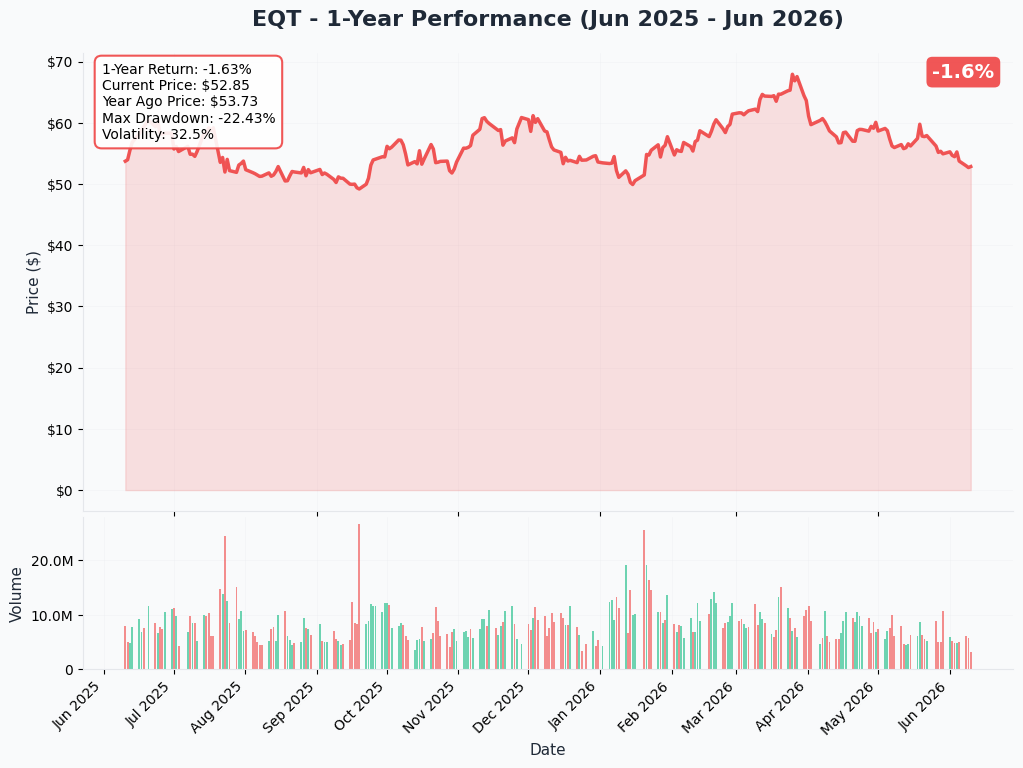
EQT started 2026 riding the momentum of a brutal cold winter and a Henry Hub spike that powered a record Q1 free cash flow print. The stock reached into the upper $60s before cooling off as gas prices retreated. More recently, EQT fell roughly 7.5% in a single session as financing/dilution concerns (shares outstanding up ≈45% year-over-year after equity issuance tied to deal funding) collided with a weakening gas tape. The chart has rolled over from its highs, and as of late May–early June the stock has been trending lower, currently holding in the low $50s.
The $50 area is significant: it sits near the lower end of the 52-week range ($48.47) and is the Piper Sandler Street-low target.
Gamma-Based Support and Resistance
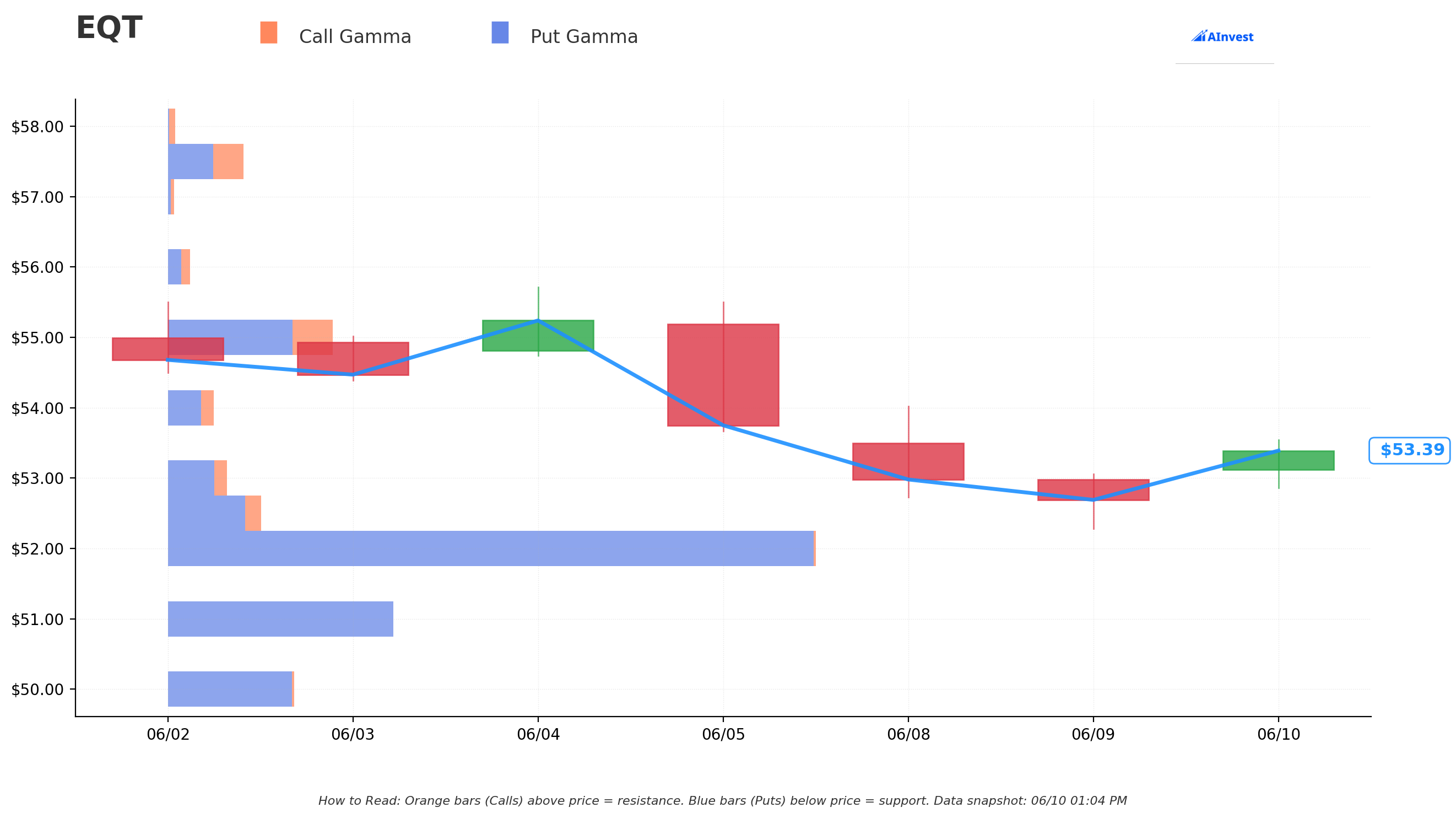
Current price: $53.36
The gamma exposure map shows dealer hedging flows clustered tightly below current price — which matters for where EQT is likely to find floor support (or acceleration) on a decline:
🔵 Support Levels (Put Gamma below price):
- $52.00 — Very Strong Support Wall: The single most significant gamma level below spot. Dealers with short puts here are buyers on a dip toward $52. A break through this level could accelerate the decline.
- $51.00 — Support Wall: Secondary gamma floor; losing $52 shifts the next natural pause to $51.
- $50.00 — Support Wall (the put strike!): The put buyer chose this strike deliberately — it sits at a gamma support level, meaning a move here is a significant technical milestone. If $50 breaks, gamma structure offers less cushion immediately below.
🟠 Resistance Levels (Call Gamma above price):
- $55.00 — Strong Resistance: The most significant call gamma level nearby. Dealer selling pressure increases as EQT approaches $55.
- $57.50 — Moderate Resistance: Extended upside target; a sustained move here would require meaningful positive catalysts.
What this tells us: The gamma structure creates a "staircase down" scenario — support at $52, then $51, then $50. If the gas macro deteriorates and EQT begins to slide, each support level could slow but not necessarily stop the decline. The put buyer's $50 strike aligns with a gamma support zone, which suggests familiarity with the technical structure.
Implied Move Analysis
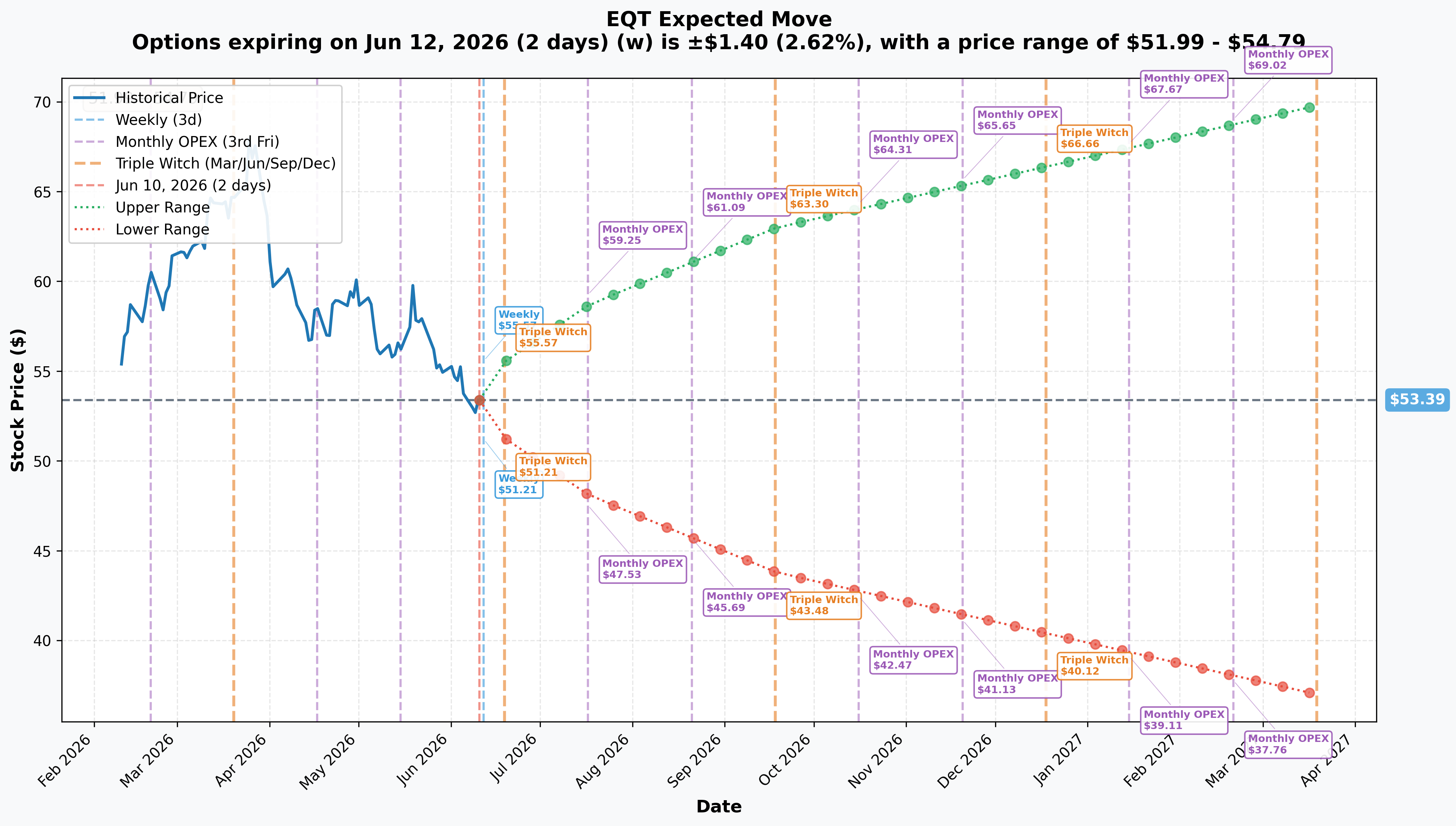
Current price: $53.39
The options market is pricing meaningful moves across all time horizons:
- 📅 Weekly (June 12 — 2 days): ±2.62% (±$1.40) → Range: $51.99 – $54.79
- 📅 July OPEX (July 17 — 37 days — THIS TRADE!): ±9.97% (±$5.32) → Range: $48.07 – $58.71
- 📅 September OPEX (Sept 18 — 100 days): ±18.0% (±$9.61) → Range: $43.78 – $63.00
- 📅 LEAP (March 2027 — 282 days): ±30.73% (±$16.41) → Range: $36.98 – $69.80
The key number for this trade: The July OPEX implied move extends down to $48.07 — the options market is already assigning meaningful probability to EQT trading below $50 by July 17. The put buyer's $50 strike sits squarely inside the lower half of this implied range. The buyer is not paying for a tail event; they are paying for an outcome that the market considers within normal bounds.
🎪 Catalysts
Past Catalysts (Already Happened)
Q1 2026 Earnings — April 22, 2026 (Blowout) EQT reported a record quarter: net income of $1.49 billion ($2.36 EPS vs $0.40 a year earlier), record Q1 free cash flow of more than $1.8 billion, sales volumes of 618 Bcfe, and realized gas prices of $5.27/Mcf before hedges (PR Newswire). EQT also earned a Fitch upgrade to BBB. The catch: those realizations rode a cold winter and a volatility spike that have since unwound. The stock has retreated substantially from its post-earnings high.
7.5% Single-Session Drop (Early June 2026) Shares fell sharply on a combination of financing/dilution concerns and a weak gas tape (QuiverQuant). Shares outstanding are up ≈45% year-over-year following equity issuances tied to deal funding and a large debt tender that was upsized from $1.15B to $1.4B.
Insider Sale — June 8, 2026 EQT Production CEO Toby Rice sold 98,714 shares (GuruFocus) — insider supply into an already softening stock.
Upcoming Catalysts (What Matters for This Trade)
Weekly EIA Natural Gas Storage Reports (every Thursday) The highest-frequency catalyst for this position. The US is currently sitting at ≈5% above the five-year seasonal storage average (EIA Weekly Storage). A string of larger-than-expected injections — the base case if cooling demand remains subdued — would pressure Henry Hub and weigh on EQT directly.
Henry Hub Gas Prices — Ongoing Front-month futures recently fell ≈2% to ≈$3.26/MMBtu, pulling back from a 16-week high. The EIA expects spot prices to fall slightly in 2026 before recovering in 2027, with 2H26 averaging only ≈$3.34/MMBtu as supply growth outpaces demand (EIA STEO). EQT at ≈20% hedged means each gas-price move flows almost entirely to realizations and cash flow.
Cooling Degree Days — June/July Weather The US tracked ≈240 CDDs in June — 15% fewer than June 2025 and 9% below the 10-year norm (EIA STEO). Power-sector burn is expected to merely match last summer at ≈43.7 Bcf/d, with new renewables absorbing incremental load. Weak cooling demand is the clearest path to the put buyer's $50 target.
LNG Export Maintenance Dip — June/July Net feedgas to export terminals dropped to ≈16.3 Bcf/d in June from 17.1 Bcf/d in May as Golden Pass and Freeport ran maintenance (Reuters via TradingEconomics). This near-term dip reduces a key demand absorber right inside the put's five-week window. New export capacity (Plaquemines ramp, Corpus Christi Stage 3) is a constructive offset for 2H26, but not before July 17.
Q2 2026 Earnings — Approximately July 28, 2026 After the July 17 expiry. This position does not capture earnings. The put buyer is not making an earnings bet — they are making a weather-and-storage bet. (MarketBeat)
Analyst Target Range — Ongoing Pressure from Low End The Street's lowest target is $48 (Piper Sandler, Mark Lear — Neutral), which sits below the $50 put strike (Benzinga, MarketBeat). The median target is ≈$68.50, but a downgrade cycle hitting gas-weighted E&Ps on oversupply concerns has already brought a few shops to cautious ratings. A fresh downgrade to $48 or below would be directly additive to this thesis.
💡 How Different Traders Might Read This
🛡️ Conservative / Income Trader
"I already own EQT — should I be worried?"
The put activity is a real warning flag for longs: a desk just paid $3M for near-term downside protection with a target 5.7% below the current price. If you hold EQT, consider whether your thesis accounts for a mild summer and flat gas prices. The $52 gamma support level is the first line of defense; losing it opens a path toward $50–$51. If you are not comfortable with a move to $50 over the next five weeks, this activity warrants a closer look at your position sizing.
⚖️ Swing Trader
"Do I follow the put buyer?"
The setup has logic: gas storage is long, cooling demand is soft, LNG feedgas is temporarily reduced, EQT is largely unhedged, and the chart has already rolled over. The July 17 expiry keeps the duration short and the thesis clean. Breakeven is ≈$49.18 ($50 strike − $0.82 premium paid). For the put to expire in the money, EQT needs to be below $50 at expiry — roughly 6% below today's price. The July OPEX implied move extends to $48.07, so the market is not calling this an extreme scenario.
The risk: if a heat dome materializes in late June or early July, Henry Hub could spike and EQT could reverse sharply. This trade has a defined, known cost ($0.82/contract) with potentially meaningful upside if the gas macro plays out, but it can and will go to zero in a hot summer.
🚀 Speculative / YOLO Trader
"Can I buy these same puts?"
Yes — the EQT July $50 put (EQT20260717P50) is a publicly traded contract. At ≈$0.82, one contract controls 100 shares and costs ≈$82. The maximum loss is what you pay; the maximum gain is $50 per share if EQT goes to zero (practically irrelevant) — the realistic scenario is EQT trading $45–$50 for a 2–7x on the contract value. Position size carefully: OTM short-dated puts can lose 100% of value quickly on any bullish catalyst, and a heat dome is a real event risk.
🔰 Beginner
"What does this mean in simple terms?"
Someone paid $3 million for the right to sell EQT stock at $50 per share, expiring July 17. They bought this because they think EQT's stock price will fall from its current ≈$53 to below $50 over the next five weeks. Why? Because natural gas prices are soft, storage inventories are high, and the summer isn't expected to be particularly hot. If EQT stays above $50 at expiry, the $3M premium is lost. If EQT drops below $50, the position starts making money. Think of it as a $3M bet that EQT's stock falls at least 5.7% before mid-July — driven entirely by the price of natural gas.
⚠️ Honest Risks — What the Tape Cannot Tell Us
What this trade cannot tell us:
- The identity of the buyer — institution, hedge fund, large gas producer hedging production revenue, or a speculator
- Whether the buyer holds an offsetting long EQT position (making this a portfolio hedge rather than a directional bet)
- Whether the buyer has other positions in natural gas futures, related E&P names, or LNG equities that provide additional context
- The exact broker or desk involved
Risks to the bearish thesis (what could make these puts worthless):
- A genuine summer heat dome across the US South/Midwest that drives power-sector gas burn materially above expectations
- Faster-than-expected LNG ramp (Plaquemines, Corpus Christi Stage 3) absorbing incremental supply
- An unplanned production disruption (hurricane, freeze, well curtailment) that removes supply from the market
- Positive macro or sector news that re-rates gas-weighted E&Ps broadly upward
- EQT-specific positive news: a bolt-on acquisition, a share buyback announcement, or a strategic partnership that moves the stock independently of gas prices
The honest bottom line: EQT is fundamentally sound — record FCF, a Fitch upgrade, a "Buy" consensus with a ≈$68 median target, and an ≈10x P/E that is not expensive for an E&P generating this cash. The bear case is not a company-quality story; it is entirely a near-term gas-price/weather story with a 37-day fuse. The bullish risk is real: NOAA still flags elevated warm-summer probability, and a heat dome event between now and July 17 would quickly erase this thesis. The put buyer accepted that risk when they bought the contracts.
Last updated: June 10, 2026. Next OI checkpoint: June 11, 2026 pre-market (≈06:30 ET) — OPRA OI update on EQT20260717P50 will confirm whether the full 37,413-contract volume registered as new open interest. OI rising to ≈39,500+ = open confirmed; OI flat or lower = investigate.
Options trading involves substantial risk and may not be suitable for all investors. Past unusual flow does not predict future returns. This article is for informational purposes only and does not constitute investment advice.