🛡️ EWY — ≈$19.6M Korea Downside Hedge: Two-Print Block Cross on Jul-17 $165 Puts
Published: 2026-06-17 | Last updated: 2026-06-18
✅ Updated 2026-06-18 — OPEN CONFIRMED (partial): Next-day OPRA OI on the Jul-17 $165P rose 5,253 → 40,932 (Δ +35,679). That confirms a large fresh long-put position opened — but the Δ is only ≈half the ≈72,000 contracts that crossed, so roughly half was brand-new open interest and the rest offset existing positions (the block's counterparty partly closed). The downside-hedge read holds; net new open interest is ≈35,700. See the ✅ RESOLVED box below.
Quick Take
A desk negotiated two block prints totaling ≈$19.6M in EWY Jul-17-2026 $165 puts — ≈20% out-of-the-money with 30 days to expiry. This is not a lit sweep; a known counterparty took the other side off the open book. The structure reads as protective tail coverage on one of the world's best-performing equity markets in 2026, heading into a compressed calendar of binary catalysts: an MSCI review (Jun 23), a Bank of Korea rate decision (Jul 16, one day before expiry), and early-July Samsung preliminary guidance. The fund is ≈45% Samsung + SK Hynix — effectively a leveraged expression of the HBM/AI-memory cycle — and the Korean won is trading near a 28-year low, which mechanically amplifies downside for any USD holder. The $165 strike sits below the level the KOSPI briefly tested during its early-June circuit-breaker crash.
Company Overview
iShares MSCI South Korea ETF (EWY) is BlackRock's flagship Korea equity ETF, tracking the MSCI Korea 25/50 Index. It is the most concentrated institutional vehicle for expressing a view on Korean equities in USD terms.
What makes EWY unusual is its extraordinary single-name concentration: SK Hynix (≈23.5%) and Samsung Electronics (≈22%) together represent ≈45-46% of the fund. The top 10 holdings account for ≈61.5% of assets. A position in EWY is, in practice, a two-stock bet on the HBM/AI-memory supercycle, wrapped in a USD-denominated structure against a won-priced underlying — so currency moves directly affect the NAV.
| Holding | Approx. weight | Role |
|---|---|---|
| SK Hynix | ≈23.5% | HBM market leader (≈57% HBM revenue share) |
| Samsung Electronics | ≈22% | Memory + foundry, HBM4/HBM4E ramp |
| SK Square | ≈3.3% | SK Hynix holding-company proxy |
| Samsung Electro-Mechanics | ≈3.3% | AI-server components |
| Hyundai Motor | ≈2.3% | Autos, tariff-exposed |
EWY is up ≈+114% year-to-date as of mid-June 2026 — one of the best-performing equity markets on Earth over the past twelve months. Spot sits at ≈$206, about 5-6% below its 52-week high of $217.76.
The Trade
A known counterparty took both sides of two negotiated block prints on EWY Jul-17-2026 $165 puts today. This is a 🤝 block cross — a broker matched buyer and seller off the open book at a pre-agreed price. It is not urgent lit aggression.
| Field | Print 1 | Print 2 |
|---|---|---|
| Time (ET) | 10:32:38 | 10:41:58 |
| Buy / Sell | BUY | BUY |
| Type | PUT | PUT |
| Expiration | Jul-17-2026 | Jul-17-2026 |
| Strike | $165 | $165 |
| Size (contracts) | 30,000 | 9,000 |
| Option Price | ≈$5.10 | ≈$5.10 |
| Premium | ≈$15,000,000 | ≈$4,600,000 |
| Spot at print | ≈$206 | ≈$206 |
| OI (prior day) | ≈5,300 | ≈5,300 |
| Flow type | 🤝 BLOCK CROSS | 🤝 BLOCK CROSS |
Combined: ≈39,000 contracts / ≈$19.6M total premium / strike ≈20% OTM
✅ RESOLVED — Next-Day OI Confirms a (Partial) Open (2026-06-18)
| Leg | Pre-print baseline (EOD 2026-06-16) | Resolving (EOD 2026-06-17) | Δ | Contracts traded | Verdict |
|---|---|---|---|---|---|
| Jul-17 $165P | 5,253 | 40,932 | +35,679 | ≈72,000 | ✅ OPEN confirmed (partial) |
Next-day OPRA open interest on the EWY Jul-17-2026 $165 put jumped by +35,679 contracts (5,253 → 40,932) — unambiguously a large fresh long-put position opening, consistent with a South-Korea ETF downside hedge / bearish-leaning bet. But the Δ is only ≈half the ≈72,000 contracts that printed across the two block-cross prints. In a negotiated block cross one side can open while the other closes; here roughly half the flow created new open interest and the other half offset pre-existing positions (a transfer / counterparty close). So the real headline is new positioning of ≈35,700 contracts, not 72,000. Conviction on the opener's downside hedge stands.
🤓 What This Actually Means — Plain English
Order type: Buy to Open (BTO) — the buyer paid ≈$5.10 per contract to acquire the right to sell EWY at $165 before Jul 17. They paid premium; no credit was collected.
Structure: A standalone long put, bought in two tranches across two negotiated block crosses nine minutes apart. This is not a spread. The full ≈$5.10 per contract is at risk if EWY stays above $165 through expiry. Maximum gain occurs if EWY falls to zero; the position becomes worthless at expiry if EWY is above $165.
What is the $165 strike telling you? EWY needs to fall ≈24% from spot (≈$206 → $165) for this put to expire in the money. This is not an at-the-money directional bet. The strike is set below the level the KOSPI briefly traded to during its early-June circuit-breaker crash — this is protection against a deeper air pocket, not a prediction of an ordinary pullback.
The won angle. EWY is a USD-denominated ETF holding won-priced assets. When the won weakens, the NAV shrinks even if Korean stocks hold flat in local-currency terms. With the won near a 28-year low (≈1,550-1,560 per dollar), a USD holder of EWY is implicitly short the won — and a put on EWY hedges both an equity drawdown and a further currency leg in a single instrument.
Why a block cross fits a hedge. A negotiated block cross at a 20%-OTM strike is the signature of a real-money holder buying portfolio insurance — or a dealer warehousing it for one. The cross mechanic means the buyer and seller were already matched; there was no urgency to sweep the book, no aggressive price-taking. The size (≈39,000 contracts, ≈$19.6M premium) and deep-OTM strike say "protect the book through July," not "make a quick directional bet."
In one sentence: A large institutional desk negotiated ≈$19.6M worth of tail coverage on Korean equities — specifically the AI-memory/HBM concentration in EWY — ahead of a cluster of binary catalysts that span the hedge's 30-day life.
Technical Setup
EWY Year-to-Date Chart
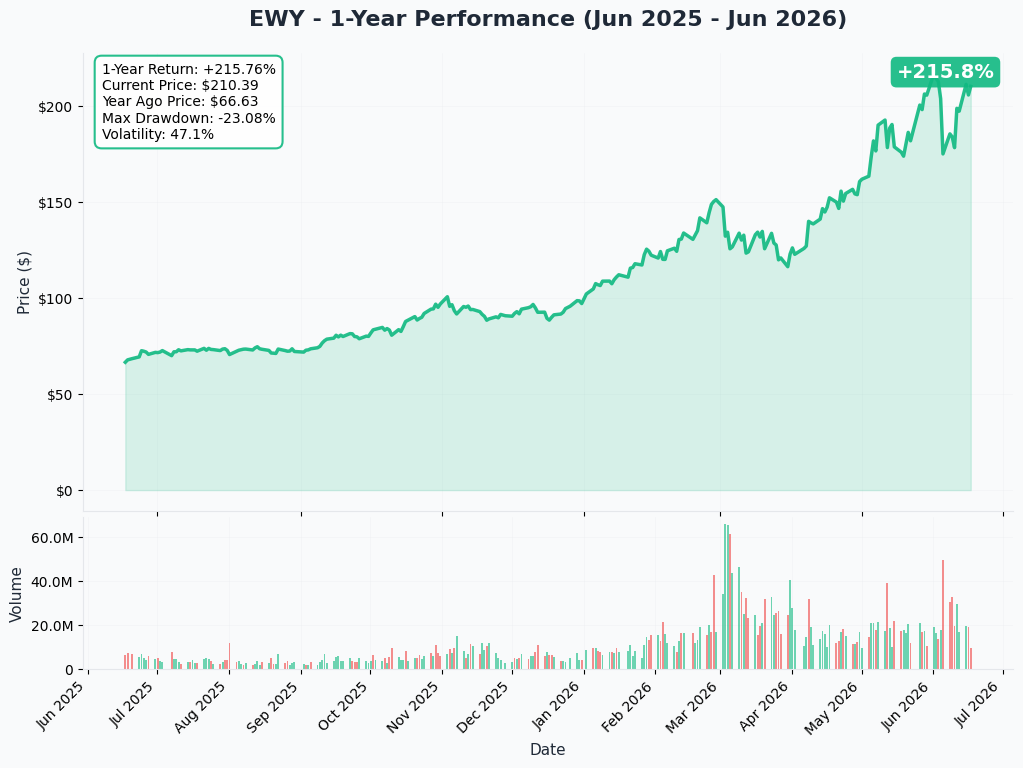
EWY has run from roughly $95 in early January to a 52-week high of $217.76, a gain of ≈+129% at peak before pulling back to the current ≈$206 range. The YTD chart shows one sharp correction in early June (the circuit-breaker episode) followed by a violent snap-back — typical of a high-beta, concentrated ETF with heavy retail leverage in the underlying market.
Gamma Support / Resistance
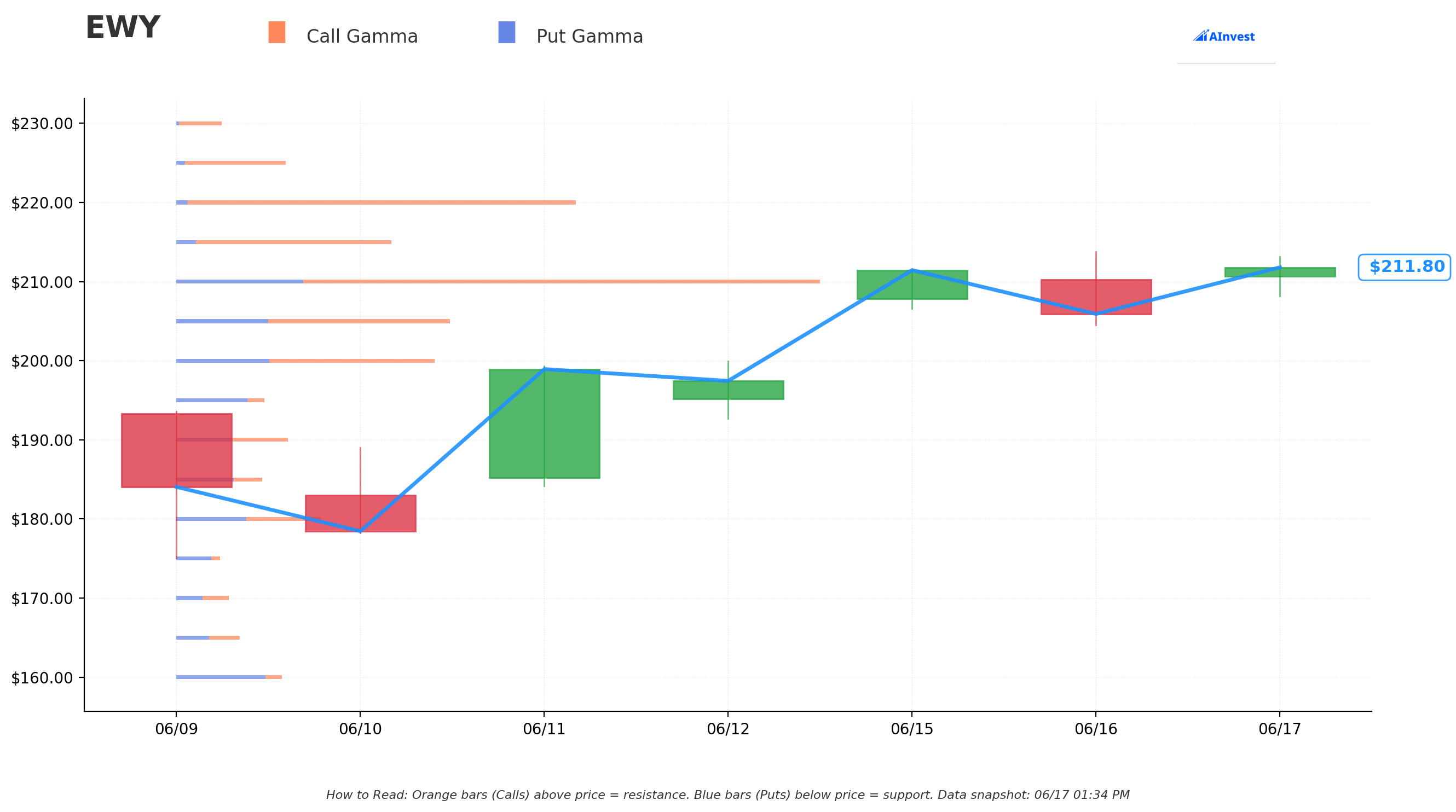
Key gamma levels from today's options open interest landscape:
Support walls (gamma pins that slow declines):
| Strike | Strength | Distance from spot |
|---|---|---|
| $210 | Very Strong | ≈0.8% below |
| $205 | Strong | ≈3.1% below |
| $200 | Strong | ≈5.5% below |
Resistance walls (gamma that slows rallies):
| Strike | Strength | Distance from spot |
|---|---|---|
| $215 | Strong | ≈1.6% above |
| $220 | Very Strong | ≈4.0% above |
| $225 | Moderate | ≈6.3% above |
The dominant gamma structure has EWY pinned between a very strong support wall at $210 and a very strong resistance wall at $220 — a ≈$10 gamma corridor around the current spot of ≈$211.60. Below $205, support gets noticeably thinner. The $165 put strike sits well below all meaningful gamma concentration; if spot were to reach that zone, there is very little market-maker hedging support between $185 and $165 to slow the descent.
The gamma picture reinforces the hedge thesis: the EWY options market is heavily concentrated near current spot (the $205-$220 zone), which means a large directional move that breaks below $200 would leave the underlying with diminishing gamma support — exactly the air-pocket scenario the put is designed to monetize.
Implied Move Cone
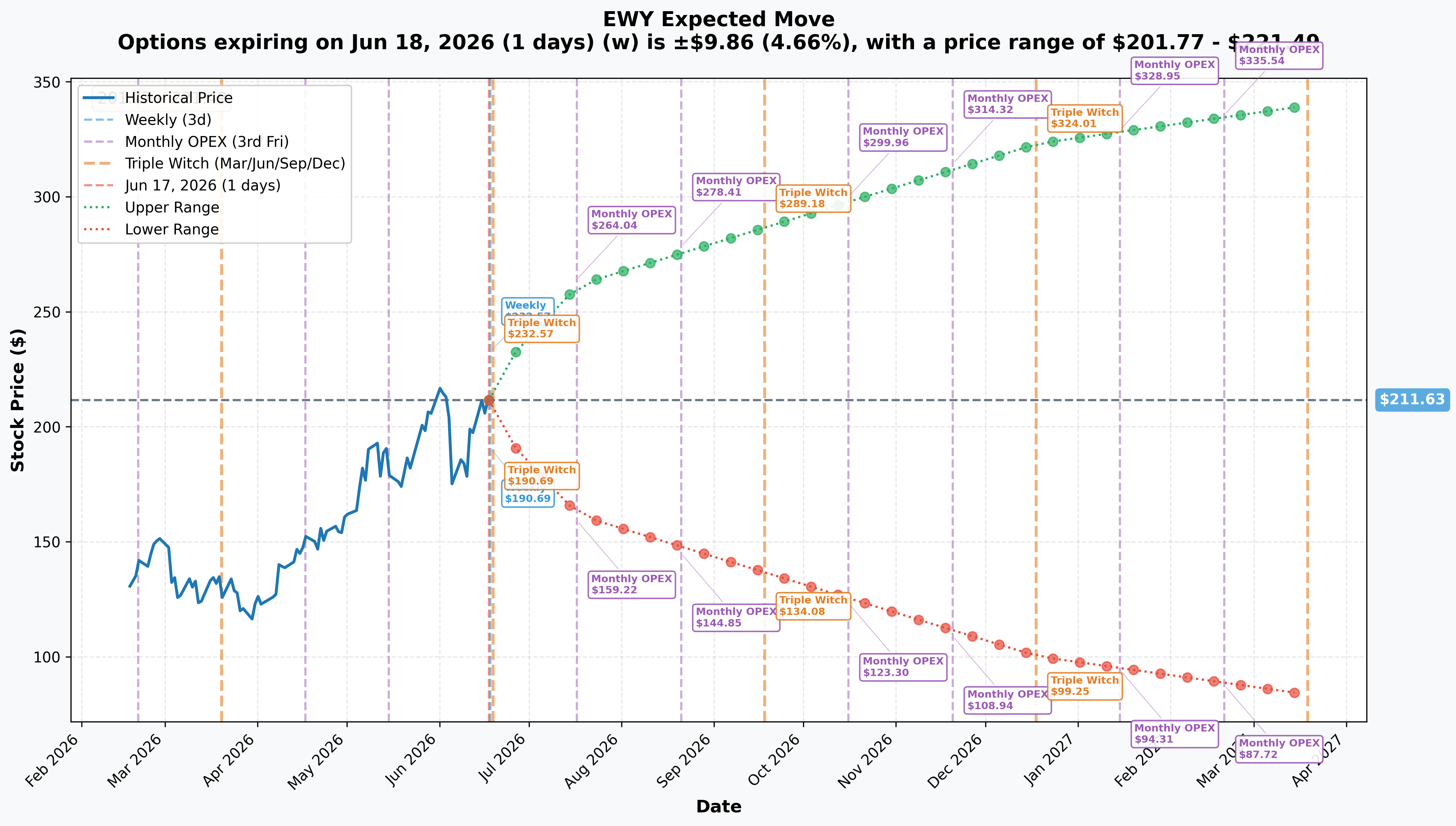
Options market implied moves through key upcoming expiries:
| Timeframe | Expiry | Implied Move | Lower Range | Upper Range |
|---|---|---|---|---|
| Weekly | Jun 18, 2026 | ±4.7% / ±$9.86 | $201.77 | $221.49 |
| Monthly OPEX | Jul 17, 2026 | ±23.6% / ±$50.02 | $161.61 | $261.65 |
| Quarterly | Dec 18, 2026 | ±52.7% / ±$111.47 | $100.16 | $323.10 |
The Jul-17 implied move of ±23.6% is telling. The options market is pricing a ≈$50 range around the Jul OPEX — a lower boundary of ≈$161.61, almost exactly at the $165 strike. In other words, the market's own implied-move lower bound and the strike of this hedge are in the same neighborhood. The $165 put is at the edge of the market-implied distribution, not deep in a tail that the market considers implausible.
Catalysts
Near-term (inside the put's window — Jun 17 through Jul 17)
Jun 18, 2026 — MSCI Global Market Accessibility Review. The annual review that sets up South Korea's path toward developed-market watchlist status. An upgrade trajectory drives passive inflows; a neutral-to-negative outcome can trigger rotation out of EM-Korea allocations. (cryptobriefing)
Jun 23, 2026 — MSCI Annual Market Classification Review. The key decision on watchlist inclusion. Korea's EM weighting has doubled in 8 months; reclassification would be a large flow event in either direction. (Seoul Economic Daily, IFR)
Late June — Korean War anniversary (Jun 25). North Korea has removed reunification from its constitution and is conducting live-fire missile-launcher tests; escalation risk historically spikes around late June. A recent Xi-Kim summit in Pyongyang prompted a US-Korea-Japan trilateral response, adding a geopolitical-risk premium. (Wikipedia, AEI)
Early July — Samsung Q2 preliminary guidance. Samsung typically releases a preliminary earnings estimate 2-3 weeks before its official report. It was a Broadcom guidance miss in early June that triggered the KOSPI circuit-breaker crash — Samsung guidance that hints at any AI-capex softness could reprice both ≈45% of the fund simultaneously. (Seoul Economic Daily)
Jul 16, 2026 — Bank of Korea rate decision. The BOK held at 2.50% in late May but revealed a hawkish board split. With the won near a 28-year low, a new BOK chief has framed rate hikes as the strongest remaining tool for currency defense. A hawkish hike pressures high-multiple memory names; a dovish hold keeps pressure on the won — a lose-lose for EWY in either scenario. This meeting falls one day before the put expires. (fxstreet, Korea Times)
Jul 17, 2026 — EWY put expiry. Terminal date for this hedge.
Macro backdrop
Currency crisis. The Korean won has hit a 28-year low, testing 1,549-1,560 per dollar with 20 consecutive sessions of net foreign selling totaling ≈70 trillion won. For a USD holder, this is a direct NAV headwind even before any equity move. (Korea JoongAng Daily, The Korea Herald)
Tariff overhang. The US raised tariffs on South Korean goods to 25% from 15% on Jan 27, 2026. A Section 232 semiconductor MFN guarantee is still being negotiated; the standalone AI-chip duty remains a live risk for the sector that is 45% of this ETF. (CNN Business)
June circuit-breaker crash. The KOSPI triggered a market-wide circuit breaker in early June, falling ≈8-9% at the open — the third circuit-breaker event this year — driven by Broadcom's lighter-than-expected AI-chip guidance and a cascade of foreign selling. EWY has recovered much of the move but the volatility regime has clearly shifted. (HTX Insights, ZeroHedge)
Four-Reader Interpretation
Swing traders / directional players: This trade says: a well-capitalized desk was willing to pay ≈$19.6M for one month of coverage against a 20%-plus decline, negotiated off-book. That alone is not a sell signal on EWY — the HBM supercycle is real, and the KOSPI has snapped back violently on every dip this year. But the concentration of binary catalysts between now and Jul 17 (MSCI, BOK, Samsung guidance) creates a window where a single guidance line could gap the entire fund. If you are long EWY, this trade is a reminder that large holders are actively paying for downside insurance at these levels.
Premium sellers / income traders: The ≈±23.6% monthly implied move means EWY options are pricing extraordinary volatility — this is not a market where selling naked downside puts is appropriate for most retail accounts. If you are comfortable with the risk, selling elevated-IV spreads above the current spot (e.g. call credit spreads in the $215-$220 zone aligning with the gamma resistance walls) captures some of that vol premium while keeping defined risk. Do not sell uncovered puts below $200 in this environment.
Long-term / value-oriented investors: EWY at +114% YTD is pricing a continuation of the AI-memory supercycle well into 2027+. If the thesis holds (supply-constrained HBM, record Q2 earnings tracking >150 trillion won combined operating profit), the put expires worthless and the ETF continues higher. The risk is that the market already knows this and has priced it — the June crash happened on a guidance miss despite the underlying supercycle being intact.
Beginners: A "block cross" means two large institutions agreed on a price privately, then printed the trade on-exchange for clearing. One side bought downside protection; one side sold it. Nobody in this transaction was making a panicked emergency trade — it was planned. The size (≈$19.6M) is institutional, not retail. The $165 strike is roughly 20% below today's price of ≈$206, so EWY would need to fall substantially before this put gains intrinsic value. Think of it like a fire-insurance policy: buying it does not mean the house is about to burn down, but someone thought the premium was worth paying given the risks on the horizon.
Honest Risk / What the Tape Cannot Prove
What is confirmed:
- Two negotiated block cross prints occurred at 10:32 and 10:41 ET totaling ≈39,000 contracts / ≈$19.6M premium on the EWY Jul-17-2026 $165 put.
- Combined size (39,000) significantly exceeds prior-day OI (≈5,300), making a fresh opening position the most probable interpretation for at least the majority of the flow.
- The cross mechanic (known counterparty) is tape-verified.
What is inferred and subject to revision:
- The buyer's identity, broker, and motive are unknown. The hedge interpretation is the highest-probability read given the deep-OTM strike, the cross mechanic, and the event calendar — but this could also be an outright bearish speculative position, a roll from a prior contract, or a dealer inventory move.
- Open vs. close is now RESOLVED as a partial open by next-day OPRA OI: open interest rose +35,679 (5,253 → 40,932), only ≈half the ≈72,000 contracts that printed — so roughly half the flow was brand-new open interest and the other half offset existing positions (the block's counterparty partly closed / transferred). The opener's downside-hedge read holds; net new positioning is ≈35,700 contracts. See the ✅ RESOLVED box above.
- The won and MSCI interpretations are contextual analysis, not tape-derived fact.
Tail risks that could invalidate the bearish thesis:
- Q2 earnings confirm the supercycle: if Samsung and SK Hynix guide for sustained HBM demand into 2027 with no softening, the rally resumes and the put expires worthless.
- MSCI upgrade: watchlist inclusion would trigger a large passive inflow into Korean equities, potentially gap-up the KOSPI.
- Won stabilization: if the BOK successfully defends 1,500/dollar, one of the main compounding downside forces for USD holders is removed.
- A ≈20% decline in 30 days from a market already up +114% YTD is a low-probability outcome; the base case remains that this put expires with limited or zero value.
Article generated: 2026-06-17. ✅ Last updated: 2026-06-18 — next-day OPRA OI confirmed a partial open on the Jul-17 $165P (5,253 → 40,932, Δ +35,679 of ≈72,000 traded; ≈half new open interest, half transfer).
Options involve substantial risk and are not suitable for all investors. This analysis is for informational purposes only and does not constitute investment advice. Past unusual options activity does not predict future price movement. Always do your own due diligence before trading.