🛡️ EWY $12.8M Delta-Hedged Protective Put — A Korea Bull Buying Crash Insurance, Not Betting Against It
📅 2026-07-30 | 🔥 Unusual Activity Detected
✅ UPDATE — July 31, 2026 pre-market: the open/close asterisk is resolved, and it was NOT a roll. Open interest at the October 16 $150 put went 4,553 → 11,768 (+7,215) against a 7,500-lot print — it more than doubled. This is confirmed fresh, newly-opened protection, not a re-shuffle of an existing hedge. See the ✅ RESOLVED box below.
🎯 The Quick Take
Someone crossed ≈7,500 EWY October-16-2026 $150 puts for ≈$12.8M this morning — but paired it with ≈300,000 shares of EWY stock bought at the same moment, almost exactly offsetting the puts' delta. That's not a bearish bet. It's a married/protective put: a trader who is long Korea buying insurance in the middle of one of the wildest month-long round-trips in market history — the KOSPI went from an all-time high in June to a technical bear market by late July. Translation: someone with real Korea exposure just paid up for a seatbelt, not a wheel to steer with.
📊 Company Overview
EWY (iShares MSCI South Korea ETF) is BlackRock's flagship South Korea fund, tracking the MSCI Korea 25/50 index — 100% Korea exposure, skewed hard toward technology (≈36.5% of the fund) (stockanalysis.com holdings).
- AUM: ≈$21.0B–$24.2B (stockanalysis.com, etfdb)
- Top holdings: SK Hynix ≈22.6% and Samsung Electronics ≈21.7% — together ≈44% of the entire fund — plus SK Square (≈3.5%) and Samsung Electro-Mechanics (≈2.8%) (stockanalysis.com holdings)
- What that means: EWY is effectively a leveraged bet on the global memory/HBM cycle. When SK Hynix and Samsung move on chip news, EWY moves — hard.
- 2026 performance: EWY's own NAV total return sits at ≈+54.4% YTD per iShares even after the crash (iShares fact sheet); the underlying KOSPI index is still ≈+62% YTD despite the July rout (Trading Economics).
💰 The Option Flow Breakdown
📊 What Just Happened
Two clips of the same trade printed 11 seconds apart as a negotiated block cross — a known counterparty took the other side, off the lit order book:
| Time (ET) | Symbol | Buy/Sell | Type | Expiration | Strike | Premium | Volume | Prior OI | Size | Spot | Option Price | Option Symbol |
|---|---|---|---|---|---|---|---|---|---|---|---|---|
| 09:48:06 | EWY | BUY | PUT | 2026-10-16 | $150 | $8.5M | 5,000 | 4,600 | 5,000 | $153.92 | $17.05 | EWY20261016P150 |
| 09:48:17 | EWY | BUY | PUT | 2026-10-16 | $150 | $4.3M | 7,500 | 4,600 | 2,500 | $154.05 | $17.05 | EWY20261016P150 |
🤝 Combined: ≈7,500 contracts, $12.8M, block cross at ≈92% of the way toward the ask (near the offer, but this was a negotiated print, not a lit sweep).
🛡️ The hedge: Alongside the two put clips, roughly 200,000 + 100,000 = 300,000 shares of EWY stock printed in the equity tape at essentially the same price (≈$152.70). That share count lines up almost exactly with 7,500 contracts × 100 × ≈0.40 put delta ≈ 300,000 shares — a near-perfect match. Long puts + long ≈300K shares of the underlying = a delta-hedged / protective-put package, not a directional short.
✅ RESOLVED — Not a roll. This was brand-new insurance.
We flagged a real asterisk here: total volume (7,500) exceeded the prior open interest (≈4,553), which normally leans "opening," but the multi-day OI trend for this contract had been slipping (≈4,693 → ≈4,553) and the trade printed as a negotiated cross rather than readable lit aggression. On that evidence we said it was equally plausible this was a roll or adjustment of an existing Korea hedge. The July 31 pre-market OPRA snapshot settles it — and the roll reading is wrong:
| Leg | Baseline OI (Jul 30 snap) | Resolving OI (Jul 31 snap) | Δ | Print size | Δ as % of print | Verdict |
|---|---|---|---|---|---|---|
| Oct-16-2026 $150 Put | 4,553 | 11,768 | +7,215 | 7,500 | ≈96% | ✅ OPEN (BTO) |
Open interest jumped by 7,215 against a 7,500-lot print — it more than doubled. We laid out the test in advance: OI rising by roughly the trade size means a fresh opening hedge, flat or falling means a close or roll. It rose by ≈96% of the size. The strike's entire session volume was 7,572 contracts, so almost every contract that traded created a new one, and there were no cancellations on the tape. The declining prior trend was a red herring — ordinary decay in an old position, not a signal about this print.
What this changes: the hedge is new risk capital, not recycled. Someone did not shuffle an existing Korea hedge around; they went out and bought ≈$12.8M of fresh downside protection they did not own the day before. That makes the protective read stronger — a holder looking at Korea's record volatility decided that being unprotected was no longer acceptable. The remaining ≈4% shortfall is small enough to be ordinary two-sided trading at the strike rather than a partial close.
What it still does not tell us: the delta-hedged, protective framing is confirmed as opening, but OPRA cannot reveal who the buyer is, what else sits in their book, or whether the paired stock leg is a permanent holding or a temporary hedge they intend to unwind later — which would leave the puts naked and genuinely bearish.
🤓 What This Actually Means — Plain English
Here's the decode, piece by piece:
- 🏠 "Married put" / protective put: this is the options-world equivalent of buying home insurance on a house you already own. The trader (or their book) is long EWY — either the ETF shares themselves or a correlated Korea/memory-chip exposure — and bought puts to cap the downside if the crash keeps going.
- ⚖️ Delta-hedged, not naked bearish: a "naked" bearish put buyer just buys puts and profits if the stock falls, full stop. This trade also bought ≈300,000 shares of stock at the same time, which cancels out most of the immediate directional exposure from the puts. Net effect right now: close to flat. The position only really starts paying off (or protecting) if EWY makes a genuinely large move from here, or if the trader unwinds the stock leg later and keeps the puts naked.
- 💸 Why the puts cost so much ($17.05, ≈11% of spot for an ≈11-week option): implied volatility on Korea is at an extreme level right now — Korea's "fear gauge" (VKOSPI) hit a record 96.94, above the 2008 financial-crisis peak (Seoul Economic Daily). Expensive options are the market's way of saying "we genuinely don't know what happens next, and we're pricing that uncertainty in."
- 🚫 Why this is NOT a bearish signal to copy: a naked put buyer is telling you "I think this goes down." A delta-hedged protective-put buyer is telling you "I want to stay long, but I refuse to be unprotected while this is this volatile." Those are very different messages, and reading this as "smart money is shorting Korea" would be a mistake.
📈 Technical Setup / Chart Check-Up
YTD Performance Chart
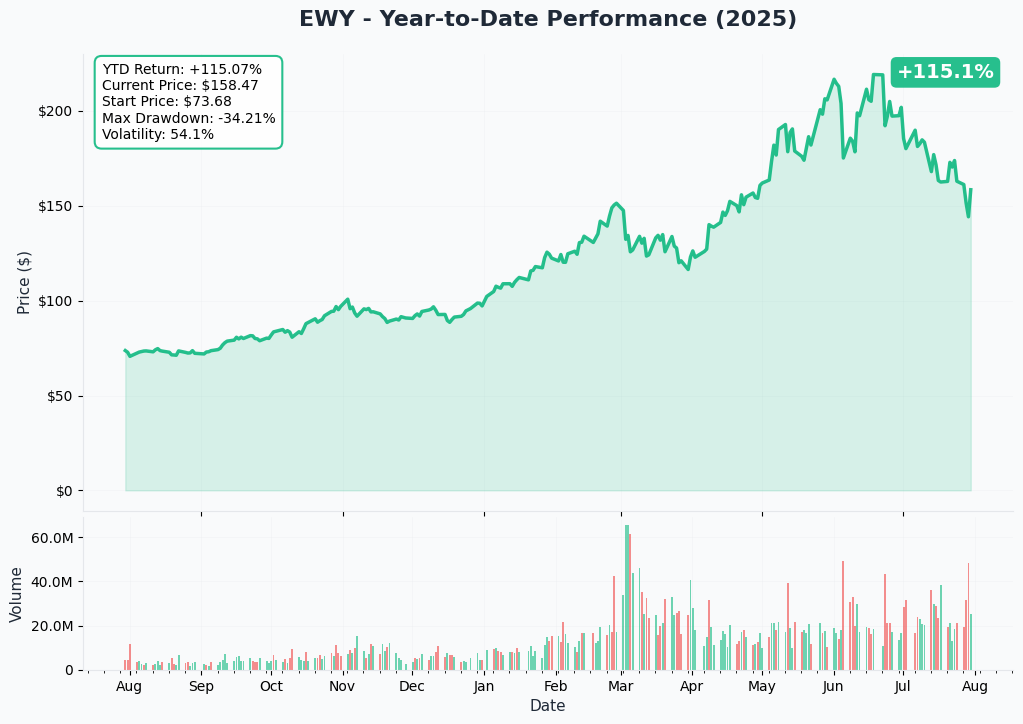
This chart says it all: a monster 2026 rally into a June top, followed by one of the fastest unwinds in the fund's history. EWY (and the KOSPI behind it) surged more than 100% off the AI-memory supercycle before cracking hard in July — the chart shows the round-trip in real time.
🔵🟠 Gamma-Based Support & Resistance Analysis
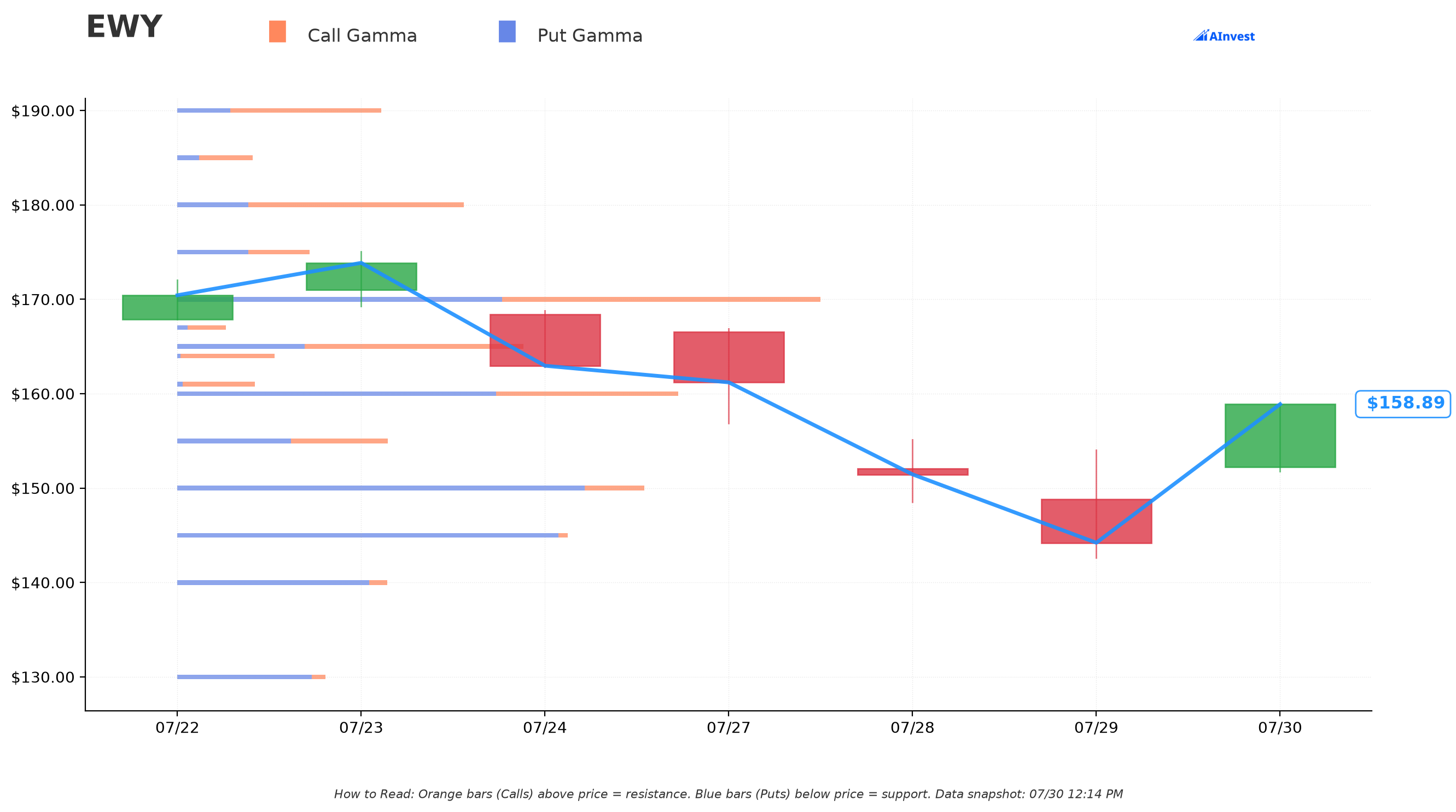
By the time this gamma snapshot was taken, EWY had bounced back to ≈$158.88 — a reminder of just how violently this ETF is whipping around intraday during the crash (it touched levels closer to $144 earlier in the session per today's tape).
🔵 Support levels below price:
- $155 — Moderate support (≈2.4% below spot)
- $150 — Very strong support (≈5.6% below spot) — this is exactly where today's put trade is struck. Not a coincidence: the buyer picked a strike sitting on top of a real dealer support wall.
🟠 Resistance levels above price:
- $160 — Very strong resistance, right on top of current price (≈0.7% away) — the nearest ceiling
- $165 — Strong resistance (≈3.9% above spot)
What this means: dealers have built a thick floor at $150 and a thick ceiling at $160. If EWY breaks below $150 with conviction, the next real shelf isn't far — the gamma map also shows a very strong support zone at $145. If it breaks above $160, $165 is the next test.
Implied Move Analysis
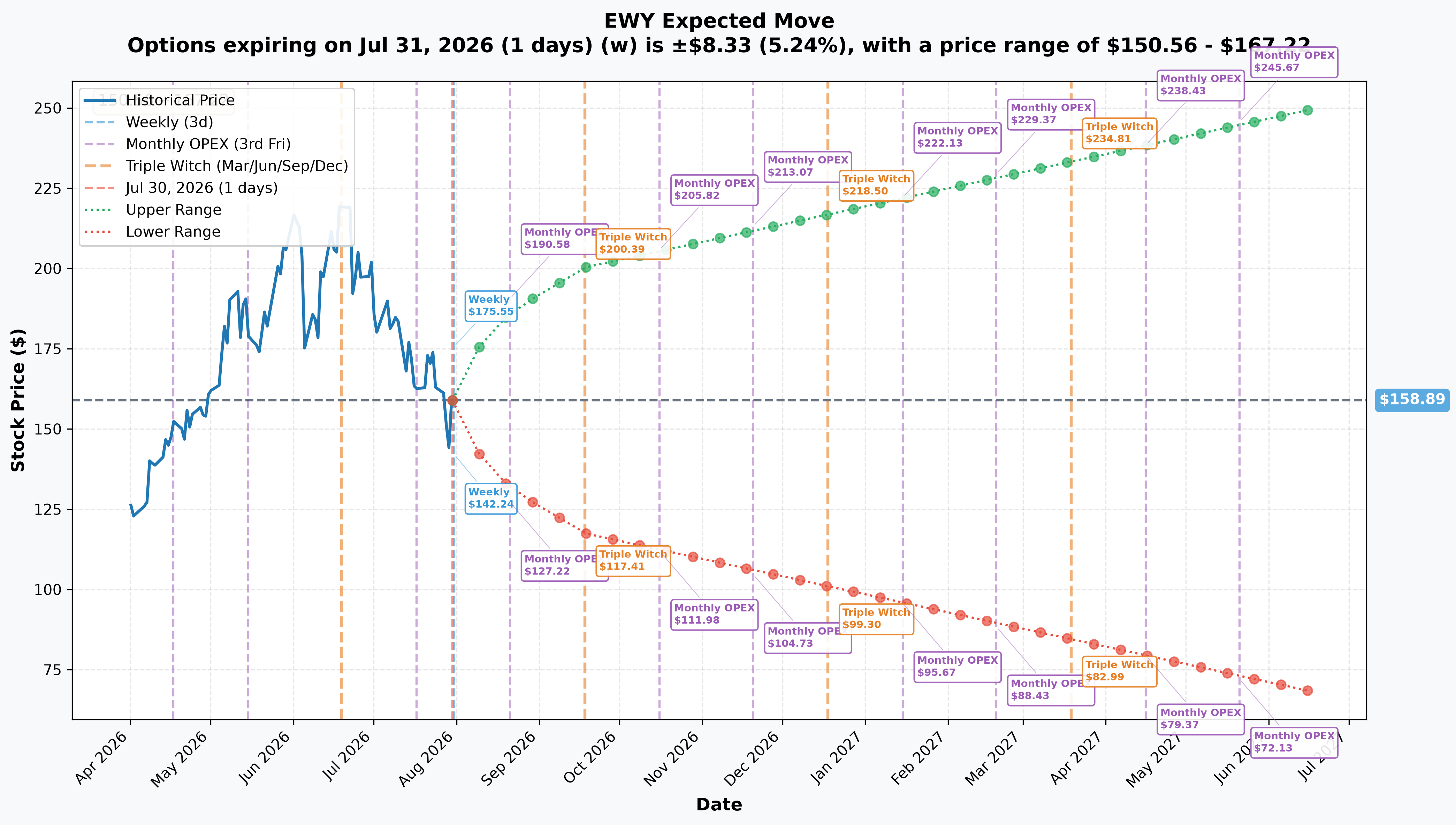
Options are pricing genuinely wide ranges given the volatility regime:
- 📅 Weekly (July 31 — 1 day): ±5.2% (±$8.33) → range $150.56 – $167.22
- 📅 Monthly OPEX (Aug 21 — 22 days): ±17.5% (±$27.75) → range $131.15 – $186.65
- 📅 Quarterly Triple Witch (Sep 18 — 50 days): ±26.1% (±$41.49) → range $117.41 – $200.39
- 📅 Through this trade's Oct 16 expiration (≈78 days): implied range roughly $111.98 – $205.82
Translation: the options market is pricing in the possibility of EWY trading anywhere from the low $100s to the high $200s before these puts expire. That's an enormous range for a country ETF — and it's exactly the kind of environment where paying up for protection, rather than going naked long or short, makes sense.
🎪 Catalysts
🔥 Already Happened (Last 3 Months)
The 2026 Korea melt-up, then melt-down. The KOSPI surged more than 100% in 2026 — beating dotcom-era gains — peaking at an all-time high of 9,385.59 on June 19, driven by the AI-memory/HBM supercycle, corporate governance "value-up" reforms, and a leveraged-ETF retail mania (Bloomberg, CNBC). Since then it has collapsed into a technical bear market, sitting near 5,594 by July 30 — still ≈62% above where it started the year, but ≈40% below the June peak (Trading Economics).
The July 28 China chip-tool shock. News that China had begun mass production of homegrown DUV chipmaking tools triggered a -10.8% single-day KOSPI drop on fears of eventual memory competition (Al Jazeera, CNBC's explainer on the DUV caveats). This is the single biggest reason EWY's≈44% memory-chip weighting is under pressure right now.
Record-breaking memory earnings that still weren't enough. SK Hynix posted record Q2 results — revenue ≈₩84T, ≈76% operating margin, and the start of HBM4 mass production — but missed the loftiest whisper numbers, and the stock fell anyway (Seoul Economic Daily, Bloomberg). Samsung's semiconductor division also posted an all-time record profit on HBM demand (TechTimes) — "record but priced for perfection" is exactly the setup that produces this kind of violent reversal.
Record foreign selling and a weak won. Foreign investors dumped a record ≈₩156 trillion (≈$99–100B) of KOSPI shares in H1 2026 — the largest half-year outflow ever, more than 5x all of 2008's net selling (Korea JoongAng Daily). The won hit a 17-year low, which directly drags on EWY since the fund is unhedged to currency (Korea JoongAng Daily).
A retail margin-call crisis. July forced liquidations reached ≈₩34.4 trillion, with over 120,000 margin traders hit and 320,000–360,000 accounts fully liquidated (KuCoin) — the kind of mechanical, forced selling that can push prices past where fundamentals alone would take them.
🚀 Coming Up (Next 3–6 Months)
- SK Hynix Q3 2026 earnings — October 27, 2026 (TipRanks): this lands after the Oct 16 put expiry, so today's hedge is aimed at the near-term deleveraging window, not that specific print.
- Samsung Q3 2026 earnings — late October 2026: HBM4/HBM4E ramp to NVIDIA in focus.
- Section 122 tariff / US-Korea trade overhang: Korea's 10% tariff authority has faced ratification friction in Congress, with Section 232 semiconductor tariffs still a live wildcard (CRS).
- North Korea geopolitical risk: recent missile tests and a deepening Russia alliance are a classic tail-risk catalyst that justifies carrying insurance (AEI).
- Bull case still alive: Goldman Sachs has kept a 12,000 KOSPI target even after the selloff — implying ≈74% upside from current levels — and Morgan Stanley called the drop a "breather, not a breakdown" (CNBC/Goldman, CNBC/Morgan Stanley).
👥 What This Means By Trader Type
🎰 YOLO Trader: This is NOT a "load up on puts and pray" trade — the stock leg neutralizes most of the directional punch. If you want raw downside speculation on Korea's memory names, you'd want naked puts, not a hedged package like this. Copying this structure exactly gets you close to flat; copying just the "buy puts" headline without the stock leg is a much riskier, unhedged bet you'd be taking on alone.
📈 Swing Trader: Worth watching the $150/$155 support cluster and the $160 resistance wall from the gamma map. A clean break of $150 with volume could accelerate toward $145; a reclaim of $160 would be the first sign the bounce has legs. Given the weekly implied range is already ±5.2% ($150.56–$167.22), size any swing position small — this tape moves fast in both directions.
💰 Premium Collector: Elevated IV (VKOSPI at a record) means options premium is rich across the board right now — a name to consider for defined-risk credit strategies once the crash shows signs of stabilizing, but not yet while realized vol is this extreme. Selling naked premium into a tape this unstable is a good way to get run over.
🌱 Entry-Level Investor: The biggest lesson here isn't "buy or sell EWY" — it's that even sophisticated institutional traders with real Korea exposure are paying up for insurance right now rather than either fully exiting or riding it naked. That's a reasonable template: if you're holding EWY or Korea-exposed positions through this volatility, protective puts (even smaller, retail-sized ones) are a legitimate way to stay invested while limiting your worst-case loss.
⚠️ Risk Factors & Honest Limits
- We cannot see the buyer's full book. The tape proves the option trade and the matching stock block; it cannot prove the buyer's total position size, whether this is a full or partial hedge, or their cost basis on the underlying shares.
- ✅ The declining-OI caution flag has been cleared. The July 31 OPRA snapshot showed OI rising 4,553 → 11,768 (+7,215 against a 7,500-lot print), so this is confirmed fresh insurance, not a roll — it is genuinely new money. That risk is retired.
- A cross has a known counterparty, but OPRA data can't tell us who either side is, their broker, or their motive beyond what the structure implies.
- Even a well-hedged trade can lose money. If EWY grinds sideways, the puts decay via time value while the stock leg just sits there — this isn't a free lunch, it's paid insurance.
- Upside-to-the-hedge risk is real: if the deleveraging is nearly finished (as JPMorgan has suggested) and Goldman's re-rating thesis reasserts, a sharp bounce would let the puts expire worthless while the stock leg gains — the "cost" of the trade in a good outcome is simply the ≈$12.8M in premium paid.
- Options trading involves substantial risk of loss and is not suitable for all investors. This analysis is for educational purposes only and is not financial advice. Always do your own research and consider consulting a licensed financial advisor before trading. Past performance does not guarantee future results.
About EWY: the iShares MSCI South Korea ETF, BlackRock's flagship fund for South Korean equity exposure, tracking the MSCI Korea 25/50 index with ≈$21–24B in assets and heavy concentration in Samsung Electronics and SK Hynix.
Last updated: 2026-07-31 — next-day OPRA open-interest resolved this trade as a fresh OPENING put purchase, not a roll (OI 4,553 → 11,768, +7,215 vs a 7,500-lot print).