🔄 EWY's $22M "Long Strangle" Was a Strangle Being CLOSED — the July Volatility Bet Came Off, It Wasn't Doubled Down
📅 August 10, 2026 | 🔥 Unusual Activity Detected
🔄 Updated 2026-08-11 pre-market — this article's headline claim has been inverted by the next-day OPRA open interest, and we are correcting it prominently. We flagged both legs ⏳ provisional and named the two branches in advance. Open interest fell on both legs by almost exactly the print size: the $165 call 25,142 → 13,839 (−11,303) and the $130 put 30,785 → 19,246 (−11,539), against 11,250 lots on each. That is the closing branch, on both strikes simultaneously. This was not a new long strangle. It was the July 30–31 strangle being taken off — the volatility position was exited, not added to. Order type on both legs is BTC (bought to close), not BTO. The title, quick take and interpretation sections below have been rewritten; see the ✅ RESOLVED box.
🎯 The Quick Take
At 11:33:11 ET, a desk crossed 11,250 October $165 calls and 11,250 October $130 puts on EWY — the iShares MSCI South Korea ETF — in the same second, for a combined ≈$21.97M. On the day, that had two possible readings: a new long strangle (a wager that Korean stocks make a big move by October 16 in either direction), or the unwind of the identical strangle someone built at these exact strikes two weeks earlier. We could not separate them from the tape and said so.
The next-day open interest separated them, and it chose the unwind. Both strikes lost almost exactly 11,250 contracts of open interest. This $22M package closed the July 30–31 volatility bet; it did not place a new one. The buyer here was buying back what they (or another holder) were short, or a long holder's position was being retired — either way, volatility exposure left this ETF's option chain on August 10, it did not enter. That inverts the story: not "a desk is betting on a big Korean move," but "a two-week-old bet on a big Korean move was closed out."
📊 Fund Overview
EWY is the iShares MSCI South Korea ETF — one of the largest single-country emerging-market funds in the world. Key stats:
- AUM: ≈$26.51 billion
- Expense ratio: 0.59%
- Holdings: 83 positions, top-10 = 57.34% of assets
- 52-week range: $70.93 – $220.89
- YTD return: ≈+65.6% (market price), even after a brutal round trip
- Current price: ≈$163.16–$164.35 at trade time
This is really a two-stock fund. Samsung Electronics is 21.13% of the fund and SK hynix is 20.25% — together ≈41.4%. Add SK Square and Samsung Electro-Mechanics and directly semiconductor-linked weight climbs to ≈47%. The rest is Korean banks (≈8.5%, the Bank of Korea/governance-reform sleeve), autos (≈4.3%, the tariff-sensitive sleeve), and a long tail of smaller names. When Korean memory chips move, EWY moves — that's the entire story of this ETF in 2026.
💰 The Option Flow Breakdown
The Tape — August 10, 2026 @ 11:33:11 ET (both legs, same second):
| Time | Buy/Sell | Call/Put | Expiration | Premium | Strike | Volume | OI (prior) | Size | Spot | Option Price | Option Symbol |
|---|---|---|---|---|---|---|---|---|---|---|---|
| 11:33:11 | BUY | CALL | 2026-10-16 | $17.73M | $165 | 11,000 | 25,142 | 11,250 | $163.16 | $15.76 | EWY20261016C165 |
| 11:33:11 | BUY | PUT | 2026-10-16 | $4.24M | $130 | 11,000 | 30,785 | 11,250 | $163.16 | $3.77 | EWY20261016P130 |
Order Type: ✅ BTC on both legs (resolved — was BTO ⏳; see the RESOLVED box below) | Strategy: Strangle closed (was read as a long strangle opening) | Mechanism: 🤝 BLOCK CROSS — this printed as a negotiated block, a known counterparty on the other side, not a lit sweep. No urgency, no panic — a desk positioned.
✅ RESOLVED — Both Legs Closed, and the Predicted Numbers Landed Almost Exactly
Updated 2026-08-11 pre-market. The resolving OPRA snapshot is timestamped August 11 and reflects the August 10 close; the baseline is the August 10 snapshot (reflecting August 7 — i.e. before this print).
| Leg | Baseline (Aug-10 snap) | Resolving (Aug-11 snap) | Δ | Print size | Δ as % | Day vol | We predicted (closing branch) | Verdict |
|---|---|---|---|---|---|---|---|---|
| Oct-16 $165 call | 25,142 | 13,839 | −11,303 | 11,250 | −100.5% | 11,561 | "falls toward ≈13,900" | 🔄 CLOSE (BTC) — was BTO ⏳ |
| Oct-16 $130 put | 30,785 | 19,246 | −11,539 | 11,250 | −102.6% | 11,694 | "falls toward ≈19,500" | 🔄 CLOSE (BTC) — was BTO ⏳ |
We published both branches and the closing branch won on both strikes, within ≈60 contracts of the predicted numbers. We said the $165 call would fall toward ≈13,900 if this closed — it printed 13,839. We said the $130 put would fall toward ≈19,500 — it printed 19,246. Open interest declined by slightly more than the print size on each leg, meaning essentially 100% of the 11,250 lots retired existing contracts, with a little extra closing traffic elsewhere in the session.
Both legs resolving the same way in the same session is what makes this conclusive. A strangle is one position; if it were being added to, both strikes would have risen together, and if only one leg had moved we would have had to treat the package as two unrelated trades. Instead both fell together, in proportion — the signature of a single two-legged position being taken off in one negotiated block.
What this changes: everything about the direction of the volatility view. The July 30–31 strangle (built when the $165 call went 740 → 23,781 and the $130 put 6,795 → 31,047) is now roughly 40% smaller on the call side and 37% smaller on the put side. Someone who bought a big move in Korean equities two weeks ago decided, on August 10, to take a meaningful chunk of it off. Read the remaining open interest — still 13,839 calls and 19,246 puts — as the surviving position, not as a growing one.
🤓 What This Actually Means — Plain English
First, the resolved version in one line: this was a strangle being closed, so the buyer of these contracts was retiring exposure, not creating it. The structure below is still worth understanding — it is the position that came off — but read it as an exit, not an entry.
A long strangle means buying a call above the current price AND a put below it, on the same expiration, for the same size. Here the call strike ($165) is ≈1.1% above spot ($163.16) and the put strike ($130) is ≈20% below spot — so this is a wide, asymmetric strangle, not a tight one. The call is basically at-the-money; the put is a deep out-of-the-money "disaster" hedge or a bet on a genuinely large downside crack.
Why "bought" can still mean "closed." This is the single most useful lesson in this article. Every option trade has a buyer and a seller, but the tape does not say whether either side is creating a position or ending one. Buying a call closes a position if you were short that call to begin with — the trade is a BTC (bought to close), and open interest falls. That is exactly what happened here: 11,250 contracts were bought on each strike and open interest fell by ≈11,300 and ≈11,540. Only the next-day open-interest print can tell the difference, which is why we flagged it rather than calling it a fresh bet.
What it costs: ≈$21.97M total debit (≈$17.73M for the calls + ≈$4.24M for the puts) for 11,250 contracts (representing 1.125 million shares of notional exposure each way).
What it needs to win: A strangle profits if the stock moves far enough in either direction to clear the combined premium paid. On a per-share basis, the breakeven math is roughly:
- Upside breakeven: ≈$165 strike + ≈$1.95 per-share cost (($17.73M+$4.24M)/1,125,000 ÷ ... simplified: total premium per share ≈$19.53, so upside breakeven ≈$184.53) — EWY needs to be above ≈$184.5 at expiration for the calls alone to cover the full package cost.
- Downside breakeven: ≈$130 strike − the same ≈$19.53 per-share cost ≈ $110.5 — EWY needs to fall below ≈$110.5 for the puts alone to cover the full cost.
That's a wide range (≈$110.50 to ≈$184.50) — this position needs a genuinely large move, not a routine wiggle, to be profitable outright. Anything short of that and the position bleeds time value every day it doesn't move, especially the near-the-money call leg. That's the core risk of any strangle: patience and premium decay are the enemy, not the direction.
Why a volatility bet makes sense right now: EWY just lived through a record KOSPI high in June, the worst calendar month in KOSPI history in July (−22.2%, with the first-ever back-to-back circuit breakers), and then a record +17.91% single-day rebound on July 31. A fund that can do all of that inside seven weeks is a fund where "how far, not which way" is a completely rational question to structure a trade around.
📈 Technical Setup / Chart Check-Up
YTD Chart
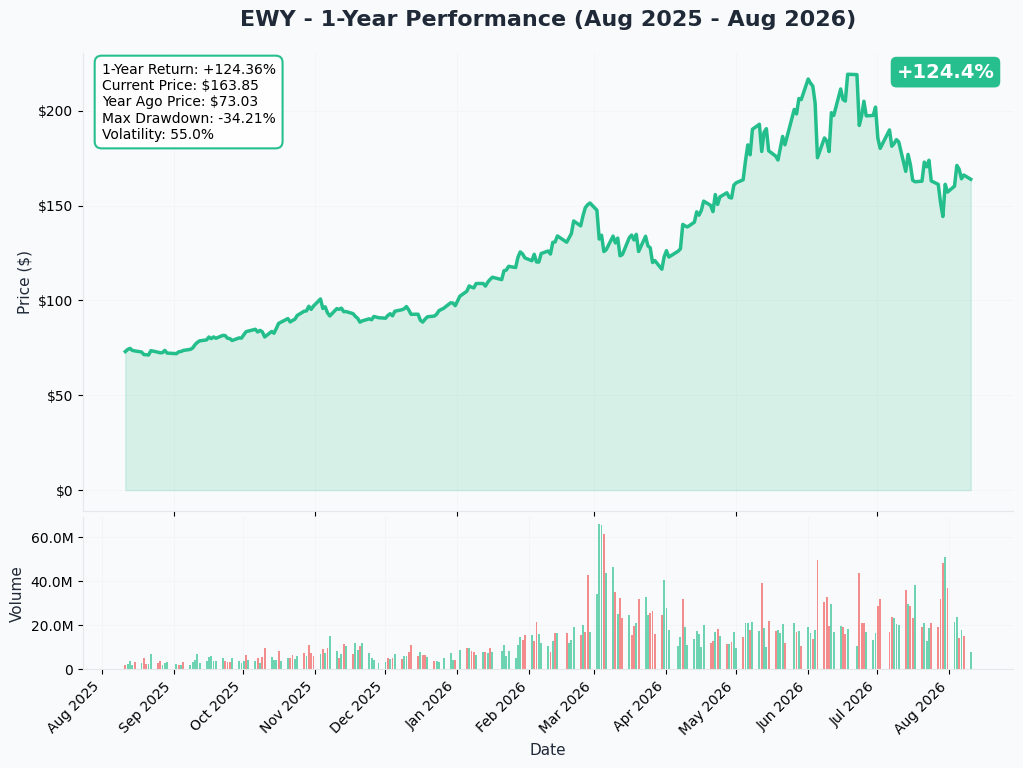
EWY is up ≈65.6% YTD but sits ≈25.6% below its 52-week high of $220.89 at today's ≈$164 print — the chart shows the melt-up into June, the violent July crash, and the sharp rebound that followed, all inside about seven weeks. That round trip is exactly the kind of regime where a strangle — rather than a directional call or put — reflects the honest uncertainty in the setup.
Gamma-Based Support & Resistance
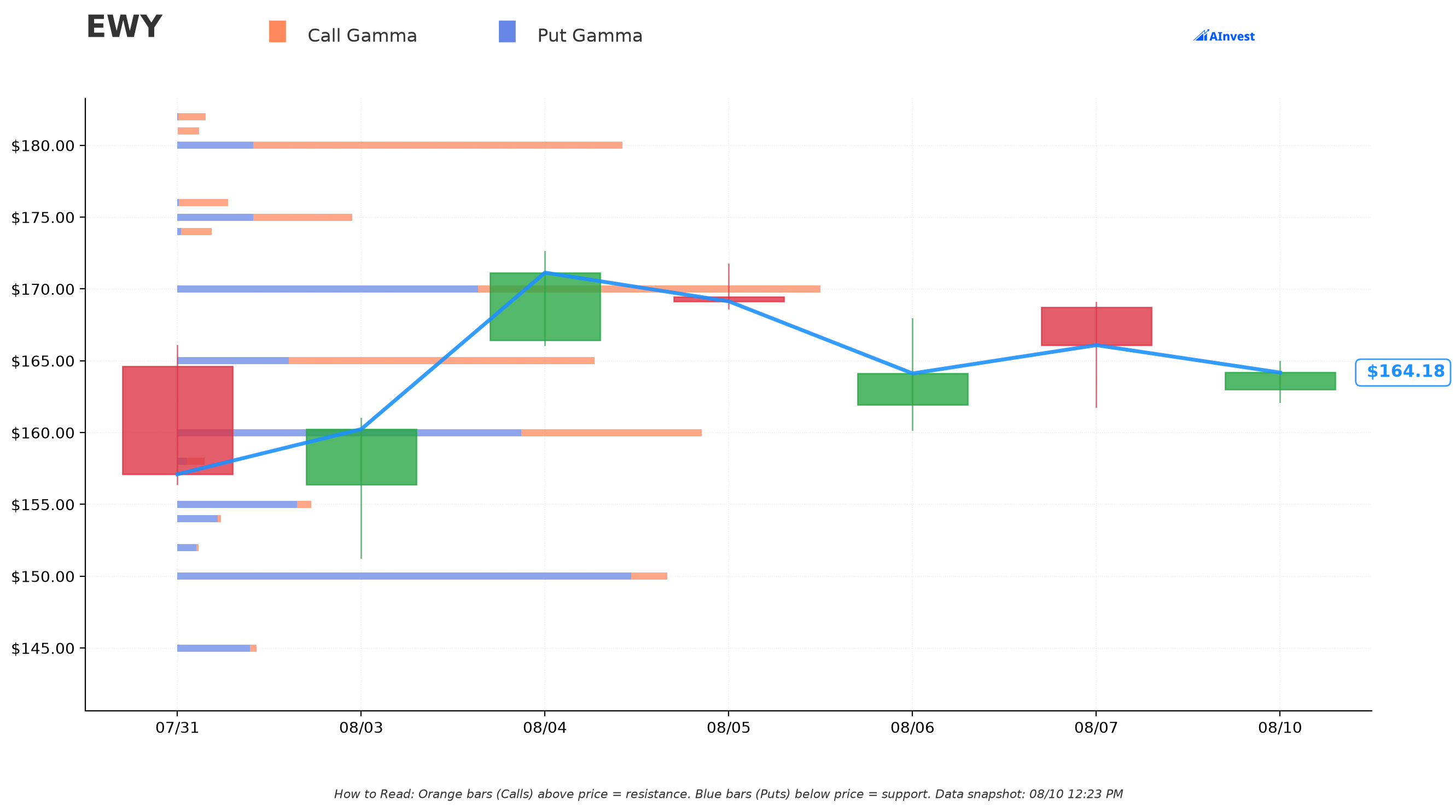
Reading gex.json at spot ≈$164.23:
- 🟠 $165 — Very Strong resistance, essentially right at the money (0.47% away), total gamma exposure 12.69B with call gamma dominant (9.31B call vs. 3.38B put). This is exactly where today's call leg struck.
- 🟠 $170 — Very Strong resistance, 19.57B total gamma, 3.5% above spot.
- 🟠 $175 — Strong resistance, 5.32B total gamma, 6.6% above spot.
- 🔵 $160 — Very Strong support, 15.95B total gamma (put-dominant, 10.46B put vs. 5.48B call), 2.6% below spot.
- 🔵 $155 — Moderate support, 4.06B total gamma, 5.6% below spot.
- 🔵 $150 — a much bigger structural floor, 14.90B total gamma (almost entirely put gamma, 13.80B), 8.7% below spot.
What this means for the strangle: the call strike ($165) sits directly on top of the single strongest nearby resistance wall — dealers have a lot of gamma concentrated exactly there, which can act as a magnet/ceiling in the near term. The put strike ($130) is well below any of the mapped gamma walls shown here (the nearest big support cluster is $150, another ≈13% below the put strike), meaning the put is positioned for a move well beyond the market's current gamma-implied "normal" trading band — consistent with it being a tail hedge rather than a base-case bet.
Implied Move Analysis
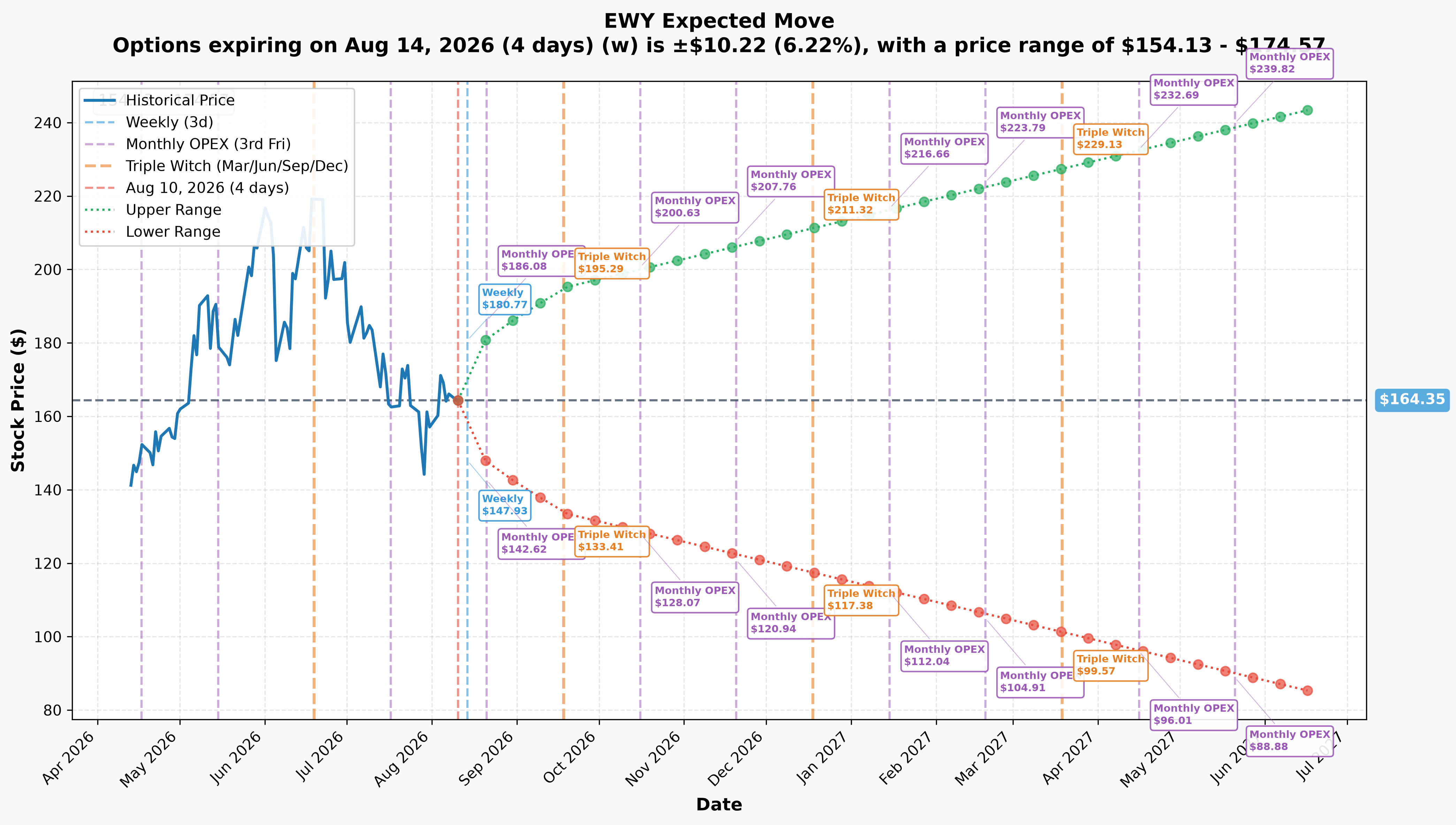
Reading EWY_implied_move.json (spot $164.35):
| Expiration | Days | Implied Move | Range |
|---|---|---|---|
| Weekly (Aug 14) | 4 | ±6.22% (±$10.22) | $154.13 – $174.57 |
| Monthly OPEX (Aug 21) | 11 | ±10.61% (±$17.45) | $146.90 – $181.80 |
| Triple Witch (Sep 18) | 39 | ±18.72% (±$30.76) | $133.59 – $195.11 |
| Oct 16 OPEX (this trade) | ≈67 | — (not directly listed; nearest OPEX label: $128.07 – $200.63) | — |
| Yearly LEAPS (2027-06-17) | 311 | ±48.19% (±$79.21) | $85.14 – $243.56 |
The options market's own pricing for the October 16, 2026 expiration implies a range of roughly $128 to $201 by expiration — and this strangle's breakevens (≈$110.50 to ≈$184.50) sit outside that implied range on the downside and comfortably inside it on the upside. Put differently: the market's own pricing suggests hitting the upside breakeven (≈$184.50) is a real possibility within the implied distribution, while hitting the downside breakeven (≈$110.50) would require a move bigger than what the options market is currently pricing as the "typical" range — which matches the read that the deep put is a tail hedge, not the base case.
🎪 Catalysts
✅ Already happened (context for the setup)
- Goldman Sachs raised its 12-month KOSPI target to 9,000 in May, calling Korea its highest-conviction Asia market.
- SK hynix's record $26.5B Nasdaq ADR listing priced July 10, 2026.
- The July crash: per Al Jazeera, the KOSPI fell ≈11% on July 28 and ≈6% on July 29, wiping ≈$2.18 trillion in two sessions; per Tech Times, it triggered the exchange's first-ever back-to-back circuit breakers.
- The record rebound: per Asia Business Daily, the KOSPI surged 17.91% on July 31 — its largest one-day gain on record.
- Both memory giants beat records but missed estimates and fell on the print: SK hynix −9.6% (Quartz), Samsung −6% (Investing.com).
- The Bank of Korea hiked 25bp to 2.75% on July 16, its first hike since 2023.
- MSCI kept Korea in Emerging Markets on June 23, citing won non-deliverability — removing that binary risk from the 2026 calendar entirely.
📅 Ahead of us — and the critical calendar mismatch
| Date | Event | Captured by the Oct 16 expiration? |
|---|---|---|
| Aug 18, 2026 | MSCI August Index Review announcement | ✅ Yes |
| Aug 26, 2026 | Nvidia Q2 FY2027 earnings — sets the HBM demand narrative | ✅ Yes |
| Aug 27, 2026 | Bank of Korea rate decision | ✅ Yes |
| Aug 28, 2026 | MSCI August review effective | ✅ Yes |
| Oct 28, 2026 | SK hynix Q3 2026 results (20.25% of the fund) | ❌ No — 12 days AFTER expiration |
| Oct 29, 2026 | Samsung Q3 2026 results (21.13% of the fund) | ❌ No — 13 days AFTER expiration |
This is the single most important structural fact for anyone thinking about copying this trade: October 16, 2026 is when the contracts stop existing — it is not a catalyst date, and nothing about Korea happens on that day. The position captures Nvidia's August 26 print and the Bank of Korea's August 27 decision, both real, dated events. But it expires ≈12–13 days before SK hynix (Oct 28) and Samsung (Oct 29) report Q3 — the two companies that are ≈41% of this fund and the dominant source of its realized volatility. A strangle sized for "Korea's big catalysts" that expires on October 16 will have expired before the two biggest ones happen. Whether that's a deliberate choice to sidestep binary earnings risk (both misses this cycle still crushed their stocks despite record numbers) or simply the expiration with the best liquidity, the tape cannot tell us — but the calendar fact itself is real and worth knowing before anyone mirrors this structure.
🎲 Price Targets & Probabilities
Using the gamma map, the implied-move data, and the catalyst calendar through October 16:
📈 Big-Move-Up Case
Nvidia's Aug 26 print reinforces the HBM supercycle narrative, the Bank of Korea holds rates the next day, and Samsung's early-October preliminary Q3 guidance (date unconfirmed) beats. EWY pushes through the $165 and $170 gamma resistance walls toward the $180–$185 zone — near the call's ≈$184.50 breakeven. This is within the market's own implied range ($128–$201) for this expiration.
🎯 Chop/Range Case (most likely a strangle prices itself for)
EWY spends the next nine weeks oscillating inside the $150–$175 gamma band that dominates the current OI structure, digesting the July whiplash without a fresh catalyst violent enough to clear either breakeven. Both legs lose value to time decay — this is the strangle's enemy scenario.
📉 Big-Move-Down Case
A fresh shock — renewed Chinese memory-supply competition, a won reversal, or a broader risk-off wave — pushes EWY back toward the $150 or even $140 gamma support zones. That's still short of the ≈$110.50 put breakeven, meaning even a serious drawdown inside this window may not make the deep put profitable outright; it would need to be closer to the disaster scenario the July 28–29 crash represented.
💡 Trading Ideas
🛡️ Conservative: Watch, Don't Copy
Strangles this wide are expensive time-decay machines, and this specific one is genuinely ambiguous (open vs. close) until tomorrow's OI prints. Wait for the OI resolution before drawing any conclusion about institutional intent, and size any similar volatility play much smaller — this package risked ≈$22M; a retail-appropriate version might be 1/1000th the size with the same $165C/$130P structure and the same October 16 expiration, sized to what you can lose entirely.
⚖️ Balanced: A Tighter, Cheaper Strangle
Rather than mirroring the wide $165/$130 strikes, a retail trader wanting Korea-vol exposure into the Nvidia (Aug 26) and BOK (Aug 27) window could look at a narrower strangle — closer strikes cost more per contract but need a smaller move to break even, and a shorter-dated expiration (the Sep 18 triple witch, implied move ±18.72%) avoids paying for weeks of decay the position doesn't need.
🚀 Aggressive: Directional Call or Put Instead
If you have an actual view (not just "it'll move"), a single-leg directional position at one of the mapped gamma levels ($165 or $170 for bullish, $160 or $150 for bearish) costs less than a full strangle and expresses a real thesis rather than paying for both sides of an uncertain range.
👥 Four Ways to Read This Trade
🎰 YOLO Trader
This is not a lottery ticket you can cheaply mirror. The package that printed cost ≈$21.97M for 11,250 contracts on each leg — a retail-sized version (even 1-2 contracts) still needs EWY to clear roughly $184.50 on the upside or $110.50 on the downside by October 16 just to break even, and both of those are large moves from ≈$163. Don't read "someone bought $22M of options" as a green light to YOLO calls or puts alone — this is a two-sided structure, not a directional signal, and we don't even know yet if it's a fresh bet or an unwind. If you want the volatility exposure, at least buy both legs like the actual trade did, sized to what you can lose completely, and treat October 16 as a hard exit — don't hold into expiration hoping for a late move.
📈 Swing Trader
The real edge here isn't the strangle itself, it's the gamma map and the calendar. The $165 call strike sits directly on the strongest nearby resistance wall, and $160/$150 are the major support shelves below. If you're swinging EWY around the Nvidia print (Aug 26) and the Bank of Korea decision (Aug 27), those levels are your reference points — not the strangle's breakevens, which are much wider. Don't assume this trade tells you which way Korea breaks; it explicitly doesn't take a side. And don't forget the calendar gap: if your swing thesis depends on SK hynix (Oct 28) or Samsung (Oct 29) reporting, a position expiring October 16 will already be closed before those prints land.
💰 Premium Collector
This is the one to sit with. Your usual trade is the mirror image of what happened here — you collect premium selling strangles or spreads; this desk paid ≈$21.97M for one. Before you reach for "well, someone has to be on the other side, might as well be me," look at the regime you'd be selling into: EWY just had a −22.2% calendar month (the worst in KOSPI history) followed by a +17.91% single-day rebound — the largest on record. Selling strangles into a name capable of both of those in the same six weeks is exactly how premium-selling accounts blow up: the eventual gap-through move is not a tail risk here, it's recent history. Don't short volatility on EWY into the Oct 16 window without stress-testing your position against a repeat of the July 28-29 crash or the July 31 rebound — either one blows through normal short-strangle risk management. If you do sell premium here, keep it small, defined-risk (an iron condor, not a naked strangle), and give yourself room well outside the $150-$175 zone.
🌱 Beginner
A strangle means buying a call and a put on the same stock, same expiration — here, a $165 call and a $130 put on EWY, both expiring October 16. The reason someone does this: they think the stock is going to make a big move, but they aren't sure which direction. The catch is the position needs a big move to actually make money — a small move in either direction, or a quiet, boring stretch, means both options can lose value at the same time, because time is always working against you when you own options. If EWY just sits around $160-$170 for the next two months (which happens plenty in markets, even volatile ones), this ≈$22M bet loses money — potentially all of it. Don't copy a trade like this without understanding that "the stock needs to move a lot, and soon" is the entire thesis, and that paying premium for two options at once is more expensive than picking one side. If you're new to options, this is a good trade to study, not to replicate.
⚠️ Risk Factors
What the tape genuinely cannot prove:
- Whether this is opening or closing — now RESOLVED: closing, on both legs (see the ✅ RESOLVED box). What the tape still cannot prove is whose position was retired — whether the original July 30–31 strangle holder took it off, or a different participant's short was bought back against it.
- Who is on the other side, and why. A block cross means a known counterparty took the other side off-book — it does not tell us if that counterparty is a market maker facilitating the trade, another institution taking the opposite volatility view, or a dealer simply pricing risk. We cannot see the broker, the customer identity, or any hedge in the underlying stock or futures.
- Whether this is truly directionless. A strangle's textbook read is "big move, either way" — but the same structure can also be a disguised risk-reversal-adjacent hedge against a much larger existing stock or ADR position we cannot see (Samsung/SK hynix shares, SK hynix ADRs, or KOSPI futures). We have no visibility into any such hedge.
- The intent behind the October 16 expiration choice. It could be deliberate earnings-avoidance, pure liquidity, or coincidence — the calendar fact (misses both Oct 28/29 memory earnings by ≈12-13 days) is real, but the reason for choosing that date is not provable from the tape.
✅ Resolved 2026-08-11 pre-market: the OPRA open-interest update is in and it says CLOSED — both legs, by almost exactly the print size. The provisional ⏳ markers are retired.
Disclaimer: Options trading involves substantial risk of loss and is not suitable for all investors. This analysis is for educational purposes only and is not financial advice. A long strangle can lose its entire premium if the underlying does not move far enough before expiration — both legs can expire worthless simultaneously. The open/close status of this EWY trade was unresolved at publication and has since been resolved as closing on both legs by the next-session open-interest data. Always size positions to what you can afford to lose and consider consulting a licensed financial advisor.
Last updated: 2026-08-11 (pre-market) — the next-day OPRA open-interest snapshot inverted this article's central claim. Both legs CLOSED: the October $165 call fell 25,142 → 13,839 (−11,303) and the October $130 put fell 30,785 → 19,246 (−11,539), against 11,250 lots each — landing within ≈60 contracts of the closing-branch numbers published here in advance. Order type on both legs changed from BTO ⏳ to BTC. The title, quick take, order-type line, plain-English section, honest-limits section and disclaimer were rewritten; the ⏳ callout was replaced with the ✅ RESOLVED box.
About EWY: The iShares MSCI South Korea ETF gives US-listed exposure to large- and mid-cap South Korean equities, dominated by Samsung Electronics and SK hynix — together ≈41% of the fund — making it, in practice, a leveraged expression of the global AI-memory-semiconductor cycle rather than a diversified country fund.