🇰🇷 EWY: The $20M Korea Strangle Was Being Taken Off, Not Put On — Both Legs Closed
📅 August 11, 2026 | 🤝 Stock-Plus-Options Cross
🔄 Updated 2026-08-12 pre-market — the next-day OPRA open interest resolved both legs, and both inverted. Neither leg opened. The October $130 put fell 19,246 → 13,763 (−5,483) and the October $165 call fell 13,839 → 8,595 (−5,244), where fresh opens would have pushed them toward ≈29,246 and ≈23,839. We wrote that "the base rate here leans toward another close-and-reopen (a roll) rather than a clean fresh open" — the print says close, with no reopen. The provisional BTO labels are retired and the "someone is putting on Korea exposure" framing has been withdrawn: this was position being taken off for the second session running. See the ✅ RESOLVED box.
Fund Overview
EWY is the iShares MSCI South Korea ETF, tracking the MSCI Korea 25-50 index — a ≈$26.51 billion fund with an 0.59% expense ratio and 154.75 million shares outstanding. It last traded at $167.72, up from an August-10 close of $163.12, inside a 52-week range of $70.93 to $220.89 (beta 1.50).
EWY is really a leveraged bet on two Korean chipmakers wearing a country-fund wrapper. Samsung Electronics is 21.13% of the fund and SK hynix is 20.25% — 41.4% combined. Add SK Square (3.21%), the holding company whose principal asset is its SK hynix stake, and memory-linked exposure runs to ≈44.6%. Samsung Electro-Mechanics (2.69%) pushes the semiconductor complex closer to ≈47%. The rest of the top 15 is mostly Korean financials (KB Financial, Shinhan, Hana) at roughly 6-8% combined, plus Hyundai Motor, NAVER, and industrials — none individually above 2%.
The MSCI Korea 25-50 methodology caps a single issuer at 25% and caps issuers above 5% at 50% in aggregate, which is why Samsung and SK hynix sit just above 20% each rather than higher — EWY is already pressed against its own concentration ceiling.
The Trade in Plain English
At 11:55:31 ET, with EWY at $167.09, a package printed 10,000 contracts of the October 16 $165 call at $17.46 (≈$17.46M) alongside 10,000 contracts of the October 16 $130 put at $2.62 (≈$2.62M) — ≈$20.08M in combined debit. The call is a shade in the money (spot is ≈1.25% above the $165 strike); the put is deep out of the money, ≈22% below spot.
The mechanism is the whole story here. The tape shows this printed as a stock-plus-options cross. A paired equity leg exists somewhere in the NMS equity tape at the same moment, negotiated off the open book with a known counterparty on both sides. That equity leg is invisible to us: we cannot see its size or direction from the option tape alone. Because shares came bundled with the options, the call and put legs by themselves do not express a clean directional or volatility view — read this as a package, not as "someone bought a strangle."
The two-day story is the real spine of this trade. Yesterday (August 10), with EWY at $163.12, a nearly identical package printed: the same October $165 call and $130 put, 11,250 contracts each. The next-morning open-interest check proved that position came off — the $165 call's open interest fell 25,142 → 13,839 and the $130 put's fell 30,785 → 19,246 overnight, both drops slightly larger than the print size, consistent with a close. So yesterday's Korea volatility bet was closed out, and today a fresh 10,000-lot version of the same two strikes goes back on — this time with a paired stock leg attached, which yesterday's version reportedly did not carry. Something differently-shaped replaced what came off.
Full Trade Details
| Field | Put Leg | Call Leg |
|---|---|---|
| Time | 11:55:31 ET | 11:55:31 ET |
| Buy/Sell | BUY | BUY |
| Call/Put | PUT | CALL |
| Expiration | 2026-10-16 | 2026-10-16 |
| Strike | $130 | $165 |
| Premium | ≈$2.62M | ≈$17.46M |
| Volume (day) | 10,123 | 10,237 |
| Prior OI | 19,246 | 13,839 |
| Size | 10,000 | 10,000 |
| Spot | $167.09 | $167.09 |
| Option Price | $2.62 | $17.46 |
| Option Symbol | EWY20261016P130 | EWY20261016C165 |
| Order Type | 🔄 Closed (resolved 2026-08-12; was BTO ⏳) | 🔄 Closed (resolved 2026-08-12; was BTO ⏳) |
| Strategy | Strangle unwind with stock leg attached (resolved close) | Strangle unwind with stock leg attached (resolved close) |
Mechanism tag: 🤝 BLOCK CROSS (stock+options cross) — a paired equity leg exists off the open book, not a lit sweep.
✅ RESOLVED — Neither Leg Opened; This Was an Unwind, Two Days Running
Updated 2026-08-12 pre-market. Resolving OPRA snapshot timestamped August 12 (reflects the August 11 close, after this print); baseline is the August 11 snapshot (reflects the August 10 close, before this print).
| Leg | Baseline (Aug-11) | Resolving (Aug-12) | Δ | Print size | What we published | Verdict |
|---|---|---|---|---|---|---|
| Oct-16 $130 put (bought) | 19,246 | 13,763 | −5,483 | 10,000 | "rise toward ≈29,246 if opening; falls if closing" | 🔄 CLOSE — was BTO ⏳ |
| Oct-16 $165 call (bought) | 13,839 | 8,595 | −5,244 | 10,000 | "rise toward ≈23,839 if opening; falls if closing" | 🔄 CLOSE — was BTO ⏳ |
We flagged the base rate and it held. The article below noted that the previous session's larger 11,250-lot version at these same two strikes had itself closed overnight, and that the pattern leaned toward another close rather than a fresh open. Both legs fell by more than half the print size.
This is the second consecutive session of shrinkage at these strikes. The $130 put has gone 30,785 → 19,246 → 13,763 across three snapshots; the $165 call 25,142 → 13,839 → 8,595. Between August 10 and August 11, roughly 55% of the put line and 66% of the call line was retired. Whatever this desk built earlier in Korea, it has spent two sessions dismantling it.
Control check. The neighbouring October strikes barely moved over the same window — $140 put 7,598 → 7,446 (−152), $160 call 2,535 → 2,534 (−1), $170 call 3,108 → 3,108 (unchanged). The declines are specific to the two traded strikes, so they are attributable to this package rather than a market-wide event in EWY options.
What changes below. Every framing that treats this as new Korea exposure — a fresh delta-hedged strangle, a view being expressed on the October window — does not survive. The attached stock leg is still real and still printed, but it accompanied an exit, not an entry. A closing package with shares attached is most naturally read as the unwind of a previously hedged position: the options come off and the hedge comes off with them. Nothing here says what this desk now thinks about Korean equities; it says they are finishing a position they already had.
The honest caveat. Open interest is a market-wide total, not this desk's book. We can prove both strikes shrank on the day this package printed; we cannot prove the same account owned both sides of the unwind.
🤓 What This Actually Means — Plain English
Strip away the size and this reads like a desk running a repeating options-plus-stock structure on Korea, not a one-off directional bet. Every day the shape looks similar — buy a near-the-money October call, buy a deep out-of-the-money October put, and staple on a stock trade — and every day it clears through a negotiated cross rather than the lit market. That negotiated stock-plus-options mechanism tells us a broker matched a specific buyer and seller with an equity leg baked in; it does not tell us whether the buyer of this options package is hedging a stock position they already own, building a fresh volatility bet, or a market maker facilitating someone else's flow.
The call/put combination itself — long a slightly in-the-money call, long a far out-of-the-money put — resembles either a risk-reversal-style structure with a stock hedge (own the shares, buy the call for continued upside participation, buy the cheap far put as tail insurance) or a collar-adjacent overlay depending on which direction the hidden stock leg runs and how large it is. Because the equity leg sits in the NMS tape rather than the options tape, we simply do not know if shares were bought or sold, or how many. What we can say: this is deliberate, recurring institutional position management around Korea's chip-stock concentration, not a retail-style directional swing.
The fact that yesterday's nearly identical position closed and today's reprinted with a stock leg attached suggests the desk adjusted the structure overnight — possibly converting a pure options volatility bet into a delta-hedged package, or rolling the whole thing while re-hedging. Either way, the option legs are a piece of a larger, partially hidden trade — treat the $20.08M headline debit as the visible fraction of a bigger position, not the whole story.
Chart Check-Up
1-Year Price Action
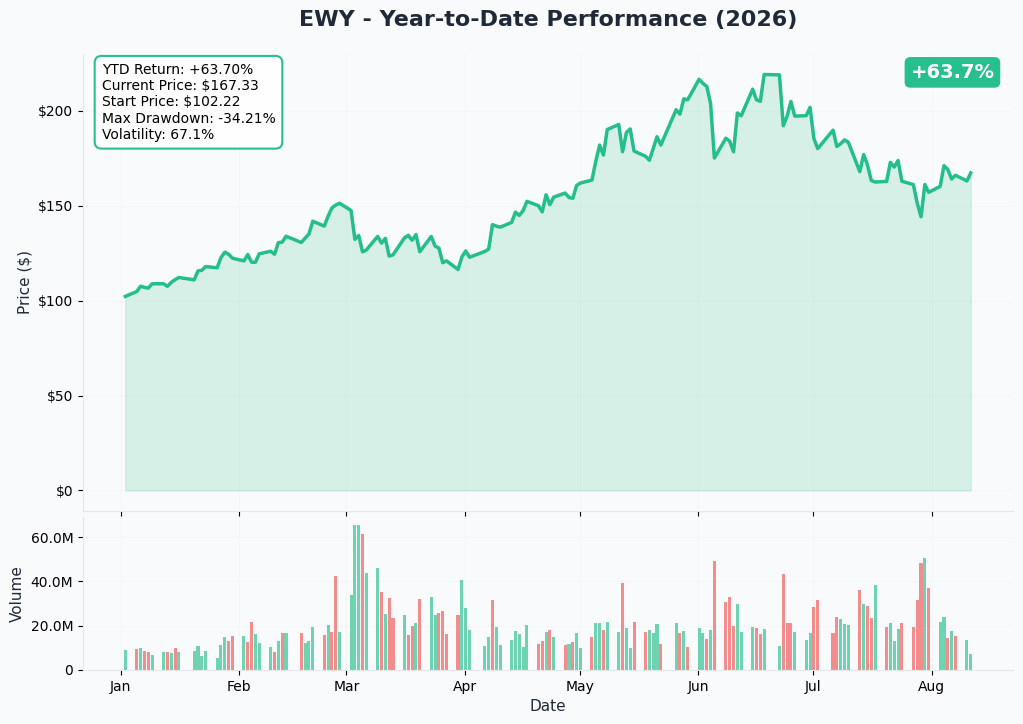
EWY's last year has been extreme even by Korea-ETF standards: the KOSPI cleared 9,000 in June, EWY peaked near $219.20 on June 18, then the index fell ≈22% in July — its worst month since 2008 — dragging EWY to a $144.21 capitulation low on July 29 (the same day Samsung and SK hynix reported Q2 earnings). EWY has since rebounded ≈16.3% off that low to $167.72, still ≈23.5% below the June peak.
Gamma Support & Resistance
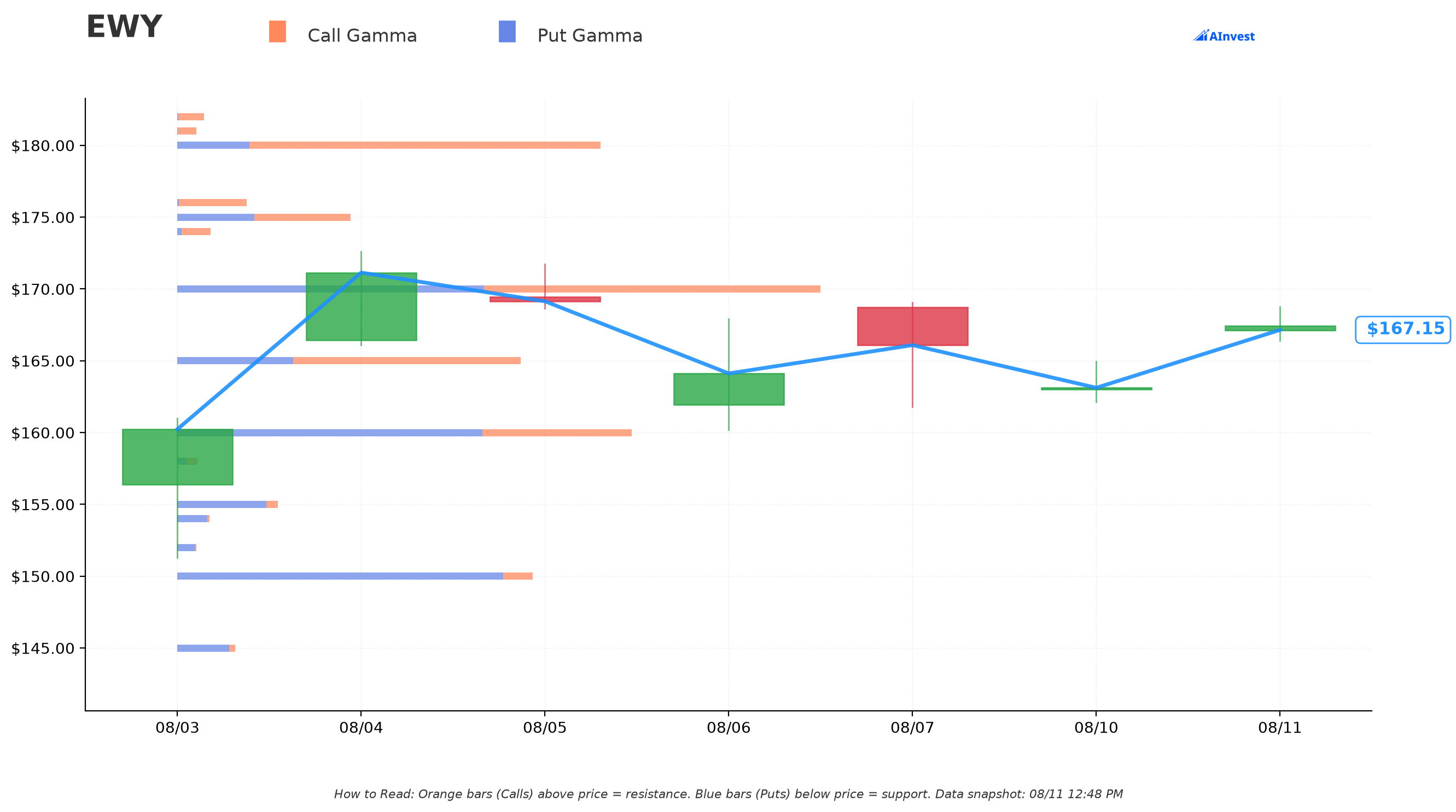
With EWY at $167.17, the gamma map shows a Very Strong support wall at $165 (total GEX ≈12.46, distance ≈1.3% below spot) and a Very Strong resistance wall at $170 (total GEX ≈23.36, distance ≈1.7% above spot) — the two levels essentially bracket spot tightly right now. Behind those, $160 is another Very Strong support zone (GEX ≈16.49, put-heavy) and $180 is a second Very Strong resistance zone (GEX ≈15.36, call-heavy, net positive gamma). Further out, $150 support (GEX ≈12.91) and $190 resistance (GEX ≈7.63) mark the wider band. Notably, today's $165 call strike sits directly on the nearest gamma support wall — the option package is anchored right at a level dealers are already positioned around, which can dampen realized moves near that price as dealer hedging absorbs flow.
Implied Move
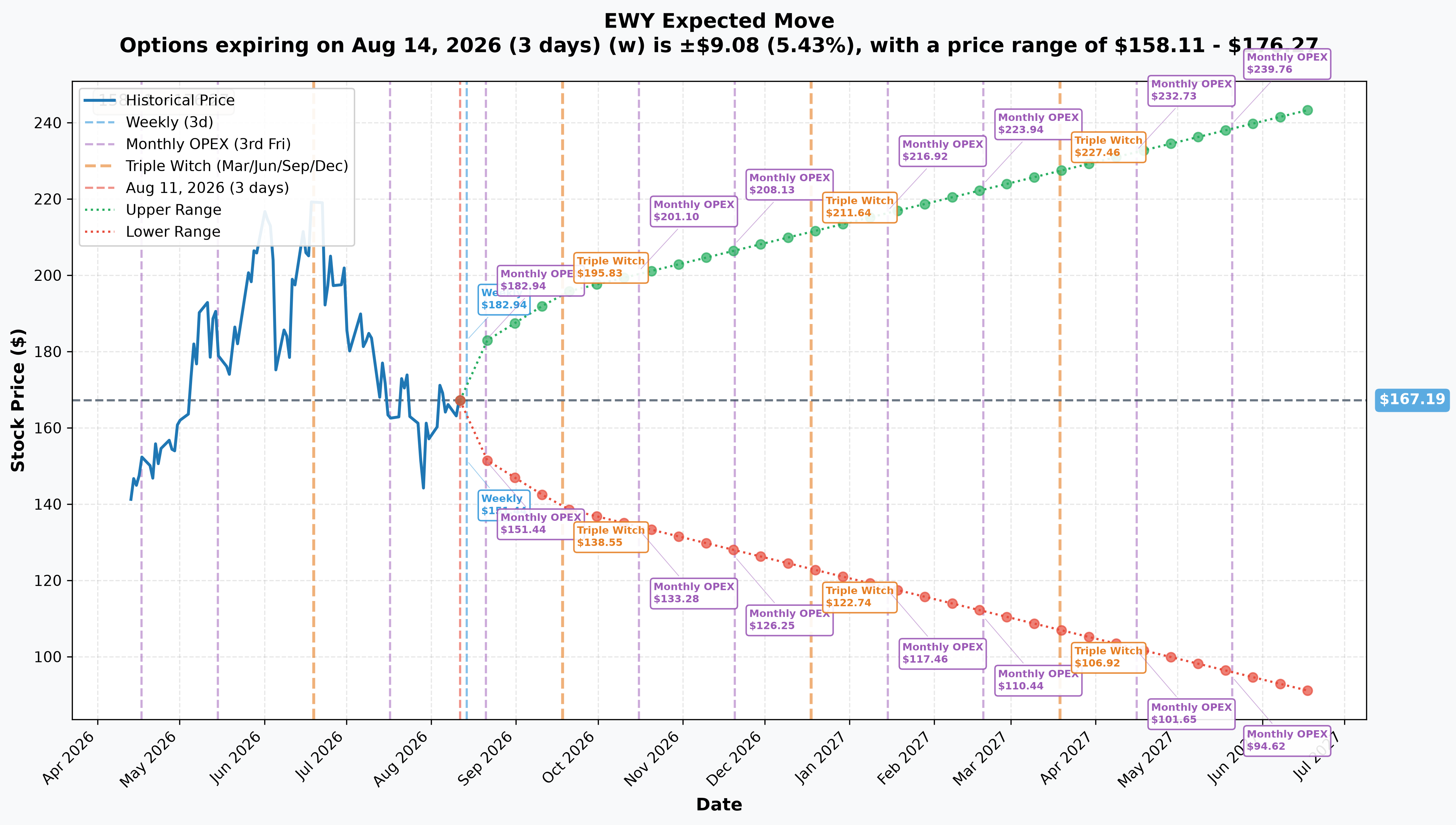
The options market is pricing real turbulence across every horizon. Weekly (Aug 14, 3 DTE): ≈5.43% implied move, range $158.11–$176.27. Monthly OPEX (Aug 21, 10 DTE): ≈9.42%, range $151.44–$182.94. Quarterly triple-witch (Sept 18, 38 DTE): ≈16.92%, range $138.90–$195.48. By the October 16 expiration itself (the OPEX date the two legs share), the labeled cone widens to a $133.28–$201.10 range — meaning the market already prices a plausible path through both the $130 put and well past the $165 call by that date. The one-year LEAPS read (June 2027) implies a ≈45.5% move, range $91.11–$243.27 — a reminder of just how wide this instrument's realistic outcome space still is.
Catalysts
The single most important fact for anyone trading the October 16 expiration: both Korean memory giants report Q3 results after it expires. SK hynix is scheduled for October 27, 2026 and Samsung Electronics for October 29, 2026 — 11 and 13 days past expiry. Together with SK Square, that is ≈44.6% of EWY's weight delivering its biggest scheduled catalyst after these contracts have already expired. One honest caveat: Samsung has historically published a preliminary/provisional Q3 print roughly three weeks ahead of full results — around ≈October 8 by pattern — which would fall inside the window, but a confirmed 2026 date could not be sourced; treat it as an expected pattern, not a scheduled event.
Before expiration (inside the window):
- August 27, 2026 — Bank of Korea rate decision. This is the only confirmed high-impact scheduled event inside the October 16 window. The BOK hiked to 2.75% on July 16, its first hike since January 2023, and on August 11 a Senior Deputy Governor said the hike was "no one-off," signaling further tightening — meaning the August 27 meeting is a genuine two-sided risk, not a formality.
- ≈September 1, 2026 — Korea August CPI and trade data. July semiconductor exports rose +178.8% year-over-year to a record $41.01 billion while the KOSPI fell roughly a third from its peak over the same stretch — fundamentals and price have visibly decoupled, and the next data print will test whether that gap closes or widens.
- ≈October 8, 2026 — possible Samsung preliminary Q3 guidance (unverified pattern, see above).
After expiration (the events the option legs do not reach):
- October 27, 2026 — SK hynix Q3 results (20.25% weight).
- October 29, 2026 — Samsung Electronics Q3 results (21.13% weight); also the likeliest venue for Samsung's anticipated first special dividend in six years, given its expanding AI-memory cash pile.
- Undated, live risk on either side of expiry: a possible broader Section 232 semiconductor tariff decision with no scheduled date, and a live Solidigm (SK hynix's NAND unit) IPO process seeking up to $7 billion pre-IPO.
Already happened (last three months, sets the context):
- The KOSPI hit an all-time closing high of 9,114.55 on June 22, 2026, then fell ≈22% in July — its worst month since 2008 — before Korean officials said on August 11 that the stock rout has "shaken confidence, not Korea's fundamentals."
- The Bank of Korea's July 16 hike to 2.75% is the most plausible proximate trigger for the deleveraging cascade that followed — the capitulation low landed just 13 days later.
- Samsung and SK hynix both reported Q2 2026 results on July 29, 2026 — the same day EWY bottomed at $144.21.
How Different Readers Might Approach This
YOLO Trader
A ≈$20M options package that we cannot even read cleanly because a stock leg is hidden inside it is not a clean signal to piggyback on. If you want raw Korea volatility exposure, the $130 put alone is a cheap, defined-risk way to express "another 2026-style crash is possible" — but you would be doing it without the desk's stock hedge, and without knowing if their own bet is even still on tomorrow morning.
Swing Trader
The gamma map puts a Very Strong support wall right at $165 and Very Strong resistance at $170 — a tight box around spot that could compress realized moves near-term as dealers hedge around it. The more actionable swing read is the calendar: this structure buys 66 days of macro-only volatility (BOK, deleveraging aftershocks, tariff headlines) and explicitly excludes the two scheduled events — SK hynix and Samsung earnings — that would otherwise move EWY the most. A swing position built around October 16 is a macro-vol trade, not an earnings trade.
Premium Collector
Selling volatility into this specific window has a real structural argument: October 16 is the last standard monthly expiration before the memory duopoly reports, so a premium seller is deliberately avoiding underwriting the two biggest scheduled binaries in the portfolio. The residual risk is the August 27 BOK decision and any undated tariff headline — smaller, but not zero, especially with the Deputy Governor already signaling more hikes are coming.
Beginner
The headline number here — "$20 million bought in options" — is misleading on its own, because this trade came with an equity leg we cannot see. Don't read this as "smart money is making a $20M directional bet on Korea." Read it as: a large, sophisticated desk is running a repeating, hedged structure around two Korean chip giants that make up over 40% of this fund, and even professional tape-readers cannot fully unpack it from the options data alone. That is a reason for caution, not a reason to copy the trade.
Honest Limits — What the Tape Cannot Prove
- The paired stock leg is completely invisible to us. We know it exists (a stock-plus-options cross), but not its size, its direction (bought or sold), or how it changes the net delta of the whole package. Any read of this trade as "bullish" or "bearish" from the options alone is incomplete by construction.
- Neither option leg's open/close status is provable today. Both printed at size below prior open interest; tomorrow's ≈06:30 ET OI snapshot is the only definitive test, and yesterday's nearly identical position already closed overnight, which sets a real precedent for another close here.
- We cannot see broker/MMID, customer identity, order ID, or whether pre-existing open interest belongs to the same account on either side of this cross — only that a counterparty was matched off the open book.
- The multi-leg auction/cross count on the tape (44 multi-leg prints on the put leg, 2 on the call) means other legs may exist at other strikes or expirations that we have not scoped here. This analysis covers only the two 10,000-lot prints captured at 11:55:31.
- Nothing here is investment advice; options trading carries substantial risk, including total loss of premium, and this structure specifically carries additional unknowns from its undisclosed equity leg. Position size accordingly.
Last updated: 2026-08-12 (pre-market) — the next-day OPRA open-interest snapshot resolved both legs and both inverted. Oct-16 $130P 19,246 → 13,763 (−5,483) and Oct-16 $165C 13,839 → 8,595 (−5,244) against 10,000-lot prints: CLOSE on both. The provisional BTO labels are retired and every framing of this as new Korea exposure has been withdrawn — this was the second consecutive session of unwinding at these strikes. The title, the trade table's order-type and strategy cells and the directional framing were updated; the ⏳ callout was replaced with the ✅ RESOLVED box.