🟠 GBTC $11.07M December $40 Call Buy — A Desk Just Bought ≈736 Bitcoin With a Built-In Floor
2026-08-12 | 🤝 Block Cross | Proven Open
✅ Updated 2026-08-13 pre-market — the next-day OPRA open interest confirmed the open to the contract. Open interest rose 9 → 9,509 (+9,500) against 9,500 bought. We predicted ≈9,509. That is an exact match — 100.0% of the print became new open interest, with zero transfer. The BTO label stands. See the ✅ RESOLVED box.
🎯 The Quick Take
At 10:31:41 ET a desk bought 9,500 December 18, 2026 $40 calls on GBTC at $11.65, ≈$11.07 million, printed as a negotiated block cross against a fund trading at $49.21. Prior open interest on this strike was 9 contracts — and had sat at 9, unchanged, for a full week — so this is about as clean a new position as the tape can show. Translated into the only asset that actually matters here, this trade controls ≈736 bitcoin of exposure for $11.07 million, with total loss capped below bitcoin ≈$51,900 and breakeven at bitcoin ≈$67,000.
🏢 What GBTC Actually Is — And the One Number That Explains Every Strike
GBTC — the Grayscale Bitcoin Trust ETF — is not an operating company and it does not have "earnings." It holds one asset: bitcoin. Sponsored by Grayscale Investments, it began trading in 2013 as a private placement and later a publicly quoted closed-end trust — the first spot bitcoin product in the US. For a decade it traded with no redemption mechanism, which is why it swung between large premiums and large discounts to its underlying bitcoin value. That changed when GBTC converted to a spot bitcoin ETF on January 11, 2024, creating a continuous creation/redemption mechanism that collapsed the discount to near zero and let a decade of trapped holders finally exit — the beginning of the outflow story that still defines the fund today.
Current size: AUM is ≈$8.4–8.6 billion, with the fund 100% allocated to bitcoin, tracking the CoinDesk Bitcoin Benchmark Rate for NAV. Per the Q2 2026 10-Q filed August 4, 2026, net assets were $8.14 billion at June 30, 2026 — down 44% from $14.50 billion at year-end 2025 — with 138,505.76 BTC held against 178.58 million shares outstanding at that filing date. Shares outstanding have fallen in a straight line: 198.7 million (March 31) → 178.58 million (June 30) → 170.28 million (today) — continuous structural redemption, not a cyclical wobble.
The fee — and why it matters more than anything else about this fund. GBTC charges a 1.50% sponsor fee, the highest in the US spot bitcoin ETF category by a wide margin — more than four times what the cheapest competitors charge, and ten times what Grayscale's own low-cost clone charges:
| Fund | Ticker | Fee |
|---|---|---|
| GBTC | GBTC | 1.50% |
| Grayscale Bitcoin Mini Trust | BTC | 0.15% |
| iShares Bitcoin Trust | IBIT | ≈0.25% |
| Fidelity Wise Origin Bitcoin Fund | FBTC | ≈0.25% |
| ARK 21Shares Bitcoin ETF | ARKB | ≈0.21% |
| Bitwise Bitcoin ETF | BITB | ≈0.20% |
That fee is not abstract — it is why GBTC remains the category's donor even as bitcoin ETF demand recovers. In July 2026, GBTC bled −$258 million while Grayscale's own 0.15% mini trust took in +$212 million in the same month. August has been the same story on a smaller scale: GBTC −$52.0 million month-to-date through August 11 while the category overall took in +$713.8 million. Redemptions retire shares at NAV and don't dilute remaining holders — the only per-share drag is the fee itself, mechanically paid out of the trust in bitcoin.
The translation that makes a $40 strike mean something. From the Q2 2026 10-Q: 138,505.76 BTC ÷ 178.58 million shares = ≈0.000775 bitcoin per GBTC share. That reconciles exactly against the filing — it reproduces the stated $45.56 NAV per share at a bitcoin price of $58,745.18. In plain terms:
GBTC ≈ bitcoin ÷ 1,290.
Bitcoin traded at ≈$63,477 today. At that price, ≈0.000775 BTC/share implies a GBTC NAV of ≈$49.2 — right in line with the $49.21 spot this trade printed against. Once you have that ratio, every strike on the chain is just a bitcoin price wearing a stock symbol.
💰 The Trade, Plain English
One clip, printed as a 🤝 block cross — a broker matched a known buyer and known seller off the open book, at an agreed price. No urgency verbs apply here: nobody "slammed" the offer. This was arranged in advance.
| Time (ET) | Buy/Sell | Call/Put | Expiration | Premium | Strike | Volume | OI | Size | Spot | Option Price | Option Symbol |
|---|---|---|---|---|---|---|---|---|---|---|---|
| 10:31:41 | BUY | CALL | 2026-12-18 | $11,067,500 | $40 | 9,500 | 9 | 9,500 | $49.21 | $11.65 | GBTC20261218C40 |
Because this was a negotiated cross, the BUY label is reported, not tape-proven — it took no liquidity, so there is no aggressor to read off the NBBO. What the tape does prove is the mechanism, the size, the price, and the prior open interest of 9.
✅ RESOLVED — Exact to the Contract: 9 → 9,509
Updated 2026-08-13 pre-market. Resolving OPRA snapshot timestamped August 13 (reflects the August 12 close, after this print); baseline is the August 12 snapshot (reflects the August 11 close, before this print).
| Leg | Baseline (Aug-12) | Resolving (Aug-13) | Δ | Print size | What we published | Verdict |
|---|---|---|---|---|---|---|
| Dec-18 $40 call (bought) | 9 | 9,509 | +9,500 | 9,500 | "rises from 9 toward ≈9,509" | ✅ OPEN (BTO) — exact, 100.0% |
This is the cleanest resolution on the August 12 board. Prior open interest of 9 contracts, flat for a week, plus a 9,500-lot print, produced exactly 9,509. Not one contract of the size matched against an existing holder. There is no residual ambiguity about whether this position exists or how big it is.
What open interest still cannot tell us: whether this deep-in-the-money call package is an outright leveraged long or the option leg of a financing or basis structure with an offsetting position elsewhere. The snapshot proves the contracts are new; the motive stays an inference.
🤓 What This Actually Means — Plain English
This is a leveraged bitcoin bet with a floor built in — not a volatility trade. Here's the arithmetic that proves it. The call has $9.21 of intrinsic value ($49.21 spot minus the $40 strike) and printed at $11.65, so only $2.44 is time value — just ≈5% of the share price for 128 days of optionality on one of the most volatile assets that trades.
Split that $2.44 in two:
- ≈$0.51 is financing cost. Carrying a $40 strike for 128 days at the current ≈3.65% policy rate costs roughly that much — it's the price of not paying $49.21 in cash today.
- ≈$1.93 is an embedded put. That's effectively the cost of insurance against bitcoin falling below the strike — a hard stop 19% below today's spot, financed for four months.
Put those together and the honest description of this trade is: the desk bought leveraged bitcoin exposure with a pre-paid floor, not a bet on how wild the ride gets. A trader who wanted pure volatility exposure buys an at-the-money or out-of-the-money call, where nearly 100% of the premium is time value. Here, 79% of the premium ($9.21 of $11.65) is money already "in the bank" at today's bitcoin price — the structure behaves far more like owning the coin on margin than like a lottery ticket.
The leverage, in real terms. This position controls 950,000 GBTC share-equivalents. At $49.21 that's ≈$46.7–46.8 million of exposure, financed for $11.07 million — roughly 4.2x notional leverage. Translated straight into the underlying asset: 950,000 shares × ≈0.000775 BTC/share = ≈736 bitcoin, worth ≈$46.7 million at today's price. For $11.07 million — about a quarter of the notional — the buyer controls the price action on 736 bitcoin between now and December 18.
Where the line is drawn. Total loss below $40 on GBTC, which is bitcoin below ≈$51,900 — an 18% drop from here, and roughly 12% below where bitcoin bottomed in June. Breakeven is $51.65 on GBTC, or bitcoin ≈$67,000, ≈+5.5% from today — a level bitcoin last touched on July 22, 2026. Between $51,900 and $67,000, the position recovers some premium but is not yet profitable. Every dollar of the $11.07 million is at risk if bitcoin sits below ≈$51,900 on December 18 — this is real leveraged exposure to an asset that is already down ≈27% year to date, not a risk-free way to "get long cheap."
📈 Technical Setup
YTD Chart
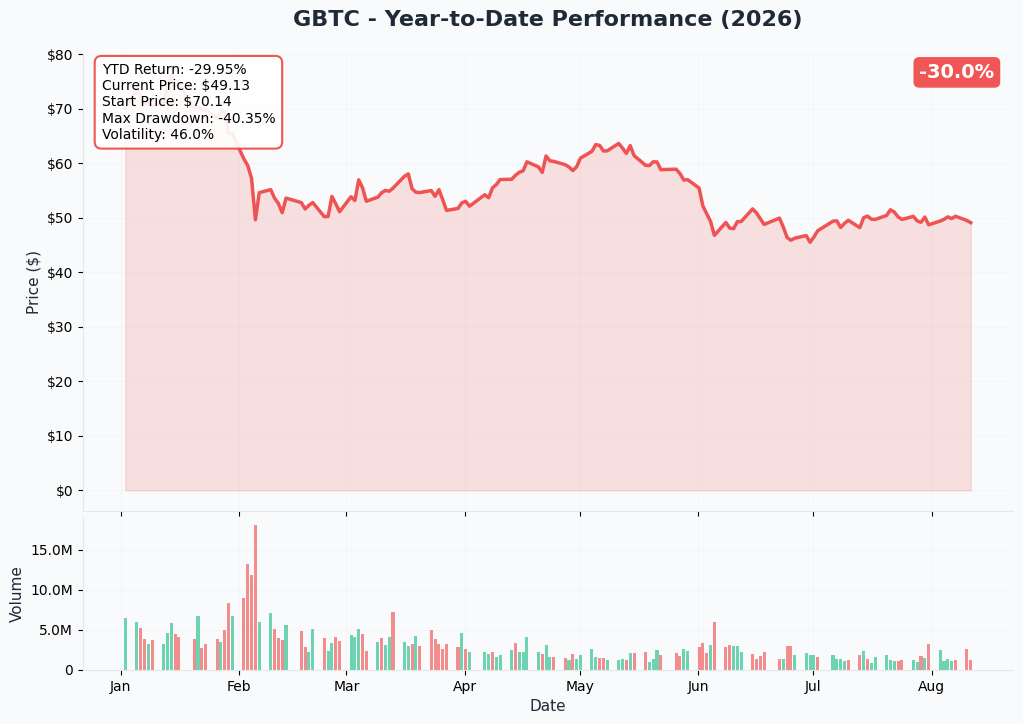
GBTC's year mirrors bitcoin's: a ≈24% collapse from ≈$81K-equivalent levels in mid-May to a liquidation-cascade low near $61K-equivalent on June 6, then roughly ten weeks of chop in a wide range. The fund's 52-week range is $44.98–$99.12, and its 1-year total return sits at −46.35% — a reminder that GBTC's 1.50% fee compounds every drawdown a little worse than owning bitcoin directly would.
Gamma-Based Support & Resistance
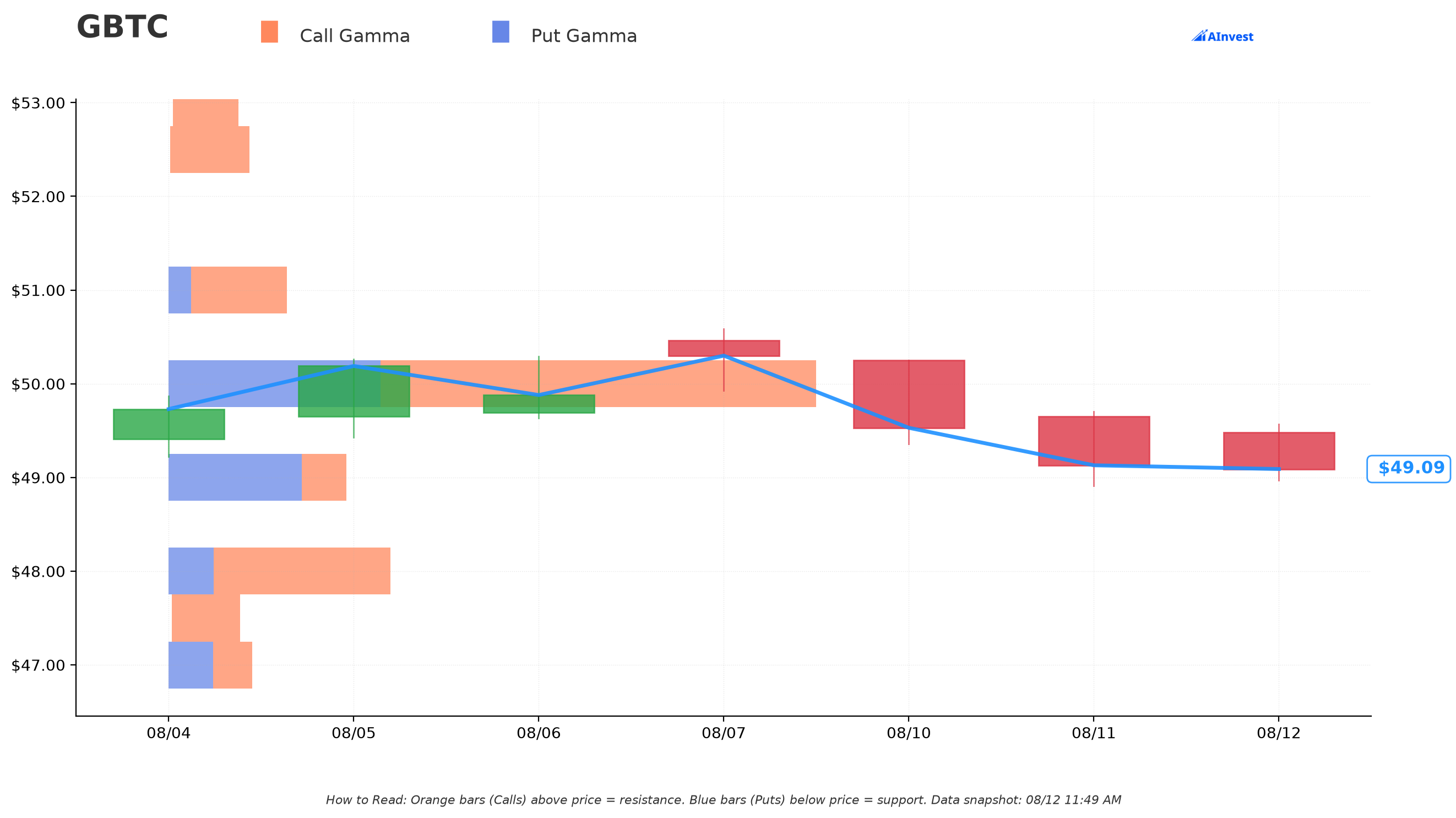
Honest read: the chain didn't produce usable gamma support or resistance levels. With spot at $49.10, open interest is scattered thinly across strikes from $45 to $70 with no strike carrying a large enough concentration of gamma to act as a real dealer-hedging wall — the largest single-strike total gamma reading in the chain is at $55, and even that is a fraction of what a liquid single-stock or major-ETF chain shows. A thin options chain is itself information here: GBTC's option market is nowhere near deep enough for market-maker hedging flow to meaningfully pin or repel price the way it does in names like SPY or QQQ. Don't lean on gamma levels for this ticker — lean on the bitcoin translation and the implied-move ranges below instead.
Implied Move
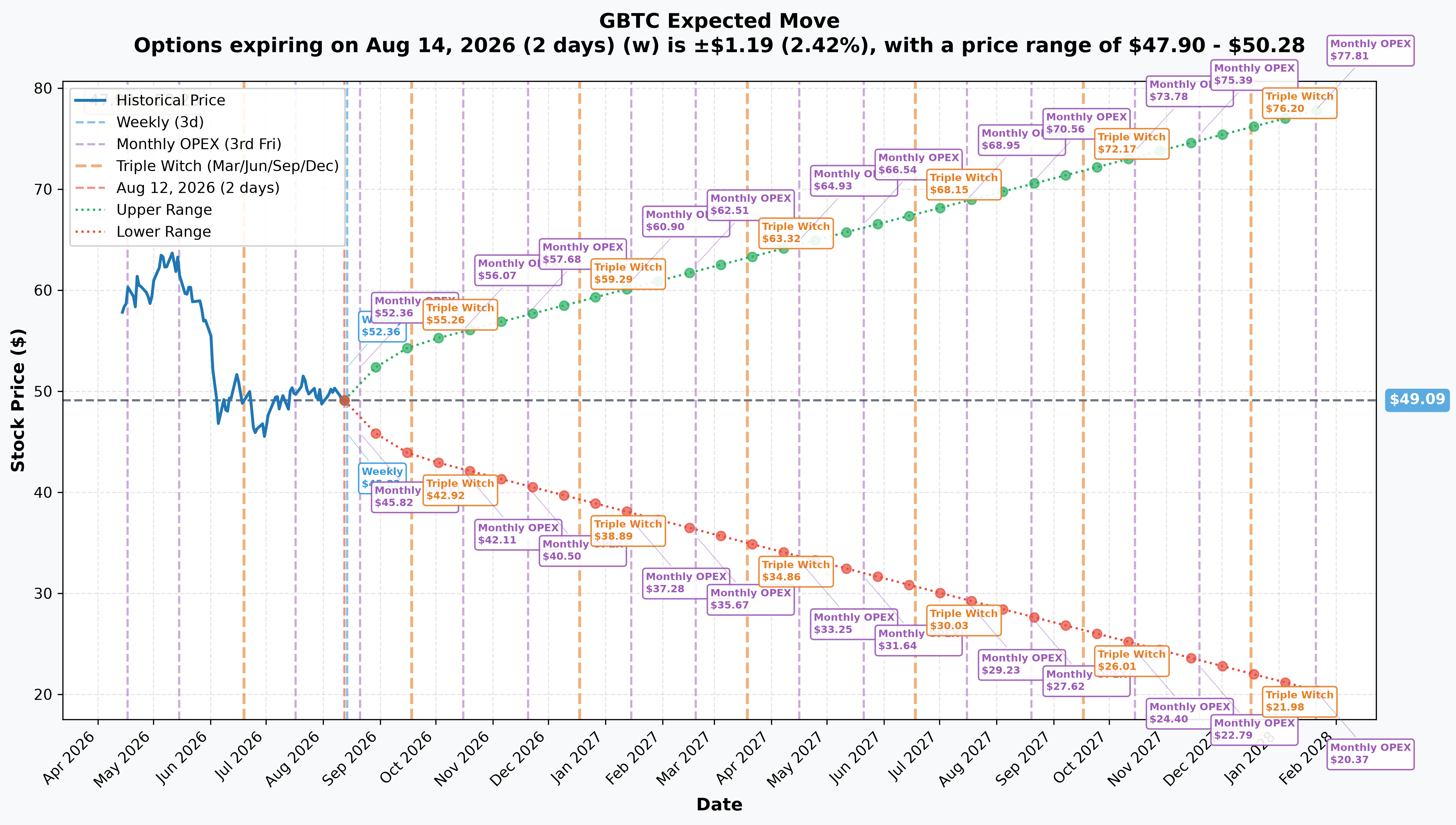
Straight from the options market's own pricing:
| Window | Expiry | Implied move | Range |
|---|---|---|---|
| Weekly | 2026-08-14 | ±2.42% | $47.90 – $50.28 |
| Monthly OPEX | 2026-08-21 | ±4.85% | $46.71 – $51.47 |
| Quarterly / triple witch | 2026-09-18 | ±11.23% | $43.58 – $54.60 |
Notice the monthly OPEX upper bound, $51.47, sits almost exactly at this trade's $51.65 breakeven — the market is pricing roughly a coin-flip chance of touching breakeven within nine days, let alone the full 128 to December. That is not a comment on where GBTC ends up at expiration; the implied-move cone widens sharply past the quarterly window and this trade's real horizon (128 days) is well beyond even the September 18 print above.
🎪 Catalysts
⚠️ Read this before the calendar: catalyst dates are NOT the expiration date
The option expires Friday, December 18, 2026 — 128 calendar days from today. Every catalyst below either lands inside that window (and can move this specific position) or after it (and cannot).
Inside the December 18 expiration window
- Jackson Hole Symposium, August 27–29, 2026 — theme: "Financial Innovation: Implications for Payments and Policy," Fed Chair Warsh's first symposium on a payments-and-innovation theme that is directly crypto-relevant.
- CPI prints: September 11, October 14, November 10, and December 10 — eight days before expiration. Bitcoin's reaction to today's July CPI (3.4% y/y, in line) was muted, but Reuters noted traders are sticking with September-hold bets — an upside surprise on any of the remaining prints is the clearest path to a hawkish repricing.
- Three FOMC meetings: September 15–16, October 27–28, and December 8–9 — just nine days before expiration. All three fall inside this option's life; the January 26–27, 2027 meeting does not. The regime is hawkish, not accommodative — the July 28–29 meeting held rates at 3.50%–3.75% with a 9-3 vote and all three dissents favoring a hike. A rate hike anywhere in this window is a live, direct tail risk for a non-yielding asset like bitcoin.
- Senate cloture vote on the CLARITY Act (H.R. 3633), September 15, 2026 — the same day the FOMC meeting begins. Sixty votes are needed just to proceed to debate, not to pass the bill. No credible whip count exists for this vote, so no probability should be assigned to it either way — it is a genuine coin-flip-with-slippage-risk, not a scored event.
- US midterm elections, November 3, 2026 — determines whether crypto market-structure legislation, including CLARITY, survives into 2027 at all.
- GBTC's Q3 2026 10-Q, expected early November — the next official read on bitcoin holdings, share count, and the fee paid in bitcoin.
The backdrop
Bitcoin is down ≈27% year to date, and the shape of that drawdown matters: a ≈24% collapse from ≈$81K in mid-May to ≈$61K by June 6, then ten weeks of range-bound chop between roughly $60K and $67K. CoinDesk reported June was bitcoin's worst month since June 2022, down ≈20%, driven by a leverage unwind, record ETF redemptions, a US–Iran conflict over the Strait of Hormuz that pushed bitcoin to trade as a risk asset rather than a safe haven, a hawkish Fed, and persistent miner selling — CoinDesk reported on August 12, 2026 that publicly listed miners have sold 28,000 BTC worth $1.78 billion since the start of the year, with production costs averaging $74,300 per coin — meaning many miners are underwater at spot and are forced sellers.
Against the trade: CoinDesk reported on July 1, 2026 that analysts see an eventual bottom in the $48,000–$55,000 range — a range that straddles this strike's bitcoin equivalent (≈$51,900) almost exactly. If those analysts are right, this call is a coin-flip on the exact number that decides its fate.
For the trade: August ETF flows have inflected positive — +$713.8 million across the category through August 11, the first clean positive stretch after the worst quarter on record, and the 18% decline in mining difficulty is starting to relieve the forced-selling pressure from miners as weaker operators exit.
👥 How Different Readers Should Think About This
🎲 The YOLO trader
You are not the natural buyer of a 19%-in-the-money call with only $2.44 of time value — that structure is built for leverage-with-a-floor, not for maximum convexity. If you want a pure lottery-ticket bet on bitcoin ripping back to new highs by December, an out-of-the-money call (say, near the $60 strike, ≈bitcoin $77,400) gives you far more torque per dollar, at the cost of needing bitcoin to actually get there. What you'd be copying here isn't a moonshot — it's someone else's leveraged, floor-protected long. Understand that even this "safer" structure loses 100% of its $11.07 million below bitcoin ≈$51,900, a level bitcoin sat within ≈13% of as recently as June.
📈 The swing trader
The number to watch is the breakeven: $51.65 on GBTC, bitcoin ≈$67,000, a level touched as recently as July 22. The implied-move table above puts the September 18 upper bound at $54.60 — well short of breakeven — so don't read a near-term bounce back toward $54–55 as validation of this trade; it needs a genuinely different regime, not routine chop, to pay off before December. The catalyst calendar is dense and mostly macro: three FOMC meetings and four CPI prints between now and expiration mean this position's fate will likely be decided in single-day moves around scheduled events, not a slow grind.
💰 The premium collector
There's no credit-collection angle in this specific trade — it's a straight debit call purchase, not a spread. But the structure is worth studying: paying only ≈5% of spot for 128 days of leveraged exposure with a built-in floor is itself a premium-selling insight in reverse — someone effectively "bought" the equivalent of a covered-call writer's downside protection by choosing the deep-ITM strike instead of an outright long position or an at-the-money call. If you already run covered calls or cash-secured puts on GBTC, the $40 strike (≈bitcoin $51,900) and the $51.65 breakeven (≈bitcoin $67,000) are reasonable reference points for where the market is now implicitly pricing risk.
🌱 The beginner
Think of this the way you'd think about buying a car with a large down payment instead of paying cash. The $9.21 of intrinsic value is like the "already-paid-for" part of the car — bitcoin would have to fall a long way (below ≈$51,900) before that value disappears entirely. The $2.44 of time value is the financing cost plus a small insurance premium, similar to loan interest plus GAP coverage. For $11.07 million, this trade controls roughly $46.7–46.8 million of exposure — about 4x leverage — which means gains and losses both move faster than owning the shares outright. This is not a "safe" way to buy bitcoin. It is a leveraged bet on an asset that is already down ≈27% this year, and the entire $11.07 million can be lost if bitcoin does not recover to roughly $67,000 by December 18, 2026.
⚠️ Honest Limits — What the Tape Cannot Prove
- The tape cannot tell us who bought or why. Prior open interest of 9 against 9,500 traded proves this is overwhelmingly a new position, but a block cross means a known counterparty agreed to take the other side in advance. Whether this is an outright directional bet, a hedge against a short bitcoin position elsewhere, or a stock-replacement trade by a holder freeing up capital is unknowable from the print alone.
- Grayscale's own websites returned errors to automated retrieval, so the 1.50% fee figure, the mini trust's 0.15%, and the bitcoin-per-share ratio are sourced from third parties and SEC filing summaries rather than the sponsor's live fact sheet. They cross-check exactly against the Q2 2026 10-Q's own arithmetic (138,505.76 BTC ÷ 178.58M shares reproduces the filing's stated $45.56 NAV at $58,745.18 bitcoin), so confidence is high, but they are not sponsor-confirmed as of today.
- Primary institutional flow dashboards also returned errors, so the July and August per-fund flow figures (the −$258M GBTC / +$212M mini-trust comparison, and the +$713.8M August category total) are single-sourced from one aggregator, not cross-verified against a second flow tracker. The broader monthly category figures they roll up to are independently corroborated.
- Bitcoin's day-by-day price path is derived from a public daily price series and is approximate to the day, not the tick. Today's ≈$63,477 level is confirmed by two independent sources.
- No credible whip count exists for the September 15 CLARITY Act cloture vote. No probability is assigned to it in this analysis — treating it as scored either way would be inventing information that doesn't exist.
- Options trading involves substantial risk of loss and may not be suitable for all investors. This position can lose its entire $11.07 million; nothing here is investment advice, and all figures should be independently verified before acting. Size any position — leveraged long or otherwise — to what you can genuinely afford to lose.
Last updated: 2026-08-13 (pre-market) — the next-day OPRA open-interest snapshot confirmed the open exactly. Dec-18 $40C 9 → 9,509 (+9,500 against 9,500, an exact match to the prediction): OPEN (BTO). The ⏳ callout was replaced with the ✅ RESOLVED box; no thesis or title change was required.