📈 GOOGL — The ≈$76.7M Roll Up: Strong Evidence, but the Next-Day OI Check Did Not Confirm It
⚠️ Last updated: 2026-08-05 — the confirming open-interest number we promised came back inconclusive, not confirming. We said we'd flag that plainly if it happened. See the ⚠️ RESOLUTION box below.
Company Overview
Alphabet Inc. (NASDAQ: GOOGL) is the parent of Google Search, YouTube, Google Cloud, and Waymo. It's a $4.63 trillion market-cap Communication Services name that joined the Dow Jones Industrial Average on 2026-06-23, replacing Verizon. The stock is up roughly +99% over the past 52 weeks and last reported Q2 2026 earnings on 2026-07-22, beating both revenue ($119.80B vs $117.07B consensus) and EPS ($9.11 vs $2.89 consensus). Spot on the day of this trade was ≈$377.
The Trade in Plain English
Four sessions ago, on July 29, 2026, somebody built a large October 2026 $375 call position — roughly 55,000 contracts, bought at an average of $7.27 per share. Today, that position started coming off: two option packages hit the tape in the same 11-minute window Tuesday afternoon, both structured the same way — sell the $375 calls, buy a higher strike — negotiated on the exchange floor rather than swept through the lit book. The larger one, Package A, sold 42,550 of those October $375 calls at a weighted average of $25.31 and bought the same number of October $410 calls. A smaller companion trade three minutes later, Package B, does the same shape out in January 2027/2028 on a much smaller scale. Combined, the desk took in a $55,646,000 net credit on the day — the second-largest credit that printed on the board today — on top of the gain already locked in by selling out of a position bought four sessions earlier for a third of today's price.
The open-interest history and the July 29 tape point to a roll rather than a fresh bear bet — see the evidence below, and see the ⚠️ RESOLUTION box for why the next-day open-interest check could not confirm it either way.
🤝 Multi-Leg Floor Trade — Package A (October 16, 2026 expiry)
| Time | Size | Leg | Strike | Price | Premium |
|---|---|---|---|---|---|
| 12:52:36 | 16,000 | SELL Call | $375 | $25.50 | $40,800,000 |
| 12:52:36 | 16,000 | BUY Call | $410 | $12.10 | $19,360,000 |
| 12:57:36 | 9,000 | SELL Call | $375 | $25.33 | $22,797,000 |
| 12:57:36 | 9,000 | BUY Call | $410 | $12.18 | $10,962,000 |
| 12:58:48 | 9,000 | SELL Call | $375 | $25.25 | $22,725,000 |
| 12:58:48 | 9,000 | BUY Call | $410 | $12.15 | $10,935,000 |
| 13:00:19 | 8,550 | SELL Call | $375 | $25.00 | $21,375,000 |
| 13:00:19 | 8,550 | BUY Call | $410 | $11.90 | $10,174,500 |
| Total | 42,550 | $107,697,000 collected / $51,431,500 paid |
Package A net: $56,265,500 credit. Full trade details: expiration 2026-10-16, right = Call, spot at execution ≈$377, mechanism = 🤝 multi-leg floor trade (negotiated on the exchange floor, not a lit sweep), $375C prior OI = 55,385, $410C prior OI = 2,426. GOOGL $375C chart · GOOGL $410C chart.
🤝 Multi-Leg Floor Trade — Package B (diagonal, Jan 2027 → Jan 2028)
| Time | Size | Leg | Expiration | Strike | Price | Premium |
|---|---|---|---|---|---|---|
| 13:02:59 | 700 | SELL Call | 2027-01-15 | $430 | $18.73 | $1,311,100 |
| 13:02:59 | 700 | BUY Call | 2028-01-21 | $550 | $27.58 | $1,930,600 |
Package B net: $619,500 debit. $430C prior OI = 3,994; $550C prior OI = 13,325 — both remain unresolved after the next-day OI check (see the ⚠️ RESOLUTION box). GOOGL $430C chart · GOOGL $550C chart.
Combined total: a $55,646,000 net credit — package net delta approximately −975,843 shares (short-delta at the package level, using the $375C delta of ≈0.5582 and the $410C delta of ≈0.3296 on Package A's 42,550 contracts, netted against Package B's much smaller size).
The proof: how the $375 calls got built, and how they're coming off
We pulled the open-interest history and the prior tape on the October 16, 2026 $375 call before writing this. It tells a clean, continuous story:
| Date | Open interest | Change |
|---|---|---|
| Jun 15 – Jul 28, 2026 | drifted 360 → 975 | flat for six weeks |
| Jul 29, 2026 | — | 55,544 contracts traded that day |
| Jul 30, 2026 | 55,181 | +54,206 |
| Aug 3, 2026 | 55,691 | +272 |
| Aug 4, 2026 (today, pre-trade) | 55,385 | — |
The July 29 tape shows exactly how that position was built — two multi-leg floor prints, both lifting the offer:
- 26,900 contracts @ $7.41 — 87% across the bid-ask spread
- 18,830 contracts @ $7.21 — 93% across the bid-ask spread
- Weighted average across all 55,544 contracts traded that day: $7.274
- A full-chain scan of the 10:06–10:07 ET window that morning found no other GOOGL option leg of 5,000+ contracts — this was a standalone long call accumulation, not a spread being opened.
Today's weighted average sale price on the same strike: (16,000×$25.50 + 9,000×$25.33 + 9,000×$25.25 + 8,550×$25.00) ÷ 42,550 = $25.31. Against the $7.274 cost basis, that's $18.04 per share × 42,550 contracts × 100 ≈ $76.7 million of realized gain in four trading sessions — and instead of walking away with the cash, the desk rolled the proceeds into 42,550 new October $410 calls. They also kept roughly 12,800 contracts at the $375 strike (55,385 held going into today, minus 42,550 sold).
This reads as a roll, not a fresh short position. Nobody typically opens a brand-new credit spread by selling a strike they bought 55,000 contracts of four sessions earlier at a third of today's price, with no companion leg on the day it was built. The bear-call-spread reading — a fresh short against a fresh long, betting Alphabet stays under $375 — fits the ownership history poorly.
But be precise about the strength of that claim. The ownership history is circumstantial evidence about intent, not a record of who held what. The next-day open-interest check that was supposed to settle it came back inconclusive (see the ⚠️ RESOLUTION box above) — the package created no net open interest either way. So the bear-call-spread reading is disfavored by the evidence, not ruled out by it. The original wording here claimed it was "effectively ruled out"; that overstated what we can support, and this correction stands in its place.
⚠️ RESOLUTION — The OI Check Came Back INCONCLUSIVE. We Predicted a Fall; It Rose.
Updated 2026-08-05 pre-market. The ≈06:30 ET OPRA open-interest snapshot (reflecting the August 4 close) has published. We predicted the October $375C open interest would fall to ≈12,800. It rose to 66,176. Here is the honest accounting.
| Leg | Baseline OI (Aug-4 snap) | Predicted | Resolving OI (Aug-5 snap) | Δ | Print size | Day volume | Verdict |
|---|---|---|---|---|---|---|---|
| Oct-16-2026 $410 C (bought) | 2,426 | ≈45,000 | 54,688 | +52,262 | 42,550 | 54,331 | ✅ OPEN (BTO) — confirmed |
| Oct-16-2026 $375 C (sold) | 55,385 | ≈12,800 | 66,176 | +10,791 | 42,550 | 54,280 | ❓ INCONCLUSIVE — see below |
| Jan-15-2027 $430 C (sold) | 3,994 | — | 3,890 | −104 | 700 | 994 | ↔️ ≈Net flat, tilts CLOSE (STC) |
| Jan-21-2028 $550 C (bought) | 13,325 | — | 13,326 | +1 | 700 | 776 | ↔️ FLAT — pure transfer, no new OI |
Why the $375C is inconclusive rather than refuting. Work the arithmetic on what open interest can and cannot show. Total day volume at the strike was 54,280; the package accounted for 42,550, leaving only 11,730 contracts of non-package volume. Net open interest rose 10,791. That bounds the package's own contribution to somewhere between −939 and +22,521 contracts — which means:
- ❌ A wholesale close on both sides is arithmetically impossible. That would require a contribution of ≈−42,550. Our stated prediction (OI falling to ≈12,800) is therefore ruled out by the data. We got that wrong.
- ❌ A fully fresh 42,550-contract short opening on both sides is also arithmetically impossible. That would require +42,550, and there isn't enough other volume at the strike to offset it back down to +10,791.
- ✅ What the data does say: the package contributed approximately zero net open interest. That is the signature of one side opening while the other side closes — the contracts changed hands rather than being created or destroyed.
Which side was which, open interest cannot tell us. Two readings survive, and they are observationally identical in the OI record:
- The roll (our published read): the desk sold to close its July 29 long, and the market maker on the other side bought to open. Net OI change from the package: zero. ✓
- A fresh bear call spread: the desk sold to open a new short, and the market maker bought to close a short it already carried. Net OI change from the package: also zero. ✓
Where that leaves the article. The roll read is not refuted — and the evidence it actually rests on is unchanged: the July 29 accumulation of ≈55,000 contracts at a weighted $7.274, executed 87–93% across the offer, with a full-chain scan finding no companion leg that morning. That remains the strongest available evidence and it still favors the roll. But we told you the OI check would be "unusually clean" and "conclusive," and it was neither. The ≈$76.7M realized gain described below is contingent on the roll reading being correct, and that reading is now supported by pre-trade evidence alone rather than confirmed by open interest. Treat it accordingly.
Package B, briefly. Both small Jan-2027/Jan-2028 legs contributed ≈zero net open interest too (−104 and +1 against 700-contract prints). The $430C's slight decline is directionally consistent with the published sell-to-close; the $550C buy created no new contracts at all, meaning the desk bought from a holder who was exiting. Neither leg is confirmed either way — the sizes are too small relative to the noise for the test to bite.
🤓 What This Actually Means — Plain English
This is a long call roll up: sell an existing long call (STC), buy a new long call at a higher strike (BTO), same underlying, structured as a call spread on paper because both legs printed together. The mechanics that make this an income-generating roll rather than a fresh credit spread are the ownership history above — a position built on July 29 at $7.27 a share, aggressively (87–93% across the offer, no companion leg), and 42,550 of it sold today at $25.31 a share.
Taking ≈$76.7 million off the table and re-establishing 33 points higher is de-risking while staying long — not a bet against Alphabet. The move cuts the position's delta from ≈0.558 (the $375C) to ≈0.330 (the $410C) per contract — roughly a 41% reduction in directional exposure — while the desk keeps a long call book intact and banks a realized gain that would otherwise be sitting as unrealized paper profit exposed to a pullback. This is a bullish holder locking in a large win and staying in the trade at a strike further from the money, the same shape as a roll we saw in QQQ today.
For completeness: a fresh, standalone bear call spread (selling the $375C to open a new short against a newly bought $410C long) is the alternative shape these two legs could theoretically form. The open-interest build history and the July 29 accumulation tape argue strongly against it — nobody typically opens a new credit spread by selling a strike they spent four sessions ago aggressively buying 55,000 contracts of at a third of today's price. It is disfavored, not eliminated: the next-day open-interest number could not separate the two readings, because both imply the same net-zero change in open interest at the strike. See the ⚠️ RESOLUTION box above for that arithmetic.
Package B (the January 2027 → January 2028 diagonal) is a much smaller version of the same roll-shaped trade — sell a nearer, lower strike; buy a farther, higher strike — and doesn't move the overall picture much given its size. Its open interest barely budged in either direction, so it too is unconfirmed.
Charts
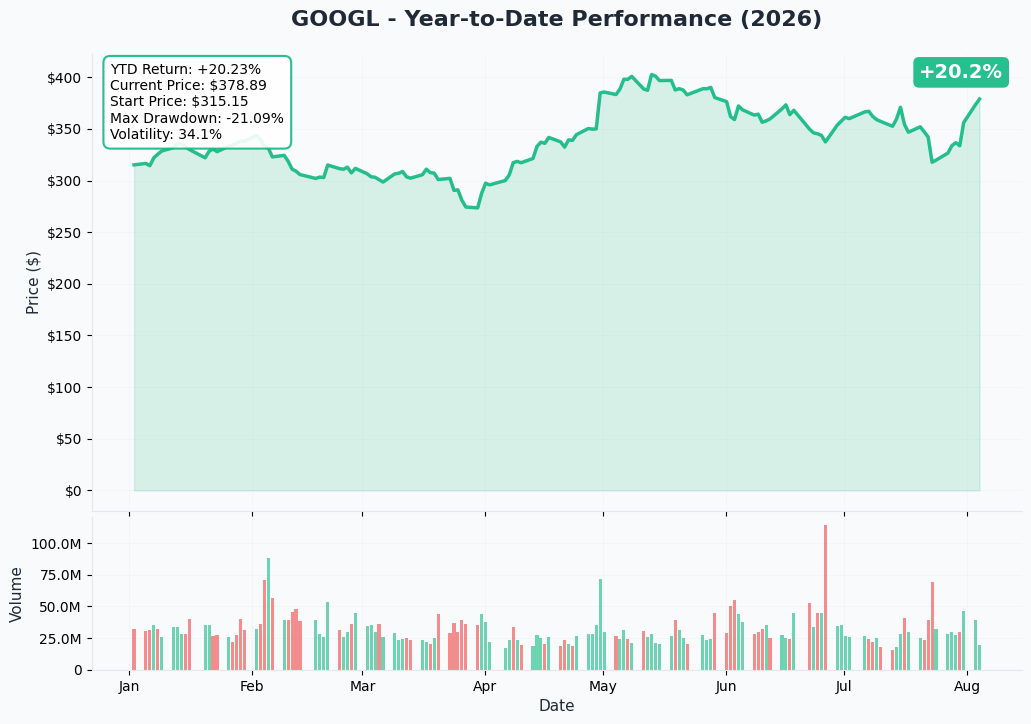
1-Year Price Action (+20.2% over the trailing year)
Gamma Support/Resistance
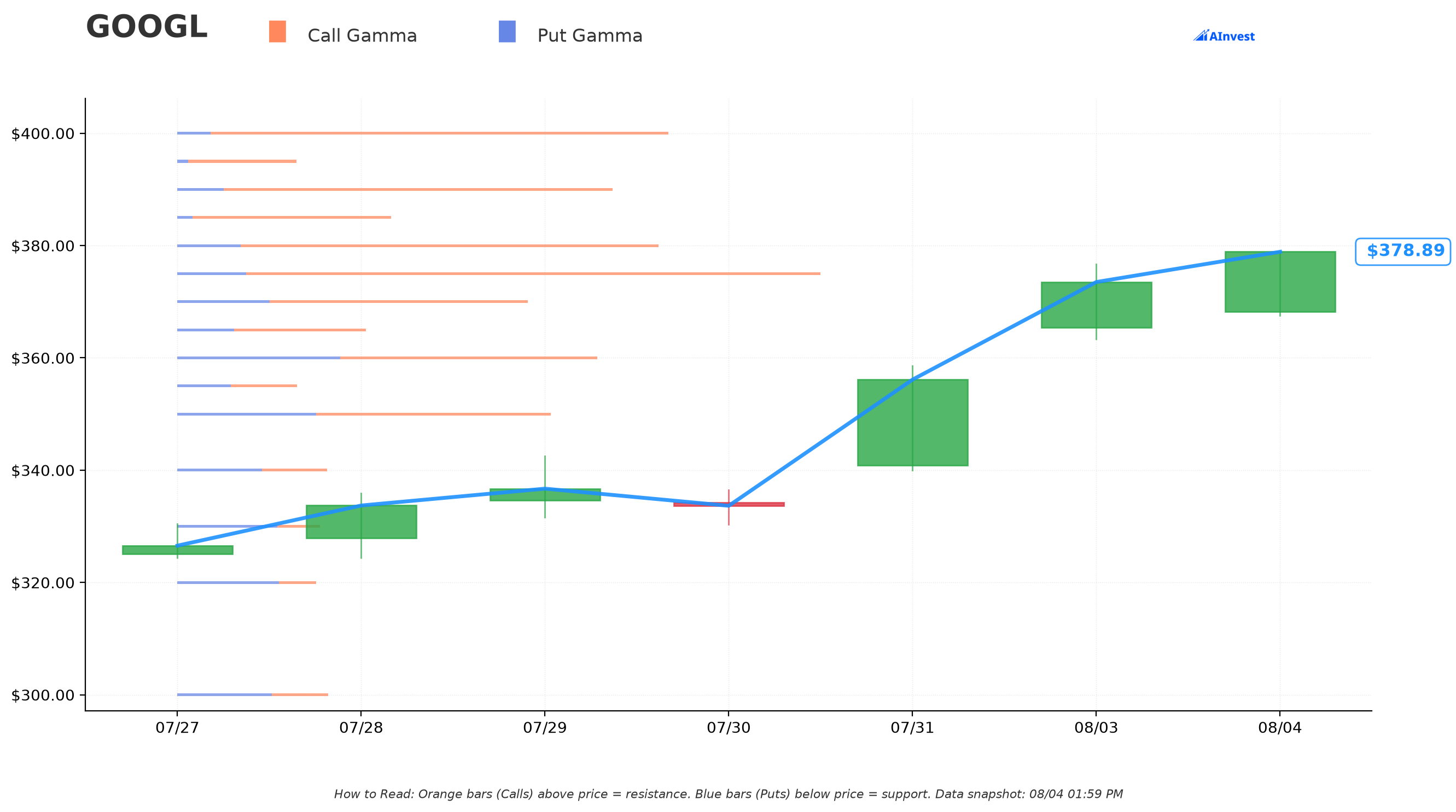
Concrete levels from today's gamma exposure snapshot (spot ≈$378.78):
- Support Wall: $375 strike — total gamma exposure ≈$36.18M (Very Strong), only ≈1.0% below spot. This is the strike the $375C leg of today's trade sits directly on top of.
- Resistance Wall: $380 strike — ≈$27.05M total gamma (Very Strong), ≈0.3% above spot; next resistance at $390 (≈$24.49M) and $400 (≈$27.62M).
- Secondary support at $360 (≈$23.60M) and $350 (≈$20.96M).
- The $410 strike — where today's Package A bought its calls — carries ≈$10.23M total gamma exposure and sits ≈8.2% above spot, essentially at the edge of the current dealer-hedging zone rather than inside it.
Implied Move
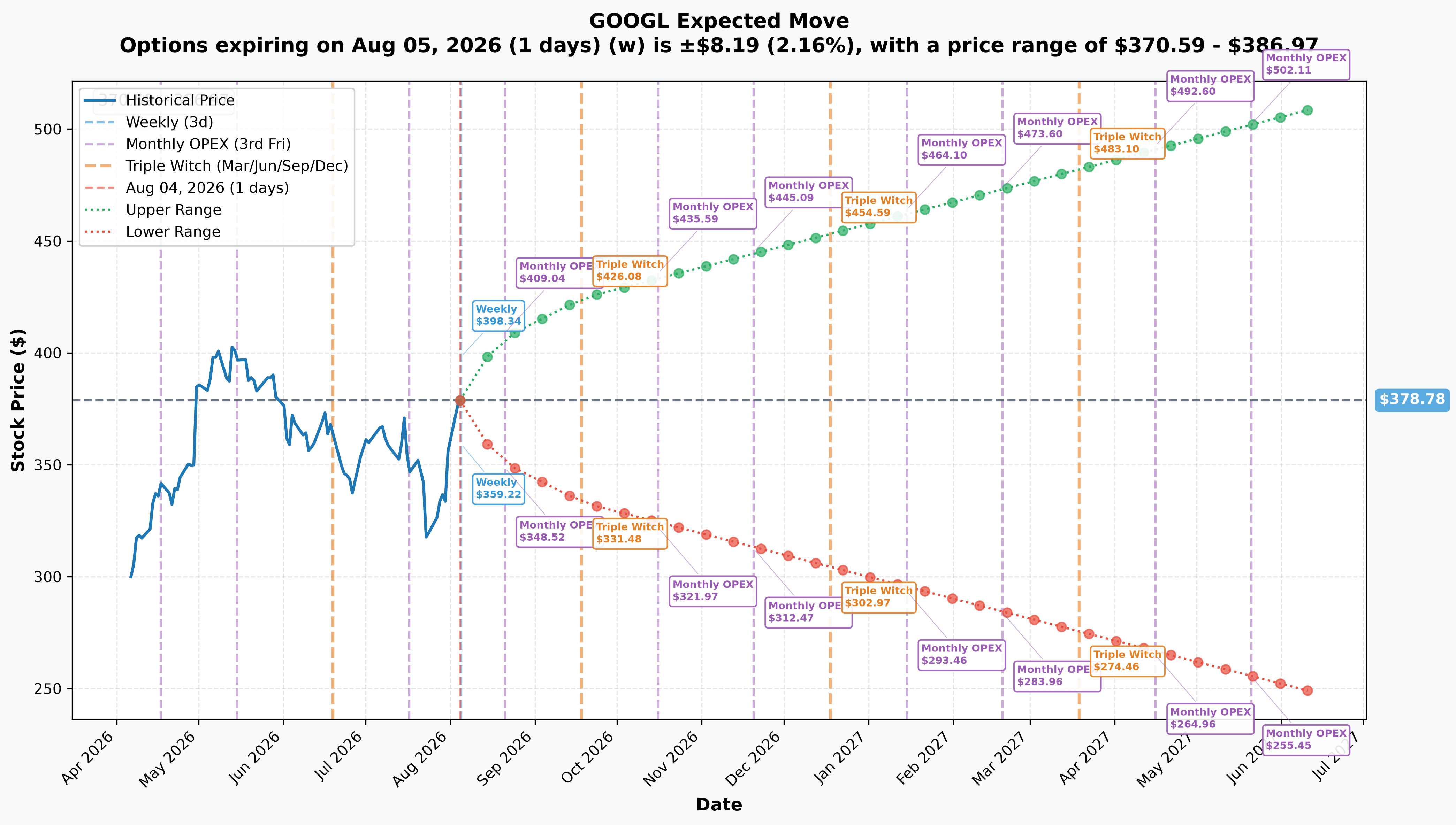
From today's implied-move read (spot $378.78):
- Weekly (Aug 5 expiry, 1 DTE): ≈2.16% / ≈$8.19 → range $370.59 – $386.97.
- Monthly OPEX (Aug 21, 17 DTE): ≈7.5% / ≈$28.41 → range $350.37 – $407.19.
- Triple witch (Sep 18, 45 DTE): ≈12.07% / ≈$45.72 → range $333.06 – $424.50.
- The October 16, 2026 monthly OPEX label (the same expiry as Package A) projects a range of roughly $321.97 – $435.59 by that date — meaning both the $375 and $410 strikes in today's trade sit comfortably inside the market's own priced-in move, which is itself a data point cutting against either side being a wildly aggressive directional bet.
Catalysts
Alphabet's next scheduled catalyst is the Q3 2026 earnings call, estimated for late October 2026 but not yet company-confirmed — MarketBeat's earnings page explicitly states no confirmed date has been posted (MarketBeat — GOOGL earnings). That date, whenever it lands, falls before or right around Package A's October 16, 2026 expiry, so earnings-date risk is baked into this structure regardless of which reading is correct.
The Q2 2026 print (reported 2026-07-22) beat on both lines — $119.80B revenue vs $117.07B consensus, $9.11 EPS vs $2.89 consensus — and triggered a wave of price-target increases on 2026-07-23, including BMO Capital to $465, Pivotal Research to $475, and Wedbush to $445 (MarketBeat — GOOGL price target). Consensus sits at "Strong Buy" with an average target of $427.59 (StockAnalysis) to $419.86 (MarketBeat), though the range runs as low as $255 and DA Davidson's Neutral call carries a $350 target — below spot (StockAnalysis, MarketBeat — GOOGL price target).
The biggest swing factor over the life of this trade is AI-infrastructure capex heading into the Q3 and Q4 calls — Alphabet's forward P/E of 28.12 against a trailing P/E of 18.74 means the market is already pricing continued earnings growth, and a Meta-style free-cash-flow compression from capex (Meta's FCF fell to $784M on $31.08B of quarterly capex) is the clearest read-through risk to watch (StockTitan — META). Alphabet also carries an unresolved antitrust remedies overhang with no specific ruling or hearing date sourceable at this time.
How Different Traders Might Read This
🎲 YOLO / momentum trader: This isn't a lottery-ticket setup — it's a large holder banking a ≈$76.7M gain and staying long, not opening a fresh directional bet. There's no edge here in trying to fade Alphabet off this trade; if anything it confirms a sophisticated player still wants upside exposure, just further from the money.
📅 Swing trader: Read this as a bullish holder trimming risk after a big win, not a signal to get defensive. A large position built at $7.27 and sold at $25.31 tells you the desk was comfortable staying long calls through the $380–$400 gamma resistance band, but wanted to lock in a realized gain and cut delta roughly in half rather than let a 3.5x winner ride unhedged into October expiry. Worth noting as constructive positioning, not a reason to avoid the name.
💰 Premium collector / income trader: The $55.6M net credit collected today is recycled profit from an already-winning position, not fresh premium sold against open-ended risk. The useful takeaway for income traders is more about technique than direction: rolling up after a large winner to lock in gains and reduce delta while staying in the trade is a disciplined way to manage a long call position that's run hard.
🔰 Beginner: The lesson here is why open interest matters — and also what it can't do. A trade table alone — sell $375, buy $410 — looks identical whether it's closing an old position or opening a new one. Pulling the OI history back to when the position was built (July 29, at $7.27) and comparing it to the sale price ($25.31) is what turns a two-line print into a story. But the second lesson landed the next morning: the confirming open-interest number came back inconclusive, because the package created no net new contracts either way. Sometimes the check you're waiting for simply doesn't answer the question, and the honest move is to say so rather than to declare victory.
Honest Risk & Limits — What the Tape Cannot Prove
- The tape cannot tell us who this trader is, or whether they hold other positions (stock, other options, hedges elsewhere) that change the real risk picture. We inferred the roll from open-interest history and the July 29 accumulation tape, not from any confirmed account-level record.
- The open-interest confirmation we promised did not arrive, and we are not going to pretend otherwise. We predicted the $375C open interest would fall by ≈42,550; it rose 10,791 instead. That specific prediction was wrong. The arithmetic (see the ⚠️ RESOLUTION box) shows the package created no net open interest at the strike, which is compatible with the roll and with a fresh short — open interest cannot separate them here. The roll remains the better-evidenced read on the strength of the July 29 accumulation tape, but it is now an inference standing on pre-trade evidence alone, and the ≈$76.7M realized gain figure is contingent on it.
- The floor-negotiated mechanism (🤝 multi-leg floor trade) means this was a broker-facilitated block with a known counterparty on the other side — not urgent, liquidity-taking aggression.
- Package B's legs (Jan 2027 $430C and Jan 2028 $550C) remain unresolved on open/close. Their next-day open interest moved −104 and +1 against 700-contract prints — too little signal to call either way.
- Options trading involves substantial risk of loss and may not be suitable for all investors. This is a description of a specific trade seen on the tape, not a recommendation to replicate it. The realized-gain and delta figures above assume the position is held as described and ignore early assignment, dividends, and transaction costs.
Updated 2026-08-05: the open-interest read on the $375C leg is in and it was inconclusive — see the ⚠️ RESOLUTION box near the top of this article for the numbers and what they do and do not establish.