🏨 HLT: That $29.15M Call Cross Was an Exit — Open Interest Collapsed From 11,916 to 198
📅 2026-08-13 | 🤝 Block Cross Detected | ❗ Resolved 2026-08-14: a closing trade, not a new short
🎯 The Quick Take
❗ This article was published on August 13 with the open-versus-close question flagged as the central uncertainty. The August 14 snapshot resolved it against the opening read, and the piece has been corrected. No new short was created. See the ❗ RESOLVED box.
At 13:20:38 ET a desk crossed 11,850 September $300 calls at $24.60 in Hilton — a transaction worth ≈$29.15 million.
The next morning's open interest settled what the tape could not: this was an exit. The $300 line fell from 11,916 contracts to 198 — a drop of 11,718, or 99% of the printed size. Open interest only falls when a closing seller meets a closing buyer, so both sides of this cross were getting out. The seller sold to close a long call position; the buyer bought back a short.
That inverts the natural reading of a $29M call sale. Nobody took on ≈$325M of short delta. What happened is that a long position of roughly a million share-equivalents was liquidated, and a strike that had carried ≈11,900 contracts steadily since at least August 5 is now effectively empty.
The strike arithmetic below still stands, and it explains why the holder wanted out. At $24.60 against a $321.57 stock the $300 strike was already 6.7% in the money, so $21.57 was intrinsic and only $3.03 was time value, with breakeven at $324.60 — 0.94% above spot. A call that deep in the money is a leveraged share substitute that bleeds time value; five weeks from expiry, someone decided to stop paying for it.
🏢 Company Overview
Hilton Worldwide runs an asset-light franchising model — it earns fees from owners and operators rather than owning most of the real estate, which is why its margins and unit growth matter more than property values.
| Attribute | Value |
|---|---|
| Price | $321.57 (at the print) |
| Sector / industry | Consumer Discretionary / Hotels, Restaurants & Leisure |
| Valuation | ≈47.4× trailing, ≈33.5× forward |
| 52-week high | $358.00 (June 17, 2026) |
| Development pipeline | Record 541,300 rooms |
💰 The Trade, in Plain English
| Time | Buy/Sell | Call/Put | Expiration | Premium | Strike | Volume | OI | Size | Spot | Option Price | Option Symbol |
|---|---|---|---|---|---|---|---|---|---|---|---|
| 13:20:38 ET | SELL | CALL | 2026-09-18 | ≈$29,151,000 | $300 | 12,000 | 11,916 | 11,850 | $321.57 | $24.60 | HLT20260918C300 |
The price decomposes like this:
| Component | Value |
|---|---|
| Intrinsic ($321.57 − $300) | $21.57 |
| Time value | $3.03 |
| Breakeven | $324.60 (+0.94%) |
This printed as a 🤝 negotiated block cross — a known counterparty, worked off the open book, no urgency signature. It took no liquidity, so the SELL label is reported rather than tape-proven.
❗ RESOLVED — Branch Two: an Existing Long Was Sold Out
Updated 2026-08-14 pre-market. Resolving OPRA snapshot timestamped August 14 (reflects the August 13 close, after this print); baseline is the August 13 snapshot (reflects the August 12 close, before this print).
| Leg | Baseline (Aug-13) | Resolving (Aug-14) | Δ | Print size | Capture | Verdict |
|---|---|---|---|---|---|---|
| Sep-18 $300 call (sold) | 11,916 | 198 | −11,718 | 11,850 | 99% | ❗ CLOSE (STC) |
We laid out three branches yesterday and refused to pick one. The snapshot picked the second.
| Branch | Predicted OI | Actual | |
|---|---|---|---|
| Opening sale (STO) — a new short-call position | rises toward ≈23,766 | — | ❌ ruled out |
| Closing sale (STC) — an existing long sold out | falls toward ≈66 | 198 | ✅ confirmed |
| Delta hedge / financing | roughly flat | — | ❌ ruled out |
Why this is proof and not inference. Open interest falls only when a closing seller meets a closing buyer — a closing seller matched with an opening buyer leaves it unchanged. The line dropped 11,718 contracts on a session where this cross was 11,850 of the strike's 11,858 total volume, so the drop is attributable to this print and nothing else. Both sides were closing. The reported SELL side was therefore STC, not STO.
What that means for the read. The article's own framing of "≈$325M of short delta to earn ≈$3.6M of decay" described the STO branch, and that branch did not happen. No new short exists. Instead a long call position of roughly a million share-equivalents was retired, and the September $300 strike went from ≈11,900 contracts to 198. That is a de-risking event, not a bearish bet — it removes long exposure rather than creating short exposure.
One residual detail, stated honestly: 11,850 printed but 11,718 closed, so ≈132 contracts of the cross did not net down. That is within ordinary noise for a block of this size and does not change the verdict.
What open interest still cannot tell us: who held the long, how long they had held it, what they paid, or whether shares or another option position sit behind the exit.
🤓 What This Actually Means — Plain English
There are two completely different reasons to sell a call, and they mean opposite things. You can sell one you do not own — that opens a short, and you are taking on open-ended upside risk for premium. Or you can sell one you already own — that closes a long, and you are simply cashing out a position. The prints look identical on the tape. Only open interest tells them apart, which is why we waited for it.
Here, open interest said "closing." The $300 line fell from 11,916 to 198. So nobody took on upside risk. Somebody who was long roughly a million share-equivalents of Hilton exposure sold it back and walked away.
Why the "in the money" part explains the motive. A $300 call on a $321.57 stock is 6.7% in the money: of its $24.60 price, $21.57 is intrinsic value — money you already have — and only $3.03 is time value. Holding it is like owning the stock with $3.03 of rent attached, and that rent decays to zero by September 18. A deep in-the-money call is a leveraged share substitute, and the longer you hold it the more you pay for the leverage. Selling it converts the position back to cash before the rent is spent.
A useful habit for reading flow: when you see a headline about millions "collected" on a call sale, ask whether the seller owned it first. Premium collected on an exit is not income — it is proceeds. That distinction is the whole difference between this trade and the bearish one it superficially resembles.
📈 Technical Setup
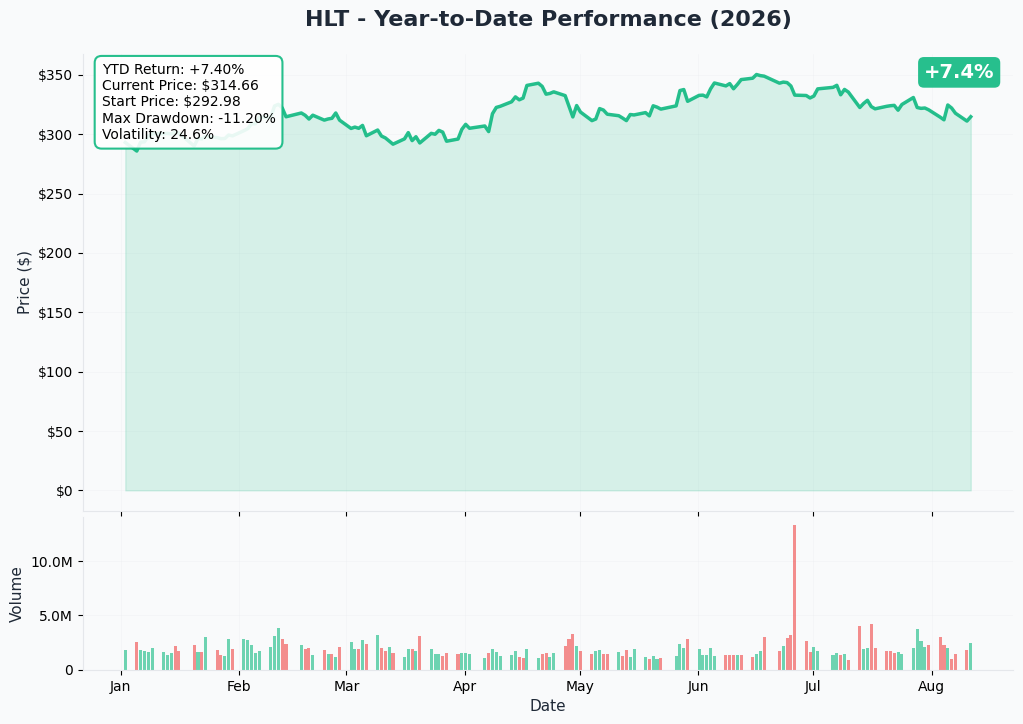
One-Year Performance
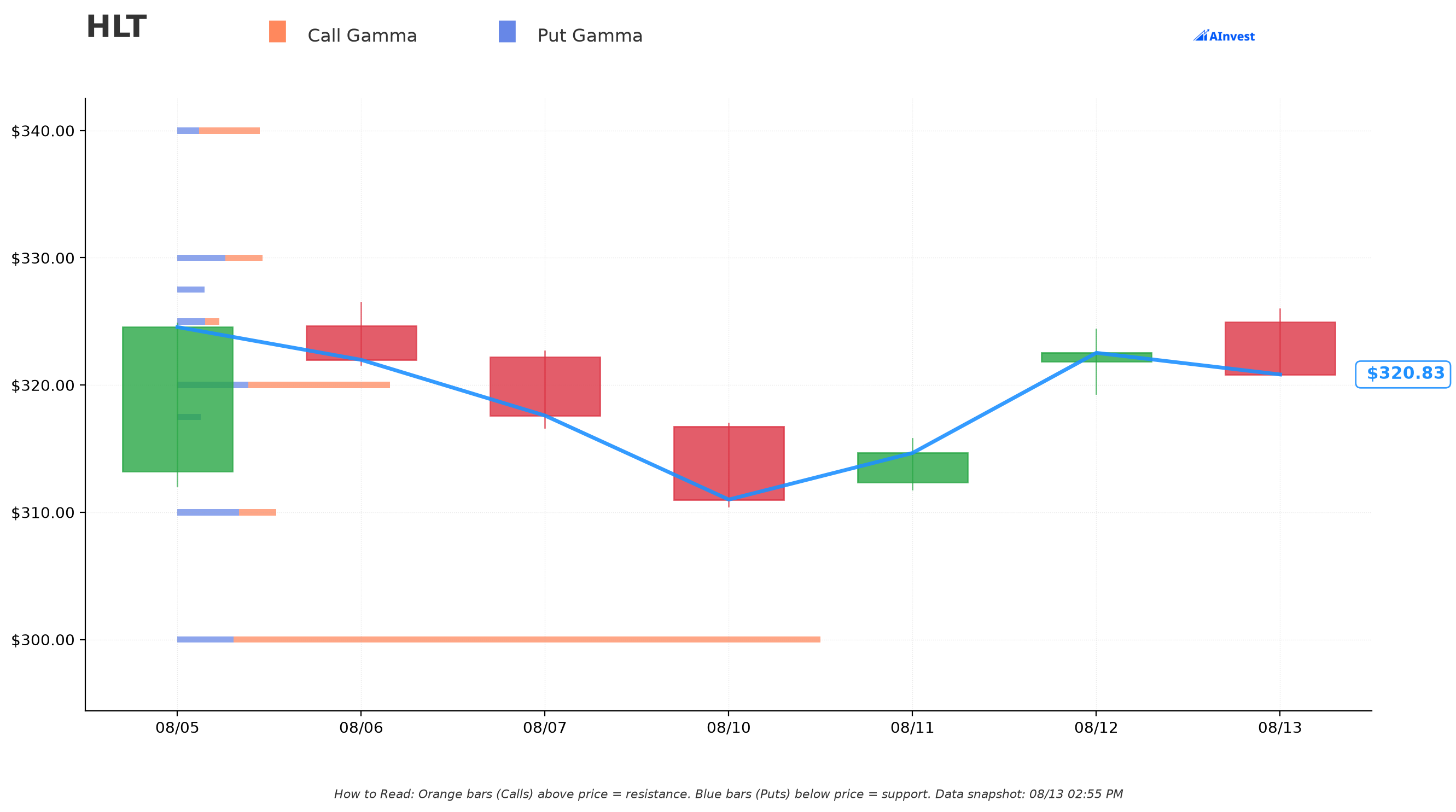
🔵🟠 Gamma-Based Support & Resistance
| Level | Strike | Strength |
|---|---|---|
| Resistance | none returned | — |
| Spot | $320.95 | — |
| Support | $300 | Moderate |
Being honest about the chart: the option chain returned no material gamma resistance level for Hilton. We are not going to invent one. The single meaningful level is support at $300 — which is exactly the strike being sold, a coincidence worth noting.
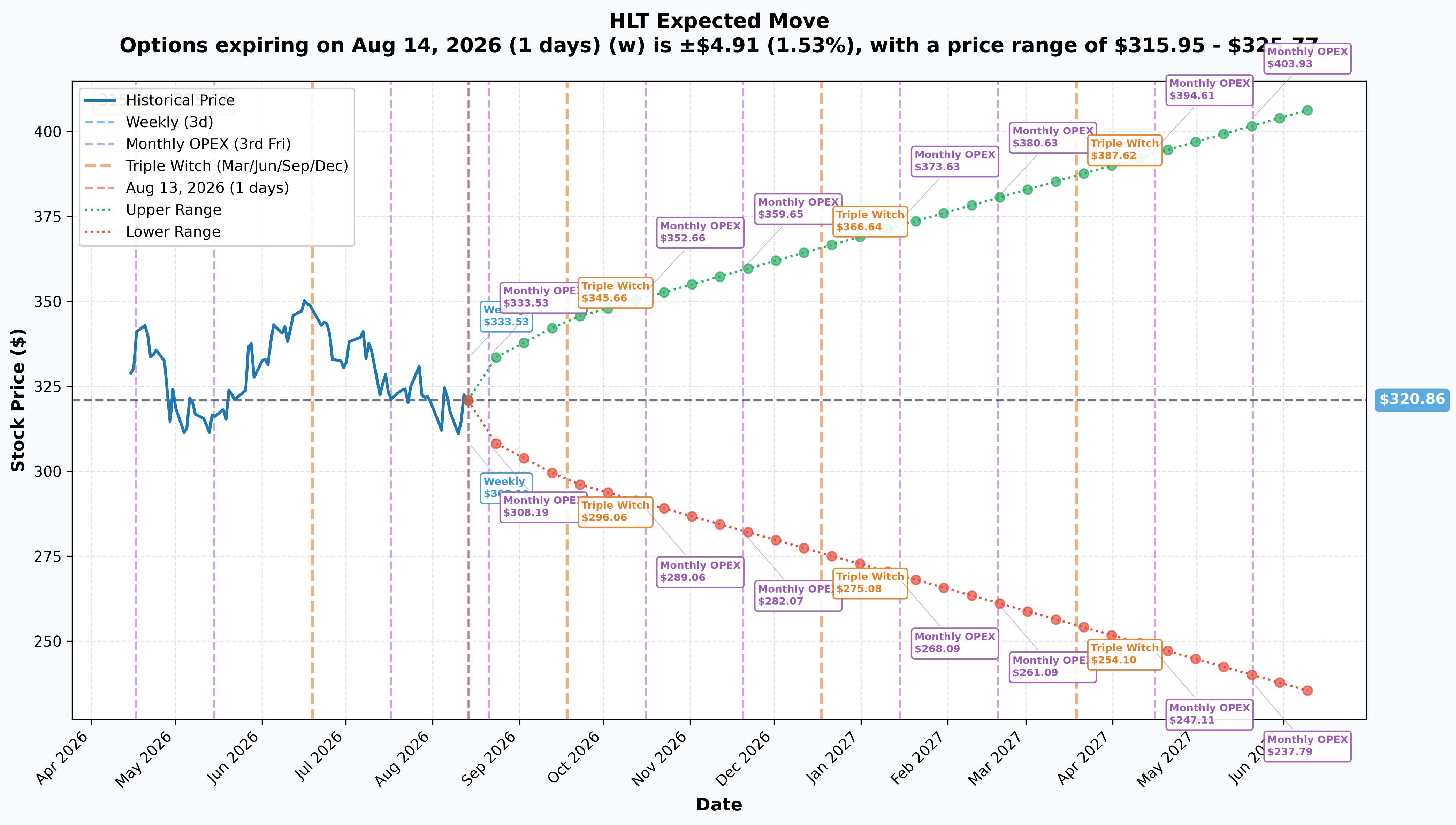
🎯 Implied Move
| Horizon | Implied move |
|---|---|
| Aug 14 | ±1.53% |
| Aug 21 | ±3.68% |
| Sep 18 (this expiry) | ±7.44% |
Now put that against the trade. The $24.60 print back-solves to roughly 23% implied volatility, which makes a one-sigma move over 36 days about 7.2% — essentially the same as the chart's ±7.44%. So a 7% move is a one-sigma event, roughly a one-in-six outcome. It is already priced. Anyone describing this trade as "safe unless something extraordinary happens" has the probability wrong.
🎪 Catalysts — And What Falls Inside September 18
No earnings inside the window. Hilton reported Q2 on July 28, 2026. The next report is estimated at ≈October 28 — and that date is explicitly not company-confirmed; Hilton's own events page lists no upcoming events at all. Any plausible Q3 date sits four or more weeks past expiry, so the option's entire 36-day life is free of company-scheduled catalysts.
The ex-dividend date IS inside — and it is company-confirmed. August 21, 2026, with a September 30 pay date, per the Q2 release.
But do the maths before worrying about assignment: the dividend is $0.15 against $3.03 of remaining time value plus roughly $1.18 of forfeited interest on the strike — about 20× coverage. Early exercise would be economically irrational. Across the whole position the dividend at stake is only $177,750 against ≈$29.15M of premium. The one condition that would flip this: if time value collapses toward $0.15 as expiry nears, re-check on August 20.
The only scheduled macro event inside is the FOMC on September 15–16 with projections, two days before expiry.
Business momentum is accelerating, not decaying — which cuts against the seller:
- RevPAR: 3.6% → 3.9% → ≈4.0% guided
- Business transient +5.7%
- Net unit growth 6.1%, record 541,300-room pipeline
- Industry supply growth below 0.5%
- FY RevPAR guidance was raised to +3.0–3.5%
And a +7% move would be a retracement, not a breakout. Hilton hit $358.00 on June 17 and closed $338.12 on July 2. A 7% rise from here is ≈$344 — still below both. Consensus sits at $353.15 (median $362.50), above that level. Two upgrades landed on August 11–12, the day before this trade.
Genuine offsets for the seller: the stock is −10.35% off its June high and fell ≈5% through a beat-and-raise; $17M of Q2 EBITDA was pulled forward from H2; management pre-flagged a weaker Q4 on calendar shifts and the midterms; and a derived ≈$294M/month buyback runs against the short call.
👥 Four Ways to Read This Trade
🎲 The YOLO trader
The other side of this — buying the $300 call — costs $24.60 to control a $321 stock, of which $21.57 is intrinsic. That is a leveraged share substitute, not a lottery ticket, and it loses the $3.03 of time value to decay. If you want convexity in Hilton, out-of-the-money calls are the honest instrument; this strike is not.
📈 The swing trader
The levels are unusually clean. $324.60 is the breakeven, ≈$344 is a 7% move, and $358.00 is the June high. Consensus ($353.15) sits between the last two. The stock is 10.35% off its high having fallen through good numbers, with two upgrades just landed — that is a genuine tension worth trading around, in either direction.
💰 The premium collector
Read this one closely, because it looks like your trade and turned out not to be one at all. This was not premium collection — it was an exit. Open interest fell 11,916 → 198, so the seller owned the calls before selling them. Two disciplines follow. First, check how much of the "premium" is actually premium: only $3.03 of the $24.60 was time value, the rest was intrinsic being handed back. Second, check open interest before reading a big call sale as bearish. Had this genuinely opened, it would have meant accepting ≈$325M of short delta to earn ≈$3.6M of decay with breakeven 0.94% away — a directional trade wearing an income costume. It did not open. That is the more common outcome than most flow commentary admits.
🌱 The beginner
Two lessons, and the second one is the reason this article changed. First, a big premium is not the same as a big income — most of this one was intrinsic value, which is not earnings, it is a transfer. Second, watch what happens when you wait for data instead of guessing. When we published, size (11,850) sat just under existing open interest (11,916), so we could not tell whether someone opened a new bet or closed an old one. Those mean opposite things, and we said so rather than pick. The next morning's number said "closed," and the more exciting version of the story — a $29M bearish bet on Hilton — turned out never to have existed. If you take one habit from this page, take that one.
⚠️ Honest Limits
- ❗ Open versus close is now resolved — it was a close. Size sat below prior open interest when we published, so the tape alone could not distinguish a new short from a long being sold out, and we laid out all three branches rather than pick one. The August 14 snapshot took the strike from 11,916 to 198, confirming the closing branch. The short-delta framing in the original piece described a position that was never opened, and has been corrected throughout.
- Direction is reported, not proven. A negotiated block cross takes no liquidity, so there is no aggressor read behind the SELL label.
- The implied-volatility, probability and delta figures above are our own derivations from the $24.60 print, not vendor data.
- No gamma resistance level exists in the chain — we say so rather than invent one.
- The next earnings date is an estimate, not a confirmation. Hilton has announced nothing.
- Research gaps, disclosed: the search budget was exhausted, so all work was done by direct retrieval; lodging-industry data providers returned errors, so the travel-demand backdrop above rests entirely on company-sourced statements; no peer earnings dates were verified.
- Unknowable from any public source: who holds this, whether shares or another option position sit behind it, and what the desk's true net exposure is.
Last updated: 2026-08-14 — ❗ thesis corrected — next-day OPRA open interest fell 11,916 → 198, proving the cross closed an existing long rather than opening a short. Title, quick take and reader sections have been rewritten (see the ❗ RESOLVED section).
This is market analysis and education, not investment advice. Options carry substantial risk of loss.