₿ IBIT — $5.7M of Bitcoin Crash Puts, Bought Above the Offer, Expiring in 2028
✅ Updated 2026-08-07 pre-market — an emphatic open, and roughly twice the size we predicted. We said ≈33,000; the December-2028 $15 put printed 66,083, up 64,771 from 1,312. The flagged 31,714-lot block was only about half of the day's opening buying at that strike. See the ✅ RESOLVED box below.
iShares Bitcoin Trust ETF is a passively managed spot-bitcoin fund launched by BlackRock in January 2024. Assets $47.48B, expense ratio 0.25%, trading at $36.51 (StockAnalysis). Follow it on the IBIT fund page.
The Trade in Plain English
At 13:54:57, with the fund at $36.60, a floor trade printed — negotiated on the exchange floor, and notably filled above the offer:
Buy 31,714 December-2028 $15 puts at $1.81 — $5,740,234 paid.
Prior open interest was 1,312, so at 31,714 contracts this is a proven open many times over.
| Time | Buy/Sell | C/P | Expiration | Strike | Size | Volume | OI (prior) | Option Price | Premium | Spot | Option Symbol |
|---|---|---|---|---|---|---|---|---|---|---|---|
| 13:54:57 | BUY | PUT | 2028-12-15 | $15 | 31,714 | 66,346 | 1,312 | $1.81 | $5,740,234 | $36.60 | IBIT20281215P15 |
Net: a $5,740,234 DEBIT. Delta −0.0658 ⇒ −208,678 shares of exposure.
What Makes This Notable: the Strike Is 59% Below Spot
The $15 strike sits about 59% below the $36.51 fund price, with almost two and a half years to run. At $1.81 a contract, this is deep-tail protection — the kind of position that pays only if bitcoin roughly halves and then some.
Run the notional: 31,714 contracts is 3,171,400 shares, or about $115.8M of bitcoin exposure, hedged for $5.74M — roughly 5.0% of the notional. That is far more expensive than an equity tail hedge, which tells you how much the options market charges for crypto downside.
Breakeven is $13.19 — the strike minus the premium — which requires the fund to fall about 64% from here.
✅ RESOLVED — Confirmed Opening, and Roughly Double the Predicted Size
Updated 2026-08-07 pre-market. The ≈06:30 ET OPRA snapshot (which reflects the August 6 close) has published.
| Leg | Baseline OI (Aug-6 snap) | Predicted | Actual (Aug-7 snap) | Δ | Print size | Δ as % of print | Day vol | Verdict |
|---|---|---|---|---|---|---|---|---|
| Dec-15-2028 $15 P (bought 31,714) | 1,312 | ≈33,000 | 66,083 | +64,771 | 31,714 | ≈204% | 67,817 | ✅ OPEN (BTO) — was ⏳ provisional |
The open is emphatic — and larger than the block we flagged. Open interest at the December-2028 $15 put went from a near-empty 1,312 to 66,083 in a single session, on day volume of 67,817. The 31,714-lot print we wrote about was only about half of the day's opening buying at that strike.
That changes the scale of the story, not its direction. This is not one desk buying a tail hedge; it is at least two comparable blocks landing on the same far-out-of-the-money bitcoin crash strike on the same day. The $5.7M headline understates the total commitment to that hedge by roughly a factor of two.
What is still unknowable. Whether the second block belongs to the same account, and what spot bitcoin or IBIT exposure sits behind either. A crash put is insurance for a holder and a directional short for anyone else.
🤓 What This Actually Means — Plain English
Buying a put this far out of the money is insurance, not a forecast. Most of the time it expires worthless, and the buyer knows that when they pay for it.
The "above the offer" fill is worth a sentence. On a negotiated floor trade, the price is agreed as part of the package rather than swept off the lit market, so paying through the displayed offer does not carry the same "aggressive buyer" meaning it would on an ordinary lit print. It says the package was priced as a whole — not that somebody panicked.
Two readings we cannot separate:
- A hedge — somebody with a large bitcoin or IBIT position buying cheap protection against a collapse.
- A standalone bearish bet on crypto falling by two-thirds within two and a half years.
The options tape shows no stock leg on a single-leg floor trade, so nothing here distinguishes them. Given the strike distance and the modest cost relative to notional, the hedge reading is the more natural one — but that is an inference, not proof.
📊 The Charts
One-Year Price Action
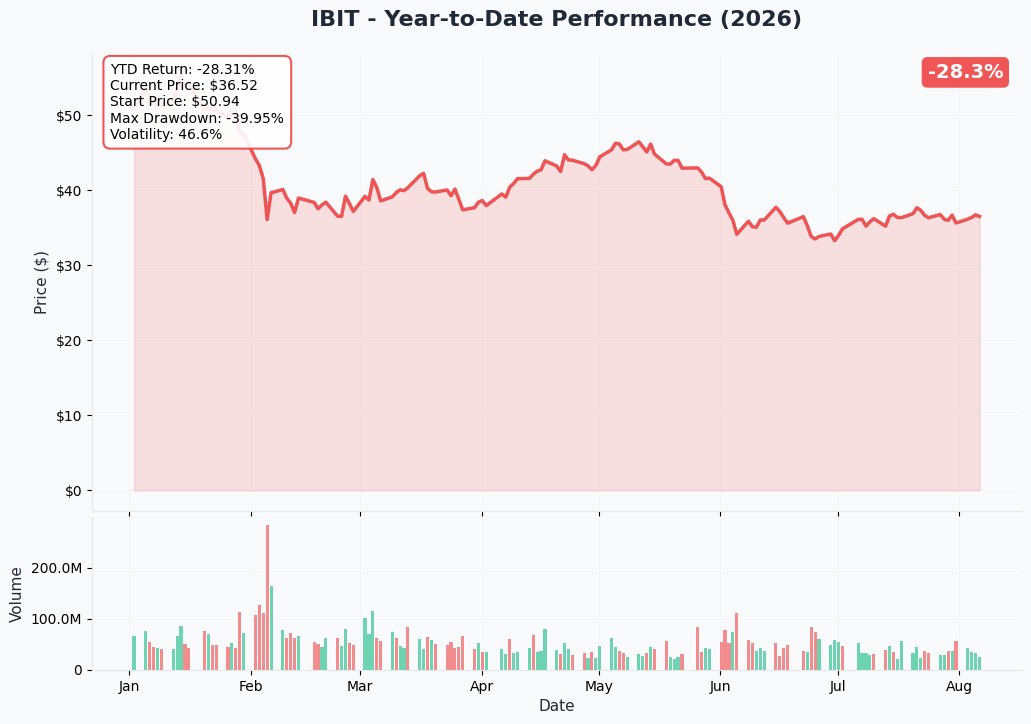
The fund is −28.3% over the past year on this chart, and its quoted one-year return is −43.33% (StockAnalysis). It sits about 11% above its 52-week low of $32.84, well below the $71.82 high.
That matters for how you read the trade. This is not protection bought at a top — it is protection bought after a large decline, against a further one. Somebody is paying for the scenario where a bad year becomes a much worse one.
Gamma Support and Resistance
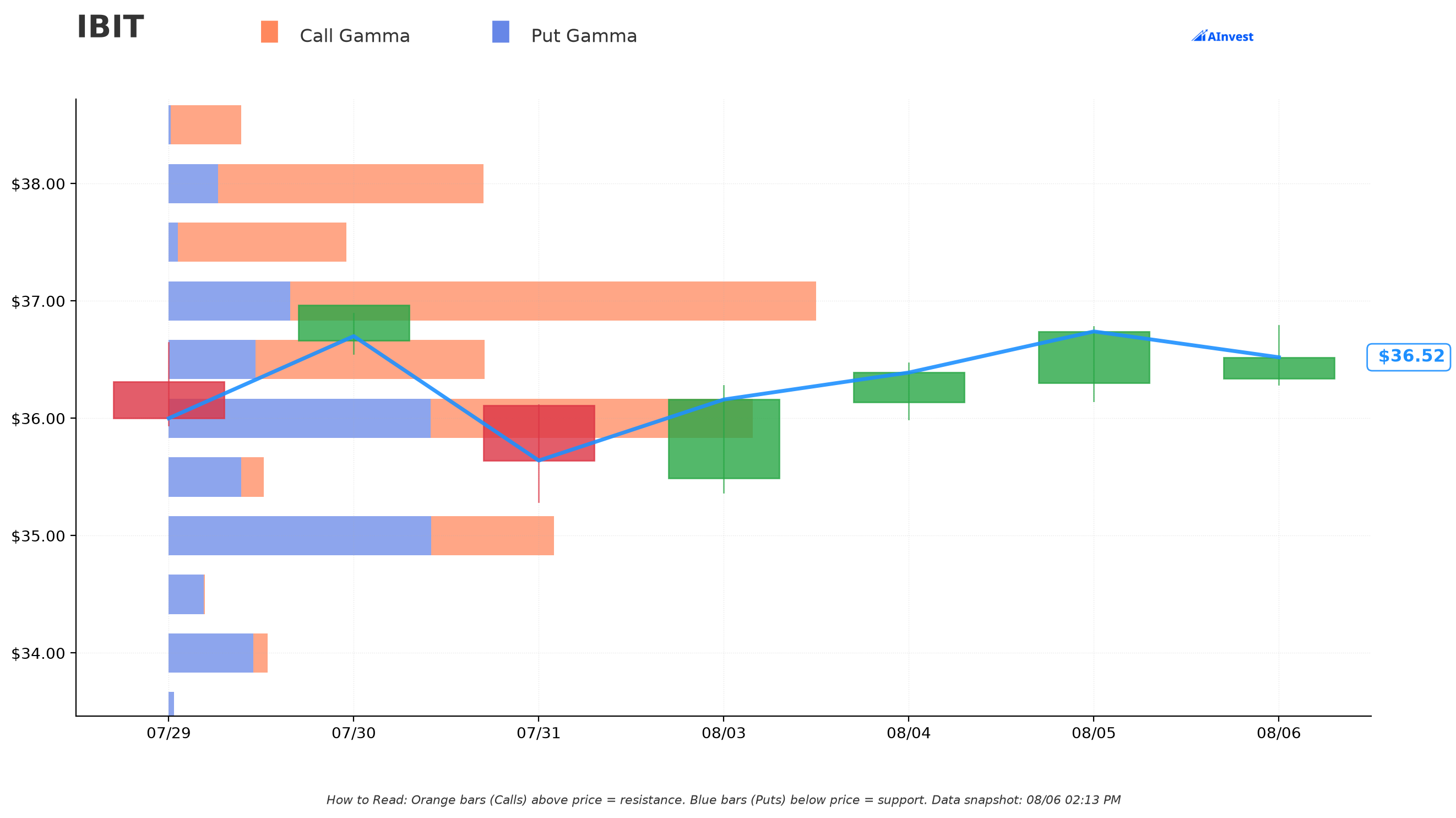
The chart shows where dealer hedging concentrates. The $15 strike sits far outside any of it — no dealer is hedging a level 59% below spot on a routine basis, which is part of why the protection is available at all.
Implied Move
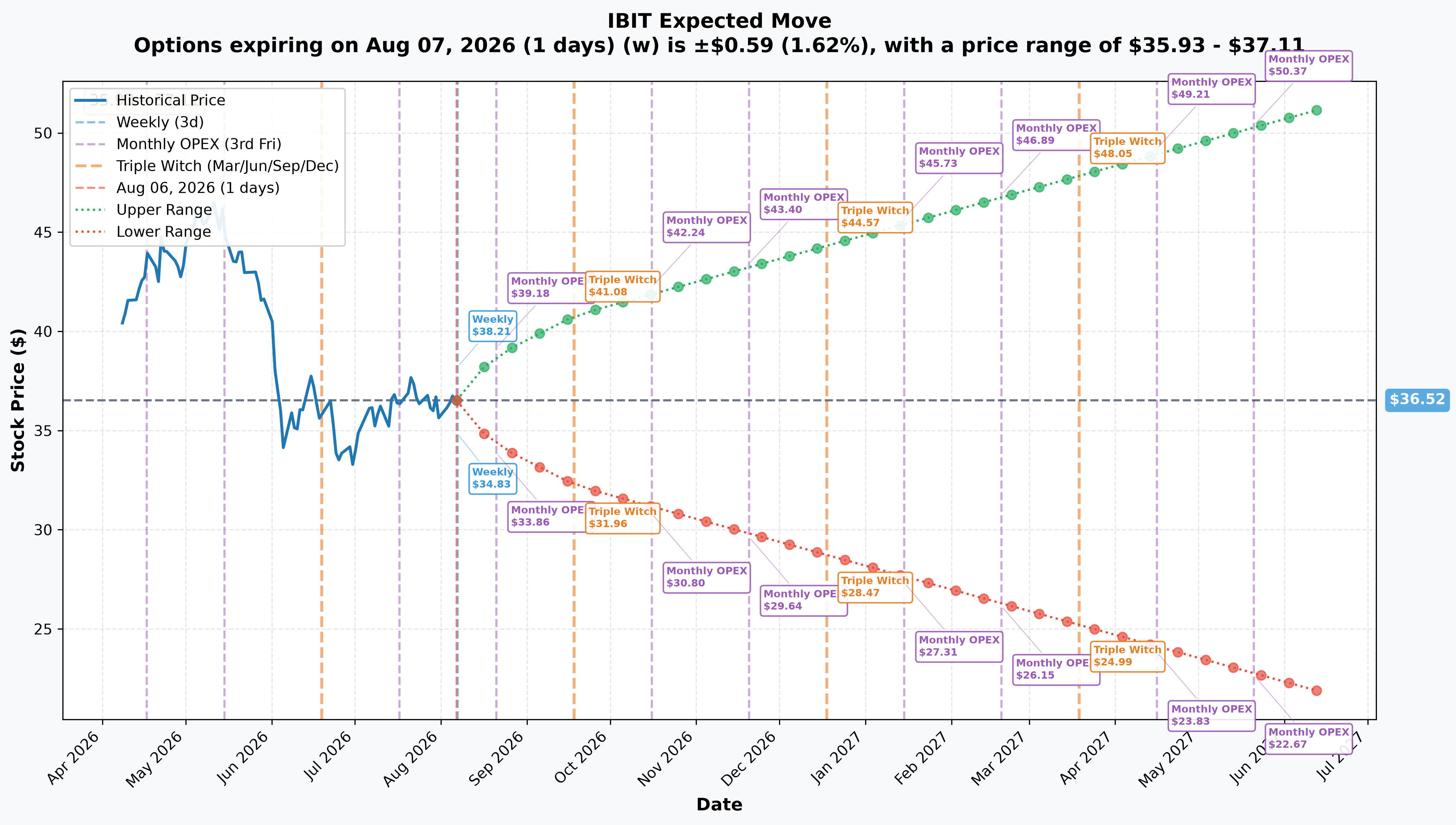
Compare the chain's expected ranges to the $13.19 breakeven. A 64% decline sits deep in the tail of any option-implied distribution, which is exactly what a crash hedge is meant to cover — and exactly why it usually costs money rather than makes it.
📅 Catalysts
- There is no company here, and no earnings. IBIT holds spot bitcoin, so every catalyst is a crypto-market or macro one.
- The fund has nearly halved over the past year (−43.33%) and trades ≈11% off its 52-week low (StockAnalysis) — the drawdown context for a tail hedge.
- ⚠️ The Fed is debating hikes, not cuts. The July 29 meeting held at 3.50–3.75% on a 9–3 vote, with Hammack, Kashkari and Logan preferring a quarter-point increase (Federal Reserve). Tighter policy has historically been a headwind for risk assets, crypto included.
- Remaining FOMC dates: September 15–16, October 27–28, December 8–9 (Federal Reserve) — all inside this expiry, along with roughly nine more meetings.
👥 Four Ways to Read This
🎲 The YOLO trader — at $1.81 these look cheap, and that is the trap. A 64% decline in bitcoin within two and a half years is possible; it is also the kind of outcome you can pay for repeatedly and never collect on.
📈 The swing trader — no near-term signal. A 2028 expiry and a strike 59% away say nothing about the next month.
💰 The premium collector — you are the counterparty, paid $1.81 to underwrite a crypto collapse. Note the asymmetry: you collect $5.7M once, and owe up to $47.6M if the fund goes to zero. Selling deep tails is where premium sellers get destroyed.
🌱 The beginner — the transferable idea is that cheap options are cheap for a reason. This one costs 5% of what it protects, which is expensive for insurance and still a lottery ticket if bought speculatively. Ask what has to happen for it to pay, then ask how often that happens.
⚠️ Honest Risk and Limits — What the Tape Cannot Prove
- Hedge or outright bet is unknowable from a single-leg options print.
- We cannot see the buyer or any bitcoin, futures or fund position behind it.
- The "above the offer" fill is not evidence of urgency on a negotiated floor trade — the price is set as part of the package.
- A 64% breakeven is a genuine tail. This position most likely expires worthless, which is what its buyer is paying for.
Nothing here is investment advice.
Last updated: 2026-08-07 — next-day OPRA open interest resolved the provisional flag: OPEN (BTO) confirmed, 1,312 → 66,083 (+64,771) — roughly double the flagged 31,714-lot block, meaning more than one comparable block opened at that strike. A ✅ RESOLVED box replaced the ⏳ callout; the scale of the story was revised upward.