🐻 IGV $3.2M Software-Sector Hedge — Block Cross Bets on a Re-Test of the Lows by March 2027
Published: 2026-06-16 · Last updated: 2026-06-17 | iShares Expanded Tech-Software ETF (IGV)
✅ Updated 2026-06-17: Next-day OPRA OI confirms a clean fresh open — the Mar-2027 $80 put rose 4,269 → 9,769 (Δ +5,500 = exactly the size traded). The full block is a brand-new long-put hedge, not a close.
Quick Take
A desk crossed a 5,500-contract block of March-2027 $80 puts on IGV at ≈$5.77 per contract (≈$3.2M total), negotiated off-market with a known counterparty. The strike sits ≈11.5% below today's spot of ≈$91.49 — well inside a range IGV has already visited this cycle (52-week low: $73.93). This is a long-dated downside hedge on the software sector, not an aggressive lit sweep; the tone is bearish-leaning/protective. Prior open interest at this strike was ≈4,300 contracts; at 5,500 contracts printed, size exceeds prior OI by ≈+1,200 contracts, meaning at least 1,200 new positions must have been opened.
Company Overview
iShares Expanded Tech-Software Sector ETF (IGV) is a concentrated, software-pure ETF holding 116 names, with the top 10 accounting for ≈60.57% of the fund. The five largest positions are Oracle (ORCL, ≈9.08%), Palo Alto Networks (PANW, ≈8.41%), Microsoft (MSFT, ≈7.75%), Palantir (PLTR, ≈6.95%), and CrowdStrike (CRWD, ≈6.57%). Salesforce (CRM) and Adobe (ADBE) are also held.
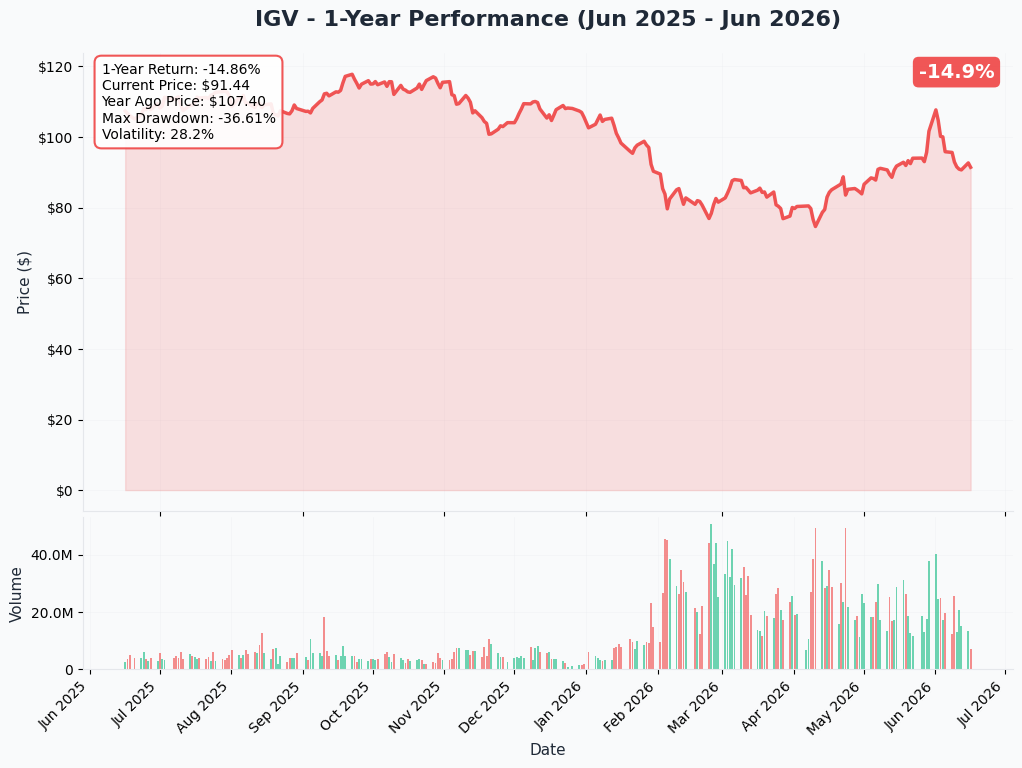
IGV is down ≈−20.6% year-to-date, trading near $91.27–$91.49 against a 52-week range of $73.93–$117.99. The drawdown is being driven by a structural fear that agentic AI is breaking the per-seat SaaS business model — a narrative that crystallized in early 2026 when roughly $1 trillion in enterprise-software market value evaporated in a week and that the June 11 Adobe earnings tape reinforced even after a beat-and-raise.
The Trade
| Field | Detail |
|---|---|
| Date | 2026-06-16 |
| Time | 11:11:19 ET |
| Symbol | IGV |
| Buy / Sell | BUY |
| Call / Put | PUT |
| Expiration | 2027-03-19 (Mar-2027) |
| Strike | $80.00 |
| Volume (contracts) | 5,500 |
| Premium Paid | ≈$5.77 / contract |
| Total Premium | ≈$3.2M |
| Prior Open Interest | ≈4,300 contracts |
| Spot at Print | ≈$91.49 |
| OTM Distance | ≈11.5% below spot |
| Order Type | BTO — Buy to Open (fresh position) |
| Flow Type | 🤝 BLOCK CROSS — negotiated, known counterparty |
| Option Leg | IGV Mar-2027 $80 Put |
✅ RESOLVED — Next-Day OI Confirms a Clean Open (2026-06-17)
| Leg | Pre-print baseline (EOD 2026-06-15) | Resolving (EOD 2026-06-16) | Δ | Verdict |
|---|---|---|---|---|
| Mar-2027 $80P | 4,269 | 9,769 | +5,500 | OPEN — fresh long-put hedge (BTO) confirmed |
The next-morning OPRA snapshot lands right on the prediction: open interest rose from 4,269 to 9,769, a +5,500 increase that matches the full 5,500-contract block exactly. The entire block is a clean new open — none of it was a close of a pre-existing position.
🤓 What This Actually Means — Plain English
This is a Buy to Open (BTO) on IGV $80 puts expiring March 2027 — a desk paid ≈$3.2M in premium to acquire the right to sell IGV at $80, nearly nine months from now.
The mechanism matters. This printed as a block cross: a broker matched a buyer and a seller off the open order book, with both sides already agreeing on price. That means there is a known counterparty who sold these puts. The cross format tells you this is a pre-arranged institutional transaction — not a trader urgently hitting the offer because software just broke a key level. Read the verb accordingly: a desk positioned downside protection, not "slammed puts."
The structure is a standalone long put — directional, bearish-leaning. The buyer profits if IGV drops below $80.00 − $5.77 = $74.23 at expiration (the breakeven). Maximum risk is the ≈$3.2M premium paid (the entire position goes to zero if IGV is above $80 in March 2027). Maximum gain is theoretically $80 − $0 = $80/share × 100 × 5,500 contracts = $44M, realistically capped by whatever IGV can fall to in the time allowed.
The most likely intent is a hedge on an existing software-sector long book. At ≈11.5% OTM and nine months of runway, this is not a short-dated speculative bet — it is portfolio insurance. A money manager sitting on a long position in IGV or its component names (MSFT, ORCL, PLTR, PANW, CRWD) buys March-2027 puts to cap downside through the full 2026 earnings gauntlet: Microsoft (July 28), Palantir (Aug 10), Salesforce (late Aug/Sep), and Oracle (September 14), plus every FOMC meeting where a hawkish surprise re-rates long-duration software. The $80 strike is not a random number — it is essentially the 52-week low zone (the fund touched $73.93 intraday), meaning the put kicks in at exactly the level the market has already proved it can reach.
Alternatively, this could be an outright bearish directional bet — a desk that believes the AI-driven SaaS de-rating has further to run and wants a cheap, leveraged way to express that view without shorting the ETF outright. Long puts with nine months of runway give the thesis time to develop through multiple binary catalyst events.
Technical Setup
Price & Gamma Context
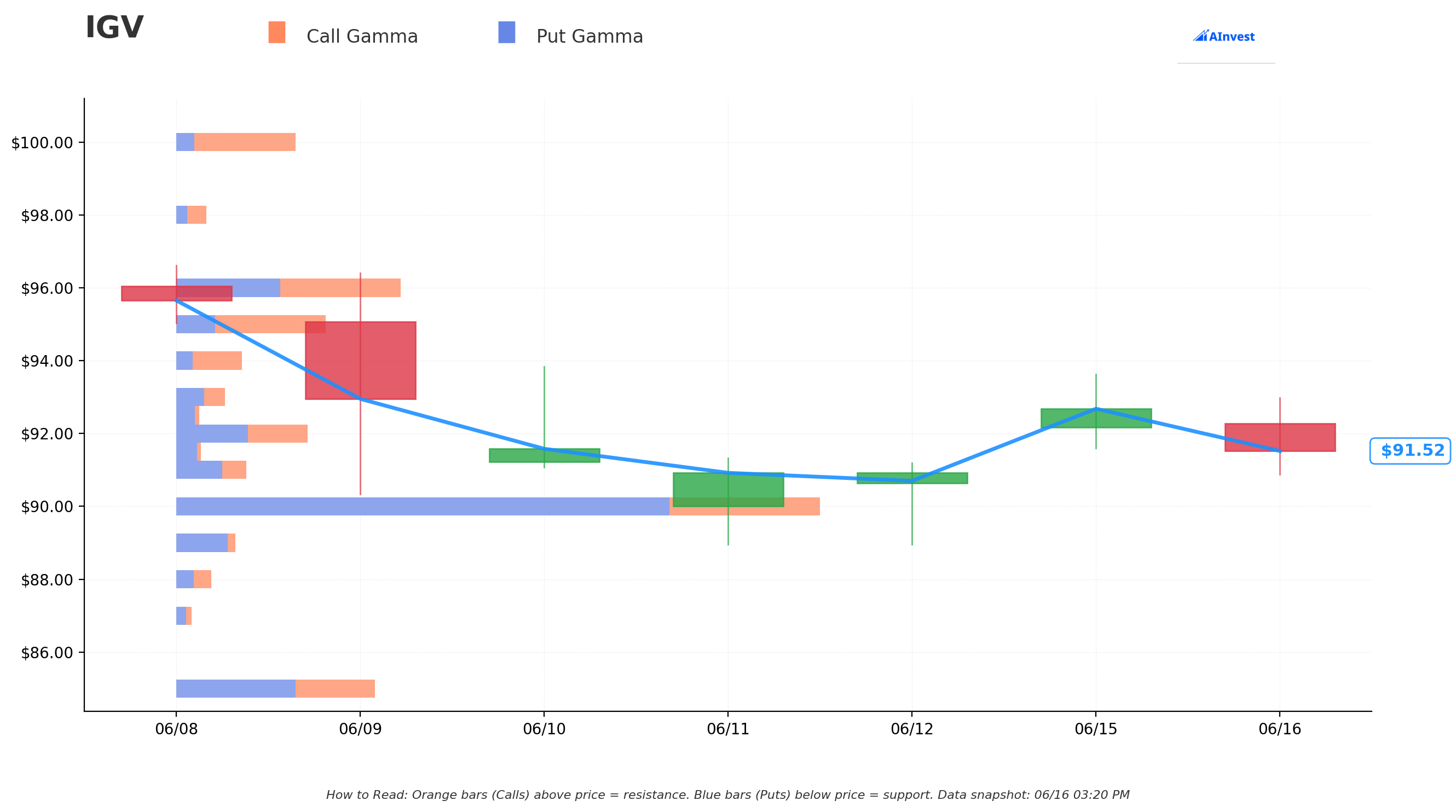
IGV is trading at ≈$91.49, bracketed by a very strong gamma support wall at $90.00 (total GEX ≈99.8, net put-heavy at −53.1) just ≈1.6% below spot and a resistance cluster at $92.00 (≈20.3 total GEX) immediately overhead at ≈0.5%. The $90 level has the densest options open interest on the board — market makers are heavily put-heavy there, which means a break below $90 removes the biggest gamma-support cushion and opens the path toward the next meaningful support at $85.00 (≈30.7 total GEX, ≈7.1% away) and then the hedge's target zone around $80.00 (≈16.1 total GEX, ≈12.6% away).
Key gamma levels from the options chain:
| Level | Type | Total GEX | Net GEX | Distance from Spot |
|---|---|---|---|---|
| $92.00 | Resistance | 20.3 | −1.9 (put-heavy) | +0.5% |
| $96.00 | Primary Resistance | 34.7 | +2.6 (call-heavy) | +4.9% |
| $100.00 | Resistance | 18.5 | +12.9 (call-heavy) | +9.3% |
| $91.49 | SPOT | — | — | — |
| $90.00 | Primary Support | 99.8 | −53.1 (put-heavy) | −1.6% |
| $85.00 | Support | 30.7 | −6.2 (put-heavy) | −7.1% |
| $80.00 | Support / Hedge Strike | 16.1 | −14.6 (put-heavy) | −12.6% |
| $75.00 | Support | 6.5 | −6.3 (put-heavy) | −18.0% |
The gamma structure is defensively skewed: put GEX dominates every major strike from $90 down, which reflects the market's existing downside-protective positioning on software. The hedge at $80 lands just above the last significant support wall at $75 and squarely on a gamma level that already carries ≈16 GEX units — not a strike chosen by accident.
Implied Move Context
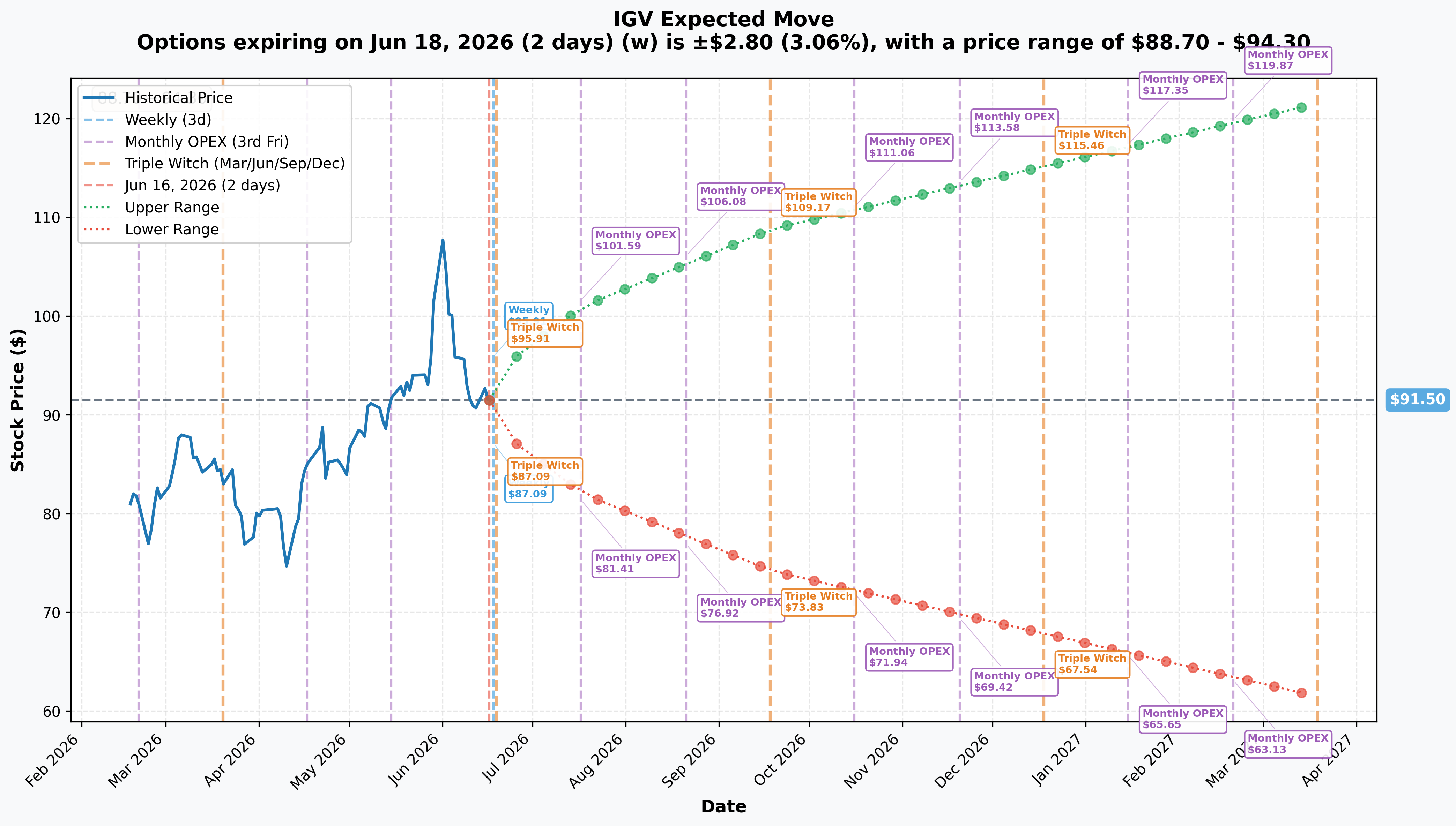
The options market's implied-move cone as of today:
| Horizon | Expiry | Implied Move | Upper Range | Lower Range |
|---|---|---|---|---|
| Weekly | 2026-06-18 | ±3.1% (±$2.80) | $94.30 | $88.70 |
| Monthly OPEX | 2026-07-17 | ±10.4% (±$9.47) | $100.97 | $82.03 |
| Quarterly | 2026-09-18 | ±18.9% (±$17.32) | $108.82 | $74.18 |
| Mar-2027 (put expiry) | 2027-03-19 | ±32.8% (±$30.05) | $121.55 | $61.45 |
The March-2027 implied cone spans $61.45 to $121.55 — a range of ≈$60 centered on current spot. The $80 put strike falls at roughly the 40th percentile of the downside distribution, meaning the market assigns a meaningful (though not majority) probability to IGV trading at or below $80 by expiration. The $74.23 breakeven sits just inside the quarterly (September) lower range of $74.18 — the put starts making money on a move roughly consistent with a September-OPEX worst-case scenario persisting through March.
Catalysts
The March-2027 expiration is deliberately long-dated because it brackets every major software earnings event over the next nine months.
Software earnings gauntlet (inside the put's life):
-
2026-07-28 — Microsoft (MSFT) fiscal Q4 2026 — Azure growth rate and Copilot monetization will be the market's bellwether for whether AI is a net tailwind or cost sink for mega-cap software. Microsoft is IGV's third-largest holding (≈7.75%). Date per Investing.com.
-
2026-08-10 — Palantir (PLTR) Q2 2026 — The fund's most richly valued holding (≈6.95%); any guidance wobble carries outsized index drag. Date per TipRanks.
-
Late Aug / early Sep 2026 — Salesforce (CRM) — The poster child for the seat-compression debate; a soft cRPO or guidance cut would validate the entire bear thesis. Prior-quarter filing per SEC 8-K.
-
2026-09-14 — Oracle (ORCL) fiscal Q1 2027 — IGV's largest holding (≈9.08%). Oracle's cloud/AI-infrastructure backlog is the key sentiment driver for the group. Date per TipRanks.
Structural overhang — AI seat compression:
The central fear is that agentic AI is breaking per-seat SaaS economics: one AI-augmented worker does the job of five, customers cut licenses, and revenue per customer shrinks even as the product improves. Per BetterCloud and Chargebee, multiple SaaS vendors reported slowing growth in Q4 2025 because AI worked too well. The industry is being forced toward usage-based pricing, which introduces budget volatility and erodes near-zero-marginal-cost economics.
Adobe as the most recent read-through (June 11, 2026):
Adobe reported a clean beat on June 11 — $6.62B revenue (+11% YoY), non-GAAP EPS $5.96 (+18%), AI-First ARR tripling past $500M, and full-year guidance raised. The stock still fell ≈−5.5% after hours, driven by CFO departure (effective June 15) and an explicit pivot away from short-term ARR maximization toward monthly-active-user growth — an acknowledgment of competitive AI pressure. Per Yahoo Finance and TechTimes. When even a tripling-AI-ARR beat gets sold, the de-rating is being driven by positioning and narrative, not fundamentals — exactly the regime in which long-dated downside protection is rational.
Rate path:
High-multiple software is among the most rate-sensitive equity cohorts. Per March 2026 FOMC minutes and The Motley Fool, the Fed's median projection collapsed to roughly one quarter-point cut for 2026 after officials raised inflation forecasts, and by late March Wall Street was pricing essentially no cuts for the remainder of the year. A higher-for-longer rate path removes the valuation tailwind software names needed and gives the hedger a second, independent reason to own downside.
Four-Reader Interpretation
YOLO trader: This is a 5,500-lot block put position expressing a bearish view on the entire software sector through March 2027. The ≈$5.77 premium per contract means you need IGV to fall below ≈$74.23 to profit at expiration. Maximum gain is large (a re-test of the 2026 lows and beyond); maximum loss is the full premium paid. The long time horizon means theta drag is slow initially but accelerates in the final months. This is not a near-term catalyst trade — it requires the de-rating thesis to keep unfolding over three quarters.
Swing trader: The most interesting near-term read is the gamma structure: the $90 support wall is the most heavily loaded level on the board (≈99.8 total GEX). A close below $90 with conviction would remove the dominant support cushion and could mechanically open the path toward $85 (next major support). The weekly implied range puts the lower bound at $88.70, so $90 is already within this week's expected move. Watch for a sustained break of $90 as a trigger signal.
Premium collector: The counterparty who sold these puts collected ≈$3.2M in premium and is now short 5,500 contracts of March-2027 $80 puts. That is a ≈11.5% cushion before intrinsic value kicks in. If you are not already in this trade, selling far-OTM put spreads on IGV (e.g., short $80 / long $75) can generate income while staying wide of the current gamma cluster — but recognize you are taking the other side of an institutional hedger who has a specific view on the downside.
Beginner: IGV tracks the software sector. The fund is already down ≈20.6% this year because investors fear that AI will reduce the number of software seats companies need to buy. Someone just paid ≈$3.2M to protect themselves (or bet) against IGV falling another ≈12% to $80 by March 2027. Think of it like buying insurance on a house in a flood zone: the flood may not come, and the insurance premium is a sunk cost, but if it does flood, the payout is large. The ≈$3.2M is the maximum the buyer can lose; the payoff grows as IGV falls further below $80.
Risks to the Thesis
Against the put (upside risks):
- Oversold bounce. Per The Motley Fool, some analysts argue the sector is now too cheap and that a dovish Fed surprise or strong Microsoft/Oracle print could spark a violent recovery that strands the hedge.
- AI-as-tailwind proof. Adobe's AI-First ARR tripled to $500M even in a challenged environment (TechTimes). If more vendors demonstrate AI monetization, the seat-compression fear deflates and multiples re-expand.
- IT sector EPS still leads. Information Technology is still projected to lead S&P sectors on YoY EPS growth, per Barchart — the fundamentals have not collapsed even as multiples de-rated.
- Theta drag. If IGV stabilizes in a range above $85 through year-end, the put loses time value steadily. A long-dated put that is not moving toward the money is an expensive way to wait.
What the tape cannot prove:
- We do not know the identity of the buyer or seller, the broker involved, or whether the buyer already holds IGV long exposure being hedged.
- The block cross format means both sides agreed on price off-market — we cannot infer from this print alone who was more motivated, buyer or seller.
- The prior-position check found no archive entry within 180 days for this exact strike/expiry combination, but a pre-existing position opened before that window remains possible. Next-day OI is the definitive answer.
Bottom Line
A desk negotiated a 5,500-contract block cross in IGV March-2027 $80 puts, paying ≈$3.2M for downside protection (or directional bearish exposure) on the software sector. The strike at $80 sits ≈11.5% below today's spot, just above the 52-week low zone already visited this year. The expiry at March 2027 spans the full earnings gauntlet: Microsoft (July 28), Palantir (August 10), Salesforce (late August/September), and Oracle (September 14) — four of the five largest holdings reporting inside the put's life. The gamma structure confirms the defensive skew: the $90 support wall carries the heaviest put open interest on the board, and a break below it mechanically opens the path toward $85 and then $80.
The trade does not shout urgency — block crosses are negotiated, not desperate. It says: a desk believes the software de-rating is not finished, that the next three quarters of earnings carry binary risk for a high-multiple, AI-exposed cohort, and that ≈$5.77/contract for nine months of protection on a sector already down ≈20.6% is fair or cheap. The $74.23 breakeven requires roughly a return to the 52-week low — a level this fund has already reached in 2026.
✅ RESOLVED (2026-06-17): clean new open confirmed. Next-morning OI read 9,769 (Δ +5,500 from 4,269) — the full block was a fresh long-put hedge, with none of it a close.
Last updated: 2026-06-17 — next-day OPRA OI confirmed a clean fresh open (+5,500).
Options trading involves substantial risk and may not be suitable for all investors. This analysis is for informational purposes only and does not constitute investment advice. Past performance of similar trades does not guarantee future results. All premium figures are approximate. Always verify open interest with next-day OPRA data before drawing conclusions about position direction.