🔄 IGV — CORRECTED: Not a Roll. A $10M Short Calendar in Software, and Both Legs Are Brand New
🔄 INVERSION — updated 2026-08-07 pre-market. We called this a roll; the next-day open interest says it was not. The whole case rested on one falsifiable number, and we published the test: if this was a roll, August-21 $100 open interest had to collapse toward 0–1,000 as the old short was retired. It did the opposite — 19,308 → 38,739, up 19,431, or 97.2% of the 20,000-lot buy. The old position is still there, untouched. Both legs opened. This is the alternative we named and set aside: a brand-new short (reverse) calendar — long the August $100 call, short the November $100 call, $10M net credit. The November leg confirmed as an open too (1,750 → 21,764). See the ✅ RESOLVED box below; the title, thesis and reader sections have been rewritten.
iShares Expanded Tech-Software Sector ETF tracks a market-cap-weighted index of US and Canadian software companies. Assets $14.72B, expense ratio 0.39%, trading at $99.30, down 1.98% (StockAnalysis). Follow it on the IGV fund page.
🤝 The Trade in Plain English
At 13:05:29, with the fund at $99.11, one package crossed as a multi-leg block cross — negotiated off the open book:
Buy 20,000 August-21 $100 calls at $2.28, and sell 20,000 November-20 $100 calls at $7.28.
Same strike, two expiries, near leg bought and far leg sold. That is the shape of a roll out in time — and it is also the shape of a short calendar spread. The two are indistinguishable on the tape. Open interest settled it the next morning, and it came back short calendar: see the ✅ RESOLVED box below.
| Time | Buy/Sell | C/P | Expiration | Strike | Size | Volume | OI (prior) | Option Price | Premium | Spot | Option Symbol |
|---|---|---|---|---|---|---|---|---|---|---|---|
| 13:05:29 | BUY | CALL | 2026-08-21 | $100 | 20,000 | 21,549 | 19,308 | $2.28 | $4,560,000 | $99.11 | IGV20260821C100 |
| 13:05:29 | SELL | CALL | 2026-11-20 | $100 | 20,000 | 20,215 | 1,750 | $7.28 | $14,560,000 | $99.11 | IGV20261120C100 |
Net: a $10,000,000 CREDIT. Package delta −141,400 shares — buying the August leg adds +939,600 and selling November removes −1,081,000, so the directional exposure barely changes.
⭐ Why We Read It as a Roll — and Why That Was Wrong
We pulled the history on both strikes:
| Strike | Open interest since June 1 | Aug-6, pre-trade |
|---|---|---|
| August-21 $100 (bought) | held 18,000–23,000 throughout | 19,308 |
| November-20 $100 (sold) | held 1,150–1,750 throughout | 1,750 |
They bought 20,000 against 19,308 outstanding — 103.6% of everything open at that strike — and sold 20,000 where barely 1,750 existed. Put beside a near-flat package delta, that looked like an existing August short being bought back and re-established in November.
We marked it a strong inference, not proof, and named the competing explanation explicitly: "a brand-new reverse calendar would produce a similar tape." That is what it turned out to be. The size-matching coincidence we thought was too precise to be accidental was, in fact, accidental — 20,000 is simply a round clip.
✅ RESOLVED — Both Legs OPENED. It Was a Short Calendar, Not a Roll.
Updated 2026-08-07 pre-market. The ≈06:30 ET OPRA snapshot (which reflects the August 6 close) has published, and it answers the single falsifiable question this article was built around.
| Leg | Baseline OI (Aug-6 snap) | If roll | If new position | Actual (Aug-7 snap) | Δ | Print size | Δ as % of print | Day vol | Verdict |
|---|---|---|---|---|---|---|---|---|---|
| Aug-21-2026 $100 C (bought 20,000) | 19,308 | ≈0–1,000 | ≈39,000 | 38,739 | +19,431 | 20,000 | ≈97.2% | 23,731 | 🔄 OPEN (BTO) — was called a roll-close |
| Nov-20-2026 $100 C (sold 20,000) | 1,750 | ≈21,700 | ≈21,700 | 21,764 | +20,014 | 20,000 | ≈100.1% | 20,220 | ✅ OPEN (STO) |
The August strike nearly doubled instead of emptying. That is the entire correction in one number. A roll must extinguish the near-dated line — you cannot close contracts and have the count go up. 19,431 brand-new August calls were created, meaning the buyer was opening long calls, not buying back a short.
The old August position is untouched. Whoever holds the ≈19,300 contracts that were outstanding on August 5 still holds them; they are simply now a minority of a 38,739-lot line. Our statement that "an existing short-call position in August was bought back" is retracted.
So what is it? A short calendar spread, also called a reverse calendar: long the near-dated August $100 call, short the far-dated November $100 call, at the same at-the-money strike, for a $10M net credit.
That is a different trade with a different risk profile than a roll. A roll is administration — same exposure, later clock. A short calendar is an active position with two distinct edges:
- It is short vega. The November call carries far more time-value sensitivity than the two-week August call, so the package profits if implied volatility on software falls, and loses if it rises.
- It is short the term structure. They sold three months of time value at $7.28 and bought two weeks of it at $2.28 — collecting the difference on a bet that the back month is expensive relative to the front.
- The real risk starts after August 21. Once the long front-month call expires, the protection disappears and what remains is a naked short November $100 call on an at-the-money strike. Unless it is closed or re-hedged, the loss above $100 is uncapped.
What is still unknowable. Open interest proves both legs are new. It cannot tell you whether fund shares sit behind the November short call (making it an overwrite rather than a naked short), whether the desk intends to hold past August expiry, or whether the front-month long is really there as protection versus as a way to cheapen margin.
🤓 What This Actually Means — Plain English
A calendar spread trades the same strike across two expiry dates. The ordinary version buys the far month and sells the near one. This is the reverse: buy the near month, sell the far month, and collect the difference — here $5.00 per share, $10M in total.
Why would anyone do that? Because the far-dated option is expensive. The November $100 call costs 3.2× the August one at the identical strike, purely for three extra months of time. Selling that and buying the cheap front month is a bet that the extra time is not worth what the market is charging — that software volatility settles down, or that IGV does not sit pinned at $100 into November.
The catch, stated plainly: the August call the trader owns expires in about two weeks. After that date they are left short a November call at a strike the fund is currently sitting on, with nothing above it. If software rallies between August 21 and November 20, that obligation grows without limit.
What it says about their view: neutral-to-bearish on software over three months, and specifically bearish on software volatility — willing to cap IGV at $100 through November, and being paid $10M for it.
⭐ The Cross-Reference Worth Noticing
IGV's top ten holdings are 59.42% of the fund, and three of them appear on today's flow board with their own large trades:
| Holding | Weight in IGV | What traded today |
|---|---|---|
| Microsoft | 9.47% | A $19.0M bull call spread, both legs new |
| Salesforce | 5.38% | A $7.96M call sale at $195 |
| Adobe | 3.68% | An $8.15M at-the-money call sale at $260 |
That is ≈18.5% of the fund with its own flow, and the direction is mixed: one bullish structure and two call sales. The fund-level trade — a newly opened short November call, financed by a cheap front-month long — leans with the sellers. Note that all three constituent trades resolved as confirmed opens in the same next-day snapshot, so the sector-level picture is genuinely new positioning rather than book-cleaning.
This does not prove anything about who is trading what. But when a sector fund and three of its largest constituents all see size on the same afternoon, it is worth knowing they exist together rather than reading each in isolation.
📊 The Charts
One-Year Price Action
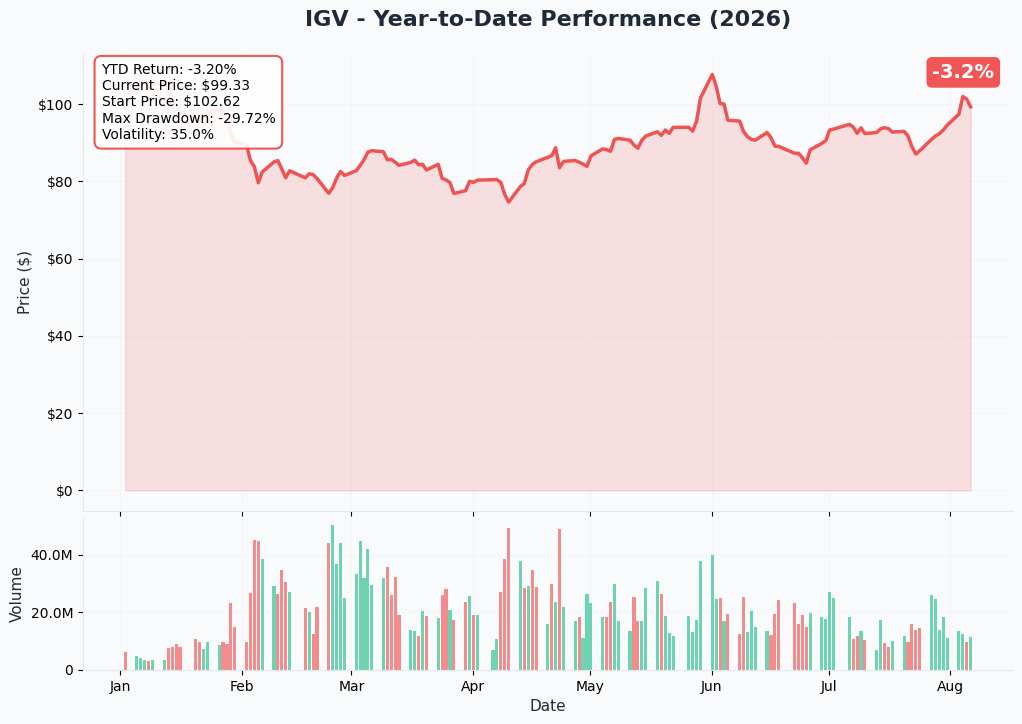
IGV is −3.2% over the past year on this chart; the fund's quoted one-year total return including distributions is −10.34% (StockAnalysis). It sits well below the 52-week high of $117.99.
Gamma Support and Resistance
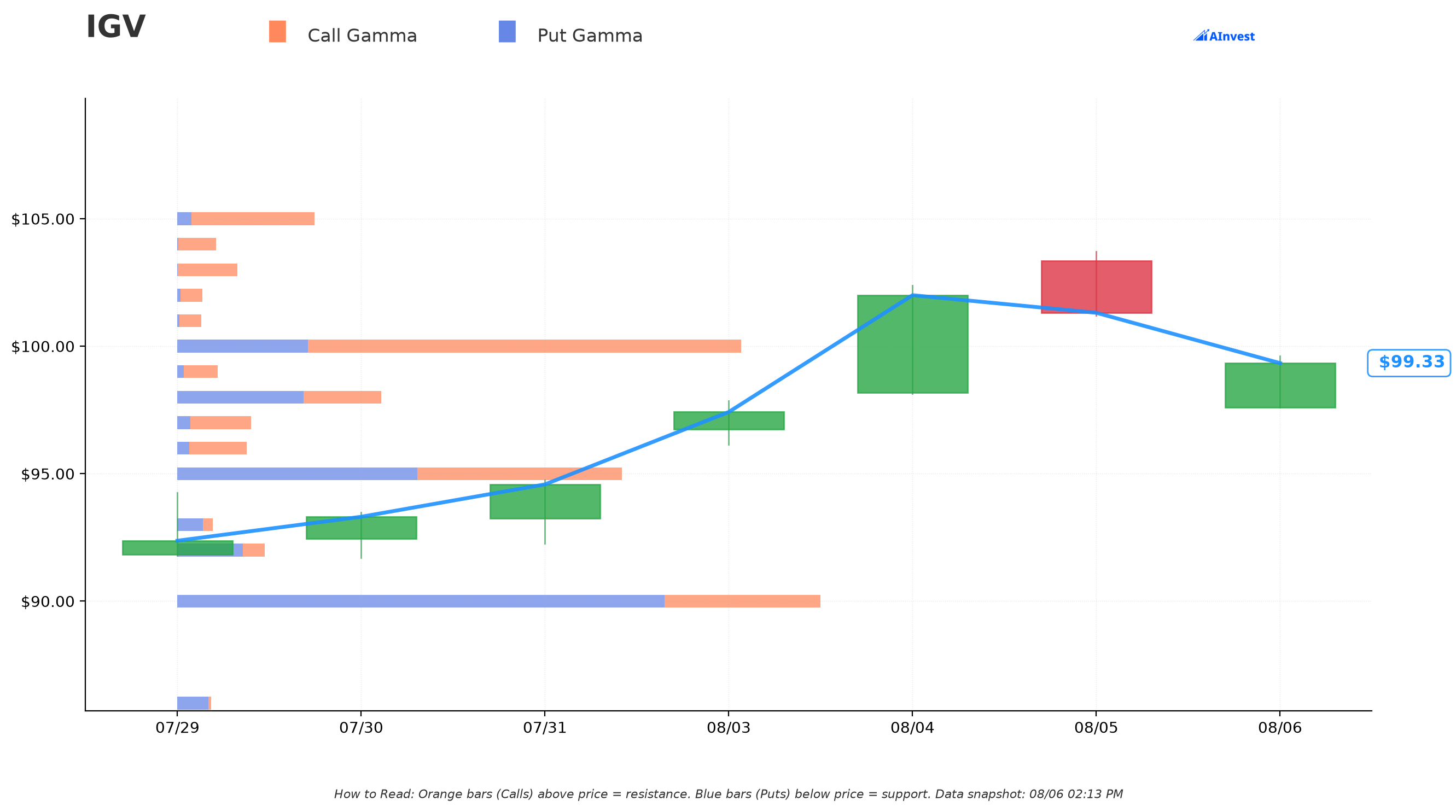
The chart shows where dealer hedging concentrates. The $100 strike is essentially at the money — the fund closed within 20 cents of it — so this position sits right in the densest part of the hedging book, where price tends to churn rather than trend.
Implied Move
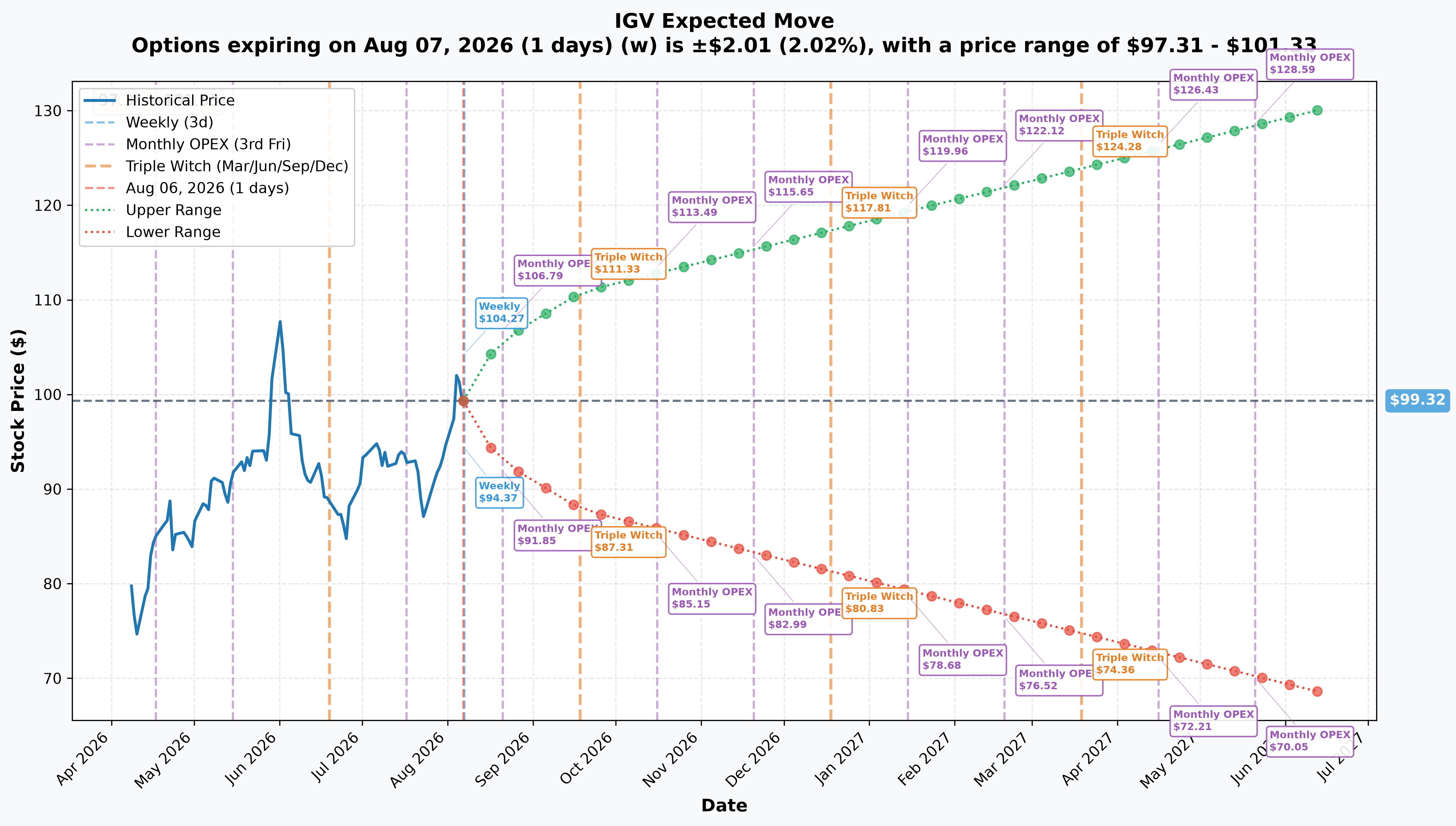
Compare the chain's expected range through November against the $100 strike and the $107.28 breakeven (strike plus the $7.28 collected on the November leg). The narrower the expected range relative to that breakeven, the more comfortable the seller's position.
📅 Catalysts
- Software is in a drawdown — the fund is down 10.34% over a year and another 1.98% today (StockAnalysis).
- The AI-disruption debate over per-seat software pricing is the structural question weighing on the sector, and it shows in the constituents: Salesforce is −27.4% and Adobe −22.8% over the past year.
- Salesforce reports August 26 (confirmed) — inside the November expiry. Adobe's forward date could not be sourced this session, so we are not asserting one.
- FOMC meetings remaining: September 15–16 (with projections), October 27–28, December 8–9 (Federal Reserve). The July 29 hold came on a 9–3 vote with three dissents preferring a hike (Federal Reserve) — the November expiry contains two of those meetings.
👥 Four Ways to Read This
🎲 The YOLO trader — still nothing to chase, but for a different reason than we first gave. This is not administration; it is a genuine new position. It is just not a directional one — the package delta is −141,400 shares against a $14.7B fund, which is close to noise. The bet is on volatility and time, not on where software goes next week.
📈 The swing trader — the marker is $100 through November, and it is now a new marker rather than an extended one. Somebody with size opened fresh willingness to cap the software sector at the money for three months. Watch the August 21 expiry: that is the date the front-month protection disappears and this becomes a naked short call.
💰 The premium collector — the discipline worth studying here is the term-structure trade, not a roll. The November call at $7.28 is worth 3.2× the August one at the same strike; this desk sold that richness and bought the cheap front month against it. Understand what you inherit at front-month expiry before copying the shape — an uncapped short call at the money is not a beginner's position.
🌱 The beginner — the real lesson is the one this article got wrong the first time. Same strike, two expiries, one bought and one sold can be either a roll (closing an old position, opening a new one) or a calendar spread (opening both). The tape looks identical. Only the next morning's open-interest count separates them: a roll makes the near-dated line shrink; a calendar makes it grow. Here it grew, from 19,308 to 38,739 — so it was a calendar.
⚠️ Honest Risk and Limits — What the Tape Cannot Prove
- The roll read was wrong and has been corrected. August-21 $100 open interest rose 19,431 instead of collapsing; both legs opened. This is a new short calendar, not a rolled-forward existing short.
- We cannot see whether fund shares or constituent positions sit behind this. A short November call against a long holding is income; standalone it is a directional view with uncapped upside risk.
- The November short call has no capped loss, and after the long August leg expires on August 21 there is nothing above it at all unless the desk acts.
- We cannot see the pre-existing August holders. Roughly 19,300 contracts were outstanding at that strike before this trade and remain outstanding; who owns them, and whether they are related to this package, is invisible.
- The constituent cross-reference is context, not evidence. Nothing links those trades to this one beyond the calendar.
Nothing here is investment advice.
Last updated: 2026-08-07 — 🔄 INVERSION. Next-day OPRA open interest refuted the roll thesis: August-21 $100 call open interest rose 19,308 → 38,739 (+19,431, 97.2% of the print) instead of collapsing toward 0–1,000, and the November-20 $100 call rose 1,750 → 21,764 (+20,014). Both legs opened — this is a newly established short (reverse) calendar spread, not a roll of an existing short. Title, thesis, plain-English, cross-reference, reader and risk sections were rewritten.