🔮 IONQ $7.7M Put Sale — Someone Is Getting Paid 24.5% of the Stock Price to Bet the Floor Holds at $35
📅 August 3, 2026 | 🔥 Unusual Activity Detected
✅ UPDATE — August 4, 2026 pre-market: confirmed an opening put sale. Open interest on the Jun-2027 $35 put rose 1,191 → 9,879 (+8,688) against a 7,933-lot print — ≈110%, so the block plus extra sellers opened. See the ✅ RESOLVED box.
🎯 The Quick Take
A trader sold 7,933 IonQ Jun-17-2027 $35 puts at $9.75, collecting $7.73 million in cash today. That's not a typo: the option itself cost 24.5% of the entire share price for a strike sitting just 12% below where IonQ trades right now. This is a premium sale, not a bullish "bet" — the seller is being paid handsomely to promise they'll buy 793,300 shares at $35 if the stock is there next June. We'll walk through exactly what that obligation looks like, why the premium is so rich, and what to watch for tomorrow morning.
📊 Company Overview
IonQ, Inc. (IONQ) offers quantum computing access through cloud platforms and dedicated services, generating revenue from quantum-computing-as-a-service, algorithm development consulting, and contracts to design and build specialized quantum systems.
- Market Cap: ≈$13.6 billion
- Industry (SIC): Services — Computer Integrated Systems Design
- Exchange: NYSE
- Current Price: $39.73 (spot at the time of this trade)
- YTD Performance: −14.7%
IonQ is a pre-profit, revenue-ramping quantum computing company — think "high-growth science project with a real, if small, revenue line," not an established cash-generative business. That framing matters for everything below.
💰 The Option Flow Breakdown
📊 What Just Happened
The Tape (August 3, 2026 @ 11:51:20):
| Time | Symbol | Buy/Sell | Call/Put | Expiration | Premium | Strike | Volume | OI | Size | Spot | Option Price | Option Symbol |
|---|---|---|---|---|---|---|---|---|---|---|---|---|
| 11:51:20 | IONQ | SELL | PUT $35 | 2027-06-17 | $7.73M | $35 | 8,713 | 1,191 | 7,933 | $39.73 | $9.75 | IONQ20270617P35 |
Flow type: 🤝 price-improvement auction — not a cross, not a lit sweep. This is a facilitated, exchange-run auction where a broker worked a large complex order to get the customer a better fill than the screen was showing. There's no visible counterparty aggression here the way there is on a lit sweep; it reads as a deliberate, negotiated-style execution for size.
✅ RESOLVED — Next-Day OI Is In (August 4, 2026 pre-market)
The OPRA open-interest snapshot timestamped August 4, 2026 ≈06:30 ET reflects the close of business August 3 — the definitive open-vs-close test we flagged when this published. Here is what it says.
| Leg | Baseline OI (Aug-3 snap) | Resolving OI (Aug-4 snap) | Δ | Print size | Δ as % of print | Verdict |
|---|---|---|---|---|---|---|
| Jun-17-2027 $35 put (sold) | 1,191 | 9,879 | +8,688 | 7,933 | ≈109.5% | ✅ OPEN (STO) |
Verdict: a genuine new short put — STO confirmed. Open interest rose by more than the flagged block, so not only did our 7,933 contracts open, other sellers opened at the same strike in the same session. Nobody was buying back an old short here. That matters for the reader: the $7.7M collected is premium taken in exchange for a live, newly-created obligation to buy IONQ at $35 through June 2027 — not a profit-taking exit on a position that already existed. The August 3 read stands.
🤓 What This Actually Means — Plain English
Let's decode this piece by piece, because "sold a put" gets thrown around loosely and the mechanics matter.
What is a put sale? When you sell a put, you're not buying insurance — you're selling it to someone else. You collect cash today ($9.75 per share × 7,933 contracts × 100 shares = $7,734,675) in exchange for a promise: if IONQ is below $35 on June 17, 2027, you must buy 793,300 shares at $35 each, no matter how low the stock has actually fallen. If IONQ is above $35, you keep the entire premium and walk away with nothing more to do.
The order type is STO — Sell To Open. This is a brand-new short put position, confirmed by the size (7,933) blowing past the prior open interest (1,191). They didn't buy back an old position; they built a new one.
Why is the premium so enormous? $9.75 on a $39.73 stock is 24.5% of the share price — for an option that's 12% out of the money and expires in about 10.5 months. Compare that to a "normal" large-cap stock, where a 12%-OTM, 10-month put might cost 3-6% of the share price. IONQ's options are pricing in massive uncertainty — huge potential upside from quantum-computing breakthroughs and revenue that's growing at 755% year-over-year, but also real potential for a violent drawdown if sentiment turns or a capital raise dilutes shareholders. The put seller is getting paid a rich premium precisely because the market is so unsure which way this goes.
The honest way to frame the "risk" here: if IONQ falls below $35, the seller's effective purchase price is $35 − $9.75 = $25.25 — about 36% below today's spot. Framed generously, that's someone effectively placing a deep-discount buy order on IonQ stock and getting paid $7.73M to wait for it to fill. Framed honestly, it's also a $27.8 million obligation (793,300 shares × $35) that comes due regardless of how far the stock has actually dropped — if IONQ is at $15 next June, they still must pay $35, eating a large loss on the shares before the premium offsets any of it.
Likely motive: this reads like a premium-collection / income play against a long-term bullish-to-neutral view — someone comfortable owning IONQ in the $25-35 zone, being paid up front for the privilege of maybe having to. It is not a leveraged bullish bet the way buying a call would be; the maximum gain is capped at the $7.73M collected, while the downside is large and uncapped down to zero. Selling puts on a volatile, pre-profit, story-driven stock like this is a high-risk strategy dressed up as "getting paid to wait" — the premium is generous specifically because the risk is real.
📈 Technical Setup / Chart Check-Up
YTD Performance Chart
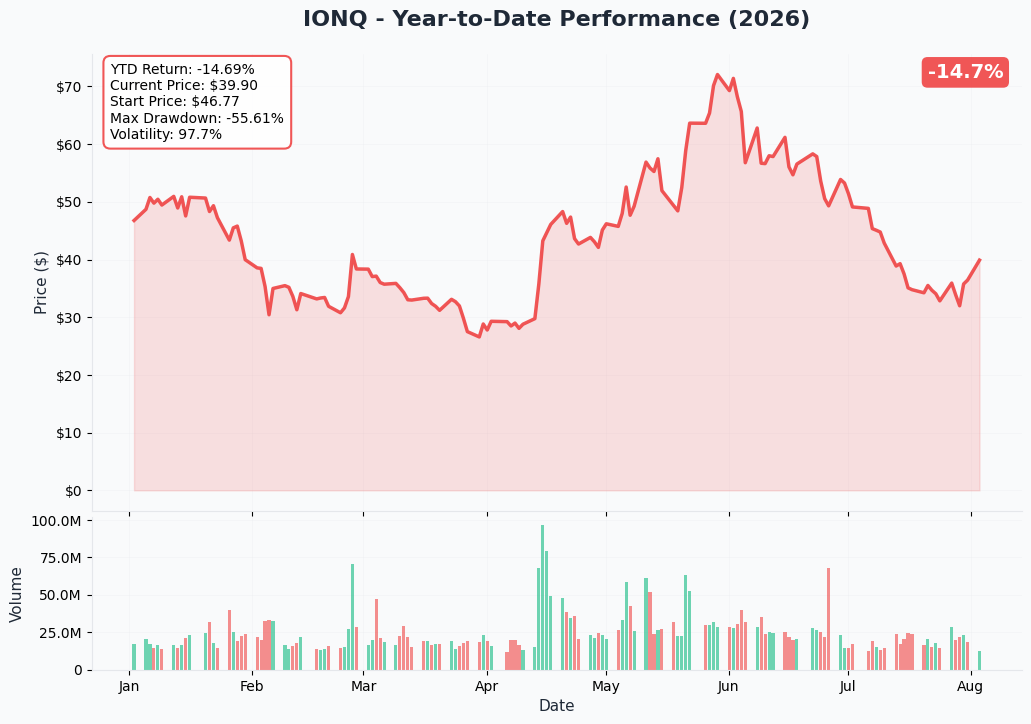
IonQ is down −14.7% year-to-date at $39.73 — a rocky ride for a stock that has, at various points, been one of the most talked-about quantum-computing names on the market. The chart reflects a name trading heavily on narrative and milestone announcements rather than steady fundamentals, which is exactly the kind of stock that carries an expensive options market.
Gamma-Based Support & Resistance Analysis
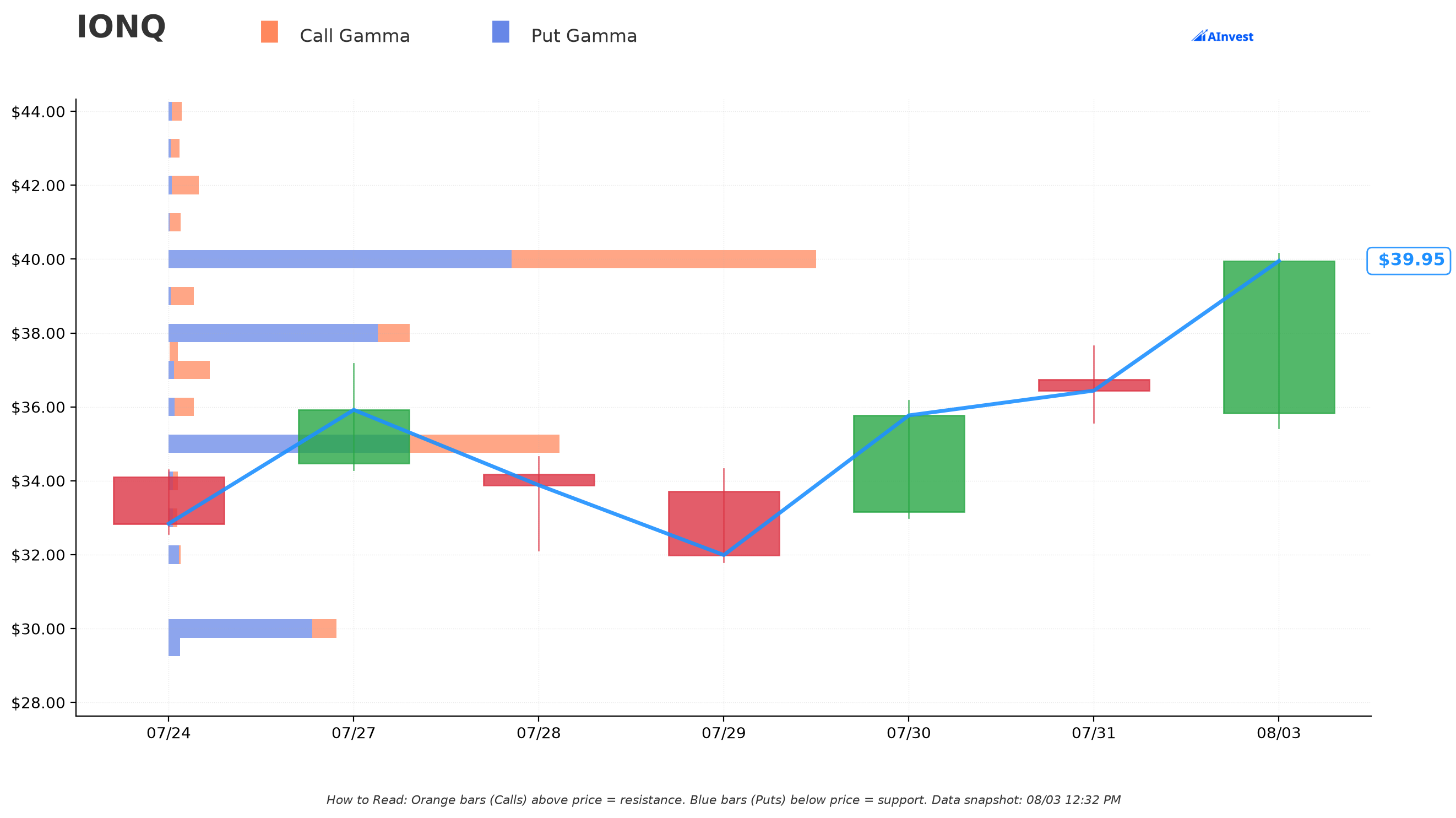
Current Price: $39.73–$39.92
- 🟠 Resistance: $40 — the single strongest gamma level on the board (8.18 total gamma), sitting almost exactly at spot (0.2% away). Dealers are heavily positioned here; expect this strike to act as a magnet/ceiling in the very near term.
- 🔵 Support: $38 — moderate support (3.04 total gamma), about 4.8% below spot.
- Secondary resistance builds again at $45 (4.61 gamma) and $50 (4.92 gamma) — both meaningfully above spot and would require a real rally to matter.
- Below $38, gamma thins out fast until $35 (4.94 total gamma, split roughly 1.9 call / 3.0 put) — notably, this is the exact strike of today's put sale. That's not a coincidence dealers will ignore: a reasonable amount of put open interest already lives at $35, and today's trade adds meaningfully to it.
What this means for traders: near-term price action is pinned around the $38–$40 zone, and the $35 strike — where this put was sold — already carries real gamma weight. If IONQ drifts down toward $35 in the coming months, dealer hedging flows around that strike could add to volatility exactly where this seller now has skin in the game.
Implied Move Analysis
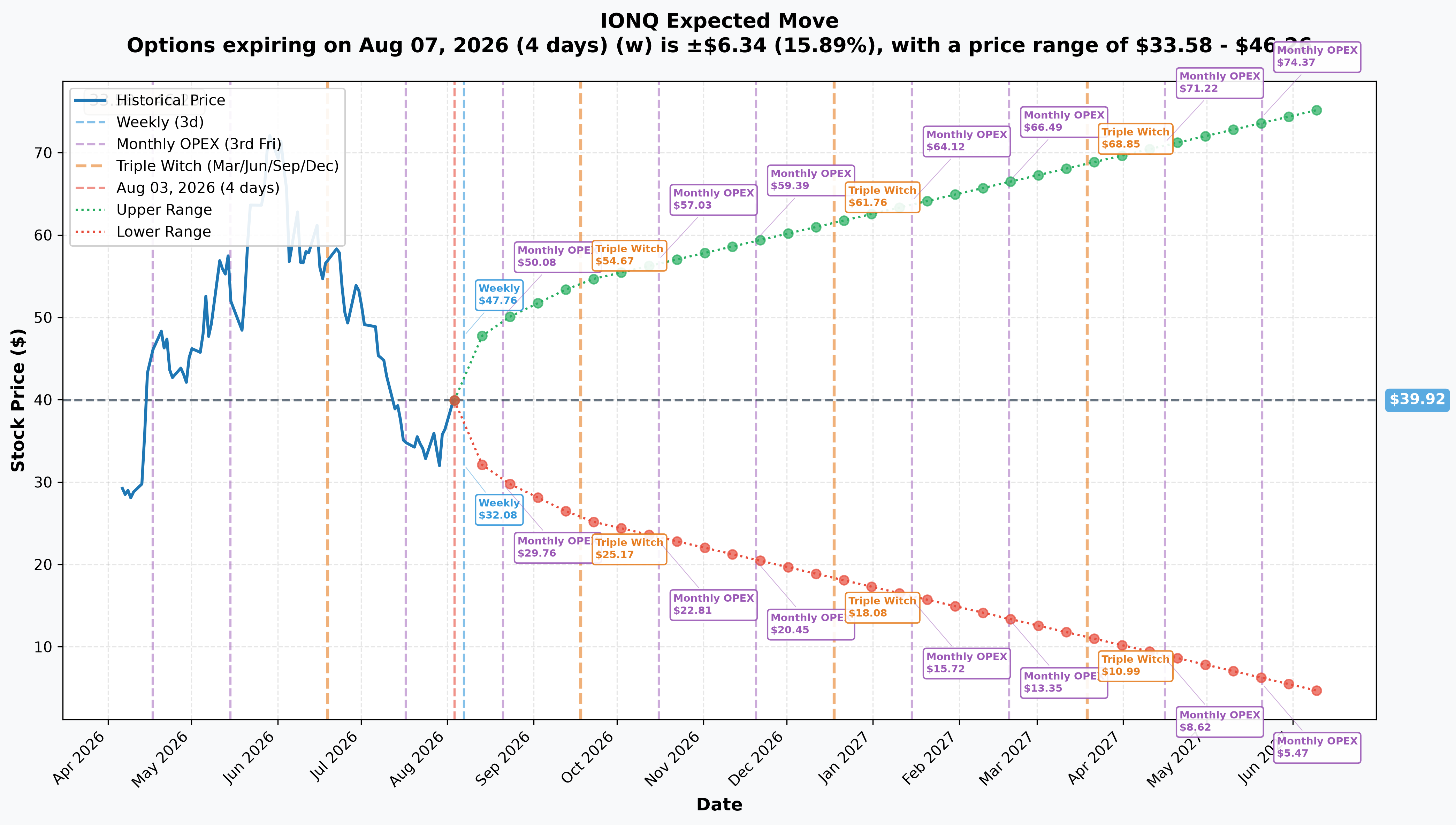
This is where IONQ's volatility becomes impossible to ignore:
- 📅 Weekly (Aug 7 — 4 days): ±$6.34 (±15.9%) → Range: $33.58 – $46.26
- 📅 Monthly OPEX (Aug 21 — 18 days): ±$9.83 (±24.6%) → Range: $30.09 – $49.75
- 📅 Quarterly Triple Witch (Sep 18 — 46 days): ±$14.43 (±36.2%) → Range: $25.49 – $54.35
- 📅 LEAPS / this trade's expiry (Jun 17, 2027 — 318 days): ±$35.87 (±89.8%) → Range: $4.05 – $75.79
Read that last line again: the options market is pricing a plausible range for IONQ over the next ≈10.5 months that runs from roughly $4 to roughly $76 — nearly a 19x spread between the low and high end. That is an extraordinary implied range even for a volatile small-cap, and it's the single clearest evidence for why a 12%-OTM put sold at this expiry commands 24.5% of the share price in premium. The put seller's $35 strike sits comfortably inside that wide cone, not at either extreme — which is exactly why they're being paid so much: the market genuinely doesn't know if $35 will look expensive or cheap by next June.
🎪 Catalysts
🔥 Immediate — Next 7 Days
Q2 2026 Earnings — August 5, 2026, after market close. IonQ announced it will report second-quarter results just two days after this put was sold, with a conference call at 4:30 PM ET. Guidance calls for Q2 revenue of $65–68 million. This is the first major volatility event the put seller has to sit through — earnings on a name with a 15.9% weekly implied move is a real test of conviction almost immediately after putting the trade on.
🚀 Near-Term (Next 1–3 Months)
SkyWater Technology acquisition — completed July 31, 2026. IonQ finalized its purchase of SkyWater Technology, described as the largest exclusively U.S.-based semiconductor foundry, paying SkyWater shareholders $15.00 cash plus 0.4883 IonQ shares per share. Regulatory approval cleared just days earlier, on July 28, 2026. The stated goal is a vertically integrated quantum platform spanning computing, networking, security, and sensing, with a domestic semiconductor supply chain feeding IonQ's own chip needs. IonQ CEO Niccolo de Masi called it a move to "crystalize IonQ's vision to serve as technology leader," while SkyWater CEO Thomas Sonderman said it will "accelerate multiple engineering pathways for next-generation quantum chips." An investor day covering the combined company is planned for Q3 2026 — that's a real catalyst still ahead, and it lands well within the life of this put.
This acquisition matters directly to the put seller's risk: large stock-and-cash M&A deals bring integration risk, and IonQ issued new shares as part of the consideration — something to watch for further dilution as the deal settles into the share count.
Q1 2026 results (reported May 6, 2026) set the growth narrative in motion. IonQ posted record GAAP revenue of $64.7 million, up 755% year-over-year, beating its own guidance midpoint by 30%, and raised full-year 2026 revenue guidance to $260–270 million. Backlog (remaining performance obligations) grew 554% year-over-year to $470 million. On the balance sheet, IonQ holds ≈$3.1 billion in cash, equivalents, and investments — a genuinely strong cushion that reduces near-term dilution risk even though the company runs a substantial adjusted cash burn (adjusted EBITDA loss of $96.8 million and negative operating cash flow of $151 million in the quarter). That cash pile is the reason a stock this volatile can still credibly promise it won't run out of money before June 2027 — but continued heavy spending on manufacturing capacity and deployment resources means further capital raises down the road are not off the table.
🔬 Technology Roadmap Inside This Put's Life (Now Through June 2027)
Fault-tolerant quantum computing roadmap — published April 22, 2026. IonQ published a technical report laying out an "end-to-end path to scaling fault-tolerant quantum computers to 10,000 physical qubits and beyond," building on a previously established 99.99% two-qubit fidelity milestone. The report emphasizes technical transparency over direct competitive benchmarking versus IBM, Google, or Rigetti — meaning the near-term stock reaction to quantum milestones tends to hinge on announced firsts (IonQ frames itself as first to link remote ion-traps via entanglement, first to convert quantum frequencies to telecom wavelengths) rather than head-to-head performance comparisons investors can independently verify. Expect more roadmap updates and milestone claims between now and June 2027 — this is a name where headlines move the stock as much as earnings do.
Photonic interconnect and networked systems. IonQ has been building out quantum networking capability (entanglement-based interconnects, telecom-wavelength conversion) alongside its core trapped-ion computing business — infrastructure plays like the Clavis XG Multiplex quantum security product (June 17, 2026) and the Florida LambdaRail statewide quantum-safe network partnership (April 27, 2026) show the company diversifying revenue beyond pure quantum-computing-as-a-service into commercial networking and sensing products (it also launched a commercial InSAR Earth-monitoring service in May 2026). More announcements of this type — real but early-stage commercial wins — are likely between now and next June, and each is a potential catalyst in either direction depending on how the market reads their materiality.
Competition: IBM, Google, and Rigetti are all racing the same clock. IonQ's public materials do not offer direct head-to-head technical comparisons, but the broader quantum-computing race (superconducting-qubit efforts from IBM and Google, trapped-ion and photonic approaches from smaller players like Rigetti and others) means IonQ's story depends on continuing to claim technical "firsts" and land paying commercial and government contracts faster than the field catches up. Any competitor announcement that leapfrogs IonQ's stated fidelity or scaling claims is a realistic risk to sentiment over a 10-month window — quantum names as a group tend to trade in sympathy with each other on both good and bad news.
⚠️ Separating announced milestones from revenue: it's worth being explicit that IonQ's technical announcements (qubit counts, fidelity records, network "firsts") are largely research and engineering achievements, not yet the primary driver of the $64.7M in quarterly revenue, which comes mostly from cloud QCaaS access, consulting, and system-build contracts. Don't conflate a strong lab result with near-term cash flow — the stock often reacts to both as if they were the same thing, and that gap is part of why implied volatility runs so hot.
🎲 What This Means for Different Traders
🎰 YOLO Trader
You're not going to copy a $7.73M put sale with retail size — the margin requirement alone (793,300 potential shares) is out of reach. But the read-through is useful: if you're bullish and want leveraged upside without selling naked puts, a smaller cash-secured put at a strike you'd genuinely be happy owning IONQ at (maybe $30 or $25, well below this $35 print) captures some of the same "get paid to wait" logic with a strike you can actually afford to be assigned on. Do not sell a put you can't afford to have exercised — a 793,300-share obligation only works because someone has that kind of capital.
🌊 Swing Trader
The $40 gamma wall is the number to watch this week, especially into the August 5 earnings print. A clean break and hold above $40 targets the next resistance shelf near $45; a rejection there into earnings could see IONQ test the $38 support fast, especially given a 15.9% weekly implied move. This is a binary-event week — size accordingly.
💰 Premium Collector
This trade is a real-world template, just executed at institutional size. If you like IonQ's long-term quantum story but don't want to chase it at $39.73, selling a cash-secured put well below spot (with a strike and expiry sized to your actual account, likely far smaller than 7,933 contracts and probably a nearer-dated expiry to manage risk) is the textbook version of what happened here: collect rich premium, set a discount buy price, accept the obligation is real. Just remember the effective cost basis if assigned ($25.25 here) still needs to make sense as a long-term hold — quantum computing stocks can and do fall well below any strike you pick.
🌱 Beginner
Selling a put means you're being paid to promise to buy a stock at a set price later — you collect cash now, but you take on real risk of loss if the stock falls a lot. It is not a way to make free money, and it is not the same as being bullish the way buying a call is. IONQ is an especially risky name to practice this on: it's a small, unprofitable, story-driven quantum computing stock with an options market pricing in an almost 90% possible price swing over the next ten months. If you're new to options, this is a name to watch and learn from, not one to trade in size.
⚠️ Risk Factors & Honest Limits
- What the tape proves: a genuine, brand-new short put position (7,933 contracts vs. 1,191 prior OI), executed via a price-improvement auction, collecting $7.73M in premium. That part is fact.
- What the tape cannot prove: the seller's full portfolio, whether they hold other IonQ positions (long stock, other options) that this put is part of a larger strategy around, their true motive, or whether they intend to hold this short to expiration or close it early. We have no visible equity hedge tied to this specific print.
- The obligation is real and large. Below $35 at expiration, the seller must buy 793,300 shares for ≈$27.8 million, regardless of how far the stock has fallen — a stock that carries an implied range down to roughly $4 over this timeframe on the options market's own pricing.
- Ten-plus months is a long time for a story stock. Two more earnings reports, ongoing SkyWater integration, an investor day, and an unknown number of technical-milestone headlines all happen before this put expires. Any one of them can move IONQ double digits in a single session.
- Cash position is a genuine positive ($3.1B) but it does not eliminate dilution risk from an unprofitable company still burning roughly $150M a quarter in operating cash flow and having just issued new shares for the SkyWater deal.
- This is not investment advice. Options trading involves substantial risk of loss and is not suitable for all investors — selling naked puts, in particular, carries obligations that can exceed the premium collected many times over. This analysis is educational; verify all figures independently and size any position to what you can genuinely afford to have assigned.
🎯 The Bottom Line
Real talk: someone collected $7.73 million today for promising to buy IonQ at $25.25 net if the stock is below $35 next June — and they're being paid that much specifically because IONQ's options market is pricing an almost 90% possible move over the next ten months. This is not a bullish "whale bet" in the way a big call purchase would be; it's a premium-collection trade on one of the most volatile, story-driven names in the market, with a real $27.8 million obligation sitting behind it. Come back tomorrow morning for the OI confirmation, watch the August 5 earnings print two days from now as the first stress test, and don't mistake "got paid a lot of money" for "safe trade" — the premium here is rich precisely because the risk is large.
Disclaimer: Options trading involves substantial risk of loss and is not suitable for all investors. This analysis is for educational purposes only and not financial advice. Selling puts carries an obligation to buy shares that can result in losses well beyond the premium collected. Always do your own research and consider consulting a licensed financial advisor before trading.
Last updated: August 4, 2026 — next-day OPRA open-interest resolution added (✅ RESOLVED box above). Original analysis published August 3, 2026.