🐻➡️🐂 KKR $2.25M Bull Put Spread — Someone Is Betting the Bleeding Stops at $95
📅 August 3, 2026 | 🔥 Unusual Activity Detected
⚠️ CORRECTION — August 4, 2026 pre-market: this was not a cleanly-built new spread. Open interest on the $90 put fell 27,367 → 21,802 (−5,565) — the direction we said would mean part of this leg was closing. The $95 put opened as published (4,436 → 19,109). Read together: a desk rolled a short put UP from $90 to $95, so the $5.25M capped-loss figure below cannot be asserted. See the ✅ RESOLVED box.
🎯 The Quick Take
A trader collected a $2.25 million credit on KKR & Co. (KKR) in the December 18, 2026 expiration — selling 15,000 of the $95 puts and buying 15,000 of the $90 puts as a single floor-negotiated package. We published it as a textbook bull put spread. The next-day open-interest snapshot revised that: open interest at the $90 strike fell by 5,565 contracts, meaning a large part of the "buy" was closing an existing short $90 put, not buying a floor. Read correctly, this is a short put rolled UP from $90 to $95 — the seller now needs KKR above $95 rather than $90, and the $5.25M capped-loss arithmetic below assumes a long $90 put floor the open-interest data does not support. The interesting part isn't the mechanics — it's the backdrop: KKR is down ≈19.7% YTD even as the company just announced a burst of M&A activity, which makes this look like a bullish-lean income bet on a beaten-down name rather than a crash hedge.
📊 Company Overview
KKR & Co. Inc. (NYSE: KKR) is one of the world's largest alternative asset managers, with roughly $723B in total managed assets and $585B in fee-earning AUM as of late 2025. The firm runs two core segments: asset management (private equity, credit, infrastructure, energy, and real estate, plus public credit and hedge/fund platforms) and insurance (through Global Atlantic Financial Group, its retirement/annuity and life insurance business).
- Market Cap: ≈$93 Billion
- Sector/Industry: Investment Advice (alternative asset management)
- Exchange: NYSE
- Current Price (at trade time): $103.67
- YTD Performance: ≈−19.7% (52-week range $82.67 – $152.10)
💰 The Option Flow Breakdown
📊 What Just Happened
A two-leg floor-negotiated block printed at 11:48:46, 15,000 contracts on each leg, both expiring December 18, 2026. Spot at the time: $103.67.
| Time | Symbol | Buy/Sell | Call/Put | Expiration | Premium | Strike | Volume | Prior OI | Size | Spot | Option Price | Option Symbol |
|---|---|---|---|---|---|---|---|---|---|---|---|---|
| 11:48:46 | KKR | SELL | PUT $95 | 2026-12-18 | $8.40M | $95 | 15,003 | 4,436 | 15,000 | $103.67 | $5.60 | |
| 11:48:46 | KKR | BUY | PUT $90 | 2026-12-18 | $6.15M | $90 | 15,016 | 27,367 | 15,000 | $103.67 | $4.10 |
🤝 BLOCK CROSS (floor-negotiated) — this printed as a manual floor block, not a lit sweep. A broker matched both legs off the open book with a known counterparty on the other side. There's no aggression here to read into; the whole package was worked and crossed at once.
- Collected $8.40M selling the $95 put, paid $6.15M buying the $90 put
- Net CREDIT: $1.50/share = $2.25M on a $5-wide spread
- Max loss: $5.25M (($5.00 − $1.50) × 15,000 × 100)
- Package delta: +101,100 shares — mildly bullish-leaning, nowhere near a full directional bet
✅ RESOLVED — Next-Day OI Is In (August 4, 2026 pre-market)
The OPRA open-interest snapshot timestamped August 4, 2026 ≈06:30 ET reflects the close of business August 3 — the definitive open-vs-close test we flagged when this published. Here is what it says.
| Leg | Baseline OI (Aug-3 snap) | Resolving OI (Aug-4 snap) | Δ | Print size | Published read | Verdict |
|---|---|---|---|---|---|---|
| Dec-18-2026 $95 put (sold) | 4,436 | 19,109 | +14,673 | 15,000 | STO (proven open) | ✅ OPEN (STO) — ≈98%, confirmed |
| Dec-18-2026 $90 put (bought) | 27,367 | 21,802 | −5,565 | 15,000 | BTO ⏳ provisional | ⚠️ PARTLY CLOSING — read revised |
We said exactly what a falling number would mean, and it fell. The article's test: "if OI on the $90 strike rises by roughly 15,000, this was a fresh spread; if OI falls instead, part of this was closing an old position and the 'textbook bull put spread' read needs revisiting." Open interest fell by 5,565.
What the arithmetic supports, stated precisely. Our block was 15,000 of the 15,018 contracts that traded at the $90 strike all day, so the OI change is attributable to it. For open interest to fall, both sides of those trades must have been closing — which means the buyer was buying back a short $90 put it already held. Between ≈5,565 and ≈10,282 of the 15,000 contracts bought were closing an existing short $90 put position. The remainder either opened, or matched against sellers who were themselves closing longs. The tape cannot narrow it further.
⚠️ What this changes for a reader
- This is best read as a short put rolled UP, from $90 to $95, not as a bull put spread built from scratch. The desk retired downside obligation at $90 and wrote more of it at $95 — a higher strike, more premium, and a higher stock price required to stay out of trouble.
- The "$5.25M maximum loss" figure below assumes the desk holds 15,000 long $90 puts as a floor. Open interest at that strike went down, not up, so that assumption is not supported. Do not treat the capped-risk arithmetic as a description of what was actually established. The credit collected is real; the floor underneath it is not proven.
- The bullish lean survives, and arguably strengthens. Rolling a short put up means getting more comfortable, not less: the roller now needs KKR to hold $95 rather than $90 through December. The directional message published August 3 — someone betting the bleeding stops — is intact. What changes is the risk profile: less defined than a spread, and dependent on a protective leg we cannot verify.
🤓 What This Actually Means — Plain English
This is a bull put spread (also called a short put vertical): sell a higher-strike put, buy a lower-strike put, same expiration, and pocket the difference in premium up front.
Order types, decoded:
- The $95 put is STO (Sell To Open) — proven, since size > prior OI. They're collecting premium for taking on the obligation to buy KKR at $95 if it's below there at expiry.
- The $90 put is BTO (Buy To Open), provisionally — it functions as insurance that caps how much they can lose if KKR really falls apart. But remember, we can't yet prove this wasn't partly closing an existing position; treat the "BTO" label as the working assumption pending tomorrow's OI.
Why sell a put spread instead of just selling a naked put? Selling the $95 put alone would collect more premium ($8.40M) but expose the seller to unlimited-down-to-zero risk. By also buying the $90 put, they cap the worst case at $5.25M. That's the entire point of a spread: less premium collected, but a hard floor on the loss.
The arithmetic retail traders should sit with: this trade risks $5.25M to make $2.25M — a payoff ratio worse than 1:2. That only makes sense if the seller believes the odds of KKR holding above $95 through December are meaningfully better than roughly 70%. It is not a "free money" trade; it's a bet that a already-battered stock has found its floor.
Worked payoff at expiration (December 18, 2026), per the full 15,000-contract package:
| KKR price at expiry | What happens | P&L |
|---|---|---|
| $110 | Both puts expire worthless | +$2.25M (max profit) |
| $103 (near today's spot) | Both puts expire worthless | +$2.25M (max profit) |
| $95 | Short put exactly at the money, no intrinsic value yet | +$2.25M (max profit, right at the edge) |
| $92 | Short put has $3 of intrinsic value, long put still worthless | −$2.25M (a loss, between the strikes) |
| $90 | Short put has $5 of intrinsic value; long put at the money | −$5.25M (max loss reached) |
| $85 | Both puts deep in the money, spread value capped at $5 wide | −$5.25M (max loss, capped — doesn't get worse) |
Breakeven is $93.50 (the $95 strike minus the $1.50 credit collected). Below that, the position loses money; below $90, the loss is capped and doesn't get worse no matter how far KKR falls.
Motive: Selling downside insurance on a stock that's already down ≈19.7% for the year is a classic "the selling is overdone" income trade — collect a premium for agreeing to buy shares at $95 (≈8.3% below the current $103.67) if the market keeps punishing KKR, while capping the worst case at $90. It's a bullish-lean bet, but a modest, risk-defined one — not a full-conviction long.
📈 Technical Setup / Chart Check-Up
YTD Performance Chart
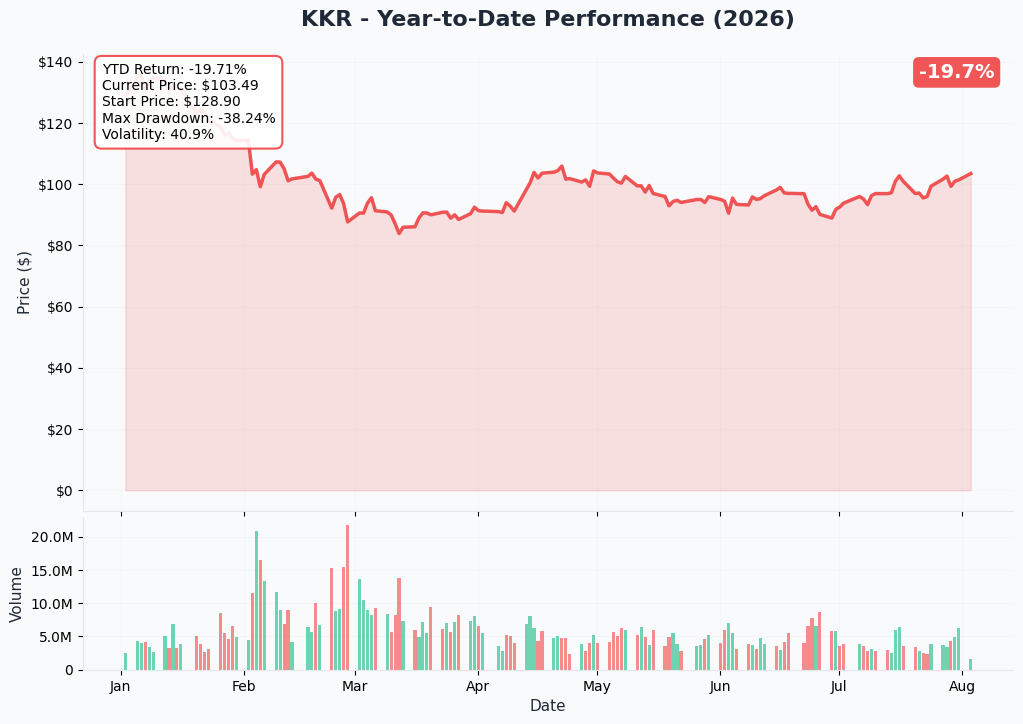
KKR opened the year near $127 and now sits at $103.67, down ≈19.7% YTD even after a run of dealmaking headlines. The stock's 52-week range spans $82.67 to $152.10 — this is a name that has been under real, sustained pressure, not just a one-day dip.
Gamma-Based Support & Resistance Analysis
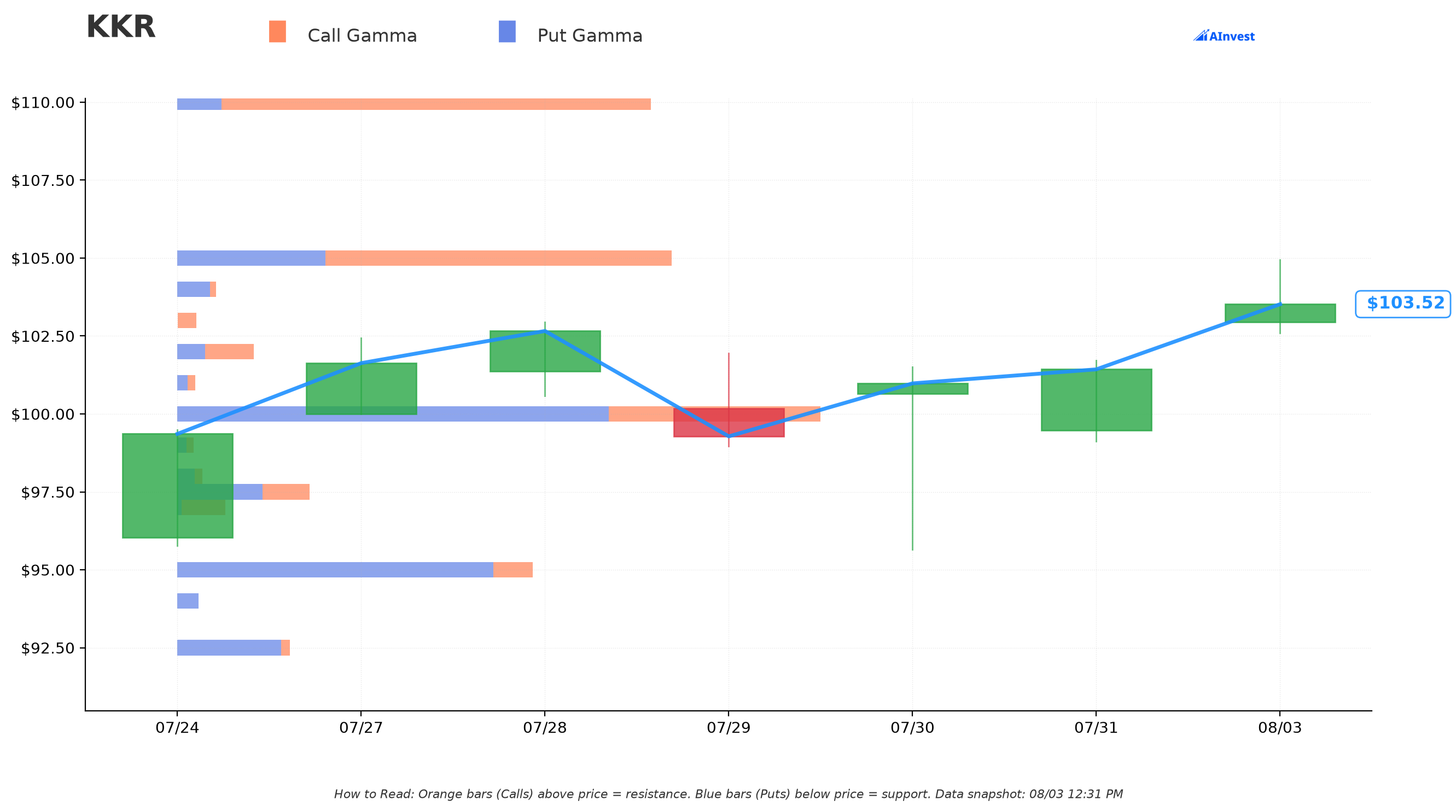
Current Price: $103.55
- 🔵 $100 support (≈3.4% below spot) — the strongest nearby level, ≈$5.6B total gamma, mostly put-driven (≈$3.76B puts vs. $1.84B calls). This is the first line of defense dealers will lean on if KKR slips.
- 🟠 $105 resistance (≈1.4% above spot) — moderate, ≈$4.3B total gamma, call-dominated (≈$3.0B calls). A near-term ceiling right above where KKR is trading now.
- 🟠 $110 resistance (≈6.2% above spot) — moderate, ≈$4.1B total gamma, call-heavy (≈$3.7B calls). The next real overhead level if KKR breaks out.
- 🔵 $95 (the short put strike, ≈8.3% below spot) — ≈$3.1B total gamma, dominated by puts (≈$2.75B). This new short put adds directly onto an already put-heavy zone.
- 🔵 $90 (the long put strike, ≈13.1% below spot) — the single heaviest gamma level on the whole chain at ≈$4.6B, almost entirely puts (≈$4.44B). This is the market's real "floor" zone — exactly where this trade's long put sits for protection.
What this means for traders: the spread's two strikes ($95 and $90) sit directly on top of the two biggest existing put walls below KKR's price. That's not a coincidence — the trader is selling premium into, and buying protection at, levels where dealer hedging flows already concentrate.
Implied Move Analysis
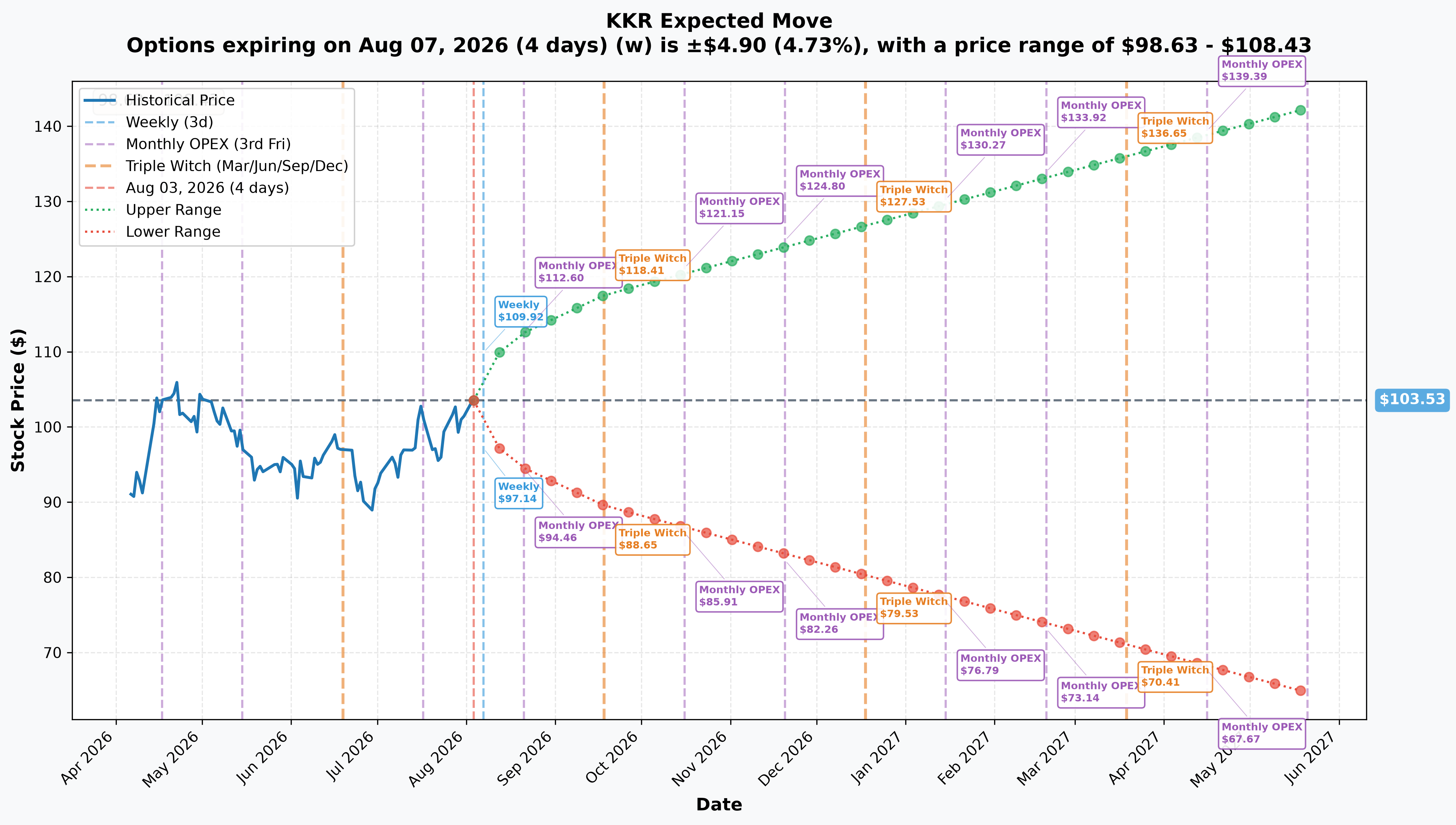
- 📅 Weekly (Aug 7 — 4 days): ±4.73% (±$4.90) → Range $98.63 – $108.43
- 📅 Monthly OPEX (Aug 21 — 18 days): ±8.76% (±$9.07) → Range $94.46 – $112.60
- 📅 Quarterly Triple Witch (Sep 18 — 46 days): ±13.59% (±$14.07) → Range $89.46 – $117.60
- 📅 December 18, 2026 (this trade's expiration — ≈137 days): implied range ≈$79.53 – $127.53
- 📅 Yearly LEAPS (May 21, 2027 — 291 days): ±37.57% (±$38.90) → Range $64.63 – $142.43
Translation: the options market itself is pricing a one-standard-deviation band of roughly $79.53 to $127.53 by this trade's December expiration. The $95 short strike sits comfortably inside that band — nothing unusual about landing there. But the $90 long strike sits close to the lower edge of what the market considers a "normal" move, meaning the very kind of swing the market already prices as plausible could push this trade close to its max loss. This is a real, non-trivial risk — not a tail-only scenario.
🎪 Catalysts
✅ Already Happened (Past Catalysts, Setting the Stage)
Q2 2026 Earnings Beat — July 30, 2026 KKR posted $1.63 EPS against a $1.43 estimate and $5.73B in revenue versus a $2.55B estimate — a sizable beat on both lines, driven by growth in asset management and the Global Atlantic insurance business, according to MarketBeat's recent news roundup. Despite the beat, KKR remains down ≈19.7% YTD — a disconnect between fundamentals and price that's central to why this trade reads as "betting the selling is overdone" rather than momentum-chasing.
A Dealmaking Blitz Into Early August 2026 In the days right around this trade, KKR announced or closed a run of large transactions:
- Agreed to acquire medical-device maker Integer Holdings for approximately $5.7 billion (announced August 2–3, 2026)
- Acquired a 50% stake in TotalEnergies' European renewable energy portfolio (≈1.2 GW), announced August 2–3, 2026
- Partnered with Blackstone and Brookfield on a $16 billion Kuwait oil-infrastructure agreement (July 27, 2026)
- Agreed with Energy Capital Partners to acquire Ireland-based DCC Energy for approximately $7.7 billion (July 27, 2026)
- Closed a $19.2 billion infrastructure fund
Detail on the current stock quote, YTD move, and this cluster of dealmaking headlines: MarketBeat's KKR overview and StockAnalysis.com's KKR profile. All of this deal activity falls before the trade's December 18, 2026 expiration and is part of why the stock ticked up on trade day (+2.18%) — the market is digesting whether this much capital deployment is a sign of confidence or overreach.
Analyst Price-Target Raises Post-Earnings Following the Q2 beat, multiple analysts raised price targets into the $118–$135 range, with the consensus rating sitting at Moderate Buy / Buy and an average target near $125–$130 — implying meaningful upside from the $103.67 print level, per MarketBeat.
🔮 Ahead of December 18, 2026 (Falls Inside This Trade's Expiry Window)
Q3 2026 Earnings — Expected Late October 2026 Based on KKR's usual reporting cadence (Q2 landed July 30), the Q3 2026 report should arrive in late October or very early November 2026 — squarely inside this spread's window. That means the position has to survive a full quarterly earnings print before expiration. A repeat beat like Q2's would help the short $95 put decay comfortably out of the money; a miss, especially one raising questions about the pace of debt-funded dealmaking (Integer, DCC Energy, TotalEnergies, Kuwait) would pressure the stock toward the $95–$90 zone where this trade actually loses money.
Integration and Financing Risk From the Recent Deal Spree With roughly $29B+ in newly announced or closed transactions (Integer, TotalEnergies stake, Kuwait infrastructure, DCC Energy, plus the $19.2B fund) layered on in the span of about a week, the market will be watching how KKR finances and integrates this activity over the rest of the year. Any signs of balance-sheet strain, financing cost pressure, or delayed closings would be a headwind landing before December 18.
Sector-Wide Rate and Private-Credit Sensitivity As an alternative asset manager with a large insurance/annuity book through Global Atlantic, KKR's earnings are sensitive to the path of interest rates (affecting both its credit portfolio yields and its insurance liabilities) and to broader private-credit market health. Neither is a company-specific event with a fixed date, but both are persistent background risks that could move the stock meaningfully before this spread expires.
🎲 Price Targets & Probabilities
Using the gamma map and implied-move data above, here's how the setup maps to this spread's payoff zones through December 18, 2026:
📈 Bull Case (the spread's target zone)
KKR stays above $95 — full $2.25M profit retained
This is what the trade is built to capture. It requires KKR to hold above the $100 gamma support and the $95 short strike through expiration — plausible if the Q3 earnings beat continues, the recent M&A is well-received, and analyst price-target raises ($118–135) start to close the gap with the current $103.67 price. The $105 and $110 gamma resistance levels above spot are realistic near-term targets if sentiment turns.
🎯 Base Case
KKR chops in the $95–$110 range
Most likely scenario given the stock's recent volatility (52-week range $82.67–$152.10) and a fresh cluster of un-integrated acquisitions to digest. The spread still expires at max profit anywhere above $95, so this base case is actually fine for the position — it doesn't need a rally, just no further collapse.
📉 Bear Case
KKR breaks below $95, tests the $90 floor
Given the stock is already down ≈19.7% YTD, a continuation of that trend — on a Q3 earnings miss, financing/integration concerns from the deal spree, or broader private-credit jitters — could push KKR back toward the heavy $90 gamma/put wall. Between $95 and $90 the position loses money; at or below $90 the loss is capped at $5.25M and doesn't get worse.
💡 Trading Ideas
🛡️ Conservative: Watch, Don't Chase
Given the trade sizes involved ($8.40M and $6.15M legs), this isn't a structure retail traders should try to replicate at scale. Watch tomorrow's OI print on the $90 strike to see whether this was a clean new spread or partly a close, and watch how KKR trades around the Q3 earnings date before doing anything.
⚖️ Balanced: A Much Smaller Mirror Spread
If you like the "beaten-down stock probably holds $95" thesis but want defined, retail-sized risk, consider a small $95/$90 December 18 put spread of your own — same strikes, same expiration, a fraction of the size. You collect a smaller credit but cap your loss at the same $5-wide risk per contract, and you're not exposed if the OI resolution tomorrow changes the read on the institutional trade.
🚀 Aggressive: Sell the Naked $95 Put (Advanced Only)
Skip the protective $90 put and just sell the $95 put outright for more premium — but understand this means unlimited downside risk down to zero, not the capped $5.25M this institutional trader chose. Only appropriate for accounts prepared to take assignment and own KKR at $95 if it goes wrong.
⚠️ Risk Factors
- The $90 leg's open/close status is unresolved. Size (15,000) is below prior OI (27,367) on that strike — we cannot prove today whether this completed a fresh spread or partly closed an existing position. That materially affects how confidently this should be read as a "textbook new bull put spread."
- This risks more than it can make. $5.25M max loss against $2.25M max profit is a worse-than-1:2 payoff ratio — it only works if the probability of holding above $95 is well above what a 1:2 ratio would suggest is fair.
- A busy quarter of earnings and deal integration sits inside the expiration window. Q3 2026 earnings and the digestion of roughly $29B+ in recently announced acquisitions both land before December 18, 2026.
- KKR is a genuinely volatile name. A 52-week range of $82.67–$152.10 and a ≈19.7% YTD decline show this stock can move hard in either direction; the options market's own implied range for this expiration ($79.53–$127.53) already brackets both strikes in this trade.
- What the tape cannot tell us: broker/MMID identity, the counterparty's true motive, whether this is a standalone bet or part of a larger portfolio hedge, and any offsetting stock or other options positions not visible in this print.
🎯 The Bottom Line
Real talk: someone collected $2.25 million to bet that KKR — down almost 20% this year despite a genuine flurry of acquisitions — holds above $95 through mid-December. It's a floor-negotiated, risk-defined trade, not an aggressive lit sweep, and the risk/reward (risking $5.25M to make $2.25M) is honest about the fact that this isn't a slam dunk — it only pays off if the market's pessimism on KKR has gone too far.
If you're watching this stock: the $95–$100 zone is the level to track. Hold above it and this trade (and the broader "the selloff is overdone" thesis) looks right. Break below $95 and head toward $90, and both this position and the bull case start to hurt.
Mark your calendar:
- 📅 Late October / early November 2026 — expected Q3 2026 earnings, the key catalyst inside this trade's window
- 📅 December 18, 2026 — expiration of this $95/$90 bull put spread
- 📅 Tomorrow, pre-market (≈06:30 ET) — next-day OPRA open interest on the $90 put resolves whether this was a fresh spread or a partial close
Disclaimer: Options trading involves substantial risk of loss and is not suitable for all investors. This analysis is for educational purposes only and is not financial advice. Past performance doesn't guarantee future results. The open/close status of the $90 put leg is unresolved as of this writing — treat the "fresh bull put spread" framing as provisional pending next-day OI. Always do your own research and consider consulting a licensed financial advisor before trading.
About KKR & Co. Inc.: KKR is one of the world's largest alternative asset managers, running private equity, credit, infrastructure, energy, and real estate strategies alongside a large insurance business through Global Atlantic Financial Group, with a market cap of roughly $93 billion.
Last updated: August 4, 2026 — next-day OPRA open-interest resolution added (✅ RESOLVED box above). Original analysis published August 3, 2026.