🧬 KOD: A $4.7M Put Spread That Expires Two Months Before the Data
📅 2026-08-13 | 🤝 Block Cross Detected
🎯 The Quick Take
At 14:40:57 ET a desk printed 6,000 October-16 $40 puts at $8.13 and 6,000 October-16 $15 puts at $0.23 in Kodiak Sciences — same strike count, same millisecond, same expiration.
That is one put spread, not two trades. The reported buy of the $40s and sale of the $15s nets to a ≈$4.74 million debit — not the ≈$4.88M the upper leg alone suggests.
Both legs had essentially no open interest before today — the $40 line sat at zero all week, the $15 line at four contracts. This is a brand-new position, and that part is not in doubt.
Here is the detail that reframes it. Kodiak's Phase 3 PEAK topline — the readout that actually decides this company — "remains on track for December 2026." This option expires October 16. Whatever this desk is positioning for, it cannot be the data.
🏢 Company Overview
Kodiak Sciences is a clinical-stage biopharmaceutical company developing therapeutics for retinal disease. It has no product revenue — every dollar of its valuation rests on trials that have not yet reported.
| Attribute | Value |
|---|---|
| Price at the print | $41.54 |
| Session close | $39.98 — the stock fell −7.90% on the day |
| Market cap | $2.54B |
| Shares outstanding | 62.44M |
| Sector / industry | Healthcare / Biotechnology |
| Revenue (TTM) | none |
| Net income (TTM) | −$230.66M · EPS −4.16 |
| Cash | $169.5M (Q1 2026) |
| 52-week range | $8.29 – $47.84 |
| Analyst consensus | Strong Buy, average target $65.00 |
Source: KOD overview
The valuation is entirely forward-looking. A $2.54B market capitalisation with no revenue, a −$230.66M annual loss and $169.5M of cash is a company whose share price is a wager on December's readout. It has already risen from a $8.29 52-week low.
💰 The Trade, in Plain English
| Time | Buy/Sell | Call/Put | Expiration | Premium | Strike | Volume | OI | Size | Spot | Option Price | Option Symbol |
|---|---|---|---|---|---|---|---|---|---|---|---|
| 14:40:57 ET | BUY | PUT | 2026-10-16 | ≈$4,878,000 | $40 | 6,000 | 0 | 6,000 | $41.54 | $8.13 | KOD20261016P40 |
| 14:40:57 ET | SELL | PUT | 2026-10-16 | ≈$138,000 | $15 | 6,000 | 4 | 6,000 | $41.54 | $0.23 | KOD20261016P15 |
Net debit: ≈$4,740,000. Printed as a negotiated block cross — a known counterparty took the other side, off the open order book. No liquidity was taken and no urgency is implied.
The economics of the structure:
| Measure | Value |
|---|---|
| Net cost | ≈$4.74M ($7.90 per share) |
| Breakeven | $32.10 — a ≈22.7% fall from the print |
| Maximum profit | ≈$10.26M, reached at or below $15 |
| Maximum loss | ≈$4.74M, if KOD is at or above $40 on October 16 |
| Reward-to-risk | ≈2.2 : 1 |
The $40 put is slightly out of the money with the stock at $41.54, so its entire $8.13 is time value — roughly 20% of the share price for nine weeks. That is a very expensive put, and it is priced that way because the market genuinely expects this stock to move.
✅ RESOLVED — Both Legs Opened; the Cleanest Result on the Board
Updated 2026-08-14 pre-market. Resolving OPRA snapshot timestamped August 14 (reflects the August 13 close, after this print); baseline is the August 13 snapshot (reflects the August 12 close, before this print).
| Leg | Baseline (Aug-13) | Resolving (Aug-14) | Δ | Print size | Capture | Verdict |
|---|---|---|---|---|---|---|
| Oct-16 $40 put (bought) | 0 | 6,005 | +6,005 | 6,000 | 100% | ✅ OPEN (BTO) |
| Oct-16 $15 put (sold) | 4 | 6,001 | +5,997 | 6,000 | 100% | ✅ OPEN (STO) |
Exactly as predicted, on both legs. A strike that held zero contracts every session from August 3 through August 13 now holds 6,005. The spread was built from nothing, so there was never an open-versus-close question here — and the snapshot confirms it.
The structure stands as published: a genuine new Oct-16 $40/$15 bear put spread, ≈6,000 wide, still expiring two months before the December topline readout. That timing mismatch was the article's point and the confirmation does not soften it.
🤓 What This Actually Means — Plain English
A put spread is a bet on a fall, with both the cost and the payoff capped.
You buy a put at a higher strike — here $40 — which gains value as the stock drops. To offset the cost you sell a put at a lower strike — here $15 — which someone else pays you for. You keep the difference between the two as your position, and your maximum gain is fixed at the distance between the strikes.
What makes this particular spread unusual is how little the sold leg contributes. The $15 put brought in $0.23 against the $8.13 paid — it recovers under 3% of the cost. Normally a trader sells the lower strike to meaningfully cheapen the trade. Three percent does not do that.
So why sell it at all? Look at what it gives up. Below $15 this position stops making money. A plain $40 put would keep gaining all the way down. The desk surrendered the entire crash payoff — a collapse to single digits — for $138,000.
That only makes sense if you think a crash cannot happen before this option expires. And on the calendar, it cannot: the Phase 3 PEAK topline that could genuinely halve this stock is guided to December, two months after October 16. The event that would pay off below $15 is not in the window. So the desk sold that impossible tail and pocketed the change.
Read plainly, this is a position for an ordinary decline — a give-back in a stock that has run from $8.29 to nearly $48 — not for a clinical disaster. The structure itself tells you the buyer knows exactly when the data lands.
📈 Technical Setup
Year-to-Date Performance
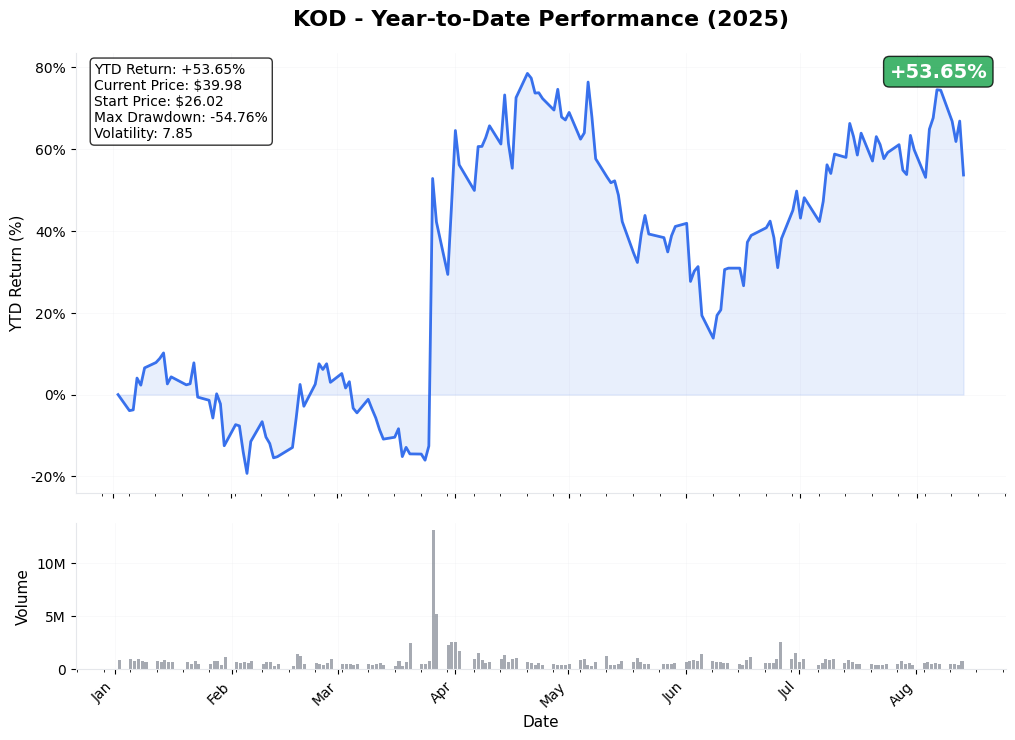
KOD is up ≈54% year to date, having started 2026 near $26. It sits well off the $47.84 52-week high, and fell 7.90% on the day this trade printed — closing at $39.98, below the $40 strike that was bought.
🔵🟠 Gamma-Based Support & Resistance
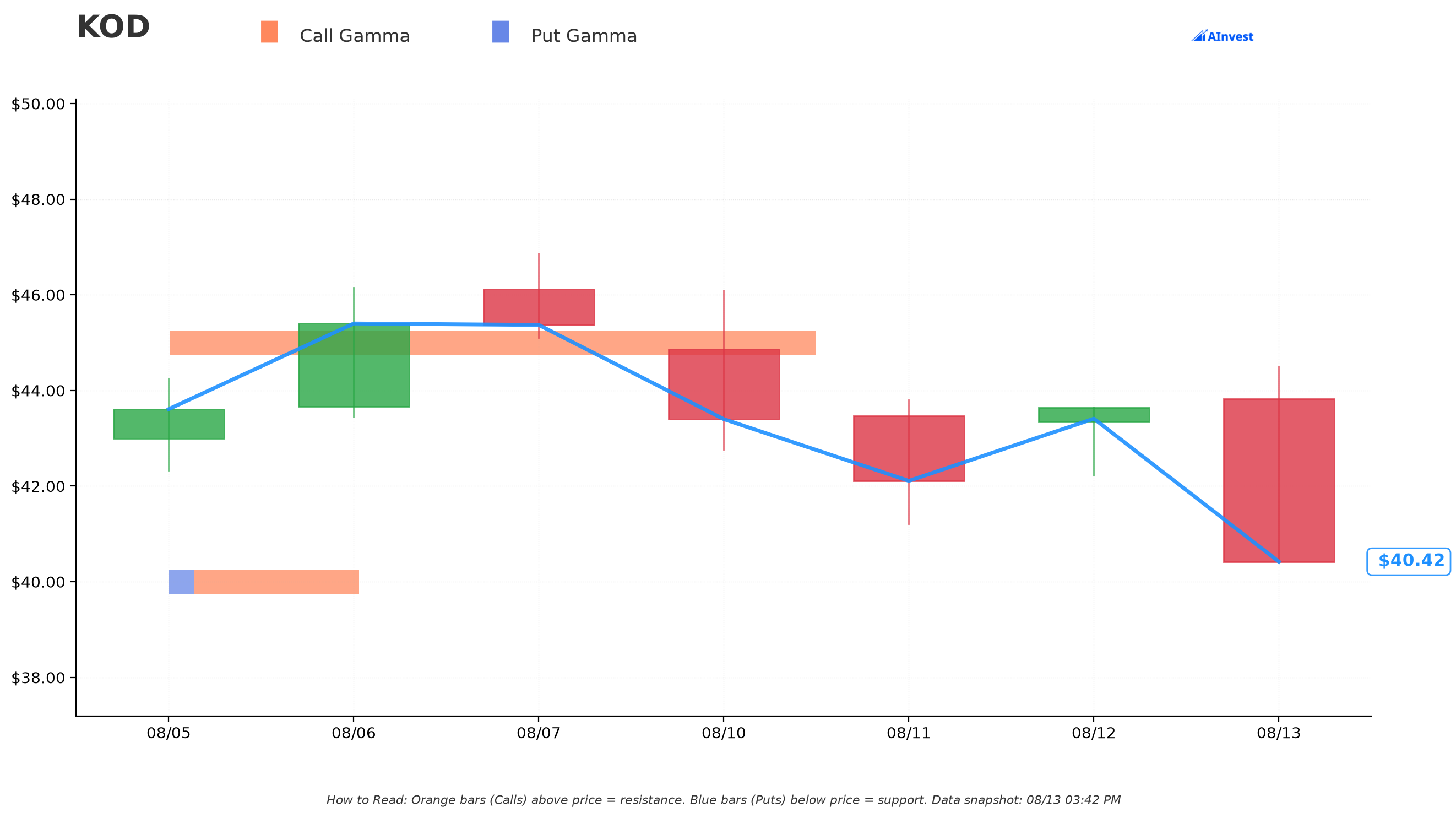
| Level | Strike | Strength |
|---|---|---|
| Resistance | none returned | — |
| Spot | ≈$40.33 | — |
| Support | none returned | — |
Being honest about this chain: it produced no material gamma levels at all. Only three strikes ($35, $40, $45) carry meaningful open interest. We are not going to manufacture support and resistance from three data points.
That thinness is itself the finding. With almost no dealer gamma concentrated anywhere, there is no structural pinning in this name — nothing mechanically holding the price near a strike. A stock with a thin options chain and a binary ahead of it moves on news, not on positioning.
🎯 Implied Move
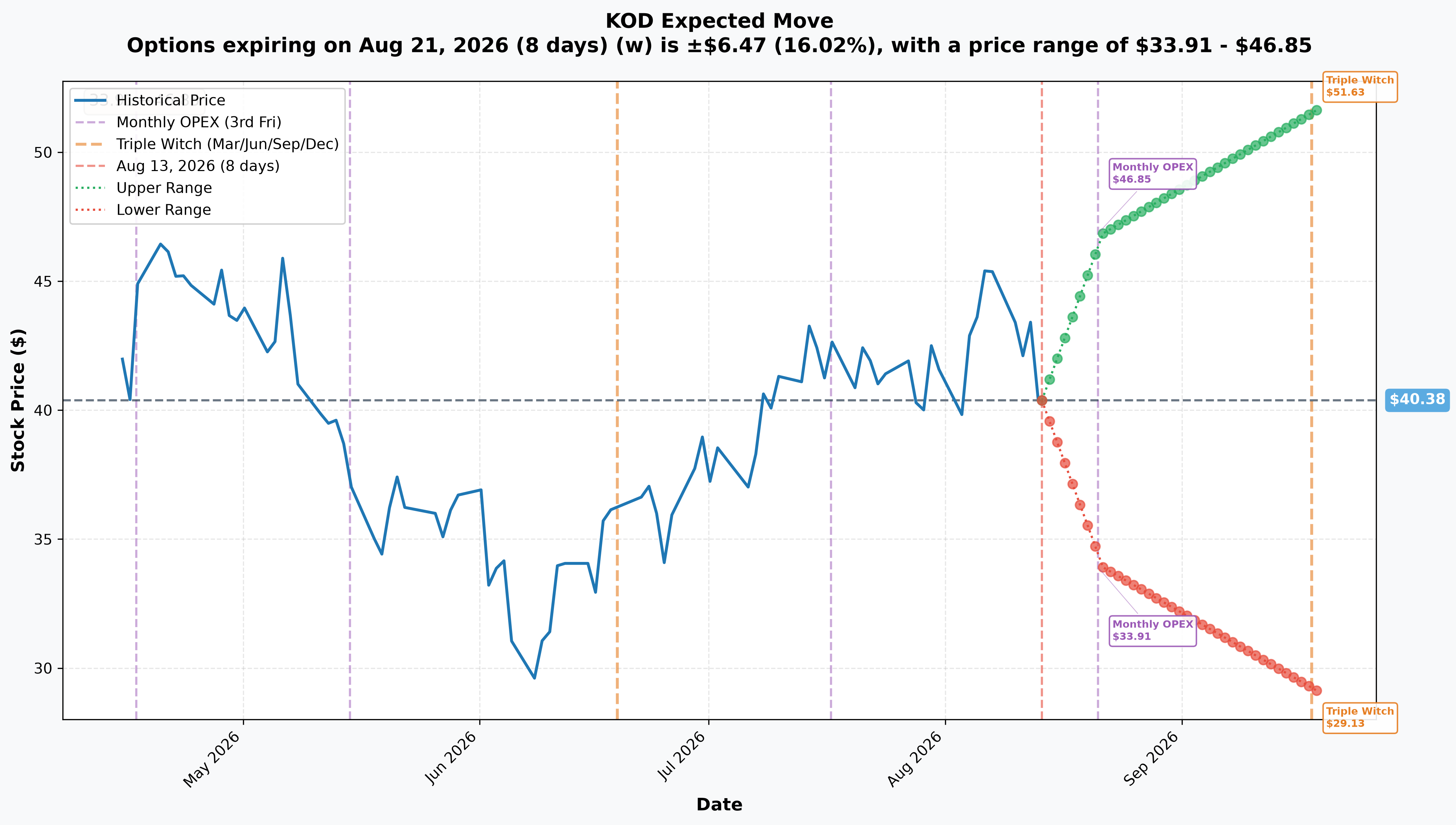
| Horizon | Implied move | Range |
|---|---|---|
| Aug 21 | ±16.02% | $33.91 – $46.85 |
| Sep 18 | ±27.86% | $29.13 – $51.63 |
A ±27.86% five-week range puts the $32.10 breakeven comfortably inside what the market already considers a normal move. This is not a bet on the improbable — it is a bet on a decline the option market fully expects to be possible.
🎪 Catalysts — Earnings Tomorrow, Data in December
The window contains exactly one confirmed event, and it is not the important one.
| Date | Event | Inside Oct-16 expiry? |
|---|---|---|
| Aug 14, 2026 | Q2 earnings — tomorrow | ✅ Yes |
| December 2026 | Phase 3 PEAK topline (KSI-101) | ❌ No — ≈2 months after |
On August 6 Kodiak completed enrollment of the first pivotal cohort in the Phase 3 PEAK trial and stated that "topline clinical data release remains on track for December 2026." On August 10 it described the Phase 3 ALTO trial as "designed to demonstrate superiority of KSI-501 versus aflibercept" in diabetic macular edema. Both are enrollment and design milestones — process markers, not efficacy results.
What earnings can actually do here. For a company with no revenue, a quarterly report is a cash-and-timelines update: runway, enrollment pace, and — critically — whether December is still December. Kodiak said in May that its cash "will support operations into 2027." With $169.5M against a −$230.66M annual loss, financing is a live question.
That is the realistic path to this trade working: a timeline slip or a financing announced tomorrow, not a data failure. A delay to the PEAK readout would hit a stock priced for December delivery, and it would hit it inside this option's life.
Analysts are positioned the other way — Strong Buy, $65.00 average target, with JPMorgan raising to $66 from $56 on July 30 and UBS to $80 from $50 in March.
Keep the dates separate: the option expires October 16; earnings are August 14; the PEAK topline is guided to December.
Sources: Kodiak overview and news
👥 Four Ways to Read This Trade
🎲 The YOLO trader
Note what the professional did not do: buy the naked put. The $15 leg caps the payoff, and a desk willing to spend $4.74M still chose to sell away the crash. If your instinct is to buy October puts for a collapse, the calendar argues against you — the collapse catalyst is a December event. The expensive part of this option is paying ≈20% of the share price in time value for a window that excludes the readout.
📈 The swing trader
The tradeable moment is tomorrow's earnings, not October. Watch one thing above all: any change to the December PEAK guidance. A slip re-prices the whole story. The chain offers you nothing structurally — no gamma support, no resistance, only three active strikes — so there are no levels to lean on, and the stock already fell ≈6% into this print.
💰 The premium collector
Someone sold these $40 puts and collected ≈$4.88M. Understand what that obligation is: buying a no-revenue biotech at $40 that has traded as low as $8.29 in the past year. The ≈20%-of-spot premium is not free money — it is compensation for a genuine binary, and the elevated implied volatility here is priced correctly rather than generously. If you want to be short puts in this name, be honest that you are underwriting a clinical outcome.
🌱 The beginner
Learn to read the structure, not just the size. The headline is a ≈$4.9M put purchase; the reality is a ≈$4.74M spread with a capped payoff — and the cap is the interesting part. When someone gives up the entire crash payoff for 3% of their cost, they are telling you they do not expect a crash in that window. Then check the calendar and you find out why: the make-or-break data lands two months after the option expires. The lesson is that expiration dates carry information, and matching them to the event calendar is often the whole analysis.
⚠️ Honest Limits
- Direction is reported, not tape-proven. This printed as a negotiated block cross, which takes no liquidity and therefore leaves no aggressor signature. If the legs are reversed — selling the $40 put and buying the $15 — the position is a bullish credit spread collecting ≈$4.74M, and the entire reading inverts. The buy label on the $40 leg comes from the reported capture, supported by that leg pricing above the middle of its quoted market while the $15 leg printed near its bid. That is consistent, not conclusive.
- The opening is proven; the intent is not. Zero prior open interest settles open-versus-close beyond doubt. It does not tell us whether this is a directional bet or a hedge against shares held elsewhere.
- No equity leg was found on the tape, but that does not rule out a stock position held away from this print.
- Prices are quoted at three different moments and labelled as such: the trade printed against a $41.54 spot (used for all trade math), the gamma and implied-move snapshots were computed intraday at ≈$40.33, and the session closed at $39.98. These are not inconsistent — they are the same day at different times.
- Gamma levels are absent, not omitted — the chain has only three strikes with meaningful open interest, so no support or resistance is asserted.
- Research gaps, disclosed: the search budget was exhausted, so this rests on direct page retrieval only. No filings were read — current cash runway, any at-the-market facility and any recent financing are unknown and deliberately not stated; the $169.5M figure is as of Q1 2026 and may be stale. The exact December date for the PEAK topline is not published — the company guides to the month. Trial design details for KSI-101 and KSI-501 were not retrievable. No short-interest figure was available.
- Unknowable from the tape: who holds this, whether a hedge sits behind it, and the sign of any pre-existing position elsewhere in the chain.
Last updated: 2026-08-14 — next-day OPRA open interest resolved both spread legs as opens — 0 → 6,005 and 4 → 6,001 (see the ✅ RESOLVED section).
This is market analysis and education, not investment advice. Options carry substantial risk of loss.