🇨🇳 KWEB: The December Block Opened Almost Exactly as Predicted — and the September Calls Were CLOSED, Not Shorted
2026-08-12 | Resolved 2026-08-13: Dec $26 OPENED (+22,109), Sep $27 CLOSED (−8,491) — a roll, not a new short
🔄 Updated 2026-08-13 pre-market — the next-day OPRA open interest resolved both legs, and the September leg inverted. The December $26 call landed at 24,207 against our published prediction of ≈24,098 — within 109 contracts, one of the most precise calls we have made. The September $27 call fell 32,719 → 24,228 (−8,491), taking the branch we described as "a holder closing out," not the rise toward ≈48,000 that would have meant "a new short position was opened." The provisional STO label on the September leg is retired in favour of STC. Read together, this is a roll out of September into December, not a premium-collection short. See the ✅ RESOLVED box.
🎯 The Quick Take
Two option blocks crossed on the KraneShares China Internet ETF (KWEB) today: a 22,000-contract December $26 call block cross worth ≈$7.04M where the feed captured no side at all, and a 15,531-contract September $27 call floor block worth ≈$2.10M tagged SELL but printed below the bid on a strike that already carries 32,719 contracts of open interest. Neither trade took liquidity, so neither can be read the normal way — and that gap in what the tape can tell us is the actual story today.
Spot is trading ≈$27.48–27.64, right between two of the strongest gamma levels on the board ($27 support, $28 resistance), on a day Tencent — KWEB's largest holding — already reported earnings before the open.
💰 The Option Flow Breakdown
🏦 The Fund — What You Actually Own
KWEB is a non-diversified, 34-holding ETF tracking the CSI Overseas China Internet Index, with $5.59B in AUM, NAV $28.23, and a 0.69% total expense ratio, per the KraneShares fund page. That's not a broad China fund — it's a concentrated bet on internet platforms: top 10 holdings are ≈60.80% of assets, top 5 are ≈41.08%, and the index caps any single name at 10% and the top five at 40%, per the Summary Prospectus. Two sectors — Consumer Discretionary (41.4%) and Communication Services (37.4%) — make up nearly 79% of the whole fund.
Here's the part a lot of US retail traders skip past. The listing split is 71.9% Hong Kong-listed, 14.6% US ADRs with a secondary Hong Kong listing, and 13.5% US ADRs with no secondary listing at all (KraneShares) — that last slice is the only piece with real, unhedged US-delisting exposure, and it's smaller than most headlines about "China ETF risk" imply.
The bigger structural wrinkle is how you actually own these companies. Per the fund's own Summary Prospectus, many of these China-based operating companies use a Variable Interest Entity (VIE) structure — "an investor in the listed offshore entity, such as the Fund, will have exposure to the Chinese-based operating company only through contractual arrangements and has no ownership of the Chinese-based operating company." The prospectus goes further: because VIEs "are not formally recognized under Chinese law," if the contracts were ever found unenforceable, investors "may suffer substantial losses with little or no recourse available." That's not boilerplate — it's the tail risk sitting underneath every trade on this board.
📊 What Just Happened — Both Trades
| Time (ET) | Buy/Sell | Call/Put | Expiration | Strike | Size | Volume | OI | Spot | Option Price | Premium | Symbol | Mechanism |
|---|---|---|---|---|---|---|---|---|---|---|---|---|
| 12:22:06 | ⚠️ unresolved — feed returned no side | CALL | 2026-12-18 | $26 | 22,000 | 22,000 | 2,098 | $27.48 | $3.20 | ≈$7.04M | KWEB20261218C26 | 🤝 Block cross |
| 09:48:25 | SELL (reported, not proven — see below) | CALL | 2026-09-18 | $27 | 15,531 | 16,000 | 32,719 | $27.64 | $1.35 | ≈$2.10M | KWEB20260918C27 | 🤝 Floor block |
Both trades are negotiated blocks — a broker matched a known buyer and seller off the open book. Neither one took liquidity from the displayed market, so neither the percentage-across-the-spread test nor the implied-volatility-through-the-print test — our two normal ways of reading direction — applies to either leg. That's unusual, and it's worth sitting with rather than papering over with a guess.
The December $26 leg: 22,000 contracts crossed at $3.20 against prior open interest of just 2,098. The math there is simple — at least 19,902 contracts must be brand-new positions, so the open is certain. What's not certain, and what the captured flow genuinely could not tell us, is which side bought and which side sold. A cross has a known counterparty on both sides who already agreed on price before it printed; there's no aggressor to read.
The September $27 leg: 15,531 contracts printed at $1.35, below the prevailing bid, tagged SELL by the feed, against prior open interest of 32,719. Because the size traded (15,531) is smaller than the resting open interest (32,719), this print alone cannot prove open versus close. It is at least as consistent with an existing long being sold to close as with a fresh short being opened.
✅ RESOLVED — December Opened on the Number; September Closed, Not Shorted
Updated 2026-08-13 pre-market. Resolving OPRA snapshot timestamped August 13 (reflects the August 12 close, after this print); baseline is the August 12 snapshot (reflects the August 11 close, before this print).
| Leg | Baseline (Aug-12) | Resolving (Aug-13) | Δ | Print size | What we published | Verdict |
|---|---|---|---|---|---|---|
| Dec-18 $26 call (block, direction unknown) | 2,098 | 24,207 | +22,109 | 22,000 | "we predict next-session open interest lands around ≈24,098" | ✅ OPEN — within 109 of the prediction |
| Sep-18 $27 call (sold) | 32,719 | 24,228 | −8,491 | 15,531 | "if OI at the $27 strike falls by roughly 15,000 toward ≈17,700, this was a holder closing out" | 🔄 CLOSE (STC) — was STO ⏳; 55% of the print retired |
The September inversion is the story. Open interest fell, decisively ruling out the opening branch: no new short-call position was created at $27. The ≈$2.1M was realised liquidating an existing long, not collected for taking on new risk. The "short near-dated OTM call" framing is retired.
Direction is decisive; magnitude is partial. −8,491 against 15,531 sold means 55% of the print extinguished open interest and ≈7,040 transferred between holders. Enough to prove no net new short — not enough to call the entire block a close.
Put the two legs together and the shape changes. September exposure retired, December exposure created at a lower strike ($26 versus $27) and a later expiration. That is a roll out in time, and the genuinely new money is the December block. What open interest still cannot settle is the one thing the article said it would not: who was long and who was short in the December cross. Direction there remains unknown, exactly as published.
Control check. The September decline is strike-specific: $25C 8,195 → 8,190 (−5), $26C 4,071 → 4,071 (0), $28C 20,938 → 27,795 (+6,857), $30C 65,189 → 66,035 (+846). Neighbouring lines rose or held; only the traded $27 line fell.
🔄 Retraction notice (2026-08-13): any framing below that treats the September $27 calls as a newly-opened short is retired. Next-day open interest fell 32,719 → 24,228, proving that leg closed an existing long. Read the two prints together as a roll out of September into December. See the ✅ RESOLVED box above.
🤓 What This Actually Means — Plain English
Let's slow down on why the December $26 block is genuinely unknowable, because it trips people up.
On a normal lit trade, you can look at where the price landed relative to the bid and ask — the buyer stepped up and paid the ask (bullish signal), or the seller caved and hit the bid (bearish signal). That's the "percentage across the spread" test, and it works because the trade actually consumed real displayed liquidity from the order book.
A block cross doesn't work that way. Two parties — a buyer and a seller, both institutional-sized — agree on a price ahead of time through a broker, and the trade just prints. No one is "lifting the offer" or "hitting the bid" because there's no book being consumed at all. The price of $3.20 tells you what they agreed to pay, not who wanted the trade more. Worse, our capture system returned literally no side annotation for this leg — so we don't even have a label to second-guess. The honest answer is: we don't know if this is a $7.04M bullish bet on China internet into year-end, or a $7.04M hedge/short position being put on. Both are equally consistent with everything the tape shows us. That's a genuinely interesting lesson in the limits of options-flow data — the size and the strike are facts; the direction, here, simply isn't.
The September $27 leg is a different kind of ambiguous. A floor block is a manually negotiated trade, worked by a broker on the floor rather than run through an automated cross. This one printed below the bid — which is unusual for a "SELL" label to actually mean confident aggressive selling, because a genuine aggressive seller hitting the lit bid would show up as a lit trade, not a negotiated floor print. What a sub-bid floor print on a strike carrying 32,719 contracts of existing open interest (more than double the size of today's trade) usually signals is a large existing holder unwinding part of a position at a negotiated discount — a profit-take or a stop-out — rather than a fresh short being initiated. That's a reasonable lean, not a proof. The next-day open-interest print is the only thing that actually settles it.
📈 Technical Setup
YTD Chart
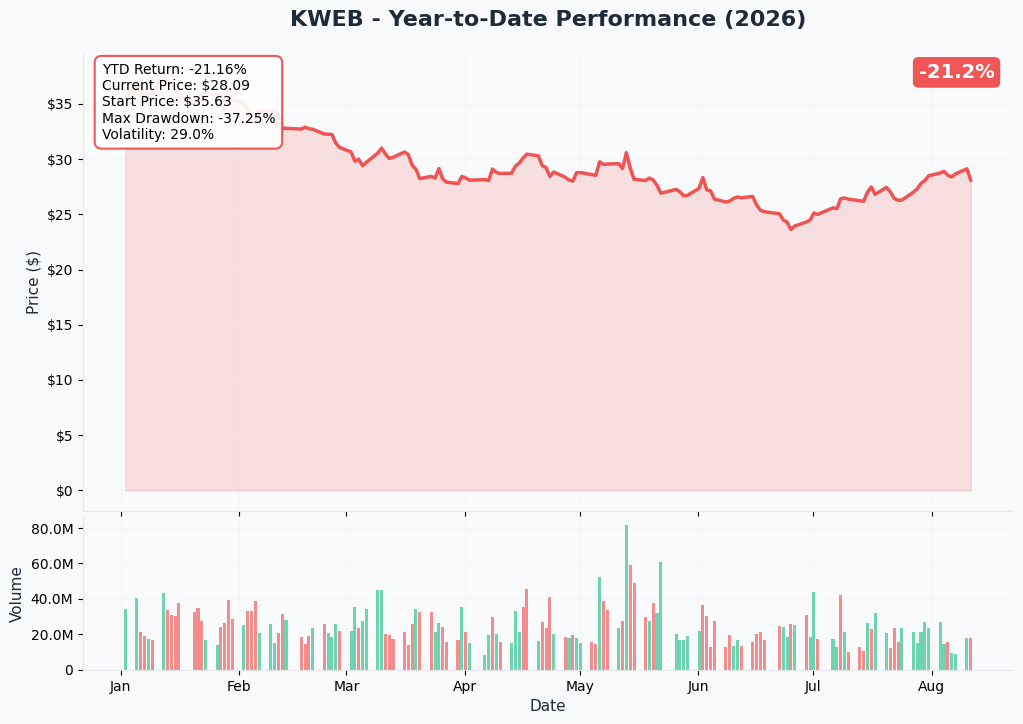
KWEB's year has been a study in violence, not direction. NAV is −17.66% year-to-date through July 31, but that figure includes a +15.90% July — which mathematically means the fund was down roughly −29% at the end of June. The entire drawdown happened in the first half of the year, and roughly half of it was clawed back in a single month. August has been giving some of that July rally back: NAV fell −2.32% on August 11 and the shares were down another ≈2% intraday today, per KraneShares and Stock Analysis. The 52-week range is $23.23–$43.37 — today's ≈$27.5 sits ≈37% below the high and ≈18% above the low.
Gamma-Based Support & Resistance
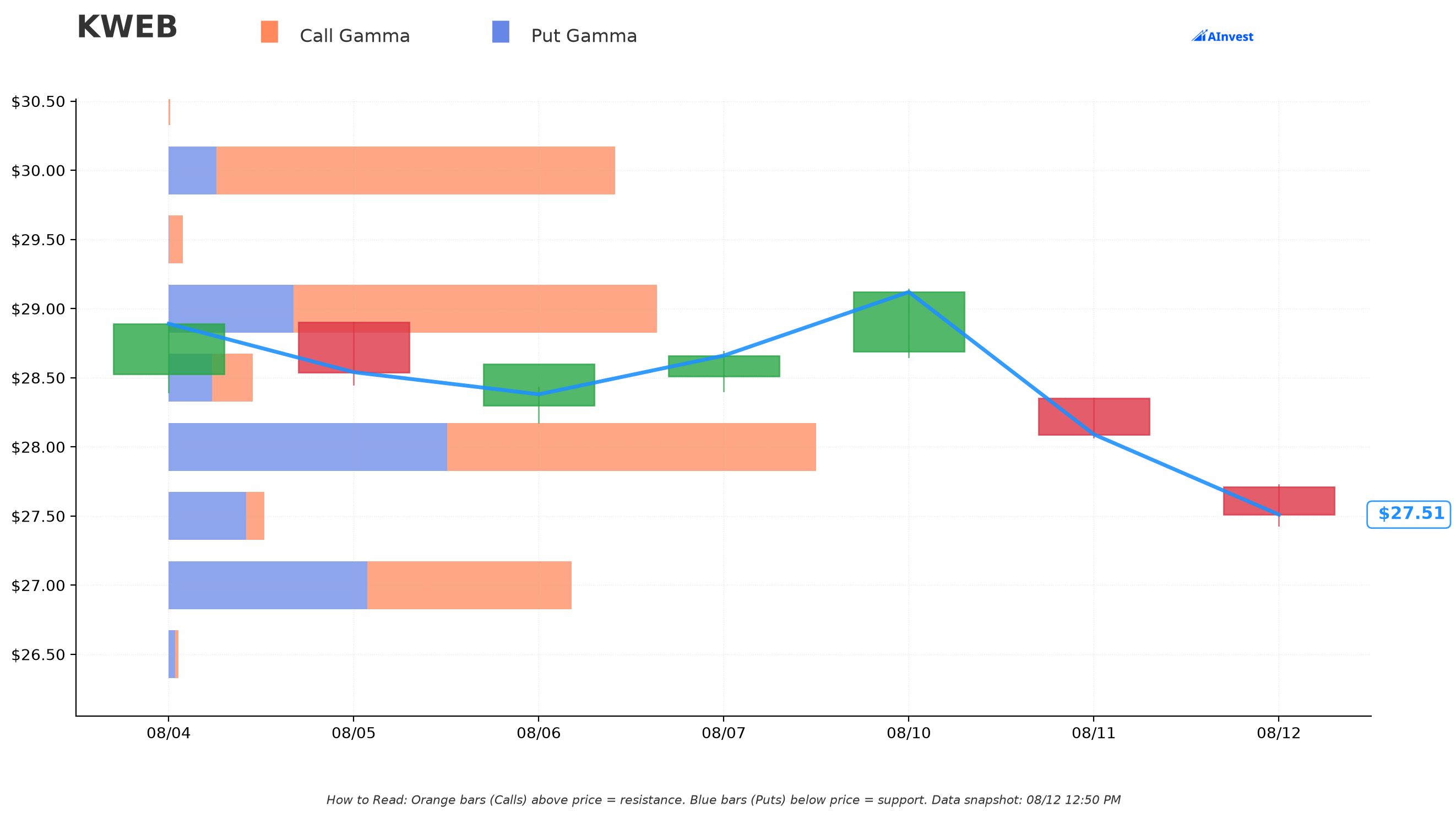
The gamma map is unusually tight around today's price. $28 is Very Strong resistance (total gamma exposure ≈$87.2M) and $27 is Very Strong support (≈$54.2M) — and both of today's trades struck strikes that sit right on either side of that band: the September $27 calls sit directly on the support strike, and the December $26 calls sit one dollar below it. With spot at $27.52, dealer hedging flows around these two levels should act like guardrails for the next several sessions — moves toward $28 likely meet selling pressure from dealers hedging call exposure, moves toward $27 likely meet buying support.
Implied Move
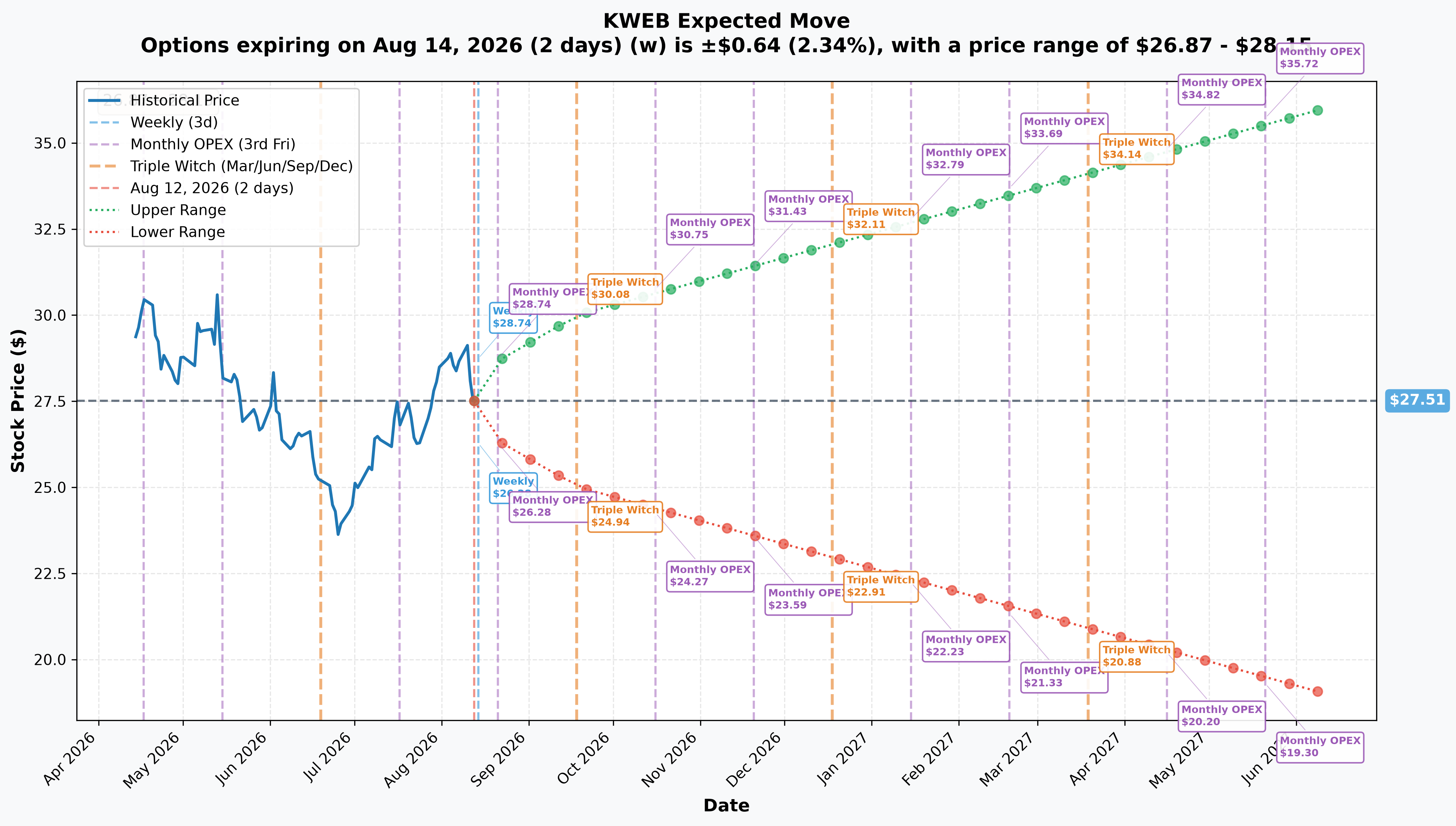
The options market is pricing in:
- ±2.34% by August 14 (this Friday) → range $26.87–$28.15
- ±4.29% by August 21 (monthly OPEX) → range $26.33–$28.69
- ±9.08% by September 18 (the September expiration on today's print) → range $25.01–$30.01
That September range is wide enough to comfortably contain the $27 strike on today's floor-block trade in either direction — the market is pricing real uncertainty into that expiration, consistent with the earnings cluster below.
🎪 Catalysts
Already Happened
Tencent (9.86% of the fund) reported this morning, August 12 — revenue +11% year-over-year to RMB 204.8B, net income RMB 70.6B, but free cash flow went negative (RMB −13.8B) after RMB 59.3B of AI capex; shares fell ≈2% in Hong Kong (China Last Night). This matters directly for the September $27 trade: Tencent's own earnings risk was already resolved hours before both blocks printed today.
The past three months carried real regulatory whiplash. On July 20, China's market regulator moved to end the delivery-subsidy price war between platforms — and rather than selling off, the market treated it as margin-restoring: Meituan +3.2%, Alibaba +3.73%, JD.com +3.2% (China Last Night). Days later, in late July, regulators fined Trip.com (3.70% of the fund) ≈$770 million for antitrust violations in online hotel booking, and sell-side cut targets in response (Stock Analysis). Back on May 22, the CSRC moved against offshore brokers Tiger Brokers, Futu Securities and Changqiao, and US-listed China names sold off on the news despite limited direct linkage (China Last Night).
On the policy side, the July 31 Politburo meeting turned explicitly consumption-first, naming "expand domestic consumption" as a priority and upgrading its fiscal language — Alibaba rallied +4.65% that day (China Last Night). But the macro backdrop stayed soft: July CPI came in at +0.5% against a +0.8% consensus (China Last Night). And on July 24, Trump announced a September Xi–Trump summit for AI talks — paired, the same day, with a US Commerce Department investigation into whether Chinese AI firms improperly accessed advanced US chips. Alibaba fell −4.3% on that combination (China Last Night).
Upcoming — Inside the September 18, 2026 Expiration
≈54.99% of KWEB's fund weight reports earnings between August 13 and August 27, 2026, all inside the September expiration window:
| Date | Holding | Weight |
|---|---|---|
| Aug 13 | JD.com | 4.26% |
| Aug 18 | Baidu | 3.45% |
| Aug 19 | Full Truck Alliance | 4.12% |
| Aug 19 | Kuaishou | 3.60% |
| Aug 20, 7:30 AM ET | Alibaba (company-confirmed) | 9.03% |
| Aug 20 | NetEase | 6.02% |
| Aug 20 | Kanzhun | 3.64% |
| Aug 21 | KE Holdings | 4.00% |
| Aug 24 | Trip.com | 3.70% |
| Aug 26 | PDD Holdings | 8.18% |
| Aug 27 | Meituan | 7.99% |
Alibaba's date comes directly from Alibaba's own investor relations events page. Note again: Tencent (9.86%) already reported this morning and is not a September-window catalyst — its event risk was gone before either block printed. Also inside the window: ≈Sep 15–16 FOMC (Federal Reserve) and the September Xi–Trump AI summit, which has a month but no confirmed day and could land on either side of the September 18 expiration (China Last Night).
Upcoming — Inside the December 18, 2026 Expiration
The December window contains everything above, plus a full second layer: Singles Day (Nov 11), a full Q3 earnings cycle across essentially the entire top 10 (mid-to-late November, by 2025 precedent), the MSCI November index rebalance (≈Nov 24), and — on the 2025 calendar precedent — the December Politburo meeting and Central Economic Work Conference, which in 2025 landed on December 8 and December 11 respectively — roughly 6–9 days before a December 18 expiration, if 2026 repeats the pattern. This is precedent, not an announced 2026 date.
One pricing nuance worth flagging directly: KWEB's annual distribution had a December 22, 2025 ex-date — after the December expiration. If 2026 repeats that timing, the December 18 calls expire before the ≈$2 annual distribution accrues, which matters for anyone modeling the fair value of that $26 strike.
🎲 Four Ways to Read This
🎲 The YOLO trader
There's genuinely nothing here to YOLO into. The single most attractive piece of information — the direction on a $7.04M December block — is exactly the piece the tape refuses to give up. Chasing either side of an unresolved cross with size is a coin-flip dressed up as conviction. If you must play the earnings density into September, size it small and buy defined risk (a call or put spread around the $27–$28 gamma band) rather than trying to front-run a mystery block.
📈 The swing trader
The gamma structure is the more actionable read here than either print. Spot at $27.52 sitting between $27 Very Strong support and $28 Very Strong resistance sets up a range-trade thesis into the ≈54.99%-of-fund earnings cluster running August 13–27. A tight iron condor or calendar around that band, sized to the ±4.29% implied move by August 21, respects both the gamma pin and the binary earnings risk without betting on the unresolved block's direction.
💰 The premium collector
The September $27 calls sit right at the support strike with 37 days to expiry and a ±9.08% implied move to expiration — that's a lot of premium on the table if you're willing to sell covered or cash-secured calls there, especially since today's floor block may itself represent a large holder taking profit on a similar position. Just size conservatively: if the September print really is a close (as the sub-bid, above-OI evidence suggests it's at least as likely to be), you'd be selling into the same crowded strike an institution just exited.
🌱 The beginner
This is a genuinely useful lesson before you start reading options flow headlines: a $7 million print is not automatically a $7 million opinion you can copy. Big dollar figures on negotiated block trades often can't tell you who was bullish and who was bearish — sometimes the data plainly can't answer that question, and the honest answer is "we don't know," not a guess dressed up as confidence. Before trading KWEB at all, understand you're buying exposure to companies through VIE contracts, not direct ownership — read the KWEB Summary Prospectus risk section once. Start with small size, and let the ⏳ next-day open-interest check — not the day-one headline — tell you what actually happened.
⚠️ Honest Limits — What We Don't Know
The direction of the December $26 call block is unresolved, and it may stay that way. 22,000 contracts crossed off-book with no side captured by our feed; a cross takes no liquidity, so neither the percentage-across-the-spread test nor the implied-volatility-through-the-print test can settle it. The open is certain (prior OI 2,098, so ≈19,902+ new contracts). The direction is not, and tomorrow's open-interest snapshot will not resolve it either — OI only proves contracts opened, not who was on which side.
The September $27 "SELL" tag is a feed annotation on a sub-bid floor print, not a proven aggressor read. Closing an existing long is at least as plausible as opening a new short, given size (15,531) is well below prior open interest (32,719).
Beyond the two trades, this research carries disclosed gaps: the session's search budget was exhausted before this research began, so every catalyst fact above came from direct page fetch of named sources rather than broad search — coverage is deep where those specific pages were reachable and thin elsewhere. SEC and PCAOB pages returned errors (403/404) and could not be retrieved, so the current Holding Foreign Companies Accountable Act / audit-inspection status is unverified here — it is described only through the fund's own prospectus risk language, and that gap should not be read as evidence either way. No specific US–China tariff expiry or snap-back deadline was found in any accessible source. The September Xi–Trump AI summit has a month but no published day — it could land on either side of the September 18 expiration, which materially changes what that expiration is pricing. And every November and December 2026 catalyst date in this article (Q3 earnings, MSCI rebalance, Politburo, Central Economic Work Conference) is inferred from a dated 2025 precedent, not a confirmed 2026 announcement — companies and government bodies routinely shift these by a week or more.
This is not investment advice. Options trading carries substantial risk, including the potential loss of your entire investment, and these structures may not be suitable for all investors. Size positions responsibly.
Last updated: 2026-08-13 (pre-market) — the next-day OPRA open-interest snapshot resolved both legs and the September leg inverted. Dec-18 $26C 2,098 → 24,207 (+22,109 against 22,000; predicted ≈24,098, actual within 109): OPEN; Sep-18 $27C 32,719 → 24,228 (−8,491 against 15,531 sold, 55% of the print retired): CLOSE (STC), was STO ⏳. The title, header line, order-type and strategy cells and the short-call framing were updated to a September-into-December roll; the ⏳ callout was replaced with the ✅ RESOLVED box. December direction remains unknown, as originally published.