🔐 LAES: A $16,000 Roll That Says "We're Not Done Yet" — Not $2.7M of New Buying
📅 2026-08-13 | 🤝 Floor Block Detected
🎯 The Quick Take
At 14:20:02 ET a desk printed 16,296 August-21 $2 calls and 16,296 September-18 $2 calls in SEALSQ — same strike, same size, same second, adjacent expirations.
That is a calendar roll, not two purchases. Reading it as ≈$2.7M of new buying would double-count one position being moved forward. The actual cost of the roll is about $16,300 — the one-cent price difference between the two legs.
And the reason for it is unusually clear: SEALSQ has nothing scheduled before August 21, and three separate items dated to September. Someone with an expiring position simply needed more time.
🏢 Company Overview
SEALSQ designs semiconductor security products — secure elements, quantum-resistant chips and certificate-management services. Its flagship post-quantum products are the QS7001 "Quantum Shield" secure element and the QVault TPM line.
| Attribute | Value |
|---|---|
| Price | $2.785 (verified Aug 13) |
| Market cap | $554.28M |
| Shares outstanding | 199.02M |
| Revenue (TTM) | $18.25M (≈30× sales) |
| Net cash | ≈$420M |
| Enterprise value | ≈$135M |
That last line deserves emphasis. With ≈$420M of net cash against a $554M market capitalisation, the operating business is valued at roughly $135M — a very different picture from the headline multiple.
Dilution is the story behind the drawdown: ≈27.7M shares (Dec 2024) → 191.5M (Dec 2025) → ≈199M now — +304% year over year — via a $69M warrant exercise and $200M offering in October 2025, and a $125M offering at $4.11 in March 2026 that carried 60.83M warrants struck at $5.50.
⚠️ A return conflict we could not resolve. Our chart computes ≈−39.9% over the past year; the public quote page reports a 52-week change of only −3.15%. We could not reconcile them, so we quote neither. The unambiguous figure is this: the $8.71 52-week high maps to the October 24, 2025 Nasdaq uplisting, and the stock is ≈68% below it.
💰 The Trade, in Plain English
| Time | Buy/Sell | Call/Put | Expiration | Premium | Strike | Volume | OI | Size | Spot | Option Price | Option Symbol |
|---|---|---|---|---|---|---|---|---|---|---|---|
| 14:20:02 ET | BUY | CALL | 2026-08-21 | ≈$1,352,568 | $2 | 16,000 | 16,554 | 16,296 | $2.78 | $0.83 | LAES20260821C2 |
| 14:20:02 ET | BUY | CALL | 2026-09-18 | ≈$1,368,864 | $2 | 16,000 | 345 | 16,296 | $2.78 | $0.84 | LAES20260918C2 |
Both legs printed as negotiated floor blocks, and both are ≈pure intrinsic value: with the stock at $2.78 the $2 strike is worth $0.78, so the August leg carries just $0.05 of time value and the September leg $0.06.
Why this is a roll, not two buys:
- Identical size (16,296) to the contract
- The same second
- The same strike
- Adjacent expirations
- The August strike had 16,554 outstanding — so 16,296 sits just under it, consistent with a position being closed
- The September strike had 345 — so 16,296 there is unambiguously new
The economics confirm it. The cost of moving four weeks forward is the price difference: $0.01 × 16,296 × 100 ≈ $16,300, or about 1.2% of the position's premium, to carry ≈$1.35M of deep in-the-money exposure. That is position maintenance. Write it as "we're not done yet," not "we're buying more."
✅ RESOLVED — It Was a Roll: August Fell, September Built
Updated 2026-08-14 pre-market. Resolving OPRA snapshot timestamped August 14 (reflects the August 13 close, after this print); baseline is the August 13 snapshot (reflects the August 12 close, before this print).
| Leg | Baseline (Aug-13) | Resolving (Aug-14) | Δ | Print size | Verdict |
|---|---|---|---|---|---|
| Sep-18 $2 call | 345 | 16,632 | +16,287 | 16,296 | ✅ OPEN — 100% of size |
| Aug-21 $2 call | 16,554 | 6,824 | −9,730 | 16,296 | ✅ CLOSE — the near leg was retired |
The roll is confirmed, and the alternative is dead. We said that if August rose toward ≈32,850 this was not a roll but two opening purchases — a much larger and genuinely bullish position. August fell. September rose by 16,287 against a 16,296-lot print, essentially contract for contract. Near leg down, far leg up, same strike, same size, same second: that is a calendar roll and nothing else.
The headline stands: this was ≈$16,300 of position maintenance, not ≈$2.7M of new buying.
Where we were wrong on detail — and it matters. We predicted the August line would collapse toward ≈258. It fell to 6,824, so only 9,730 of the 16,296 net-closed — about 60% of the print. The other ≈6,566 contracts were offset by opening interest from other participants at the same strike that session. The August 21 line is not empty; it still carries 6,824 contracts into an expiry eight days out. Whether any of that remainder belongs to the roller, we cannot tell — open interest is a net figure and does not name its owners.
Unchanged: both legs printed as negotiated floor blocks that took no liquidity, so the capture's BUY/BUY labels remain unreliable — and the resolution reinforces that, since open interest proves one leg closed while the capture called both a buy. Open interest confirms the structure of the roll; it does not prove whether the roller was long or short.
🤓 What This Actually Means — Plain English
A calendar roll is the options version of extending a deadline. You hold a position that is about to expire, you still want the exposure, so you close the near-dated one and open the same thing further out. The cost is the price difference between the two.
Here that difference is one cent. The August call was worth $0.83 and the September call $0.84, because a deep in-the-money option with almost no time value costs almost the same whenever it expires. So this desk paid ≈$16,300 to buy four more weeks on a ≈$1.35M position.
Why these calls behave like stock. At $2.78 with a $2 strike, $0.78 of the $0.83 price is intrinsic — money already earned. Only 5 cents is the option part. A call like that moves nearly dollar-for-dollar with the shares, which is why traders use them as capital-efficient share substitutes rather than as bets on volatility.
The signal, such as it is: someone with a substantial existing position was unwilling to let it expire. That is a statement about timing — they think something happens after August 21 — not a fresh statement about direction.
📈 Technical Setup
One-Year Performance
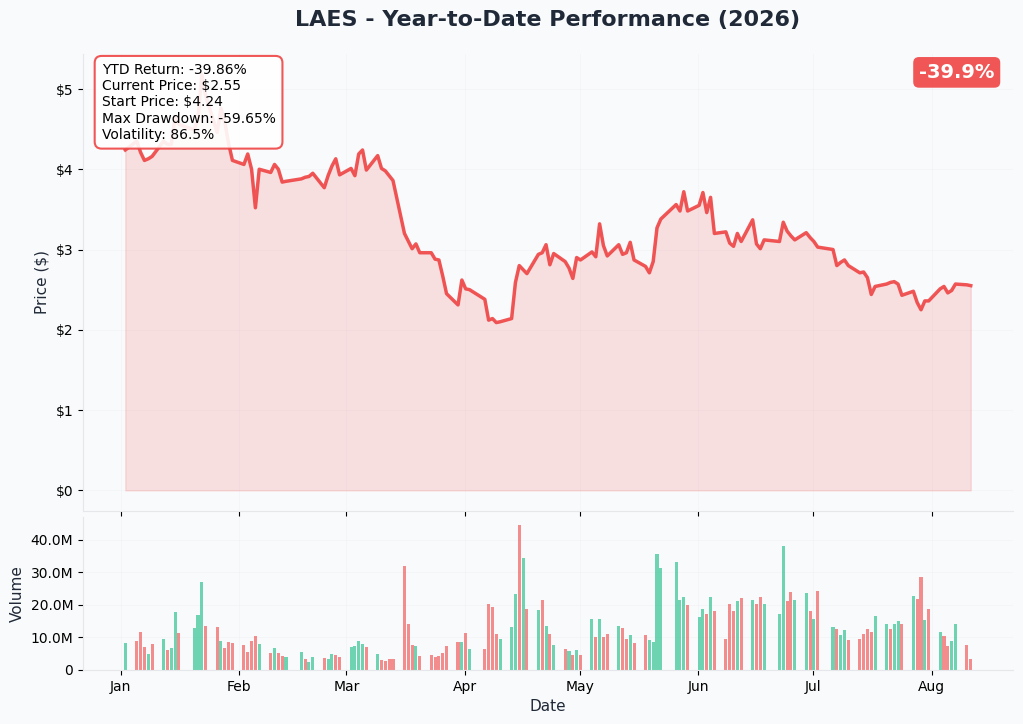
Read with the caveat above — our chart's return conflicts with the quoted 52-week figure and neither is used here. The reliable framing is ≈68% below the October 2025 high of $8.71.
🔵🟠 Gamma-Based Support & Resistance
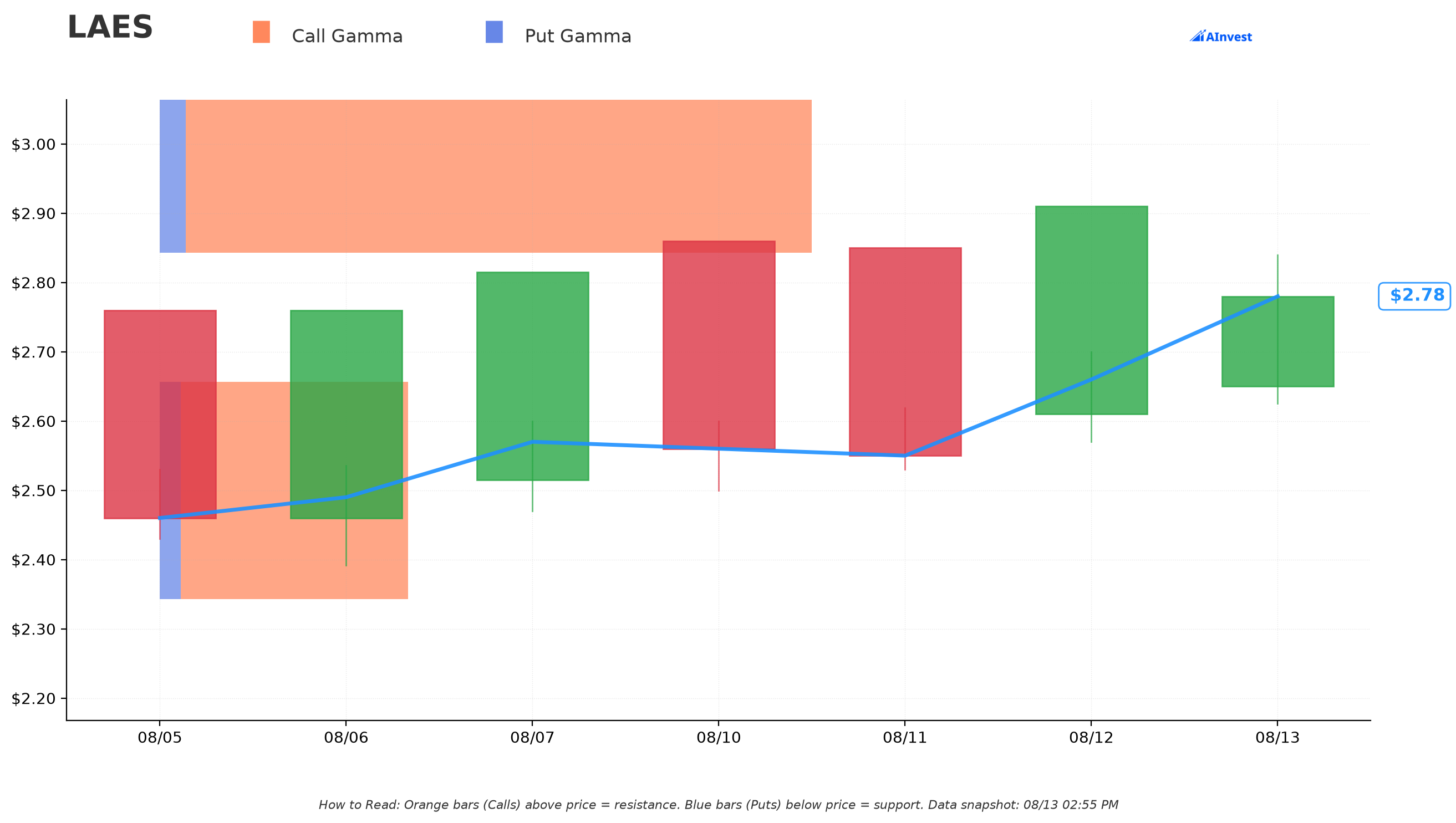
| Level | Strike | Strength |
|---|---|---|
| Resistance | $3 | Very Strong |
| Spot | $2.81 | — |
| Support | none returned | — |
Being honest: the chain produced no material gamma support level. We are not going to invent one. The single meaningful level is resistance at $3, roughly 7% above spot.
🎯 Implied Move
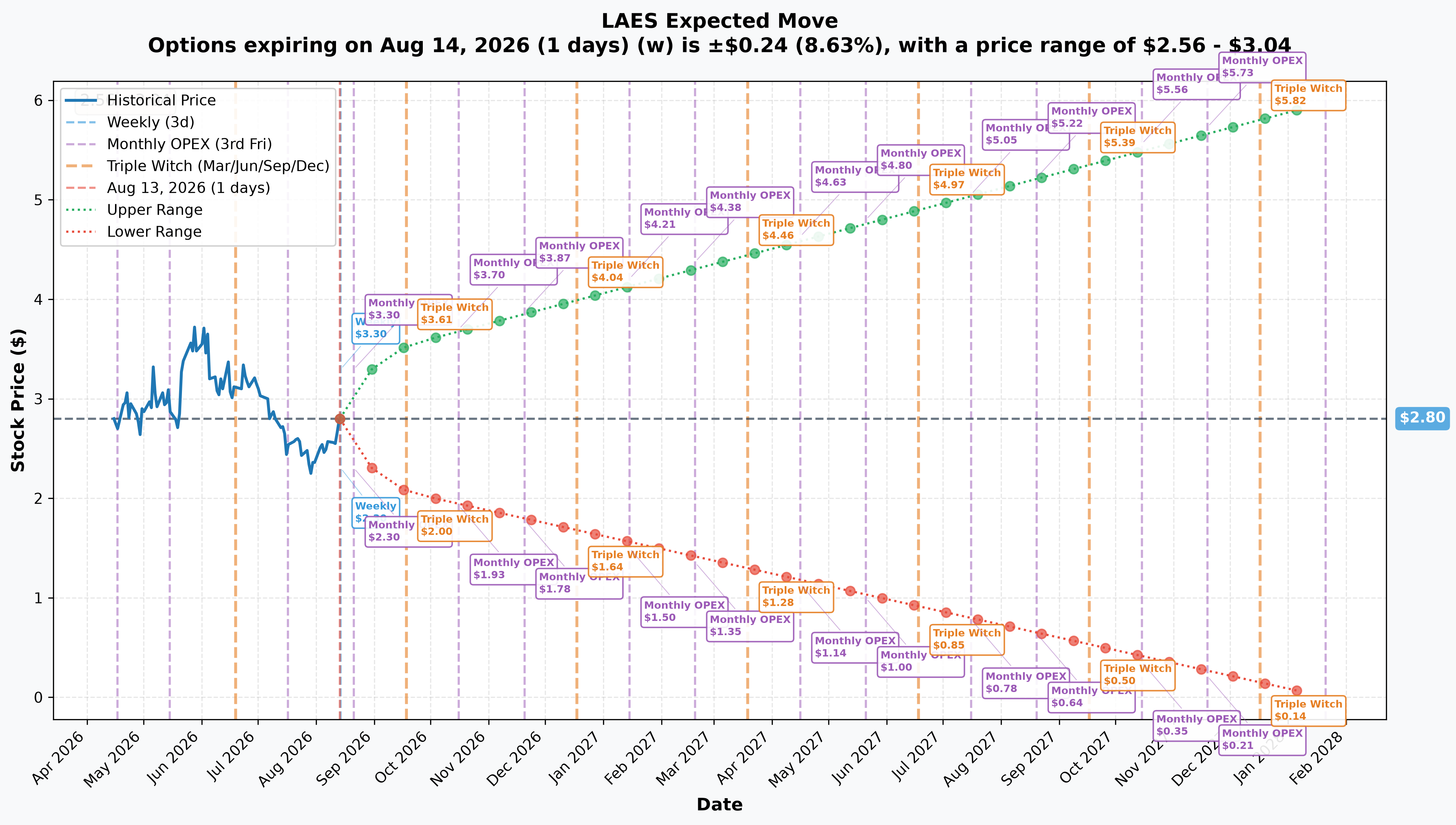
| Horizon | Implied move |
|---|---|
| Aug 14 | ±8.63% |
| Aug 21 (the expiring leg) | ±13.44% |
| Sep 18 (the new leg) | ±26.60% |
A ±26.60% expected range by September is enormous — and it is precisely what makes the extra four weeks worth buying for a cent.
🎪 Catalysts — Why September, Not August
This is the cleanest expiration-alignment answer on today's board.
Before August 21: nothing. SEALSQ's investor events page lists no event at all between August 2026 and February 2027, and its August 13 CEO letter was the last catalyst.
Dated to September — three separate items, all separately sourced:
| Item | Source | Timing |
|---|---|---|
| QS7001 V1 Common Criteria lab letter | The company's own certification table | September 2026 |
| SEALQuantum Phase Two launch ($100M earmarked through end-2027) | August 7 release | September 2026 |
| H1 2026 interim report | Historical cadence | SEALSQ has never reported half-year results before September — H1 2025 landed Sept 9, H1 2024 landed Sept 25. No 2026 date is announced. |
A fourth possible item — the Quantisimo/GigCapital8 definitive agreements — is plausibly in the window.
That asymmetry is the entire explanation for the roll. August contains nothing; September contains everything. Paying a cent to step over the gap is rational position management.
Recent operating context: preliminary H1 2026 revenue was ≈$11M, up 120% year over year, with Q2 (≈$7M) accelerating over Q1 (≈$4M), and cash of ≈$495M at June 30. FY2026 guidance of $27–36M is demanding — it requires H2 to deliver $16–25M, or 1.5× to 2.3× the first half. Certification milestones have been landing steadily: NIST SP 800-90B entropy validation (May 29) and alignment with France's ANSSI post-quantum mandate (June 22).
Keep the dates separate: the near leg expires August 21; the new leg expires September 18; the events that matter fall between them.
👥 Four Ways to Read This Trade
🎲 The YOLO trader
The $2 strike is not your instrument — it is 78 cents in the money and behaves like stock. If you want leverage to a September catalyst, out-of-the-money calls give you convexity; this one gives you delta. And note what the roll tells you: even the desk with a $1.35M position chose the deep strike, not the lottery ticket.
📈 The swing trader
The tradeable structure is the September cluster — certification letter, Phase Two launch, and an interim report that has never arrived before September. $3 is Very Strong gamma resistance, ≈7% above spot. Against a ±26.60% implied range to September 18, that is a level worth watching in both directions.
💰 The premium collector
There is almost nothing to collect at this strike — the August call carried 5 cents of time value and September 6 cents. Selling deep in-the-money calls here means taking on delta risk for pennies of decay, which is the wrong end of the trade. If you want to sell premium in this name, the elevated implied volatility lives in the out-of-the-money strikes, not here — and remember you would be short a stock with a September catalyst cluster and 199M shares outstanding after +304% dilution.
🌱 The beginner
Learn to spot a roll. Same strike, same size, same second, two expiration dates — that combination almost always means one position being moved, not two being opened. The tell is the price: the two legs differed by a single cent, so the "trade" cost about $16,300, not $2.7 million. Headlines that add the legs together get this wrong constantly.
⚠️ Honest Limits
- ✅ The August leg's open-versus-close status is now resolved — it closed. When published this was a strong inference from structure, not proof. The August 14 snapshot took the line from 16,554 to 6,824 (−9,730) while September rose +16,287, which confirms the roll. The qualification: the near leg net-closed only ≈60% of the printed size, so 6,824 contracts remain outstanding at the August 21 $2 strike rather than the ≈258 we predicted.
- Direction is reported, not tape-proven — both legs printed as negotiated floor blocks that took no liquidity. Both were labelled BUY by the capture, which is itself inconsistent with a simple roll and is part of why we treat the labels as unreliable here.
- The return conflict is unresolved — our chart says ≈−39.9%, the quote page says −3.15%. We quote neither and use "≈68% below the October 2025 high" instead.
- No gamma support level exists in the chain — stated rather than invented.
- Research gaps, disclosed: the search budget was exhausted, so all sourcing was by direct retrieval. Regulatory filings returned errors on every attempt, so none were read — WISeKey's ownership percentage is unverified, no at-the-market facility was found (absence of evidence, not evidence of absence), the H1 earnings date is unconfirmed, short interest carries no settlement date, and the company's own June-30 cash figures disagree between releases ($485M versus $495M).
Last updated: 2026-08-14 — next-day OPRA open interest confirmed the roll — August fell 16,554 → 6,824 while September built 345 → 16,632 (see the ✅ RESOLVED section).
This is market analysis and education, not investment advice. Options carry substantial risk of loss.