🐋 META — $4.4M Bullish LEAP Roll-Down: A Desk Rolls Its Dec-2028 Calls Down to $640 for More Delta
Published: June 16, 2026 | Last updated: 2026-06-17 | Spot at print: ≈$599 | Flow type: 🎯 Multi-Leg Auction (Facilitated)
✅ Updated 2026-06-17 — STRUCTURE CORRECTED (this is a roll, not a fresh spread): Next-day OPRA OI resolves the provisional leg and flips the structure. The Dec-2028 $640 call OPENED (OI 391 → 3,394, Δ +3,003 — clean BTO) but the Dec-2028 $700 call OI FELL (4,016 → 2,035, Δ −1,981) — meaning the $700 leg was sold to CLOSE an existing long (STC), not sold to open a new short. This is therefore not a fresh capped bull call spread — it is a bullish LEAP roll-DOWN: the desk closed higher-strike ($700) Dec-2028 calls and opened lower-strike ($640) Dec-2028 calls, same expiry, paying ≈$4.4M net. Rolling DOWN to a closer-to-money strike increases delta and the probability of finishing in-the-money — a conviction-increase that lowers the target from $700+ to $640+. Direction is unchanged (bullish); the "capped at $700 / $130M max gain" framing below no longer applies — the resulting position is long $640 calls with uncapped upside.
Quick Take
A desk paid ≈$4.4M net today to roll a December 2028 long-call LEAP DOWN in strike in Meta Platforms (META) — closing higher-strike Dec-2028 $700 calls and opening lower-strike Dec-2028 $640 calls, a ≈2.5-year bet that Meta's AI capital cycle converts into a sustained re-rate well above current levels. (Next-day OI confirmed the $700 leg was a close of an existing long, not a new short — so this is a roll, not a capped spread; see the ✅ box above.) The order was executed as a facilitated multi-leg auction (a worked order routed for price improvement, not an aggressive lit sweep and not a block cross). With spot near $599, the new long $640 strike sits ≈7% out of the money. Rolling down to a higher-delta strike increases the position's upside participation while lowering the working target from $700+ toward $640+.
Company Overview
Meta Platforms (META) is the parent of Facebook, Instagram, WhatsApp, and Messenger — the largest social media advertising ecosystem in the world, serving ≈3.3 billion daily active people across its Family of Apps. The company is simultaneously the dominant player in digital advertising (Q1 2026 ad revenue +33% YoY) and one of the most aggressive capital spenders in AI infrastructure, having raised its 2026 capex guidance to $125–145B to fund data centers, custom silicon, and frontier model development. According to StockAnalysis, Meta's market cap stood at ≈$1.44 trillion as of mid-June 2026. The stock trades at a compressed ≈20.6x P/E — a notable discount to a company growing revenue at 33% annually — driven primarily by investor anxiety over near-term free cash flow erosion from the AI buildout. A decisive FTC antitrust win in June 2026 (Instagram and WhatsApp not broken up) removed the largest existential overhang on the long-term thesis.
Sector: Communication Services | Exchange: NASDAQ
Option Flow Breakdown
The trade printed at 10:53 ET on June 16, 2026 as a two-legged Dec-2028 LEAP roll — a fresh long $640 call opened against a simultaneous close of an existing long $700 call (confirmed by next-day OI; see the ✅ box) — structured as a facilitated multi-leg auction, meaning a broker worked the two legs simultaneously through a price-improvement auction mechanism, not by aggressively lifting offers in the open market.
| Time | Buy/Sell | Call/Put | Expiration | Premium | Strike | Volume | OI | Size | Spot | Option Price | Option Symbol |
|---|---|---|---|---|---|---|---|---|---|---|---|
| 10:53 ET | BUY (BTO — open) | CALL | Dec 15, 2028 | ≈$34M gross | $640 | 2,174 | 391 | 2,174 | ≈$599 | ≈$157.15 | META20281215C640 |
| 10:53 ET | SELL (STC — close) | CALL | Dec 15, 2028 | ≈$30M gross | $700 | 2,174 | 4,016 | 2,174 | ≈$599 | ≈$137.15 | META20281215C700 |
Net debit (capital at risk on the roll): ≈$4.4M ($157.15 − $137.15 = $20.00 per share × 100 × 2,174 contracts). The gross figures ($34M paid / $30M collected) overstate the position size — the net is the right headline number. (Per next-day OI, the SELL leg closed an existing long $700 position rather than opening a new short — so the $4.4M net is what the desk paid to roll its strike down.)
Flow tag: 🎯 Multi-Leg Auction (Facilitated) — A broker routed this two-legged order through a price-improvement auction. A known counterparty took the other side of the package. This is NOT a desperate, last-second sweep of the book; it is an orchestrated, institutional-grade roll order. The auction mechanism means the desk likely got a tighter fill on the net than the quoted markets would have offered.
✅ RESOLVED — Next-Day OI Reveals a Roll, Not a Fresh Spread (2026-06-17)
| Leg | Pre-print baseline (EOD 2026-06-15) | Resolving (EOD 2026-06-16) | Δ | Verdict |
|---|---|---|---|---|
| Dec-2028 $640C | 391 | 3,394 | +3,003 | OPEN — fresh long (BTO) confirmed |
| Dec-2028 $700C | 4,016 | 2,035 | −1,981 | CLOSE — sold to close an existing long (STC) |
This is the ❗ scenario the article flagged in advance: the $700 call OI fell by ≈1,981 rather than rising, so the $700 leg was not an opening sale (STO) — it was a sell-to-close (STC) of a pre-existing long $700 call position. Meanwhile the $640 call opened cleanly (+3,003).
The structure therefore changes from a fresh bull call spread to a bullish LEAP roll-DOWN: the desk closed its higher-strike ($700) Dec-2028 long calls and opened lower-strike ($640) Dec-2028 long calls, same expiry, for ≈$4.4M net debit. It traded a lower-delta, higher-target position for a higher-delta, closer-to-money one — a conviction increase (more participation per point of META upside), accepting a lower working target ($640+ vs $700+). The resulting net exposure is long Dec-2028 $640 calls with uncapped upside — there is no longer a $700 short cap. The "$130M max gain capped at $700" math in the original draft no longer applies; see the corrected payoff section below.
🤓 What This Actually Means — Plain English
What is a LEAP roll-down? (corrected after next-day OI) A roll closes one option position and opens another at the same time. Here the desk sold to close its existing Dec-2028 $700 calls and bought to open Dec-2028 $640 calls — same expiry, lower strike. Lowering the strike from $700 to $640 moves the long call closer to the money, which raises its delta (it gains more per dollar META rises) and raises the probability of finishing in-the-money. The desk paid ≈$20 per share net (≈$4.4M) to make that move. This is a bullish conviction increase: they want more direct upside participation now, and they accept a lower working target ($640+ instead of $700+).
What does BTO / STC mean here?
- BTO (Buy to Open) on the $640 call: the desk paid money to open a new long position. They own this call; they want META above $640. (Confirmed: OI 391 → 3,394.)
- STC (Sell to Close) on the $700 call: the desk sold calls it already owned to close that higher-strike long. This is NOT a new short and does NOT cap the upside — it simply exits the old, lower-delta strike. (Confirmed: OI 4,016 → 2,035, i.e. it fell.)
Why roll down instead of holding the $700 calls? The $700 calls require META to climb ≈17% just to reach the strike — a lot of the LEAP's value sat far out of the money. By rolling to $640 (≈7% OTM), the desk owns a higher-delta call that participates much sooner as META rises. The cost of that move is the ≈$4.4M net debit (the $640 calls cost more than the $700 calls fetched). The trade-off versus a capped spread: there is no $700 ceiling — upside is open-ended above $640.
What is the maximum gain / maximum loss (post-roll)?
- Max loss: the net premium now tied up in the long $640 calls (the desk's at-risk capital, of which ≈$4.4M is the incremental net debit paid today). This is realized if META is at or below $640 at December 2028 expiry.
- Max gain: uncapped. As an outright long call, the position gains roughly dollar-for-dollar above the breakeven with no upper limit — the earlier "≈$130M capped at $700" figure was based on the spread interpretation and no longer applies now that the $700 leg is confirmed as a close.
- Breakeven at expiry: ≈ the $640 strike plus the long call's net cost basis. META needs to finish comfortably above $640 at December 15, 2028 for the position to pay.
What is the desk's apparent thesis? A patient, multi-year institutional bet that Meta's $125–$145B AI capex cycle pays off in ad-revenue compound growth, smart-glasses monetization, and frontier-model economics by late 2028 — and the stock re-rates from its current compressed ≈20x P/E toward the ≈$700–$825 analyst target range. The Dec-2028 expiry gives the thesis ≈2.5 years of runway. The roll-down says the desk now wants that exposure with more delta today, having decided the $640 strike is the better risk/reward than the further-OTM $700 it previously held.
One important nuance: This was executed as a facilitated multi-leg auction — a broker matched buyer and seller in a price-improvement setting, not by aggressively chasing the open market. That means there is a counterparty on the other side of every leg. We cannot determine from the tape alone who that counterparty is or what their motivation is (hedging, rolling, taking the opposite view). The identified "bullish" desk is whoever bought the $640 call and sold the $700 call in net-debit form. The counterparty is short the $640 and long the $700 — a mildly bearish or neutral view. Both sides are institutional; neither is a retail click.
Technical Setup
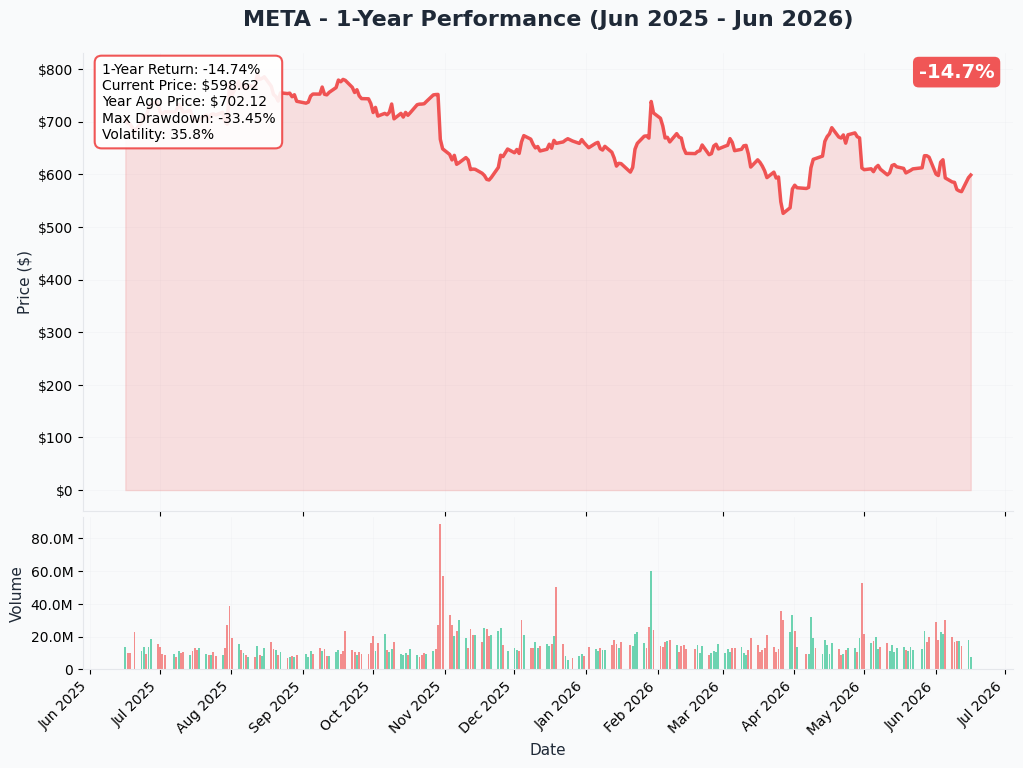
YTD Chart
Gamma Support & Resistance
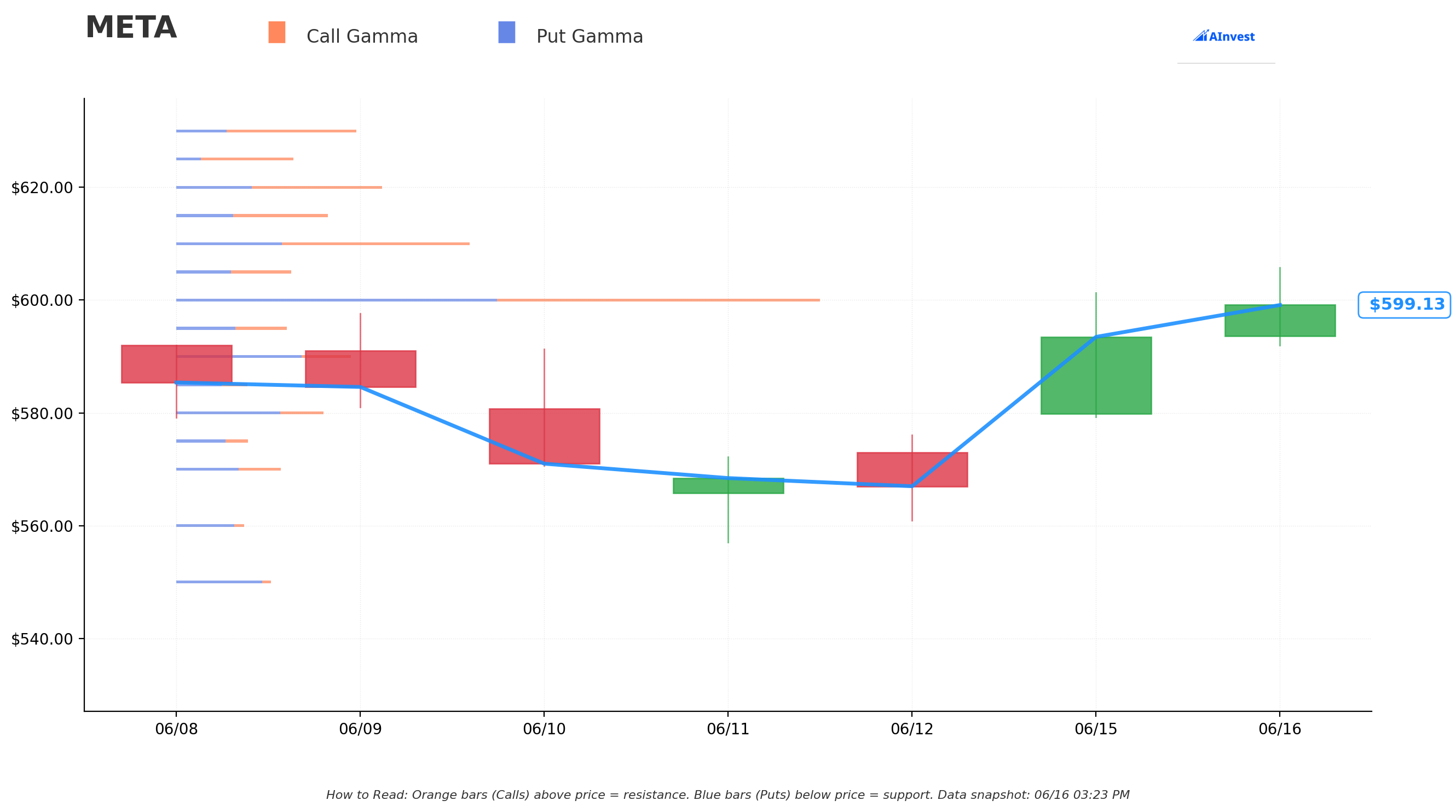
Key gamma levels from today's options market:
The dominant feature on the gamma landscape right now is the $600 strike, which carries the highest total gamma exposure across the entire chain — a Very Strong resistance wall just ≈0.11% above current spot. This level will act as a magnet and a ceiling simultaneously: market makers are short gamma here and will hedge by selling rallies and buying dips near $600. Breaking and holding above $600 is the first hurdle for any near-term bullish momentum.
Above $600, gamma walls stack at:
- $605 — Strong resistance (≈0.94% above spot)
- $610 — Very Strong resistance (≈1.78% above spot)
- $615 — Very Strong resistance (≈2.61% above spot)
- $620 — Very Strong resistance (≈3.44% above spot)
- $625 and $630 — additional resistance walls, each requiring sustained buying pressure to clear
- $640 — resistance wall at ≈6.78% above spot (the long-leg strike of today's spread; note meaningful existing OI here)
- $650 and $660 — further resistance cluster
- $700 — resistance wall at ≈16.79% above spot (also the short-leg strike; significant call gamma accumulates here)
On the downside, the floor structure is:
- $595 — Strong support (≈0.73% below spot)
- $590 — Very Strong support (≈1.56% below spot); the largest put-gamma cluster in the near zone
- $580 — Strong support (≈3.23% below spot)
- $570 and $550 — additional support walls below
Read: META is currently pinned just below the monster $600 gamma wall. For the bullish roll thesis to begin working, the stock needs to clear $600 convincingly and then work through a dense wall-to-wall resistance ladder up to the $640 long strike. Gamma pinning near $600 will dampen short-term volatility, which is actually favorable for a LEAP holder (lower near-term realized vol keeps the term structure elevated, benefiting long-vega LEAP positions).
Implied Move Cone
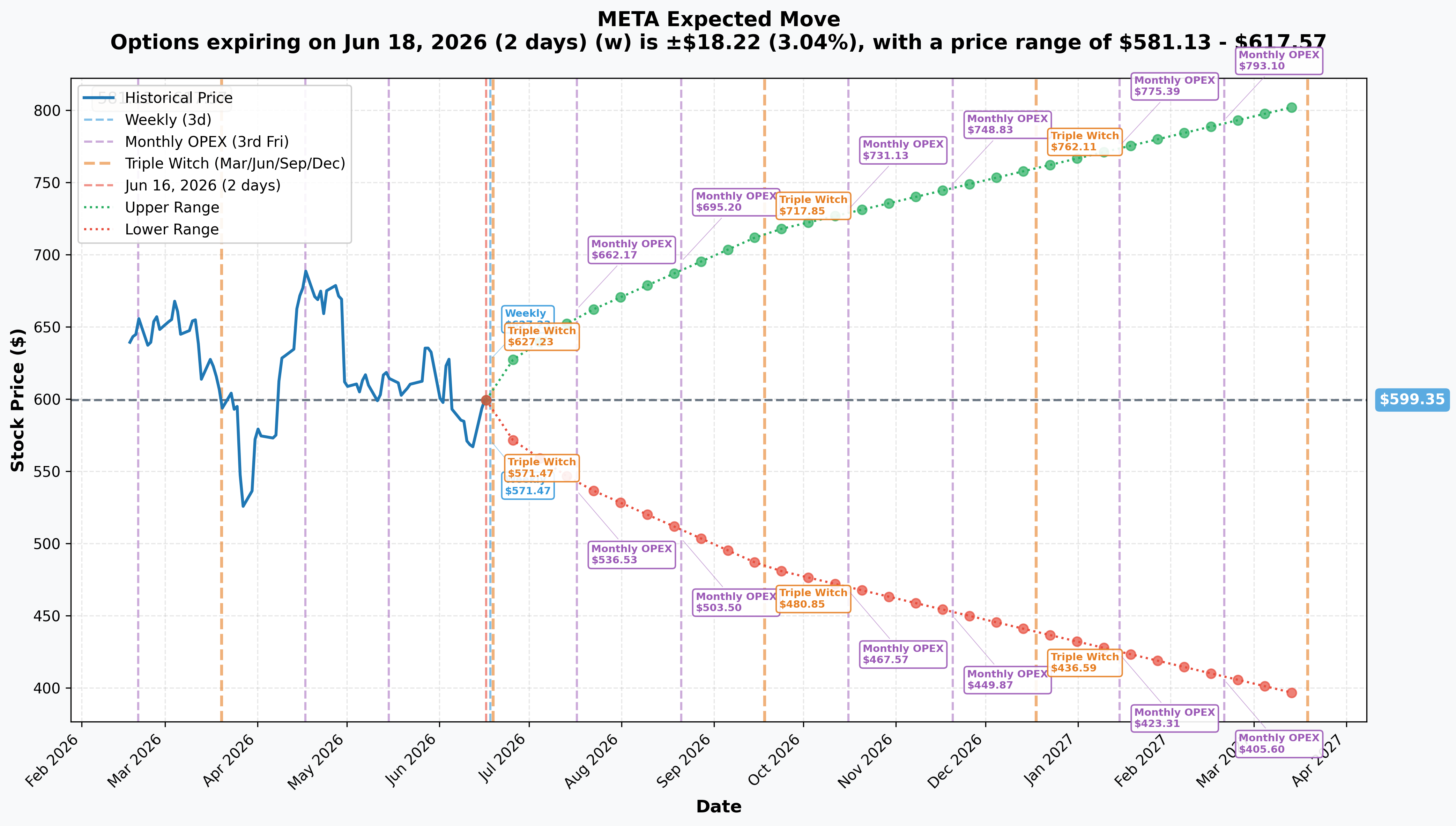
Market-implied price ranges (from today's options curve):
| Timeframe | Expiry | Implied Move | Upper Range | Lower Range |
|---|---|---|---|---|
| This week | Jun 18, 2026 | ±3.04% (±$18.22) | ≈$618 | ≈$581 |
| Monthly OPEX | Jul 17, 2026 | ±9.72% (±$58.23) | ≈$658 | ≈$541 |
| Quarterly | Sep 18, 2026 | ±19.36% (±$116.04) | ≈$715 | ≈$483 |
| LEAPS | Mar 19, 2027 | ±34.3% (±$205.55) | ≈$805 | ≈$394 |
Read for the position: By the Q2 earnings print on July 29, 2026 (see Catalysts below), the options market implies a ≈±9.72% move from spot by July OPEX. That puts the upper range at ≈$658 — already above the $640 long strike. In other words, the long $640 call starts to move meaningfully in-the-money if a strong Q2 print delivers a sustained re-rate above $640. By the Sep 2026 quarterly, the upper implied range touches ≈$715. The Dec-2028 expiry is well beyond the longest standard LEAPS data point; the ±34.3% LEAPS cone (to Mar 2027) anchors the long-horizon vol estimate. At the same ±34% annualized IV, the 2.5-year Dec-2028 cone would imply roughly ±54% from spot by expiry — a theoretical upper bound of ≈$920. With no $700 cap, the position keeps gaining all the way up that cone. The long call is priced for the thesis to work inside the market's own implied distribution.
Catalysts
The next ≈2.5 years to Dec-2028 expiry are dense with binary events:
Near-term (next 90 days):
- June 2026 (ongoing): "Hatch" AI agent entering internal testing for wearables (autonomous scheduling, email, task management), per Geeky Gadgets. An early read on the AI-as-software-layer thesis.
- July 29, 2026 (after close, confirmed): Q2 2026 earnings — the first major inflection point for the spread, per Catacal. Watch: whether ad price growth (+12% in Q1) holds, capex trajectory within $125–$145B, and Reality Labs loss direction. A strong print could push META toward the $640 long strike within weeks. The options market is pricing ≈9.72% move by July OPEX — a gap through $640 is a realistic scenario on a strong beat.
- H2 2026: Additional restructuring waves (≈8,000-person AI reorganization underway), per The Next Web. Cost-out could partially offset capex drag on free cash flow.
Medium-term (Q3–Q4 2026):
- H2 2026: Neural Band virtual handwriting and next-gen smart-glasses features roll out, per Geeky Gadgets. Wearables are the "second screen" monetization thesis that extends past advertising.
- Late October 2026 (expected): Q3 2026 earnings — the most important read on whether $145B capex lands at the high or low end, and the first data point on 2027 depreciation forecasts.
- 2026 (timing fluid): Third-generation Ray-Ban AI smart glasses launch, per TechBuzz and Road to VR. Volume here is the proxy for the wearables monetization runway.
- December 2026: "Mojito VIP" high-end smart-glasses model with waveguide display targeted for launch, per Geeky Gadgets.
- 2026 (early/ongoing): "Avocado" frontier LLM debut aimed at competing with Gemini and ChatGPT, per Investing.com. Execution here sets the internal AI-leverage story.
Structural / ongoing:
- FTC antitrust appeal: 29 state AGs backing the FTC's appeal of the June 2026 trial win (Instagram/WhatsApp breakup ruling), per TechTimes. The DC Circuit appeal is a multi-year process — the Dec-2028 expiry sits squarely inside this timeline. An unfavorable ruling would be a material negative for the long position.
- EU regulatory drag: Ongoing "consent or pay" ad-model enforcement and DMA obligations represent a chronic, modest EU revenue headwind, per Noerr and PYMNTS.
- AI capex monetization: Per 24/7 Wall St., AI-driven ad pricing is the swing factor that could push the stock well above the $700 short strike if it compounds as bulls expect.
4-Reader Interpretation
🚀 YOLO (Short-term speculator) This trade is NOT your instrument. A Dec-2028 LEAP long call is a 2.5-year time commitment. There is no near-term catalyst that converts this into a quick double — even a 10% gap on Q2 earnings would only put META at ≈$659, just above the $640 long strike. If you want to express a directional META view this week, look at weekly or monthly options, not a LEAP. Following this exact trade would mean tying up capital for nearly three years on a bet whose payoff grows the further META runs above $640 by expiry.
📊 Swing (Multi-month directional trader) The roll's construction is instructive: the desk chose to move DOWN to $640 for a reason. The $640 strike is roughly where META traded in early-to-mid 2025 before the capex-fear selloff, and at ≈7% OTM it carries meaningfully more delta than the $700 strike (≈17% OTM) it just closed. The desk decided it would rather own the closer, higher-delta strike outright than keep paying time-value on the further-out $700. If you share this multi-quarter bullish view and want leveraged long-call exposure, a smaller-scale Dec-2028 $640 long call gives you a similar (uncapped) payoff profile — with the same caveat that a long LEAP bleeds time value if META stalls. Key decision point: July 29 earnings. A strong Q2 beat with stable capex guidance likely rallies the stock toward or above $640 — at which point the long call's delta and notional gain accelerate. A capex raise or revenue miss could push META below $590 support, hurting the position but leaving two full years of runway.
🛡️ Premium Collector (Income / short-vol trader) This is a roll into a long call — the desk is PAYING net premium, not collecting it. There is no theta credit for you to harvest here; in fact, as an outright long LEAP the position now pays time decay rather than collecting it. The next-day OI shows the $700 leg was the desk closing its own prior long (not opening a new short), so there is no neat "premium-collector counterparty" template to mirror. Given the highly compressed short-term implied vol (the options market is only pricing ±3% this week, with META pinned at the $600 gamma wall), if your view is that the capex overhang keeps the multiple capped, selling near-term call spreads above $600 is a reasonable income structure — but that is your own trade, not the mirror image of this roll.
🌱 Beginner (First-time options reader) An institution just paid ≈$4.4M (net) to move its long-term Meta bet to a lower, closer strike — closing the Dec-2028 $700 calls it already owned and buying Dec-2028 $640 calls instead. Think of it like a season-ticket holder trading up to seats closer to the field: they pay extra now, but every play (every dollar META rises) counts for more. They want META above ≈$640 by December 2028. The further above $640 it finishes, the more the position is worth — there is no upper cap now that the higher $700 strike has been sold off. If META is at or below $640 at expiry, the long calls expire worthless and the capital tied up in them is lost. For context, Meta only needs to rise ≈7% from today's ≈$599 to reach the new $640 strike — a far more reachable bar than the ≈17% the old $700 strike required.
Honest Risk Factors — What the Tape Cannot Prove
What we can confirm from the tape:
- 2,174 contracts of the Dec-2028 $640 call were bought at ≈$157.15, and 2,174 contracts of the Dec-2028 $700 call were sold at ≈$137.15, both at 10:53 ET on June 16, 2026.
- The execution mechanism was a facilitated multi-leg auction — a broker-routed worked order.
- The $640 long leg opened fresh (size 2,174 > prior OI 391); this is confirmed.
- Net premium paid = ≈$4.4M.
What the tape cannot prove:
- Counterparty identity: We do not know who took the other side of this roll. It could be a market maker hedging an existing book, a different institution expressing the opposite view, or a fund unwinding a prior position.
- Whether the $700 leg is a new open or a close — RESOLVED: next-day OI shows the $700 call OI fell (4,016 → 2,035), confirming the SELL leg closed an existing long (STC), not opened a new short. That is what makes this a roll-down rather than a fresh capped spread.
- Any hedging activity: The desk may simultaneously hold stock, futures, puts, or other offsetting positions that we cannot see from the options tape alone. A large long-call LEAP is not necessarily a naked directional bet — it could be one leg of a more complex structure.
- Motive beyond what the structure implies: We infer "bullish, multi-year, AI re-rate thesis" from the strikes, expiry, and net-debit framing. This is the most parsimonious interpretation, but we cannot confirm the actual investment mandate, risk parameters, or position size relative to the desk's total book.
Key structural risks to the thesis:
- FCF collapse: Meta's free cash flow is projected to fall ≈80% in 2026 (from ≈$43.6B to ≈$8.5B) and could go negative in 2027 under ≈$26B of new AI depreciation, per GlobalDataCenterHub. If the market prices in a prolonged FCF drought, the $640–$700 zone could be years away rather than 2.5.
- Capex without ROI: The single biggest bear argument is that $125–$145B of AI spend fails to generate commensurate ad/product revenue by 2028, leaving the stock range-bound or lower.
- FTC appeal outcome: An adverse DC Circuit ruling requiring a partial divestiture of Instagram or WhatsApp would be a material negative event squarely within the Dec-2028 LEAP window.
- Macro / interest-rate environment: A sustained rise in long-term rates would compress the multiple on a company whose near-term FCF yield has collapsed; higher discount rates disproportionately hurt growth stocks priced on 2027+ earnings.
- Time value: With 2,174 lots × 100 shares × $20 net debit = ≈$4.4M at risk, the position erodes in value every day that META does not advance toward $640. If the stock is flat or down over the next year, the LEAP will lose significant value even though expiry is still >1 year away.
Bottom Line
A desk paid ≈$4.4M net to roll a Dec-2028 long-call LEAP DOWN in META — closing higher-strike $700 calls and opening lower-strike $640 calls through a facilitated multi-leg auction. After next-day OI, the architecture is clear: this is a multi-year bullish bet that Meta's AI capital cycle pays off in higher ad revenues, wearables monetization, and multiple expansion — repositioned for more delta today by moving from $700 (≈17% OTM) to $640 (≈7% OTM).
Next-day OI resolved the structure (2026-06-17): the $640 leg opened cleanly (OI 391 → 3,394) and the $700 leg was a close of an existing long (OI 4,016 → 2,035, i.e. it fell). So this is a roll, not a fresh capped spread — the resulting position is long Dec-2028 $640 calls with uncapped upside. The July 29 Q2 earnings print is the first meaningful inflection point: the options market implies META can move ≈±10% by July OPEX, which would put the stock in the $640 zone on a strong beat.
The gamma structure warns that $600 is the immediate ceiling (dominant resistance wall) — clearing it is the first near-term test. Above $600, a dense wall-to-wall resistance ladder extends through $610, $615, $620, $625, $630, and $640 before the long $640 strike becomes in-the-money. This is not a trade that pays quickly; it is a two-and-a-half-year thesis.
For the thesis to work: META needs to finish comfortably above the $640 long strike at December 2028 expiry — a ≈7% advance from today gets to the strike, and every dollar beyond adds open-ended value (no $700 cap). A long LEAP bleeds time value if META stalls, so the position rewards a genuine multi-quarter re-rate, not chop — a reachable hurdle for a 33%-revenue-growth mega-cap trading at a compressed 20x P/E, if the AI spend lands as the bulls expect.
Last updated: 2026-06-17 — next-day OPRA OI corrected the structure from a fresh bull call spread to a bullish LEAP roll-down: $640C opened (+3,003, BTO), $700C closed (−1,981, STC). Direction unchanged (bullish); upside is now uncapped.
Options trading involves substantial risk and is not suitable for all investors. This analysis is for informational purposes only and does not constitute investment advice. As an outright long-call LEAP, the position's loss is limited to the premium tied up in the $640 calls but it carries open-ended (uncapped) upside; it pays time decay rather than collecting it. Past unusual options activity does not guarantee future returns.