🛡️ MO $3.15M Diagonal Collar — Altria Fences In a Winner, But the Two Legs Don't Expire Together
📅 August 3, 2026 | 🔥 Unusual Activity Detected
⚠️ UPDATE — August 4, 2026 pre-market: the put leg is confirmed open; the call leg opened only partially. The Jan-2027 $62.50 put rose 1,102 → 8,671 (+7,569), ≈101% of its print. The Sep-18 $70 call rose 9,456 → 11,004 — only +1,548, or ≈21% of the 7,500 sold. Net open interest went up, so nothing was wholesale unwound and the collar read survives, but most of that call sale changed hands with existing holders rather than creating new contracts. See the ✅ RESOLVED box.
🎯 The Quick Take
Someone crossed $3.15M of gross premium in Altria (MO) options at 14:10:21 — a collar: buy a downside put, sell an upside call, same 7,500-contract size on each leg. What makes it worth a closer look isn't the size (it's a small ticket for a mega-cap) — it's that the two legs expire five months apart. The short call dies September 18. The long put runs all the way to January 15, 2027. Net cost: just $735,000 to put on. This reads like a shareholder fencing in gains after a strong run — but the tape cannot prove that a share position exists behind it, so treat the "why" as an educated guess, not a fact.
📊 Company Overview
Altria Group, Inc. (MO) trades on the NYSE and is the parent of Philip Morris USA, U.S. Smokeless Tobacco, John Middleton, Helix Innovations, and NJOY. Altria holds the leading US cigarette position through Marlboro (≈40% category share), the #2 spot in machine-made cigars, an ≈8% stake in Anheuser-Busch InBev, and a ≈41% stake in cannabis producer Cronos. Its "smoke-free" push runs through NJOY (e-vapor), a heated-tobacco joint venture with Japan Tobacco, and the on! nicotine pouch brand.
- Market Cap: ≈$114.1 billion
- Industry (SIC): Cigarettes
- Employees: ≈5,900
- Headquarters: Richmond, Virginia
- Current Price: $68.07 (trade print), ≈+18.9% year to date
💰 The Option Flow Breakdown
📊 What Just Happened — The Tape (August 3, 2026 @ 14:10:21)
🤝 BLOCK CROSS — a single negotiated print, two legs, both 7,500 contracts, different expirations. Spot at the print: $68.07.
| Time | Buy/Sell | Call/Put | Expiration | Strike | Premium | Volume | Prior OI | Size | Spot | Option Price | Option Symbol |
|---|---|---|---|---|---|---|---|---|---|---|---|
| 14:10:21 | BUY | PUT | 2027-01-15 | $62.50 | $1,942,500 | 7,610 | 1,102 | 7,500 | $68.07 | $2.59 | MO20270115P62.5 |
| 14:10:21 | SELL | CALL | 2026-09-18 | $70.00 | $1,207,500 | 11,488 | 9,456 | 7,500 | $68.07 | $1.61 | MO20260918C70 |
- The put printed 89% across the NBBO ⇒ buy side. The call printed at the bid (0% across) ⇒ sell side.
- Net debit: $735,000 ($1,942,500 paid − $1,207,500 collected).
- Net package delta: ≈ −513,300 shares. A negative options delta is exactly what you'd expect layered on top of a long stock position — the collar leans against upside, not with it.
- No paired equity block was found in the surrounding tape. The dominant mechanism on both legs was a multi-leg cross — a genuine negotiated block, not a lit sweep. No aggression language applies here; this was a broker matching a known counterparty off the order book.
✅ RESOLVED — Next-Day OI Is In (August 4, 2026 pre-market)
The OPRA open-interest snapshot timestamped August 4, 2026 ≈06:30 ET reflects the close of business August 3 — the definitive open-vs-close test we flagged when this published. Here is what it says.
| Leg | Baseline OI (Aug-3 snap) | Resolving OI (Aug-4 snap) | Δ | Print size | Δ as % of print | Verdict |
|---|---|---|---|---|---|---|
| Jan-15-2027 $62.50 put (bought) | 1,102 | 8,671 | +7,569 | 7,500 | ≈100.9% | ✅ OPEN (BTO) — confirmed |
| Sep-18-2026 $70 call (sold) | 9,456 | 11,004 | +1,548 | 7,500 | ≈20.6% | ⚠️ PARTIAL OPEN (STO) |
The put leg landed exactly where we predicted (≈8,600 forecast, 8,671 actual) — a clean, fully fresh long put. That half of the collar is settled at HIGH confidence.
The call leg is the honest asterisk. We laid out two outcomes: open interest up ≈7,500 would confirm a new short call and the collar read; open interest down would mean an old long call was being closed and the trade was something else entirely. Neither extreme happened. Open interest rose, but by only 1,548 contracts against a 7,500-lot sale, with 11,571 contracts trading at that strike on the day.
What that means, stated carefully:
- The direction is right — nothing was unwound. Open interest at the $70 strike went up, which rules out the alternative we flagged (a desk closing out an old long call position). The STO label stands, and so does the diagonal-collar structure described below.
- But only ≈21% of the sale created new contracts. The rest matched against existing open interest — meaning a large share of the print was position transfer between participants rather than fresh short inventory being created. Somewhere between zero and roughly 5,000 of the 7,500 contracts sold could have been offset by closing activity on the other side; the strike-level data cannot narrow it further.
- Note on the site badge: the web app marks this call leg CLOSED. That flag is set by an automated rule asking whether the full 7,500-lot position is sitting at the strike — it is not, so the rule trips. It is not evidence of a wholesale close: open interest went up. Read this box, not the badge.
- Practical read: treat the collar as real and newly established on the put side, and as partially new on the call side. The mismatched-expiration risk described below — a September short call against a January long put — is unchanged, because the desk sold those calls either way. What is weaker than a headline "$3.15M new collar" suggests is how much genuinely new short call exposure entered the market on August 3.
🤓 What This Actually Means — Plain English
This is a diagonal collar: buy a put below the market, sell a call above the market, and use the call premium to pay for most of the put. On its own that's a textbook hedge — protection on a stock position, financed cheaply. What's unusual here is the mismatched clock: the short call expires September 18, 2026 (≈6.5 weeks out), while the long put runs to January 15, 2027 (≈5.5 months out).
Order types, per leg:
- BUY put = BTO (bought to open) — confirmed by the tape, HIGH confidence.
- SELL call = STO if opening — MEDIUM confidence, provisional pending tomorrow's OI. We're calling it STO for now because that's the collar reading, but flag it as ⏳ until OI confirms.
Why the mismatch matters — walk through the calendar:
- Now through September 18: they've given up upside above $70 in exchange for collecting $1.61/share. If MO rallies past $70 before then, the short call caps their gain at $70 (an assignment/buy-back risk if they don't actually own shares to deliver).
- September 18 onward, if the call isn't rolled: the short call expires and disappears. What's left is a naked long January put — cheaper protection than they started with (most of its cost was already paid for by the call premium collected), and full, uncapped upside participation resumes. They also get the option to sell another call against the position later, effectively re-collaring on their own schedule. That optionality — cap now, uncapped later, re-cap if they choose — is what makes this an actively managed hedge, not a set-and-forget position.
- All the way to January 15, 2027: downside is fenced at $62.50 the entire time, regardless of what happens to the short call.
Payoff in plain terms, at a few prices:
| MO price | Before Sep 18 (both legs live) | After Sep 18 (put only) |
|---|---|---|
| $75 | Capped at $70 — the short call is deep ITM; if they hold shares, they're forced to sell (or buy back the call) at $70, giving up $5/share of the rally above the cap | N/A (call already expired) — full $75 participation, no cap |
| $70 | Right at the short call strike — upside caps almost exactly here | N/A — full participation, this is just a normal stock price |
| $68.07 (current spot) | Call expires worthless if unchanged; they keep the stock free and clear, still holding the January put for protection | Same — no cap, put still protecting below $62.50 |
| $62.50 | Put is exactly at the money — the floor is right here, no protection has kicked in yet | Put at the money — floor line |
| $58 | Put is in the money — they can exercise and sell (or the put's value offsets the loss) around $62.50 instead of taking the full drop to $58 | Same protection — this is the whole point of carrying the put through January |
The takeaway: above $70 they're capped only until mid-September; below $62.50 they're protected all the way to mid-January. In between, they simply hold the stock (or the exposure the stock represents) and let time pass.
⚠️ Motive — INFERRED, not proven. You typically only sell calls against shares you already own (or a synthetic equivalent) — selling a naked call carries open-ended risk that doesn't fit a simple "collar" story. The economics here (protection funded mostly by premium collected, negative package delta) look exactly like someone fencing in a stock position after a strong run. But the tape cannot prove share ownership, and a full scan of the surrounding print found no paired equity block. Treat "this is a shareholder hedge" as the most plausible read, not a confirmed fact.
📈 Technical Setup / Chart Check-Up
YTD Performance
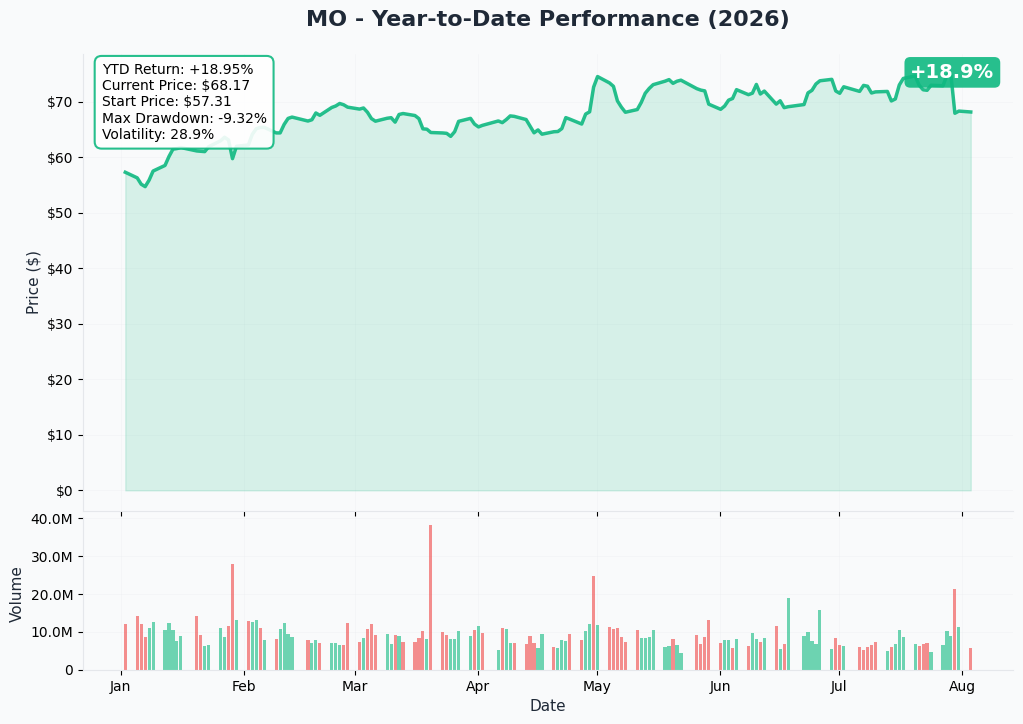
MO is having a strong year — ≈+18.9% year to date, one of the better runs among defensive, high-yield names. Collaring after a move like that is a natural, unglamorous risk-management step: you don't have to believe the stock is done going up to want to protect what you've already made.
Gamma-Based Support & Resistance
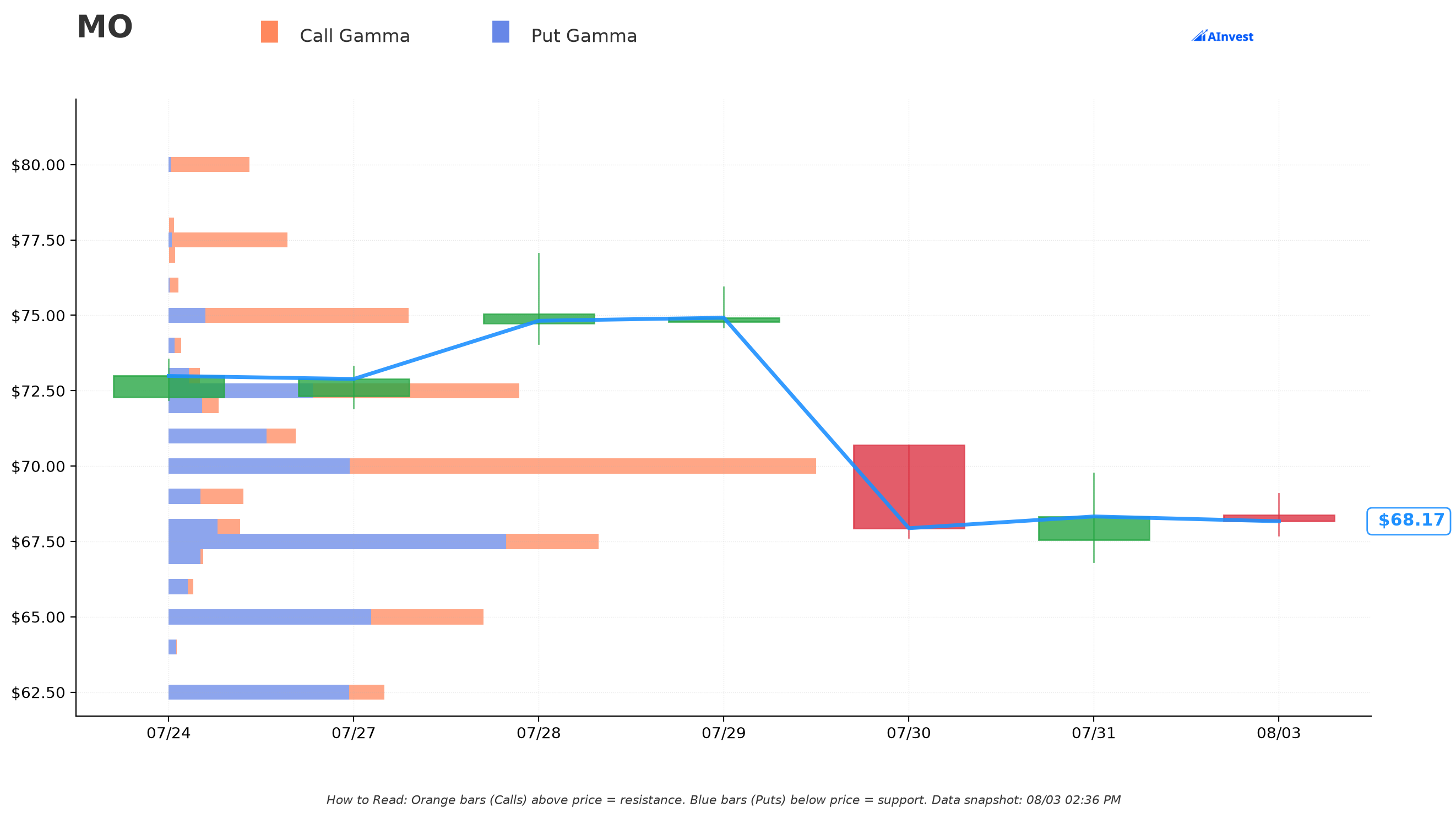
Current price in the gamma map: $68.19
🟠 Resistance (call gamma above spot):
- $70 — Very Strong wall, total gamma ≈15.82 (call gamma ≈11.40 dominant), only ≈2.7% above spot. This is exactly the short call's strike — dealer hedging flow around this level lines up with where the seller capped their upside.
- $72.50 — secondary resistance, total gamma ≈8.57, ≈6.3% above spot.
- $75 — further resistance, total gamma ≈5.86, ≈10.0% above spot.
🔵 Support (put gamma below spot):
- $67.50 — Very Strong wall, total gamma ≈10.51 (put gamma ≈8.24 dominant), just ≈1.0% below spot — the nearest floor.
- $65 — secondary support, total gamma ≈7.69, ≈4.7% below spot.
- $62.50 — support wall, total gamma ≈5.27, ≈8.3% below spot. This is exactly the long put's strike — the protection floor sits right on top of an existing gamma support level, which is a sensible place to buy insurance.
What this means for traders: the market's own options positioning already treats $70 as a magnet/ceiling and $62.50 as a shelf — the collar's strikes weren't picked in a vacuum; they line up with where dealer hedging flow is heaviest.
Implied Move
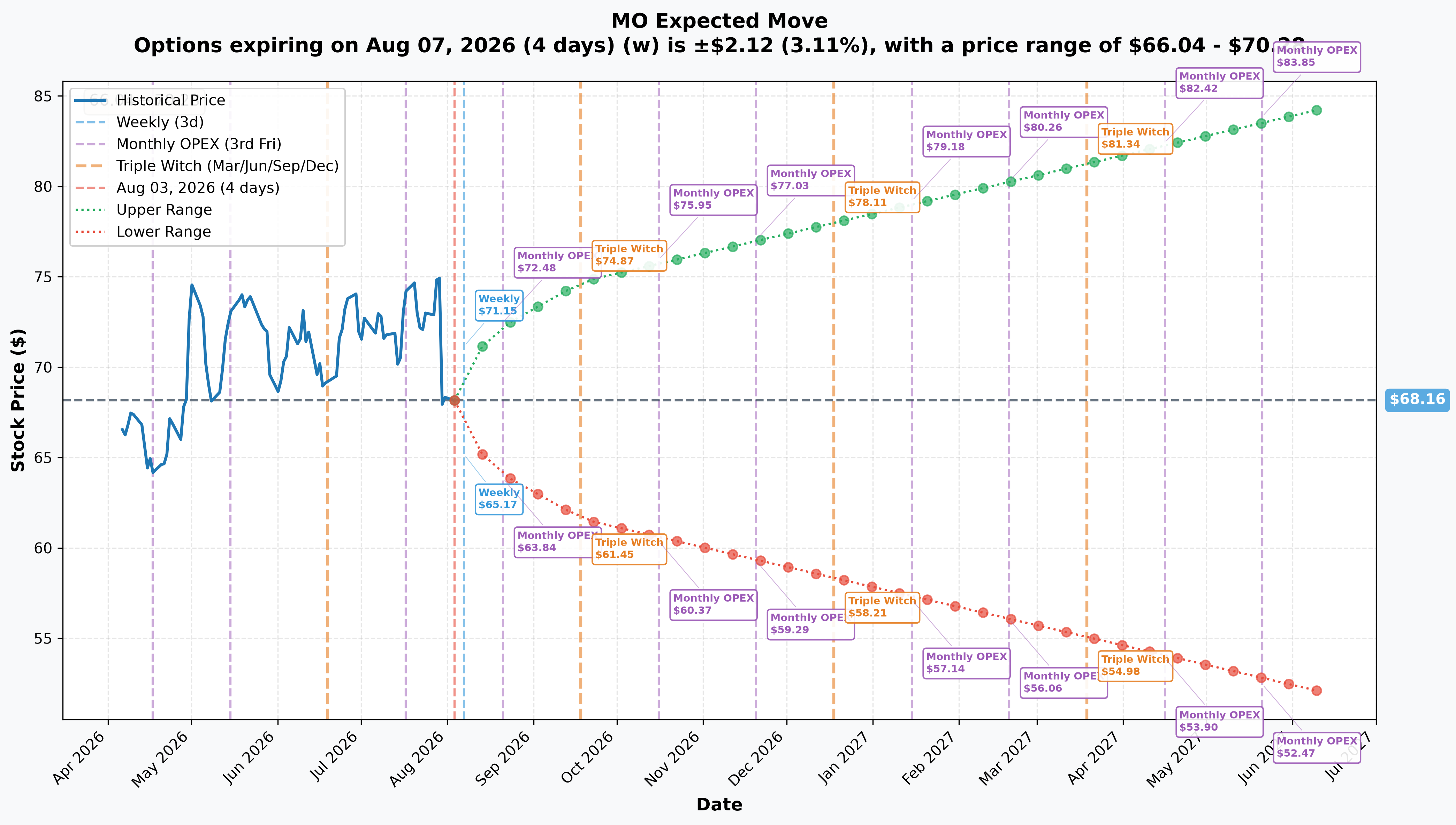
Current price: $68.16.
- Weekly (Aug 7, 4 DTE): ±3.1% (±$2.12) → range $66.04 – $70.28
- Monthly OPEX (Aug 21, 18 DTE): ±6.1% (±$4.15) → range $64.01 – $72.31
- Quarterly Triple Witch (Sep 18, 46 DTE) — same day the short call expires: ±9.6% (±$6.57) → range $61.59 – $74.73
- LEAPS tenor (Jun 17, 2027, 318 DTE — the closest listed long-dated tenor to the Jan-15-2027 put): ±24.0% (±$16.34) → range $51.82 – $84.50
Two things worth flagging: the options market's own September implied range ($61.59–$74.73) comfortably brackets both strikes of this collar — $70 sits inside the upper end, and $62.50 sits just below the lower end, meaning the put buyer picked a strike the market doesn't expect to reach by September even without this trade. The January 15, 2027 expiry itself isn't a listed tenor in the implied-move file — the nearest bracket runs from the ≈9.6% September number out to the ≈24.0% mid-2027 number, so a rough (estimated, not tape-derived) implied range for January would sit somewhere between those two — call it high-teens percent, wider than September but narrower than next summer.
🎪 Catalysts
Inside the September leg's window (now → Sep 18, 2026)
- No earnings event. Altria reported Q2 2026 results on July 30, 2026 — just four days before this trade — so Q3 2026 earnings won't land until after this call expires. The short leg is deliberately earnings-free.
- Dividend cadence. Altria has raised its dividend annually, typically in August, for 56 consecutive years; if that pattern holds in 2026, an announcement could land inside this window. The current payout ratio is reported at ≈89.5%, with analyst models projecting it easing toward ≈72.2% as earnings grow — a high but not new-territory number for a mature tobacco payer. Stockanalysis.com puts the latest declared quarterly dividend at $1.06/share, a ≈6.2% yield at current prices.
- Structural, not date-specific: the ongoing cigarette volume-decline-vs-price-increase tug-of-war, and the slow build of the smoke-free portfolio (NJOY e-vapor, on! pouches) continue in the background through this window, but we don't have a fresh, dated news item to cite for either today.
Inside the January leg's window (now → Jan 15, 2027) — everything above, plus:
- Q3 2026 earnings, expected late October 2026 based on Altria's historical reporting cadence — this is an estimate, not a confirmed date, but if the pattern holds it falls well inside the put's life and after the call has already expired. This is one reason the mismatched expiries make sense: the protection is built to survive an earnings print the upside cap wasn't exposed to.
- Q4/full-year 2026 earnings would typically land in late January or early February 2027 — right at or just past the January 15 expiry edge, so it may or may not fall inside this window depending on the exact date.
- Continued visibility on NJOY's regulatory path with the FDA and on!'s pouch-category growth remain multi-quarter, structural themes for Altria's "moving beyond smoking" strategy — real catalysts over this horizon, but without a specific dated announcement to link today.
- Wall Street currently carries a Hold consensus on MO with an average price target near $70.78 (range $60–$79), per MarketBeat — notably, the average target sits almost exactly on the short call's $70 strike.
🎲 Price Targets & Probabilities
Combining the gamma map and the implied-move data: $70 is both the resistance wall and the average analyst target and the short call strike — a level with a lot of independent reasons to matter near-term. $62.50 sits just below a real support wall and lines up with where the January put's protection begins. The September implied range ($61.59–$74.73) already covers both strikes comfortably, which is consistent with a collar sized to survive normal volatility rather than to bet on an extreme move.
- Base case: MO drifts within the $65–$72 gamma-dense zone through September; the short call expires worthless or close to it, the collar cost only the $735,000 net debit, and the position converts into a standalone long put for the rest of its life.
- Bull case: MO pushes through $70 before September 18 — the short call caps the gain (or forces a buy-back/roll decision) at that strike.
- Bear case: MO weakens toward or through $62.50 at any point before January 15, 2027 — the put pays, with a floor that was bought for a modest net cost relative to the size of the position it covers.
💡 Trading Ideas
🛡️ Conservative — Just watch this one, don't copy the structure blind
Why: This trade's whole rationale depends on an unconfirmed assumption — that the trader owns MO shares underneath it. Copying a "collar" without owning the stock isn't a collar; it's a naked short call with open-ended risk plus a long put, a very different risk profile. If you don't already own MO, there's nothing here to replicate directly.
Action: If you already hold MO shares and like the idea, note the exact strikes and expiries ($70 call to Sep-18, $62.50 put to Jan-15-2027) as a reference point, and revisit after tomorrow's OI confirms whether the call leg is genuinely new.
⚖️ Balanced — Premium Collector's read: this is how you finance protection
This is the natural home for a premium-focused trader. The mechanics here are worth studying even if you don't trade this exact structure: the $1.61/share collected from the Sep-18 $70 call financed 62% of the cost of the Jan-2027 $62.50 put ($1.61 vs $2.59), leaving only $0.98/share as the true out-of-pocket cost of ≈5.5 months of downside protection. If you hold MO for its dividend and want to defend the year's gains without paying full price for insurance, a shorter-dated covered call against a longer-dated protective put — sized to your own share count — is the textbook version of this trade. The tradeoff you're accepting: capped upside through the call's expiry in exchange for materially cheaper portfolio insurance.
🚀 Aggressive — Not really an aggressive trade, but here's the closest read
Why this isn't a great template for speculation: the net delta here is negative and modest relative to the premium at risk — this was built to reduce risk, not add it. A trader wanting direct speculative exposure to the same $62.50/$70 range would do better buying a simple vertical rather than trying to reverse-engineer a hedge into a directional bet.
If you insist: a standalone long $70 call betting on a breakout through the gamma wall by September 18 is the speculative mirror image of what this trader sold — you'd be taking the other side of their cap, with defined risk limited to the premium paid. Small size only; MO is a low-volatility defensive name and outsized moves are the exception, not the rule.
⚠️ Risk Factors
- Ownership is unproven. The entire "shareholder hedge" reading is inferred, not confirmed. If no stock sits underneath this, the short call is a naked position with theoretically unlimited loss above $70 before any offsetting long-put gains kick in below $62.50 — a materially riskier structure than a true collar.
- The call leg's open/close status is unresolved. Size (7,500) sits below prior OI (9,456), so today's tape cannot prove whether this was a new short position or the closing of an existing long call. If it resolves as a close, the whole "new collar" framing needs to be revisited.
- A roll decision looms in ≈6.5 weeks. When the September call expires, whoever is behind this trade has to decide whether to let the position go naked-long-put, roll the call out again, or unwind. We have no visibility into what they'll do.
- No paired equity block was found. This doesn't prove there isn't one — a stock position could have been built gradually, off-exchange, or well before today — but a scan around the print turned up nothing that ties directly to this trade.
- Altria-specific risks remain in place regardless of this options trade: regulatory pressure on cigarettes and vapor products, excise-tax and menthol-ban policy risk, secular volume decline in combustible tobacco, and litigation exposure are all structural to the name and unaffected by this collar's mechanics.
- A defensive, high-yield stock can still move. MO's ≈+18.9% YTD run means there's real embedded gain at stake; a reversal doesn't need a company-specific catalyst — sector rotation out of defensives alone could pressure the stock toward the gamma support zones discussed above.
🎯 The Bottom Line
Real talk: this is a small-ticket, textbook-shaped risk-management trade dressed up in an unusual detail — the two legs don't expire together. Someone gave up upside above $70 for about six and a half weeks, in exchange for cheap-to-free downside protection down to $62.50 that runs almost half a year, through January 15, 2027. The mismatch means they're not locked into anything long-term on the upside — once September passes, they're free (and likely to choose) to keep riding the stock while carrying inexpensive insurance underneath it.
If you own MO: this is a legitimate structure to study for your own position, especially the "sell a near-term call to finance a longer-dated put" logic — just size it to shares you actually hold.
If you're watching from the sidelines: the interesting signal here isn't direction — it's that a MO holder judged this a good moment to lock in protection after an ≈18.9% year. That's a data point about risk appetite at current levels, not a reason to trade MO yourself.
Mark your calendar:
- 📅 Tomorrow, ≈06:30 ET — next-day OI resolves whether the Sep-18 $70 call was opened or closed.
- 📅 September 18, 2026 — short call expires; watch for a roll, an assignment, or a naked long put emerging.
- 📅 Late October 2026 (estimated) — Q3 2026 earnings, expected to fall after the call expires but well inside the put's life.
- 📅 January 15, 2027 — the long put expires; the protection window closes here.
Disclaimer: Options trading involves substantial risk of loss and is not suitable for all investors. This analysis is for educational purposes only and is not financial advice. The motive behind this trade (hedging an existing share position) is an inferred, not proven, read of the tape — the options market cannot show us whether the trader owns MO stock. Past performance doesn't guarantee future results. Always do your own research and consider consulting a licensed financial advisor before trading.
About Altria Group, Inc.: Altria is the parent of Philip Morris USA, U.S. Smokeless Tobacco, John Middleton, Helix Innovations, and NJOY, holding the leading US position in cigarettes through Marlboro and building out smoke-free alternatives via NJOY e-vapor and on! nicotine pouches, with a market cap of ≈$114.1 billion in the Cigarettes industry.
Last updated: August 4, 2026 — next-day OPRA open-interest resolution added (✅ RESOLVED box above). Original analysis published August 3, 2026.