🔥 PCG $5.24M Short Strangle — A Desk Is Betting PG&E Stays Boring Through Fire Season
📅 2026-08-12 | 🤝 Block Cross Detected
✅ Updated 2026-08-13 pre-market — the next-day OPRA open interest confirmed both legs opened, but at roughly a QUARTER of the size we predicted. The $17 put rose 16,626 → 22,248 (+5,622) against 20,000 sold — we predicted ≈36,600. The $18 call rose 11,864 → 16,293 (+4,429) against 20,000 sold — we predicted ≈31,900. Direction is confirmed (both lines rose, so these were opens, not unwinds), but only ≈25% of each print became genuinely new open interest; the rest was a transfer between existing holders. The STO labels stand; the two-session campaign figures in this article overstate the net new position. See the ✅ RESOLVED box.
🎯 The Quick Take
At 10:58:14 ET a desk printed a negotiated block cross in PG&E Corporation (NYSE: PCG): sold 20,000 January 2027 $17 puts and sold 20,000 January 2027 $18 calls, collecting ≈$5.24M in premium — a classic short strangle. This is a bet that a beta-0.28 California utility trades quietly for the next five months. The problem: those five months contain the entire rest of the 2026 wildfire season, and PG&E has been to bankruptcy court twice over exactly this risk.
🏢 The Company
PG&E Corporation is the holding company for Pacific Gas and Electric, the combined electric-and-gas utility serving 5.2 million households across northern and central California — Bakersfield to the Oregon border. Market cap is $38.19B (2.20B shares × $17.34; one data aggregator shows $46.42B, but shares outstanding times price confirms $38.19B is correct). Sector: Utilities, multi-utility (electric + gas).
PG&E has filed Chapter 11 twice. The first, in 2001, came from California's deregulated power-market crisis. The second — the one that actually matters here — was filed January 29, 2019, against roughly $30 billion of wildfire liability from the 2015–2018 fire seasons. PG&E pleaded guilty to 84 counts of involuntary manslaughter for the 2018 Camp Fire and exited bankruptcy in June 2020, funding a $5.4 billion Fire Victim Trust plus 22.19% of reorganized equity.
That history is why this stock trades at 10.28× forward earnings while collecting an unusually rich options premium — the market prices in a bankruptcy tail, not just a recession tail.
The wildfire backstop: AB 1054, signed in 2019, created the California Wildfire Fund — a ≈$21 billion pool that reimburses PG&E, SoCalEd, and SDG&E for eligible wildfire claims. It's administered by the California Catastrophe Response Council with the California Earthquake Authority as fund administrator. Critically, that fund is already expected to be exhausted by the January 2025 Eaton Fire alone (UCLA estimates Eaton losses at $24–45B). A newer law, SB 254 (September 2025), authorized up to $19B of additional bond capacity to rebuild the backstop — but the point stands: the shock absorber is thinner heading into this fire season than it was designed to be.
Rate structure: the CPUC sets PG&E's revenue through a General Rate Case (filed every four years) and a triennial Cost of Capital Mechanism. PG&E's authorized return on equity for 2026–2028 was cut to 9.98%, with an overall rate of return of 7.61% — already locked in, with no reset scheduled until roughly 2029.
💰 The Trade — Plain English
Someone sold two options at once on the same stock, same expiration, and pocketed the combined premium:
| Time | Buy/Sell | Call/Put | Expiration | Strike | Premium | Volume | OI | Size | Spot | Option Price | Option Symbol |
|---|---|---|---|---|---|---|---|---|---|---|---|
| 10:58:14 ET | SELL | PUT | 2027-01-15 | $17 | $2,560,000 | 20,000 | 16,626 | 20,000 | $17.34 | $1.28 | PCG20270115P17 |
| 10:58:14 ET | SELL | CALL | 2027-01-15 | $18 | $2,680,000 | 20,000 | 11,864 | 20,000 | $17.34 | $1.34 | PCG20270115C18 |
🤝 Mechanism: this was a block cross — a pre-negotiated trade between two known counterparties, printed off the lit order book. No urgency, no panic, no "sweep." A desk crossed both legs simultaneously.
The math:
- Combined credit collected: ≈$5.24M ($2.56M + $2.68M)
- Maximum-profit zone: $17.00–$18.00. If PCG sits anywhere between the two strikes at expiration, both options expire worthless and the seller keeps the entire $5.24M. Spot at $17.34 is inside this zone right now.
- Per-leg breakevens: $15.72 and $19.32. Below $15.72, the put alone starts losing more than its own premium collected; above $19.32, same story for the call.
- True package breakevens (using the full $2.62 combined credit): $14.38 and $20.62. This is the real zero-line for the position as a whole, since the untested leg's premium cushions the tested one.
- Worth flagging directly: PG&E's own trailing 52-week low is $14.30 — below the $14.38 lower breakeven. The stock's actual trading range over the last year would have tested this position on the downside.
- The obligation is real: 20,000 short puts = 2,000,000 shares of potential downside exposure at $17 a share.
Direction note: the $18 call printed at the bid (0% across) and the $17 put close to it (23% across) — both consistent with a sale. But this was a negotiated block that took no liquidity from the order book, so this is corroboration, not proof.
✅ RESOLVED — Both Legs Opened, But Only ≈25% of the Size Was Genuinely New
Updated 2026-08-13 pre-market. Resolving OPRA snapshot timestamped August 13 (reflects the August 12 close, after this print); baseline is the August 12 snapshot (reflects the August 11 close, before this print).
| Leg | Baseline (Aug-12) | Resolving (Aug-13) | Δ | Print size | What we published | Verdict |
|---|---|---|---|---|---|---|
| Jan-15-2027 $17 put (sold) | 16,626 | 22,248 | +5,622 | 20,000 | "climb toward ≈36,600 on the $17 put" | ✅ OPEN (STO) — but only 28% of size; ≈14,378 short of prediction |
| Jan-15-2027 $18 call (sold) | 11,864 | 16,293 | +4,429 | 20,000 | "climb toward ≈31,900 on the $18 call" | ✅ OPEN (STO) — but only 22% of size; ≈15,607 short of prediction |
Direction is settled and the article's core read survives: this was opening, not closing. Both lines rose. Nobody unwound a strangle here.
But the magnitude claim in this article needs correcting, and we are correcting it. We wrote that "the real campaign is roughly 29,000 puts and 30,000 calls sold across two sessions" and that the ≈$5.24M headline understates the total. The open-interest snapshot says the opposite about today's contribution: of the 20,000 contracts printed on each leg, only 5,622 puts and 4,429 calls created new open interest. Roughly three-quarters of each print matched against holders who were already there — most plausibly the counterparties from the prior session's build trading back out.
The honest position size after two sessions is the resolving open interest itself: 22,248 puts and 16,293 calls outstanding at these strikes. That is a large short strangle, and the fire-season thesis is unaffected — but it is not the ≈29,000/30,000 two-session accumulation this article described, and readers sizing the premium collected should use the smaller number.
Control check. Neighbouring January-2027 put strikes were completely static across the window — $15P 7,480 → 7,480, $16P 2,376 → 2,376, $19P 98 → 98, $20P 1,023 → 1,023. The movement is confined to the two traded lines, so this is a genuine transfer signature, not a chain-wide artefact.
🤓 What This Actually Means — Plain English
A short strangle means selling both a put and a call on the same stock, at different strikes, same expiration. Here the put strike is $17, the call strike is $18, and spot is $17.34 — sitting right between them.
This is not a directional bet. The desk isn't saying PG&E goes up, and isn't saying it goes down. They're betting the stock does nothing dramatic — that's why it's called "short volatility." They get paid $5.24M today, and they keep it in full only if the stock stays boring through January 2027.
Both sides collected a credit, not a debit — this is Sell-To-Open (STO) on both legs, which means the desk is being paid to take on risk, not paying for the chance of a payoff. That's the "premium collector" mindset.
Here's the part that matters most: the short put side is not a normal income trade. A regular cash-secured put seller is comfortable owning the stock at the strike. Here, 20,000 short puts obligate the seller to 2,000,000 shares of PG&E at $17 if the stock craters — and PG&E's specific tail risk isn't "the market has a bad quarter." It's a wildfire that CAL FIRE later attributes to PG&E equipment, which has twice put this exact company into Chapter 11. That's a fundamentally different animal from selling puts on, say, a soft-drink company. And the short call side has unlimited theoretical loss if a legislative win or buyout rumor gaps the stock through $18 and keeps going. Undefined risk, both directions, on a stock with a documented bankruptcy precedent for the very risk that sits inside this trade's window.
📈 Technical Setup / Chart Check-Up
YTD Chart
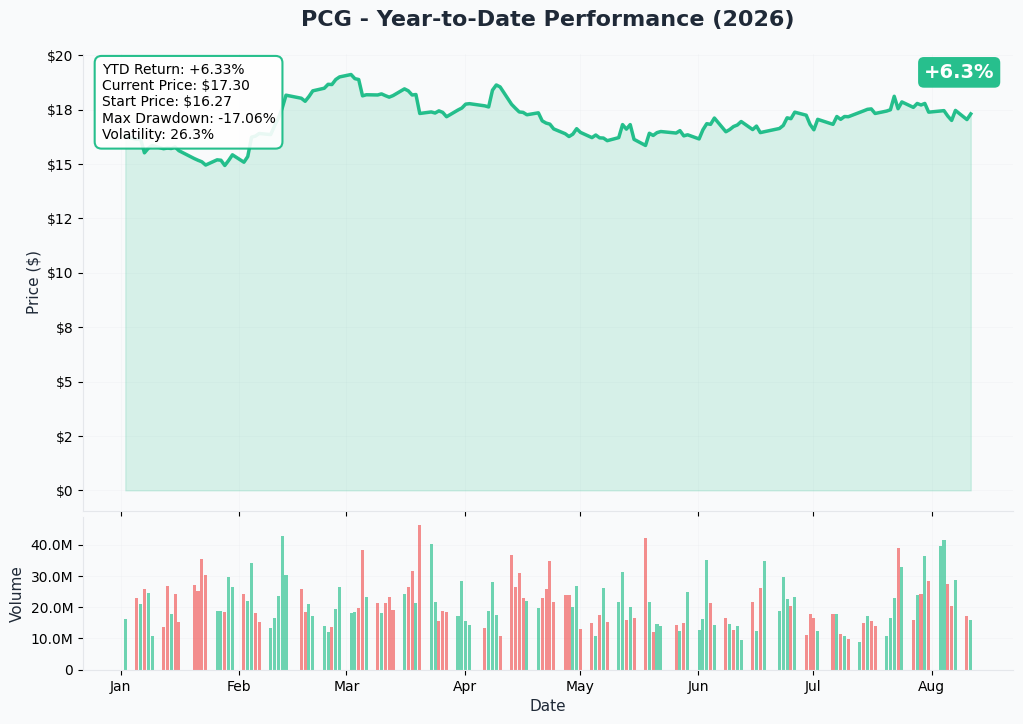
PCG is up +7.81% year to date and +3.06% over the trailing three months — but essentially flat over six months (−1.34%). That's a drift-free, low-realized-volatility tape, exactly the kind of setup a strangle seller wants: the 50-day ($17.15) and 200-day ($16.74) moving averages sit within 2.5% of each other. Worth saying plainly before the risk section: on the numbers, this is genuinely a well-timed regime for selling volatility on this name.
Gamma-Based Support & Resistance
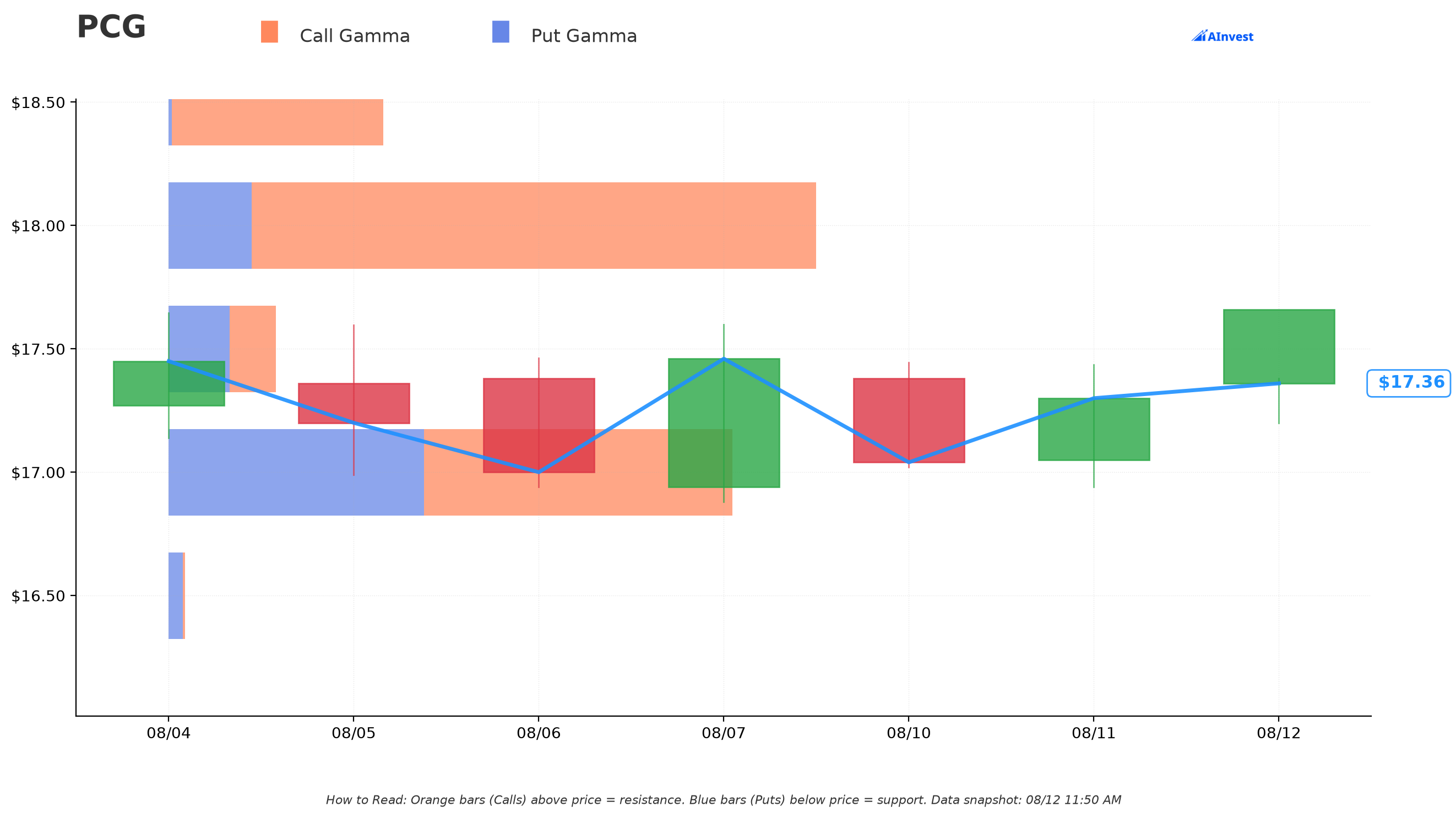
With spot at $17.36, the options market shows:
- 🟠 Resistance at $18.00 (Very Strong) — the single largest call-gamma concentration on the board
- 🔵 Support at $17.00 (Very Strong) — the single largest put-gamma concentration on the board
That's a genuinely useful tell: both of today's short strikes sit exactly on the two strongest gamma levels in the chain. Dealer hedging flows around these strikes tend to dampen movement near them — the market's own positioning suggests PCG is likely to get "pinned" close to this $17–$18 band in the near term, which is directly supportive of the strangle's max-profit zone. That's the bull case for this trade in one chart.
Implied Move
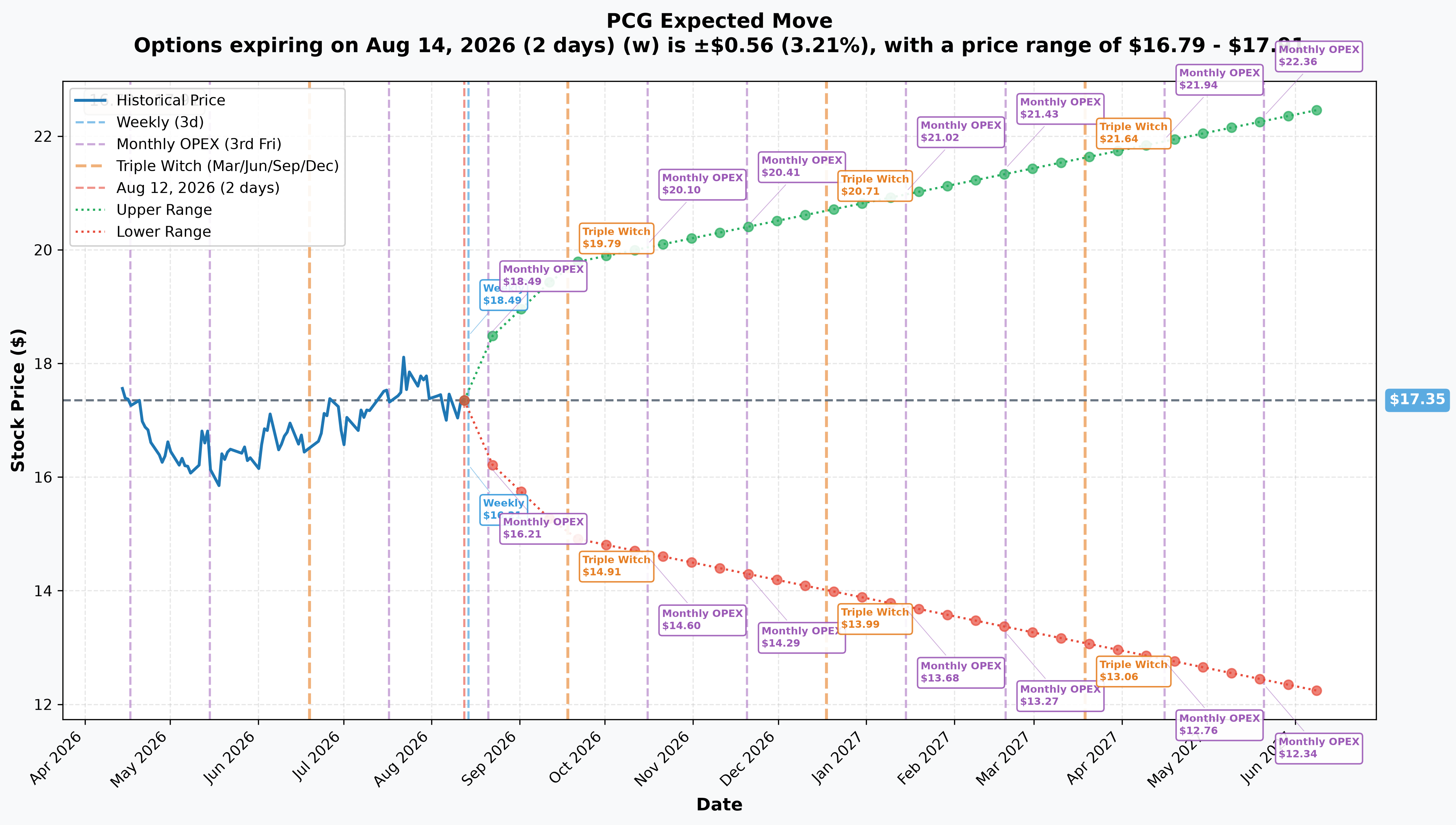
- To Aug 14 (2 days): ±3.21% → range $16.79–$17.91
- To Aug 21 (9 days): ±6.29% → range $16.26–$18.44
- To Sep 18 (37 days): ±13.91% → range $14.94–$19.76
Note what happens by September: the implied range already breaches both short strikes ($14.94 is below $17, $19.76 is above $18). The options market itself is pricing meaningful odds that PCG trades outside the strangle's max-profit zone well before this position's January expiration — even though today's realized volatility has been calm.
🎪 Catalysts
🔴 Live right now — the nearest binary, ≈3 weeks out
The single most time-urgent item: on August 12, 2026 — today — CalMatters reported that Governor Newsom is making a "last-minute push" on a multi-bill wildfire-liability package, with California's legislative session ending in roughly three weeks (≈August 31, 2026). Reported provisions include capping non-economic damages at $150,000, limiting attorneys' fees (currently 30–40% of payouts), restricting hedge-fund purchase of claims, and requiring shareholder-funded rate reductions for two summers. Insurers are running ads calling it a "utility bailout"; wildfire-survivor groups call it a "secret bill."
This cuts both ways, and that's the point. Passage is a credible catalyst to gap PCG through the $18 short call and toward the $19.32–$20.62 upside breakevens. Failure — especially heading into peak fire season with the Wildfire Fund already thin — reads bearish. Both directions are live within roughly a month of this trade being placed. That is exactly the wrong shape of event for a position that only wins if the stock stays calm.
🔥 The central risk — the rest of the 2026 wildfire season
The January 2027 expiration means this position is carried through August, September, October, November, and December 2026 — the entire remainder of California's fire season, including the September–November Diablo-wind peak — with no roll point before the season resolves.
2026 is not a benign year. As of today, California has recorded 228,390 acres burned across 4,393 fires, following a winter of only 18% of average snowpack and extreme statewide heat. The active Bug Fire has burned 57,363 acres and is only 4% contained as of its most recent report. None of this is confirmed to involve PG&E equipment yet — CAL FIRE cause determinations routinely lag by months — but the conditions are primed, and the $21B AB 1054 Wildfire Fund is already expected to be exhausted by the Eaton Fire, meaning the backstop is thinner for whatever comes next. A catastrophic PG&E-linked fire is a low-probability, high-severity event — and PG&E's own history says that when it happens, the equity response isn't a 10% drawdown, it's a bankruptcy filing.
📅 Only one earnings report falls inside the window
PCG's Q3 2026 results are estimated for ≈October 22, 2026 — the only quarterly report that lands before the January 15, 2027 expiration. Q4/FY2026 results and first FY2027 guidance are expected in February 2027, outside the window entirely, and the next triennial cost-of-capital reset isn't due until roughly 2029. Low event density inside the window favors the seller — set that against the wildfire exposure above.
Recent print — Q2 2026 earnings (July 23, 2026)
PG&E beat on the bottom line and missed on the top: core EPS $0.40 vs. $0.36 consensus, but revenue $5.90B missed the $6.20B estimate, and FY2026 guidance was reaffirmed at $1.64–$1.66. The stock still fell 3.15% on the print — a useful data point for a strangle seller, since even a beat-and-reaffirm quarter only moved the stock about a third of the way to the nearest breakeven. Q1 2026 (April 23) was similarly strong: $0.43 vs. $0.39 consensus.
Financing activity
PG&E has raised $4.4B of utility debt year to date, including a $2.2B June bond, and launched (then upsized to $1.2B) a cash tender offer for 2027 maturities priced at a 20 bp spread over Treasuries — market access consistent with a functioning, non-distressed borrower. The authorized return on equity was cut to 9.98% for 2026–2028, a direct earnings headwind layered on top of rising Wildfire Fund expense ($126M in Q2, up from $109M a year ago).
Structural growth story
PG&E's data-center pipeline now exceeds 12 gigawatts, and management says each incremental gigawatt translates to roughly 1% of monthly bill savings for existing customers — a slow-burn bull case that aligns growth with the state's rate-affordability politics, but not the kind of catalyst that moves the stock sharply in a single day.
Analyst tension worth surfacing
Recent price-target revisions have all pointed down: Truist ($23→$21), BMO ($28→$27), and JPMorgan ($24→$23) all cut targets while keeping constructive ratings. Yet every published analyst target — $19 to $28 — sits above the $18 short call. If sell-side sentiment ever caught up to spot, it kills this trade on the call side. What protects the position for now is that the trend in revisions has been cuts, not chases.
🎲 How Different Traders Should Think About This
🎲 The YOLO trader
There's nothing here to YOLO into directly — this is a short-premium structure that pays slowly and can lose catastrophically, the opposite of a lottery-ticket trade. If you want vol exposure on PCG, buying a cheap out-of-the-money call or put ahead of the ≈August 31 legislative deadline is a far more YOLO-shaped way to play the binary than trying to front-run this desk's strangle.
📈 The swing trader
Watch the $17–$18 gamma band — both walls are "Very Strong," so PCG has real structural reasons to chop in this range near-term. A swing long above $18 targeting the next gamma wall at $19–$20, or a swing short below $17 toward the $16 support wall, both make more sense than trying to replicate this strangle with retail-sized size and retail-sized margin.
💰 The premium collector
This is the trade most directly relevant to you, and it needs a hard caveat: this is undefined risk on both sides. The put side alone is 100 shares of $17-strike obligation per contract — scale that to 20,000 contracts and you get the 2,000,000-share number above. If you're going to sell premium on PCG, do it in a size where a fire-season tail event doesn't blow up your account, and strongly consider defining your risk — a put credit spread or an iron condor instead of a naked strangle — specifically because the tail here isn't generic market risk, it's a name-specific bankruptcy tail with a documented precedent. Selling $17/$18 strangles this far out, at this size, only makes sense with position sizing built around "what if the worst case actually happens," not around the (very plausible) base case that it doesn't.
🌱 The beginner
If you're new to options: this trade involves selling two different options at once, which is more advanced than buying a single call or put. The seller collects money today in exchange for taking on risk that can, in the worst case, be very large and open-ended. Before you ever try something like this yourself, learn defined-risk strategies first (spreads, where your maximum loss is capped and known in advance) — and treat this article as "here's what smart money did," not "here's what you should copy."
⚠️ Honest Limits — What The Tape Cannot Prove
- The tape proves the trade happened and the size; it does not prove the desk's motive. We cannot see whether this is a standalone volatility bet, part of a larger hedged book, or one leg of something bigger.
- Broker identity, customer identity, and any offsetting position elsewhere are invisible to OPRA. We don't know who did this or why.
- A pending test-year-2027 General Rate Case decision could not be verified — no docket number, requested revenue figure, or decision date was retrievable. This is the single largest unmapped catalyst inside the window; a GRC decision materially below request is a classic utility gap-down mechanism, and it could land inside this trade's life.
- No 2026 credit-rating action from Moody's, S&P, or Fitch could be verified. Financing activity (successful bond issuance, an upsized tender) is consistent with non-distressed market access, but that is circumstantial, not a rating confirmation.
- No current wildfire-season outlook text could be retrieved to independently corroborate how the rest of the 2026 season is expected to unfold beyond the acreage and containment figures cited above.
- No equity-issuance statement appeared in the Q2 2026 release, despite a trailing buyback yield of −3.06%, which implies net share issuance rather than repurchase. A surprise equity block is a plausible non-fire route toward the $15.72–$14.38 put-side breakevens, and it isn't addressed in the company's own disclosure reviewed here.
This is options-flow research, not investment advice. Options trading involves substantial risk, including the potential for loss greater than the initial investment on undefined-risk positions like the one described above, and is not suitable for all investors.
Last updated: 2026-08-13 (pre-market) — the next-day OPRA open-interest snapshot confirmed both legs as opens but at far below the predicted size. Jan-2027 $17P 16,626 → 22,248 (+5,622 against 20,000, 28% of size; predicted ≈36,600) and $18C 11,864 → 16,293 (+4,429 against 20,000, 22% of size; predicted ≈31,900): OPEN (STO) on both. The article's ≈29,000-put / ≈30,000-call two-session campaign figure is corrected — ≈75% of each print was a transfer between existing holders, and the honest outstanding position is 22,248 puts and 16,293 calls. The ⏳ callout was replaced with the ✅ RESOLVED box; no title change was required.