🎲 PHVS $2.08M Block Cross Buys October $30 Puts — Right Before Pharvaris' Biggest Data Readout of the Year
📅 2026-08-12 | 🤝 Block Cross — Certain New Position
✅ Updated 2026-08-13 pre-market — the next-day OPRA open interest confirmed the open above the full print size. Open interest on the October $30 put rose 0 → 5,008 (+5,008) from literal zero against a 4,000-lot print; we predicted ≈4,000. The extra ≈1,008 contracts mean additional put buying arrived at this strike behind the block. The BTO label stands. See the ✅ RESOLVED box.
🎯 The Quick Take
A desk crossed 4,000 October 16, 2026 $30 puts at $5.21 — a $2.08M block — with prior open interest sitting at exactly zero, so this is a clean, provable new position, not a guess about open or close. The put is ≈14% out-of-the-money and costs ≈15% of the share price for 65 days, and the reason it's priced that rich is sitting right there on the calendar: Pharvaris reaffirmed this morning that its CHAPTER-3 Phase 3 prophylaxis readout lands in Q3 2026 — by September 30 — sixteen days before this contract expires.
🏢 Company Overview
Pharvaris N.V. (ticker page) is a Netherlands-incorporated, Zug, Switzerland-headquartered, Nasdaq-listed Health Care / Biotechnology company (profile). It is a foreign private issuer — it files Form 6-K, not the US 10-Q, and has no obligation to pre-announce a data readout day. That detail matters a lot for this specific trade, and we'll come back to it.
The whole company is built around one molecule, deucrictibant, in two formulations for hereditary angioedema (HAE):
- 🩹 Deucrictibant IR (on-demand, acute attacks) — Phase 3 complete, NDA filed and accepted by the FDA, PDUFA action date April 23, 2027, European MAA validated in July 2026.
- 💊 Deucrictibant XR (daily prophylaxis) — in CHAPTER-3, a placebo-controlled Phase 3 with topline company-guided to Q3 2026.
📊 Key numbers: market cap $2.40B, 69.88M shares outstanding, cash of €318.3M against near-zero debt (€0.67M), runway guided "into 2028" after a $132.3M offering closed May 11, 2026 at $29.68/share (balance sheet, Q2 PR). No diversification exists here — it's one drug, two indications, and the company's entire equity story rides on it.
💰 The Trade — Plain English
A trader (or a hedger — more on that below) paid ≈$2.08 million to buy 4,000 October 16 $30 puts, printing as a negotiated block cross — a known counterparty took the other side, at a pre-arranged price, off the open book. That means we can't read this as an aggressive lit sweep and shouldn't apply any urgency language to it.
| Field | Detail |
|---|---|
| Time | 10:47:09 ET |
| Buy/Sell | BUY (reported from the print; see mechanism note below) |
| Call/Put | PUT |
| Expiration | 2026-10-16 |
| Strike | $30 |
| Premium | $2,084,000 (≈$2.08M) |
| Volume | 4,000 |
| Prior Open Interest | 0 |
| Size | 4,000 |
| Spot | $34.82 |
| Option Price | $5.21 |
| Option Symbol | PHVS20261016P30 |
| Mechanism | 🤝 Block cross |
Mechanism caveat: a block cross takes no liquidity, so the "BUY" label here is reported, not tape-proven the way a lit sweep's aggressor side would be. What is proven, independent of the label, is that prior open interest was zero — so whatever this is, it is a brand-new position, not a rolled or unwound one.
✅ RESOLVED — From Zero to 5,008: More Puts Opened Than We Captured
Updated 2026-08-13 pre-market. Resolving OPRA snapshot timestamped August 13 (reflects the August 12 close, after this print); baseline is the August 12 snapshot (reflects the August 11 close, before this print).
| Leg | Baseline (Aug-12) | Resolving (Aug-13) | Δ | Print size | What we published | Verdict |
|---|---|---|---|---|---|---|
| Oct-16 $30 put (bought) | 0 | 5,008 | +5,008 | 4,000 | "rise to ≈4,000 in the next OPRA snapshot" | ✅ OPEN (BTO) — 125% of size, from zero |
No ambiguity was possible and the result exceeded the print. A strike starting at zero open interest cannot be closed, so the only question was the landing size. It landed at 5,008 — ≈1,008 contracts above the 4,000-lot cross we captured, meaning other buyers took downside protection at the same strike on the same session.
That makes the position modestly larger than this article described, and it strengthens rather than weakens the read: more than one participant wanted October $30 puts ahead of Pharvaris' catalyst.
What open interest cannot show: whether any of these puts are protective against a long share position rather than an outright bearish bet. The tape does not reveal the equity side.
🤓 What This Actually Means — Plain English
Let's break down what buying this specific put actually is.
It's 14% out-of-the-money. Spot is $34.82; the strike is $30. The stock has to fall more than 14% just for this put to have any real value at expiration — right now it's worth exactly zero if PHVS closed today.
It's 100% time value. Every cent of the $5.21 paid is pure optionality — there's no intrinsic value baked in at all, because the put is out of the money. The buyer is paying entirely for the chance something moves the stock, and for the time left on the clock (65 days) for that chance to play out.
It costs ≈15% of the share price. That's an extraordinarily rich price tag for a two-month out-of-the-money put on a normal stock. On a quiet, boring equity, a put like this might cost 2-4% of spot. Paying 15% only makes sense if the market is pricing a real, specific, dated event that could move the stock a lot — and here, there is one: Pharvaris has said three separate times (May 12, June 15, and again this morning) that its CHAPTER-3 Phase 3 readout — the daily-dosed prophylaxis trial, the bigger of its two indications — lands in Q3 2026, by September 30. That's sixteen days before this option expires. The public trials registry independently backs this up with an August 2026 primary completion date for the same study.
That's why the breakeven is so far away. Breakeven at expiration is $24.79 — a ≈−28.8% move from here, below both the $29.68 May offering price and the $27.75 level where 2026 started. That's not a small ask. It requires PHVS to give back essentially the entire year's gain, and then some. This isn't a put positioned to profit from ordinary noise — it's positioned to pay off only if a genuine binary event breaks badly.
The single most important sentence in this whole article: don't confuse this trade with an FDA-approval bet. The FDA's PDUFA decision on the acute formulation is April 23, 2027 — roughly six months AFTER this option expires. None of that regulatory decision resolves inside this contract's life. A position betting on approval risk is in the wrong expiration entirely. A position betting on the CHAPTER-3 clinical readout — which is squarely inside the window, with about two weeks of buffer — is in exactly the right one.
One more wrinkle: Pharvaris is a foreign private issuer, which means it has no legal obligation to pre-announce the exact readout day. The data could land on any morning between now and September 30 with zero warning. That "surprise-ability" is part of what makes this a genuinely expensive, genuinely hedge-worthy put rather than an easy short-vol sale.
📈 Chart Check-Up
YTD Performance
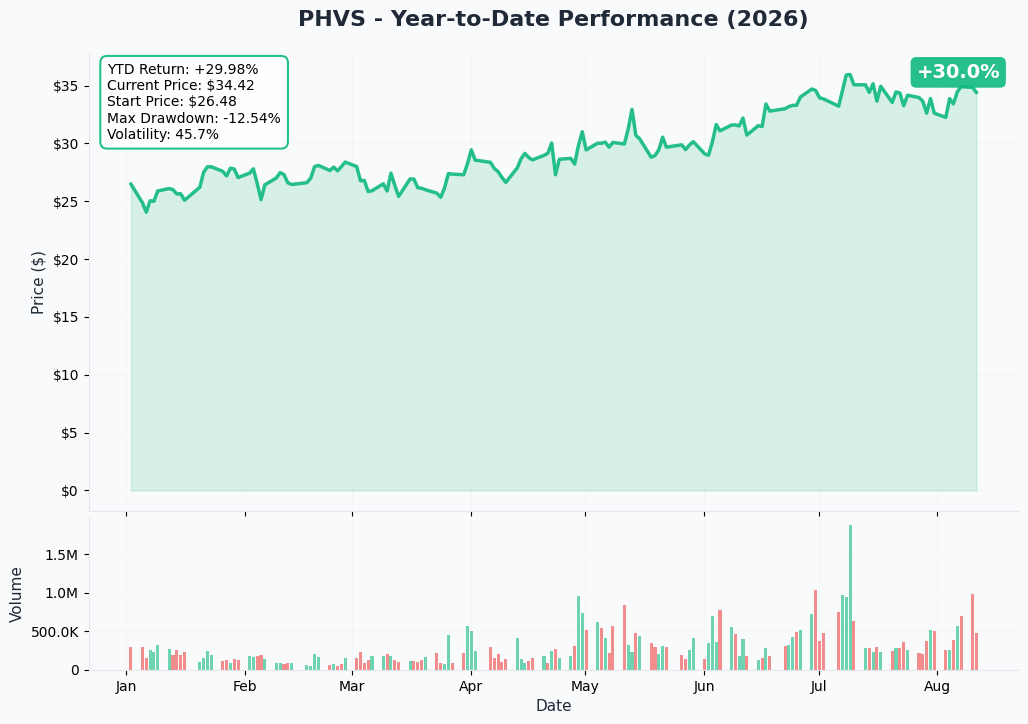
PHVS opened 2026 at $27.75 and is now ≈$34.82, up +23.5% YTD and +71% over twelve months. The path: flat-to-down through the May offering (which reset the stock to $29.68), then +16.75% in July on the FDA acceptance and EMA validation, and now consolidating within 6% of the 52-week high of $36.60 — entering its biggest binary event of the year near the top of its range.
Gamma Support & Resistance
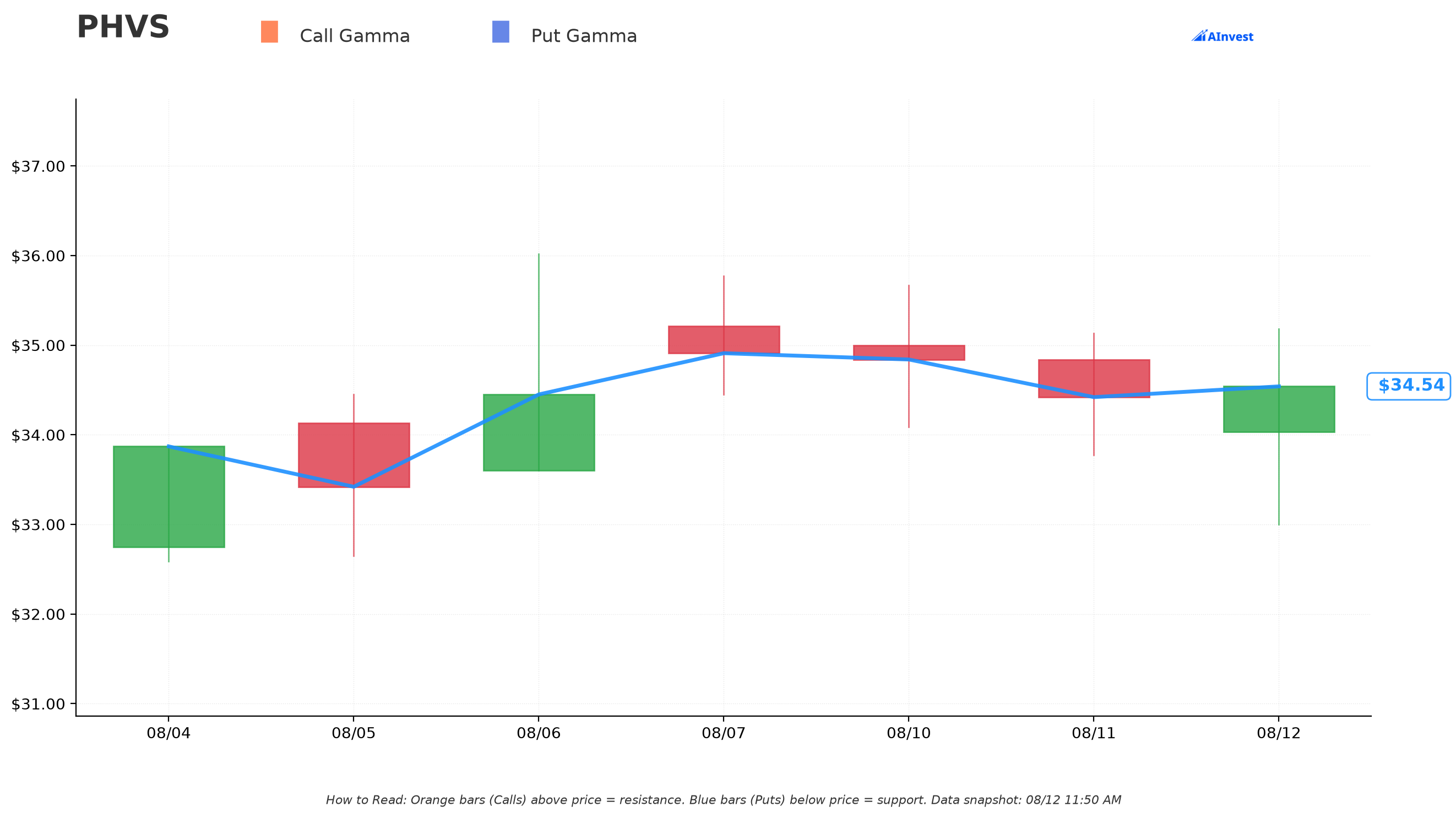
Being honest here: the options chain returned no material, actionable gamma support/resistance levels for PHVS today. The chain shows only two strikes with meaningful open interest concentration — $30 (mostly put gamma, ≈12.6% below the $34.33 reference spot) and $50 (mostly call gamma, ≈45.6% above spot) — and neither clears the bar for a genuine dealer-hedging wall. That's typical for a name this size and this thinly traded in options; don't lean on gamma levels for this ticker. The catalyst calendar and implied-move data below are the more reliable framework here.
Implied Move
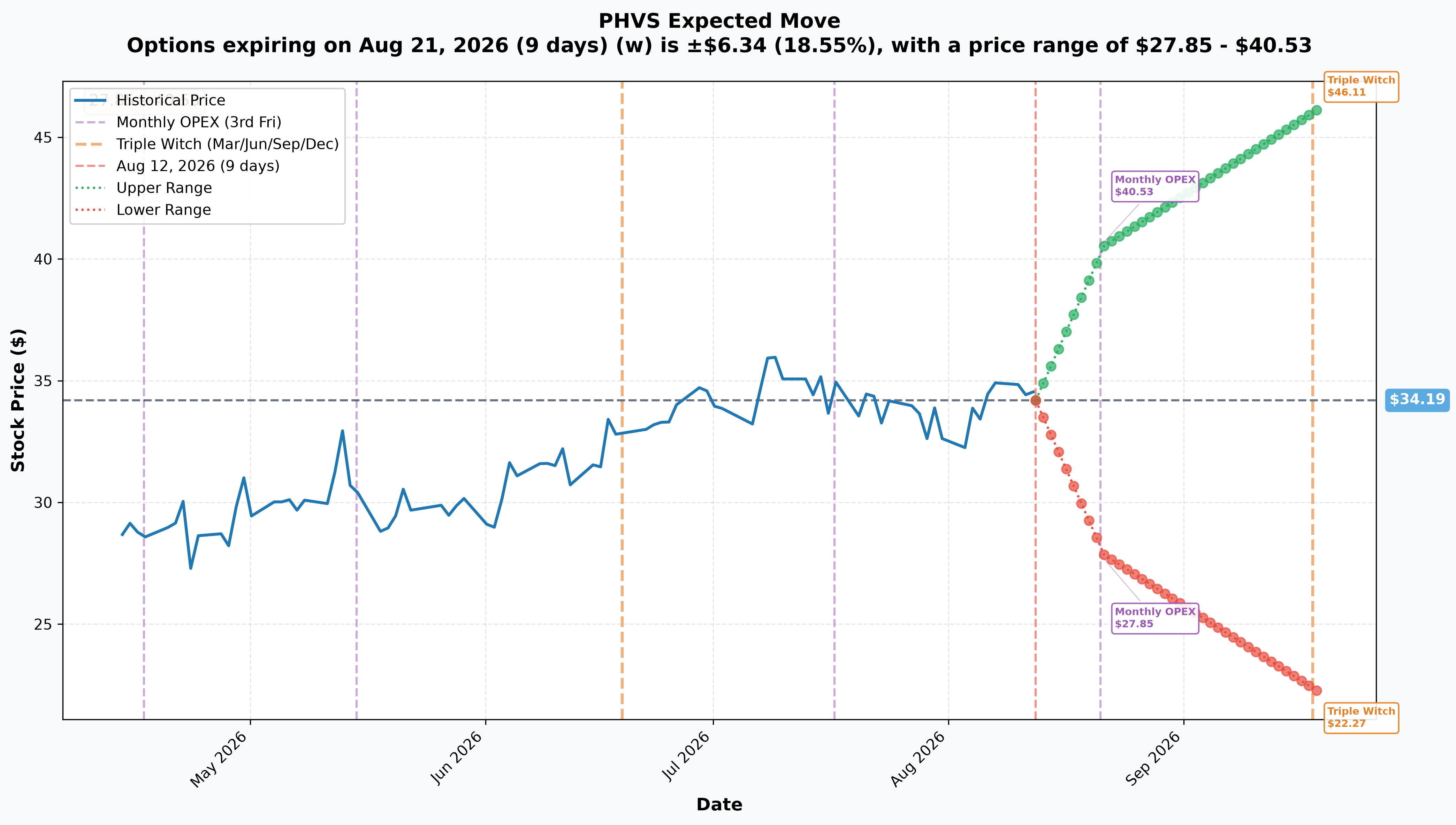
The options market is pricing serious movement, and it lines up with the calendar:
- To August 21, 2026 (9 days): ±18.55%, implying a range of $27.85 – $40.53.
- To September 18, 2026 (37 days, quarterly triple witch): ±34.86%, implying a range of $22.27 – $46.11.
Note that both of those windows sit before the September 30 CHAPTER-3 guidance deadline — the market is already pricing elevated uncertainty well ahead of a possible readout, and the range widens sharply as more of the guided quarter gets priced in.
🎪 Catalysts
✅ Inside this option's life (August 12 → October 16, 2026)
- CHAPTER-3 Phase 3 topline data — company-guided by September 30, 2026. Reaffirmed in Pharvaris' Q1 2026 results (May 12), again in the EAACI data release (June 15), and again in this morning's Q2 2026 release. Independently corroborated by an August 2026 primary completion date in the public CHAPTER-3 trial registry record. CHAPTER-3 is a placebo-controlled, 2:1 randomized, 81–85-patient Phase 3 of deucrictibant XR 40mg for HAE prophylaxis across 52 sites in 20+ countries, with a primary endpoint of time-normalized attack rate over 24 weeks. Exact day is not announced.
- US Expanded Access Program for deucrictibant IR posted today, August 12, 2026 (registry record), designed to run "approximately 6 months following commercial approval" — behavior consistent with a company that expects to win on the acute side.
❌ Outside this option's life — don't conflate these
- FDA PDUFA action date: April 23, 2027 for deucrictibant IR (the acute formulation) — confirmed by the FDA's NDA acceptance on July 6, 2026. This is roughly six months after the October 16 expiration. This trade's window has nothing to do with FDA approval risk — it's about the CHAPTER-3 clinical readout, a completely separate event on a completely separate timeline.
- EMA CHMP opinion — estimated H2 2027, far outside.
- Q3 2026 earnings — estimated ≈November 2026, outside by about three weeks.
Already happened (sets up the current setup)
- May 8-11, 2026: $132.3M offering priced and closed at $29.68/share with the underwriters' option exercised in full — a sign of real institutional demand, and it means the company doesn't need CHAPTER-3 to succeed just to stay funded (pricing PR, closing PR).
- June 12-15, 2026 (EAACI Congress): Pharvaris released the full CHAPTER-1 Phase 2 prophylaxis data — the direct read-through to CHAPTER-3 — showing ≈92% average reduction in HAE attack frequency and roughly half of patients attack-free, plus clean cardiovascular safety across ≈570 subjects (no QT prolongation, no serious arrhythmias, zero discontinuations for adverse events).
- July 6, 2026: FDA accepted the NDA for deucrictibant IR, confirming RAPIDe-3 "met the primary and all 11 secondary efficacy endpoints with statistical significance."
👥 Four Ways to Read This
🎲 The YOLO trader
If you're chasing this exact structure, understand what you'd be buying: a 14%-out-of-the-money put, all time value, needing a ≈29% drop to profit, on a stock that can gap violently on a single unscheduled press release. The entire $2.08M is fully at risk if PHVS is anywhere above $30 at October 16 expiration — this isn't a "the stock probably pulls back a little" trade, it's a bet on a specific clinical trial failing or disappointing. If you want exposure to the CHAPTER-3 binary specifically, size it like the coin-flip it is — not like a high-probability setup.
📈 The swing trader
The window here is genuinely useful: implied move data shows ±18.55% by August 21 and ±34.86% by September 18, both dates arriving before the CHAPTER-3 deadline. A swing approach might mean watching for elevated volatility to build into late August/September and deciding whether to position ahead of the readout or wait for it to resolve and trade the reaction — remembering the exact readout day is unannounced, so "waiting for it to resolve" could mean waiting past your intended entry window.
💰 The premium collector
Selling premium into a name with a real, dated, company-guided binary less than seven weeks out is a different risk than selling premium into a quiet stock. This is a name to stay away from as a short-vol seller until CHAPTER-3 has actually reported — the ≈15%-of-spot put price reflects real, appropriately-priced uncertainty, not an obvious overpay to harvest. If you do sell premium here, treat it as taking the other side of a genuine event risk, not as free theta.
🌱 The beginner
This is a single-asset, clinical-stage biotech with no revenue and one drug across two formulations. Its stock can move 20-40% overnight on a press release with no warning. If you're new to options, this specific setup — a rich, deep-time-value put ahead of an unscheduled binary event — is one of the harder ones to size correctly and one of the easiest to lose 100% of your premium on. It's a good one to study, not necessarily one to trade with real size until you're comfortable with binary-event risk.
⚠️ Honest Limits — What We Can and Can't Prove
What the tape proves: the trade happened, at this size, at this price, as a negotiated block cross, against zero prior open interest — so the open is certain. What the tape cannot prove: who's on either side of this trade, or why. The block-cross mechanism means a known counterparty took the other side — this could just as easily be an institutional holder (plausibly one of the May offering buyers, sitting on gains) buying portfolio insurance through the readout as it could be an outright bearish bet on CHAPTER-3 failing. A hedge and a directional bet look identical on the tape, and nothing here distinguishes them.
Counterweight worth taking seriously: a CHAPTER-3 failure would not zero this company. The already-filed acute NDA — primary endpoint plus all eleven secondary endpoints met — is a real valuation floor, which makes the $24.79 breakeven harder to reach than a pure single-shot binary would suggest. The Phase 2 prophylaxis prior is strong (≈92% attack-rate reduction, roughly half of patients attack-free, clean cardiovascular safety across ≈570 subjects), and management opened a US Expanded Access Program today designed to run six months post-approval — behavior consistent with a team that expects to win. Against that: insiders sold $5.97M over three months with zero purchases, Bank of America sits at Hold/$35 — no upside from spot, and Weiss carries an outright Sell. Analyst targets span $35.46 to $75.09, a 2.1x spread across 14 analysts — that dispersion is the fundamental-research mirror of the options market's own extreme pricing, and the two agree with each other.
Research gaps, disclosed rather than papered over:
- The company's own investor-relations site and press-release archive repeatedly timed out; every Pharvaris release cited here comes from a third-party archive, not the corporate site directly.
- SEC EDGAR returned errors on every attempt — no 6-K or 20-F was read directly; all financial figures are third-party aggregations of those filings.
- The exact NDA submission date isn't public — only "1H 2026" guidance followed by the July 6 acceptance announcement.
- The RAPIDe-3 topline announcement date is inferred, not confirmed — placed in early December 2025 based on a cluster of analyst price-target increases dated December 3-4, 2025, not a primary company statement.
- No exact May 12, 2026 closing price was available, so the three-month return is anchored to the $29.68 offering price as an approximation.
- No Q3 2026 earnings date has been confirmed by the company; ≈November 2026 is inferred from the reporting cadence.
- Insider sales could not be verified as 10b5-1 plan sales versus discretionary — as a foreign private issuer, Pharvaris insiders are exempt from Section 16 reporting, so the standard trail may not exist at all.
- No options-pricing model was run. The "extraordinarily rich" and "100% time value" characterization of the put is a qualitative read on premium-to-spot and moneyness, not a computed implied-volatility figure.
- The exact CHAPTER-3 readout day is unannounced, and Pharvaris has no legal obligation to disclose one in advance. Guidance slippage past September 30 into October — or later — is a live, real risk, and would leave this specific contract to expire with the catalyst still pending.
Come back the next trading morning around 06:30 ET for the open-interest snapshot that confirms this print — though on a prior-OI-of-zero position like this one, the open itself is about as settled as it gets on this board.
This is options-flow research, not investment advice. Options trading carries substantial risk, including total loss of premium, and may not be suitable for all investors. Clinical-stage biotechnology equities carry the additional risk of total loss tied to a single trial outcome. Catalyst dates guided by a company are estimates and routinely slip.
Last updated: 2026-08-13 (pre-market) — the next-day OPRA open-interest snapshot confirmed the open above the captured size. Oct-16 $30P 0 → 5,008 (+5,008 from literal zero against a 4,000-lot print, 125% of size): OPEN (BTO). Roughly 1,008 contracts of additional put buying arrived at this strike beyond the block. The ⏳ callout was replaced with the ✅ RESOLVED box; no thesis or title change was required.