🤝 SLS $1.16M Put Calendar Roll — A Desk Just Bought Three More Months of Crash Insurance on the AML Readout
📅 2026-08-12 | 🤝 Floor Block Detected
✅ Updated 2026-08-13 pre-market — the next-day OPRA open interest confirmed the calendar roll on both legs. The October $10 put fell 14,404 → 11,392 (−3,012), taking the close branch we published, and the January-2027 $10 put rose 4,532 → 12,557 (+8,025) against a predicted ≈12,000. Both the provisional STC ⏳ and the BTO labels are confirmed: this really was crash insurance being extended, not a new short put. See the ✅ RESOLVED box.
🎯 The Quick Take
At 09:44:40 a desk printed a floor block on SELLAS Life Sciences (SLS): sold 7,500 October 16 $10 puts and bought 7,500 January 15, 2027 $10 puts, same strike, at a net cost of ≈$1.16M. This is a put calendar roll, not a fresh bearish bet — the desk is pushing its downside hedge out past the October expiration and into a window that holds essentially the entire binary readout complex for SELLAS's Phase 3 REGAL trial. Spot was $11.89 at the print; SLS closed the day at $11.71, +5.93%.
🏢 Company Overview
SELLAS Life Sciences Group is a late-stage clinical biopharmaceutical company developing novel therapeutics for cancer indications, headquartered in New York and led by founder/CEO Dr. Angelos M. Stergiou. GICS sector Health Care, industry Biotechnology. The company runs on just 13 employees — a striking number against a market cap that, at the $11.71 close, sits at ≈$2.30 billion.
Two clinical programmes carry the whole valuation:
- Galinpepimut-S ("GPS") — a WT1-targeting peptide immunotherapy. Its Phase 3 REGAL trial tests GPS in acute myeloid leukemia (AML) patients who reached complete remission after second-line salvage therapy. REGAL is event-driven: a pre-specified 80th death/progression event triggers database lock and the final analysis. This is the company-defining binary.
- SLS009 (tambiciclib) — a CDK9 inhibitor. Its first-line AML Phase 2 (80-patient trial) had 28 patients enrolled as of August 11, 2026, with topline guided to Q4 2026. A separate relapsed/refractory AML cohort has already reported a 46% overall response rate.
Balance sheet: $138.3 million in cash and investments as of June 30, 2026, against an H1 2026 net loss of $18.0 million. A $150 million at-the-market facility remains completely untouched. That combination means no financing cliff before January 2027 — whatever this options desk is hedging, it isn't a forced raise.
Share count — read this before trusting the $11.89 tape: shares outstanding went 153.1 million (Dec 31, 2025) → 181.3 million (Mar 31, 2026) → 201.9 million (Aug 11, 2026) — a ≈32% increase in roughly seven and a half months, almost entirely from ≈$50.1 million of warrant exercises, not marketed dilution.
And the price itself is manufactured, not organic. SELLAS has executed two reverse stock splits — 1-for-30 on January 2, 2018 and 1-for-50 on November 8, 2019 — a cumulative 1-for-1,500 consolidation. A pre-2018 holder of 1,000 shares would own 0.67 shares today. Do not read $11.71 as a "normal" price history; it's a manufactured double-digit handle sitting on top of massive historical share consolidation.
💰 The Trade in Plain English
A desk sold 7,500 October $10 puts and simultaneously bought 7,500 January 2027 $10 puts — same $10 strike, just three months further out. This is a calendar roll: closing (or reducing) protection that expires October 16 and re-opening the same protection out to January 15, 2027, for a net cost of about $1.16 million.
Because this printed as a negotiated floor block — a manually worked trade with a known counterparty, not a lit sweep hitting the public order book — there's no urgency signal here. Nobody "panicked" into this trade. A desk sat down and re-papered a hedge.
| Time | Buy/Sell | Call/Put | Expiration | Premium | Strike | Volume | OI | Size | Spot | Option Price | Option Symbol |
|---|---|---|---|---|---|---|---|---|---|---|---|
| 09:44:40 | SELL | PUT | 2026-10-16 | $2,512,500 | $10 | 7,900 | 14,404 | 7,500 | $11.89 | $3.35 | SLS20261016P10 |
| 09:44:40 | BUY | PUT | 2027-01-15 | $3,675,000 | $10 | 7,700 | 4,532 | 7,500 | $11.89 | $4.90 | SLS20270115P10 |
🤝 Mechanism: floor block. This was a manually worked, negotiated print with a known counterparty on both sides — not a cross, not an auction, and not a lit sweep. Because it took no liquidity from the public book, the reported BUY/SELL labels above are reported, not tape-proven — there's no percentage-across-the-spread reading that can validate direction on a negotiated block like this.
Net effect: the desk paid ≈$1.16M ($3,675,000 bought − $2,512,500 sold) to move the same $10 strike of protection three months further into the future.
✅ RESOLVED — The Calendar Roll Is Confirmed on Both Legs
Updated 2026-08-13 pre-market. Resolving OPRA snapshot timestamped August 13 (reflects the August 12 close, after this print); baseline is the August 12 snapshot (reflects the August 11 close, before this print).
| Leg | Baseline (Aug-12) | Resolving (Aug-13) | Δ | Print size | What we published | Verdict |
|---|---|---|---|---|---|---|
| Oct-16 $10 put (sold) | 14,404 | 11,392 | −3,012 | 7,500 | "if this was a close, October $10 OI falls … if it was a new short, OI holds flat or rises" | ✅ CLOSE (STC) confirmed — 40% of size |
| Jan-15-2027 $10 put (bought) | 4,532 | 12,557 | +8,025 | 7,500 | "should rise to roughly 12,000" | ✅ OPEN (BTO) — 107% of size |
Both branches landed where we said they would. October open interest fell — ruling out the fresh-short reading — and January rose past the predicted ≈12,000, capturing 107% of its print with ≈525 contracts of extra buying behind the block.
Magnitude nuance on the October leg. Open interest retired 3,012 contracts against 7,500 sold (40%), so the direction is decisive but the close was partial: roughly 4,488 contracts changed hands between other holders. Enough to prove no new short was opened; not enough to say the entire October position came off.
The article's read holds. Protection was moved from October into January 2027 — three more months of downside coverage — and the net new money is the January leg.
🤓 What This Actually Means — Plain English
Think of this less like a new bet and more like renewing an insurance policy that was about to lapse before the risk event it was written for.
Here's the calendar problem the desk was staring at: before October 16, 2026, there is no guided clinical data event at all for SELLAS. The only thing scheduled is the announcement that REGAL's 80th event has occurred — and that's a process trigger, not the result. It just starts the clock on database lock, blinded review, and unblinding, which the company says takes weeks to months on its own.
Almost the entire binary complex sits in the window between October 16 and January 15: the ASH late-breaking abstract window (October 14–28), abstracts posting online (November 4), late-breaking abstracts posting (December 7), the 68th ASH Annual Meeting in New Orleans (December 12–15), the company's own SLS009 first-line AML topline guided to Q4 2026, an estimated Q3 earnings report in mid-November, and — the big one — the REGAL topline itself, which the disclosed sequence of events places somewhere between November 2026 and January 2027.
So paying $1.55 per contract ($4.90 − $3.35) to move the same $10 strike three months out isn't a statement about whether SLS falls below $10 — it's a statement about when the desk needs that protection to still be alive. A put expiring October 16 would go dark eleven weeks before the data most likely lands. This trade keeps the insurance policy in force straight through the readout window instead of letting it lapse and having to re-buy it later (probably at a much higher price once the event count firms up or the stock starts moving).
The reason the hedge needed extending at all is itself the risk to flag. REGAL's event count has gone quiet: 72 of 80 at December 26, 2025, → 78 of 80 at May 11, 2026 — six events in 4.5 months — then no number at all on August 11, 2026, just "approaching." The trial has apparently sat within two events of its trigger for at least three months with zero fresh disclosure. That opacity, more than any single number, is probably why a holder chose to extend rather than let the near-dated put run off.
One more honest note on cost: on a rough Black-Scholes solve of these prices (not a vendor-quoted figure), January implies roughly 225–235% volatility and October roughly 235–245% — essentially flat, maybe even slightly inverted. That means this wasn't a volatility-term-structure trade exploiting cheap vol further out. It was a straightforward calendar extension, paid for at a roughly equal (extremely elevated) vol level in both months. The January $10 put's break-even is $5.10 — SLS would need to fall ≈57% from today's close for that put to be profitable at expiry. The options market is pricing that as a real possibility, not a tail curiosity, which only makes sense if you're pricing the chance of a failed Phase 3 into a name still carrying a multi-billion-dollar valuation.
📈 Technical Setup
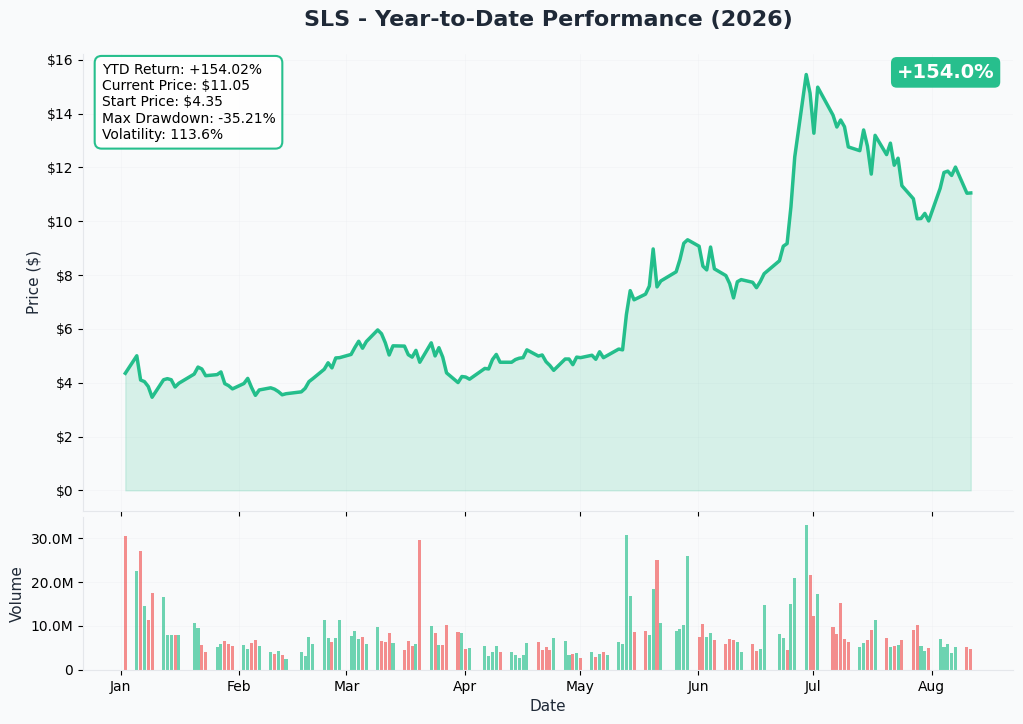
SLS closed at $11.71 on August 12, up 5.93% on the day, against a 52-week range of $1.39 – $15.88 — the stock is +660% over the past year and trades more than double its own 200-day moving average of $5.78. The 50-day average sits at $10.95, meaning today's close is barely above the short-term trend.
Gamma-based support & resistance
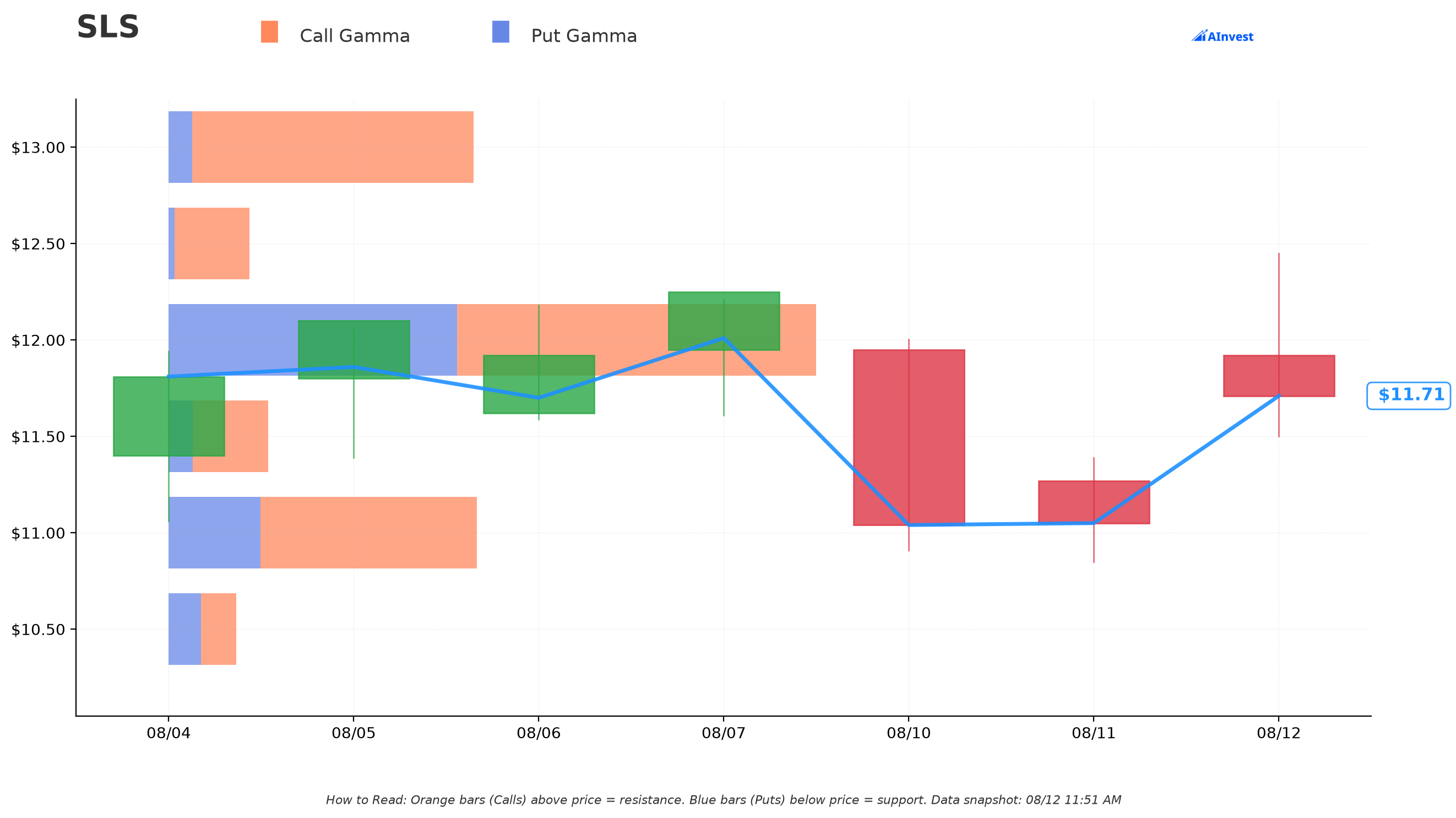
Here's the honest read: the chain returned no material, clearly-separated gamma support or resistance level near spot. The one flagged "resistance wall" sits at the $15 strike, roughly 28% above the $11.71 close — too far away to matter for a trade window measured in weeks. Total gamma exposure across the whole chain is thin and choppy strike-to-strike (a few tenths of a million dollars of GEX per strike, nothing that reads as a defended level). Translation: dealer positioning isn't going to pin this stock the way it might on a large-cap name. With options this expensive and open interest this modest relative to the float, gamma levels here are a weak signal — price is far more likely to be driven by the REGAL data cadence than by dealer hedging flows.
Implied move — the real story
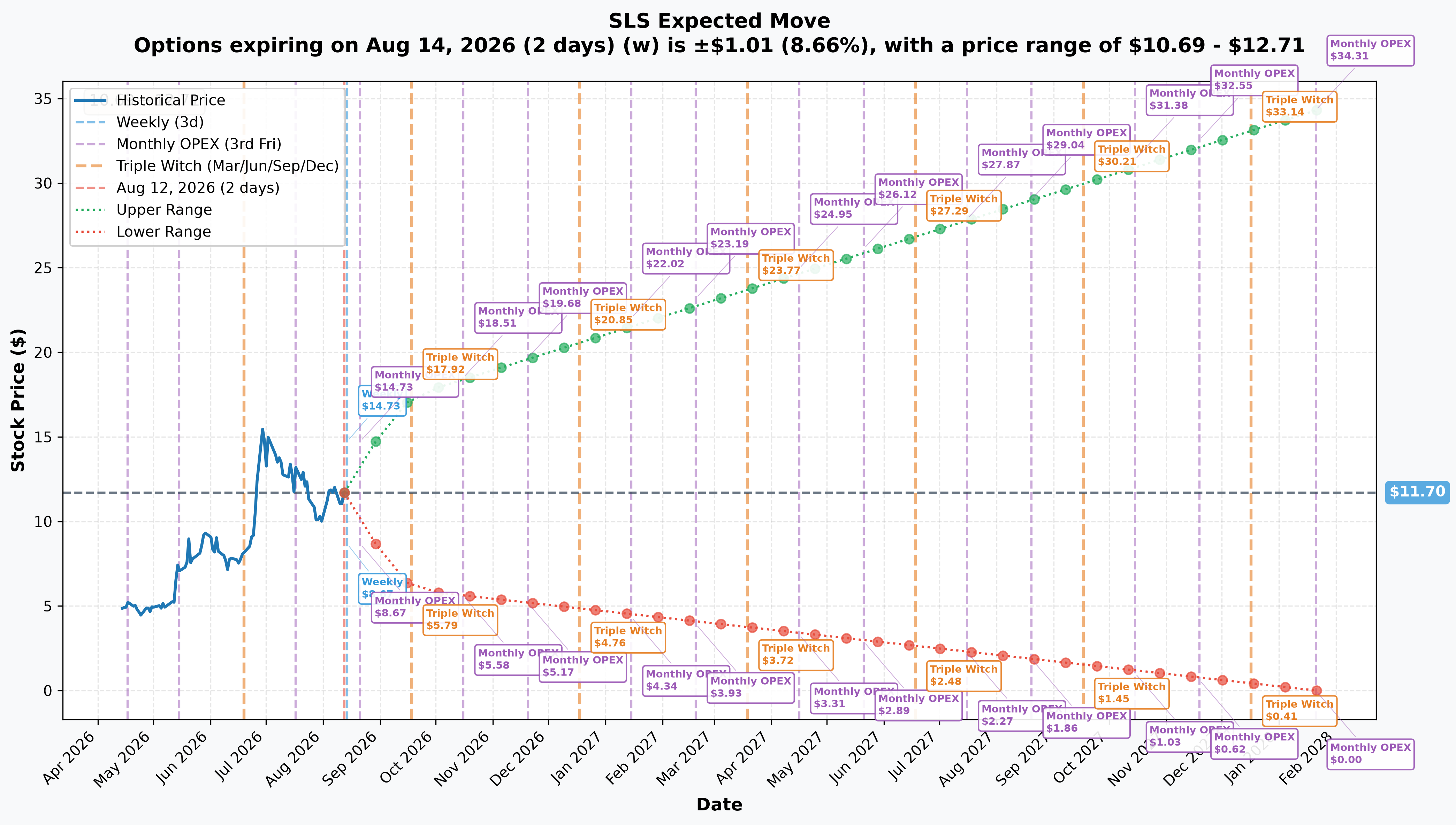
This is where the market's fear actually shows up:
- To August 14 (2 days): implied move ±8.66%, range $10.69 – $12.71
- To August 21 (9 days): implied move ±16.57%, range $9.76 – $13.64
- To September 18 (37 days): implied move ±49.09%, range $5.96 – $17.44
A ±49% five-week range is not a normal volatility surface — it's the market pricing in the real chance of a binary catalyst landing inside that window (the REGAL 80th-event announcement could plausibly hit any day). That's also exactly why this hedge is expensive: when the options market already prices a near-50% swing five weeks out, extending protection three more months into an even bigger event costs real money, which is precisely the ≈$1.16M this desk just paid.
🎪 Catalysts
Already happened
- July 27, 2026 — SELLAS lost the 3D Medicines arbitration, assessed $1 million in costs, over GPS China-region payment rights (news index). Stock fell to a one-month low on the news. The full scope of the ruling — whether the China licence survives — could not be independently verified; the underlying filing was unreachable.
- May 12, 2026 — Q1 2026 results: REGAL disclosed at 78 of 80 events (Q1 2026 press release).
- June 2026 — the 71.67% monthly rally happened with zero company press releases in June or July. Drivers instead: anticipation of the REGAL trigger, a late-June executive severance/change-of-control filing reset the market read as M&A prep (Yahoo Finance coverage), and a short squeeze — short interest hit an all-time high that month.
- July 6 and July 9, 2026 — two analyst price-target raises, both after the stock had already tripled: A.G.P./Alliance Global Partners' James Molloy to $25, Maxim Group's Jason McCarthy to $30 (forecast page).
- August 11, 2026 — Q2 2026 results: net loss $9.6M, cash $138.3M, 201.9M shares, REGAL only described as "approaching" the 80th event with no number disclosed (Q2 2026 press release).
Ahead — catalyst dates, kept separate from the two option expirations
| Date | Catalyst |
|---|---|
| Undated, "approaching" | REGAL 80th event occurs — company has committed to announce it, no date given (Q2 2026 release) |
| ⏹️ Oct 16, 2026 = October put expiration | — |
| Oct 14–28, 2026 | ASH late-breaking abstract submission window (ASH) |
| Nov 4, 2026 | ASH regular abstracts posted online (ASH) |
| ≈mid-November 2026 | Q3 2026 earnings (estimated from Q1/Q2 cadence — not confirmed) |
| Q4 2026 | SLS009 first-line AML Phase 2 topline — company-guided, though only 28 of 80 patients enrolled as of August 11 |
| Q4 2026 – Q1 2027 | REGAL topline itself — not company-guided, derived from the disclosed lock/unblind sequence |
| Dec 7, 2026 | ASH late-breaking abstracts posted (ASH) |
| Dec 12–15, 2026 | 68th ASH Annual Meeting, New Orleans (ASH) — most likely venue for a full REGAL presentation |
| ≈Jan 11–14, 2027 | J.P. Morgan Healthcare Conference — 2027 dates unconfirmed, estimated from historical scheduling |
| ⏹️ Jan 15, 2027 = January put expiration | — |
Zero guided data events fall before October 16, 2026. At least five confirmed calendar events plus the company-guided SLS009 topline plus the REGAL unblinding itself all sit in the October-to-January window.
🎲 The Four Readers
🎲 The YOLO trader
You're staring at a stock up 660% in a year, 28.55% of the float sold short, and a binary Phase 3 that could resolve any week now. That's a legitimate lottery ticket setup in both directions — but this specific trade isn't a directional signal for you to copy. A desk paying $1.55 to extend a hedge is defensive positioning, not a "smart money says buy/sell" tell. If you want exposure to the binary, size it like you'd size a coin flip with a fat tail, not like a normal trade.
📈 The swing trader
The technical setup here is close to useless — gamma levels are thin and don't cluster near spot, so there's no dealer-hedging magnet to trade off of. What actually matters for you is the implied-move ladder: ±16.6% by August 21 and ±49% by September 18. If you're playing a short-term move, respect that the options market already prices enormous swings well before the "real" catalyst window opens in October.
💰 The premium collector
This name is not a premium-selling candidate right now. With implied vol running in the 225–245% range on the puts alone, selling premium here means selling insurance against a genuine binary event, not collecting time decay on a range-bound stock. The desk in this very trade was a buyer of the longer-dated put, paying up for protection — that should tell you where the smart money sits on cheap-vol-selling here.
🌱 The beginner
Two things to internalize before you touch this name. First, the $11.71 share price is not a "normal" stock history — two reverse splits totaling 1-for-1,500 manufactured this price level; it says nothing about long-term value creation. Second, this trade is a calendar roll, meaning the same investor is simply choosing to keep an existing insurance policy (a put option) alive for longer, not making a brand-new bearish bet. Understanding that distinction — roll versus fresh position — is one of the more advanced but useful skills in reading options flow.
⚠️ Honest Limits — What We Can't Prove
- Direction on this trade is reported, not tape-proven. It printed as a negotiated floor block that took no liquidity, so there's no aggressor-side reading (no meaningful percentage-across-the-spread signal) to independently confirm BUY/SELL on either leg.
- The October $10 put's open/close status is unresolved until the next-morning OI snapshot — size (7,500) sits below prior OI (14,404), so today's tape alone cannot distinguish a partial close from a fresh short.
- SEC EDGAR returned access errors during this research — the late-June severance/change-of-control 8-K and the Q2 10-Q were not read directly. The "M&A preparation" interpretation of that filing is press interpretation, not verified filing text.
- The 3D Medicines arbitration ruling text was unreachable. The $1M costs figure comes from a headline; the underlying claims and whether the China licence survives are not established here.
- The company's own investor-relations site returned access errors; all press-release content cited here comes from a syndicated release stream, not SELLAS's own site.
- January–May 2026 monthly price bars were unavailable, so no precise year-to-date percentage is asserted in this article — only the verified 52-week change of +660% and the 200-day average.
- 2027 J.P. Morgan Healthcare Conference dates are unconfirmed — listed above as an estimate based on historical scheduling, not a confirmed date.
- Implied volatility figures cited (≈225–245%) are our own Black-Scholes solves from the quoted option prices, not vendor-quoted implied volatility.
- What OPRA cannot tell us in general: the identity or broker of either counterparty, whether either side had a pre-existing position beyond what OI history shows, and whether any hedge exists off-exchange (stock, swaps, or otherwise) tied to this options position.
This is not investment advice. Options trading involves substantial risk, including total loss of premium, and is not suitable for all investors. SLS carries binary clinical-trial risk, thin analyst coverage, extreme historical volatility, and heavy short interest — position size accordingly.
Last updated: 2026-08-13 (pre-market) — the next-day OPRA open-interest snapshot confirmed the roll on both legs. Oct-16 $10P 14,404 → 11,392 (−3,012 against 7,500 sold, 40% of size): CLOSE (STC) confirmed, was STC ⏳; Jan-2027 $10P 4,532 → 12,557 (+8,025 against 7,500, 107% of size): OPEN (BTO). The ⏳ callout was replaced with the ✅ RESOLVED box; no thesis or title change was required.