🧊 SNOW $15.1M Deep-ITM Call Cross Was a Pure TRANSFER — Open Interest Didn't Move a Single Contract
2026-08-12 | 🤝 Block Cross | Resolved 2026-08-13: OI flat at 1,286 — neither an open nor a close
🔄 Updated 2026-08-13 pre-market — the next-day OPRA open interest resolved this print onto the third branch we published, and it is the least-expected one. Open interest at the March-2027 $200 strike came in at 1,286 — identical to the baseline, a change of exactly ZERO against a 1,000-lot cross. We published three branches: ≈2,286 for a fresh short, ≈286 for a long being sold out, and "if OI is roughly flat, the print was mostly a transfer between existing holders rather than a clean open or close." It was flat to the contract. The provisional STO label is retired: no new short was opened and no long was closed. ≈$15.1M changed hands and the market's net position did not move. See the ✅ RESOLVED box.
🎯 The Quick Take
A desk crossed 1,000 March-2027 $200 calls at $151.00 on Snowflake this morning, collecting ≈$15.1M in premium against a $335.17 stock. Before you read "SOLD CALLS" as a crash bet: $135.17 of that $151.00 is pure intrinsic value — the option is already $135 in the money — and only $15.83 is time value, so this behaves a lot more like a financed short-stock position than a bearish opinion. And because the 1,000-lot sits below the 1,286 contracts already open at this strike, we genuinely cannot tell yet whether this opened a new short or closed out an existing long. Come back tomorrow for the answer.
🏢 Company Overview
Snowflake Inc. (NYSE: SNOW) runs the "AI Data Cloud" — a cloud-native data platform that separates storage from compute and sits on top of AWS, Azure, and Google Cloud rather than owning its own data centers. The business model is consumption-based: customers pre-buy capacity and burn through it as they run queries, load data, and use AI features, so revenue tracks workload in near real time rather than on a fixed subscription schedule.
- Market cap: ≈$117.4–117.7B
- Sector / industry: Technology → Software — Application (GICS: Information Technology → Software → Application Software)
- Fiscal year end: January 31 — this matters enormously for reading Snowflake's calendar. "Fiscal 2027" is almost entirely calendar 2026, and it's the single biggest source of date confusion with this stock.
- 52-week range: $118.30 – $340.50, with the stock currently trading within ≈0.6% of that high.
💰 The Trade — Plain English
At 09:32:29 ET, a desk sold 1,000 contracts of the SNOW March 19, 2027 $200 calls at $151.00, printed as a negotiated block cross — a pre-arranged trade with a known counterparty on the other side, not a sweep that took displayed liquidity. Total premium collected: ≈$15.1 million.
| Field | Detail |
|---|---|
| Time | 09:32:29 ET |
| Buy/Sell | SELL (reported from the print — see caveat below) |
| Call/Put | CALL |
| Expiration | 2027-03-19 |
| Strike | $200 |
| Premium (computed) | $15,100,000 (1,000 × 100 × $151.00) |
| Option Price | $151.00 |
| Volume | 1,000 |
| Prior Open Interest | 1,286 |
| Size | 1,000 |
| Spot | $335.17 |
| Option Symbol | SNOW20270319C200 |
| Mechanism | 🤝 Block Cross |
Direction caveat: this printed as a negotiated block at the middle of the market, so it took no displayed liquidity. The SELL label is what the tape reported for this leg — it is not proof of aggressor intent the way a lit sweep would be.
SNOW's ticker page on AInvest →
✅ RESOLVED — Exactly Zero Change: A Pure Transfer Between Existing Holders
Updated 2026-08-13 pre-market. Resolving OPRA snapshot timestamped August 13 (reflects the August 12 close, after this print); baseline is the August 12 snapshot (reflects the August 11 close, before this print).
| Leg | Baseline (Aug-12) | Resolving (Aug-13) | Δ | Print size | What we published | Verdict |
|---|---|---|---|---|---|---|
| Mar-19-2027 $200 call (sold) | 1,286 | 1,286 | 0 | 1,000 | "if OI is roughly flat (still near 1,286), the print was mostly a transfer between existing holders rather than a clean open or close" | 🔄 TRANSFER — was STO ⏳; neither open nor close |
A change of zero on a 1,000-lot print is about as clean a transfer signature as OPRA produces. Not one net contract was created or retired. Someone who already held these deep-in-the-money calls handed them to someone else at $151.00, and the aggregate short interest at the $200 strike this morning is exactly what it was yesterday morning.
What this retires. The financing / share-substitute structure described in this article is no longer presented as newly initiated — because nothing was initiated. If a desk is running that structure at this strike, it was already running it; today's print moved the position between counterparties. The ≈$15.1M headline is ≈89.5% intrinsic value changing hands between two parties who had already agreed on the price, and the remaining time-value carry math describes the contract, not a new trade decision.
What it does not retire. The article's central warning — do not read "SOLD CALLS" on a deep-ITM strike as a crash bet — is if anything strengthened. There is now no directional inference available at all: no new bearish position was opened, and no bullish position was liquidated.
Control check. Neighbouring March-2027 call strikes were equally static: $190C 153 → 153, $210C 285 → 285, $220C 226 → 226. The flatness at $200 is not an artefact of a stale chain — it is the whole neighbourhood sitting still while 1,000 contracts changed owner.
🔄 Retraction notice (2026-08-13): the financing / share-substitute structure described below is no longer presented as newly initiated. Next-day open interest was flat to the contract (1,286 → 1,286), proving this print created no new position and closed none — it was a transfer between existing holders. The carry math below describes the contract, not a new trade decision. See the ✅ RESOLVED box above.
🤓 What This Actually Means — Plain English
Here's the math that matters: SNOW is trading at $335.17. The call sold has a $200 strike, so it's already $135.17 in the money — meaning $135.17 of the $151.00 price tag is just the stock's own value, not a bet on anything. Only $15.83 (≈10.5% of the price) is "time value" — the part of the premium that reflects time left and uncertainty.
Why does that matter? A call this deep in the money has a delta near 0.85–0.95 (a rough estimate, not read off the tape) — meaning it moves almost dollar-for-dollar with the stock. Selling a call like this behaves a lot like selling the stock short, just financed differently. The $15.83 of time value works out to ≈4.72% over 219 days, or roughly 7.9% annualized — that's a carry number, the shape of a financing or share-monetization trade, not the shape of someone paying up for a bearish view. A trader with a genuine "this stock is going down" thesis typically buys puts or sells calls near the current price, where almost all the premium is time value. Here, 89.5% of the money changing hands is just intrinsic stock value moving between two parties who already agreed on the price.
What the two open/close branches would actually mean:
- Opening a new short here is consistent with a desk building a financing structure, a collar leg, or delta-hedged inventory against a long stock or convertible position — cash today, capped upside at $351.00, real downside exposure retained.
- Closing an existing long would mean this trade says essentially nothing about anyone's forward view — it's simply profit-taking after the calls quadrupled or more in value as SNOW ran from ≈$152 in May to $335 today.
The risk that must not get lost: if this is a fresh short call, it carries open-ended risk above the strike just like any short call — the cushion here is only $15.83, or 4.72%, to the $351.00 breakeven. SNOW has moved more than that in a single session four times in the last three weeks (+4.64%, +5.37%, +4.86%, +3.93%). This is not a low-risk structure if it's a fresh open, and it's already deep enough in the money that early assignment is a live possibility.
📈 Charts & Levels
YTD Performance
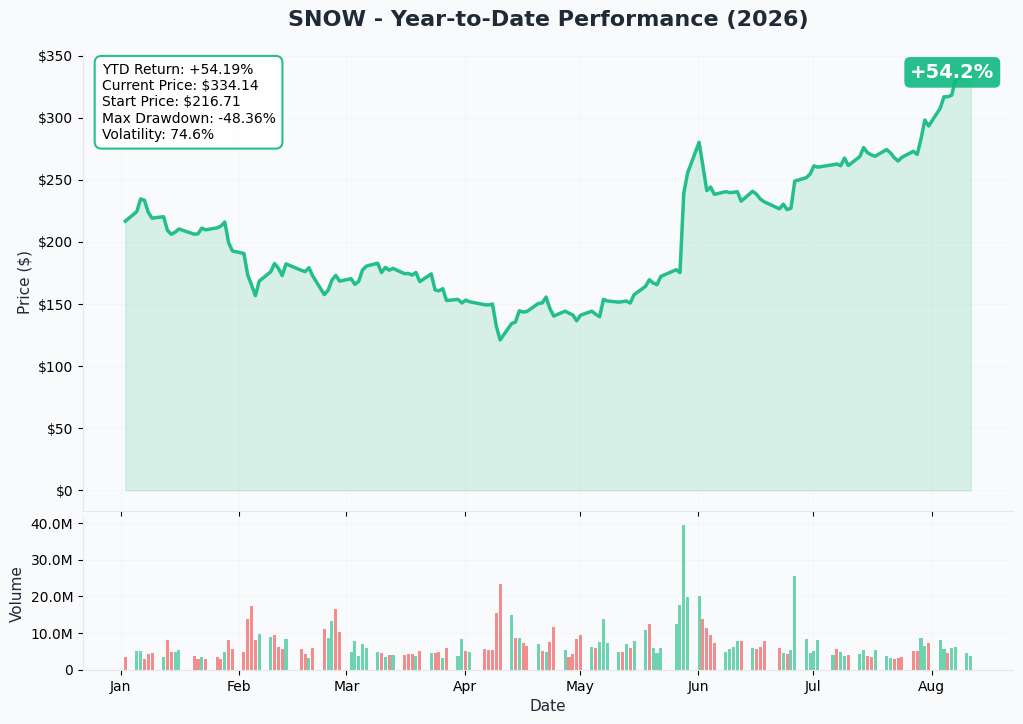
SNOW's chart tells a round-trip story, not a smooth climb: the stock fell from ≈$219 at the end of 2025 to a 52-week low of $118.30, then ripped +123% in three months back to today's $335–339 area — that's why the "+55% year-to-date" headline badly understates both how far it fell and how fast it came back.
Gamma-Based Support & Resistance
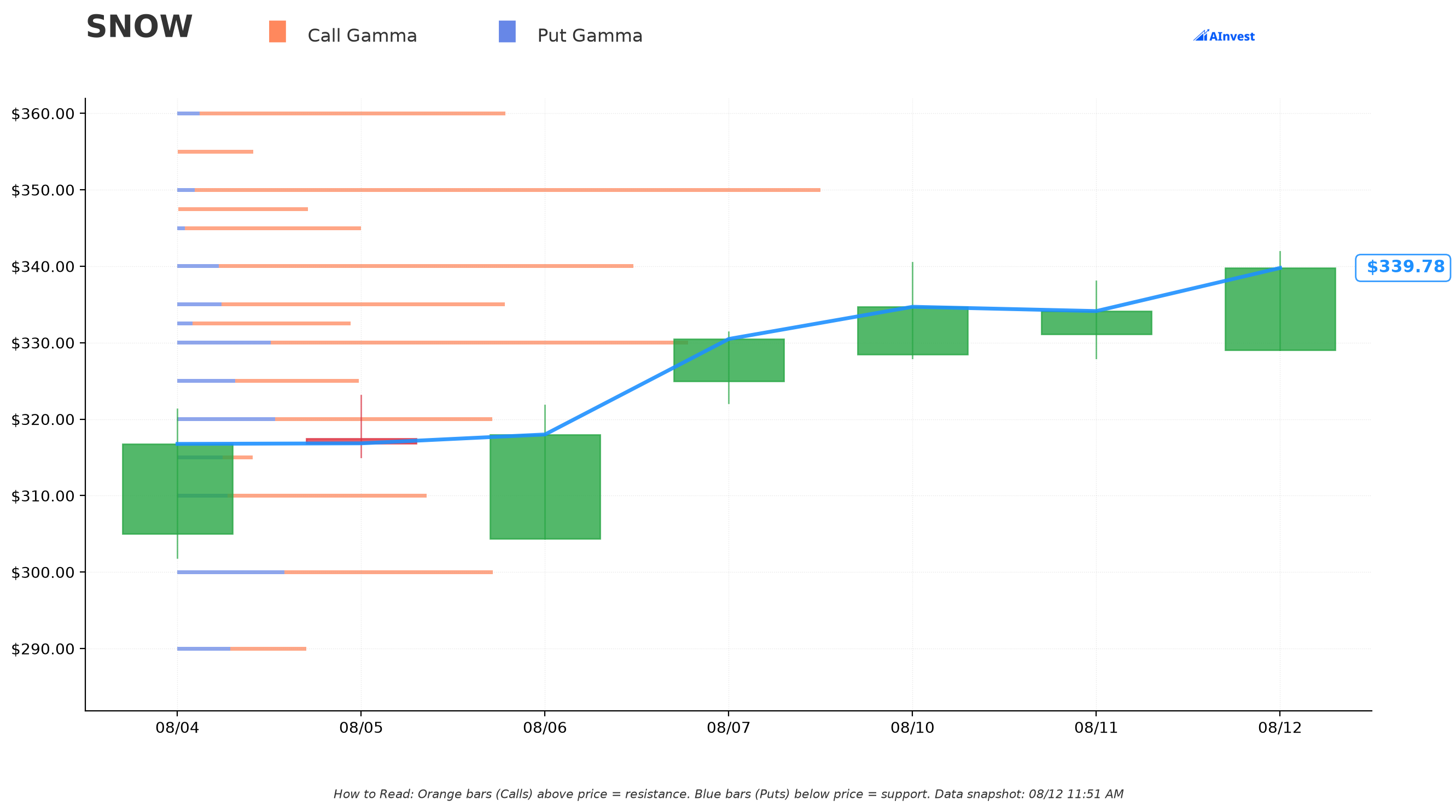
Spot for this snapshot: $339.50. The options chain shows real resistance building overhead, but no material gamma support level below current price — worth being honest about, since that's unusual and means the options market isn't showing a strong dealer-hedging floor beneath the stock right now.
- 🟠 $340 resistance (Moderate) — essentially at-the-money, ≈0.15% above spot
- 🟠 $350 resistance (Moderate) — ≈3.1% above spot, aligning closely with the sold call's $351.00 breakeven
Implied Move
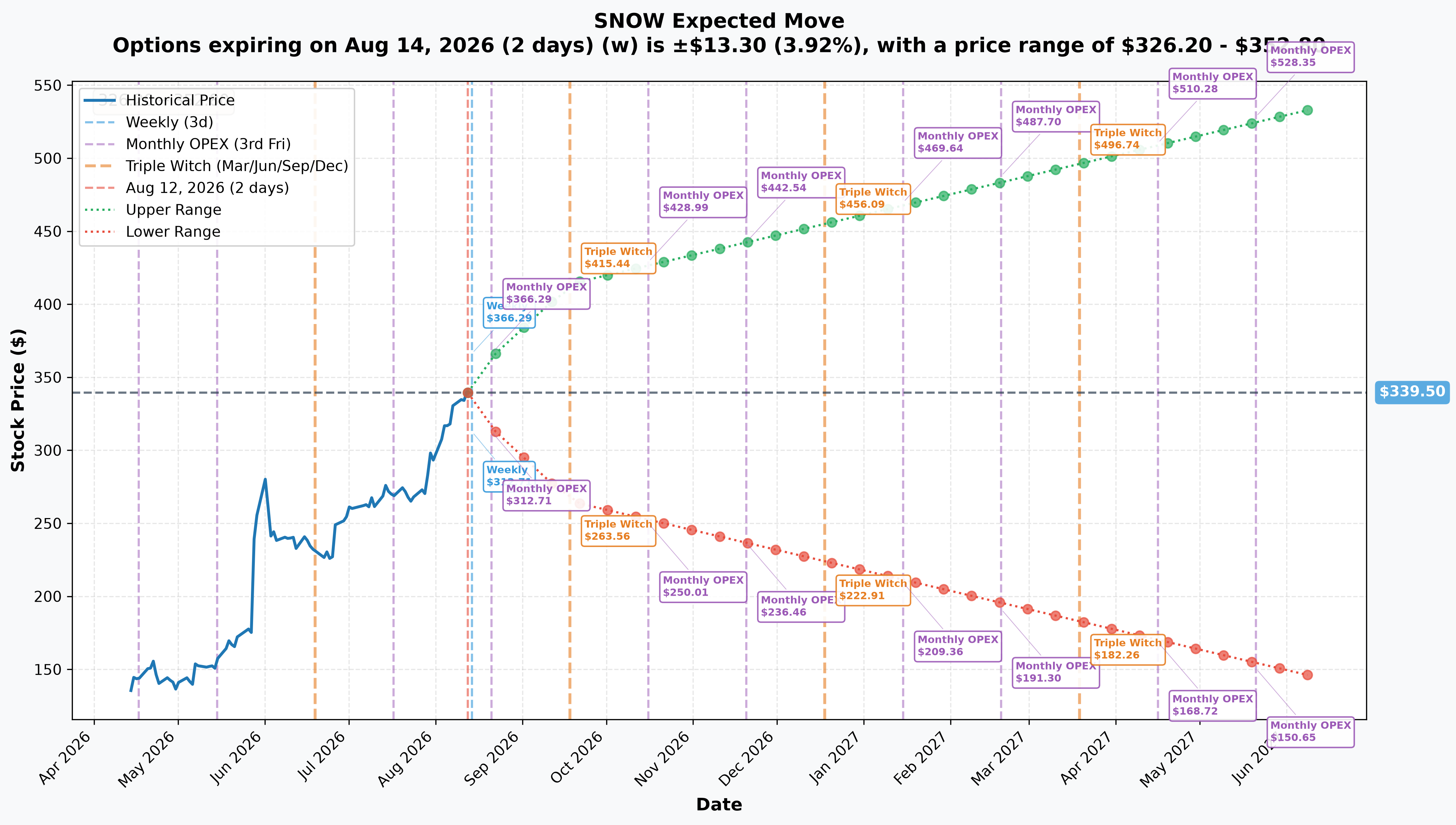
| Horizon | Expiry | Implied Move | Range |
|---|---|---|---|
| Weekly | 2026-08-14 | ±3.92% | $326.20 – $352.80 |
| Monthly OPEX | 2026-08-21 | ±7.37% | $314.48 – $364.52 |
| Quarterly / Triple Witch | 2026-09-18 | ±21.97% | $264.91 – $414.09 |
The jump from ±7.37% (Aug 21) to ±21.97% by September 18 isn't noise — it's the options market pricing in Q2 FY2027 earnings on September 2, which sits inside that window. That's the tell that the next real catalyst risk for this name is three weeks out, not this week.
🎪 Catalysts
Keep this separate from the expiration date. The option expires 2027-03-19; none of the events below happen on that date — the expiration is just when the contract stops trading.
Upcoming
- ≈2026-08-13 — next-session open-interest snapshot. The mechanical event that resolves this entire article's central question: did the $200 call print open or close?
- 2026-09-02 — Q2 FY2027 earnings (company-confirmed). Quarter ended 2026-07-31. Management guided to product revenue of $1,415–1,420M (+30% YoY) and non-GAAP operating margin of 12.5% in the Q1 FY2027 results release. Watch whether net revenue retention keeps climbing past 126% and whether FY2027 guidance gets raised a second time.
- ≈2026-12-02 — Q3 FY2027 earnings (estimated), based on last year's Q3 FY2026 report landing 2025-12-03.
- ≈2027-02-24 to 2027-03-04 — Q4 + full-year FY2027 earnings (estimated), based on Q4 FY2026 landing 2026-02-25 and Q4 FY2025 landing 2025-02-26. This is the report to watch — it carries the first full-year FY2028 guidance, historically Snowflake's biggest single volatility event, and it lands only ≈2–3 weeks before the option's March 19, 2027 expiration. There is essentially no time to recover from a bad print here before the contract expires.
- 2027-06-07 to 2027-06-10 — Snowflake Summit 2027 (company-confirmed via Snowflake's Summit page). This falls ≈11 weeks after expiration, so it's outside this option's life entirely — worth naming because it's the kind of date that's easy to mistakenly pull inside the window.
Already Happened (context for the current price)
- 2026-05-27 — Q1 FY2027, the quarter that broke the stock out. Product revenue $1,334.3M (+34% YoY), total revenue $1,391M against a $1.32B consensus, non-GAAP EPS $0.39 vs. $0.32 expected. Net revenue retention rose to 126%, remaining performance obligations hit $9.21B (+38% YoY). Management delivered a rare double raise — FY2027 product revenue guidance from $5.66B to $5.84B, and non-GAAP operating margin guidance from 9.0% to 13.5% — a 450-basis-point margin raise alongside a growth raise. Source: Snowflake's Q1 FY2027 results release.
- 2026-06-02 — Snowflake Summit 2026 produced a dense product slate — Snowflake CoWork, Snowflake CoCo, the Horizon Catalog, Apache Iceberg v3 support, and customer wins including Sanofi and Thomson Reuters, per the company's news index.
- ≈2026-08-10 — a reported ≈$6 billion multiyear AWS commitment. This is flagged as secondary-sourced only — MarketBeat's coverage reports it, but no primary Snowflake or AWS release could be located confirming the deal's duration or exact terms. Treat the $6B figure as reported, not verified.
- 2026-08-04 to 2026-08-12 — a wave of analyst target hikes, including Wells Fargo raising to $500 and Oppenheimer raising to $400 on 2026-08-12. Average sell-side target still sits around $304, roughly 11% below the current price — the dispersion between a $110 low target and a $500 high target signals a genuinely split market, not a settled consensus.
- S&P 500 inclusion has been ruled out as a near-term catalyst. Index eligibility requires positive GAAP earnings, and Snowflake posted a GAAP net loss of $295.6M in Q1 FY2027 per stockanalysis.com's financials.
🎭 Four Ways to Read This Trade
🎲 The YOLO trader
You want to fade or follow $15.1M of premium — fine, but understand what you'd actually be trading. If you think this is an opening short and want to lean the same way, a debit put spread near the $300–320 area for September expiration captures the same "stock is stretched" idea with defined risk. If you'd rather fight it and lean bullish into the September 2 earnings, a call spread above $350 (right at the resistance zone and the sold call's breakeven) at least caps your cost. Either way: this print alone is not a signal — it's ⏳ unresolved until tomorrow's OI, and you're speculating on top of an already-ambiguous trade.
📈 The swing trader
The real levels to watch are $340–350 resistance overhead (both gamma-flagged as Moderate) and the $351.00 breakeven on the sold call — a level SNOW could reach or exceed given its recent four ≈+4–5% single-session moves. If SNOW holds above $340 into September 2 earnings, this options market is pricing a ±21.97% swing by September 18, meaning a real trade setup either direction around that print. Wait for tomorrow's open-interest print before assuming this flow tells you anything about smart-money direction.
💰 The premium collector
This trade itself — a deep-ITM covered call structure — is closer to your playbook than a directional bet. Selling a call this deep in the money for 7.9% annualized carry is a legitimate financing technique if you already own the shares (or want the exposure), but note the seller here gave up all upside above $351.00 in exchange for that modest annualized yield, and retains full downside below $200. If you're considering something similar, a less deep strike (closer to the money) with more time value captures more premium per dollar of upside surrendered — this specific structure is really a share-substitute, not a pure income play.
🌱 The beginner
Two things to take away here. First: a call sold for $151 with the strike deep below the stock price isn't a big bearish bet — most of that money is just the stock's own value changing hands, and only about 10% is a genuine time-based premium. Second: when a trade's size is smaller than existing open interest, options data can't yet tell us if it's a new position or an old one being closed out — that's exactly this trade, and it's why the honest answer today is "we don't know yet," with the real answer landing in tomorrow's open-interest update.
⚠️ Honest Limits — What the Tape Cannot Prove
- Open vs. close is the central unresolved question. Size (1,000) sits below prior open interest (1,286), so today's tape cannot distinguish a new short position from an existing long being sold out. Only the next-session open-interest snapshot (≈06:30 ET) settles it — and even a confirmed change could resolve as mostly a transfer between existing holders rather than a clean open or close.
- The SELL label is reported, not tape-proven. This printed as a negotiated block cross at the middle of the market, meaning it took no displayed liquidity — the standard aggressor-side reading that applies to lit trades doesn't apply here.
- No primary source exists for the ≈$6 billion AWS commitment. It is reported by secondary sources only; duration, terms, and revenue-recognition treatment are all unverified.
- Buyback authorization size is unverified. Snowflake's earnings releases confirm an active repurchase program exists but do not disclose the authorization size or remaining capacity.
- Convertible-note maturity terms are unverified. The balance sheet shows $2,282M classified long-term as of 2026-04-30, which implies nothing matures before ≈2027-04-30 — covering the full life of this option — but the note's principal, coupon, conversion price, and any capped-call structure could not be confirmed from a primary source.
- No verifiable 2026 competitor figures exist for Databricks. Snowflake's own metrics (126% net revenue retention, 38% RPO growth) argue against material share loss, but that's evidence about Snowflake, not a measurement of the competitor.
- Exact closing prices for mid-May 2026 could not be retrieved from a primary source, so the "calls bought near $152 in May" framing in the closing-read scenario above is a reasonable inference from return percentages, not a confirmed price.
This is options-flow analysis, not investment advice. Options trading carries substantial risk, including the potential for open-ended losses on short call positions above the strike price, and may not be suitable for all investors. Always size positions according to your own risk tolerance and confirm open-interest data before acting on any single print.
Last updated: 2026-08-13 (pre-market) — the next-day OPRA open-interest snapshot resolved this print as a pure transfer. Mar-2027 $200C 1,286 → 1,286 (Δ = 0 against a 1,000-lot cross): neither an open nor a close. The provisional STO label is retired — no new short position was opened and no long was closed. The title, header line, order-type and strategy cells and the "financing move" framing were updated to reflect a transfer between existing holders; the ⏳ callout was replaced with the ✅ RESOLVED box.