💵 VALE — 144,000 Deep-ITM Calls, ≈$64M Notional, and It's Not a Bullish Bet — It's a Dividend Play
📅 2026-08-12 | 🤝 Floor Block Activity — Dividend-Capture Mechanics, Not Directional Conviction
✅ Updated 2026-08-13 pre-market — the next-day OPRA open interest confirmed the dividend-capture thesis on the branch we predicted. Against 144,000 contracts traded, open interest on the September $10 call moved 35,230 → 34,320 — a change of just −910, or 0.6% of the print. We predicted OI "should NOT rise anywhere near +144,000" and should come in "flat to sharply LOWER." It came in flat. A normal bullish opening trade of this size would have added ≈144,000 contracts; essentially none were added. The provisional BTO label is retired: this resolves as a transfer / exercise rotation, not a new directional position. See the ✅ RESOLVED box.
🎯 The Quick Take
Between 15:07:33 and 15:24:43 ET, a desk traded 144,000 contracts of the VALE September 18 $10 call in 24 distinct floor prints, ≈$64.0 million of notional, against a stock sitting at $14.47. That's roughly 4.1× the entire prior open interest of 35,230 contracts, printed the day before Vale's ADR goes ex-dividend on Thursday, August 13, 2026.
This is not a bullish trade. It's a dividend-capture arbitrage — a mechanical play that harvests a distribution that would otherwise be forfeited by short call holders who don't exercise in time. Read on for why the math forces this outcome, and why a headline like "$64M of VALE calls bought" would badly mislead anyone reading it as conviction.
🏢 Company Overview
Vale S.A. (NYSE: VALE) produces iron ore and nickel across Brazil, Asia, the Middle East, North Africa, Europe, the Americas and Oceania, and runs two reporting segments — Iron Ore Solutions and Vale Base Metals (copper, nickel) — plus logistics, renewable energy generation and mineral exploration. GICS classification: Materials sector, Other Industrial Metals & Mining industry. Founded 1942, 65,805 employees, headquartered in Brazil.
Market cap ≈US$61.4 billion, 4.26 billion shares outstanding, price ≈US$14.44 as of the session.
Vale trades in the US as an ADR — one American Depositary Receipt equals one Brazilian common share (VALE3), which itself trades on B3 at R$73.10. The ADR ratio being 1:1 matters here: Vale states its dividend per common share, and that number flows straight through to the ADR unchanged, just converted to US dollars and paid on a slightly offset US calendar.
Iron ore is still roughly 75% of revenue, but copper EBITDA nearly doubled year over year in the most recent quarter — base metals are becoming a real second leg of the business.
💰 The Trade in Plain English
A desk built a 144,000-contract position in the September 18 $10 call, deep in the money (spot $14.47, strike $10 — intrinsic value of $4.47 per contract). It printed across 24 separate prints on the floor over about 17 minutes, not as one block — this reads as multiple counterparties or clips being worked through, tagged 🤝 floor block, not an aggressive lit sweep.
One honest note on how this got here: the flow the desk originally captured showed 22 rows that looked like repeated snapshots of a single working order, with a cumulative-volume column climbing in a steady ladder — summing that premium column naively would have produced an imaginary ≈$59M across what looked like separate blocks. Pulling the real OPRA tape resolves it to 24 genuinely distinct prints and ≈$64.0M of notional. That gap is exactly why we verify against the tape rather than trust a capture at face value.
| Time | Buy/Sell | Call/Put | Expiration | Premium | Strike | Volume | OI | Size | Spot | Option Price | Option Symbol |
|---|---|---|---|---|---|---|---|---|---|---|---|
| 15:07:33–15:24:43 | BUY (reported) | CALL | 2026-09-18 | ≈$64.0M | $10 | 144,000 | 35,230 | 144,000 | $14.47 | $4.4458 (VWAP) | VALE20260918C10 |
The volume-weighted average price of $4.4458 sits $0.024 below the $4.47 of pure intrinsic value — the option traded at negative time value. That single fact is the whole story, and we unpack why below.
✅ RESOLVED — 144,000 Contracts Traded, Open Interest Moved 910. Thesis Confirmed.
Updated 2026-08-13 pre-market. Resolving OPRA snapshot timestamped August 13 (reflects the August 12 close, after this print); baseline is the August 12 snapshot (reflects the August 11 close, before this print).
| Leg | Baseline (Aug-12) | Resolving (Aug-13) | Δ | Print size | What we published | Verdict |
|---|---|---|---|---|---|---|
| Sep-18 $10 call (deep ITM, 144,000 traded) | 35,230 | 34,320 | −910 (−2.6%) | 144,000 | "OI should NOT rise anywhere near +144,000 … expect flat to sharply LOWER" | ✅ TRANSFER / dividend rotation — BTO label retired |
This is the falsifiable test passing. The whole point of the article was that a "BUY 144,000 calls" headline would be badly misread as bullish. If it had been a genuine directional open, open interest would have jumped by roughly the traded amount. It moved −910. The bullish reading is not merely unsupported — it is ruled out by the data.
What actually happened: deep-in-the-money calls at a $10 strike against a $14.47 stock traded in size and were largely matched, exercised, or rotated between desks running the dividend mechanic, leaving the outstanding line essentially where it started.
The neighbouring strike makes the mechanic visible. The September $12 call collapsed 15,663 → 1,957 (−13,706, −87.5%) across the same window — an early-exercise wave through the in-the-money lines. The $8, $9 and $11 strikes are effectively empty and unchanged ($8C 3 → 1, $9C 0 → 0, $11C 5 → 3). That is the signature of dividend-driven exercise concentrated where it is economic, not of directional accumulation.
The order-type label is retired. "BTO" implies net new long exposure that persists. Open interest says there is none.
🤓 What This Actually Means — Plain English
Here's the mechanic from first principles, because the arithmetic is what makes this trade make sense and nothing else does.
Step 1 — why does a deep-in-the-money call ever trade below intrinsic value? A call option is normally worth at least its intrinsic value (strike-to-spot difference) plus some extra "time value" for the chance the stock moves further before expiration. Here, the $10 call's intrinsic value is $4.47, but it traded at $4.4458 — 2.4 cents below intrinsic. That basically never happens for a random call with weeks left on the clock, unless something specific is about to change the value of holding stock versus holding the option.
Step 2 — that "something" is the dividend. Vale's board approved US$1.701 billion in dividends and interest on capital on July 30, 2026, working out to roughly US$0.40 gross per ADR, confirmed three independent ways (the dividend database figure, US$1.701B ÷ 4.26B shares, and the Brazilian per-share amount converted at Vale's own FX assumption). The ADR goes ex-dividend Thursday, August 13 — meaning whoever owns the actual shares as of the close on August 12 collects that dividend; whoever is still holding an option on the shares does not.
Step 3 — the decision rule. A holder of a deep-in-the-money call should exercise early — give up the option, pay the strike, take the shares — exactly when the dividend they'd collect by owning the stock exceeds the time value they'd give up by exercising early instead of waiting. Normally that time value is comfortably positive, so early exercise is rare. Here, time value is negative $0.024, and the dividend is ≈$0.40. The dividend beats the time value by roughly 13× to 17×, depending on which vendor's net-of-fees estimate you use. There is no version of this arithmetic where holding through the ex-date is the better choice — exercising is a straightforward win.
Step 4 — why the size is enormous. To be a shareholder of record for the August 13 record date, an exercise notice needs to go in on August 12 — today. These prints landed between 15:07 and 15:24 ET, inside the final window before that cutoff. And the size — 144,000 contracts against a prior open interest of just 35,230, frozen at that level all week — is the tell: this play works by manufacturing a large pool of new open interest so that the resulting assignments land on short call holders across the board, some of whom won't exercise or manage their own position in time and effectively forfeit their share of the dividend to whoever is on the other side. The locked-in edge on the traded contracts themselves is small and mechanical — about $2.42 per contract, ≈$348,000 across all 144,000 before fees and one day of carry — but the real prize is the ≈$1.41 million of dividend exposure sitting on the pre-existing 35,230 contracts of open interest that this maneuver is positioned to capture a share of.
Step 5 — and this is why it says nothing about Vale's stock. None of the above requires anyone to have a view on whether iron ore prices rise or Vale beats earnings. It's a settlement-mechanics arbitrage that exists purely because options and dividends interact in a specific, predictable way around ex-dividend dates. Twenty-four floor clips between professional counterparties is what this trade looks like mechanically — it is not aggression, and it is not a bet on direction.
Worth noting for context, not as a signal: a separate name on today's board, Blue Owl, ran the same play into the identical August 13 ex-date. Seeing it happen twice on the same day is a sign this is routine market-structure behavior around a known calendar event, not a one-off pattern worth reading into.
📈 Technical Setup
YTD Chart
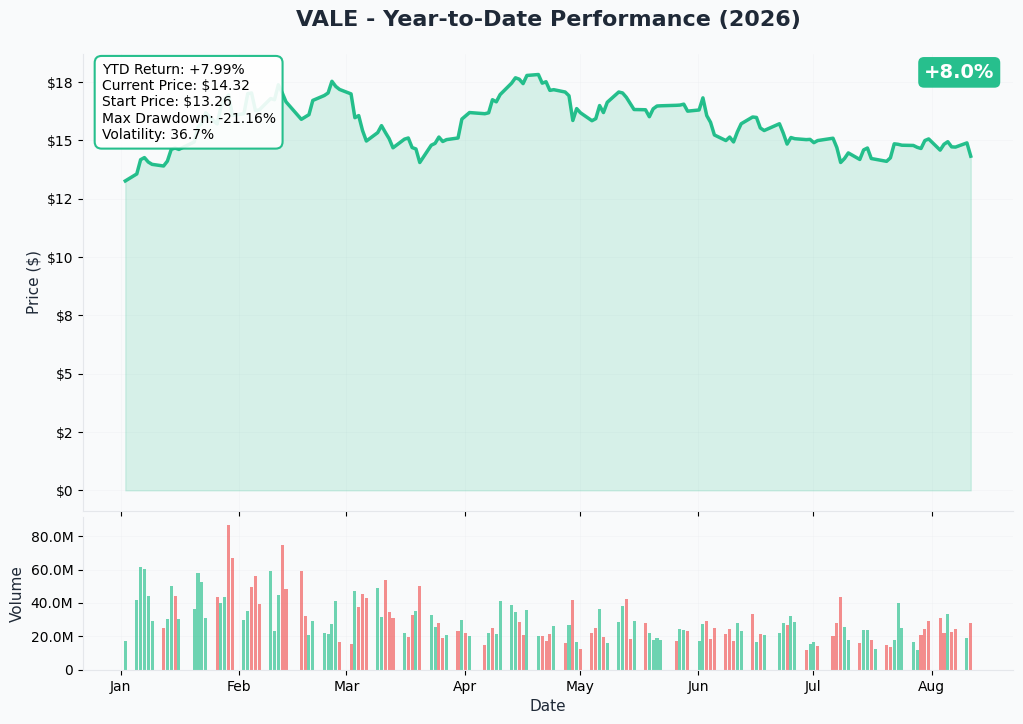
Vale is up ≈+10.7% year-to-date but has given back ≈15.3% over the last three months — the stock rallied hard early in 2026 and has been sliding since mid-May. 52-week range is roughly $9.45–$17.94.
Gamma-Based Support & Resistance
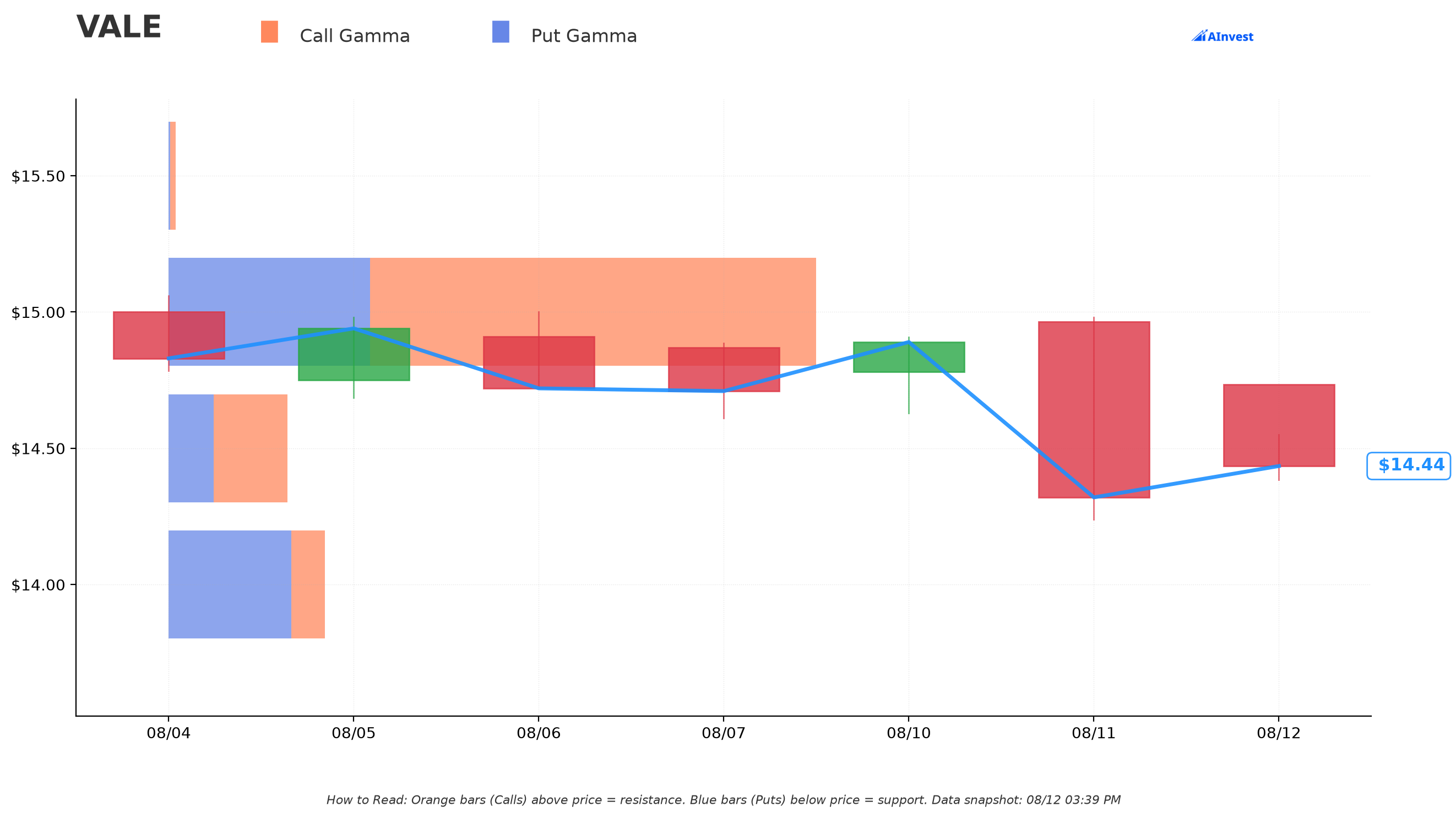
With spot at $14.43:
- 🟠 Resistance at $15 — Very Strong. This is the biggest gamma concentration on the whole chain (total GEX ≈55.6), sitting less than 4% above spot. It's the level dealer hedging flows would tend to make "sticky."
- 🔵 Support at $14 — Very Strong. Roughly 3% below spot, with total GEX ≈13.4, mostly put-driven.
- Secondary resistance sits at $16 and $17; secondary support at $13 and $12. The $14–$15 band is where the bulk of the near-term dealer hedging activity is concentrated.
These levels shift as new option flow prints and existing positions expire, so treat them as the current picture, not a fixed forecast.
Implied Move
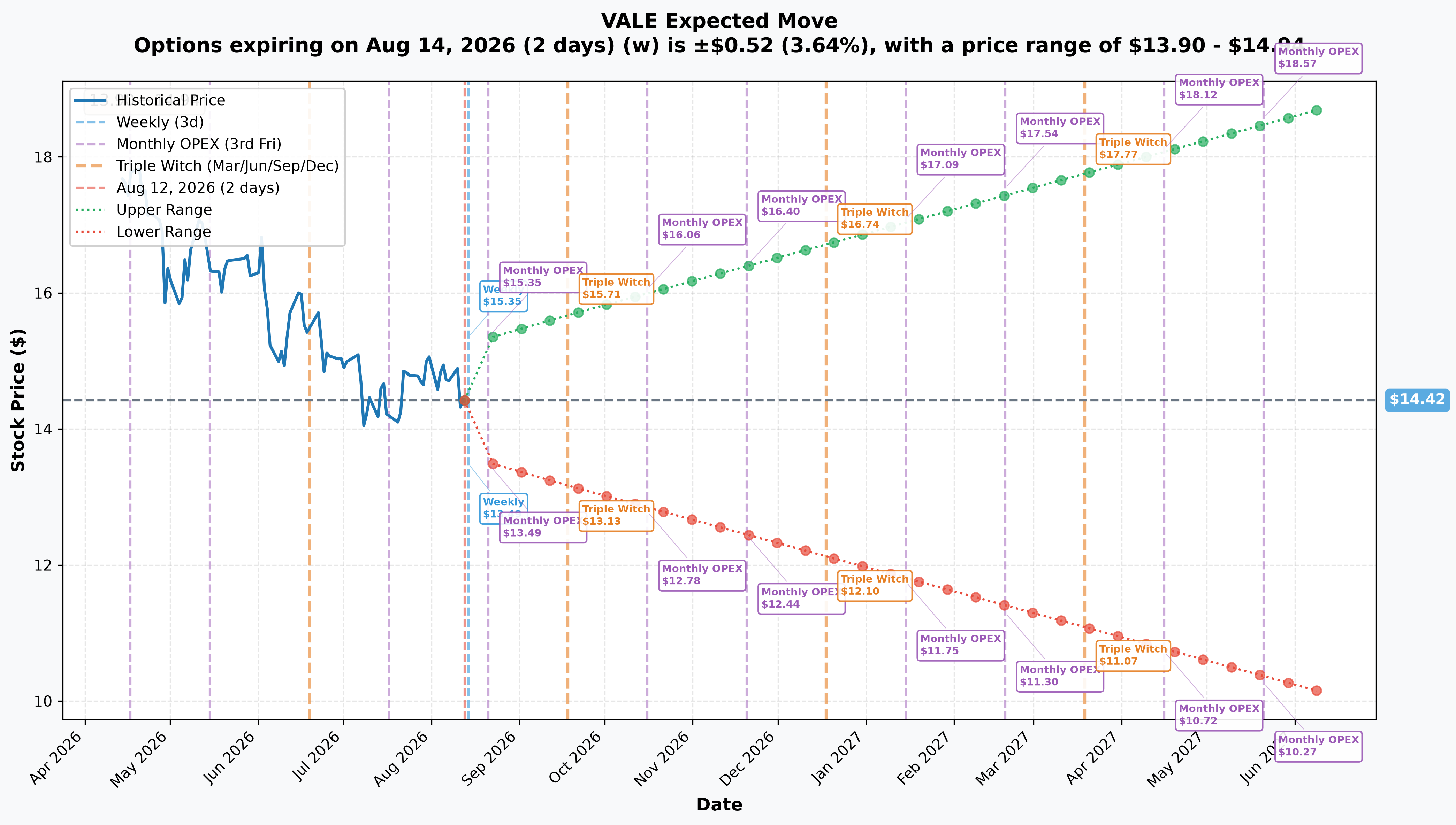
- To August 14 (2 days): ±3.64%, range $13.90–$14.94.
- To August 21 (monthly OPEX, 9 days): ±6.40%, range $13.50–$15.34.
- To September 18 (the expiration this flow used, 37 days): ±8.75%, range $13.16–$15.68.
Note that the $10 strike traded today sits well below even the wide end of the 37-day implied-move range — another sign this isn't a bet on the stock reaching some target, since the option is already so deep in the money that it barely has any optionality left.
🎪 Catalysts
✅ What's Already Happened
Vale's 2Q26 production report (July 21) showed iron ore production of 84.3 Mt — the best second quarter since 2018, up 1% year over year, alongside copper production +6% and nickel +4% (Vale 2Q26 production and sales).
The 2Q26 financial results (July 30) told a mixed story. Net operating revenues came in at US$10,498 million, +19% year over year, and proforma EBITDA hit US$4,066 million, +19% (Vale's Performance in 2Q26). But net income attributable to shareholders fell 35%, and it was a double miss versus consensus: EPS of $0.36 against $0.46 expected, revenue of $10.24B against $10.47B expected (MarketBeat earnings) — the second consecutive quarterly miss.
2026 cost guidance was revised meaningfully worse: C1 cash cost to US$22.5–23.5/t from US$20.0–21.5/t, and all-in costs to US$58–62/t from US$52–56/t, driven mainly by a stronger Brazilian real assumption (5.13 vs 5.60 USD/BRL) and a higher Brent oil assumption ($86 vs $68/bbl) (Vale 2Q26 report, p.11-12).
On capital returns: Vale repurchased US$140 million of shares in the quarter, and the board approved a new buyback of up to 100 million common shares or ADRs in July, worth roughly US$1.44 billion at the current price (Vale 2Q26 report, p.2).
Three bulge-bracket banks moved to neutral inside five weeks: Morgan Stanley (July 8, Overweight → Equal Weight), Goldman Sachs (July 27, Buy → Neutral), and Bank of America (August 5, Buy → Neutral) (MarketBeat price target history). Consensus sits around US$16.00–16.80 depending on the vendor.
📅 What's Ahead — Kept Clearly Separate From the September 18 Expiration
- Thursday, August 13, 2026 — ADR ex-dividend and record date, ≈$0.40 gross per ADR (DividendHistory.org, MarketBeat). This is the event that explains today's trade — it is one day after the flow printed, and it is a completely separate date from the option's expiration.
- September 10, 2026 — ADR dividend payment date (DividendHistory.org).
- September 18, 2026 — the option's own expiration. This is 36 days after the dividend record date. Between the trade and this expiration, the ex-dividend is the only hard corporate event — no earnings, no production report, no scheduled project milestone falls inside that window.
- ≈October 20, 2026 — 3Q26 production report (estimated by pattern), and ≈October 29, 2026 — 3Q26 earnings (estimated) both fall outside the September 18 window entirely.
🎲 Four Ways to Read This
🎲 The YOLO trader
There's genuinely nothing to YOLO here — that's the whole point. This isn't a stock that's about to explode or crater off this flow; it's plumbing. If you're looking for a directional lottery ticket on Vale, this print gives you zero edge either way. Look elsewhere for that signal, or make your own directional call independent of this trade.
📈 The swing trader
The technical picture is worth watching on its own merits, separate from this flow: $15 is a Very Strong gamma resistance level roughly 4% above spot, and $14 is a Very Strong support level roughly 3% below. A break and hold above $15 with volume, or a failure at $14, would be the more useful signals here — not the dividend flow. Keep an eye on the analyst de-rating wave (three bulge-bracket downgrades in five weeks) as a headwind to any rally attempt.
💰 The premium collector
This trade is a reminder that dividend-driven early exercise is a real risk to manage if you're short deep-in-the-money calls into an ex-dividend date, especially when the strike is far enough below spot that time value goes negative. If you're running covered calls or short-call positions on dividend payers, check your strikes against the ex-date every cycle — this is exactly the mechanism that can get your shares called away earlier than you planned.
🌱 The beginner
Here's a habit worth building: whenever you see a huge options print that's deep in the money (the strike is way below the stock price for a call, or way above for a put) and it's happening right before a stock's ex-dividend date, stop before assuming it's a bullish or bearish bet. Deep-in-the-money options with almost no time value left behave a lot like the stock itself, and big trades in them right around dividend dates are very often mechanical — exercising early to capture or avoid a dividend, not a signal about where the stock is headed. A quick check — is there a dividend coming up in the next few days? — will save you from misreading a lot of "whale" flow.
⚠️ Honest Limits — What We Can't Prove
No directional signal. This is the headline limitation: this flow tells us nothing about whether VALE goes up or down. Treat that as the primary takeaway, not a footnote.
Beyond that:
- No web search was available when this research was compiled, so several primary sources — including Vale's own regulatory filing announcing the dividend — could not be fetched directly. The dividend conclusion rests instead on Vale's own 2Q26 performance report (the US$1.701 billion figure, board-approved July 30, 2026), cross-checked against two Brazilian data sources and two US dividend-tracking sources, plus independent arithmetic — a four-way confirmation, but not a direct filing read.
- The net-of-withholding per-ADR dividend amount is unresolved. The gross figure (≈US$0.3998) is solid and corroborated three ways, but one data source shows a lower figure of US$0.3088, likely reflecting withholding tax and depositary fees that could not be sourced in this session. We are not stating a specific withholding percentage — treat the actual amount landing in an ADR holder's account as somewhere between roughly US$0.31 and US$0.40, unresolved. Even the lower figure still exceeds the call's negative time value by more than an order of magnitude, so it doesn't change the read on this trade.
- There's a documented one-day ambiguity between the Brazilian "last cum-dividend" date (August 11) and the ADR's own ex-dividend/record date (August 13). We're relying on the ADR-specific dates from two independent US sources, corroborated by the timing of this very trade (a dividend play prints the day before the record date, which lines up with August 13, not August 12).
- One data vendor's annual forecast figures for Vale were excluded as unusable — they appeared to be denominated in a different currency than Vale's reported USD figures and could not be reconciled, so they don't appear anywhere in this analysis.
This analysis is for informational purposes only and is not investment advice. Options trading involves substantial risk, including the potential loss of the entire premium paid, and is not suitable for all investors. Always do your own research and consider consulting a licensed financial advisor before trading.
Last updated: 2026-08-13 (pre-market) — the next-day OPRA open-interest snapshot confirmed the dividend-capture thesis on the flat branch. Sep-18 $10C 35,230 → 34,320 (−910 against 144,000 traded, 0.6% of the print): TRANSFER / dividend rotation, and the neighbouring $12C collapsed 15,663 → 1,957 (−13,706) in an early-exercise wave. The provisional BTO label is retired — no net new long exposure was created. The article's thesis and title were already correct and are unchanged; the ⏳ callout was replaced with the ✅ RESOLVED box.