🧩 WMT $12.46M Credit, Now Resolved: a Short-Put Roll Up to $119 Into Earnings — and the "$105 Floor" Was Not a Floor
📅 August 5, 2026 | 🔥 Unusual Activity Detected
🔄 Updated 2026-08-06 pre-market — the $105 leg resolved against our provisional read, and it changes the risk profile of this trade. We flagged the $105 puts as provisionally bought-to-open, the "floor" under the position. Next-day open interest shows that strike lost 15,930 contracts against a 23,702-lot buy — it was predominantly a close, not a new long put. The most likely structure is therefore a short-put roll up from $105 to $119, which means there is no protective floor beneath this position. The bullish direction is unchanged and the $119 sale is confirmed opening. See the ✅ RESOLVED box below.
🎯 The Quick Take
At 10:44:38 AM ET on August 5, a four-print package worked through the Aug-21-2026 options chain in Walmart: 19,877 of the $119 puts sold against 23,702 of the $105 puts bought, all landing as WMT traded at $113.04. Net effect: a $12,459,987 credit collected — a bullish position, even though every leg on the tape is a "sold put" or "bought put."
The next-day open-interest print sharpened the picture considerably. The $119 sale is a confirmed fresh open — that strike went from 2 contracts of open interest to 20,950, about as clean an opening print as this tape produces. But the $105 leg was not a new floor being bought; it was existing open interest being retired. Read together, this looks like a desk that was already short Walmart puts at $105 moving that short up to $119 — collecting far more premium, taking on a far higher assignment price, and giving up the downside cushion in the process.
Why it matters: this landed one day before Walmart's estimated August 20 earnings date, meaning the position carries the print — now, on the evidence, as an unhedged short-put obligation rather than a spread.
🏢 Company Overview
Walmart Inc. (NASDAQ: WMT) is the world's largest retailer by revenue, running Walmart stores, Sam's Club warehouse clubs, and a fast-growing e-commerce and advertising business (Walmart Connect) across the U.S. and internationally. It sits in the Consumer Staples — broadline retail sector, with a $888.52B market cap, trailing-twelve-month revenue of $725.31B (+5.9%), net income of $22.74B (+20.8%), and EPS of $2.84 (+21.4%). It pays a $0.99 annual dividend (0.89% yield).
💰 The Option Flow Breakdown
📊 What Just Happened
All four prints hit at the same second — 10:44:38 AM ET — with WMT trading at $113.04, and all four were confirmed off the tape as a 🧩 MULTI-LEG AUCTION: a facilitated, exchange-run price-improvement auction where a worked complex order gets exposed and matched. That's not a cross (no pre-arranged single counterparty) and it's not a lit sweep (nobody ripped through the displayed book) — think of it as a broker working a big multi-leg order through the exchange's own price-improvement mechanism.
| Time (ET) | Buy/Sell | Call/Put | Expiration | Strike | Premium | Volume | Prior OI | Size | Spot | Option Price | Option Symbol |
|---|---|---|---|---|---|---|---|---|---|---|---|
| 10:44:38 | SELL | PUT | 2026-08-21 | $119 | $8,615,677 | 20,000 | 2 | 11,851 | $113.04 | $7.27 | WMT20260821P119 |
| 10:44:38 | SELL | PUT | 2026-08-21 | $119 | $2,933,870 | 8,200 | 2 | 4,019 | $113.04 | $7.30 | WMT20260821P119 |
| 10:44:38 | SELL | PUT | 2026-08-21 | $119 | $2,925,110 | 4,200 | 2 | 4,007 | $113.04 | $7.30 | WMT20260821P119 |
| 10:44:38 | BUY | PUT | 2026-08-21 | $105 | $2,014,670 | 40,000 | 47,595 | 23,702 | $113.04 | $0.85 | WMT20260821P105 |
Totals: $14,474,657 collected selling 19,877 of the $119 puts, minus $2,014,670 paid for 23,702 of the $105 puts = $12,459,987 net credit. Package delta: ≈+1,059,688 shares of long-equivalent exposure — roughly $118M of stock-equivalent risk at today's price, all leaning bullish.
🧩 MULTI-LEG AUCTION — a facilitated block, not urgent buying or selling. Weigh the open/close and strike geometry over the headline premium; this was two sides that had already agreed to work a price through the exchange's auction mechanism, not one side chasing the market.
✅ RESOLVED — the Next-Day OI Print Is In, and the Two Legs Went Opposite Ways
Updated 2026-08-06 pre-market. The ≈06:30 ET OPRA open-interest snapshot (reflecting the August 5 close) has published.
| Leg | Baseline OI (Aug-5 snap) | Resolving OI (Aug-6 snap) | Δ | Print size | Δ as % of print | Day vol | Verdict |
|---|---|---|---|---|---|---|---|
| Aug-21 $119 P (sold 19,877) | 2 | 20,950 | +20,948 | 19,877 | ≈+105.4% | 20,948 | ✅ OPEN (STO) — as published |
| Aug-21 $105 P (bought 23,702) | 47,595 | 31,665 | −15,930 | 23,702 | ≈−67.2% | 42,376 | 🔄 CLOSE-leaning (BTC ≈67%) — INVERSION |
The $119 sale confirmed exactly as written. We predicted open interest would jump from 2 to ≈19,900. It printed 20,950. That strike was created from nothing on August 5, and the desk is unambiguously short 19,877 deep-in-the-money Walmart puts into the earnings print.
The $105 leg inverted. We published both branches: OI up toward ≈71,300 if opening, down toward ≈23,893 if closing. It went down, to 31,665. That direction is decisive — a strike cannot lose open interest while new long puts are being created there. So the $105 puts were not bought as fresh insurance.
What that does to the structure. The article's whole "floor beneath the position" framing rested on those $105 puts being new longs. They were not. The far more coherent reading is that this desk was already short the $105 puts, bought them back, and simultaneously sold the $119 puts — a roll up of a short-put position by 14 strikes. That is a materially more aggressive stance: the desk more than doubled the price at which it can be forced to buy Walmart stock, in exchange for collecting substantially more premium, and it did so with no long put left underneath.
The honest limit on this read. Open interest proves 15,930 contracts were extinguished at $105. It does not prove this desk was the one closing a short there. Total volume at that strike was 42,376 — well above the package's 23,702 — so unrelated flow also moved the line. The alternative (the desk bought $105 puts to open while roughly 39,600 contracts of other closing activity swamped it) is arithmetically possible but strained. Roll-up is our inference from the geometry, graded likely, not proven. What is proven: the $105 leg did not open on net, so the payoff math below no longer describes the position.
🤓 What This Actually Means — Plain English
Here's the part that trips people up: four "put" trades that are actually a bullish bet.
Selling a put obligates you to buy the stock at the strike if it's assigned — that's the opposite of shorting. When the strike is deep in the money (the $119 puts have about $5.96 of built-in intrinsic value against a $113.04 stock), selling that put is what traders call a synthetic long: you're agreeing to buy WMT at $119, but you already collected $7.27–$7.30 per share for taking on that obligation. Net it out and your effective purchase price is roughly $111.73–$111.77 — a few cents below where the stock was actually trading. That's the textbook reason a deep-ITM put sale reads bullish, not bearish.
On the day we read the $105 puts as insurance — the floor beneath the position. The open-interest print says they were not. That strike lost 15,930 contracts, meaning those puts were being retired, not created. Here is what changes, and it is not a footnote:
The payoff math we published assumed a floor that does not exist. For the record, that math was: breakeven ≈$112.73, maximum gain the full $12.46M credit above $119, a worst point at exactly $105 costing ≈$15.37M, and a theoretical return to profit near ≈$64.83 from the 3,825 extra long puts. Disregard it. It described a $119/$105 ratio spread. What the resolved data supports is a short-put roll up: an existing short at $105 bought back, a new and much larger short opened at $119.
What a naked short put at $119 actually looks like. The desk is obligated to buy Walmart at $119 if assigned, having collected ≈$7.27–$7.30 per share for that obligation — an effective purchase price near $111.73–$111.77, a few cents below where the stock was trading. Above $119 at expiration the puts expire worthless and the desk keeps the full credit. Below $119 the loss grows dollar-for-dollar with the stock, and nothing stops it — there is no long put underneath to cap the damage. At $100 the position is down roughly $37M against the credit collected; at $90, roughly $57M. Those are not tail scenarios requiring a 42% collapse, they are ordinary bad-earnings outcomes.
Why a desk would do this. Rolling a short put up in strike is a bullish escalation. You are saying: I was comfortable being forced to buy at $105, and now I am comfortable being forced to buy at $119, because I think the stock is going higher and I want the much larger premium that a deep-in-the-money strike pays. It is the premium-collector's version of pressing a winning bet.
So: bullish thesis, credit-funded, unhedged, and it carries Walmart's estimated August 20 earnings print inside the August 21 contract's final day of life. That last point is the real story — whoever built this is being paid to hold Walmart risk through a binary event, one trading day before the contracts expire, without a floor.
Order type read: the $119 legs are confidently sold-to-open (STO) — size crushes the prior OI of 2, and the resolving OI confirmed it (2 → 20,950). The $105 legs resolved as predominantly bought-to-close (BTC), reversing the provisional "bought-to-open" read.
📈 Technical Setup / Chart Check-Up
YTD Chart
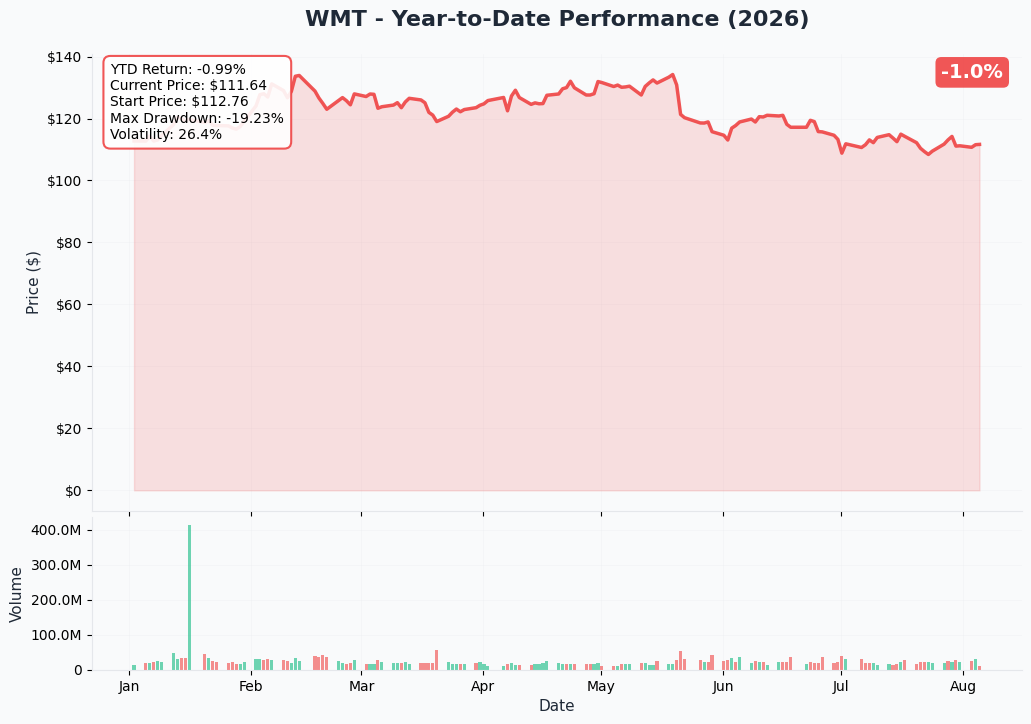
WMT has round-tripped hard off its 52-week high, now trading ≈17% below the $135.16 peak and down 12.42% over the past three months to $111.65, right into the teeth of an August 4 Oppenheimer downgrade and an estimated earnings print two-and-a-half weeks out.
Gamma-Based Support & Resistance
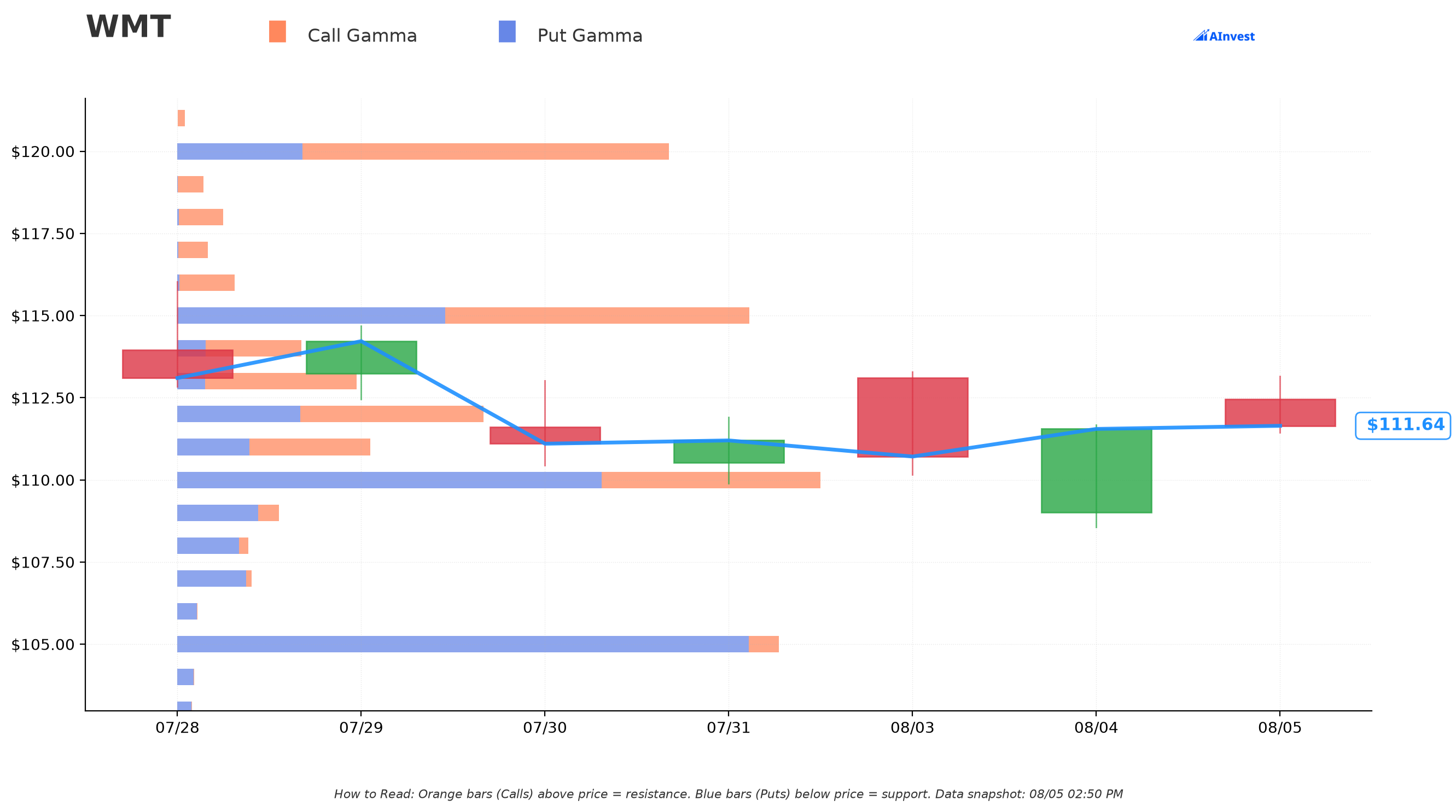
Reading the dealer gamma map around a $111.65 spot:
- 🔵 $110 support — "Very Strong" (total gamma exposure ≈30.8, put-dominant): the first line of defense just below spot.
- 🔵 $105 support — "Very Strong" (≈28.8, overwhelmingly put-driven): this is the strike the whale traded — and, on the resolved open interest, the strike it exited. The gamma wall is still there; the trade's protection at that level is not.
- 🟠 $115 resistance — "Very Strong" (≈27.4, balanced call/put): the first real ceiling above spot.
- 🟠 $120 resistance (≈23.6, heavily call-driven): sits just above the $119 strike the whale sold puts at — the market's own positioning is bunched right around where this package's max-profit zone begins.
- Smaller in-between walls at $111 (support), $112–$113 (resistance), and $114 (resistance) show the market is fairly evenly gridded right around today's price — no single dominant pin, which tracks with an event (earnings) still two weeks out.
Implied Move
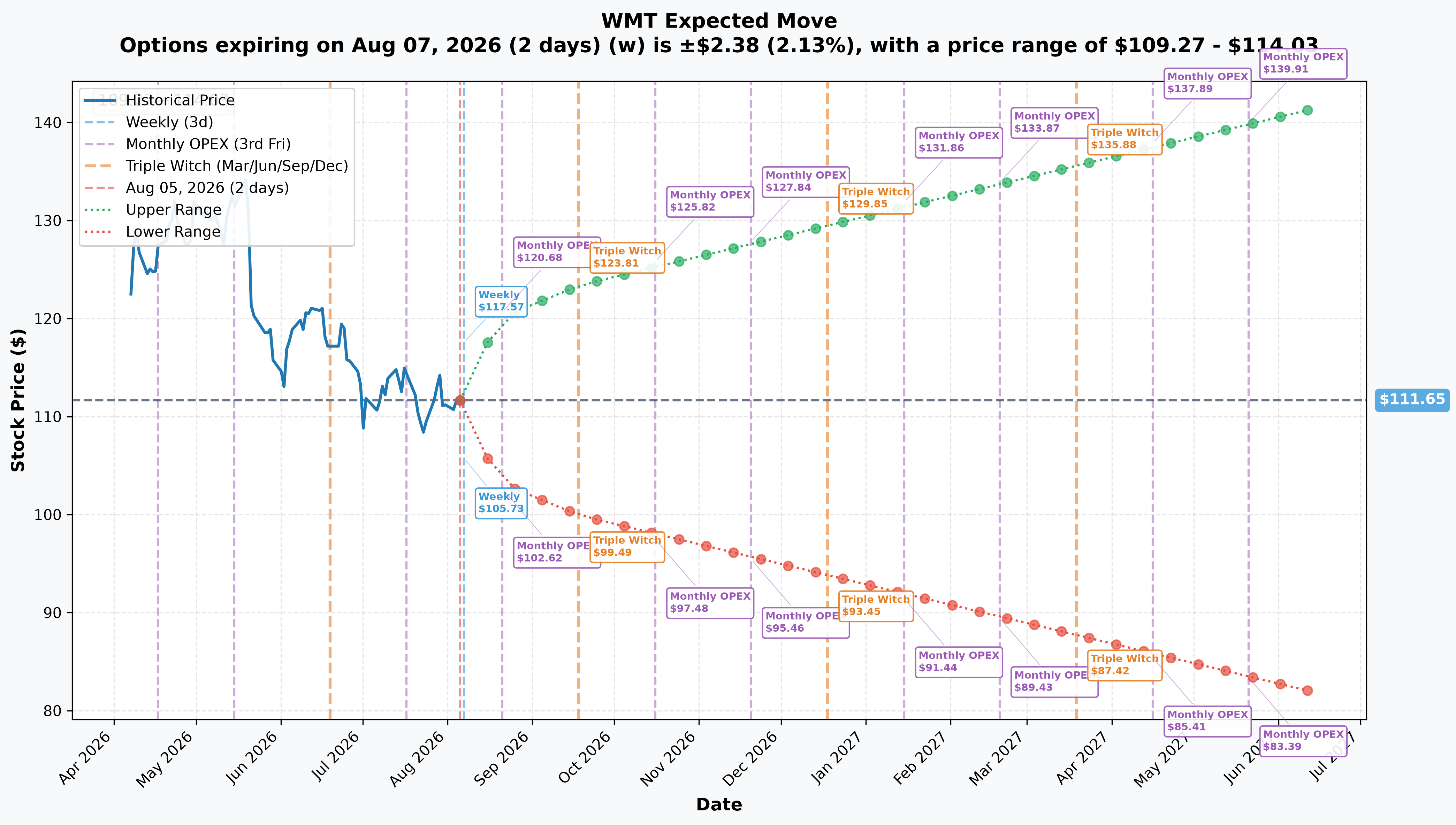
The chain is pricing a 7.67% implied move (±$8.57) into the August 21 monthly options expiration (16 days out) — a range of roughly $103.08 to $120.22. That's notable: the upper bound (≈$120) sits just above the $119 strike they sold puts at, so the max-profit zone begins right at the edge of the market's own expected range. The lower bound (≈$103) is where this matters most after the resolution: with the $105 leg confirmed as a close rather than a floor, an ordinary one-standard-deviation down-move to ≈$103 now lands the short puts roughly $16 in the money with nothing underneath them. This is a package monetizing the range the market already expects, leaning bullish within it — and, as resolved, absorbing the full downside if that range breaks.
For context, the shorter weekly expiration (Aug 7, 2 days out) implies just a 2.13% move (±$2.38), range $109.27–$114.03 — that's a normal week. The move steps up sharply once August 20 earnings falls inside the window.
🎲 Scenario Analysis — Payoff If Held to the August 21 Expiration
Revised 2026-08-06 after the OI resolution. The table originally published here priced a $119/$105 ratio spread. Since the $105 leg resolved as a close rather than a new long put, the surviving position is a short 19,877 Aug-21 $119 puts, unhedged. That removes both the artificial trough at $105 and the deep-tail recovery — the downside is now simply linear and open-ended.
| WMT spot at expiry | Position P&L (short 19,877 $119 puts, held to expiration) |
|---|---|
| ≥ $119.00 | +$14.47M (max gain — full $119-leg credit kept) |
| $115.00 (gamma resistance) | +$6.52M |
| $113.04 (August 5 print price) | +$2.63M |
| ≈$111.72 | $0 — breakeven ($119 strike − ≈$7.28 credit) |
| $110.00 (gamma support) | −$3.42M |
| $105.00 | −$13.36M |
| $100.00 | −$23.30M |
| $90.00 | −$43.18M |
| $80.00 | −$63.05M — no floor; the loss keeps growing |
P&L above is for the $119 short-put leg alone, which is the position the resolving open interest supports. The ≈$2.01M paid on the $105 leg is treated as the cost of retiring a prior obligation rather than as part of this payoff. If the roll-up inference is wrong and the $105 puts were genuinely opened, the originally published ratio-spread table would apply instead — but the open-interest decline argues strongly against that.
These are theoretical expiration values assuming zero management between now and August 21 — in practice a position this size is very likely to be adjusted, rolled, or partially closed around the August 20 print, so treat this as a risk map, not a forecast.
🎪 Catalysts
Upcoming
- ≈August 20, 2026 — fiscal Q2 2027 earnings (ESTIMATED, not company-confirmed). StockAnalysis and Investing.com both list this date, but Walmart's own investor-events page returned a 404 during research and no scheduling press release exists on the StockTitan WMT feed — treat as high-confidence consensus, not confirmed fact. Consensus: $186.91B revenue / $0.742 EPS (Investing.com). This date lands one day before the August 21 options expiration used in this package.
- Express Delivery from in-store Subway restaurants scaling to ≈1,400 stores by end of summer 2026 (StockTitan).
- Analyst-revision cycle following the August 4 Oppenheimer downgrade — watch whether the 5 current holds (of 36 analysts) expand (MarketBeat).
Already Happened
- August 4, 2026 — Oppenheimer downgrade (MarketBeat); prior rating, new rating, and price target were not disclosed in the retrieved source.
- July 15, 2026 — back-to-school campaign advertising the "lowest prices since 2019" on the 14 most popular school supplies (StockTitan).
- July 6, 2026 — price cuts across summer grocery and outdoor-living merchandise (StockTitan) — deliberate gross-margin sacrifice for traffic, a mechanism that can make a revenue beat still produce a stock-down print.
- June 23, 2026 — Vibe.co acquisition agreed, folding the connected-TV ad platform into Walmart Connect; expected to close by end of fiscal 2027, though StockAnalysis notes it has since been completed (StockTitan).
- June 23, 2026 — nuclear power purchase agreement with Constellation for ≈176 MW from an Illinois facility, effective 2029–2030 (StockTitan) — a long-dated cost hedge, not an earnings-window catalyst, but cited by bulls on the AI/data-center power narrative.
- Fiscal Q1 2027 earnings: revenue of $177.8B beat by $2.97B (+1.7%) on 6% constant-currency growth; EPS of $0.66 landed exactly in line with consensus (Investing.com).
💡 Trading Ideas — Defined-Risk Ways to Play the Same Zone
These are structural ideas, not a recommendation to replicate the whale's position — which, on the resolved reading, is an unhedged short put whose downside has no defined floor at all. That is emphatically not sized for a retail account. Note that the ideas below are all defined-risk, which is deliberate: the resolution made the institutional structure riskier, not safer. Always check live markets for current pricing before entering; none of the premiums below are quoted from the August 5 tape.
🛡️ Conservative — Defined-Risk Call Spread
A long $112 call / short $120 call (both Aug 21) caps risk at the net debit paid and needs WMT to hold the same $113-and-above zone into the August 20 print, without any assignment or margin exposure. Max loss = debit paid; max gain = $8 wide minus debit.
⚖️ Balanced — Cash-Secured Put at $105
Selling the $105 put for Aug 21 sits right on the "Very Strong" $105 gamma support wall — the strike the whale appears to have just exited, which is worth knowing before you enter it. This must be fully cash-secured (≈$10,500 set aside per contract), not margined naked — you're being paid to say "I'm happy owning WMT below $105."
🚀 Aggressive — 1:1 Put Credit Spread
Sell the $115 put / buy the $105 put (both Aug 21), a clean one-to-one vertical — no ratio, no asymmetric trough. Max loss is capped at the $10 strike width minus the credit collected, participating in the same "WMT holds up into earnings" thesis the whale is expressing, with a defined, calculable worst case instead of an open-ended ratio.
🗣️ Four Ways to Read This
🎰 YOLO Trader: The headline dollar figure is eye-catching, but this was a facilitated auction, not aggression — there's no urgency signal to chase here. And the structure it resolved into is a naked short put, which is the opposite of a defined-risk YOLO. If you want the exposure, use the 1:1 vertical above.
📈 Swing Trader: The real tell is the ≈$111.72 breakeven sitting just below the $113.04 print — this is a bet WMT holds roughly where it already is into the August 20 print, not a bet on a big rally. Watch the $110–$115 gamma zone for confirmation either way.
💰 Premium Collector: This is the reader who should care most about the OI resolution. On the day it looked like a ratio spread with a bounded trough. Resolved, it is an unhedged short put: the credit is capped at ≈$14.47M and the loss below ≈$111.72 is open-ended — roughly −$23M at $100, −$43M at $90, and it keeps going. "Credit collected" is not the same thing as "safe," and a structure can get riskier the day after you read about it.
🌱 Beginner: Selling a put deep in the money is functionally similar to agreeing to buy the stock at a discount to its current price, and you get paid for agreeing to it. The catch: if the stock keeps falling, you can lose far more than you collected. This is a lesson in reading structure, not a trade to copy at this size.
⚠️ Risk Factors & Honest Limits
- The earnings date is estimated, not company-confirmed. If August 20 shifts even one day later, it could land after the August 21 expiration instead of one day before it — which would materially change this package's risk profile. Verify against Walmart's own investor-relations page before trading around this date.
- The $105 put leg resolved as a close, not a floor — and that made the position riskier, not safer. Open interest fell 47,595 → 31,665 (−15,930) against a 23,702-lot buy. What OI still cannot prove is that this desk was the closer: 42,376 contracts traded at that strike on the day, so unrelated flow also moved the line. The short-put roll-up reading is our inference from the package geometry, graded likely, not proven.
- Everything downstream of that leg was rewritten. The scenario table, breakeven, reader interpretations and bottom line originally described a $119/$105 ratio spread. They now describe an unhedged short $119 put. If the roll-up inference is wrong, the original ratio math would apply instead.
- OPRA cannot tell us who did this or why. We cannot see the broker, the customer's identity, the order ID, whether there's a pre-existing position being adjusted, or any invisible stock/futures hedge sitting alongside it. Everything above is inferred from size, price, and open interest — not proof of intent.
- The scenario table assumes the position is held unchanged to expiration. A package this size is very likely to be actively managed — rolled, partially closed, or adjusted — well before August 21, especially around the earnings print itself.
- This is not investment advice. Options trading involves substantial risk, including the potential loss of more than the amount invested, and may not be suitable for all investors. The strategies discussed are for educational purposes; consult a licensed financial advisor before trading.
🎯 The Bottom Line
Real talk: four put trades that look bearish on the surface net out to a $12.46M credit, bullish-leaning package — the market's habit of reading "SELL PUT" as automatically bearish would get this one backwards. The direction was right on the day. The structure was not.
The resolving open interest confirmed the $119 sale as a near-total fresh open (2 prior contracts → 20,950) and showed the $105 buy was retiring open interest, not creating it. Read together, this is a desk rolling a short put up from $105 to $119 — pressing a bullish premium-collection bet — and carrying Walmart's estimated August 20 earnings print inside the contract's final trading day of life on August 21, without a floor underneath it.
Own it: above ≈$111.72 at expiration the position keeps the credit, up to ≈$14.47M at or above $119. Watching: the $110–$115 zone is where the market's own gamma structure says the tug-of-war happens between now and the print. Bearish case: there is no worst point anymore — the loss simply grows with the fall (≈−$23M at $100, ≈−$43M at $90). That is the real lesson of this resolution: a trade can look defined-risk on the day of the print and turn out, one open-interest snapshot later, to be anything but.
Mark your calendar for ≈August 20 (verify against Walmart IR).
Last updated: 2026-08-06 (pre-market) — next-day OPRA open interest resolved both legs. The $119 sale confirmed opening (2 → 20,950); the $105 buy inverted from provisionally-opening to predominantly closing (47,595 → 31,665). Title, lead, plain-English section, scenario table, gamma and implied-move commentary, reader interpretations, trading ideas, risk factors and bottom line were all corrected to describe an unhedged short-put roll-up rather than a ratio spread.