🤝 BHP $13.5M Put Sale — A Desk Collects Premium Betting the Floor Holds at $77.50 Into August Earnings
📅 July 29, 2026 | 🔥 Unusual Activity Detected
✅ Updated July 30, 2026 — confirmed, textbook. Next-day OPRA open interest on the Nov-2026 $77.50 put rose 55 → 30,115 (+30,060) against a single 30,000-lot block cross — ≈100.2% of the print. A brand-new short-put position of exactly the advertised size; the ≈$13.5M credit is real. Detail in the ✅ RESOLVED box below.
🎯 The Quick Take
At 09:54:07 ET, a desk sold 30,000 BHP Nov-20-2026 $77.50 puts at $4.50 — collecting roughly $13.5 MILLION in cash upfront — as a negotiated 🤝 block cross with a known counterparty on the other side. This is not a bearish bet. Selling a put means the seller gets paid today and is on the hook to buy BHP at $77.50 (≈7% below the ≈$83.36 print price) if the stock is below that level at the November 20 expiration. It's a premium-collection, bullish-to-neutral wager that BHP holds above $77.50 through the August 18 full-year results and the September dividend window. Translation: someone got paid $13.5M to promise they're happy owning BHP roughly 7% cheaper than today.
📊 Company Overview
BHP Group (NYSE: BHP) is the world's largest diversified mining company by market capitalization:
- Market Cap: ≈$205B–$232B (estimates vary by source/date)
- Sector: Materials / Diversified Mining
- Core Businesses: Iron ore (Western Australia Iron Ore — WAIO), copper (Escondida, the world's largest copper mine, plus Spence and Pampa Norte), steelmaking coal, and potash-in-development (the Jansen project in Canada)
- Current Price: ≈$83.7 (52-week range: $49.68 – $93.83)
A quick note on that 52-week range before anyone panics: the ADR genuinely traded in the $50s earlier in the window. That reflected a weaker iron-ore/copper price backdrop and a softer Australian dollar at the time — not a share-structure change. Each NYSE ADR still equals 2 BHP ordinary shares, unchanged.
💰 The Option Flow Breakdown
📊 What Just Happened
| Time | Buy/Sell | Call/Put | Expiration | Premium | Strike | Volume | OI | Size | Spot | Option Price | Option Symbol |
|---|---|---|---|---|---|---|---|---|---|---|---|
| 09:54:07 ET | SELL | PUT | 2026-11-20 | ≈$13.5M CREDIT | $77.50 | 30,000 | 55 | 30,000 | $83.36 | $4.50 | BHP20261120P77.5 |
🤝 Mechanism: BLOCK CROSS. This printed as a single-leg negotiated block — a broker matched a known buyer and a known seller off the lit order book. It is not an aggressive lit sweep, so there's no urgency to read into the tape mechanics themselves. $4.50 × 30,000 contracts × 100 shares/contract = ≈$13,500,000 collected as a credit, not paid out. That's real cash in the seller's account today, in exchange for the obligation described below.
✅ RESOLVED — Next-Day OI Confirmed It Almost Exactly (July 30, 2026, ≈06:30 ET)
Prior open interest on this exact strike/expiration was only 55 contracts. That was the key number: there was no way 30,000 contracts could be closing out a pre-existing long put position when only 55 could have existed to sell. The ≈545x size-to-OI ratio pointed to an unambiguous fresh opening short (STO), and the official OPRA snapshot timestamped 2026-07-30 (reflecting the EOD July 29 close) confirms it:
| Leg | Baseline OI (Jul 29 snap) | Resolving OI (Jul 30 snap) | Δ | Print size | Strike day-vol | Verdict |
|---|---|---|---|---|---|---|
| Nov-20-2026 $77.50 P | 55 | 30,115 | +30,060 | 30,000 | 30,120 | ✅ OPEN (STO) — confirmed |
What the numbers say:
- ΔOI is ≈100.2% of the print. This is as clean as an open-vs-close verdict gets — the strike went from functionally empty to 30,115 contracts, and virtually the entire build is this one cross.
- The remaining ≈120 contracts of session volume were retail-sized odds and ends (28 small
AUTO_EXECUTIONprints totalling 110 contracts). Our 30,000-lot block cross is the strike. - No partial unwind, no transfer component, no cancellation. The tape was re-pulled and carries no cancellation codes (the 40-44 family). The ≈$13.5M premium was genuinely collected against a genuinely new obligation.
- What is still unknowable: because this printed as a block cross (a negotiated, off-book match), a specific counterparty took the buy side of these exact 30,000 puts. Open interest proves the position is new to the market; it cannot tell us who is on either side, or whether the seller holds BHP shares, a broader short-vol book, or something else entirely.
Bottom line: a brand-new 30,000-lot short-put position of exactly the advertised size. The floor-holds thesis is confirmed as freshly established.
🤓 What This Actually Means — Plain English
Here's the translation for anyone who hasn't sold options before:
- 💰 They got PAID, not the other way around. Selling ("writing") a put is the opposite of buying one. The seller collects the premium ($4.50/share = $13.5M total) immediately, in cash.
- 🎯 The obligation: If BHP closes below $77.50 on November 20, 2026, the seller can be assigned — meaning they must buy 3,000,000 shares of BHP (30,000 contracts × 100 shares) at $77.50 each, regardless of how far below $77.50 the stock has fallen.
- 📉 Delta ≈ −0.35 on this put. Selling it flips the seller's exposure to roughly +0.35 delta per contract — meaning this position gains value as BHP goes up or sideways, and only starts really hurting on a serious drop. That's why this reads as bullish-to-neutral, not bearish.
- 🛡️ This is downside insurance, and the seller is the insurance company. They're betting BHP doesn't crash below $77.50 (≈7% under the $83.36 print price) before mid-November — a level that would still sit comfortably above the middle of BHP's 52-week range.
- ⚖️ Order type: STO (Sell to Open). Confirmed by the Vol/OI math above — this is a fresh short position, collecting premium as income, not someone panic-buying protection.
Unusual Score context: Vol/OI of ≈545x on a single print is a genuinely large multiple for this strike/expiration — this is the kind of size that shows up maybe a handful of times a year on a name like BHP, not an everyday occurrence. It's meaningfully large, not "once in a lifetime" — treat it as a real institutional-size bet, not a freak event.
📈 Technical Setup / Chart Check-Up
YTD Performance Chart
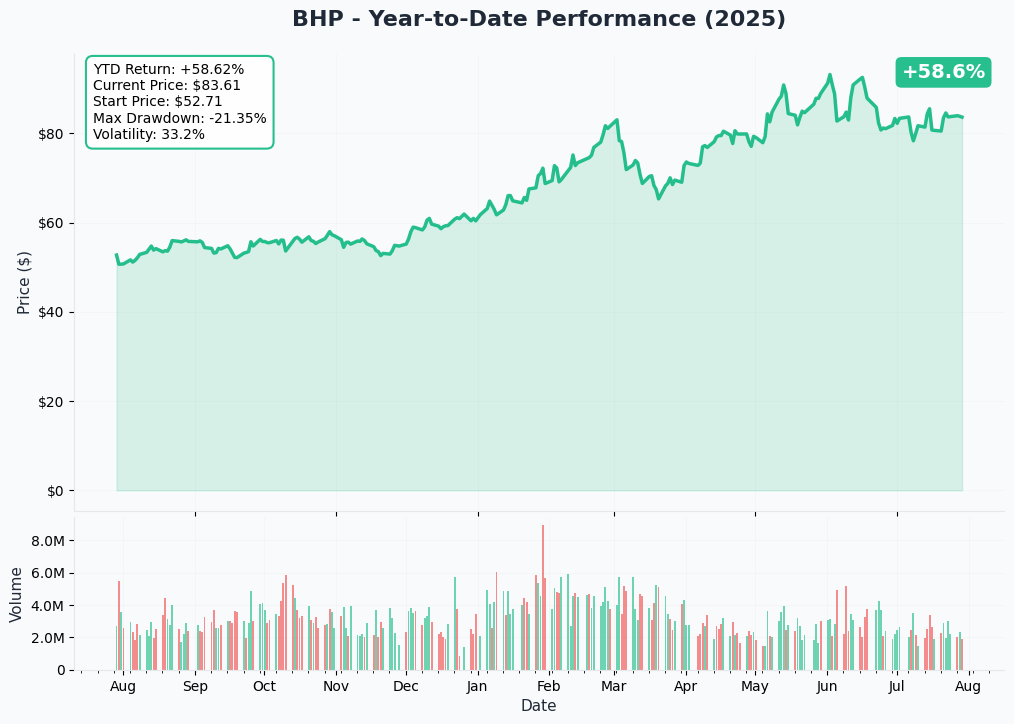
BHP is trading at ≈$83.7, sitting in the upper third of its 52-week range ($49.68 – $93.83) and roughly 11% below its 52-week high of $93.83. The stock re-rated meaningfully higher off its lows alongside record iron-ore volumes and strong 2026 copper pricing — this isn't a name drifting near its floor, it's a name that has already done a lot of the climbing.
🔵🟠 Gamma-Based Support & Resistance Analysis
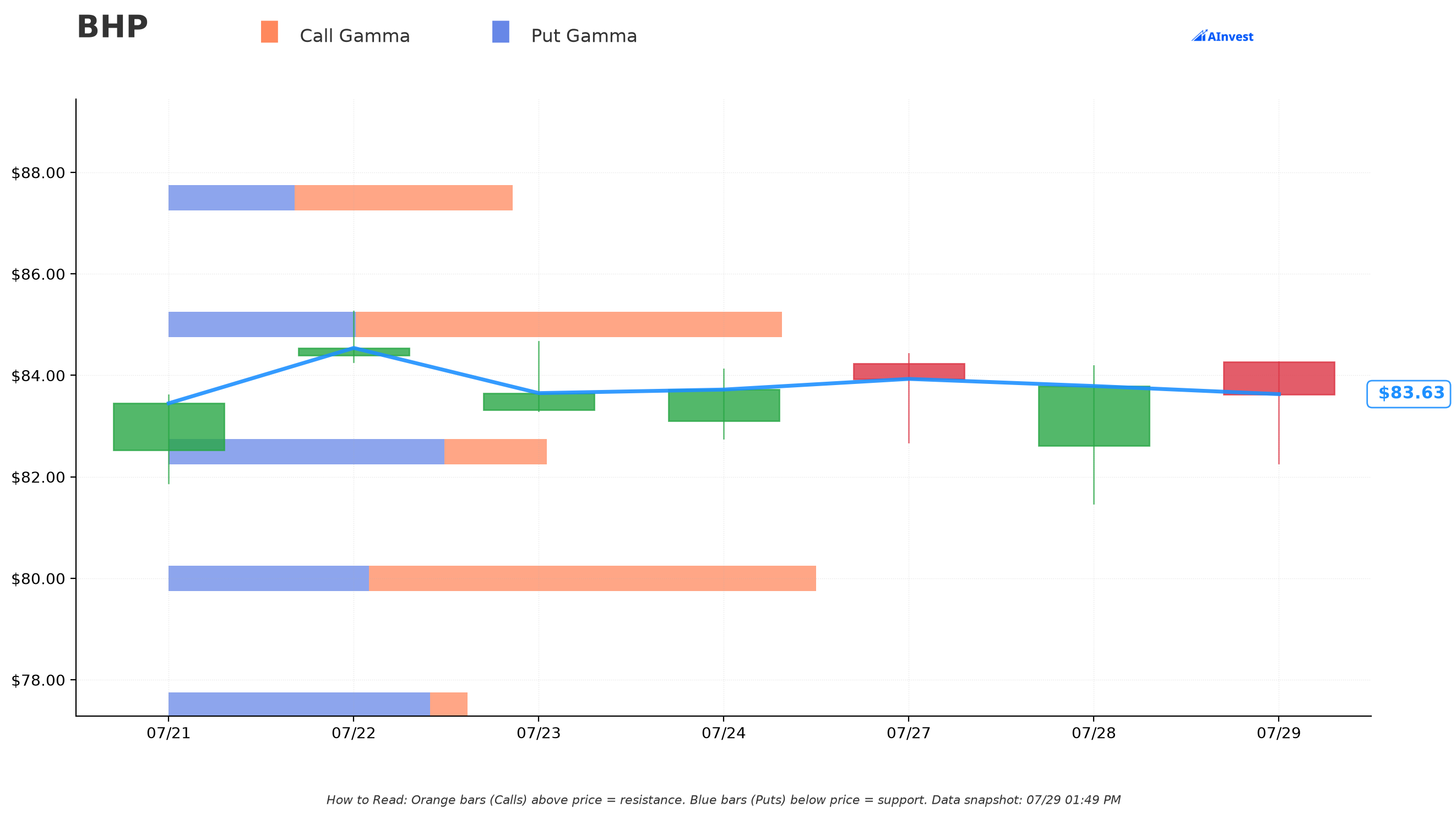
Current Price: ≈$83.68
Reading the options-market's own positioning (gamma exposure by strike):
🔵 Support Levels (Put Gamma Below Price):
- $82.50 — the single largest put-gamma concentration below spot, just ≈1.4% under current price. This is the market's nearest "cushion" zone.
- $77.50 — the exact strike this put was sold at — the second-largest put-gamma concentration in the whole chain, ≈7.4% below spot. The seller didn't pick a random number; they wrote the put right into a level the options market already treats as a meaningful floor.
- $75.00 and $72.50 — secondary support further down, ≈10–13% below spot, thinner but still present.
🟠 Resistance Levels (Call Gamma Above Price):
- $90.00 — the largest call-gamma concentration in the entire chain, ≈7.6% above spot. This is the chart's most significant overhead level — expect dealer hedging flows to lean against rallies as price approaches it.
- $85.00 — a nearer, smaller resistance shelf just ≈1.6% above spot.
What this means for traders: BHP is sandwiched between a well-defined $82.50 support just below and a $85–$90 resistance band above. The $77.50 put strike sits directly on top of real chart support, not in a vacuum — reinforcing why a seller would be comfortable getting "put" the stock there if it comes to that. Overall, call-side gamma outweighs put-side gamma across the chain (≈$10.4M vs. ≈$6.2M in notional gamma exposure), a mildly call-heavy, dealer-positioning bias — consistent with the bullish-to-neutral lean of this trade rather than fighting it.
🎯 Implied Move Analysis
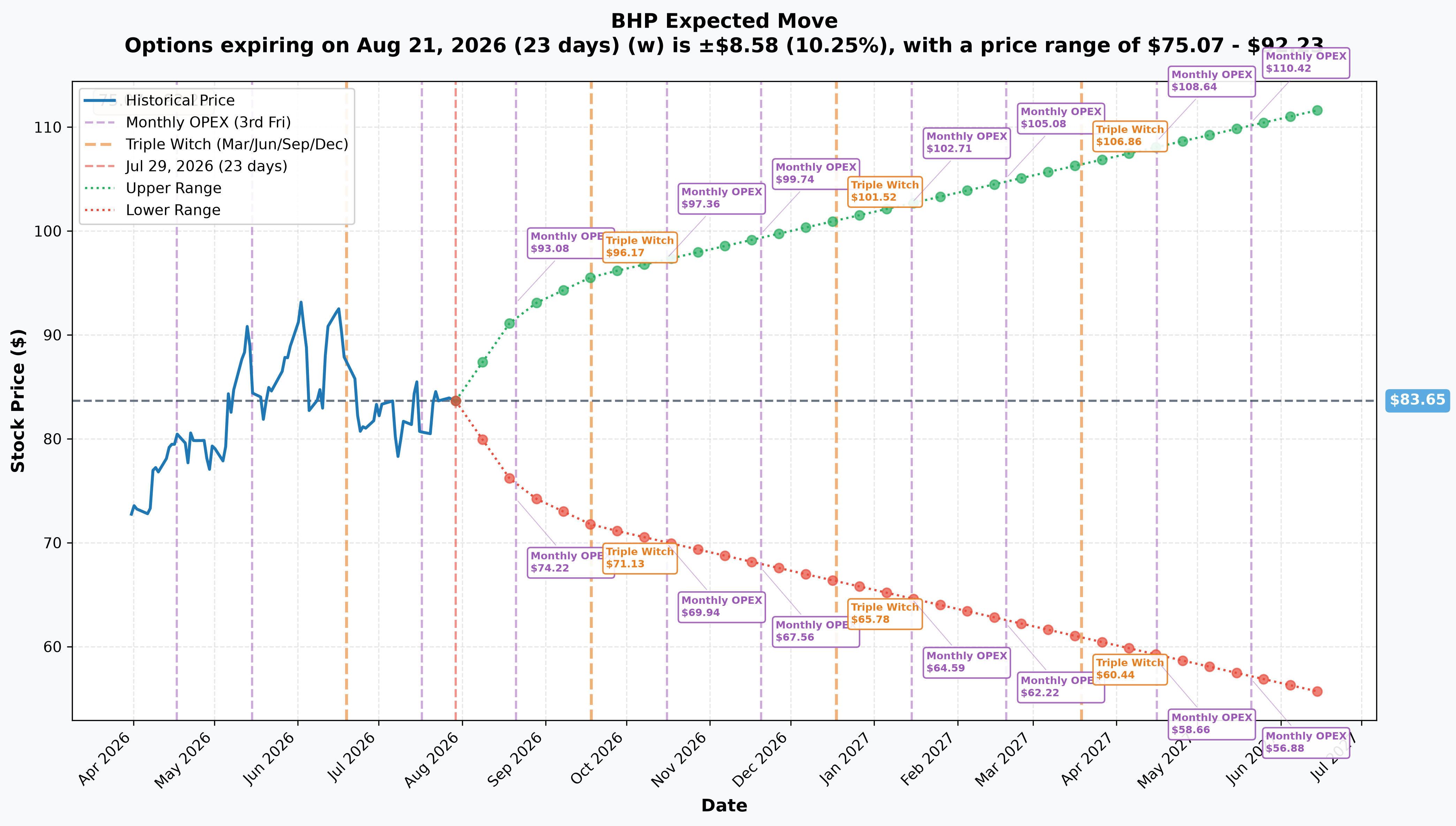
Options market pricing for key expirations:
- 📅 Monthly OPEX (Aug 21, 2026 — 23 days, covers the Aug 18 earnings): ±10.25% (±$8.58) → Range: $75.07 – $92.23
- 📅 Quarterly Triple Witch (Sep 18, 2026 — 51 days, covers the dividend window): ±14.33% (±$11.99) → Range: $71.66 – $95.64
- 📅 Nov 20, 2026 OPEX (the exact expiration of this trade): implied cone runs roughly $67.56 – $99.74
- 📅 LEAPS (Jun 17, 2027 — 323 days): ±33.64% (±$28.14) → Range: $55.51 – $111.79
Translation for regular folks: By the exact date this put expires (Nov 20), the options market's own pricing implies BHP could plausibly trade anywhere in a $67.56 – $99.74 band. Notice that the $77.50 strike sits comfortably inside that band, not near its outer edge — this means the seller isn't betting against some crazy long-shot tail event. The options market itself is already pricing real odds of BHP touching or dipping below $77.50 at some point before November. That's the honest way to read this trade: it's a bet with real, priced-in risk on the other side of it, collected for real money today.
🎪 Catalysts
✅ Already Happened (Last 3 Months)
- FY2026 half-year results (Feb 17, 2026): Underlying attributable profit $6.2B, +22% YoY; Underlying EBITDA $15.5B (+25%) at a 58% margin (BHP HY release). Interim dividend of $0.73/share was paid March 26.
- FY2026 Operational Review (July 16, 2026): A record 264.7 Mt of iron ore for the year at WAIO (Globe and Mail); copper landed at ≈1,952.8 kt, a second straight ≈2 Mt year, though Q4 copper fell 5% YoY on softer Escondida ore grade (Kalkine).
- Carrapateena conveyor-belt failure (July 2026): Up to 8 weeks of lost copper production at the South Australia asset — a near-term operational drag (TS2).
- Anglo American bid collapsed: BHP's ≈$53B renewed bid for Anglo American failed; Anglo stayed committed to its Teck Resources merger of equals, approved December 11, 2025 (Globe and Mail). Under the UK Takeover Code, BHP can't make a fresh approach for six months without a material change.
- Analyst activity turned cautious in July: JPMorgan cut its price target to 2,900p (from 3,000p, July 17); RBC (Hold, July 20), Citi (Hold, July 17), and Barclays (Hold, July 16) all reiterated Hold ratings (MarketBeat).
📅 Upcoming (Next 6 Months)
- FY2026 full-year results — August 18, 2026. The single most important date on the calendar for this trade. Watch the final dividend size, full-year underlying profit versus the $6.2B first-half run-rate, net debt, and any fresh impairments (Jansen/Samarco) (BHP financial calendar).
- FY2026 final dividend: analyst forecast ≈$1.20/share, with an ex-date around September 7 and payment around September 25 — not yet officially declared (StocksGuide forecast).
- FY2027 copper guidance: 1,650–1,800 kt — a notable step DOWN from ≈1,953 kt, driven by a planned Escondida grade decline (feed grade guided to ≈0.70% in FY27 vs. 0.90% in FY26) (SEC 6-K FY2026). This is the key bearish overhang investors will be watching closely at the August print.
- FY2027 iron ore guidance: 253–264 Mt (BHP share) at WAIO — broadly in line with the FY2026 record (Kalkine).
- Anglo-Teck deal targeted to close by end-2026, pending Canadian government and shareholder approvals — this removes BHP's own copper-consolidation option and creates a strengthened competitor (Globe and Mail).
- Commodity backdrop: Iron ore recovered to ≈$102.73/t CFR by July 14, supported by a 15.3% MoM jump in Chinese imports (IndexBox); copper hit record highs in early 2026 (LME 3-month forwards peaked ≈$14,527.50/t) with 2026 forecasts diverging between UBS (bullish, ≈$14,000–14,500/t) and Goldman Sachs (more conservative) (INN; Goldman Sachs).
🎲 Reader Playbook — Four Different Lenses
🎰 YOLO Trader
Copying this exact trade (selling naked puts) is not a beginner-friendly YOLO play — it's the opposite of a lottery ticket. Max gain is capped at the $4.50/share premium; the downside if BHP craters is large (theoretically up to $73.00/share per contract — strike minus premium — if BHP went to zero, which is unrealistic but mathematically the ceiling on loss). Selling naked puts requires margin approval and real buying-power set-asides from your broker — this is not a "click buy and walk away" trade. If you want the YOLO version of this thesis, a smaller, defined-risk way to express "I don't think BHP breaks $77.50 before Nov 20" is a credit put spread (sell the $77.50 put, buy the $70 put) — same directional bet, capped loss, far less capital at risk than a naked short put.
📊 Swing Trader
Watch the $82.50 support / $85–$90 resistance band identified in the gamma read above. A bounce off $82.50 into the August 18 earnings date is the setup this flow is implicitly leaning into. If BHP breaks and holds below $82.50 heading into earnings, that's a signal the "floor holds" thesis behind this trade is getting tested early — worth tightening any bullish swing positions.
💰 Premium Collector
This trade is the premium-collector playbook, executed at institutional size. A retail-sized version: selling a smaller number of cash-secured $77.50 (or a further-OTM, cheaper-premium) BHP puts against cash set aside to actually buy the shares if assigned. Cash-secured means setting aside the full $7,750 per contract (100 shares × $77.50) in your account — this is the conservative way to run this strategy without margin risk. You're being paid to say "I'd be happy to own BHP ≈7% cheaper than today," which lines up with a name trading well off its 52-week high with a solid dividend track record.
🌱 Beginner
Selling a put is like being an insurance company: you get paid a premium ($4.50/share here) upfront, and in exchange you promise to buy the stock at an agreed price ($77.50) if it falls that far by a set date (Nov 20, 2026). If BHP stays above $77.50, you keep the whole premium and nothing else happens. If it falls below $77.50, you're obligated to buy shares at $77.50 even though the market price is lower — that's the risk you're being paid to take. Never sell a put on a stock you wouldn't actually want to own at that strike price.
⚠️ Risk Factors & Honest Limits
What the tape proves: the trade printed, the size (30,000) vs. prior OI (55) makes this an unambiguous fresh opening short put, and it executed as a negotiated block cross rather than lit aggression.
What the tape can NOT prove:
- Who the counterparty is — broker/MMID, customer identity, and order ID are all invisible to us. We know a known counterparty bought these puts in the cross; we don't know if it's a market maker recycling the position, a fund, or something else.
- Whether this is cash-secured or margined, or whether the seller holds an offsetting hedge (long stock, long calls, or another options structure) elsewhere in their book that we can't see.
- Whether tomorrow's OI print will exactly match +30,000. We expect it to (given the Vol/OI math), but next-day OI is the definitive confirmation, not today's tape alone.
Real financial risk if you follow this trade's structure:
- Breakeven: $77.50 − $4.50 = $73.00. Below that, a short-put seller loses money, dollar-for-dollar with BHP's decline, down to a theoretical (if unrealistic) max loss of $73.00/share.
- Assignment risk: if BHP is below $77.50 at expiration, you (or the institution that mirrors this) can be forced to buy shares at $77.50 regardless of the actual market price.
- China demand risk: Chinese crude steel output was down 4.1% YoY through April 2026, and 2026 steel demand growth is projected at just ≈0.3% — iron ore, BHP's largest profit engine, is vulnerable to any China stimulus disappointment.
- Copper guidance risk: the FY27 step-down to 1,650–1,800 kt (from ≈1,953 kt) on Escondida grade decline is a real, already-guided headwind, not a rumor.
- Valuation/sentiment: consensus rating is "Hold," several analysts cut price targets in July, and Investing.com's average target ($73.64) sits below current spot — the crowd doesn't see a lot of near-term upside cushion.
Disclaimer: Options trading involves substantial risk of loss and is not suitable for all investors. Selling puts (naked or cash-secured) carries real capital risk — you can be assigned shares at a loss well beyond the premium collected. This analysis is for educational purposes only and is not financial advice. Always confirm your broker's margin requirements before selling any option, and never risk more than you can afford to lose. Commodity prices, guidance, and dividend estimates referenced above are as-reported on the dates cited; BHP's FY2026 final dividend remains an analyst forecast until officially declared on August 18, 2026.
🎯 The Bottom Line
Real talk: A desk sold 30,000 BHP Nov-20 $77.50 puts for ≈$13.5M in cash, via a negotiated block cross with a known counterparty on the other side. Prior open interest of just 55 contracts makes this an unambiguous fresh opening short (STO) — not a closing trade. This is premium-collection, bullish-to-neutral positioning: the seller gets paid today and is comfortable owning BHP roughly 7% below where it trades now, right into the August 18 full-year results and the September dividend window.
Mark your calendar:
- 📅 August 18, 2026 — FY2026 full-year results, the trade's central catalyst
- 📅 ≈September 7, 2026 — expected final dividend ex-date
- 📅 November 20, 2026 — this put's expiration
✅ The next-day OPRA open interest print is in (July 30, ≈06:30 ET): OI on the $77.50 put jumped 55 → 30,115 (+30,060), ≈100.2% of the 30,000-lot cross. The "fresh open" read is locked in.
Last updated: July 30, 2026 — next-day OPRA open interest confirmed the fresh opening short: 55 → 30,115 (+30,060), ≈100.2% of the print, no cancellations on the tape. No narrative change; the STO read and the ≈$13.5M collected credit are confirmed. Original publication: July 29, 2026.