🇧🇷 EWZ: 42,000 Puts Bought — And the Expiration Misses Brazil's Election by Four Days
📅 2026-08-13 | 🤝 Block Cross Detected
🎯 The Quick Take
At 11:36:37 ET a desk bought 42,000 September-30 $32 puts at $0.53 in EWZ — ≈$2.23 million of premium controlling ≈$141 million of notional. Prior open interest was 27 contracts. That is about as clean a new position as this market produces.
Now the detail that reframes everything: Brazil's presidential first round is October 4, 2026 — four days AFTER this option expires. A desk spending $2.23M did not miss an election by four days by accident.
So this is not an election bet. It is a bet on the road to the election — or a quarter-end hedge. Both are defensible; neither is "someone knows who wins."
🏛️ Fund Overview
EWZ holds large-cap Brazilian equities, unhedged for currency. A US investor takes Brazilian real risk on top of equity risk — which turns out to be the crux of this trade.
| Attribute | Value |
|---|---|
| Price | $33.67 (at the print) |
| AUM | ≈$8.5–9.2B (issuer page unreachable; ≈$8.52B reconciles from 251.95M shares × $33.83) |
| Valuation | 9.68× earnings, 4.33% yield |
| Currency | Unhedged BRL |
The fund is dominated by commodity and financial names — Vale, Petrobras and the large Brazilian banks — so iron ore, oil and the Selic rate drive it more than any domestic consumer story.
💰 The Trade, in Plain English
| Time | Buy/Sell | Call/Put | Expiration | Premium | Strike | Volume | OI | Size | Spot | Option Price | Option Symbol |
|---|---|---|---|---|---|---|---|---|---|---|---|
| 11:36:37 ET | BUY | PUT | 2026-09-30 | ≈$2,226,000 | $32 | 42,000 | 27 | 42,000 | $33.67 | $0.53 | EWZ20260930P32 |
The $32 strike is ≈5.0% below spot and the option is 100% time value. Breakeven is ≈$31.47 — a ≈6.5% decline in 48 days.
Printed as a negotiated block cross: a known counterparty, no urgency signature, no liquidity taken. The BUY label is reported rather than tape-proven — but with 27 contracts outstanding against 42,000 traded, the opening is beyond doubt.
Note the expiration itself is unusual: September 30 is a month-end expiry, not the standard third-Friday monthly. That choice was deliberate, and it buys three specific things the September 18 monthly would have missed.
✅ RESOLVED — Opened in Full
Updated 2026-08-14 pre-market. Resolving OPRA snapshot timestamped August 14 (reflects the August 13 close, after this print); baseline is the August 13 snapshot (reflects the August 12 close, before this print).
| Leg | Baseline (Aug-13) | Resolving (Aug-14) | Δ | Print size | Capture | Verdict |
|---|---|---|---|---|---|---|
| Sep-30 $32 put | 27 | 42,436 | +42,409 | 42,000 | 101% | ✅ OPEN (BTO) |
A line that held 27 contracts for a week now holds 42,436. The rise slightly exceeds the block, so roughly 409 contracts of additional buying landed at the $32 strike beyond the print captured here. Nothing matched against existing holders.
The position is real and it is new. What open interest still cannot tell us is whether it is a hedge against Brazilian equity held elsewhere or a standalone directional view — that limit stands, and so does the observation that the September 30 expiry misses the election by four days.
🤓 What This Actually Means — Plain English
A put is the right to sell. Here: the right to sell EWZ at $32 through September 30, bought for 53 cents a share.
With the fund at $33.67 that right is currently worthless — you would not sell at $32 what you can sell at $33.67. The entire 53 cents is payment for the possibility that Brazil falls more than 6.5% in seven weeks. If it does not, all ≈$2.23M is gone.
Here is the part most readers will not expect: the cheapest path to profit runs through the currency, not the stock market. EWZ is priced in dollars but holds Brazilian assets. If the real weakens from 5.1912 to ≈5.55 per dollar — a ≈6.5% move — the buyer reaches breakeven even if the Brazilian stock market does not move a single point in local terms.
That matters because currency is historically the thing that moves in a Brazilian election run-up. The real is currently supported by an enormous carry cushion — the Selic at 14.00% against a Fed at 3.50–3.75%, a ≈10-point differential — and every rate cut narrows it.
Why the four-day gap is the point. Options get more expensive as a big event approaches, because uncertainty rises. A buyer who owns volatility before that repricing can sell into it — collecting the increase without the underlying ever reaching the strike. Buying a September 30 put ahead of an October 4 election is a textbook expression of that: own the ramp, avoid the event.
📈 Technical Setup
One-Year Performance
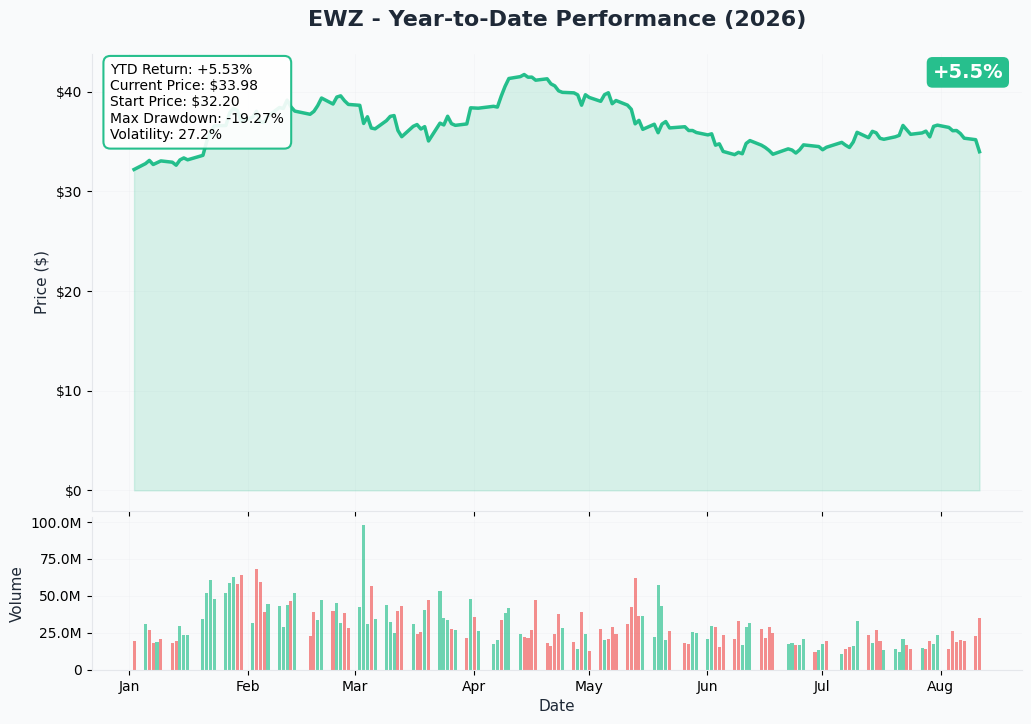
Recent context matters more than the year: the Ibovespa is −5.36% on the month off a seven-month low, and EWZ has fallen 7.7% from $36.65 on July 31 to $33.84. The put was bought into weakness, not into strength.
🔵🟠 Gamma-Based Support & Resistance
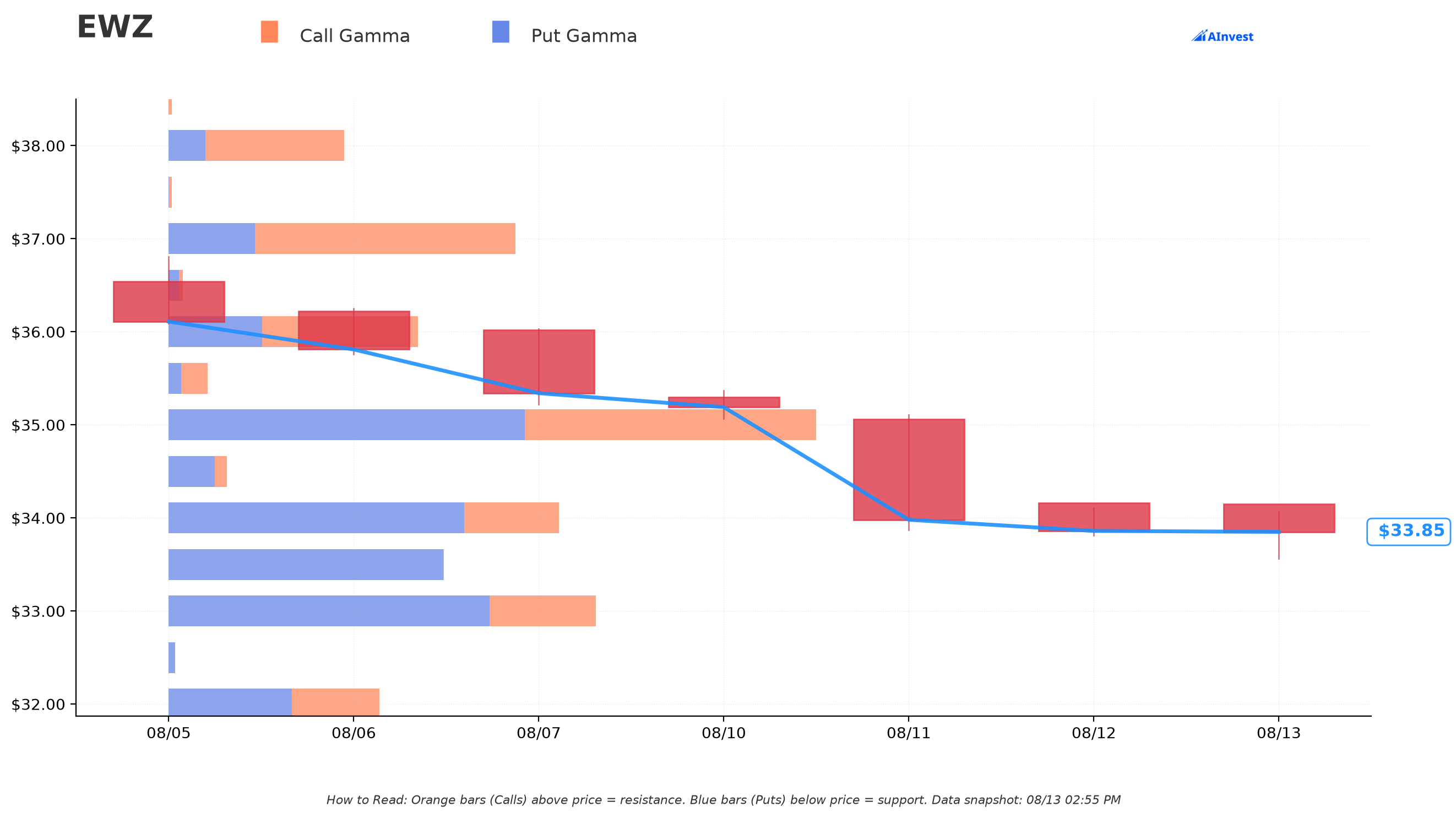
| Level | Strike | Strength |
|---|---|---|
| Resistance | $35 | Very Strong |
| Spot | $33.84 | — |
| Support | $33 | Very Strong |
Support at $33 sits above the $32 strike — the fund must break a Very Strong gamma level before this put begins to work.
🎯 Implied Move
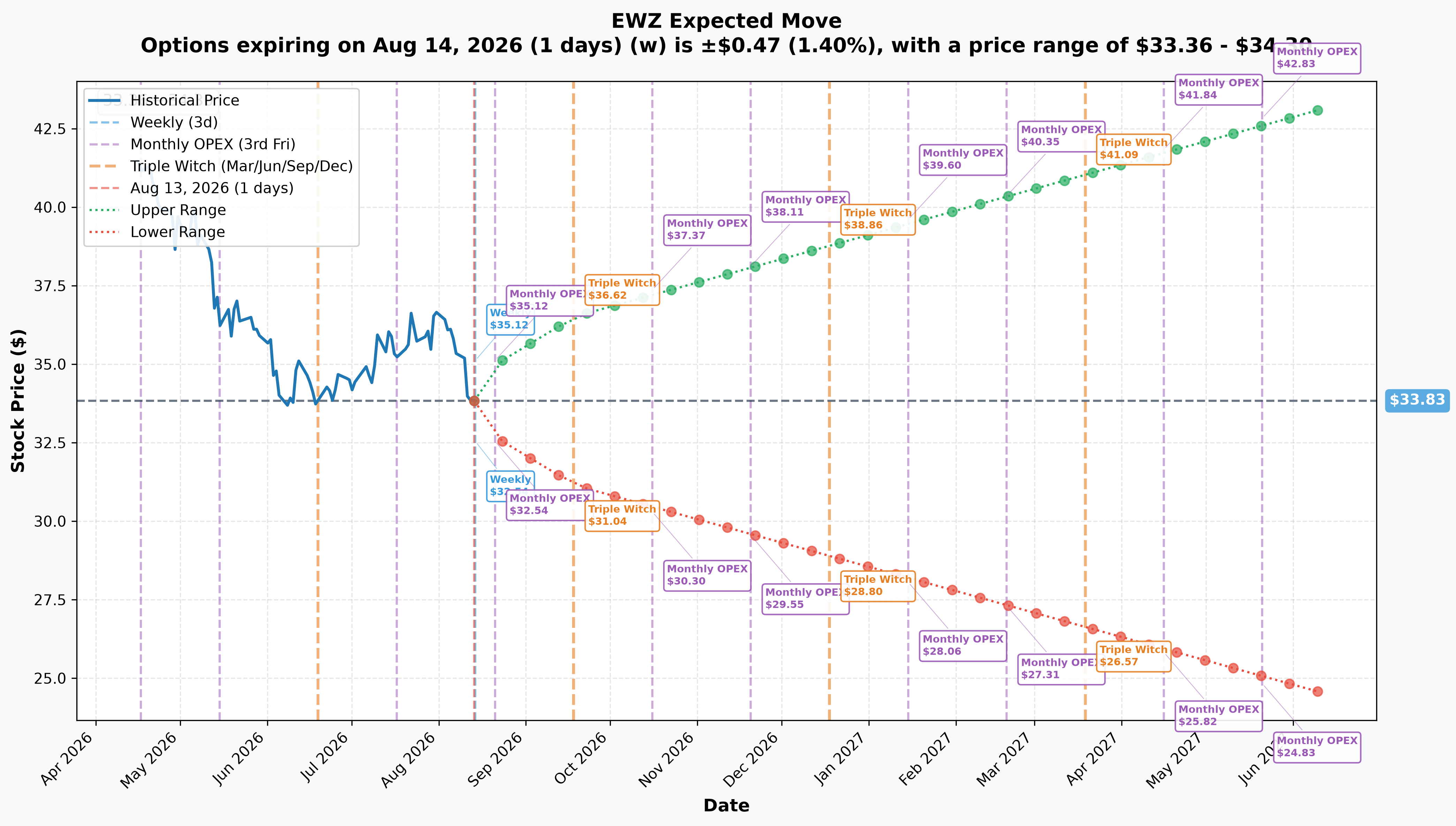
| Horizon | Implied move |
|---|---|
| Aug 14 | ±1.40% |
| Aug 21 | ±3.48% |
| Sep 18 | ±7.96% |
The ±7.96% five-week range covers the 6.5% needed for breakeven, so the market prices this as achievable. Our own back-out puts implied volatility near 25% with a delta of roughly −0.27 (≈−$38.5M of synthetic short exposure) and about a 30% chance of finishing in the money — our calculation, not a vendor figure. 25% is cheap for what is scheduled, which strengthens the "buy volatility before it inflates" reading.
🎪 Catalysts — What the Month-End Expiry Actually Buys
The decisive fact: the first round of Brazil's presidential election is October 4, 2026 — four days after expiry. The fourth debate on October 1 misses by one day.
Choosing September 30 over the September 18 monthly buys exactly three things:
- The ≈September 24–25 IPCA-15 inflation print
- The September 27 third presidential debate
- September 30 quarter-end rebalancing
Everything inside the window:
| Date | Event | Inside? |
|---|---|---|
| Aug 23 | 1st presidential debate (São Paulo) | ✅ |
| Aug 26 | IPCA-15 | ✅ |
| Sep 1 | Q2 GDP — forecast to decelerate to 1.40% from 1.80% | ✅ |
| Sep 14 | 2nd presidential debate | ✅ |
| ⚠️ mid-Sep | Copom rate decision — date inferred from cadence, could not be verified | ✅ (probable) |
| Sep 24-25 | IPCA-15 | ✅ |
| Sep 27 | 3rd presidential debate | ✅ |
| Sep 30 | Quarter-end | ✅ |
| Oct 4 | Presidential first round | ❌ four days too late |
The Copom decision cuts both ways, which is unusual. A pause crushes the ≈24% financials block; a 50bp cut narrows the carry holding the real up. Both tails hurt EWZ — there is no comfortable outcome for a long holder.
Supporting evidence for the bearish case: JPMorgan downgraded Brazilian equities citing "increased volatility ahead of the presidential election," and fresh 25% Section 301 tariffs landed on Brazil in July 2026 — notably, Section 301 is insulated from the February 2026 Supreme Court ruling that struck down the earlier 50% IEEPA tariff.
The counter-case is genuinely strong. Vale, Petrobras and Itaú all posted record or near-record second quarters. The fund trades at 9.68× earnings with a 4.33% yield and carries Buy consensus broadly. Disinflation is intact — IPCA 4.72% → 4.64% → 4.44% — and forecasters expect the real to strengthen (5.07 at quarter-end, 4.91 in twelve months), which is a direct headwind for this put. And this was a block cross, not a sweep — a known counterparty sold 42,000 puts willingly, with no urgency signature at all.
The fragility in the bull case: disinflation leans on fuel, and Brent is +30.06% year to date. If crude re-accelerates, the fuel tailwind reverses, inflation re-breaches 4.50%, and the easing path stalls — directly bearish for equities inside this option's life.
👥 Four Ways to Read This Trade
🎲 The YOLO trader
If your instinct is "buy Brazil puts into the election," notice that this desk deliberately did not own the election. A cheaper, more honest expression of an election view would be an October or November expiry that actually contains October 4. Copying the September 30 strike gets you the ramp, not the result — make sure that is the trade you meant to make.
📈 The swing trader
The cleanest observation is that the currency is the lever. USD/BRL at 5.1912 moving to ≈5.55 delivers the entire required decline with the Ibovespa flat. Watch the Copom decision and the debate calendar (Aug 23, Sep 14, Sep 27), and note that $33 is Very Strong gamma support — the fund has to break that first.
💰 The premium collector
You are the counterparty here, and the base case favours you: forecasters expect the real to strengthen, the fund is at 9.68× earnings with a 4.33% yield, and the underlying companies just posted record quarters. But be clear about what you are short — a currency and an election ramp, not just an equity index. The Copom's two-sided risk means there is no obvious "quiet" outcome to lean on.
🌱 The beginner
Learn one habit from this trade: check whether the option expires before or after the event everyone is talking about. Brazil votes on October 4. This option dies on September 30. Anyone reading the headline as "a $2.2M bet against the Brazilian election" would be describing a trade that literally cannot be in existence when the votes are counted. Dates first, story second.
⚠️ Honest Limits
- We cannot distinguish a hedge from a directional bet. A block cross with a willing counterparty and no urgency signature is equally consistent with a quarter-end portfolio overlay.
- Direction is reported, not tape-proven — the print took no liquidity. The opening is proven by size versus 27 contracts of prior open interest.
- ⚠️ The September Copom date could not be verified from five separate attempted sources and is inferred from the April 29 / June 17 / August 5 cadence. It is marked as inferred everywhere it appears.
- Our implied-volatility, delta and probability figures are derivations, not vendor data.
- Research gaps, disclosed: the search budget was exhausted, so all sourcing was by direct retrieval. The issuer fund page was unreachable, so AUM is given as a range with our own reconciliation shown. No sourced mid-May price was available, so no precise three-month return is stated. The published $42.02 52-week high is internally inconsistent with the sourced price path and is flagged unreliable. Q3 earnings dates for Vale, Petrobras and Itaú could not be confirmed.
Last updated: 2026-08-14 — next-day OPRA open interest resolved the put as an open — 27 → 42,436 (see the ✅ RESOLVED section).
This is market analysis and education, not investment advice. Options carry substantial risk of loss.