🛡️ GEV $30M Put Sale — A Desk Just Bet GE Vernova Won't Crack $800 Through Mid-2027
📅 July 29, 2026 | 🔥 Unusual Activity Detected
✅ Updated July 30, 2026 — confirmed, above target. Next-day OPRA open interest on the Jun-2027 $800 put rose 162 → 2,697 (+2,535) against a 2,483-lot auction — ≈102% of the print, and above our published 2,483–2,645 prediction. The biggest credit on the tape that day is a genuinely new short-put position. Detail in the ✅ RESOLVED box below.
🎯 The Quick Take
Someone just collected $30.1 MILLION in cash selling 2,483 GE Vernova $800 puts expiring June 17, 2027! This is the single biggest premium ticket of the day across our whole scan, and it's a credit, not a debit — the seller got paid up front to promise they'll buy GEV at $800 if it ever gets there over the next ≈11 months. With the stock at $931.34 when this printed (≈14% above the strike) and GE Vernova's gas-turbine backlog sitting at a record 116 GW, this reads as high-conviction, bullish-to-neutral positioning, not a bearish bet. Translation: someone got paid $30M to say "I don't think GEV crashes."
📊 Company Overview
GE Vernova (GEV) is the energy-equipment business spun off from General Electric in 2024, and it has become the poster child for the AI-datacenter power buildout:
- Market Cap: ≈$265.4 Billion
- Industry: Power & Energy Equipment / Electrification (gas turbines, grid equipment, wind, nuclear)
- Current Price: ≈$917 (as of today; the observed trade printed at spot $931.34 earlier in the session)
- All-Time High: $1,195.94 (July 6, 2026)
- Primary Business: Heavy-duty gas turbines (the scarcest asset in the AI power race), electrification/grid equipment (transformers, switchgear), wind turbines, and small modular nuclear reactors (BWRX-300)
💰 The Option Flow Breakdown
📊 What Just Happened
The Tape (July 29, 2026 @ 10:16:53 ET):
| Time | Symbol | Buy/Sell | Call/Put | Expiration | Premium | Strike | Volume | OI | Size | Spot | Option Price | Option Symbol |
|---|---|---|---|---|---|---|---|---|---|---|---|---|
| 10:16:53 | GEV | SELL | PUT $800 | 2027-06-17 | $30.1M | $800 | 2,500 | 162 | 2,483 | $931.34 | $121.40 | GEV20270617P800 |
🔨 Mechanism: single-leg price-improvement auction. This was a worked order that got price improvement on an exchange auction — not a negotiated off-book block cross and not an aggressive lit sweep. It still carries a real premium tag; we're just being precise about how it printed. The trade sold at ≈29% of the way across the bid-ask spread (closer to the bid), consistent with a seller working size through the auction mechanism.
🤓 What This Actually Means — Plain English
This is a Short Put (STO — Sell To Open), and the direction matters a lot here:
- 💰 They didn't pay $30M — they COLLECTED it. Selling a put means you get paid premium up front in exchange for taking on an obligation. This trader banked $121.40 per share × 2,483 contracts = ≈$30.1M in cash today.
- 🛡️ They're selling insurance, not buying it. Whoever bought these puts (probably a hedger protecting a long GEV position) paid $30.1M for downside protection below $800. Our trader is the insurance company on the other side of that trade — collecting the premium and taking on the risk.
- 📏 The cushion: $800 sits ≈14% below the $931.34 spot at the time of the trade. GEV has to fall more than 14% and stay there through June 2027 before this trade starts costing real money.
- 📐 Delta ≈ −0.30 — roughly a 30% market-implied probability this put finishes in the money. A short put like this adds positive delta to a book, meaning the position actually benefits if GEV grinds higher or just holds flat — that's the bullish-to-neutral lean.
- 🎯 Breakeven math: Full profit ($30.1M kept) if GEV is above $800 on June 17, 2027. Breakeven is roughly $678.60 (strike minus premium received). Below that, losses start accumulating — and in a true worst case (GEV collapsing toward $0, which is not realistic but is the textbook max-loss scenario), the theoretical max loss on 2,483 contracts runs into the hundreds of millions. This is a real obligation, not free money.
- 📊 Why size matters: 2,500 contracts traded against just 162 contracts of prior open interest — volume was ≈15.4× the existing open interest. That kind of imbalance is the clearest signal we get intraday that this is a genuinely new position, not someone unwinding an old one.
Unusual Score: This is the single largest premium print of the day in our scan — not "once in a lifetime," but a size that stands out clearly against typical GEV LEAP flow, where a ≈15x-of-OI single print is uncommon.
✅ RESOLVED — Next-Day OI Confirmed the Fresh Open (July 30, 2026, ≈06:30 ET)
Size (2,483) was ≈15.4× the prior open interest (162), so this read as an unambiguous fresh open (STO) rather than a close — there simply weren't enough existing contracts outstanding for it to be mostly an unwind. The OPRA snapshot timestamped 2026-07-30 (reflecting the EOD July 29 close) confirms it, and then some:
| Leg | Baseline OI (Jul 29 snap) | Resolving OI (Jul 30 snap) | Δ | Print size | Strike day-vol | Predicted | Verdict |
|---|---|---|---|---|---|---|---|
| Jun-17-2027 $800 P | 162 | 2,697 | +2,535 | 2,483 | 2,537 | 2,483–2,645 | ✅ OPEN (STO) — confirmed, above range |
What the numbers say:
- ΔOI is ≈102% of the print and ≈100% of the strike's entire session volume (2,537). The build came in slightly above the top of our predicted range — the extra ≈52 contracts are the day's small retail prints, which also opened.
- The strike grew ≈17-fold, from a near-dormant 162 contracts to 2,697. There was no meaningful transfer component: essentially everything that traded created something new.
- No partial unwind. No cancellation. The tape was re-pulled and shows no cancellation codes (the 40-44 family). The ≈$30.1M credit — the largest single premium collection on the July 29 tape — was genuinely collected against genuinely new risk.
- What is still unknowable: the print was a single-leg price-improvement auction (a facilitated, worked order — not a lit sweep, not a cross), so there is no aggressor read to extract. Open interest proves the obligation is new to the market; it cannot tell us whether the seller is naked, cash-secured, holding GEV shares, or hedging a larger book, nor who took the other side.
Bottom line: the "GE Vernova won't crack $800" bet is confirmed as brand-new. This desk newly took on the obligation, it did not inherit or unwind one.
📈 Technical Setup / Chart Check-Up
YTD Performance Chart
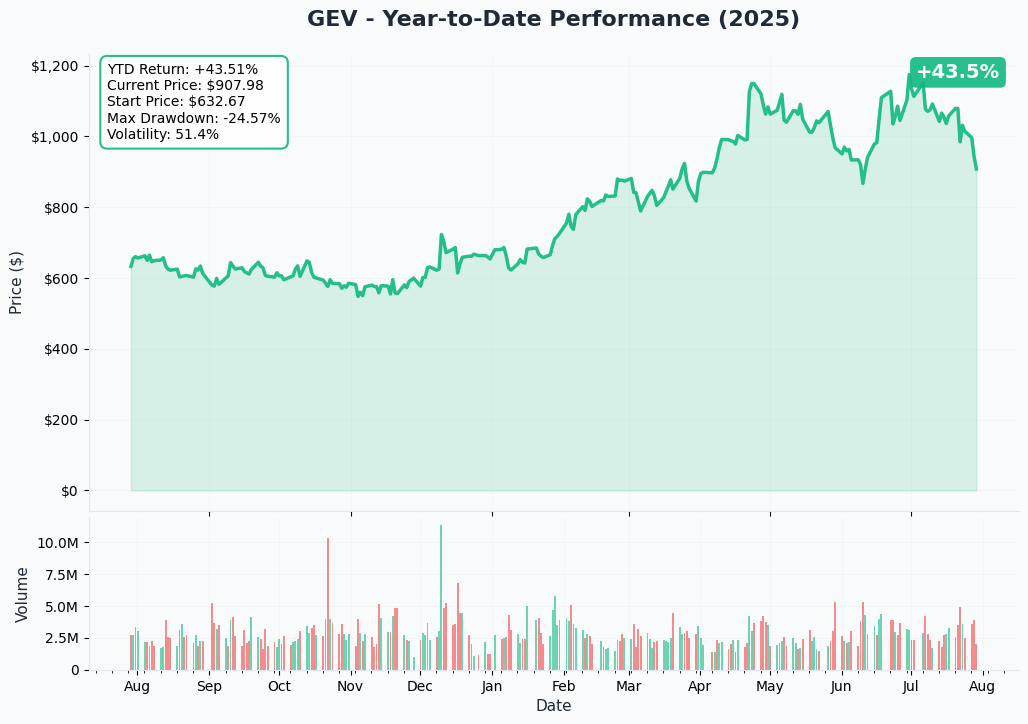
GE Vernova has been one of 2026's biggest winners — up roughly +80% in the first half of 2026 and ≈+88% over the trailing 52 weeks, running from the low $500s toward an all-time high of $1,195.94 on July 6. The stock took a sharp ≈6.4% hit on the July 22 earnings print (EPS miss despite a revenue beat and raised guidance), then whipsawed — rallying ≈4.5% the next day before drifting back down toward ≈$917 today. This is a name that moves fast in both directions on headlines, even with the long-term trend firmly up.
Gamma-Based Support & Resistance Analysis
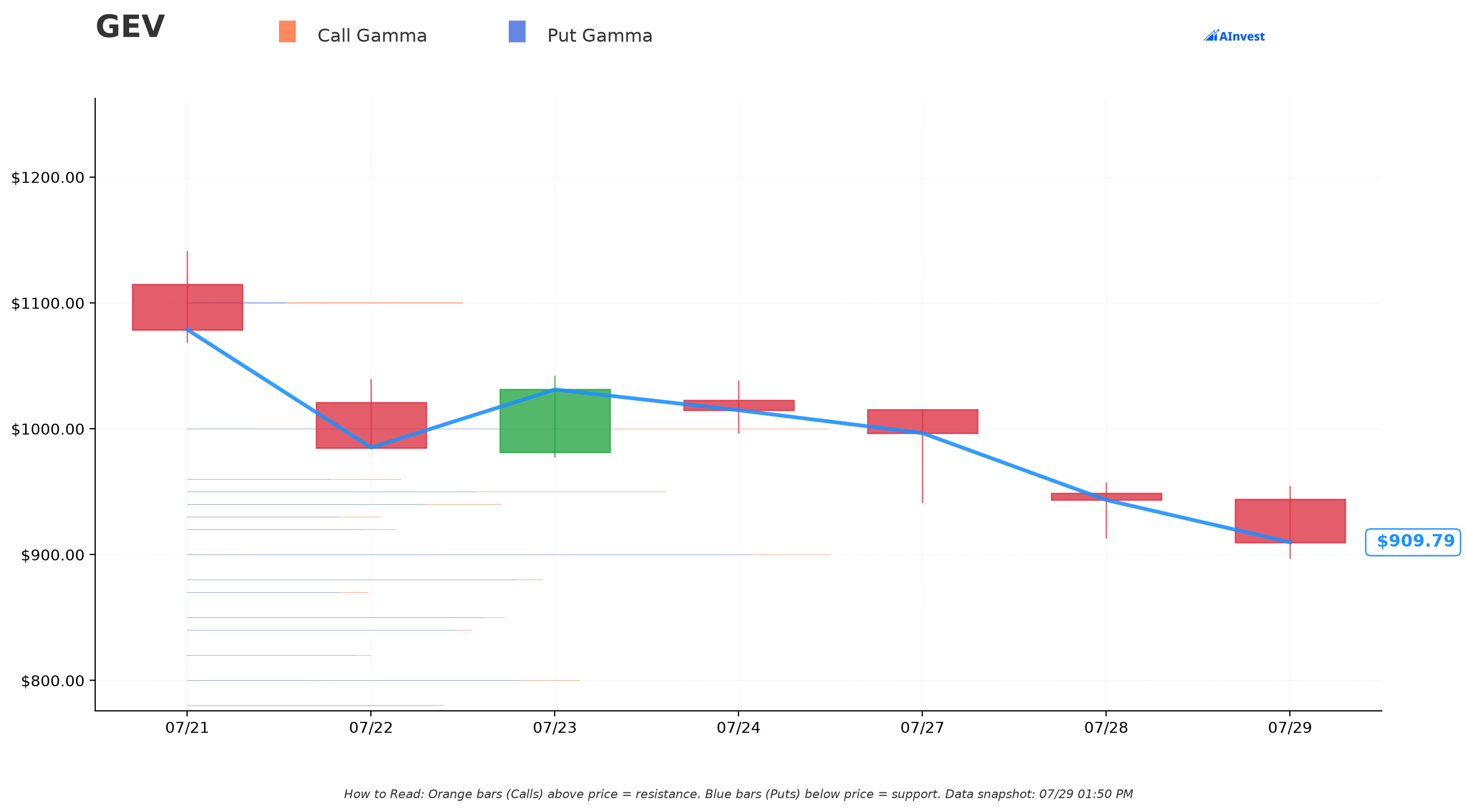
Current Price: ≈$910–917
🔵 Support Levels (Put Gamma Below Price):
- $900 — the single strongest gamma level on the whole board (put gamma weight ≈1.12, more than any other strike), just ≈1% below current price. This is the line dealers are most likely to defend on a pullback.
- $880 — secondary support (≈0.66 put gamma), ≈3.3% below spot.
- $850 — next layer down (≈0.59 put gamma), ≈6.6% below spot.
- $800 — exactly the strike sold in today's trade (≈0.66 put gamma), ≈12% below spot. Not a coincidence — this level already carries real dealer put-gamma weight, and today's $30M sale adds another 2,483 contracts of open interest sitting right on top of it.
🟠 Resistance Levels (Call Gamma Above Price):
- $950 — nearest real call-gamma ceiling (≈0.38), ≈4.4% above spot.
- $1,000 — the largest call-gamma level above price (≈0.45), ≈9.9% above spot — a round-number magnet.
- $1,100 — extended resistance (≈0.35), ≈21% above spot.
Net GEX Bias: Put-heavy across the board (total put gamma ≈13.5 vs total call gamma ≈5.0) — a common signature for a stock that's rallied hard, where hedgers have piled into downside protection at multiple strikes. That's actually the exact backdrop this $30M put sale is playing into: heavy demand for GEV puts from hedgers, and this seller getting paid a rich premium to supply that insurance.
What this means for traders: GEV is sitting almost directly on top of its strongest gamma level ($900), with the next real floor down at $850, then $800 — right where today's short put lives. If GEV holds $900–950 in the near term, dealer hedging flows should keep price relatively contained; a break below $850–800 is where things could accelerate.
Implied Move Analysis
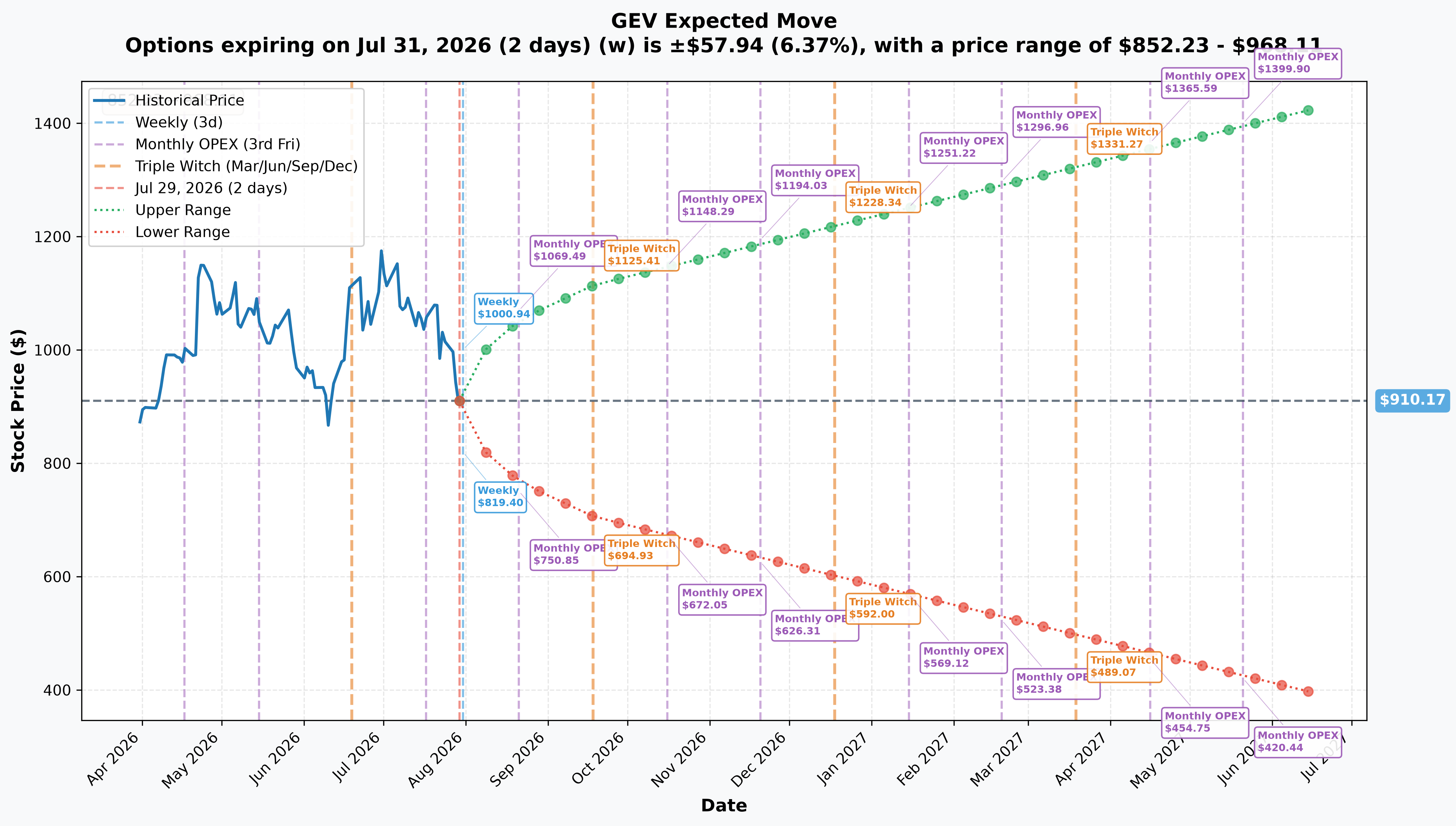
Options market pricing for upcoming expirations (from ≈$910 current price):
- 📅 Weekly (Jul 31 — 2 days): ±6.4% (±$57.94) → Range: $852 – $968
- 📅 Monthly OPEX (Aug 21 — 23 days): ±15.8% (±$144.11) → Range: $766 – $1,054
- 📅 Quarterly Triple Witch (Sep 18 — 51 days): ±22.5% (±$204.95) → Range: $705 – $1,115
- 📅 LEAP / Jun 2027 OPEX (this trade's expiration — 323 days): ±56.7% (±$516.03) → Range: $394 – $1,426
Translation for regular folks: Over a horizon this long (≈11 months), the options market is pricing in a genuinely enormous range — GEV could plausibly trade anywhere from the high-$300s to over $1,400 by June 2027 based on current implied volatility. Against that backdrop, the $800 strike sold today sits only about 21% of the way down from spot toward the lower end of that 1-standard-deviation range — meaning the market broadly agrees this is a "meaningful but not extreme" downside level, not a lottery-ticket tail strike. That's consistent with the ≈30% delta on the put.
🎪 Catalysts
✅ Recent Catalysts (Already Happened)
Q2 2026 Earnings — July 22, 2026 📊
GE Vernova reported Q2 revenue of $11.1B (a beat) but adjusted EPS of $2.47, missing the ≈$3.04–$3.17 consensus. The company raised full-year guidance to $45.5–$46.5B revenue and $11.5–$12.5B free cash flow, and grew total backlog to $176B — yet the stock still fell ≈6.4% on the print before partially recovering.
Record Gas-Turbine Backlog — 116 GW 🔥
The core bull thesis: GE Vernova's gas-turbine order backlog hit a record 116 GW at Q2 close, up from 100 GW one quarter earlier, with slot-reservation agreements growing to 63 GW as hyperscalers lock in manufacturing capacity for deliveries out to 2031. Management now expects ≥125 GW under contract by year-end.
Wind Segment Drag & Tariff Hit ⚠️
Not all good news: GE Vernova flagged a $100–$200M tariff hit for 2026, and the wind business's EBITDA loss widened to $275M as wind orders fell ≈40%. This remains the one structurally weak segment inside an otherwise strong story.
AI-Datacenter Power Deals 🤝
Beyond turbines, GE Vernova has been landing hyperscaler partnerships — supplying Microsoft's Texas data centers, a strategic framework with Amazon Web Services for turbines and grid substations, and a multi-year Xcel Energy alliance securing hardware capacity through the 2030s.
Doubled Dividend + Bigger Buyback 💵
Late 2025, GE Vernova doubled its quarterly dividend to $0.50 (from $0.25) and raised its buyback authorization to $10B (from $6B). The company has already returned $3.9B to shareholders year-to-date in 2026.
Analyst Reaction: Morgan Stanley Raises Target to $1,350 📈
Morgan Stanley's David Arcaro raised his GEV target to $1,350 from $1,250 (Overweight), calling the post-earnings drop a "significant overreaction." Bernstein also reiterated its Buy rating. Street consensus overall is Buy (≈38% Strong Buy, ≈46% Buy, ≈17% Hold, 0% Sell), with average targets around $1,212 — well above today's spot.
80% First-Half Rally 🚀
The Motley Fool detailed why GEV surged roughly 80% in the first half of 2026 — the AI power buildout story converting into real order growth.
🔮 Upcoming Catalysts (Next 6 Months)
Q3 2026 Earnings — Expected Late October 2026 📅
GE Vernova's next scheduled earnings report should land in late October, well before this put's June 2027 expiration. Watch for: progress toward the ≥125 GW year-end gas-backlog target, slot-reservation-to-firm-order conversions, electrification margins (18–20% guide), and whether the wind-loss trajectory improves.
BWRX-300 Nuclear Milestones ⚛️
GE Vernova's small modular reactor construction at Ontario Power Generation's Darlington site continues, targeting completion by end-2029 and commercial operation by end-2030 — the first SMR of its kind in the Western world. Continued milestones here (plus potential further international design agreements) add a long-dated optionality story on top of the core gas/grid business.
Continued Gas-Turbine Slot Bookings
Expect ongoing announcements as hyperscalers continue reserving 2031-delivery manufacturing slots — the mechanism directly feeding the 116 GW backlog number.
🎲 What This Trade Is Really Saying
Using the gamma levels, the implied-move range, and the catalyst backdrop together:
📈 Bull/Base Case — This Put Expires Worthless (the seller's target outcome)
GEV needs to simply stay above $800 through June 2027 — a ≈14% cushion from the trade's $931.34 print level, and the seller keeps the full $30.1M. Given the Street's Buy consensus, average target ≈$1,212, Morgan Stanley's $1,350 target, and a record 116 GW backlog with slots booked to 2031, this is a genuinely reasonable bet — GEV would need to give back most of its 2026 gains and then some to threaten $800.
📉 Bear Case — Where It Gets Painful
If GEV's AI-capex thesis cracks (a hyperscaler pullback, a wind-loss blowout, a sharp valuation de-rating at ≈46x forward P/E), the stock could realistically test the $850–$800 gamma zone — and the implied-move data shows the market isn't pricing that out entirely: the 1-year LEAP range runs as low as $394. Below the ≈$678.60 breakeven, this position starts losing real money, and losses could compound quickly given how far the stock has run.
💡 How Different Traders Should Read This
🎰 YOLO Trader
This isn't really a YOLO setup — it's a 2.5-year, deep-OTM premium sale that most retail accounts won't have the margin (or the risk tolerance) to replicate at this size. If you want to express the same bullish-to-neutral view with defined risk, look at a much smaller short put spread (e.g., sell the $800 put, buy the $700 put, same expiration) instead of a naked short put — it caps your downside instead of leaving it theoretically open-ended.
🌊 Swing Trader
This LEAP trade tells you very little about the next few days or weeks. For swing setups, the more useful levels here are the gamma zones: $900 is the nearest real support, $950–$1,000 the nearest resistance. A bounce off $900 with the broader bull thesis intact is the more tradeable near-term signal than trying to mirror a 2027-dated options trade.
💰 Premium Collector
This is exactly your playbook, scaled down. Selling cash-secured puts well below spot on a stock you'd be happy to own is a legitimate income strategy — just size it to your account. A retail-sized version might be selling 1 contract of a nearer-dated (30–60 day) GEV put around the $850–$800 zone for a much smaller credit, collecting premium while defining your own risk with position size rather than 2,483 contracts.
🌱 Beginner / Just Getting Started
The key lesson here: "SELL" on a put doesn't mean bearish. Selling a put is a bet the stock won't fall below a certain price — it's actually a bullish-to-neutral position, and it generates cash up front instead of costing money like buying a call or put does. But it also comes with real obligation: if GEV really did crash, this seller would be on the hook. Selling options for premium is a strategy with genuine risk, not free money — start by paper-trading it before risking real capital.
⚠️ Risk Factors & Honest Limits
What the tape tells us — and what it doesn't:
- ✅ Proven from the tape: Direction (SELL), size (2,483 contracts), price ($121.40), strike ($800), expiration (June 17, 2027), and that this printed via a price-improvement auction (not a cross, not a lit sweep).
- ✅ PROVEN (upgraded July 30): This is a fresh open (STO). Vol/OI ≈15.4x was already about as clean as intraday data gets, and next-day OPRA open interest has now confirmed it outright — 162 → 2,697 (+2,535), ≈102% of the print. This is no longer an inference.
- ❓ What we cannot know from the tape: Who placed this trade, whether it's part of a larger multi-leg portfolio hedge we can't see, whether the seller has an offsetting long-stock or long-call position elsewhere, or their exact cost basis and account size. We also can't see if this is a fund systematically writing puts for yield (common at institutions) versus a directional bet.
- ⚠️ This is not "free money": A short put has real, substantial downside if GEV falls hard and stays down. At 46x forward P/E, GEV has very little room for a growth disappointment, and the wind segment remains a genuine drag.
- ⚠️ Valuation risk: The entire bull case is levered to hyperscalers converting slot reservations into firm, profitable orders over multiple years — a long runway where a lot could change.
- ⚠️ This trade tells you almost nothing about tomorrow or next week. It's an 11-month view; don't read short-term direction into it.
Disclaimer: Options trading involves substantial risk of loss and is not suitable for all investors. This analysis is for educational purposes only and is not financial advice. Past performance doesn't guarantee future results. Selling puts (especially uncovered/naked) carries risk that can exceed the premium collected — always understand margin requirements and worst-case scenarios before attempting to replicate any strategy discussed here. Always do your own research and consider consulting a licensed financial advisor before trading.
About GE Vernova: GE Vernova designs and manufactures gas turbines, wind turbines, grid electrification equipment, and small modular nuclear reactors, positioning it as a core infrastructure supplier for the AI-datacenter power buildout, with a market cap of ≈$265.4 billion.
Last updated: July 30, 2026 — next-day OPRA open interest confirmed the fresh opening put sale: 162 → 2,697 (+2,535), ≈102% of the 2,483-lot auction and above the published 2,483–2,645 prediction. Open/close status upgraded from inferred to proven; no narrative change. Original publication: July 29, 2026.