🖥️ IGV — The July 24 $14.2M Software Bull Cashes Out for ≈$36M as the Calls Go In-the-Money 💰
📅 July 28, 2026 | 🔥 Unusual Activity Detected — a CLOSE, not a new bet
🎯 The Quick Take
Remember the desk that spent five separate clips on July 24 building a ≈$14.2M bullish bet on ≈100,000 IGV July 31 $88 calls, betting a beaten-down software sector would bounce into the FOMC/Microsoft/Meta window? IGV just ripped ≈4% from ≈$88 to ≈$91.62, and that same-size position just got sold for ≈$36M in a single block cross at 15:41:07 ET. This is the trade finishing its round-trip — buy the dip, sell the relief rally — not a new bearish signal.
✅ The next-day open-interest snapshot has now confirmed it: open interest at the $88 strike fell 100,102 → 55,971 (−44,131), which only happens when contracts are retired. This was a genuine closing sale, not a new bearish position. One refinement, though: roughly 44,131 contracts were actually extinguished and ≈55,869 changed hands to new buyers — so the desk exited, but over half the block was absorbed by fresh longs rather than liquidated outright. Details in the ✅ RESOLVED box below.
📊 ETF Overview
IGV (iShares Expanded Tech-Software Sector ETF) is BlackRock's concentrated vehicle for trading the U.S. software sector as a single ticker:
- What it does: tracks the S&P North American Expanded Technology Software Index — application software, infrastructure software, cybersecurity, and select interactive-media names
- AUM: ≈$13.87 billion (as of July 16, 2026)
- Holdings: 112 constituents; top-10 concentration ≈59.3%
- Trailing P/E: ≈35–38
- Expense ratio: 0.41%
- 52-week range: $73.93 – $117.99
Top holdings (the names that move IGV the most):
| Weight | Holding |
|---|---|
| 10.13% | Palo Alto Networks (PANW) |
| 8.50% | Microsoft (MSFT) |
| 8.35% | Palantir Technologies (PLTR) |
| 7.20% | CrowdStrike (CRWD) |
| 5.17% | Salesforce (CRM) |
Why IGV moved: software staged a "relief rally" July 27–28, drawing money out of semiconductors and into software — the VanEck Semiconductor ETF (SMH) fell more than 3% for a fourth straight day — ahead of the July 29 FOMC decision and the same-evening Microsoft/Meta earnings. IGV touched $92.49 intraday, its highest level since January, before settling near $91.62. It's still ≈15.7% negative for the year, so this bounce is being read as a laggard sector catching a bid off oversold levels, not a breakout to new highs.
💰 The Trade — Plain English
Someone sold 100,000 IGV July 31, 2026 $88 calls at ≈$3.60 for ≈$36 million in a single block cross (a pre-arranged, off-book trade with a known counterparty on the other side — not a panic sale hitting the open market). With IGV at $91.62, the $88 strike is now in-the-money by ≈$3.62, and the trade printed almost exactly at that intrinsic value — meaning essentially all the time premium is gone, three days before expiration.
Here's the tell: prior open interest at this exact strike was ≈100,349 contracts — and that number is not a coincidence. It is the same position that was built from a standing start of 38 contracts on July 24, when a desk spent ≈$14.2M across five clips buying this exact $88 call, and that open was later confirmed at ≈100,349 contracts (see the original accumulation writeup). Today's sale is ≈100% of that entire open interest — a size match too clean to be a coincidence.
Full trade details:
| Field | Value |
|---|---|
| Time | 15:41:07 ET |
| Buy/Sell | SELL (sell-to-close) |
| Call/Put | CALL |
| Expiration | 2026-07-31 |
| Strike | $88 |
| Premium | ≈$36,000,000 |
| Volume | 100,000 |
| Prior OI | ≈100,349 |
| Size | 100,000 |
| Spot | $91.62 |
| Option Price | $3.60 |
| Mechanism | 🤝 Block cross (negotiated, known counterparty) |
| Option Symbol | IGV20260731C88 |
| Ticker | IGV |
Our independent delta check on this option comes back at ≈0.815 — consistent with a deep in-the-money call three days from expiry — and the trade printed at the bid, i.e., sold at essentially intrinsic value with no time-premium cushion left to give up.
✅ RESOLVED — The Close Is CONFIRMED, but It Was Roughly Half (updated July 29, 2026)
The July 29 pre-market OPRA snapshot is in. Our lead thesis was right about the direction and too aggressive about the size.
Resolved from the OPRA open-interest snapshot for EOD July 28, 2026. This box replaces the ⏳ provisional flag published on July 28.
| Leg | Baseline OI (Jul 28 snap) | Resolving OI (Jul 29 snap) | Δ | Print Size | Verdict |
|---|---|---|---|---|---|
| Jul-31-2026 $88 CALL | 100,102 | 55,971 | −44,131 | 100,000 (strike's full session volume 100,085) | ✅ CLOSE CONFIRMED (STC) — but only ≈44% of size |
The thesis that mattered is confirmed. We set the test as: a close means open interest falls; "something else — e.g. a fresh short position being opened by a new seller" means it stays flat or rises. Open interest fell by 44,131 contracts, wiping out nearly half the strike in a single session. This was unambiguously a closing sale, exactly as the size-match to the July 24 accumulation and the sale-at-intrinsic-near-expiry both suggested. The alternative reading — a new bearish seller opening — is disproven.
But we over-predicted the magnitude, and that's worth being straight about. We wrote that open interest should fall "from ≈100,349 back down toward the low hundreds or less," implying essentially the whole position unwinding at once. It didn't. It landed at 55,971 — a little over half the strike still standing.
What that gap tells us, and it's genuinely informative rather than just an error bar: of the 100,000 contracts sold, roughly 44,131 were retired (the July 24 buyer's long being extinguished against a counterparty who was closing a short) and roughly 55,869 were transferred — bought by someone opening a new long position at $88, three days before expiry. In other words, the July 24 desk got out, but it did not have to force the whole block into the void: more than half its position found willing new buyers who wanted ITM IGV calls into the July 31 expiry. That's a healthier exit than a pure liquidation, and it explains how a 100,000-lot sale cleared without visibly breaking the price.
One small correction while we're here: the article originally cited prior open interest of ≈100,349. The actual July 28 OPRA snapshot reads 100,102. The difference is immaterial to the analysis — the size match to the July 24 accumulation still holds — but the resolving table above uses the exact figure.
What it means from here: ≈55,971 contracts remain open at the $88 strike with expiry on July 31, now in the hands of at least some fresh buyers rather than the original July 24 desk. Those contracts are ITM with IGV at ≈$91.62 and have two trading days to run.
🤓 What This Actually Means — Plain English
Let's connect the dots between the two trades:
- 🔁 Same strike, same expiration, matching size — this reads as the same desk. July 24: buy ≈100,000 IGV $88 calls when IGV was ≈$88 (basically at-the-money). July 28: sell that exact ≈100,000-contract position when IGV is ≈$91.62 (now in-the-money). The size lining up almost exactly with the prior open interest is the strongest evidence we have that this is a close, not a fresh trade.
- 💵 What "sold at intrinsic" tells you. At $3.60 against ≈$3.62 of pure intrinsic value, there's almost no time premium left in this option. A seller three days from expiry with nothing left to gain from holding has every reason to cash out now rather than risk a reversal.
- 🎯 STC = Sell-to-Close a long call, not a new bearish bet. This is not the same thing as someone opening a fresh short call (STO) to collect premium and bet against IGV. It's the original bullish buyer taking their winnings off the table. Nothing here says "IGV is going down" — it says "the person who bet on the bounce got the bounce and is banking it."
- 📅 Why cash out with three days left? The Jul-31 expiry sits right up against a loaded catalyst stack — the FOMC decision and Microsoft/Meta earnings all land July 29, one day after this sale, with results priced in before the option even expires. Holding through two binary macro/earnings events with almost no time premium left to gain, just to save a few days of theta, is a bad risk/reward trade. Selling now locks in the ≈4% move and removes the risk of a hawkish Fed surprise or a weak AI-monetization print erasing the gain overnight.
- ⚖️ The lesson: knowing when to walk away with a win is just as important as picking the right trade in the first place. This desk bought fear (an oversold, ≈-21% YTD sector) on July 24 and sold strength (a fresh ≈4-month high) on July 28 — a genuinely disciplined round-trip, not a lucky accident.
📈 Technical Setup / Chart Check-Up
YTD Performance Chart
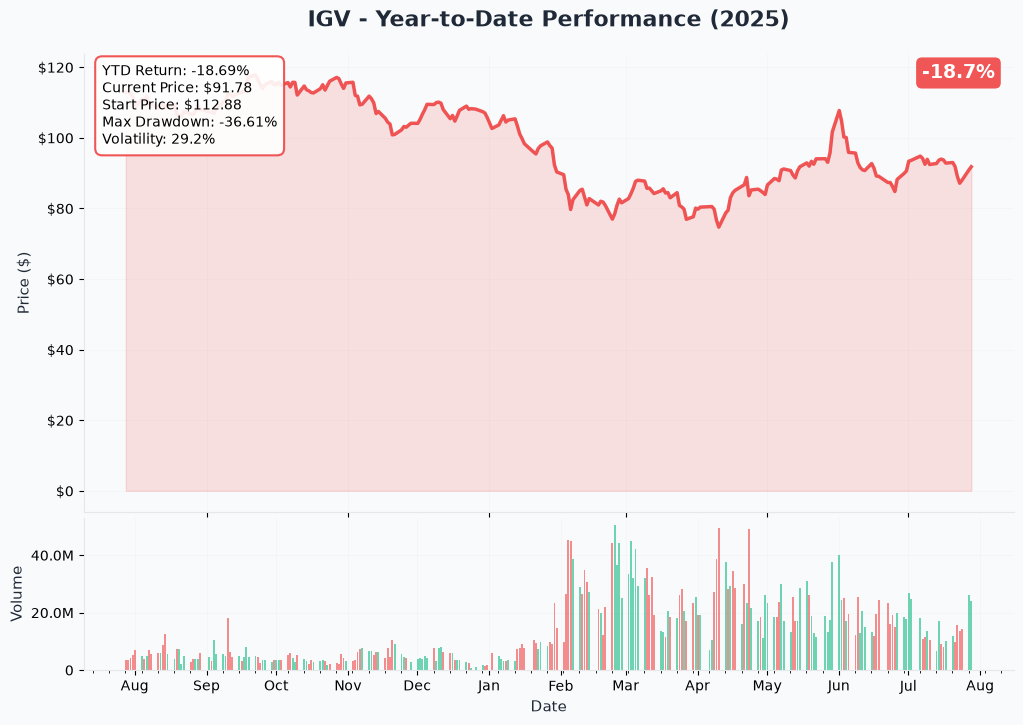
The YTD chart shows exactly why this trade makes sense as a round-trip: IGV spent most of 2026 grinding lower, then snapped higher on the software relief rally of the past two sessions. The July 24 buy came near the bottom of that range; the July 28 sale comes right as the ETF touches its highest level since January.
Gamma-Based Support & Resistance Analysis
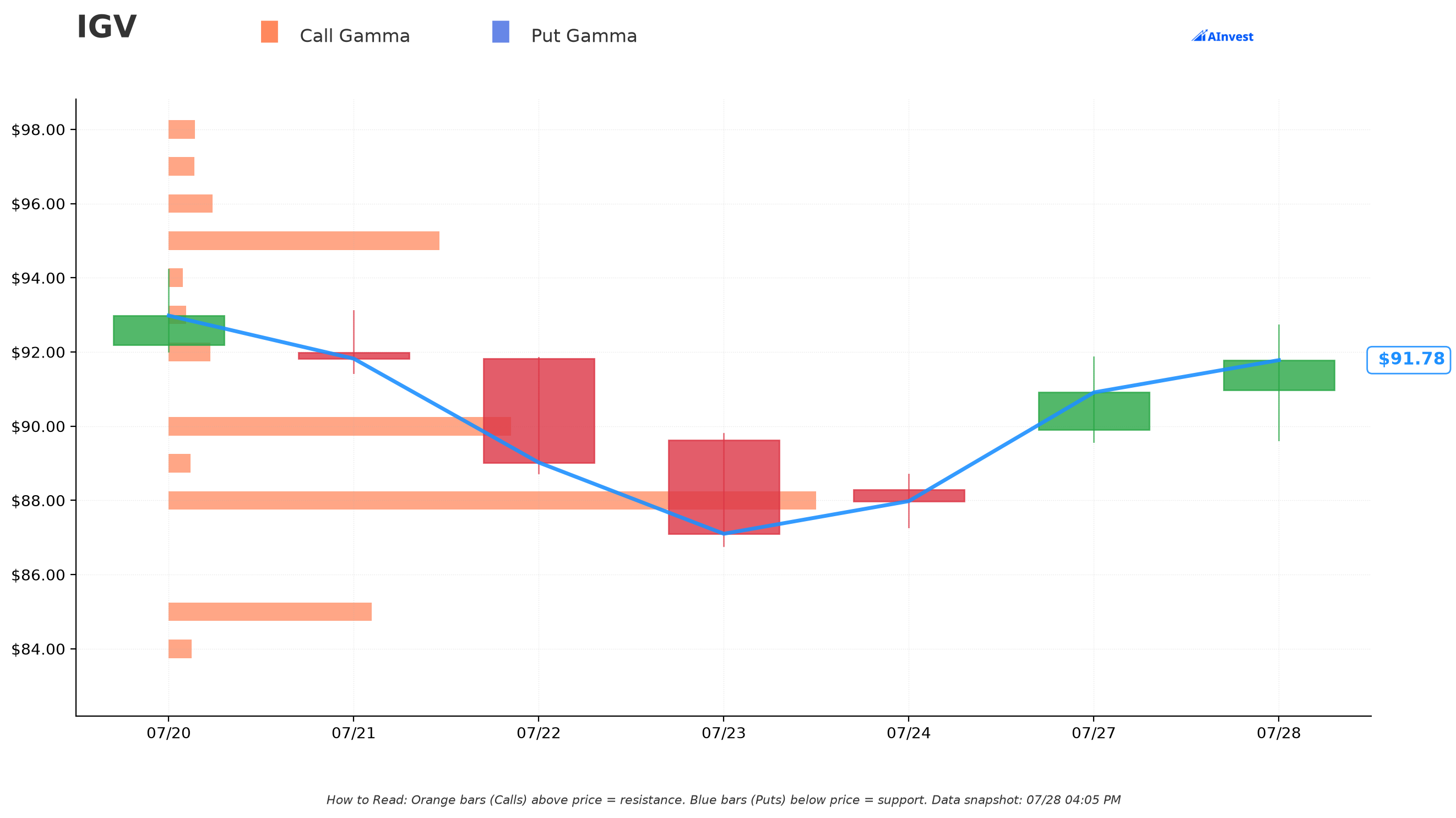
Reference price for the gamma map: ≈$91.78
- 🔵 $88 — now support, not the trade's ceiling anymore. This is the strike the closed position was built on; with IGV having pushed ≈$3.62 above it, $88 is now the nearest gamma floor underneath the market (moderate strength).
- 🟠 $90 / $92 — light overhead gamma right where spot is sitting. These strikes carry modest call-gamma concentrations essentially at the current price — normal chop territory, not a major wall.
- 🟠 $95 — the next real resistance level (moderate strength, ≈3.5% above spot) — the level bulls would need to clear for the relief rally to keep extending meaningfully.
What this means for traders: the $88 strike flipping from "the trade's entry level" to "the market's own gamma support" is a small but real confirmation that the ≈4% move has structural backing, not just headline momentum.
Implied Move Analysis
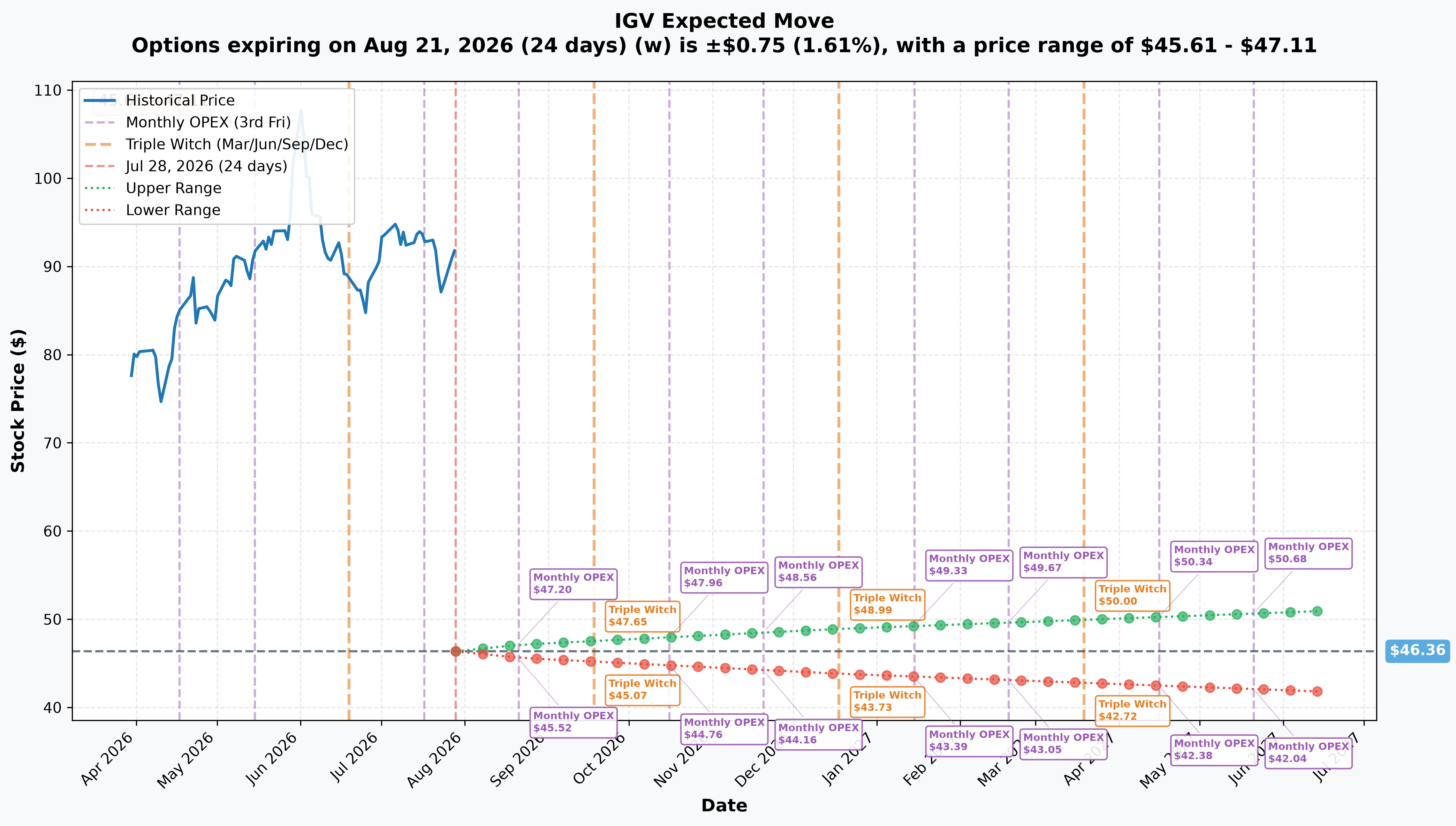
This closing trade has only three days left to expiration, so a forward-looking implied-move range matters far less here than it did on July 24 — there simply isn't much time left for a move to develop before this specific contract expires. We're not citing specific implied-move percentages for this write-up; the chart is included for context on how the options market is pricing volatility into the FOMC/earnings week ahead, which matters more for anyone considering a new position than for understanding this closing trade.
🎪 Catalysts
⚠️ Keep the option's Jul-31 expiration separate from the event dates below — the closed position expires mechanically on July 31; the catalysts are what actually moved (and will keep moving) IGV.
Already happened (what drove the ≈4% move that made this close profitable)
- July 27–28: Software "relief rally," rotation out of semis. A rally in software stocks lifted the Nasdaq off session lows while the VanEck Semiconductor ETF (SMH) fell more than 3% for a fourth straight day — a visible rotation out of chips and into software, exactly the trade IGV expresses, per CNBC.
- July 28: IGV hit $92.49 intraday, its highest level since January, as the busiest catalyst week of the summer opened — Fed, GDP, PCE, consumer confidence, and mega-cap earnings all inside five days, per CNBC's outlook.
Inside this option's remaining life (before Jul-31 expiry)
- Wednesday, July 29 — FOMC rate decision. As of July 24, CME FedWatch data showed ≈62% odds of a hold at 3.50–3.75% versus ≈38% odds of a surprise hike, driven by resurgent energy-driven inflation with Brent crude above $100/bbl, per CNBC. Long-duration software is among the market's most rate-sensitive sectors — this is the single biggest reason to de-risk before Jul-31 rather than hold through it.
- Wednesday, July 29 (after close) — Microsoft FQ4 earnings. Microsoft is IGV's #2 holding at ≈8.5%; consensus is EPS ≈$4.22–4.24 on revenue ≈$87.5–87.7B, with the market watching AI ARR run-rate (reportedly ≈$37B, up ≈123% year-over-year), per TipRanks.
- Wednesday, July 29 (after close) — Meta Q2 earnings, consensus EPS ≈$7.18–7.24, reporting the same evening as Microsoft, per TipRanks.
- Thursday, July 30 (after close) — Apple and Amazon earnings, setting the broader tech tape into month-end.
- Friday, July 31 — the closed IGV $88 calls expire. A mechanical options date, not a fundamental catalyst.
After this option's life (relevant to IGV the ETF, not this specific trade)
- Monday, August 3 (after close) — Palantir (PLTR) Q2 earnings, IGV's #3 holding at ≈8.35%, confirmed via Businesswire.
- Monday, August 24 (after close) — Palo Alto Networks (PANW) earnings, IGV's largest single holding at ≈10.13%, per Saxo/Bloomberg.
- Wednesday, August 27 (after close) — CrowdStrike (CRWD) earnings, ≈7.20% of IGV, a stress test of the cybersecurity "comeback rally," per Saxo/Bloomberg.
IGV's four biggest holdings — PANW, PLTR, CRWD, and Microsoft — are ≈34% of the fund combined and all report between July 29 and August 27. That's exactly the stretch of event risk this closing trade sidesteps.
👥 How Four Different Traders Might Read This
🎲 YOLO Trader
The desk that bought the July 24 dip just banked ≈$36M near intrinsic rather than press the bet through FOMC and Microsoft/Meta earnings — that restraint is worth noting even if you're the type to run it up. If you're still long this same call from lower levels, ask yourself honestly whether you have a better reason to hold through two binary events tomorrow than "it might go higher," because that's essentially all the upside left to gain against a real chance of giving the whole ≈4% move back overnight.
📈 Swing Trader
The $88 strike has flipped from this trade's entry point into the market's own gamma support, with $95 the next real resistance level ≈3.5% above spot. If IGV holds $88–$90 through the FOMC/earnings reaction and pushes toward $95, the relief rally has legs; a slide back under $88 would undo the very gamma support this close just helped confirm. Either way, mark July 29 on the calendar — that's when this thesis gets its real test, one day after the option that funded it already closed out.
💵 Premium Collector
This trade is a useful reminder of what a real "sell" looks like at the end of an options position's life: essentially zero time premium left, printed at intrinsic, done as a negotiated block rather than dumped into the lit market. If you're running your own income strategy on IGV into the FOMC/earnings week, know that implied volatility is elevated for a reason right now — a defined-risk structure that respects the $88 gamma floor is safer than a naked short into a genuinely two-sided binary week.
🌱 Beginner
Here's the full arc in one trade: July 24, someone paid ≈$14.2M to bet IGV would bounce. It did — up ≈4% in four sessions. July 28, they sold that same position for ≈$36M, banking the win before two big binary events (the Fed, then Microsoft and Meta) could put it at risk. That's not luck — it's discipline: decide your exit before you need one, and take the win when the thesis plays out rather than gambling it on "just a little more."
And here's the method lesson. On July 28 we could not prove this was the same trader closing out — we inferred it from four independent pieces of evidence agreeing (size, strike, expiration, and selling at intrinsic right before a catalyst). That's how you build confidence in a trade read. Then the next morning's open-interest snapshot tested it: open interest fell 44,131 contracts, which is only possible if contracts were being retired. Inference confirmed. Note what the confirmation also refined — we expected the whole ≈100,000 to disappear and only about 44% did, because the rest was bought by new longs rather than liquidated. Good evidence gets you the right direction; the actual data gets you the right size.
⚠️ Risk Factors — What This Trade Cannot Tell Us
- ✅ Open vs. close is now CONFIRMED — it was a close. Open interest fell 100,102 → 55,971 (−44,131) against the 100,000-lot print. Contracts only disappear when they are retired, so this was a closing sale, not a new short being opened.
- ⚖️ But only ≈44% of the print actually retired contracts. The remaining ≈55,869 transferred to new buyers opening fresh longs. Our July 28 prediction that open interest would fall "toward the low hundreds" was too aggressive — the strike still carries 55,971 contracts into the July 31 expiry.
- We cannot see who's on either side of this cross. A block cross means a known counterparty took the other side off-book — we don't know if that's a market maker, another institution, or anything about their own book or hedges.
- One ETF options print doesn't call the sector's direction. This is one trade closing out — it tells us a specific bullish bet paid off and was monetized, not that software is about to reverse lower. The bullish thesis (rate-cut hopes, AI-software re-rating, a dense earnings calendar) is still fully intact; this desk simply chose not to hold their leveraged bet through the binary risk.
- The FOMC decision is genuinely two-sided. With ≈62% odds priced for a hold and a real ≈38% tail for a surprise hike, no tape signal or gamma level can tell you which way a live rate decision goes.
- Being "the same desk" is inferred, not proven. The size match, strike match, expiration match, and behavior (selling at intrinsic right before a loaded catalyst stack) all point toward the same position being closed — but the tape cannot prove identity. Treat this as a high-confidence read, not a certainty.
Disclaimer: Options trading involves substantial risk of loss and is not suitable for all investors. This analysis is for educational purposes only and is not financial advice. Past performance does not guarantee future results. The trade discussed here is a single institutional options print; it does not imply future trades will be profitable or that you should copy this activity. Macro events like FOMC decisions and mega-cap earnings reports are inherently unpredictable. Always do your own research and consider consulting a licensed financial advisor before trading, especially around binary events like Fed decisions and earnings.
🎯 The Bottom Line
Real talk: the desk that spent ≈$14.2M on July 24 betting a beaten-down software sector would bounce just sold that same ≈100,000-contract position for ≈$36M as IGV touched its highest level since January. This is a close, not a new bearish bet — the size lines up almost exactly with the July 24 open, the option printed at intrinsic value with no time premium left, and it happened one day before a loaded FOMC-plus-mega-cap-earnings stack that the seller chose not to hold through.
What this trade tells us:
- ✅ Open interest FELL 100,102 → 55,971 (−44,131) — contracts were retired, which proves a closing sale and rules out a new bearish position
- 🔁 Size (100,000) ≈ prior OI (100,102) at the exact strike and expiration from the July 24 accumulation — the size match that flagged this as a close in the first place
- 💵 Sold at ≈$3.60 vs. ≈$3.62 intrinsic — essentially zero time premium left to capture by holding
- 📅 The sale lands one day before the FOMC decision and Microsoft/Meta earnings — a disciplined "de-risk before the binary event" move
- ⚖️ Not a signal that software is turning bearish — the original bullish thesis played out; this is profit-taking, not a reversal call
- 👥 Over half the block found new owners rather than being liquidated: ≈55,869 contracts transferred to fresh buyers, leaving 55,971 open into the July 31 expiry
Mark your calendar:
- ✅ July 29, 2026, ≈06:30 ET — RESOLVED. Next-day OPRA open interest fell 44,131 contracts, confirming the close. See the ✅ RESOLVED box above.
- 📅 Wednesday, July 29 — FOMC decision, then Microsoft and Meta earnings after the close
- 📅 Friday, July 31 — the IGV $88 calls expire, with ≈55,971 still open
This is a case study in taking the win. The tape showed conviction on the way in (July 24) and discipline on the way out (July 28), and the open-interest data confirmed the exit was real. Now watch July 29-31 to see whether the broader software rotation this trade rode has more room to run — the buyers who took the other side of ≈55,869 of these contracts are betting it does.
Last updated: July 29, 2026 — next-day OPRA open interest resolved this leg and confirmed the close: open interest fell 100,102 → 55,971 (−44,131) against a 100,000-lot print. The closing (STC) read is confirmed; the magnitude was refined from "nearly the whole position retires" to ≈44% retired and ≈56% transferred to new buyers. The prior-OI figure was corrected from ≈100,349 to the exact snapshot value of 100,102.
About IGV (iShares Expanded Tech-Software Sector ETF): IGV tracks the S&P North American Expanded Technology Software Index, giving investors concentrated exposure to application software, infrastructure software, and cybersecurity companies. With ≈$13.87 billion in assets under management and top holdings including Palo Alto Networks, Microsoft, Palantir, CrowdStrike, and Salesforce, IGV is one of the most widely-used ways to trade the software sector as a whole rather than a single name.