🤝 MAR: The $22.75M Call Sale Did Not Open a Short — Open Interest Fell, Retiring the Premium-Collection Read
📅 2026-08-11 | 🔥 Unusual Activity Detected
🔄 Updated 2026-08-12 pre-market — the next-day OPRA open interest resolved the leg, and it inverted. Open interest on the September $330 call fell 10,495 → 8,034 (−2,461), where an opening short would have pushed it toward ≈20,345. The provisional STO label is retired: this sale created no new short-call interest. Net 2,461 contracts were retired and the remaining ≈7,400 changed hands between existing holders, so the natural read is a long call position being sold out or transferred, not a desk collecting premium against a six-week calendar hole. See the ✅ RESOLVED box.
🎯 The Quick Take
At 11:37 AM ET, a $22.75M block printed in Marriott International (MAR) options: 9,850 September 18 $330 calls sold at $23.10, with the stock at $348.47 — a strike sitting ≈5.3% in the money, below the current price. It printed as a negotiated 🤝 block cross, not a lit sweep, and the timing lines up with a stretch of the calendar that has almost nothing scheduled in it. We'll walk through exactly why that matters.
🏢 What Marriott Actually Is
Marriott doesn't own hotels — it franchises and manages them. The company "engages in the operation, franchising, and licensing of hotel, residential, timeshare, and other lodging properties," and as of quarter-end runs a system of 10,082 properties and ≈1.81 million rooms across 148 countries, per the Q2 2026 results release. It's asset-light: owners put up the capital, Marriott supplies the brand, the distribution, and the loyalty program, and collects fees off systemwide RevPAR and net rooms growth rather than hotel-level margin.
The loyalty program — Marriott Bonvoy — is the moat. It grew to more than 295 million members at quarter-end and is the reason independent owners keep converting into the system: conversions made up 34% of signings and 40% of openings in the first half of 2026 (Q2 2026 release).
Snapshot (August 11, 2026):
| Metric | Value |
|---|---|
| Sector / Industry | Consumer Discretionary / Lodging |
| Market cap | $91.25B |
| Price | $349.93 |
| 52-week range | $256.49 – $410.98 |
| 52-week change | +34.3% |
| Dividend | $2.92/yr (0.83% yield) |
Source: stockanalysis.com.
💰 The Trade, in Plain English
Someone sold 9,850 September 18 $330 calls for $23.10 each — $22.75M changing hands, with MAR trading at $348.47. Because the strike is below the stock price, this isn't a bet on a moonshot — it's a bet that MAR doesn't run away to the upside before September 18, and the seller is being paid handsomely to take that side.
The print crossed as a block — one broker matched a known buyer and a known seller off the open order book. That means no urgency, no lit-market chase; this was pre-arranged.
📊 Full Trade Details
| Field | Value |
|---|---|
| Time | 11:37:00 ET |
| Buy/Sell | SELL |
| Call/Put | CALL |
| Expiration | 2026-09-18 |
| Premium | $22.75M (net credit) |
| Strike | $330 |
| Volume | 9,900 |
| OI (prior) | 10,495 |
| Size | 9,850 |
| Spot | $348.47 |
| Option Price | $23.10 |
| Option Symbol | MAR20260918C330 |
| Order Type | 🔄 Not an open — resolved 2026-08-12 (OI fell 10,495 → 8,034); was STO ⏳ |
| Strategy | ITM call exit/transfer (resolved — no new short interest created) |
| Mechanism | 🤝 BLOCK CROSS (negotiated, off-book) |
✅ RESOLVED — Not an Open: Open Interest Fell, and the Short-Call Read Is Withdrawn
Updated 2026-08-12 pre-market. Resolving OPRA snapshot timestamped August 12 (reflects the August 11 close, after this print); baseline is the August 11 snapshot (reflects the August 10 close, before this print).
| Leg | Baseline (Aug-11) | Resolving (Aug-12) | Δ | Print size | What we published | Verdict |
|---|---|---|---|---|---|---|
| Sep-18 $330 call (sold) | 10,495 | 8,034 | −2,461 | 9,850 | "rise toward ≈20,345 if opening; fall toward ≈645 if closing" | 🔄 NOT AN OPEN — was STO ⏳ |
The direction is decisive; the magnitude is not. We published both branches. Open interest went down, which rules the opening branch out completely — no new short-call obligation was created at this strike. But it fell only 2,461 against a 9,850-lot sale, nowhere near the ≈645 a clean full close would have produced. So roughly a quarter of the print retired open interest and three-quarters transferred between holders who were already there.
What survives, stated honestly.
- ✅ Proven: this sale did not open a short call position. Whatever else it was, it was not new premium collection.
- 🔄 Inferred (medium confidence): a long September $330 call position was sold out — partly to a buyer who closed a short (the 2,461 retired) and mostly to a buyer who took the position over (the ≈7,400 transferred). That is the standard signature of a holder exiting a deep-in-the-money call, and it fits the flat two-week open-interest history we noted below (10,449 → 10,495 — a position sitting quietly, then leaving).
- ⛔ Unprovable: whether the seller was long from a materially lower level, and what the new holder intends.
Control check. Neighbouring September strikes were essentially static across the same window — $320 call 72 → 67, $340 call 263 → 260, $350 call 135 → 135 — so the decline is specific to the traded strike.
What changes below. The analysis frames this as a short in-the-money call sold into a catalyst-empty six-week window, with the "no news inside the expiration" calendar as the seller's edge. That framing rests on a short being opened, and it was not. Readers should treat the calendar analysis as context on the strike, not as a rationale attributable to this trade. The premium-collector reading in particular does not apply: nobody collected premium to hold a new short here — a long got out.
🤓 What This Actually Means — Plain English
Selling an in-the-money call is a different animal from selling an out-of-the-money one, and it's worth being precise about what the seller signed up for.
The obligation: if MAR closes above $330 at the September 18 close (or the calls get exercised earlier), the seller is on the hook to deliver 985,000 shares at $330 — regardless of where the stock actually is. If MAR is at $360 on expiration, the seller still only gets $330 a share for that stock. That's the cap.
Why $23.10 and not less: at the moment of the trade, $330 was already $18.47 below spot ($348.47 − $330), so $18.47 of the $23.10 premium is pure intrinsic value — money the call is worth just from being in the money. Only ≈$4.63 is genuine time value, the part the seller is actually getting paid for the risk of the next 38 days. On 9,850 contracts, that time-value slice is ≈$4.56M — a more honest number for "what did the seller actually earn" than the $22.75M headline, most of which is the intrinsic value simply changing hands.
The dividend wrinkle: MAR goes ex-dividend $0.73/share on August 20 — the one date inside this window where an in-the-money short call carries real early-assignment risk. The mechanical test: if the option's remaining time value falls below the dividend amount, the call holder has an incentive to exercise early and capture the dividend, forcing the seller to deliver shares before expiration. Today's $4.63 of time value comfortably clears the $0.73 dividend, so early assignment looks unlikely right now — but that gap narrows as expiration approaches, and it should be checked against the live option quote on August 19, not assumed away.
What we can't tell you: whether this is a naked short call or a covered one written against an existing long-stock position. OPRA shows us the option print, not the seller's stock book. If it's covered, the "breakeven" on the whole package is effectively $330 + $23.10 = $353.10 — a modest profit versus today's $348.47 even if assigned. If it's naked, losses above $353.10 are theoretically open-ended.
📈 Chart Check-Up
YTD Price Action
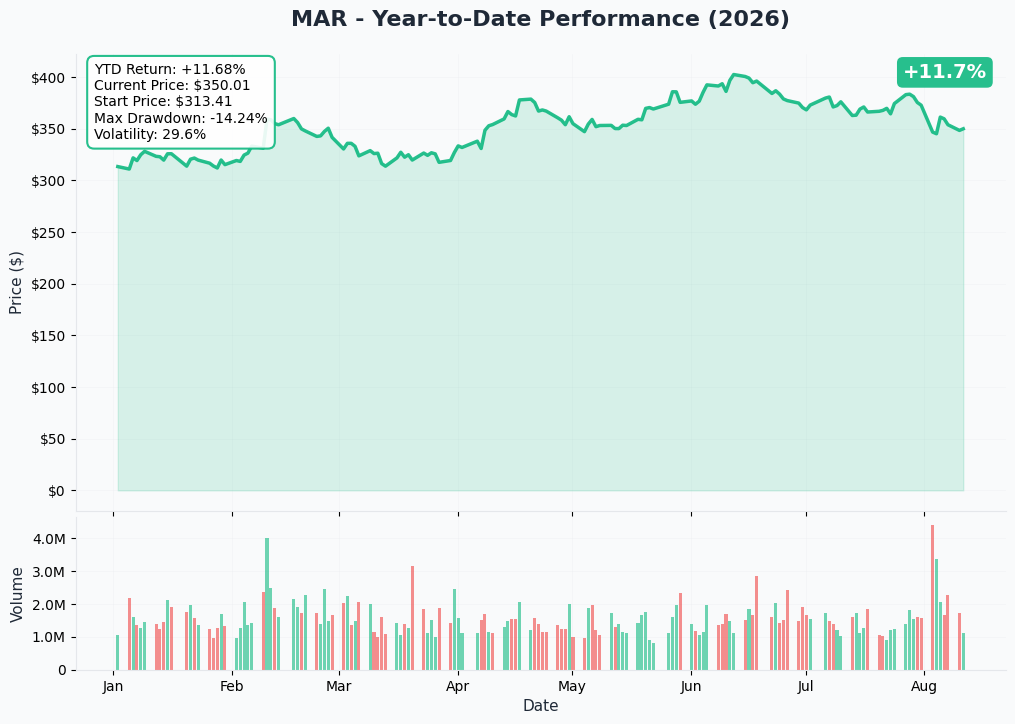
MAR ran from a 52-week low of $256.49 to a high of $410.98, up 34.3% over the trailing year. The more relevant recent stretch: the stock closed $372.83 on July 31, then dropped ≈7.0% to $346.83 on the August 3 Q2 earnings print, and has traded in a tight $345–$352 band since — right where today's trade sits.
Gamma Support & Resistance
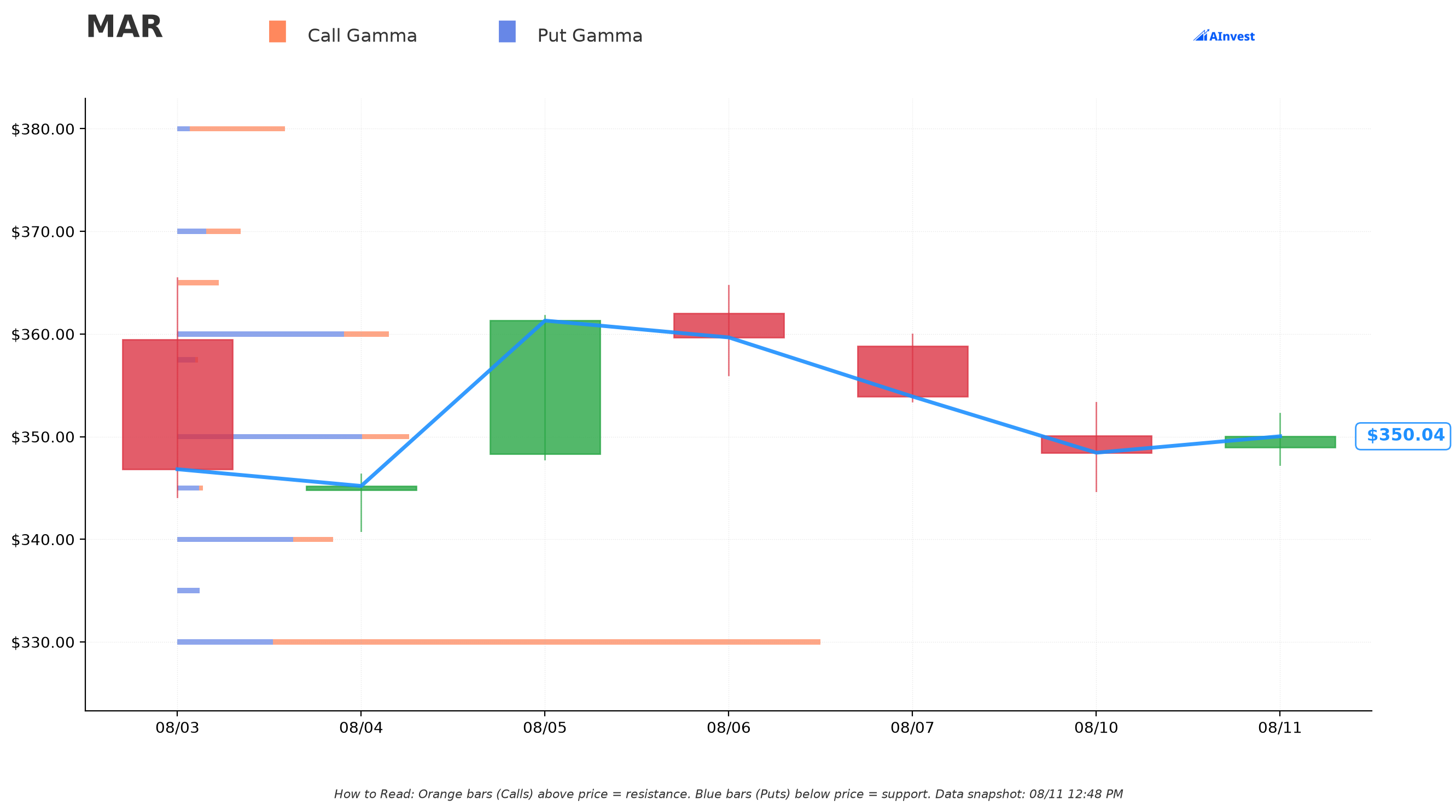
The gamma model (spot reference $350.04) flags exactly one notable level on the board: $330, showing moderate-strength support with total gamma exposure of 4.36 (call gamma 3.71 of that, net gamma +3.07), sitting ≈5.7% below the reference spot. That's the exact strike this trade sold calls against — dealer positioning is already concentrated right where the short call caps out. Above spot, the model doesn't show a clean resistance wall; call gamma thins out fast past $350 and only picks back up modestly near $380–$420, none of it flagged as a strong level. In plain terms: gamma gives $330 a real floor, but no obvious ceiling below the $380 area.
Implied Move
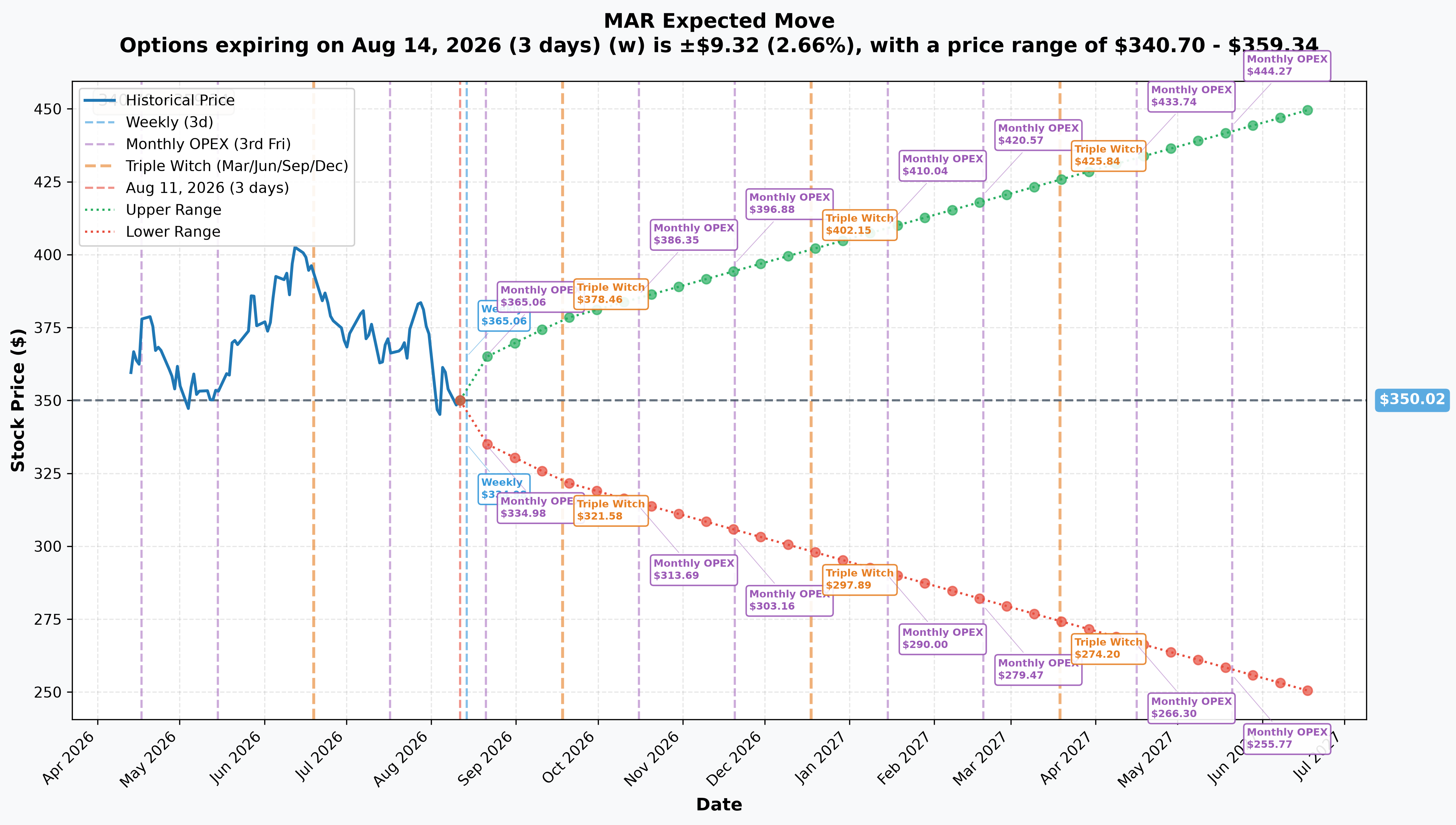
The implied-move model lines up with this trade's exact expiration: for the 2026-09-18 date (38 days out), the options market is pricing a ±7.97% move (±$27.91), putting the expected range at $322.11 to $377.93. Two things jump out. First, the lower bound ($322.11) sits below the $330 strike — meaning the market itself isn't ruling out a move that puts this call fully out of the money; the strike is inside the implied range, not outside it. Second, the upper bound ($377.93) lands almost exactly at the $380.13 analyst consensus target (more on that below) — so a "normal" one-window move back toward where the sell side thinks fair value sits would blow straight through the $330 strike.
🎪 Catalysts
The headline finding: this is a catalyst-empty window
The single most important fact about this trade's calendar: the next Marriott earnings report falls outside the option's life. Q2 2026 already reported on August 3, 2026 — eight days before this trade — and the next quarterly print isn't expected until ≈October 29 – November 4, 2026 (earnings history), roughly six to seven weeks after the September 18 expiration. Marriott hasn't even announced its Q3 date yet — that announcement itself is expected in early-to-mid October, after these options expire.
Inside the window, there is exactly one confirmed, company-specific event: the August 20 ex-dividend, $0.73/share (dividend declaration) — a mechanical adjustment worth ≈0.2% of the share price. Beyond that, the window holds only recurring industry data (CoStar/STR hotel data), Labor Day on September 7, and an unverified mid-September FOMC date. That's the setup a call seller wants: 38 days, ≈27 trading days, of theta decay with nothing company-specific scheduled to interrupt it.
What already happened (past)
- August 3, 2026 — Q2 2026 results: adjusted EPS $3.19 beat consensus $3.05 (+4.6%), but revenue $7.07B missed $7.17B (−1.4%). The stock fell 7.0% on the print, to $346.83 (earnings history, price history).
- August 4, 2026 — five analyst target cuts, zero raises: Wells Fargo $449→$425, BMO $410→$395, Baird $394→$393, Mizuho $384→$374, and Barclays $379→$348 — essentially at spot (MarketBeat).
- August 6, 2026 — dividend declared, $0.73/share, ex-date August 20 (dividend release).
- August 7, 2026 — CoStar/Tourism Economics raised their 2026 U.S. RevPAR forecast from 2.8% to 4.4%, while pegging 2027 growth at only 2.1% — the industry's own forecaster flagging a deceleration once 2026's World Cup and America 250 comps roll off (Hotel Dive).
What's still ahead (outside the window)
- September 30, 2026 — dividend payment date, ≈12 days after expiration.
- ≈October 29 – November 4, 2026 — Q3 2026 earnings, ≈6-7 weeks after expiration.
- ≈February 10-17, 2027 — Q4/FY2026 results and initial FY2027 guidance, against that softer 2.1% industry RevPAR backdrop.
Where consensus sits — and why the strike isn't a gift
The average analyst price target is $380.13 — ≈15.2% above the $330 strike — against a distribution of 11 Strong Buy, 1 Buy, 12 Hold, 1 Sell, 1 Strong Sell (a genuinely split "Buy") (stockanalysis.com forecast). And the stock traded as high as $410.98 within the past year. A short call at $330 is not free money — it's a bet that the post-earnings de-rating (five cuts, zero raises, Barclays down to $348) holds through a stretch where the calendar happens to be empty, even though the sell side's own average number sits well above the strike.
🎭 How Different Traders Should Read This
🚀 YOLO Trader
This isn't your trade. A deep-in-the-money block-crossed short call is a premium-collection or hedging position, not a directional lottery ticket. If you're chasing upside, buying the $330 calls off this level doesn't make sense either — you'd be paying a premium that already has a known large seller capping the strike above. If you want continuation exposure, look further out-of-the-money and accept you're fighting the $322-$378 implied range on a coin flip, not a thesis.
📈 Swing Trader
The useful signal here isn't the trade itself — it's the level. Gamma flags $330 as the only real support/resistance marker on the board, and the implied move brackets $322-$378 through September 18. If you're trading MAR's range in the next few weeks, $330 and the $345-$352 band it's been consolidating in since the earnings drop are the levels to watch, with Labor Day (September 7) as a minor seasonal marker. With no earnings inside the window, this is a range trade, not a catalyst trade.
💰 Premium Collector
This is the natural audience for this structure, and the logic tracks: post-earnings vol has room to decay, 38 days is a clean cycle, and the calendar is empty. But be honest about the math — the real time-value collected here is ≈$4.63 per contract (≈$4.56M total), not the $22.75M headline, and the $330 strike caps you ≈15% below where the sell side's own average target sits. If you're running something similar, size it knowing a "normal" move back toward consensus ($380) or even a retest of the $365-$378 area implied-move ceiling would put this call meaningfully in the red before expiration. This works if MAR chops; it doesn't if the China/RevPAR upside case plays out early.
🌱 Beginner
A short call means you're promising to sell shares at $330 if asked to. Because this strike is already below the stock price, the person who sold it is already "underwater" on the obligation in the sense that the buyer has real value to exercise — they collected a big premium precisely because the risk is real, not theoretical. Before you'd ever sell a call like this, you need to know: do you already own the shares (covered), or are you promising to sell shares you don't have (naked, where losses are theoretically unlimited)? That distinction is the single most important thing to understand before touching this strategy.
⚠️ Honest Limits — What the Tape Can't Prove
- Open vs. close is unresolved. Size (9,850) sits below prior OI (10,495); we cannot tell you today whether this opened a new short or closed an existing long. Only tomorrow's ≈06:30 ET OI snapshot resolves it.
- Covered vs. naked is invisible. OPRA shows the option print, not the seller's stock position, other option legs, or account-level hedges. We cannot confirm this is a covered write.
- Counterparty and motive are unknown. A block cross means a broker matched a known buyer and seller off-book — we can't see who either side is or why.
- Q3 earnings date is a calendar estimate, not company-confirmed (Investing.com); the actual date could shift, though not enough to land inside the September 18 window on any plausible scenario.
- A Marriott investor day or analyst meeting could not be confirmed or ruled out for this window — none has been announced, but the IR events page could not be independently verified.
- September FOMC date and the September 18 index-rebalance details are unverified and not being asserted as fact.
Options trading involves substantial risk, including the potential loss of more than the amount invested, and short calls in particular carry defined-to-unlimited risk depending on whether they're covered. This is not a recommendation to buy or sell any security — do your own diligence and size positions according to your own risk tolerance.
Last updated: 2026-08-12 (pre-market) — the next-day OPRA open-interest snapshot resolved the leg and it inverted. Sep-18 $330C 10,495 → 8,034 (−2,461) against a 9,850-lot sale: not an open — the provisional STO label and the entire premium-collection framing are retired. Roughly a quarter of the print retired open interest and three-quarters transferred, so the defensible read is a long call position being sold out rather than a new short being built. The title, the trade table's order-type and strategy cells and the premium-collector framing were updated; the ⏳ callout was replaced with the ✅ RESOLVED box.