👤 META $41M Delta-Hedged Covered-Call Overwrite — A Desk Sold Meta's Upside Above $750 Into Tomorrow's Earnings
📅 July 28, 2026 | 🔥 Unusual Activity Detected
🎯 The Quick Take
✅ Update (July 29, 2026): next-day open interest confirmed this as a genuine opening sale (STO) — OI at the $750 strike rose 217,641 → 229,279 (+11,638), meaning ≈73% of the 16,000-lot print created brand-new short calls and the rest transferred between existing holders. The provisional ⏳ flag is resolved; the delta-neutral overwrite read stands. See the ✅ RESOLVED box.
A desk sold 16,000 META Jan-15-2027 $750 calls for ≈$41M in CREDIT — and paired it, in the same window, with a 448,000-share long-META stock block. That stock size lines up almost exactly with the option's own delta, which means this is not a bet that Meta falls. It's a delta-neutral covered-call / overwrite: collect a rich premium on a ≈26%-out-of-the-money, 5.5-month-out LEAP call, cap the upside there through January 2027, and let time and volatility decay do the rest. It lands the trading session before Meta's Q2 2026 earnings, due Wednesday, July 29 after the close — but the position itself takes no view on how that print goes.
🏢 Company Overview — What Meta Platforms Actually Is
Meta Platforms, Inc. (NasdaqGS: META) is the parent of Facebook, Instagram, WhatsApp, Messenger, and Threads — the world's largest social-media and digital-advertising company, monetizing ≈3.4B+ daily active people through its ad platform. It's also become one of the largest single spenders on AI infrastructure on the planet, running the Reality Labs (Quest AR/VR, smart glasses) hardware business and the newer Meta AI / Meta Superintelligence Labs research effort alongside the core ad engine.
- 💰 Market Cap: ≈$1.50 trillion
- 🏭 Sector / Industry: Communication Services — Interactive Media & Services (Internet Content & Information)
- 📉 Where the stock sits: ≈$593, down ≈10% year-to-date and ≈25% below its August 12, 2025 all-time closing high of $787.42.
💰 The Option Flow Breakdown
📊 What Just Happened
| Time | Buy/Sell | Call/Put | Expiration | Premium | Strike | Volume | OI (prior) | Size | Spot | Option Price | Option Symbol |
|---|---|---|---|---|---|---|---|---|---|---|---|
| 15:32:55 ET | 🔴 SELL | CALL | 2027-01-15 | ≈$40.9M | $750 | 16,000 | ≈217,641 | 16,000 | $593.13 | $25.58 | META20270115C750 |
Flow tag: 🤝 Block cross, delta-hedged. This printed as a negotiated block with a known counterparty on the other side — not an aggressive lit sweep, so there's no urgency to read into the print itself; it sold near the bid, consistent with a seller working size off the open book. The option's own independent pricing model puts its delta at ≈0.277.
Paired with it, on the equity tape, in the same stretch of trading: a 448,000-share long-META stock block at $595 — a known-counterparty block, not open-market buying pressure.
✅ RESOLVED — Opening Sale Confirmed (updated July 29, 2026)
The July 29 pre-market OPRA snapshot is in, and it confirmed the opening-sale read.
Resolved from the OPRA open-interest snapshot for EOD July 28, 2026. This box replaces the ⏳ provisional flag published on July 28.
| Leg | Baseline OI (Jul 28 snap) | Resolving OI (Jul 29 snap) | Δ | Print Size | Verdict |
|---|---|---|---|---|---|
| Jan-15-2027 $750 CALL | 217,641 | 229,279 | +11,638 | 16,000 (strike's full session volume 16,350) | ✅ OPEN CONFIRMED (STO) — ≈73% of size |
What this proves: we set the test as "if OI rises → a genuine opening sale (STO); if OI falls → the seller was actually buying back an existing position." Open interest rose by 11,638 contracts. The closing scenario is ruled out; the STO label is confirmed and no longer provisional.
We also flagged in advance that "the real number [may] land somewhere under 16,000, not necessarily the full print, since existing holders can be on the other side of part of the trade" — and that is precisely what happened. ≈11,638 of the 16,000 contracts (≈73%) created genuinely new short calls, while the remaining ≈4,362 represent contracts that changed hands between existing holders rather than being newly minted.
What that means, concretely:
- New short-call supply at $750 is real, and it's ≈11,638 contracts. Someone newly committed to capping Meta's upside at that strike through January 2027, the session before earnings.
- The ≈$41M credit is ≈73% "new income" and ≈27% transfer price. If you want the cleanest number for how much fresh premium was harvested here, scale accordingly.
- The overwrite structure and the delta hedge are unchanged. The ≈101% match against the 448,000-share long-stock block still stands, and this remains a delta-neutral covered-call overwrite — an income and volatility trade, not a directional bearish call on Meta's earnings.
- A ≈73% open rate is normal and healthy, not a red flag. On a strike already carrying ≈217,641 contracts of open interest, some existing holders taking the other side of a large print is exactly what you would expect.
🤓 What This Actually Means — Plain English
Here's the decode, piece by piece.
Selling a call means getting paid cash today for a promise: "I'll sell you META shares at $750 anytime before January 15, 2027, if you want them." META is at ≈$593 today, so that promise is currently out of the money by ≈26% — the $25.58 collected per contract (≈$41M total) is time value and volatility premium on a 5.5-month window, priced richer than usual because it was sold the session before earnings.
Now the part that changes the whole story: this is not a naked short call. We pulled both tapes — the option print and the paired equity block — and checked the math independently rather than trusting a label:
- Expected hedge if delta-neutral: 16,000 contracts × 100 shares × 0.277 delta = ≈443,200 shares
- What actually printed on the equity tape, same window: 448,000 shares at $595
- 448,000 actual vs. ≈443,200 expected = a ≈101% match — a tight, tape-verified confirmation of a genuine delta hedge
Translation: the desk sold $41M of call premium and simultaneously holds (or bought) ≈448,000 shares of META to offset the calls' delta. What's left is a textbook covered-call / overwrite — long stock, short calls against it — run at institutional scale. This is the same mechanic a retail investor uses selling a covered call against shares they already own, just far larger and with a delta match precise enough to prove it's genuinely hedged, not guessed at.
- 🎯 What the desk is betting: that META's rich, earnings-inflated implied volatility comes in higher than the stock's actual move will turn out to be over the next 5.5 months — a volatility/carry view, not a directional call on tomorrow's print. The position is roughly delta-neutral at inception.
- 💵 The win scenario: META reacts however it reacts to Wednesday's earnings, then chops, drifts, or grinds higher — but stays under $750 through January 15, 2027. The $41M premium decays in the seller's favor (helped by the post-earnings IV crush that typically follows a binary event), and the long shares capture any upside up to the strike.
- ⚠️ The tradeoff — capped, not unlimited, but real: because this is covered (long stock behind it), the loss isn't uncapped the way a naked short call would be. But a sustained rally through $750 caps the combined position's gain right at the strike — the seller gives up everything above $750, even if META keeps running toward its ≈$815–843 analyst targets over the next 5.5 months.
- 📆 Order type: STO (Sell to Open) — ✅ CONFIRMED. Size (16,000) was below prior OI (≈217,641), so we flagged this provisional pending the OI snapshot. That snapshot showed open interest rising 11,638 — new short calls were genuinely created, and ≈73% of the print was a fresh open.
Bottom line in plain English: this isn't "smart money thinks Meta is capped going into earnings." It's "smart money getting paid ≈$41M to bet that META's rich, earnings-inflated implied volatility decays faster than the stock can climb through $750 over the next 5.5 months" — an income/carry trade layered on top of a large long-stock position, not a bearish call on Wednesday's print.
📈 Technical Setup / Chart Check-Up
YTD Performance Chart
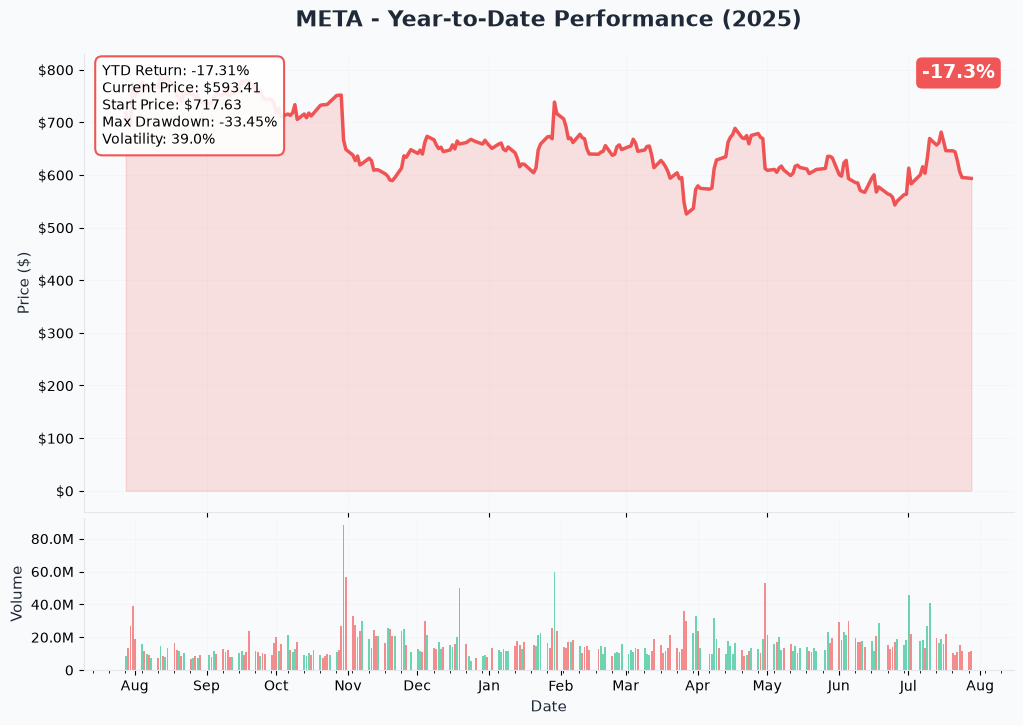
META has spent 2026 grinding lower off its August 2025 peak — down ≈10% year-to-date and ≈25% below the $787.42 all-time high — as the market repriced the stock's multiple against a doubled AI-capex bill rather than any breakdown in the ad business itself. Wednesday's earnings is the next real test of that de-rating.
Gamma-Based Support & Resistance Analysis
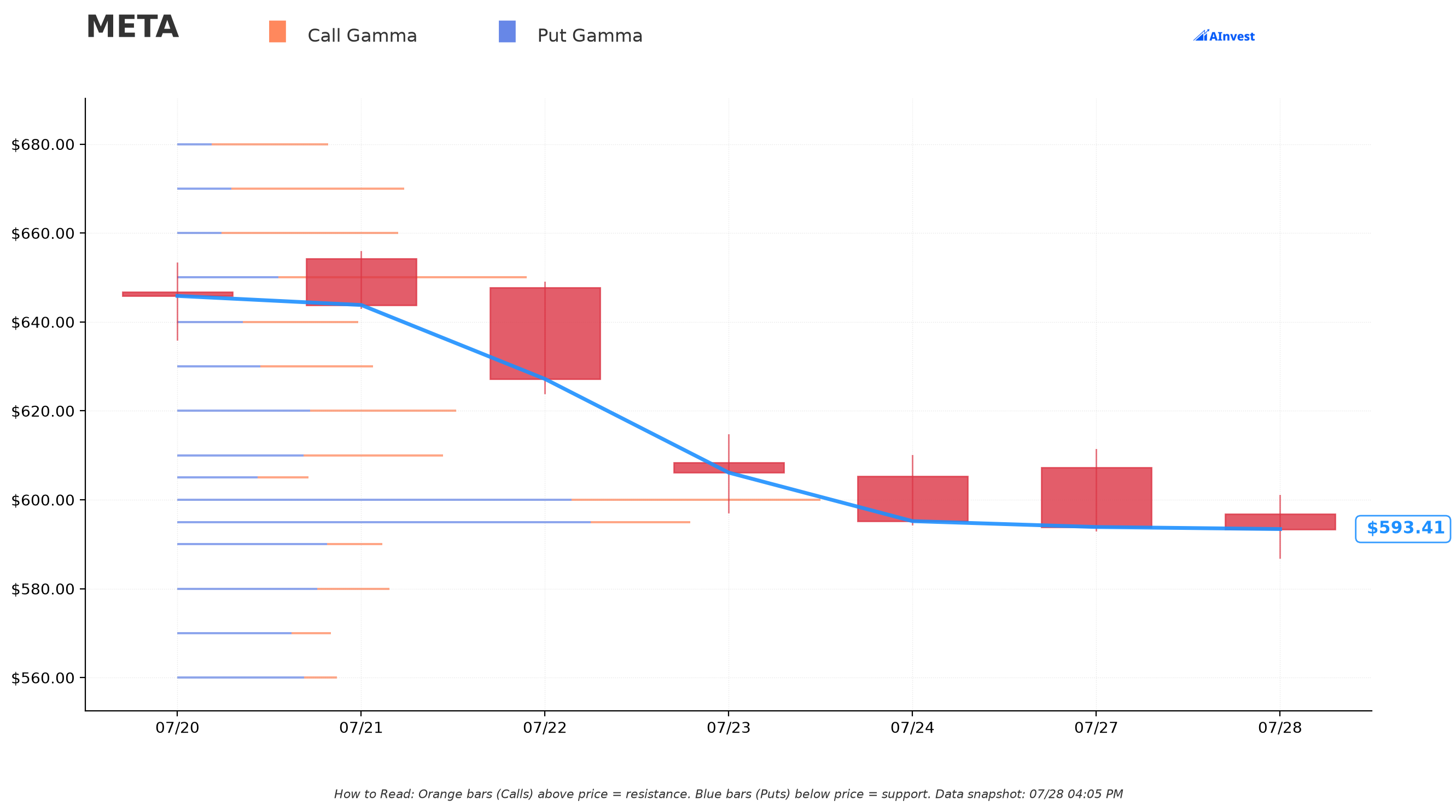
Current Price: ≈$594
- 🔵 Support wall: $590 (Strong) — ≈0.6% below spot, the nearest floor
- 🔵 Support wall: $580 (Strong) — ≈2.3% below spot
- 🟠 Resistance wall: $600 (Very Strong) — ≈1.1% away, the nearest ceiling
- 🟠 Resistance wall: $700 (Strong) — ≈17.9% away
- 🟠 Resistance wall: $750 (the single largest gamma wall on the whole chain) — ≈26.3% away, and exactly where the sold call strike sits
What this means for traders: the desk didn't pick $750 randomly — it's parked directly on top of the biggest dealer-hedging wall in the entire options chain, well beyond the immediate $600 ceiling and the $700 level above it. That's a strike the market itself treats as a major structural barrier, not an arbitrary number.
Implied Move Analysis
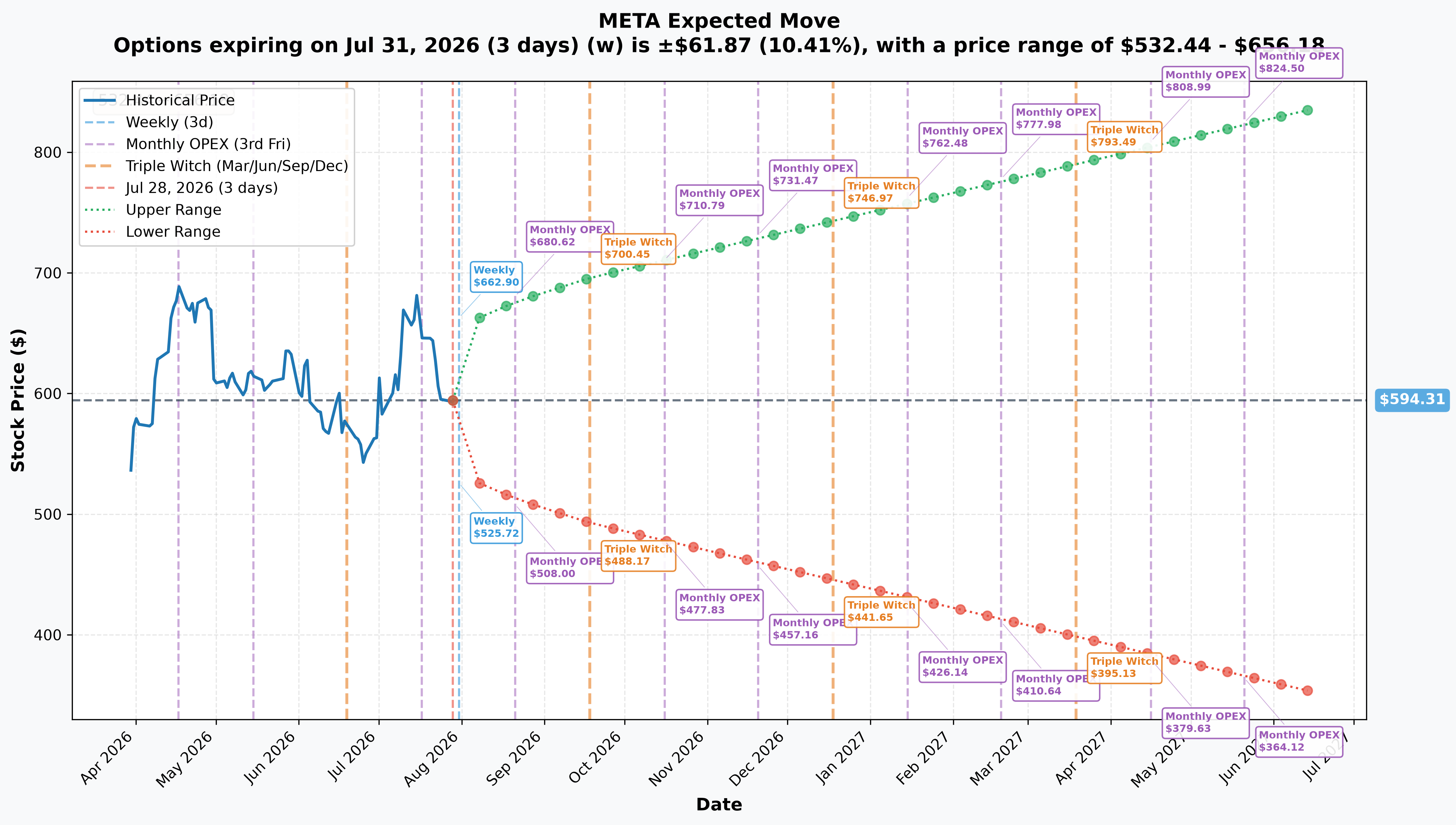
Options market pricing from ≈$594 spot:
- 📅 July 31 (3 days out, covers earnings): ±10.41% → Range: $532.44 – $656.18
- 📅 August 21 (monthly OPEX, 24 days out): ±13.8% → Range: $512.28 – $676.34
- 📅 September 18 (Triple Witch, 52 days out): ±17.16% → Range: $492.30 – $696.32
- 📅 January 15, 2027 (the sold call's own expiration, 5.5 months out): the market's own OPEX-implied range puts the upper edge at ≈$762.48 — just barely above the $750 strike.
Translation: the $750 strike sits right at the edge of the market's own expected range for that exact expiration date. The desk isn't selling a wildly out-of-reach strike — it's selling calls at roughly the outer boundary of where the options market itself thinks META could plausibly trade by January 2027, which is exactly the kind of disciplined strike selection an overwrite seller looks for: enough OTM cushion to be a real bet, not so far out that the premium collected is trivial.
🎪 Catalysts
Keep two dates separate: the earnings event is July 29, 2026 (tomorrow, after the close). The overwrite option's January 15, 2027 expiration is ≈5.5 months later — the earnings print is the near-term vol event the desk is harvesting; the LEAP is the long-dated upside strike being sold.
Upcoming (the dominant catalyst)
- Meta's Q2 2026 earnings, Wednesday, July 29, 2026, after market close. Consensus looks for ≈$60.2–61.3B in revenue (≈+26–27% YoY) and EPS near $7.13–7.32, per Alphastreet's Q2 preview and Barchart's earnings-date coverage. The market is treating the print less as an ad-revenue check and more as "a referendum on AI capital intensity," per Tickeron's earnings preview.
- The AI-capex debate. Meta already raised its full-year 2026 capex guide to $125–145B (from $115–135B) on its April 29 report — nearly double 2025 spend — and the stock fell ≈6% after-hours on that guide despite beating on revenue and EPS, per Fortune's coverage. The question for tomorrow: does Meta hold, raise, or trim that number, and does it hint at 2027 spend, per Indmoney's preview.
- Superintelligence-Labs talent spend and margin. S&P Global's earnings preview models R&D up ≈65% YoY and GAAP opex up ≈56%, with Citi projecting Q2 operating margin falling to ≈33.8% from 43.0% a year earlier — the first quarter where AI/talent spend visibly bites into profitability.
- Reality Labs losses. The unit lost $4.03B in Q1 2026 on just $402M revenue, with CFO Susan Li guiding full-year 2026 losses "on par" with 2025's ≈$19B, per moomoo's earnings preview.
- The ad engine, the funding source. Q1 2026 ad impressions were up 19% YoY and average price-per-ad up 12% YoY, with AI ranking tools lifting ad conversion more than 6% — the real question isn't whether ads are growing, it's whether that growth can keep outrunning the capex bill, per Investing.com's Q1 recap.
Already Happened (context into the print)
- Q1 2026 results (April 29): revenue $56.3B, +33% YoY, per CNBC's report and Variety's coverage — the ad engine is strong; the market's worry is spend discipline, not demand.
- Analyst positioning: consensus rating is "Strong Buy," with price targets clustering around $815–843 across 63–72 analysts, per stockanalysis.com's forecast page and public.com's target tracker — implying large upside from ≈$593, but on estimates that predate any July 29 surprise.
- Stock down ≈10% YTD heading into the print, per Yahoo Finance, and ≈25% below its August 2025 all-time high of $787.42.
Why this matters for the overwrite: selling the night before a binary, high-magnitude earnings event is exactly when LEAP call premium is richest — the desk is harvesting that one-day vol spike while committing to a strike (25×+% OTM, right at the market's own outer expected range for that expiration) it doesn't expect to be sustained through January 2027, regardless of which way tomorrow's print breaks.
👥 How Four Different Traders Might Read This
🎲 YOLO Trader
Copying this exact trade at retail scale is unrealistic — 16,000 covered calls requires owning ≈1.6M shares of META (close to $1B). If you want the directional flavor of "I don't think META rips through $750 by the time it matters to me," the retail-shaped mirror is a small clip of short-dated OTM call debit spreads or put spreads sized around Wednesday's earnings date, where your max loss is fixed and known upfront — not a capital-intensive, multi-month overwrite. Earnings-week options are also expensive right now (the market's pricing a ±10.41% weekly move); a naked long call or put here is a bet you need to be right on both direction AND magnitude, fast.
Risk level: High if you try to mirror this directly (capital-intensive) | Skill level: Advanced.
📈 Swing Trader
This January 2027 overwrite isn't a swing-trade signal — it says almost nothing about which way META reacts tomorrow. The tradable window for a swing idea is the run-up to and reaction from Wednesday's print, where the market's own implied move (±10.41%, $532–$656) sets the realistic range to plan around. A defined-risk way to play that catalyst: a short-dated debit or calendar spread sized to that weekly range, rather than reading directional conviction into a multi-month hedged block that expires nearly half a year later.
Risk level: Moderate-to-high (event-driven) | Skill level: Intermediate.
💵 Premium Collector
This trade is literally your playbook, run at institutional size. A desk owns (or bought) ≈448,000 shares of META and sold calls ≈26% out of the money against them, timed to collect ≈$41M in credit right as pre-earnings implied volatility peaked — the single richest day of the option's life to be a seller of premium. The retail-safe version of this is exactly the same mechanic on a smaller scale: if you already own META shares, selling an OTM LEAP call against them the day before earnings harvests that same volatility spike with a fully defined, known-in-advance opportunity cost (the stock called away at the strike) — never an uncapped loss, because the shares back the position. Picking a strike that sits right at the market's own outer expected range for that expiration ($750 vs. an implied ≈$762 upper bound) — rather than something arbitrarily far out or dangerously close — is worth studying.
Risk level: Moderate (opportunity-cost capped, not loss-uncapped, when fully covered) | Skill level: Intermediate.
🌱 Beginner
Selling a call means getting paid cash today for a promise: "I'll sell you META shares at $750 anytime before January 15, 2027." Because the seller here also holds roughly 448,000 real shares of META (matching the option's delta almost exactly), this is called a covered call — very different from a naked call sale, which carries theoretically unlimited risk. Covered means the worst case is capped: if META rallies hard past $750, the seller simply sells their shares at $750 instead of participating in further upside — a real cost, but not a runaway loss. This is the same strategy many long-term retail investors use on stocks they already hold to generate extra income; the difference here is pure scale (≈448,000 shares vs. the 100–1,000 a retail account might hold), the timing (sold the day before a major earnings report, when option premiums run hottest), and a delta match precise enough to prove it's genuinely hedged, not guessed at.
Risk level: Moderate (capped upside, not unlimited loss) | Skill level: Beginner-friendly concept, institutional-scale execution.
⚠️ Honest Risk & Limits — What the Tape Can and Can't Prove
What we know for certain (PROVEN from the tape):
- ✅ 16,000 META Jan-15-2027 $750 calls sold for ≈$25.58 average, ≈$41M total credit, via a negotiated block cross with a known counterparty, sold near the bid
- ✅ A 448,000-share long-META stock block printed at $595 in the same window
- ✅ Independent model delta of ≈0.277 on the option, and 448,000 actual vs. ≈443,200 expected hedge shares = a ≈101% match — strong, tape-verified confirmation of a genuine delta hedge
What's still unresolved (needs tomorrow's OI):
- ✅ Open vs. close is now RESOLVED — it was an open. Open interest rose 217,641 → 229,279 (+11,638) against the 16,000-lot print, confirming ≈11,638 contracts of genuinely new short calls (≈73% of size) with the remainder transferring between existing holders. The STO label is confirmed.
What we're inferring (reasonable, but not proof):
- 🔍 That the motive is income/carry-harvesting on rich, earnings-inflated implied volatility, rather than a partial hedge against a larger, invisible book (other options, a broader equity overlay program) — the tape cannot see the seller's full portfolio
- 🔍 That the position is intended to run for a meaningful stretch of its 5.5-month life rather than be actively managed or unwound right after earnings
What the tape flatly cannot tell us:
- ❌ Who the seller is (retail, institution, market maker) or their broker
- ❌ Whether the 448,000-share stock position was already held, freshly purchased for this exact overwrite, or part of a larger equity book
- ❌ Whether $41M is a meaningful position size or a small slice of a much larger portfolio
- ❌ Whether the seller plans to roll the calls up/out if META approaches $750, or simply let assignment happen next January
- ❌ What tomorrow's earnings will actually show — this position takes no view on that, by design
The key risk to this structure: a genuine AI-monetization breakout — a beat-and-raise Wednesday paired with capex discipline, a credible cloud/Anthropic revenue story, and a re-rate back toward the ≈$815–843 analyst targets — could carry META decisively through $750 well before January 2027, capping the combined position's gain right at the strike even though the long shares cushion (but do not fully offset) missing further upside. This is a direction-neutral, low-signal trade by design — it tells us far less about "which way Meta breaks on Wednesday" than a naked directional bet would, and should not be read as a call on tomorrow's earnings reaction.
Options trading involves substantial risk of loss and is not suitable for all investors. This analysis is for educational purposes only and is not financial advice. The delta-hedge match (≈101%) is based on the option's independently modeled delta compared against the paired equity block — it strongly supports a genuine hedge but cannot prove the seller's full intent or portfolio. Always confirm next-day open interest before drawing conclusions about a trade's open/close status, and consider consulting a licensed financial advisor before trading options.
Mark your calendar:
- ✅ July 29, 2026, ≈06:30 ET — RESOLVED. Next-day OPRA open interest rose 217,641 → 229,279 (+11,638), confirming an opening sale. See the ✅ RESOLVED box above.
- 📅 July 29, 2026, after market close — Meta's Q2 2026 earnings, the near-term event this overwrite is harvesting vol from
- 📅 January 15, 2027 — this trade's expiration
Last updated: July 29, 2026 — next-day OPRA open interest resolved the provisional flag and confirmed the read: open interest rose 217,641 → 229,279 (+11,638, ≈73% of the 16,000-lot print), confirming a genuine opening sale (STO) with the remaining ≈27% transferring between existing holders. The delta-hedged covered-call framing is unchanged.