🛡️💊 MRNA — A $1.9M Cheap Crash Put Bought One Day Before Moderna's FDA Flu Decision
📅 2026-08-04 | Small Ticket, Big Timing — Floor-Negotiated Put, One Day Before a Binary
🎯 The Quick Take
Someone paid $1,875,000 for 5,000 far-out-of-the-money Jan-15-2027 $37 puts on Moderna (MRNA), one trading day before the FDA's August 5, 2026 PDUFA decision on Moderna's seasonal flu vaccine. It's a small ticket — the smallest of everything that printed today across the board we track — bought at a strike ≈34% below the stock, negotiated on the exchange floor rather than swept off the lit book. This reads as cheap insurance or a lottery ticket against a bad outcome tomorrow, not a conviction bet that Moderna is heading toward $37.
🏢 Company Overview
Moderna, Inc. (Nasdaq: MRNA) is a biotechnology company built around messenger RNA (mRNA) technology. It became a household name with its COVID-19 vaccine and has since been trying to turn that single-product story into a multi-franchise respiratory, oncology and rare-disease pipeline — flu, RSV, next-generation COVID, cancer vaccines and gene-therapy-adjacent rare disease programs are all in various stages of development or early commercial rollout.
| Metric | Value |
|---|---|
| Sector / Industry | Healthcare / Biotechnology |
| Market cap | ≈$22.85B |
| 52-week range | $22.28 – $85.60 |
| 52-week price change | +102.86% |
| 50-day / 200-day moving average | $58.72 / $45.14 |
| Short interest | 52.40M shares ≈14.07% of float, 5.21 days to cover |
Moderna more than doubled over the past year, is trading above its 200-day average but below its 50-day average, and carries unusually heavy short interest for a name this size — a setup where a binary regulatory outcome can move the stock hard in either direction.
💰 The Trade — What Printed
09:49:16 ET, spot $56.43 — a single-leg put buy, negotiated on the exchange floor:
| Time | Symbol | Buy/Sell | Type | Expiration | Strike | Premium | Volume | Prior OI | Size | Spot | Option Price | Option Symbol |
|---|---|---|---|---|---|---|---|---|---|---|---|---|
| 09:49:16 | MRNA | BUY | PUT | 2027-01-15 | $37 | $1,875,000 | 5,000 | 508 | 5,000 | $56.43 | $3.75 | MRNA20270115P37 |
🏛️ Mechanism: FLOOR TRADE. This was negotiated manually on the exchange floor, not swept off the lit book — it printed 79% across the bid-ask spread, on the aggressive side but through a facilitated, negotiated process, not a chase for displayed liquidity. There's no urgency language warranted here — no one "slammed the ask" or "panic bought." A broker worked this order.
The size is honestly small. $1.9M is the smallest ticket across today's board of unusual flow. Don't read heavy conviction into it — this looks like a modest hedge or speculative flyer, not a whale-sized directional bet.
Structure at a glance:
- Strike $37 sits ≈34% below the $56.43 spot.
- Expiration is 5.5 months out (≈164 days).
- Breakeven at expiry: $33.25 (strike minus the $3.75 paid) — Moderna would need to fall ≈41% from here for this put to be profitable at expiration.
- Delta −0.1457 ⇒ −72,850 shares of short-equivalent exposure — a modest hedge-sized position, not a portfolio-moving one.
✅ RESOLVED — Confirmed Open
Updated 2026-08-05 pre-market. The ≈06:30 ET OPRA snapshot (reflecting the August 4 close) has published.
| Leg | Baseline OI (Aug-4 snap) | Resolving OI (Aug-5 snap) | Δ | Print size | Δ as % of print | Verdict |
|---|---|---|---|---|---|---|
| Jan-15-2027 $37 P (bought) | 508 | 5,404 | +4,896 | 5,000 | ≈97.9% | ✅ OPEN (BTO) — confirmed |
We expected ≈5,500; the actual number is 5,404. Open interest rose by 4,896 against a 5,000-contract print — ≈98% of the trade created brand-new contracts. This is pure new risk, not an offset of existing positions. The buy-to-open read is confirmed.
🤓 What This Actually Means — Plain English
Buy-to-open (BTO) means the buyer paid cash premium to create a brand new long position — they don't own it yet, and they're now paying $3.75 per share ($375 per contract) for the right, not the obligation, to sell MRNA at $37 anytime before January 15, 2027.
Buying a far out-of-the-money put like this does one of two things, and the tape genuinely cannot tell us which:
-
A hedge. If someone already owns MRNA stock, or is short MRNA-related risk in some other way (a biotech basket, a related position), a cheap put struck 34% below spot is disaster insurance — it costs very little upfront and pays off only if something goes badly wrong. Most of the time it expires worthless and the buyer is fine with that, the same way you're fine when your car insurance goes unused for a year.
-
A bet. If there's no offsetting position, this is a speculative wager that Moderna suffers a serious setback — a rejected or delayed FDA decision, a bad Q3, a cash crunch, or all three — landing sometime before mid-January 2027. Because the strike is so far away and cheap, the most this buyer can lose is the $1.875M paid; the most they can make, in the extreme case Moderna goes to zero, is roughly $16.6M (the $33.25-per-share intrinsic value on 500,000 shares of exposure, minus what they paid).
The difference between a hedge and a bet is invisible from the tape. We can't see whether this buyer owns MRNA stock, owns a competitor's stock, or owns nothing at all. What we can say is that the size is too small to be a meaningful hedge against a large institutional book, and too cheap and far out to represent a confident, high-conviction directional call. It sits in the "why not, just in case" zone.
📈 Technical Setup / Chart Check-Up
YTD Performance
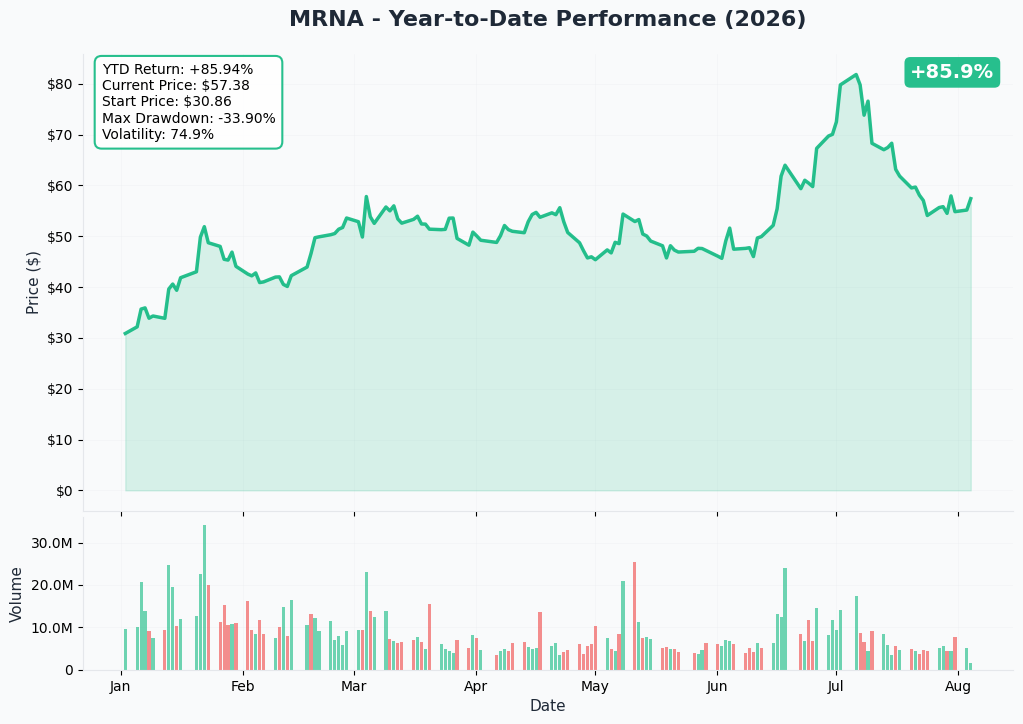
MRNA is up +102.86% over the past 52 weeks, off a 52-week low of $22.28 and well below its $85.60 high, currently sitting above its 200-day average ($45.14) but stalled below its 50-day average ($58.72) — an uptrend that's lost momentum in recent weeks heading into tomorrow's decision.
Gamma-Based Support & Resistance
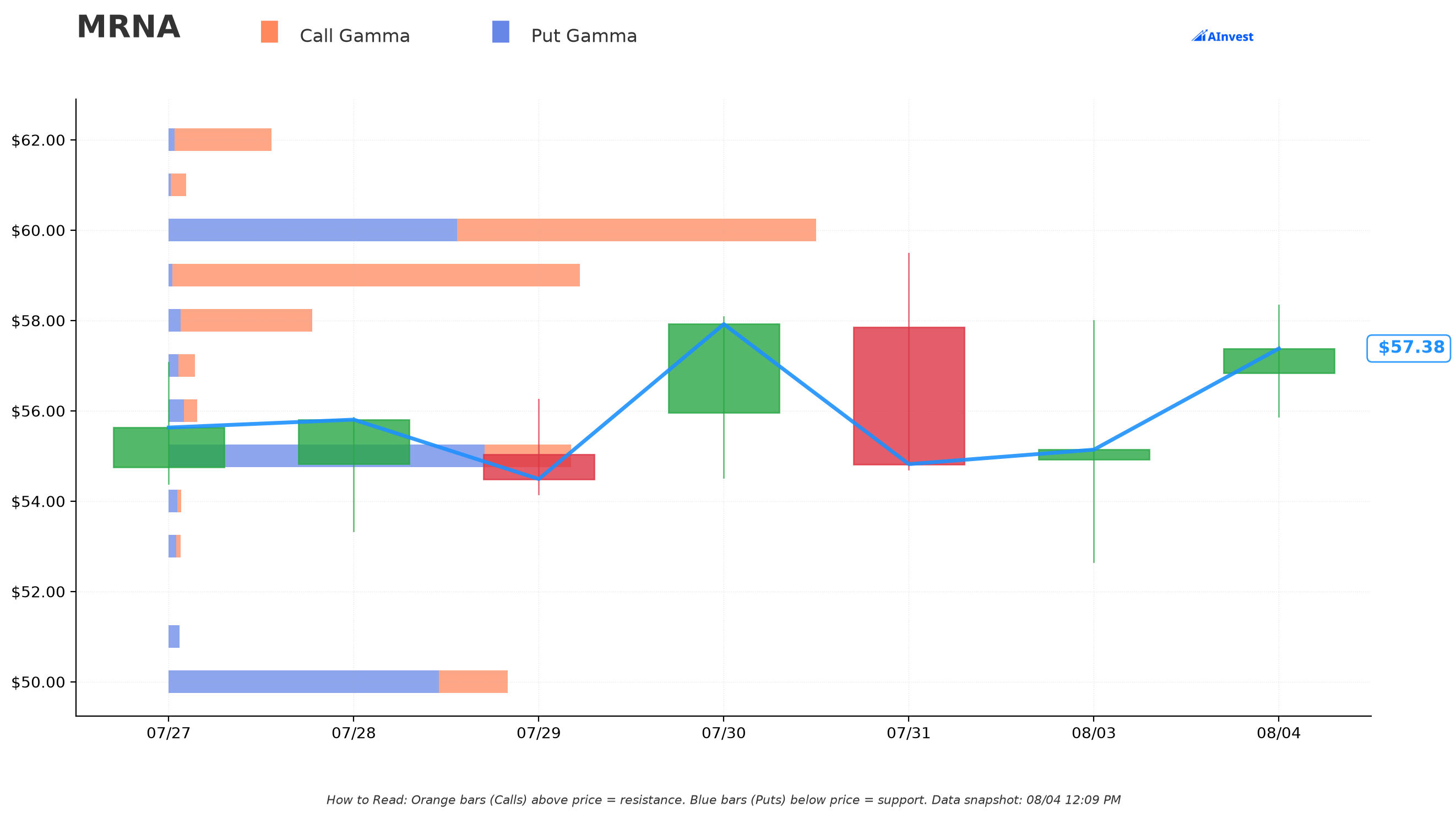
Current price: $57.31
- 🔵 Support: $55 — Moderate strength, ≈4.0% below spot, put-dominated ($3.72M put gamma vs $1.01M call gamma there).
- 🟠 Resistance: $60 — Strong, ≈4.7% above spot, call-dominated ($4.23M call gamma vs $3.40M put gamma).
Where the $37 put strike sits relative to dealer positioning: almost nowhere. Total gamma exposure at the $37 strike is roughly $0.17M — a small fraction of what's sitting at $55 or $60. In plain terms, market makers aren't actively hedged anywhere near this strike day to day. That's consistent with what this position is: a strike so far out that it lives outside the zone where dealer flows currently matter, which is typical of tail-risk insurance rather than a level anyone expects price to test soon.
Implied Move Analysis
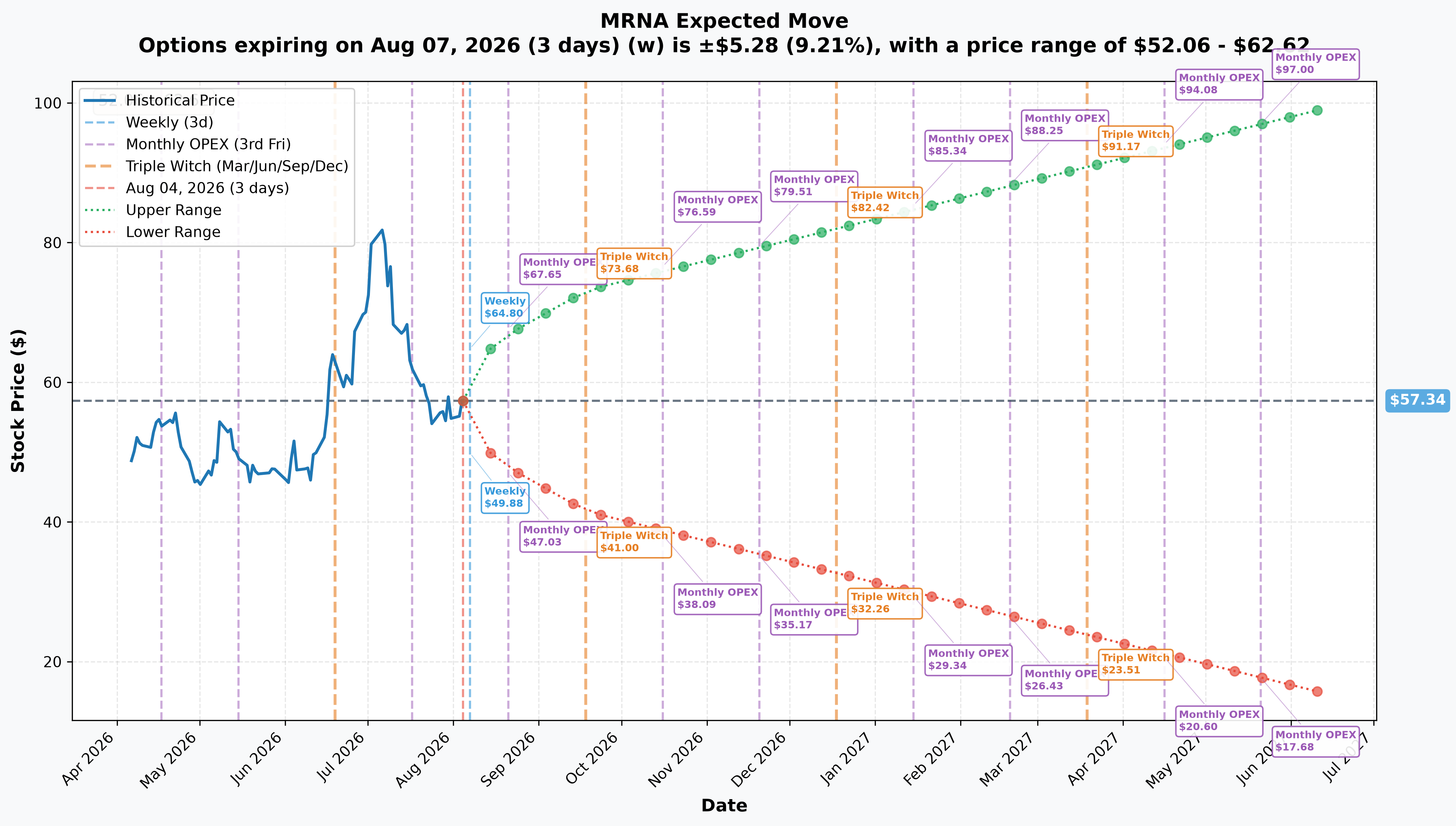
This is the single most useful number for this trade, because tomorrow's PDUFA decision is a hard binary event:
- Weekly (2026-08-07, 3 days — covers Wednesday's decision): ±9.21% (±$5.28) → range $52.06 – $62.62
- Monthly OPEX (2026-08-21, 17 days): ±16.83% (±$9.65) → range $47.69 – $66.99
- Quarterly / Triple Witch (2026-09-18, 45 days): ±27.64% (±$15.85) → range $41.49 – $73.19
- LEAPS (2027-06-17, 317 days): ±73.73% (±$42.28) → range $15.06 – $99.62
Read this carefully. Even the weekly cone — the option contract whose life actually contains the PDUFA date — only prices MRNA down to ≈$52.06 in a typical move. Even the 45-day quarterly cone's low end, $41.49, is still above the $37 strike. Only the far-dated 317-day LEAPS cone dips low enough ($15.06) to reach below $37 — and that's for a full year of accumulated uncertainty, not the 5.5-month window this actual put covers. In other words, the options market's own pricing treats a fall to $37 as a genuinely low-probability, tail-scenario move, not something priced as a routine outcome even around a binary FDA date. That's exactly why the put is cheap, and exactly why it's a lottery-ticket/insurance profile rather than a high-conviction directional bet.
🎪 Catalysts
🔴 Tomorrow — the event this trade is about
FDA PDUFA decision — August 5, 2026, for mRNA-1010 (mFLUSIVA), Moderna's seasonal flu vaccine for adults 50-64 and 65+. This follows a unanimous 9-0 favorable vote from the FDA's Vaccines and Related Biological Products Advisory Committee on June 18, 2026 (Moderna's press release).
The detail worth sitting with: the stock fell 7.22% in the session right after that favorable 9-0 vote (StockTitan coverage of the June 18 release). Good regulatory news has already been sold once this year. Anyone assuming "approval tomorrow = the stock goes up" should sit with that fact before reacting to tomorrow's headline either way.
🟡 Already happened — the last few days
- Q2 2026 earnings, July 31, 2026: beat on both lines — EPS −$1.97 vs −$2.03 estimated, revenue $145.00M vs $102.93M estimated — yet the stock closed −5.35% the same session (MarketBeat earnings history, Moderna's Q2 2026 release). Moderna has now beaten consensus EPS in 3 of its last 4 quarters, and the market keeps finding other reasons to sell the print — this is not a stock where the EPS line drives the reaction.
- The same Q2 release disclosed the norovirus vaccine (mRNA-1403) missed its Phase 3 interim early-success bar, with the trial continuing blinded and enrolling an additional cohort (Q2 2026 release).
- A $950M litigation settlement payment was made in July 2026, disclosed as a non-recurring charge inside 2026 cost-of-sales guidance. Moderna's release gives the amount and timing but does not name the counterparty or case.
- Cash burn math: $6.9B in cash and investments at June 30, 2026, guided down to $4.7–$5.2B by year-end — implying roughly $1.7–$2.2B of second-half cash consumption, inclusive of that litigation payment (Q2 2026 release).
- Ex-US momentum is real but the US flu/COVID combo has no filing path yet. Moderna secured European Commission marketing authorization for mCOMBRIAX, an EU joint-procurement contract for up to 24M mRESVIA doses across six countries, and mNEXSPIKE approvals in Japan and Taiwan — but the company is still "awaiting further guidance from the U.S. FDA on refiling" mCOMBRIAX domestically (Q2 2026 release).
🟢 Ahead — the rest of the window this put covers
- "Potentially 2026" — Phase 3 adjuvant melanoma data for intismeran (mRNA-4157, partnered with Merck) — the single largest non-vaccine catalyst inside this put's remaining life (Q2 2026 release).
- ≈Early November 2026 — Q3 2026 earnings, estimated from prior-year cadence but not yet company-confirmed (MarketBeat earnings history). This falls comfortably inside the Jan-15-2027 expiry of the put.
- Sell-side positioning is unusually split right on top of tomorrow's decision. In the last two trading days: Goldman Sachs raised its target $49→$67 (Neutral), Citigroup raised $41→$60 (Neutral), Piper Sandler is at $77 (Buy), against J.P. Morgan initiating Sell at $40 and Wolfe Research reiterating Underperform at $25. All three major consensus trackers — $50.84, $42.13, $52.95 — sit below the current spot.
🧑💻 Four-Reader Interpretation
🚀 YOLO Trader
This is not a trade you copy for the leverage — $1.9M for a 34%-out-of-the-money put is already someone else's version of "cheap," but the breakeven at $33.25 needs a ≈41% drawdown to even reach par. If you want to speculate on a bad outcome tomorrow, understand you're buying pure optionality on a low-probability tail, priced by the market as exactly that. Size any position at what you're fully willing to lose to zero, because a strike this far out very often does exactly that.
📊 Swing Trader
Worth watching, not worth acting on directly. This print is a data point that at least one participant paid up for downside protection heading into a binary event — but it's small, and the mechanism (floor-negotiated, 79% across) tells you it was a worked order, not a signal of urgent institutional fear. If you're long or short MRNA into tomorrow, treat this as a minor confirmation that some smart money wants insurance, not as a reason to change your own thesis.
💰 Premium Collector
A cheap, far-OTM put like this is exactly the kind of contract premium sellers occasionally get a bid under for no obvious reason — a reminder that demand for tail protection exists independent of your own view. If you're running a cash-secured put or covered call program on MRNA, this flow doesn't change your strikes, but it's a useful reminder that implied vol here (already elevated into a binary event) can spike further on any bad headline tomorrow.
🌱 Beginner
The lesson here is simpler than the trade: options let you make a small, defined-risk wager on a big event. This buyer risked $1.875M — and can never lose more than that — to control roughly $18.5M of notional exposure (500,000 shares × $37). That's the whole appeal of options in one trade. But notice also how far out of the money the strike is and how much the stock needs to fall for this to pay off — that's the tradeoff for the cheap price. Don't mistake "cheap" for "likely to work."
⚠️ Risk Factors & Honest Limits
What the tape proves: a single-leg BUY of 5,000 Jan-15-2027 $37 puts at $3.75, $1,875,000 total, negotiated on the exchange floor, against a prior open interest of 508 — comfortably proving this created new open interest.
What's inferred, not proven: whether this is a hedge against an existing position or an outright directional bet — the tape cannot distinguish the two. Motive, counterparty identity, and whether the buyer holds MRNA stock elsewhere are all invisible to us.
The size doesn't carry a strong signal. At $1.9M, this is the smallest ticket on today's board of unusual flow. Treat it as a data point, not a conviction call.
The math is unforgiving. Moderna needs to fall roughly 41% from today's spot just to reach breakeven at expiry, and the strike sits below where even the options market's own 45-day implied-move cone reaches. Most of the time, a put like this simply expires worthless.
Volatility crush is a real risk here, and it can hurt you even if you're right on direction. Because this put expires 5.5 months out, its price is driven mostly by longer-dated implied volatility, not purely by tomorrow's event — so it won't crush as violently as a weekly option would. But options priced into a hard binary catalyst do carry elevated implied volatility ahead of the event, and once the FDA decision is out (whichever way it goes), some of that "event premium" typically deflates. If MRNA doesn't move as much as the market feared, this put's price can fall even though nothing about the underlying thesis has technically been disproven yet — a correct eventual call can still lose money if the timing or magnitude of the move disappoints relative to what was priced in.
Two source conflicts worth flagging: short interest is reported as 14.07% of float on one tracker and 16.16% on another — we're using the more conservative 14.07% figure throughout this piece. Separately, Morgan Stanley shows up twice in recent rating data under two different analysts with two different targets ($39 on August 3, and $33→$39 on July 20-21) — likely a data duplication rather than two separate calls, and we haven't been able to resolve which is authoritative.
What we will not claim: we are not naming the counterparty in the $950M litigation payment (Moderna's release doesn't identify one), we are not citing any 2026 ACIP or HHS vaccine-policy action (nothing sourced), we are not citing any government contract cancellation, and we are not quoting an efficacy percentage for mRNA-1010 (none was disclosed in the sourced release).
Standing risk disclosure: options trading involves substantial risk of loss and may not be suitable for all investors. This is a description of one trade printed on one day's tape, not a recommendation to buy or sell MRNA options. Past option flow is not predictive of tomorrow's FDA decision or of future price action.
About Moderna, Inc. (MRNA): a biotechnology company built on messenger RNA technology, best known for its COVID-19 vaccine and now expanding into flu, RSV, oncology and rare-disease programs, with a binary FDA decision landing one trading day from today.
Last updated: 2026-08-05 — next-day OPRA open-interest resolution added: confirmed OPEN (BTO) — ≈98% of the print created new contracts.